Thursday, 20 March 2014

NYMPHOMANIAC VOL. 1 and NYMPHOMANIAC VOL. 2 - Review By Greg Klymkiw - ***** for new Lars von Trier

Young Joe (Stacy Martin) prefers her cream
STRAIGHT UP. Coffee not necessary.
Nymphomaniac Vol. 1 and Vol. 2 (2014) Dir. Lars von Trier *****
Starring: Charlotte Gainsbourg, Stellan Skarsgård, Stacy Martin, Shia LaBeouf, Christian Slater, Jamie Bell, Sophie Kennedy Clark, Mia Goth, Uma Thurman, Willem Dafoe, Udo Kier

Review By Greg Klymkiw

The dark is a scary place. For Lars von Trier, it seems to be the only place, but no matter how deeply pitched the black gets, he takes us to places many never want to go, but he does it with the aplomb of a master showman and as such, delivers movies that provoke, annoy, anger and almost always, entertain. Nymphomaniac is nothing, if not an all-out dazzler of a picture. Just don't take your granny to see it.

The picture had me hooked from its opening frames - which, of course, are black with the sound of water splashing. Or is it rain? Or is it someone taking a piss? I have images of an appetizer comprising a golden shower scene - after all, it's Lars von Trier and the movie is called Nymphomaniac. 'Twas, I believe, a reasonable expectation. But no, it's rain spattering onto metal, brick and cement, whilst water forms puddles and/or rushes into drains as the camera now reveals a grungy, dark back alley. In no time, the camera's eye moves towards a literal patch of dark in the wall of an old building. Once we're completely enveloped in the black, von Trier slams us in the face with a series of powerful images and splits our ear drums with the pounding, blistering Rammstein song "Führe Mich" ("Lead Me"). He chooses to cut into the song at the 10-second mark and I have to admit, it jolted me with all the force of any great cinematic shock cut.

As Rammstein slashes our oh-so delicate tympanic membranes to shreds, we're introduced to Joe (Charlotte Gainsbourgh) lying on the wet pavement, bruised, bleeding and clearly a victim of a severe beating. And hell, we'll accept that Von Trier has her positioned like Christ on the Cross because, well, it's a movie by Lars von Trier. We're also introduced to the imposing, hulking Seligman (Stellan Skarsgård) as he walks with the determination of a hit man on his way to dispatch his quarry, but is in fact, on his way to a little Kosher convenience store (in an alleyway, no less, or wherever the fuck we are). With a full grocery sack, he discovers the pulverized waif-like Joe on the wet cement. She doesn't want an ambulance or the police. Seligman suggests she come back to his place for a cup of tea.

TEA!!!

Once snuggled in Seligman's guest bed, with tea ('natch), Joe declares that she's a nymphomaniac and as such, is little more than filth. Seligman, a paternal academic, dotes on her and tut-tuts her self-hatred. Joe opens up to our lanky, Swedish Mr. Chips and tells him her life story, as if to support her inner loathing of everything she is. And it's definitely a case of "is", for it didn't take her a lifetime to discover her nymphomania, but that she discovered her "cunt" and its hold over her at age two. With cunt in hand, as it were, Joe takes Seligman through her childhood, adolescence and adulthood of debauchery.

Oh, and what debauchery, what degradation, what defilement. With a combination of real, digital and prosthetic cocks, cunts and assholes, Von Trier doesn't at all hold back on the sexual activity. You name it, you'll probably see it all here. However, there's nothing clinically dull in the hardcore action as you might find in your regular, good old fashioned, garden-variety XXX-picture. The onscreen sex is not only fun to watch, but Von Trier tears a few pages out of the rule books of great genre directors and makes damn sure that every beat of onscreen "action" is rooted (so to speak) in narrative thrust (as it were).

For example, what so many filmmakers who direct action, suspense or horror films don't understand is that the staging and choreography of their thrill-inducing set-pieces must always be rooted in narrative. It's not enough to turn said set pieces into roller coaster rides, and in most cases these days, set pieces that are poorly directed and edited for ADHD-challenged viewers to boot. In fact, what most contemporary filmmakers don’t seem to get is that set pieces must not stop the movie dead in its tracks nor inversely should non-set-pieces of pure narrative feel like a by-rote chore to get through twixt the action.

Great movies, great filmmakers realize that every element is a means to an end. Take any great set piece of action - let's use Sam Peckinpah's final twenty-minute slaughterhouse in The Wild Bunch as a case in point; not one shot, not one cut, not one excruciating slow-motion blood ballet is wasted, nor is it ever there simply for effect. Every element is working in tandem to enhance the thematic resonance, the complexity of character, the reflection of a time and place and, most importantly, the picture's narrative.

Von Trier handles his sex scenes in exactly the same fashion. There is, unlike pure hardcore porn, nothing on display for sheer masturbation-inducing prurience, BUT it is titillating, entertaining and always rooted in narrative, theme and character.

If anything, it's a lot of fun.

Somehow, the more degrading Joe's need to debase herself gets, we're rooting big-time for her to go as far as she needs to go in order to feel something down below. That's okay, though. This is her choice or, at least, the choice Von Trier chooses to give her. There's no morose, humourless, dullsville jack-hammering a la Steve McQueen in his precious toe-dip into sexual addiction Shame.

Besides, shame is just shame for McQueen, but for Von Trier, shame is part of the thrill for both Joe and the audience. It's kind of like the Guy Maddin credo (especially in the film he directed and co-wrote with George Toles, Careful) wherein the closet equals repression which equals shame, but sometimes it's the closet, the repression and the shame - O! THE GLORIOUS SHAME! - that's, well, pretty electrifying, thrilling, dangerously delightful and, if truth really be told, boner-and-wet-pussy-inducing. This is, I think, the thing that spurs Joe's character on and as an audience, it radiates so gloriously that we're carried along her yellow-brick road of need - to FEEL SOMETHING.

The primary element that keeps Nymphomaniac such a joyous and compelling experience is its structure or rather, its coat-hanger. The manner in which Joe's story is told is rooted in the near omnibus style we've occasionally experienced in films like Julien Duvivier's Tales of Manhattan, but best exemplified in the classic Ealing horror film Dead of Night (and a few subsequent 70s offerings from Amicus inspired by E.C. Comics, most notably Tales From the Crypt). For an omnibus-styled film to work best, the thread that hangs everything together is the reason for several different stories to be told and is, in fact, a wrap-around story that provides a story unto itself as well as the final kicker.

Often this style of film is rooted in some literary source, or inspired by the notion of literature. It's the latter that Von Trier has chosen and, in fact, rather enjoys implementing in many of his films. Here though, it works beautifully for several reasons.

The movie is a sprawling epic of fucking. This is fine by me. It's so sprawling that, Von Trier's original 5½ hour cut can't even be seen theatrically - at least not for now. The film is being released in two halves - each carrying a separate admission tag. Von Trier felt obligated to his investors to provide a product that had as much chance to generate a myriad of revenue streams. What we have are two parts that together do not equal 5½ hours. The first half is 118 minutes and the second 123 minutes. We're talking four hours here and they both include lengthy end-title credit sequences. Each part carries a disclaimer that the film doesn't represent Von Trier's final vision, but that he has indeed delivered his blessing whilst not actively participating in this shorter version.

Don't worry, though, Nymphomaniac is ALL VON TRIER ALL THE TIME!!!

Each half is considered a "volume" and within each volume there are 4 stories - totalling 8 official tales over the course of both volumes, but still including a myriad of delightful sidebar meanderings and, of course, the aforementioned wrap-around story. I never once felt the film I saw was incomplete and was thoroughly satisfied. That said, I did want more. I wanted to stay in the cinema much longer and could have practically set up house there. This, however, is the ultimate satisfaction - when I leave a movie wanting more. (I also know we'll eventually get it.) Besides, I hate going to a great restaurant and leaving the place wanting to spew vomit and shit a la Terry Jones in Monty Python's The Meaning of Life and such is the case with genuinely great pictures like this. I'm not leaving dissatisfied, but wanting more. My first thought after my inaugural taste was how much I wanted to see the movie - in its current state, even - again and again.

This, for me, is what makes a great picture. (And yes, a second helping was utterly transplendent.)

The wraparound story is, finally, a genuine delight. The conversation between Joe and Seligman is completely nutty. Joe admonishes herself, Seligman tries to appease her with hilarious intellectualizations, which she sometimes accepts and, as is her wont, sometimes rejects. However, the conversations always contribute elements that take us into the next story and, importantly, up the ante each time on the degradation-meter. That the conversations themselves involve fly-fishing, Orthodox Iconography, the fucking Fibonacci Sequence and assorted other topics requiring - NAE! DEMANDING! - rumination, is a constant source of pure euphoria.

The story Joe provides us is always mediated through her perspective, but we always sense a playful quality wherein she picks and chooses elements - sometimes, not always - based on her whims as a storyteller, her opportunity to have an avid listener and, of course, the aforementioned flights of fancy and philosophy imparted by the listener.

Von Trier has populated his movie with a huge cast of stars and name actors. I can't think of a single performance that's any less than outstanding, but in addition to the stalwart presence of Von Trier regulars Gainsbourgh and Skarsgård there are several notable renderings which stand out.

Christian Slater is surprisingly wonderful as Joe's loving, loyal father. This is not only a tremendously moving performance, but it provides the movie's only layer of what seems like genuine love and certainly not drenched in sex - at least not between the two characters. There is, for me, though, an element perfectly in keeping with the film's relentless focus on sex and it makes a fair bit of narrative sense. Joe's Dad is not only an all-out tree-aficionado (he's especially fond of the Ash), he's a lover of trees, he hugs them, seeks them out in any way he can, imparts his thoughts to his daughter about said leafy, tall, knobby trunks jutting ever-so erectly into the awaiting cunt of Heaven itself and yes, like Clint Eastwood in Paint Your Wagon, he even talks to the trees. Unlike Terence Malick's ludicrous The Tree of Life, though, Christian Slater's obsession with trees is not so much preciously spiritual, but ultimately borders on being fetishistic.

A tree fetish? Hey, why not? It's a Lars von Trier picture.

"Don't call me Billy Elliot ever again!"
Another performance in Nymphomaniac that I hope to cherish until I'm six feet under is served up by none other than Jamie Bell.

What his character does to Joe is relentlessly, endlessly shocking, brutal, repulsive and, for some, downright reprehensible. His frosty demeanour is at once scary, but it's also kind of sexy and, in fact, it delivers an element of connection between Joe and another male character not paralleled by any other relationship in the movie.

I also have to admit it's a few wheelbarrows full o' fun seeing the title star of the utterly sickening Billy Elliot, all grown up and administering often unbearable physical pain and torture.

"Look, Billy, I just want you to wear a tutu."
There will, no doubt, be a whack of humourless, pole-up-the-butt namby-pamby types who ask, "How dare Lars Von Trier tell us a story about female sexuality from a female perspective? What in the hell would he know about it?"

Grab a brain, people. There isn't a single character in this movie - man, woman or child - who, in some fashion doesn't represent shards of Von Trier himself. He's crazy, nasty and ugly, but he's a great director and so much of what drives his pictures are his own obsessions. In Nymphomaniac he creates a world unto itself, but within that world, the characters seem true to the film and though I know Von Trier is barfing up a whole mess of his own viscous fluids, he does so with style, wit and intelligence.

Who knows? I kept thinking that Joe is Von Trier. After all, he gives her character's name the male spelling and it's hard not to acknowledge that Charlotte Gainsbourg (who I find really sexy) has that thin, almost teenage-boy body to add a touch of androgynous ambiguity to the proceedings. The bottom line is that he puts Joe through the sort of wringer one suspects Lars puts himself through every single moment of his life.

Finally, though, much as I love cinema more than life itself, movies these days often render me numb. Not so with Von Trier. Like a mere handful of other great living directors, he's happy to smash me in the teeth with a baseball bat, but he does it in perfect rhythm and at always the right pitch so that I keep wanting him to just bring it on and on and on.

Lay it on me, Lars.

Hit me with your best shots, motherfucker.

"Nymphomaniac Vol. 1" and "Nymphomaniac Vol. 2" are in theatrical release via Mongrel Media and are currently playing at the TIFF Bell Lightbox in Toronto. I urge all Canadians who care about cinema to hop on a plane, train, bus or in an automobile and hightail it to Hogtown. There is no better venue in the entire Dominion of Canada to see this movie. For further information, visit the TIFF website HERE and now and order up your tickets.

Here's a whack of Lars von Trier movies and a few others you might wish to stock up on. If so, please buy them by clicking on the links below and, in so doing, assist in the maintenance of The Film Corner. In my humble opinion, there isn't a single title here you shouldn't own. So if you don't, get buying, eh.


Wednesday, 19 March 2014

COUNTDOWN #3 TO NYMPHOMANIAC by LARS von TRIER (opening March 21, 2014 at TIFF Bell Lightbox via Mongrel Media). Today's countdown is a review of Lars von Trier's THE IDIOTS on DVD - Review By Greg Klymiw


The Idiots (1998) dir. Lars von Trier *****
Starring: Anne Louise Hassing, Bodil Jørgensen, Jens Albinus, Troels Lyby

Review By Greg Klymkiw

To spass or not to spass; that, is the question. Whether 'tis nobler in the mind to suffer the slings and arrows of the bourgeoisie, or to take arms against that which is a shallow sea of hypocrisy, and by the spassing, end them. With assistance from the Bard of Avon, I ask you: Hast thou found thine inner idiot? No? Well then, get cracking, fool. In The Idiots, Lars von Trier's only official Dogme film - the movement he founded in 1995 during the 100th anniversary of movies with fellow Danish filmmaker Thomas Vinterberg to create pure, unfettered cinema - we are introduced to a group of young people who stage a perverse form of theatre in the arena of life itself where they enter any number of public places and pretend to be mentally retarded. Drooling, screeching, screwing up their face and engaging in overtly aberrant behaviour, these want-to-be activists engage in a theatre of cruelty. Their nastiness in exploiting those who are mentally ill and/or challenged to expose the nastiness of those they accost is lost on them, until a new member to their group begins to question their motives.

Interview segments of the participants which hint at eventual discord amongst the group punctuate several set pieces wherein our ragtag group spass or, in the colloquial parlance of the politically incorrect - "spazz out", have sex, argue, make up, break up and to spass with abandon.

Few movies have made me laugh as hard as Lars von Trier's The Idiots. There is no question that the wholesale slaughter of sacred cows has always been a hallmark of the brilliant bad boy from Denmark, though I suspect none of his films are as gloriously, unabashedly, delightfully repugnant in rubbing an audience's nose in the putrid fecal matter of their own prejudices and repressions generated by their holier than thou pretence to political correctness. It is a cinematic declaration of war on bourgeois values.

Of course, it cuts much deeper than the surface. Lars von Trier digs his lens like a bayonet into the foul intestines of the bourgeoisie, rips them out and tosses them to the dirt for all to see. That said, those he skewers are also those who believe they are acting in defiance of said bourgeois values, but are as much a part of the problem as they believe they are the solution.

The movie begins brilliantly in an upscale restaurant where a snooty waiter takes an order from Karen (Bodil Jørgensen), a melancholy young woman who scales back her culinary desires due to a lack of funds. Around her are couples and quartets of affluent diners - quaffing expensive wine with their opulent brunch selections and occasionally cleansing their vile bourgeois palates with overpriced mineral water. Karen's eye roams to a corner of the dining establishment where a caregiver tries to control a table of her mentally retarded adult charges.

They spit up their food, whine and grunt, then - much to everyone's dismay, two of them get up and begin wandering around the restaurant. One of the retardates is relatively benign - going up to each table, smiling and saying "Hi!" The other charges about in a fury. Hands are wiped on tablecloths belonging to other diners, baskets of bread rolls are removed from others and the caregiver is quite overwhelmed trying to control her charges. When the snooty waiter insists the caregiver control her group for the sake of the other diners, it simply becomes too overwhelming for her. When the benign retard approaches Karen's table, she is touched by his innocence and purity and accompanies the group as they're forced to leave the restaurant.

Up to this point, one is compelled to laugh quite uproariously - not AT the mentally challenged people, but WITH them in their innocent flouting of bourgeois convention and the stuck-up diners who are shocked by this behaviour.

Once everyone is bundled into the cab, it becomes clear that none of them are retarded - especially when they laugh about how they were all able to dine in a fancy restaurant without paying. As it is finally established that these people are engaging in a big practical joke, the laughs the film elicits are very different indeed. Now we laugh at the darkness of this group's actions. Not only do they spass in public, but do so in private as well. Spazzing-out delivers a sense of inner peace, but also a perverse sense of accomplishment that their actions are affecting a change in society. It's somehow even more viciously funny when we discover they're all lounging about on the family estate of the one member of the group who is much a member of the club he, and the group seek to condemn.

The Idiots is a film which belongs to a long and noble tradition of cinema that seeks to shock and provoke - to downright anger an audience. That said, the real anger should be directed at those who ARE angered BY THE MOVIE ITSELF and, of course, for all the wrong reasons. I think it's safe to say that this tradition exploded in full splendour with Luis Bunuel's L'Âge d'or, the scathing 1930 indictment of bourgeois values and, for good measure, the Catholic church. Since the release of The Idiots in 1998, the great Ulrich Seidl stomped about similar stylistic territory with Dogdays and I'm even compelled to include Tom Green's universally reviled, but stunning and vastly misunderstood bit of nastiness Freddy Got Fingered.

What Lars von Trier and those others prove beyond a shadow of a doubt is that if you're going to eviscerate something, it can't be done timidly, or in half measures. As always, pure disembowelment of the bourgeoisie MUST be bold. That's probably why I love Lars von Trier - he's always about being bold. And that, frankly, is what makes for great cinema!

"The Idiots" is available on DVD.

Tuesday, 18 March 2014

COUNTDOWN #2 TO NYMPHOMANIAC by LARS von TRIER (opening March 21, 2014 at TIFF Bell Lightbox via Mongrel Media). Today's countdown is a review of the Criterion Collection's Outstanding 2-Disc DVD of EUROPA (aka ZENTROPA) - Review By Greg Klymkiw

2 Films Floating under a Blanket of Zeitgeist.
2 Films Featuring Hypnotized Characters.
1990: Guy Maddin Hypnotizes His Actors
1991: Lars von Trier Hypnotizes the Audience

Narrator/Hypnotist: 
You will now listen to my voice.
My voice will help you and guide you
still deeper into Europa.
Every time you hear my voice,
with every word and every number,
you will enter into a still deeper layer,
open, relaxed and receptive.
I shall now count from one to ten…
On the mental count of ten,
you will be in Europa.
Europa aka Zentropa (1991)
dir. Lars von Trier *****
Starring: Jean-Marc Barr, Barbara Sukowa, Udo Kier, Eddie Constantine, Ernst-Hugo Järegård, Max von Sydow

Review By Greg Klymkiw

In 1990, Canadian filmmaker Guy Maddin was directing his tragedy of the Great War Archangel which told a tale of lovers afflicted with severe mustard gas apoplexy who forget, at any given moment, who precisely they are in love with.

To ensure his actors were always in a trance, he secured, with my deft finagling (in the spirit of full disclosure I was the film's producer) the services of a renowned hypnotist (who, due to a binding non-disclosure policy cannot be named) to place Maddin's on-camera charges in a state of waking and walking sleep during the entire shoot of the film. Complete and utter submission was the goal.

This, of course, is the goal of all great artists - to subjugate. Submission and repression, when handled aggressively
Mad Orthodox Monk: (Chants ominously in Ukrainian Church Slavonic).
Dr. O'Ebbing: How do we know she is fully hypnotized?
Mad Orthodox Monk: I will ask her a question.
(To Veronkha) What is the most terrible thing that you have done?
Veronkha: I poked my baby brother's eye out and said it was an accident.
Mad Orthodox Monk: I think she's ready.
in all aspects of the filmmaking process create narrative, emotional, dramatic, psychological and stylistic psychoses of the most powerful kind. They roil just below the surface until nothing can stop the eventual explosion of shrapnel-like elements that pierce the mind, body and soul with all the pathological force of deep, unrelenting mental illness - a sickness so twisted and bent out of shape it becomes invisible except on a subconscious level. The very act of watching the film is not unlike staring into the deepest pits of one's soul, to gaze into a mirror that reflects a dream of Hell that will never end. In light of this, Archangel was, as a film, drenched in black and white, occasionally colour tinted, replete with post-dubbed dialogue (also performed under hypnosis), a cornucopia of in-camera special effects including double (and triple) exposures, matte paintings, rear and front screen projection, as well as optical shots.

At the same time, across the pond from the Dominion of Canada, one Lars von Trier was making Europa (renamed Zentropa for its initial North American release) which, like Maddin's film, was set in a strange never-never land of historical revisionism (though in post-WWII Germany as opposed to Maddin's WWI/Russian Revolution cusp period). It too was in black and white (though with dollops of full-blown colour rather than colour tinting) and was, like Maddin's film, bursting at the seams with wild in-camera and optical effects.

Where they differed, and yet existed in the same zeitgeist, was this: Maddin hypnotized his actors whilst von Trier rendered a movie that literally hypnotized the audience. The results were identical. Much like any living subject of hypnotism, audience-members who opened themselves willingly to both cinematic experiences were, in fact, under the power of suggestion.

Upon first seeing Europa back in the 90s, I was initially coaxed into the alternately pleasurable and disturbing states of waking and walking sleep and as such, became so obsessed with Lars von Trier's vision that I fought hard on subsequent viewings to deflect the hypnotic power in order to fully experience his dazzling, sumptuous genius in all its glory. Twenty years after my initial exposure to his great film, I am not only happy to report that it holds up magnificently, but has deepened for me to such dizzying degrees that I am convinced it is one of the most stunning works of cinematic art I have ever seen.

Maddin and von Trier's films must be seen on a big screen and, when possible, projected in glorious 35mm. This is especially important given the special quality in-camera and optical effects have over the much colder digital approach to rendering screen magic today. It is, finally, the warmth of cinema in the format of its birth that allows us to be enveloped in fluffy white blankets of forgetfulness (in Maddinesque parlance) and the sheer joyful terror of being forced into a unique, trance-like state of both yearning and forgetfulness that is, indeed, TRUE magic. Luckily, both Maddin and von Trier are available in the next best thing - their home consumption via visionary companies like the Criterion Collection and Zeitgeist Films.

Europa begins with the hypnotic tones of a voiceover belonging to Max von Sydow (The Exorcist himself and longtime Ingmar Bergman star), whilst we slowly cascade over train tracks engulfed in darkness, save for the soft light beaming gently over the centre of the frame. Lars von Trier plunges us into the black tunnel that is Germany just after World War II. Leopold Kessler (Jean-Marc Barr), an American of German descent has come to his expatriate father's homeland and taken a job as a railway employee under the tutelage of his persnickety, alcoholic Uncle (Ernst-Hugo Järegård). He meets and falls in love with a fetching film-noir-like femme fatale, Katharina Hartmann (Barbara Sukowa) who is the daughter of the German rail magnate Max Hartmann (Jørgen Reenberg). He is taken into the family with open arms. Max, in particular, is drawn to the notion of Germany becoming more international and is impressed with Kessler's desire to bring his North American, yet German-influenced know-how to the reconstruction of the country.

This is in vast contrast to the American armed forces occupying the Fatherland. The American commander mysteriously presiding over all matters of a reconstructive variety is Colonel Harris (played by the brilliant, gravel-voiced American expatriate tough guy actor Eddie Constantine, he of Lemmy Caution fame in numerous French movies like Alphaville). Harris knows all too well that Max used his train company Zentropa to transport Jews to concentration camps, but he also realizes that a vast majority of Germany's populace had been, to varying degrees, complicit in the activities of the Nazi regime. He seeks to protect Max since he believes this guilt-ridden rail baron is ultimately important to the American goal of reconstruction. Harris is also embroiled in a secret fight against a mysterious group of German partisan terrorists called Werewolf and while the young American Kessler trains on the railways and romances Katharina, his services are secured to delve into and expose the forces of evil.

Europa is both important and original on numerous fronts. In terms of theme and content, it is one of the most indelible screen portraits of post-World War II Germany ever committed to celluloid. Delivering a narrative which, I think, more than ably points a finger at America's complicity in the evils of Nazi Germany, especially in terms of making it clear how many Americans owned munitions factories IN Germany and did business with the Nazis under the radar. The overwhelming sense that we are in a nightmare world where an occupying force bullies the occupied, yet represents the corporate interests of the occupier is precisely what Lars Von Trier exposes. For all the lip service paid to the needs of assisting Germany with reconstruction, he presents a portrait of American military goons exercising the same sort of encroachment upon basic civil liberties as the Gestapo. While he does not veer away from Germany's rightful guilt in supporting one of the most foul regimes in all of recorded history, his film is not afraid to point a finger at America's military regime and its fascistic defence of America interests - in particular, the corporate interests - using reconstruction as a thin veil over basic greed. Unrestricted sovereignty was not ultimately granted to Germany until reunification in 1990 - a point not lost on von Trier. Both the narrative and mise-en-scène etch a chilling portrait of occupation - juxtaposing the German adherence to bureaucracy with the American adherence to back-door dealing and how both are equally flawed, but also at odds with each other within the context of the political situation.

Mixed into this heady brew of conflicting ideals, von Trier never neglects the thematic elements of complicity, betrayal and redemption. The Americans - in particular, the character of Colonel Harris - are complicit only in their exploitation of the situation while on the German side, complicity is a heavy cross that all the other characters must bear. Betrayal runs rampant throughout the narrative, though von Trier wisely explores this theme within the tropes of film noir elements and melodrama. I place an accent on "wisely" here because at the time the film was made, Germany was on the cusp of reunification and the issues he deals with had repercussions on a world wide scale, but by placing them within this stylized framework, he created a work that is not ephemeral in its power, but is, indeed, truly universal. In this sense, Europa feels less a film of its time, but rather, a film for all times. For example, while I feel the best works of American cinema in the 70s more than adequately capture the overwhelming paranoia of the period WITHOUT feeling dated, these are films directly from the periods of history and culture they represent.

Making a film in any contemporary context and looking back upon a period of history with contemporary eyes, requires an emphasis upon recreating the past world with indelible historical accuracy on as many levels as possible. However, when placing works dealing with historical issues and made during different historical periods - especially a film about the beginnings of occupation in Germany made at a time of German reunification - framing its narrative and themes in an almost post-modern aesthetic allows the artist a context to create a work that's truly visionary. This, is what Lars von Trier accomplishes. Reading reviews from the time of Europa's original release, one sees how even the best of the best acknowledge von Trier's visual gifts, but dismiss and/or outright ignore his narrative and political savvy. This, of course, did not keep the film from finding an audience at the time, but what's phenomenal to me is just how ahead of its time the film actually was, and in a sense, still is. Certainly viewing the film in the context of the current situation we face in terms of the economy, terrorism, the corporate imperialism of America, the domination of the New World Order and the horrendously obvious notion that war is ultimately all about money, Europa is without question a film for our times and, no doubt, will be so in the future as well.

The idea in certain circles, a confederacy of dunces to my way of thinking, that there's something wrong with melodrama is both myopic and elitist. There is, to be sure, good melodrama and bad melodrama, but it is a worthy genre and one that can work quite perfectly when presenting important historical and political themes. I suspect that von Trier and Maddin might well be cinema's leaders in understanding the importance of utilizing melodrama within stories dealing with political, historical and/or humanist subjects. Neither are afraid of filling their work with retro melodramatic devices and doing so, not with tongue in cheek, but playing them straight. When this approach sings ever-so sweetly, it is the humour - both natural and satirical - that comes to the fore - sans the empty spoof-like manner which is the domain of the holier-than-thou, the better-than-that and all the other head-nodding-eye-winking purveyors of mediocrity.

Europa is deliciously blessed with both the crazed big emotions of Douglas Sirk and the humanity of Carl Dreyer. Most amazingly, there are several moments of suspense that even owe their existence to the feverish qualities of D.W. Griffith - notably, several sequences involving the arming of a bomb and the subsequent attempt to disarm the bomb. Von Trier throws in everything including the kitchen sink to extend our dread and anticipation. Our desire for relief to said tension hits stratospheric heights. In addition to the visual flourishes reminiscent of another age, the score is sumptuously derived from a variety of original and pre-recorded pieces - most notably and pointedly from Bernard Herrmann's haunting music from Hitchcock's dreamy expressionistic thriller Vertigo. The stylized performances - aided further with the use of hollow dubbing - are a marvel and in particular, Jean-Marc Barr as the addled protagonist delivers what surely must be one of the bravest performances I've ever seen. He runs the gamut of emotion, but often in a controlled and intentionally stiff manner. He allows himself to be the puppet of Lars von Trier and as such, takes the thankless, but often surprising and engaging task of representing our (we, the audience) point of view. He is our way in to this world and for an actor to expose himself and yield so uncompromisingly to a filmmaker's vision is brilliantly, stunningly, delightfully foolhardy and ultimately, what makes his performance and the film itself so great.

This is razzle-dazzle filmmaking at its best. The bonus is plenty of food for thought and the cherry on the sundae is the occasional laughs and tears von Trier elicits from us. Some have charged that von Trier's approach is, in this, and other films, cold. All I can say to this, ladies and gentlemen, is thus: "I give you - once again - the aforementioned confederacy of dunces."

One of the more extraordinary achievements of Europa is the narration. It works two-fold. First, it is a hypnotic device - literal hypnotism and I'd argue that anyone open to the picture on a first viewing will, indeed, succumb. Secondly, it's a wonderful use of the great, though rare literary tradition of a second person point of view. In contemporary American literature this was popularized by Jay McInerney in his brilliant 1984 debut novel Bright Lights Big City. The book announces its bold style and brash approach in these extraordinary opening sentences:
"You are not the kind of guy who would be at a place like this at this time of the morning. But here you are, and you cannot say that the terrain is entirely unfamiliar, although the details are fuzzy."
The idea of a detached voice speaking directly to its central character in order to relay the narrative was, even in the 80s, not a new approach, but it was one that thrust the pelvis of its literary conceit in the faces of readers all over the world and frankly, proved to be an ideal way of telling the story of a young man in the midst of a cocaine-addled phase of his life. As von Trier's central character Kessler is plunged into a similarly opaque world, we constantly hear Max Von Sydow's "you-are-getting-sleepy"-styled hypnotic offscreen orders to both the character and viewer. In 80s New York, it's coke-fuelled headlong dives into nightclubs. In Post-World War II Germany, its the strange, dreamy, addled world of occupation.

Certainly William Faulkner's Absalom, Absalom! is replete with both second person point of view and narrative techniques and is, in a sense, very close to the territory von Trier explores in Europa. Where Faulkner's novel is rooted in myth, one in which its central character is representative of the myth of the deep South and resulting in his ultimate, almost inevitable demise, von Trier's Europa seems similarly rooted in myth - in particular that of the Greek goddess of Europa who is seduced by a horny, old Zeus. That Europa herself, in mythic terms, was from a long, noble lineage is also a fascinating element in von Trier's film. We have Kessler, for example, seduced by his German roots and his American need to "do good" (or, one might even suggest the deeper American need to "meddle") and his attraction to the female heir to the Hartmann's rail empire.

In Faulkner's words:
"You cannot know yet whether what you see is what you are looking at or what you are believing."
Beat by beat, shot by shot - this is Europa. Images we will never forget rush by - Kessler dashing in silhouette in front of a huge illuminated clock, a scarlet ocean of blood rushing from under a door, a harrowing walk through mysterious cars on the Zentropa train full of caged Holocaust victims, corpses of "werewolf" partisans hanging from knotted ropes round their snapped necks, exquisitely composed Josef von Sterberg-like shots of Barbara Sukowa resembling Marlene Dietrich come-to-life, the desperate flailing of a drowning man as he seeks life and instead finds redemption and finally, the most gorgeous of all - a midnight Christmas mass in a bombed-out cathedral as puffs of snow gently fall upon the devout.

We cannot know yet what we see is what we're looking at, or what we're believing.

Amen.

"Europa" is available on a wonderful 2-Disc DVD that features a restored high-def digital transfer, a commentary featuring director Lars von Trier and producer Peter Aalbæk Jensen (in Danish, with English subtitles), "The Making of Europa” (1991), a documentary detailing the storyboarding to production, "Trier’s Element", a 1991 documentary featuring an interview with von Trier, and footage from the set and Europa’s Cannes premiere and press conference, "Anecdotes from Europa" a 2005 short documentary featuring interviews with film historian Peter Schepelern, actor Jean-Marc Barr, producer Peter Aalbæk Jensen, assistant director Tómas Gislason, co-writer Niels Vørsel, and prop master Peter Grant, 2005 interviews with cinematographer Henning Bendtsen, composer Joachim Holbek, costume designer Manon Rasmussen, film-school teacher Mogens Rukov, editor/director Tómas Gislason, producer Peter Aalbæk Jensen, art director Peter Grant, actor Michael Simpson, production manager Per Arman, actor Ole Ernst, A conversation with Lars von Trier from 2005, in which the director speaks about the “Europa” trilogy, "Europa—The Faecal Location" (2005), a short film by Gislason, a highly improved English subtitle translation, and an essay by critic Howard Hampton.

Monday, 17 March 2014

COUNTDOWN #1 TO NYMPHOMANIAC by LARS von TRIER (opening March 21, 2014 at TIFF Bell Lightbox via Mongrel Media). Today's countdown is a review of the Criterion Collection's Outstanding Blu-Ray of one of the most powerful, shocking, terrifying and profoundly moving films of the new millennium, ANTICHRIST - Review By Greg Klymkiw


Antichrist (2009) Dir. Lars von Trier *****
Starring: Willem Dafoe and Charlotte Gainsbourg

Review By Greg Klymkiw

Antichrist is a movie that burns its reflection of pain into your memory like a branding iron – plunging itself through your cranium and searing your brain matter, creating that sickeningly sweet stench that only burning flesh gives off and remaining in your nostrils for (no doubt) a lifetime. The pain and by extension – the Passion – also stays with you.


A first viewing renders you drained, immobile, and numb and yet, paradoxically there are feelings of profound excitement – that you have witnessed an expression of emotion in ways that only cinema, of all the art forms, is capable of delivering. You are also breathless, and in spite, or maybe even because of the horror you’ve witnessed, you’re almost giddy with the desire to recall every beat, every image and every soul sickening moment of the experience. It’s a movie that demands to be seen more than once – it is a movie to be cherished, savored and devoured as ravenously and gluttonously as possible.

There’s simply no two ways about it – Antichrist is a great movie! It will be loved! It will be hated! It will be debated! And it will never be forgotten – neither by those who see it, nor by the sands of time! It’s a picture designed to live forever and will, no doubt, be Lars von Trier’s masterpiece.

Now, I will be the first to admit that my feelings about von Trier used to be mixed. In his early work, he was clearly a serious filmmaker who demanded the sort of regard one lavishes upon great artists, yet in spite of this, I often felt that the art, though dazzling, seemed rooted in spurious posturing. His motives (in spite of his visual gifts) seemed no more serious than any hack machine-tooling a product for the widest consumption possible. I must admit, though, he grew on me and with each subsequent effort I was constantly and increasingly reminded of the fact that all films and certainly most great films ARE exploitation – they exploit subject matter, human emotion and the audience – the best doing so with great panache.

And in this regard, von Trier is a master. The difference, of course, is that rather than working within genre and/or dramatic convention, his is the work of the high-toned, the intelligentsia (if you will) and his genre is that of the “art house film” and as such, he has developed his voice and craft to a sufficient degree that he has earned the right to be called “master” even though I still detest his pretentious early work like The Element of Crime and Epidemic. (Medea's heart is in the right place, but it too, finally stinks.)

This all changed for me with Europa, one of the most indelible screen portraits of post-World War II Germany ever committed to celluloid. Delivering a narrative which, I think, more than ably pointed a finger at America's complicity in the evils of Nazi Germany and in creating a literal act of hypnosis, von Trier plunged us into a nightmarish world that seemed to open the floodgates for one movie after another that brilliantly and entertainingly ripped down the bulwarks of cinema's borders whilst oddly adhering to them as well.

With Antichrist, von Trier has made a horror film – pure, though not so simple.

Alternately fueled by his clear love and respect for Strindberg’s great play “Miss Julie” and the work of filmmaker Carl Dreyer, von Trier ventures into the sort of daring territory we not only expect from him, but frankly, must demand of our greatest artists. As a horror film, however, it might not immediately be in the territory we expect, but certainly as it proceeds on its unrelenting journey, we know all to well that we are ensconced in the genre – not in a traditional manner, but certainly in its use of expressionistic elements.

At the end of the day, Antichrist creates exactly what we have come to expect from the genre of horror and it oozes a creepy quality that not only keeps us on the edge of our collective seats, but inspires the sort of revulsion that dares to make us feel resolutely unclean for having participated in this powerful, foul descent into human suffering. Goose flesh of the most unpleasant kind overtakes us as we watch the picture and when it ramps up to scenes of PHYSICAL torture and violence (the first two-thirds of the picture deal in psychological aspects of the above mentioned), one’s revulsion takes on dimensions that are almost indescribable.

The movie is broken into four parts, or “chapters” as von Trier labels them, which are bracketed by a prologue and an epilogue. The prologue introduces us to the characters of a man (Willem Dafoe) and a woman (Charlotte Gainsbourg) as they make love – the only sound accompanying their passionate coupling being a haunting aria by Handel. As they reach a pitch of orgasm, we follow their infant child as he wanders about the house and eventually perishes in a horrendous, tragic accident. The four chapters that follow are entitled “Grief”, “Pain” “Despair” and “The Three Beggars” as we experience the couple’s suffering and the man’s attempts to help his wife (he’s a psychiatrist) deal with her pain and in so doing, to assist himself with his own feelings of despair.

Most of this is set against the backdrop of a remote cabin in the wilderness where much of the creepy qualities emanate from the natural world itself. This extended therapy session builds to one of the most sickening extensions of inner pain imaginable – where the internal becomes very external. It’s Strindbergian as all get-out, but von Trier doesn’t merely place a razor in “Miss Julie’s” hand, he takes us into the full-blown horror of the actions, which in Strindberg’s play are only implied.

The epilogue, which follows the orgy of horror, contains some of the most stunning images I have ever seen in a picture – images that are as heart-achingly beautiful as they are grotesque. And while von Trier is definitely in Strindberg territory, he does not separate naturalism from expressionism, but is quite happy to make use of both and, when necessary, blend these elements.

As to the charges of misogyny leveled against the film, I can only hurl out the invective, “Bullshit!” While von Trier does not fully attain a level of spirituality that infuses the work of Carl Dreyer, he is nevertheless playing in a similar sandbox in terms of exploring the subjugation and exploitation of women at the hands of patriarchy and/or organized religion. The relentless analysis forced upon Gainsbourg’s character by Willem Dafoe’s character takes on the creepy hysteria and austerity that Dreyer himself explored in The Passion of Joan of Arc, Day of Wrath and Gertrud.

That said, however, von Trier allows a turning of the tables that Dreyer could never have brought himself to actually do, though in fairness, I have some belief that if Dreyer were making films today, he might well have dared to cross into the same territory von Trier does in Antichrist – territory that is as horrific as it is uniquely and profoundly moving.

I reiterate – Antichrist is a great picture!

"Antichrist" is available on an astounding Criterion Collection Bluray and DVD. The picture is a sumptuous high-definition digital master, approved by von Trier and supervised by D.O.P. Anthony Dod Mantle, a FUCKING wonderful commentary track featuring von Trier and Murray Smith, new interviews with von Trier, Dafoe and Gainsbourg, seven mini-docs examining the production of "Antichrist" through interviews with von Trier and others on his creative team, behind-the-scenes footage, "Chaos Reigns at the Cannes Film Festival" - a terrific doc on the film’s world premiere, press interviews with Dafoe and Gainsbourg, Trailers and a brilliant essay by Ian Christie. The picture had its North American premiere at the 2009 Toronto International Film Festival. This is an ABSOLUTE MUST-OWN title.

Sunday, 16 March 2014

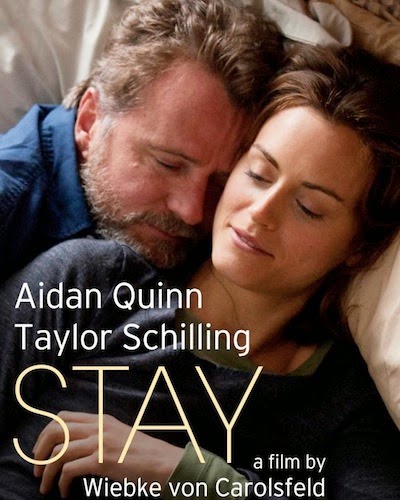
STAY - Review By Greg Klymkiw - No matter how much one tries to gussy it up, twee is as twee is and always will be. Twee, that is.


Stay (2014) Dir. Wiebke von Carolsfeld *½
Starring: Aidan Quinn, Taylor Schilling, Michael Ironside

Review By Greg Klymkiw

I always liked Aidan Quinn, but he really hasn't had a decent role since Barry Levinson's Avalon almost one quarter of a century ago. As such, I was kind of looking forward to seeing him in this movie - one I knew little about, save for the fact that he was in it and had a starring role opposite Taylor Schilling (an actress of dubious gifts, but not without some screen presence displayed in a clutch of bad movies like The Lucky One, Argo and (Ugh!) Atlas Shrugged). Alas, my heart sank a tiny bit when a head credit popped up which read: "With the financial participation of Telefilm Canada". I thought, oh, perhaps this won't be a real movie after all, but a Canadian movie pretending to be a foreign film with pig-in-a-poke "names" as window dressing to sucker audiences in to see it. Still, I was willing to give this a shot. Unfortunately, the movie's staggeringly stereotypical Canadian preciousness announced itself right at the outset as Quinn kicks a tin can along the ground as he walks along a lovely big-sky aquatic vista.

Great way to open a movie - kicking a can, looking forlorn against a topographical backdrop that might as well have been some Maritime Canadian locale. Luckily, it's not Canada, but Ireland. I recall thinking, "Well, at least I won't have to listen to Maritime fiddle music or Newfie rugby songs."

Well, maybe luck isn't with me. The soundtrack began to swell with some sickeningly twee folk song with the twittering voice of an Irish lass as Quinn enters his home, prepares a lovely tray of breakfast-in-bed and saunters gently into the boudoir where a gorgeous, young Taylor Schilling sleeps ever-so soundly.

Ack!

The movie then veered into territory I fully expected it to (based upon the initial letdown of the Telefilm Canada credit) and it does so with all the typical, uh, flair of a Canadian movie that values studied, ambrosial flatness.

Based upon a novel I haven't read by Aislin Hunter, I think perhaps I can't heap all my disdain for this flaccid movie and its ho-hum narrative upon screenwriter-director Wiebke von Carolsfeld since she did a perfectly decent job with Daniel MacIvor's Marion Bridge. But damn! This is one rink-dink sojourn into Dullsville that not even the presence of Aidan Quinn can quite save.

Quinn plays a semi-retired Archeology professor who lives in this relatively obscure small Irish community with his best gal, the supple late-20-something Schilling whose cradle he robbed during a trip to nearby Galway. It turns out the lassie is preggers with Aidan's seed and due to a deep, dark secret (revealed later on), he's not too keen on having kids. Schilling, conveniently from Montreal (allowing for a co-production twixt Canada and Ireland for this movie), decides to travel back to La Belle Province to engage in some soul searching with her Dad (Michael Ironside, looking very uncomfortable without automatic weaponry in his arms). Quinn does his fair share of soul searching too. We basically bounce back and forth between the Emerald Isle and French Canada's very own City of Lights as both characters spend a lot of time thinking about their relationship as well as the notion of having a child.

The lion's share of this whole-lotta-ruminating-going-on takes place in the Land o' Leprechauns where we get treated to subplots involving a young lad who is fatherless, a young preggers Momma who is motherless and Quinn learning a few lessons from both of them. Schilling learns a few lessons from friends and relatives in Montreal and even more sickeningly, we discover that her own Momma buggered off long ago because she didn't want a child. Wow! So many people abandoned by their Mamas and Papas. It's no wonder all these conveniently converging plot lines require a fair bit of mulling over.

If any of this had been treated with some good old fashioned passion and panache, it might have been palatable - maybe even, uh, good - but of course, since the movie is ultimately Canadian and not directed with any of the oomph Canadians can deliver (Cronenberg, Maddin, Veninger, the Soska Sisters, etc.), we're treated to little more than a limp, precious meander that doesn't even have the sort of TV-movie watchability that many Canadian dramas are infused with. In spite of some potential for roiling melodrama, all we get is a movie that's not edgy enough to be art, nor narratively competent enough to be entertaining.

Like many Canadian films (and, in fact, resembling much of the country's ethos), Stay sits rigidly on a fence post - the tip of it, and beyond, lodged firmly in that place where the sun don't shine.

"Stay" is distributed by Alliance VivaFilm in Montreal and is enjoying a limited run in that otherwise magical city and the not-so-magical city of Toronto at the TIFF Bell Lightbox.

Saturday, 15 March 2014

VERONICA MARS - Review By Greg Klymkiw - Movies are getting so awful that too many feel like bad TV.

*NOTE* I couldn't believe how awful this movie was. After I wrote this review, I did a quickie Google and discovered a whole lot of background info that makes me hate this movie even more. I'm especially happy to watch movies without knowing anything (or as little as humanly possible) about them and even happier to not write the pieces with pre-conceived notions (well, as best as one can in this day and age). I'm also happy I don't watch TV or trailers, nor read reviews, puff pieces or press kits before I see movies and write about them. In spite of what I now know about this horrendous excuse for a "major" motion picture, I'm even happier to stand by this review without amending it to reflect any of the ghastly information that now roils about in my brain like some rogue tapeworm bent on total ingestion.

Beneath my Beautiful Golden Tresses is, uh, nothing - reflecting, of course,
the collective total I.Q. of my loyal fans who love me without even thinking
about it, because happily, they can't think. Kinda like me. Tee-hee-hee!!!


Veronica Mars (2014)
LOWEST FILM CORNER RATING:
TURD DISCOVERED BEHIND HARRY'S CHAR BROIL and DINING LOUNGE
Dir. Rob Thomas, Starring: Kristen Bell, Jason Dohring, Enrico Colantoni
Review By Greg Klymkiw


What in Christ's name is this movie? Why was it made? Who is it supposed to please? How can any major feature film be so awful? How can a respected studio like Warner Brothers attach themselves to a feature film that seems, for all intents and purposes, to be little more than a vapid, incompetently crafted television drama stretched out to an interminable length?

I normally would have walked out of something this dreadful after two minutes, but I was, frankly, so utterly agog at the film's wretchedness and inconsequence I girded my mighty loins and nailed my feet to the floor.

The first ten (or maybe longer) minutes of the movie is some of the most ludicrous expositional material I've ever seen in any movie - ever. At least it seemed that way. Incomprehensibly shoehorned and top loaded into the picture is a putrid miasma of horrendously written voice-over that explained a whole whack of information so quickly that all I could really glean from it was that the main character was once a teenage private detective in a small California resort town and now, many years later, finds herself in the big city looking for a job as a lawyer in a high-profile firm.

The voice-over, however, is not only incomprehensible, but so flatly delivered by Kristen Bell, the purported actress in the title role, that when she finally opens her mouth by way of interacting with other characters, her delivery is as fake and vapid as the dialogue implanted in her brain via microchip. It's impossible to believe she could even graduate from the scuzziest community college with a certificate in septic sanitation maintenance, let alone garner a degree in Psychology and then (I guffawed) Law.

When it appears that an old friend (we're supposed to know he's an old friend because the movie tells us in the aforementioned expositional voiceover) is being charged with murder, our heroine hightails it back to her hometown and we're forced to suffer through a lugubrious series of perfunctory TV-style murder mystery machinations, punctuated every so often as Veronica reunites with a myriad of characters introduced to us in the said same aforementioned expositional voiceover and at this point, we still don't really know who anyone is as none of them appear to resemble characters in a movie other than the fact that the movie, via the - ahem - said same aforementioned expositional voiceover - tells us they're characters.

The only thing for sure is that our title character knows who they are.

The movie continues to plod mercilessly through one of the most uninteresting murder mysteries ever committed to film and we're forced to tolerate a hit parade of mostly no-name actors who look like they're delivering lines by rote in an overlong failed television pilot. There are minor appearances - extended cameos - by real actors like Jamie Lee Curtis and James Franco, who all provide ever-so brief oases from the dreadful semi-sitcom-styled acting.

Most egregiously, we have to experience a solid performance, in spite of the horrendous script, from Enrico Colantoni who seems like he deserves a more distinguished career than playing second fiddle to Kristen Bell whose only claim to fame was making poor Jason Segel's life miserable in Forgetting Sarah Marshall and prancing around in her knickers in the kitsch-fest Burlesque. I can't, sadly remember ever seeing Colantoni in any features films of note, but he appeared in a great Canadian short film called Winter Garden from earlier last year. If the Gods are smiling, he might still knock us on our butts with work in a terrific feature with a great role and real writing. In the 70s, he'd have had a decent shot as a leading character star a la Gene Hackman, but nobody makes movies like that anymore other than Quentin Tarantino. Hmmmmmmmmm. If I were Colantoni's agent, I know who's door I'd be knocking on.

As for direction - what direction? Rob Thomas, the no-name first-time feature director (well, I assume it's a first feature since I try to see every feature that opens and I'd remember the name of anyone so bereft of talent) proves that he can direct bad overlong television, but he clearly can't even do it competently. His coverage is so pathetically generated I'd hazard a guess that he might actually be the directorial equivalent to Mr. Magoo.

Earlier I asked who this movie is for. I saw it with a whole mess of tween and teen girls and their mothers. They all seemed to know what was going on and squealed with delight at every character introduction and reference to plot points regurgitated later on in the movie from the ludicrous - you guessed it - said same aforementioned expositional voiceover.

Christ, I felt like I was sitting through those wretched Sex and the City movies. Though Veronica Mars is thankfully without the equine Sarah Jessica Harper braying throughout the movie, I was even more appalled to see such young ladies in the audience shovelling this crap down their gullets. It's one thing seeing bovine forty-something women screeching over Sex and the City, but here we're talking about the next generation.

All I can do is sigh and continue to mourn at the cultural decline of Western Civilization.

"Veronica Mars" is not, it seems, in that wide of a theatrical release via Warner Bros. but mostly available on VOD.

Friday, 14 March 2014

Klymkiw watches TV (HBO CANADA) - It's nice when rich people produce films about poverty. Kudos to Maria Shriver for this one. PAYCHECK TO PAYCHECK: THE LIFE AND TIMES OF KATRINA GILBERT - Review By Greg Klymkiw


Paycheck To Paycheck: The Life and Times Of Katrina Gilbert (2014) ***
Dir. Nick Doob, Shari Cookson, Prod. Maria Shriver, Starring: Katrina Gilbert

Review By Greg Klymkiw

I can't help it, but trying to remove the taste of bile in my mouth is near-impossible when super-rich White People manage to weasel their way into arts and culture, based primarily upon their wealth, blue-blood family pedigree, celebrity and all the luxuries afforded to them and then make films about poor people. Such is the case of this latest production by Maria Shriver, daughter of Eunice Kennedy Shriver (hence, JFK's niece) and ex-wife of the nanny-defiling movie-star-body-builder-former-California-Governor Arnold Schwarzenegger.

Still, I'm happy enough to assess the 75 minute feature film Paycheck To Paycheck: The Life and Times Of Katrina Gilbert on its own terms since co-director Nick Doob has the distinction of being a real filmmaker and a longtime member of the unimpeachable Pennebaker Hegedus Films team, whilst his directorial partner Cookson, has a prolific c.v. which, includes the popular, though somewhat spurious doc series "Real Sex" (with its audience grabbing emphasis upon soft-hard-core antics and personalities).

Doob and Cookson had a whole year to dip into Shriver's access to O.P.M. (said access also generously applied, in fairness, to her many charitable activities) and follow around a Chattanooga, Tennessee nursing assistant to examine the life of the working poor - most specifically an example of America's most vulnerable and largest targets of poverty, single mothers.

Katrina Gilbert has three children and toils for 9 bucks an hour in an extended care facility. It's back-breaking, flat-footing work, but Gilbert genuinely seems to enjoy the daily human contact she has with the old and infirm. Still, she'd prefer to "better herself" and continue her post-secondary studies in the health care field, but in spite of her meagre salary and needing to support three kids, she is turned down - shockingly and inexplicably - for financial aid to further her education and perhaps get a better paying job.

Welcome to America.

Gilbert also has on-going medical conditions which, could well eventually morph into something life-threatening, yet when she goes to get an overdue check-up, she's hit with a doctor bill for over $300 as opposed to the $120 she was initially quoted. In America, there is no socialized medicine - it's big business in the Land of the Free and most people, including the working poor, have to cough up. (Obama Care doesn't appear to be in full implementation during the shooting, but even if it were, it's such a mess I can't imagine it would really help her.) Even more horrifying is that the list of medications she requires to keep her health on the up-and-up are so ludicrously expensive, she needs to make the decision of what drugs she can afford during a last-minute tabulation at the pharmacy.

Welcome to America.

She has three kids to feed, but since her ex is unemployed and often in arrears with his childcare payments, she not only has to lend him gas money to visit the kids, but her ration of food stamps to actually feed her progeny is shockingly and inexplicably cut-off.

Welcome to America.

The film itself is pretty compelling stuff and as a subject, Gilbert is pleasing, kind-hearted and smart. That being said, the movie presents her story in a what-you-see-is-what-you-get style, but I did find a few editing choices somewhat dubious - perhaps even downright unfair to her struggle.


For example, after discovering she doesn't qualify for educational assistance AND forced to choose what drugs she can actually afford, the filmmakers follow her into a beauty parlour so she can "do a little something" for herself. When she drops a healthy whack of dough for her new hair-do, I began to wonder, uh, lady - you have no money for drugs, yet you're dumping 70 or so smackers on what looks to be a (not-especially) flattering makeover. Given how much we feel for this woman, I felt this artistic choice - no matter how "true" - was simply cruel (intentional or not). Maybe it's the filmmakers' desire to make viewers have a similar response to the salon scene and intentionally plant a seed that grows into guilt for even having such a thought.

Whatever the reason it somehow feels out of place, just as a breakfast scene in the family's squalid home is shot and included wherein we watch the kids scarf down grease-laden plates of bacon and eggs, then guzzle-back bottles of pop. Yeah, we know that nutrition-choices are, for the poor, dictated by their poverty, but by continually including such sequences, one occasionally suspects there's a deeper agenda at play here - even if there isn't.

The choice to do this kind of thing might be true to the filmmakers's adherence to a direct cinema approach, but it's almost to the detriment of the film's forward trajectory since you, as a viewer, almost waste more time thinking about the rather mean-spirited approaches than what really counts. I suspect mean-spiritedness was not the intent and that the adherence to a direct cinema approach was paramount. However, even within that context, these moments stick out like sore thumbs rather than integrating with the whole. Greater attention needed to be paid to the desire to present an unfettered reality that should have addressed these important and clearly dichotomous moments in this woman and her family's life.

For example, the movie occasionally interviews individuals on the sidelines of the activities captured - in one case, a man who works as a clerk in a money-lending firm and in another, a clerk in a tax preparation office. In both instances, these brief side trips address the issues at hand - a woman who can't get credit anywhere else other than a usurious money lending service is acknowledged and treated like a human being who knows how hard she's trying to manage her debt and another who seems to even sense the absurdity of poor people needing to pay for a third party to report an income that, for all intents and purposes, is at the poverty line.

Where then is an individual to advocate for the "poor" or even simply acknowledge how easy it is to choose ephemeral pleasure over medical well-being and how prevalent it is in the lower financial strata of society? Where is the same perspective in terms of the grotesquely unhealthy breakfast the family is eating?

I think it's important we see these elements of Katrina's life - especially since it's presented as an individual sampling of the kind of thing millions of Americans are living through. I hate to make generalizations, but I think there's some truth to this one. Poor people see the world through the eyes of hardship and life experience. Some even acquire a modicum of wealth, but they've had to WORK - really WORK for it. Their sense of observation and even balance seem far more aware and open. The rich, generally, are criminals and/or assholes who most always see things from an elevated position. Some are neither, but I'd suggest that even the well meaning ones have prejudices that temper their observations.

Since the directors have not addressed this, I have to ask:

Where, in this film, is the producer (who especially in television has a very strong creative hand) to address the weird perspectives I point out above? And let me be clear, where is that strong hand, NOT to censor, but to address the shortfalls in the direct cinema approach and to do so aesthetically within the context of the whole film and its style/POV?

There wasn't one. She's a Shriver. Why would she even think about it? Sure, her credentials as a journalist, filmmaker and philanthropist cannot be ignored, BUT there is a perspective she has not been able to bring to bear upon this film that her directors also ignore. Direct cinema, in its purest forms and as we know them today were, in fact, rooted in colonialism, prejudice, poverty, working-class values and very little access to post-secondary education in the Canadian province of Quebec. (Though, it would also be remiss of me to not acknowledge the influence of Dziga Vertov's "Truth of Cinema" movement in the 1920 - born out of repression, revolution and the eventual sad march to another form of repression with a different name.)

Look, I'm not suggested Shriver nor her directors must have tasted subjugation to utilize this form, BUT it's of utmost importance for all artists - especially those working in documentary - to leave as few stones unturned in their quest for truth.

While the journey of Katrina Gilbert moved and inspired me, I could only feel saddened and defeated by the end of the film - not just as a viewer, but for her, those like her and the world as a whole. One of the very last things the film leaves us with is the knowledge that Gilbert is finally getting her first raise at work - ever! It's in the amount of a few cents. Chances look good she'll continue living in a trailer park.

All the film really leaves me with, especially because it does such a good job of detailing her struggle and allowing us to get to know her as well as we can, is one overwhelming annoyance. With one pen-stroke upon a check book, Executive Producer Shriver (who lives in a $10 million dollar Brentwood mansion) could make this woman's life turn around.

Instead, Shriver made this movie. On other people's money.

Welcome to America, indeed.

Paycheck To Paycheck can be seen on HBO Canada. For Dates and Times, visit the HBO Canada website HERE.

Thursday, 13 March 2014

NIM'S ISLAND - More drab contemporary kid-lit makes for unexceptional, but watchable family viewing. Special FREE screening as part of the Spring Break Family Matinees on March 16, 2014 at the Toronto International Film Festival's TIFF Bell Lightbox.


Nim’s Island (2008) **1/2
dir. Jennifer Flacket and Mark Levin
Starring: Abigail Breslin, Jodie Foster and Gerard Butler

Review By Greg Klymkiw

Family fantasy adventures based upon bestselling books continue to be cranked out as entertainment-starved parents continue to require motion pictures they can safely take their kids to, but also (presumably) enjoy as much as their progeny. While "Nim’s Island" is far from first-rate, it’s most definitely a solid ride with as much to recommend it to Moms and Dads as the kiddies. However, this recommendation and rating is extended, and I repeat – extended ONLY – to those requiring a family fantasy adventure based upon a book they may (or may not) have already read to their children. All others need not apply.

"Nim’s Island" ambles along pleasantly enough as it spins a yarn involving the cute, perky and (of course) precocious little darling of the title – Nim (Abigail Breslin) – as she and marine biologist Dad (Gerard Butler) live out their idyllic existence on a tiny tropical island in the middle of God-knows-where. Palm trees abound, fresh fruit sprouts from every nook and cranny and Nim’s pals include all the animals of the island including an especially flatulent seal.

When Nim is not gamboling about her island paradise, she reads voraciously. Her literature of choice comes in the form of the seemingly autobiographical adventure tales of the swashbuckling Jack Rover (also Gerard Butler). When her Dad disappears at sea whilst on a mission to survey marine life, Nim – using satellite email – sends cries of help to Rover. Believing the swashbuckler to be real, she suspects he’ll swoop in at some point to answer her pleas.

Unbeknownst to our heroine is the sad fact that Jack is a fictional character who exists – not only exclusively to the written page, but also as an imaginary character in the mind of agoraphobic authoress Alexandra Rover (Jodie Foster). Touched by the sincerity of Nim’s emails, the writer with the irrational fear of a world outside her home embarks bravely on a dangerous to take the place of her fictional character in order to rescue both Nim and her Dad.

Two things, and two things only, make this potentially hoary family fantasy palatable.

First of all, the cast is pretty first-rate. Abigail Breslin continues to amaze and delight – she’s an engaging young actress and as she matures and fills out, she’s becoming quite riveting – the camera clearly loves her and she has only one way to go – up, up and up. Gerard Butler, he of the firm buttocked King Leonidas fame in “300”, seems more at home as the Indiana-Jones-styled hero of his dual role duties, but he’s a terrific actor and it’s fun watching him prance about as a Daddy in second fiddle mode to Miss Breslin and her amazing farting seal. Jodie Foster manages to use her annoyingly pinched qualities to exceptional use. This tightly-wound, oh-so-serious actress who is as highly skilled as she is dull seems quite at home in her role as an agoraphobe and even manages to loosen up a tad in order to – you heard it hear first, folks – make us laugh.

The second reason to recommend the picture is its strict belief in family values. While Mr. Butler portrays a single parent, it is not the otherwise usual sort of pathetic baby-boomer characters who've messed up their children’s lives by being selfish and breaking up their families through divorce. No, Mr. Butler’s character is widowed, not divorced. This not only allows us to feel more for him and his child, but rejoice when he and Nim eventually become a full family unit with the appearance of the husband-less Jodie Foster.

If you’re looking for a shred of originality, you won’t find it here, but if you’re looking for a relatively pleasant time to kill time with the child you love, you can do much worse than “Nim’s Island”.

And how about those family values? Family values abound and prosper on “Nim’s Island”, and for that, we can all be just a little bit thankful.

“Nim’s Island” is available on DVD and Blu-Ray from 20th Century Fox Home Entertainment

8/6/08

Wednesday, 12 March 2014

VANYA ON 42nd STREET - Review By Greg Klymkiw - One of the Greatest, if not THE greatest of Chekhov Film Adaptations Ever Made on Criterion Blu-Ray


Vanya on 42nd Street (1994) ****
dir. Louis Malle
Starring: Wallace Shawn, Julianne Moore, Brooke Smith, Larry Pine, Andre Gregory

Review By Greg Klymkiw
"When we come to die, we'll die submissively. Beyond the grave we will testify that we've suffered, that we've wept that we've known bitterness. And God will take pity on us and we will live a life of radiant joy and beauty and we'll look back on this life of our unhappiness with tenderness and we'll smile. And in that new life we shall rest, we shall rest to the songs of the angels in a firmament arrayed in jewels and we'll look down and we'll see evil, all the evil in the world and all our sufferings bathed in a perfect mercy and our lives grown sweet as a caress." - Sonya's final monologue in David Mamet's adaptation of Anton Chekhov's play Uncle Vanya.

If your idea of a good time is not watching two hours of wasted lives, think again. When those same wasted lives come to the collective realization - almost like a series of epiphanies - of just how much they've failed to fulfill their dreams and/or promise, you'll have been rewarded with a journey that will have enriched your very being.

Vanya on 42nd Street is raw in its emotion and approach. Watching Louis Malle's film of the David Mamet adaptation of the great play "Uncle Vanya" is one of the best ways to experience Anton Chekhov on film.

The final product represents the culmination of Andre Gregory's grand theatrical experiment of taking some of New York's greatest actors and rehearsing Vanya for two years with no intention of ever staging it. Gregory, (the Andre of Malle's My Dinner With Andre) had a dream - to create an ideal opportunity for great actors to intimately dive into the depths of Chekhov's multi-layered work - to get to know the text so deeply that the journey's end would, in fact, never end. The goal was to infuse these actors with Chekhov's genius and, at the same time, for very select audiences - usually in the living rooms of friends' apartments - to experience, from Gregory's vantage point, both the journey of the actors and that of Chekhov's characters.

Malle attended one of these legendary living room performances and immediately decided a film version that captured both Gregory's vision and the truly astounding interpretations of Mamet's adaptation of Chekhov's work was in order. With Malle's unique eye as a cinematic storyteller - blending both his documentary background with his deft and delicate touch for drama, Malle framed a performance of the play as a run-through with the actors - in their street clothes and in the environs of a crumbling old theatre on 42nd Street in New York.

At first, we're quite aware of this conceit, but as the magic of Chekhov overtakes us, it's impossible not to be drawn in by the brilliance of the original play, Mamet's adaptation (more of an edit, or polish - to strip out a few formal tropes of theatre from Chekhov's period), a gorgeously composed, though unobtrusive camera and last, but not least, a cast that includes actors who seem like they were born to evoke Chekhov's universal themes and language.

Vanya (Wallace Shawn, the writer of Malle's My Dinner With Andre and who played the "My" of the title) is the brother-in-law of Serebryakov (George Gaynes), a stuffy academic who acquired an old country estate by marrying his first wife (Vanya's late sister) and has now, left his widowhood behind to marry the unmistakably beautiful Yelena (Julianne Moore). With his niece Sonya (Brooke Smith), Vanya manages the estate and the business affairs of his late sister's blusteringly pretentious husband. The family receives visits from Astrov (Larry Pine), a physician constantly called to tend to Serebryakov's ailments - most of which are of the psychosomatic variety.

Vanya and Yelena are greatly suited to each other in every respect - save for the fact that she finds him physically repulsive. Astrov, along with Vanya, is madly in love with Yelena. She's physically attracted to him, but they clearly do not share the intellect and humour she enjoys with Vanya. Then there's Sonya - who is madly in love with Astrov, who barely notices she's there - hanging on his every move, word and gesture. Serebryakov loves Yelena, but fears he is too old for her. Yelena, clearly has no love for Serebryakov, but she is intent to stay faithful to him.

These roiling passions - all unrequited - come to a head when Serebryakov decides he wishes to sell the estate and move to Finland. This would displace the whole family and housekeeping staff. Vanya is finally, after years of subservience and servitude, forced into action.

Wallace Shawn is a perfect Vanya - a funny, charming, yet occasionally sad-sack nebbish. His lovely performance elicits an equal number of laughs and tears. Julianne Moore is utterly radiant as the object of everyone's affection and Larry Pine as the physician who abandons everything for a love that will never be, is a perfect skewed-reverse-image of Shawn's Vanya. The revelation is the sad, funny and yes, beautiful Charlotte Moore as Sonya - her character creeps about in the background, yet when she exudes a force before unimagined, it instills the overwhelmingly expressive feeling that, "Of course! Her actions and words make total sense!" Moore deliver's Sonya's final speech from the play with such gentle, persuasive force that I can't imagine anyone watching it dry-eyed.

Vanya on 42nd Street is an extraordinary experience. Malle's career was one in which he delivered many great films. This one in particular made me and his numerous admirers wait with baited breath for his next work. Sadly it never came. It was his last film before he died of lymphoma one year after making the picture.

I can't think of a more perfect swan song.

"Vanya on 42nd Street" is currently available on a gorgeous new Blu-Ray from the Criterion Collection. In addition to the stunning new transfer, it is accompanied by modest, but at the same time, extremely informative and revealing extra features.

Tuesday, 11 March 2014

ABOUT LAST NIGHT - Review By Greg Klymkiw - With Steve Pink's re-imagining of the Mamet play taking box-office and critics by surprise, it might be worth taking a look at Edward Zwick's re-imagining of the Mamet play from the 80s. Or, maybe not.

About Last Night (1986) *
dir. Edward Zwick
Starring: Demi Moore, Robe Lowe, James Belushi, Elizabeth Perkins

Review By Greg Klymkiw

About Last Night is atrocious. In spite of this, it provides a few delights. First and foremost, the film offers ample exposure to Demi Moore’s naked body, which is quite splendid to gaze upon with its lithe, youthful, and pre-boob-job-pre-child-bearing-milk-sack-udder-creation-perfection.

One also gets to eyeball a nude Rob Lowe and marvel at his perfect bum that is, not surprisingly, much nicer than Miss Moore’s and designed to both worship and penetrate. Finally, we are occasionally treated to shots, unexceptional though they are in both composition and lighting, of the great city of Chicago, which, even when poorly photographed, makes us long to make a pilgrimage to the Windy City and stay forever.


Aside from the aforementioned, about the only reason to see About Last Night is to study exactly HOW it could have been a good movie, to longingly contemplate the original source material that is David Mamet’s play “Sexual Perversity in Chicago” and imagine a world where something resembling a good movie director, as opposed to the no-talent hack that is Edward Zwick, took Mamet’s words and displayed them cinematically, yet reverentially upon the screen.

Zwick reduces Mamet’s glorious, strangely universal and viciously funny play to a simple boy-meets-girl-gets-girl-loses-girl-and-gets-girl-back scenario aimed squarely at that empty generation that embraced the Brat Pack of St. Elmo’s Fire as romanticized cinematic reflections of themselves. The only thing worse would be to do the same thing with the even more repulsive generation of today. Wait a minute. Didn't Steve Pink do that? Yeah, but at least he did it a whole lot better.

Mamet’s play yielded a dramatic examination of relationships between young and women in a pre-Generation-X world that somehow predicted the Gen-X experience and furthermore proposed the notion that we can apply as many labels as we’d like to various eras, but that ultimately, the differences between men and women do not really change with time. Mamet’s play is universal. Zwick’s film is dated. One is alive. The other is dead.

This is no surprise with Zwick at the helm. In spite of the fact that he was able to pinch out a loaf of decent celluloid with Glory, one could argue that only a complete bonehead would have failed with such stirring subject matter as a Civil War picture focusing on Black soldiers.

Alas, Zwick’s other “accomplishments” are not as stellar as the aforementioned war epic. His big screen efforts are mostly humourless, clunky, turgid costume dramas like Legends of the Fall, The Last Samurai and his entry in the Holocaust sweepstakes, Defiance or worse, his dumb socially conscious action pictures like Courage Under Fire, The Siege and the execrable Blood Diamond which prove that even a no-talent can get pictures repeatedly green-lit based solely on subject matter that must appeal to left-leaning studio heads.

Zwick’s primary small-screen accomplishment was the creation of the popular, but annoyingly dated “dramedy” that stills sends shivers down my spine when I think about it, the reprehensibly twee “thirtysomething”.

What this all adds up to is a severe watering-down of Mamet’s delicious savagery. Not only that, it’s incompetent to boot. Zwick takes the opening of the play, a magnificently nasty bit of dialogue between the brutish Bernie (James Belushi) and the slightly more sensitive Danny (Rob Lowe) wherein the former recounts a Penthouse-Forum-styled tale of his sexual exploits. Even now, the language has the power to provoke and entertain. The way Zwick presents the scene is jumpy, confused and frankly, a just plain crude barrage of “guy talk”. Zwick idiotically presents the continuous conversation over a series of different locations. His intent was to obviously “open up” the dialogue – to render it “cinematic” as opposed to leaving it visually intact and (oooohhhhh, dirty word…) “theatrical”. What this does, however, is confuse the focus and detract from the story and conversation’s natural rhythm. Instead of moving the action forward through dialogue which, in and of itself is already action-oriented, Zwick sledgehammers us with unnecessary location changes and, of course, completely unnecessary cuts. All this contributes to destroying Mamet’s great dialogue and curiously, make the characters seem one-dimensional instead of extremely layered.

Uselessly “opening up” theatrical scenes in a movie are the hallmark, knee-jerk touch of true hacks. Rather than trusting the original author’s intent, a buckshot approach to visually presenting the material is used. “Opening up” is extremely unimaginative. In the flawed, but eminently watchable adaptation of Peter Schaffer’s Equus, Sidney Lumet allowed Richard Burton to sit at a desk uttering purple verbal ruminations directly into the lens. This was nothing if not “cinematic”. When Mike Nichol’s adapted Edward Albee’s Who’s Afraid of Virginia Woolf? he wisely kept most of the action centered on George and Martha’s den of verbal savagery and the only opening up that falls on its face are the few scenes outside of their physical domain – most notably the action in the car and the roadside bar. And of course, one cannot forget James Foley’s simple, effective and extremely subtle opening up of Mamet’s Glengarry Glen Ross.

Nothing so subtle exists in the world of Mr. Zwick. From the abovementioned opening sequence and onwards, the picture simply gets worse. In addition to spotty performances (especially and surprisingly from a forced, bombastic Belushi and the always sickening Elizabeth Perkins), we’re hogtied to a soundtrack score bearing some of the more grotesque 80s pop tunes.

Interestingly, the play’s original title, “Sexual Perversity in Chicago” was dropped when it was discovered that many venues refused to carry advertising with a title like that. So from that point on, it became known as About Last Night.

This must continue to be a blessing for Mamet.

“About Last Night” is available on Blu-Ray from Sony Pictures Home Entertainment.