Showing posts with label War. Show all posts

Sunday, 17 September 2017

THE BREADWINNER, DARKEST HOUR, THE DISASTER ARTIST - TIFF 2017 - Roundup of 4-Star **** Capsule Reviews By Greg Klymkiw


The terrific pictures at TIFF 2017, keep on coming.

3 Four-Star Capsule Reviews of
The Breadwinner, Darkest Hour & The Disaster Artist


By Greg Klymkiw

BREADWINNER, THE (2017) ****
Dir. Nora Twomey
From Aircraft Pictures and director Nora Twomey comes The Breadwinner, a harrowing, thrilling and inspiring film (blessed with a great screenplay adaptation by Anita Doron) of the young adult novel by Deborah Ellis in which a young girl in Afghanistan must pose as a boy in order to help her family when their patriarchal head is imprisoned. The suspense during the final third is almost unbearable. This is one of the best animated feature films I've seen in years.

DARKEST HOUR (2017) ****
Dir. Joe Wright
Starring: Gary Oldman,Ben Mendelsohn, Kristin Scott Thomas
In Darkest Hour, director Joe Wright expertly weaves the tale of Prime Minister Winston Churchill during the early days of WWII - from his appointment as PM and through to his historical "we shall fight on the beaches" speech to parliament. Gary Oldman plays the irascible orator with verve and passion. In many ways, Oldman is the movie. The film is little more than war propaganda, but it's first-rate war propaganda and the fictional sequence involving old Winnie riding the London Underground is insanely, gloriously stirring and moving. His performance overall, moved me to tears.

DISASTER ARTIST, THE (2017) ****
Dir. James Franco
Starring: James Franco, Greg Franco, Seth Rogen
Based on the memoir by actor Greg Sestero, director-leading-man James Franco and co-star (his real-life brother Dave Franco) take us into similar territory Tim Burton occupied with his glorious biopic Ed Wood. Here we get the strangely moving, heartfelt and often hilarious tale of Tommy Wiseau, the "auteur" who made The Room (often considered the best bad movie ever made). I still haven't seen Wiseau's film, but it hasn't been an impediment to my thorough enjoyment of Franco's film.

The Breadwinner, Darkest Hour and The Disaster Artist are TIFF 2017 presentations.

Tuesday, 11 July 2017

Le Silence de la mer (The Silence of the Sea) - Review By Greg Klymkiw - Haunting portrait of French Resistance during wartime at TIFF Bell Lightbox Summer 2017 series "Army of Shadows: The Films of Jean-Pierre Melville" and available on the Criterion Collection.

A Nazi soliloquizes to silent listeners in Melville's debut.

Le Silence de la mer - The Silence of the Sea (1949)
Dir. Jean-Pierre Melville
Nvl. Vercors (Jean Bruder)
Starring: Howard Vernon, Nicole Stéphane, Jean-Marie Robain

Review By Greg Klymkiw

There are many forms of resistance during an occupation. As Jean-Pierre Melville's debut feature film proves, the most powerful of all is silence. When an old man (Jean-Marie Robain) and his niece (Nicole Stéphane) are forced to billet Nazi officer Werner von Ebrennac (Howard Vernon) in their own home, they choose to contribute to the French resistance of German occupation by going about their lives as if their unwelcome guest doesn't exist.

Silence proves to be a formidable weapon. Le Silence de la mer is based on the secretly published novel by Jean Bruder under the nom-de-plume "Vercors", published and circulated in France during the Occupation. So horrific is the power of Melville's adaptation that the film succeeds as one of the most chilling anti-war films ever made and this from a picture that seldom leaves the confines of a cozy, bourgeois country living-room. What a gloriously mad first feature film, but one that radiates the sheer abundant cinematic glory that is Jean-Pierre Melville.

The first two-thirds of the movie involves the old man and his niece sitting quietly - the old man reading and/or smoking his pipe whilst his niece intensely embroiders. The Nazi officer pays them nightly visits. He acknowledges and respects their resistance, their cold, borderline cruel silence.

Still, this does not deter him from trying to establish a human connection. He wanders about the living-room, speaking in soliloquy. His words are always gentle, mannered and cultured. It doesn't take long to figure out he isn't the usual garden variety Nazi Officer. It seems that Werner von Ebrennac has the soul of an artist and he holds a deep love and admiration for French culture.

Many of his monologues are heart-achingly beautiful observations on art, language, music and literature. He even reveals tidbits about his life in Germany, some very personal. When he tells the story about his one great love and how he was eventually driven from her when she displayed a deep-seeded cruelty he could have never before imagined, we are allowed to see the pain and disappointment in his eyes. We are allowed to feel for him as a human being. His hosts, however, remain unmoved - at least on the surface. No matter what he says, the old man and his niece remain impassive - and, silent.

Their silence does indeed border on cruelty, though our Nazi doesn't see it that way. He acknowledges their right to silence. Astonishingly he seems to welcome it as the right of any countryman to resist their occupation at the hands of an enemy.

He occasionally veers into political territory - dangerous territory indeed since he betrays considerable naiveté and in so doing he attempts to provide a perverse justification for Germany's occupation of France. This eventually proves to be his biggest mistake because eventually he comes face-to-face with the true reality of his country's motives, their final solution.

Eventually a word will indeed be spoken from the "resistance". When it comes, it's excruciatingly painful. I personally find myself gasping and on the verge of weeping every time I experience this moment.

There's something so perfect, so indelible about this motion picture. Melville, a French Jew who was a resistance fighter during WWII, made this film not long after the war. Given the horror, danger and cruelty he experienced, one might have expected a very different film on his feature debut, but no, he is, after all Jean-Pierre Melville. Le Silence de la mer seems to set the stage perfectly for the compassion and humanity he displayed throughout his career.

He's achieved the impossible. He allows us to see cruelty in resistance and humanity in a Nazi. Just thinking about this makes me want to weep with joy.

And sadness.

THE FILM CORNER RATING: ***** 5-Stars

Le Silence de la mer (The Silence of the Sea) plays at at the TIFF Bell Lightbox Summer 2017 series "Army of Shadows: The Films of Jean-Pierre Melville". It is also available on a gorgeous Criterion Collection Blu-Ray and DVD that comes complete with a new high-definition digital restoration, with uncompressed monaural soundtrack on the Blu-ray, Melville's first film, the short 24 Hours in the Life of a Clown (1946), a new interview with film scholar Ginette Vincendeau, Code Name Melville (2008), a seventy-six-minute documentary on Melville’s time in the French Resistance and his films about it, Melville Steps Out of the Shadows (2010), a forty-two-minute documentary about Le silence de la mer, an interview with Melville from 1959, a new English subtitle translation, plus a booklet featuring an essay by critic Geoffrey O’Brien and a selection from Rui Nogueira’s 1971 book "Melville on Melville".

Thursday, 29 June 2017

Army of Shadows (L'armée des ombres) - Review By Greg Klymkiw - Grim, Haunting Portrait of Collaboration and Resistance at Toronto's TIFF Bell Lightbox in summer 2017 series "Army of Shadows: The Films of Jean-Pierre Melville" and, via a gorgeous (O.O.P. limited availability) Blu_Ray/DVD via the Criterion Collection

Collaboration is a dirty business. So is Resistance.

Army of Shadows AKA L'armée des ombres (1969)
Dir. Jean-Pierre Melville
Nvl. Joseph Kessel
Starring: Lino Ventura, Simone Signoret, Jean-Pierre Cassel,
Christian Barbier, Paul Crauchet, Claude Mann, Paul Meurisse, Serge Reggiani

Review By Greg Klymkiw

Collaboration is a dirty business. So is resistance. In an occupied country, both will thrive, yet seldom have either been more grim, mean and downright foul than in France during World War II.

Jean-Pierre Melville's film adaptation of Joseph Kessel's fictionalized version of his own real-life experience during this shameful period of 20th Century French History is not only a masterpiece, but it might be one of the most heroic depictions of the French Resistance ever made. That said, Melville's brand of heroism is replete with relentless outrage and deep, deep anguish.

Army of Shadows (L'armée des ombres) will be a bitter pill for any audience to swallow, but its necessity might be more urgent now than ever. "Occupation" of one country by another has become especially endemic to the ongoing and mounting political strife plaguing our world in this century and has resulted in the kind of "collaboration" and "resistance" that ripped the guts out of France and so many other European countries during the Second World War. One of the most fascinating features/attributes of Melville's picture is the fact that it stands before us as a film made almost half a century ago, about events that occurred almost one quarter of a century before the film itself was made, and yet here we sit, now, looking at it, our jaws agape over the cruelties and complexities the movie depicts, and realizing, ever-sadly, how so little, how so goddamn little in our world has actually changed.

It's a movie of universal qualities. The picture comes by them due to the strange narrative and stylistic structures Melville has chosen to infuse it with, all of which place us in a world that, from beginning to end, knock us off-kilter, keep us on edge and finally instil in us a dread that its events, which once happened, are indeed happening now and will happen again and again if we do not, by both acknowledgment and action, recognize and work towards ensuring that it stops.

Melville creates a film here that rubs our noses in the fact that our very nature as human beings is highly susceptible to the damage caused by occupation and how the inevitable resulting collaboration with occupying forces yields the kind of self-serving selfishness (the selfishness of survival, if you will) which gives way to the kind of inhumanity that even resistance can engender.

So how then, does he do this?

The first thing Melville chooses to greet us with are words.

Popping up from deep black, brilliant white typeface announces:

"Unhappy memories! Yet I welcome you...You are my long lost youth..."

My God, was there ever an epigram infused with more truth?

There is no elegant fade to black from these words, no gentle dissolve. Melville jolts us with a cut and the beautifully composed long shot he bestows upon us is that of the Arc de Triomphe de l'Étoile, that glorious symbol of France's victories over those who would dare profane French soil - a testament to the fallen warriors of the Revolutionary and Napoleonic Wars and, indeed, the resting place of the Tomb of the Unknown Soldier from World War I.

The Eiffel Tower might well be the ultimate symbol of Paris, but situated at one end of the Champs-Élysées, smack in the middle of the now-named Place Charles de Gaulle, but the more evocatively once-named Place de l'Étoile, the imposing Arch of Triumph remains, for most of us, the definitive apogee of France itself.

And we sense, immediately, that something is amiss. It's not the shot itself, nor is it the the drumbeats and marching feet from a line of soldiers on parade that slowly creep onto the soundtrack and intensify, but rather, it's the sky towering above the grand arch, so grey, so weirdly forbidding in the drabness of the clouds that makes us uneasy.

The camera never moves - or so it seems. Initially, the soldiers are so far away from us they're dwarfed by the Arch itself. As the parade gets closer and the music and marching become ever-cacophonous: beats, bleats, blasts and finally a blare - we're jolted into reality and the camera does indeed shift, ever-so subtly for us to realize that the soldiers are Nazis. As they get closer, filling the frame, defaming the composition of the Arch itself, our nerves are jangled.

And we are sickened.

Things don't get brighter. Melville bestows the rest of the opening of the film in swathes of dull blues, greens and greys as we're introduced to the well-groomed civil engineer Philippe Gerbier (Lino Ventura) who is being driven to a prison camp filled with "enemies" of the collaborationist Vichy government of France, the ruling bureaucracy which has prostrated itself before the Germans who have swallowed the country whole as an occupying force.

Dirty Nazis.

Dirtier still are the French - or rather, those Frenchmen who betray their soil, their nation and their people to serve the foul occupiers.

Phillipe is treated by his captors in a relatively gentlemanly fashion. Housed in a barracks that was ironically designed by the French to house German officers, but is instead now populated by Frenchmen, the pensive, almost bookish prisoner has little regard for his fellow captives, until he takes a shine to a bright young man who proposes a brilliant plan of escape.

This will be our (and Phillipe's) first taste of betrayal in the film. The vibrant youthful co-conspirator sells out our hero to the Vichy pigs and he soon finds himself transported to a Nazi facility. Phillipe escapes (quickly, efficiently and shockingly engineered) and we eventually find him ensconced on the Riviera where he leads the French Resistance movement.

From here, the film charts a series of resistance movements - some successful, and others scuttled by either circumstance or worse (and most often), betrayal. Occupying forces count on the Judas Kiss and Melville's film doesn't spare its characters from being forced to sell out. Then again, and most tragically, the film doesn't save several other characters from refusing to turncoat, and what awaits them is torture and inevitably, agonizing death. And though we see numerous instances of characters succumbing to the equivalents of the "death-by-a-thousand-cuts", Melville conversely doesn't spare an equal number of them from being snuffed out brutally and swiftly.

Throughout his career, Melville 's approach to on-screen violence was unique in its savage efficiency and in Army of Shadows, we are "treated" to several instances of this, so ferocious in the barbarity of the acts, that we're forced to cringe and gasp through several agonizing stranglings, stabbings, beatings and shootings. From a tea towel garrotte wrenching a traitor's last gasps of air to a cold, hard pistol appearing out of nowhere, pausing to give its intended victim a few moments of recognition and then, the inevitable, the blast of a gunshot, the piercing of flesh and death that is as merciful as it is cruel.

There are, of course, moments of tenderness, love, loyalty and yes, even hope. However, the film's overall tone is one of despair. The picture begins as it ends, beginning with one thing and allowing it to transform into something quite different - jolting us out of anything resembling comfort or complacency.

Yes, amongst the army of shadows in this horrific topsy-turvy world of collaboration and resistance, there is heroism, but nobody - nobody is a winner.

THE FILM CORNER RATING: ***** 5-Stars

Army of Shadows AKA L'armée des ombres is being screened during the TIFF Bell Lightbox series entitled "Army of Shadows: The Films of Jean-Pierre Melville" and is available on the Criterion Collection in a (limited availability O.O.P.) BLU-RAY and DVD that includes an audio commentary with film historian Ginette Vincendeau, an interview with editor Françoise Bonnot, On-set footage and excerpts from archival interviews with director Jean-Pierre Melville, cast members, writer Joseph Kessel, and real-life Resistance fighters, "Jean-Pierre Melville et L’armée des ombres” (2002) and "Le journal de la Résistance" (1944), a rare short documentary shot on the front lines during the final days of German-occupied France.

Thursday, 13 October 2016

UNDER THE SHADOW - TORONTO AFTER DARK 2016 - Review By Greg Klymkiw - Horror film against the backdrop of the Iran-Iraq War of the 1980s will knock you on your ass!


Under the Shadow (2016)
Dir. Babak Anvari
Starring: Narges Rashidi, Avin Manshadi, Bobby Naderi

Review By Greg Klymkiw

Living in Tehran during the eight long years of the Iran-Iraq War in the 1980s was terrifying enough with endless bombs dropping. Eventually, with the threat of missiles from Iraq, the city emptied to ghost town proportions. Against this backdrop is one of the most creepy, harrowing and heart-stoppingly scary movies of the year.

Shideh (played by the intense and babe-o-licious Narges Rashidi) lives the life of a housewife and Mom to hubby Iraj (Bobby Nederi) and daughter Dorsa (Avin Manshadi) respectively.

After unceremoniously being booted from medical school for her "political" leanings, she's disappointed to learn that after years of repentance, she will still be barred from completing her studies. Iraj is sympathetic, but he is a practising doctor himself and tries to placate her with taking solace in the good life they have together.

She's having none of it. Even in the repressive world they live in, she yearns for independence and self-fulfilment - perhaps, even, to a fault. When Iraj is drafted into military service, she refuses to leave Tehran with Dorsa and into the relatively safe harbour of her in-laws. As bombs and missiles strike the city with more frequency, Shideh gets frantic telephone calls from Iraj, begging her to leave.


Infused with the similar kind of Dustin Hoffman from Straw Dogs ethic of "This is our home", Shideh digs her heels in.

However, other than a war waging, there's another problem which creepily, insidiously begins to plague the family's home. Is it a ghost? A demon? A Djinn?

If it's an evil Djinn, this is definitely not a good thing.

Shideh is, however, a woman of reason, of logic, of intellect. She refuses to believe in old Arabic superstitions. But soon, the horror visiting upon her is far too real to ignore.


Under the Shadow is a slow burn. What begins as a domestic drama during wartime starts to unravel itself into a full blown horror film. You'll never see the first jump-scare coming, but when it does, you will be gasping for breath and clutching your chest. And it's no cheap jump scare. It's earned and rooted deeply in the psychological, cultural and sociological fabric of both the narrative and world of the film.

Writer-Director Babak Anveri displays such control over the proceedings that the visceral moments have the kind of impact we seldom see in contemporary horror films. The film is dazzling and original and one of the few movies that flirts with being genuinely in the same league as The Exorcist.

THE FILM CORNER RATING: ***** 5-Stars

Under The Shadow is an official selection at the 2016 Toronto After Dark Film Festival.

Wednesday, 11 May 2016

SUNSET SONG - Review By Greg Klymkiw - Oh Dear, Another Terence Davies Masterpiece. What else is new? UK's Greatest Living Director Serves Up Epic of Romance and War.


Sunset Song (2015)
Dir. Terence Davies
Nvl. Lewis Grassic Gibbon
Starring: Agyness Deyn, Peter Mullan, Kevin Guthrie, Jack Greenlees, Daniela Nardini, Douglas Rankine, Ian Pirie, Linda Duncan McLaughlin, Mark Bonnar

Review By Greg Klymkiw

To my mind, Terence Davies is a National Treasure and easily the United Kingdom's greatest living director. Over the course of 30+ years, he's brought us eight feature length diamonds. Some have been exquisitely in the rough like 1983's The Terence Davies Trilogy of short films, the 1993 Southern Gothic of The Neon Bible and the shimmering 2008 Liverpool documentary Of Time and the City.

The carefully hewn diamonds are something else altogether - one picture after another to take their rightful place as cinematic equivalents to the priceless Persian Koh-I-Noor diamond. Blending painterly tableaux, to-die-for lighting, sweetly breathtaking camera moves (often slow and subtle), replete with Davies's virtually trademark recurring themes of time and memory, are, with few peers, amongst the best films of all time.


The masterpieces include 1988's Distant Voices, Still Lives, the gulp-and-tear-inducing exploration of a family seeking solace in "old songs" at the local pub to allay the constant physical, verbal and psychological assaults from a brutal patriarch, 1992's The Long Day Closes, a ravishing ode to movies in post-war Britain, 2000's The House of Mirth, the finest Edith Wharton film adaptation anyone will ever make, and 2011's The Deep Blue Sea, the finest film adaptation of any Terence Rattigan play that (you guessed it) anyone will ever make. (That said, Anthony Asquith's adaptation of The Browning Version with Michael Redgrave is a pubic-hair-close-second in the Rattigan movie sweepstakes.)

And now, a new masterpiece can be added to the pile.


Sunset Song is the ravishing, romantic story of a young woman who gives up her dreams of a higher education to care for farm and family. Her father is a brute who physically abuses his eldest son and demands constant sex from his wife, turning her into a breeding machine long after she is physically able to handle it. Upon the matriarch's death, Daddy Dearest gets a stroke and attempts to demand sexual favours from his only daughter. As she always has, she fights back against the unfairness and evil of patriarchy. Though her dreams of teacher's college were dashed, she discovers that her real dream consists of a deep love for the land, its people and the sweet-faced kindness offered by marrying a handsome, caring young man.

All seems well and then, war.

What's precious about her life is about to flip topsy turvy, but her strength, indomitable courage and intelligence will constantly be set upon the greatest of life's challenges. Davies charges this simple, yet complex tale with an astonishing mise en scène. Never has an on-screen courtship been sweeter and the love experienced by the young man and woman beats its heart constantly through joyous events, strife and hardships of the most devastating order and beyond.

We're faced with a myriad of life's moments with Davies's masterly direction: a deliriously romantic exchange amidst a sea of sheep, a glorious wedding sequence and barn dance, the cruelties of shell shock and the horrors of war.


There's a sequence in Sunset Song which is blessed with one of the most moving series of images and sounds that you're likely to see in any films - period. It's pure Terence Davies, yet also worthy of the very best of John Ford. The sequence is especially reminiscent of those stirring moments from Ford's screen adaptation of novelist Richard Llewellyn's How Green Was My Valley - a cornucopia of knockout moments wherein Welsh miners sing songs of sadness and joy at key points in Ford/Llewellyn's narrative of the land and its people.

Davies, of course, is not in Ford's Wales, but delivers his narrative of the land and people of Scotland in this heartbreaking, but ultimately moving and soaring film adaptation of Lewis Grassic Gibbon's immortal book "Sunset Song", the first in his important trilogy, "A Scots Quair".

As this is a Terence Davies film, music and song carry us to euphoric and elegiac heights. Using what might be the ultimate contemporary recording of Hugh Robertson's arrangement of Katherine Tynan's gut wrenching "All in the April Evening" (performed by The Glasgow Orpheus Choir), Davies and cinematographer Michael (Winter's Bone) McDonough's dazzling camera follow the people of the Estate of Kinraddie in Kincardineshire Mearns of northeastern Scotland as they slowly make their way over the rolling fields of yellow grasses until they converge upon the parish cathedral to prepare for a very solemn Sunday Service.


As beautiful and rich as the images are, along the country road and past the ancient rock buttressing the House of God, the camera, then dollying slowly backwards inside the cathedral as the townsfolk sit whilst sun streams through the majestic windows, waiting for the words of Reverend Gibbon (Mark Bonnar), there is a portent we cannot help but feel to our very core. It doesn't seem lost upon the townspeople either - what begins as a happy parade to worship, soon betrays visages of both melancholy and trepidation and the gait of the assembled, is ultimately not unlike a funeral march.

Tynan's song tells the tale of Christ's Passion, but given that Scotland has been corralled into war by England against The Hun, we cannot help but ascribe the meaning of the lyrics to reflect what really awaits the folk of Kinraddie:

The sheep with their little lambs
Pass'd me by on the road;
All in an April evening
I thought on the Lamb of God.

The lambs were weary, and crying
With a weak human cry;
I thought on the Lamb of God
Going meekly to die.


As the camera passes by the newly, happily married couple, Chris (Agyness Deyn) and Ewan (Kevin Guthrie), the lyrics are timed thusly:

. . . but for the lamb, The Lamb of God
Up on the hill-top green;

Here, Davies and McDonough reverse the angle upon the pulpit as the grim-faced Reverend slowly makes his way to the "holy" perch above the people. And the lyrics lament:

. . .Only a cross, a cross of shame
Two stark crosses between.


The Reverend ascends the stairs to his lectern of doom, lowers his head, then raises it, staring straight out at the congregation as the final lyrics hang in the air like a harbinger of death:

I saw the sheep with their lambs,
And thought on the Lamb of God.

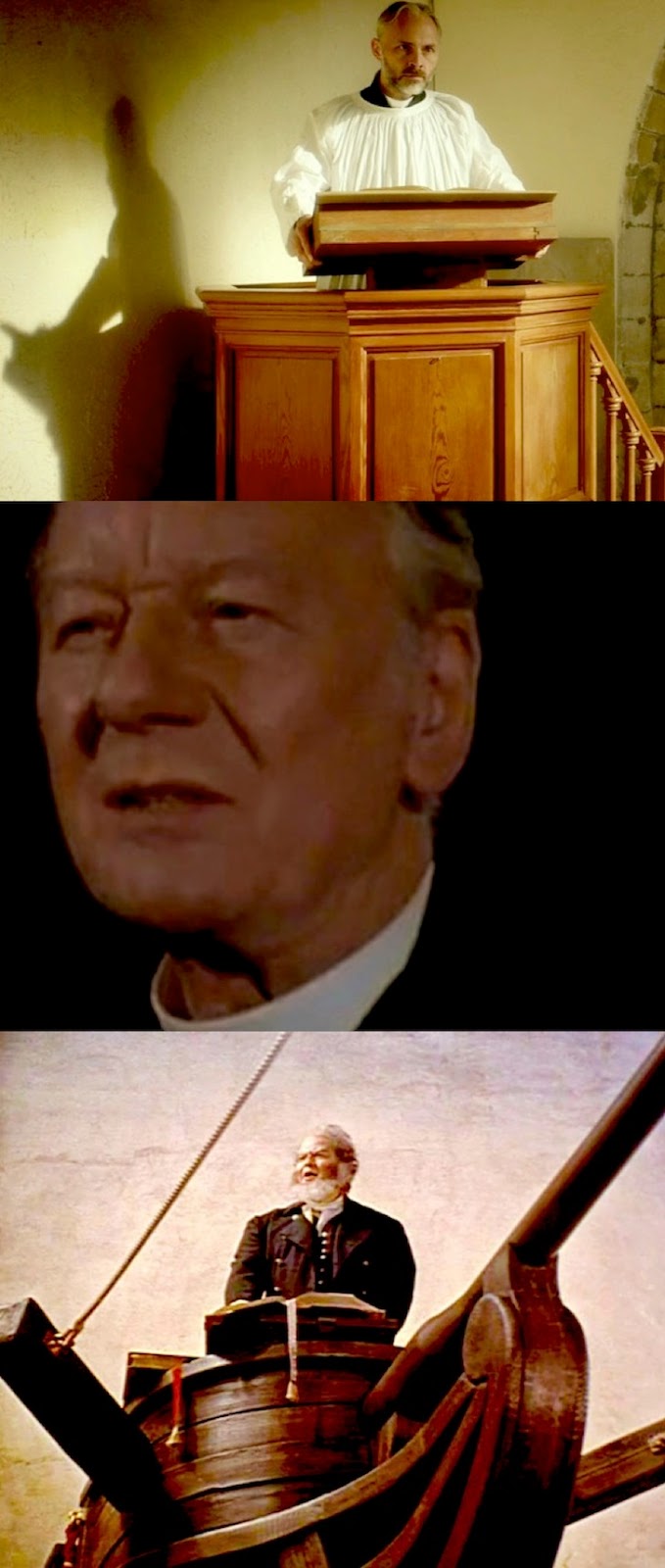
The light then shines upon the suitably creepy Reverend as if it's been cranked-up by God Himself. Taking its place amongst such hellfire and brimstone cinematic sermons like John Gielgud in Joseph Strick's 1977 film of James Joyce's A Portrait of the Artist as a Young Man and Orson Welles in John Huston's film of Herman Melville's Moby Dick, Davies is blessed with the casting of Mark Bonnar to have us (and the congregation), quaking with horror.


With his brogue pitched to hysteria and meanness, Bonnar's rendering of the sermon seems to be the very core of the film (even though the picture is essentially a grand coming of age story). It goes thusly:

"As you know, we are now at war with Germany. This NEW BABYLON has as many corruption as the old one. How long it will rage is what God in His wisdom will only know. But it's a chastisement by blood and fire that the nations must arise and prevail against this enemy. And Scotland, not the least of these, in its ancient health and humility to tread again the path of peace and courage that will ultimately lead to our victory.

Their King, which they also call Kaiser, is the Antichrist - a foul evil upon this Earth that must be swept away by the righteous.

Those who will not fight to defend their country, must be exposed for that they truly are.

Cowards. And pro-German cowards at that."

History proves that the needs of the state are always bolstered by organized religion. Worse yet, World War I notoriously sacrificed the youngest and largest number of men from Scotland, Ireland and the colonies (including Canada, Australia, etc.) to ensure victory. Whole swaths of generational promise were sacrificed in this dirty war fought between the "ruling classes".

God forbid Davies should ever be politically obvious in a didactic fashion, but in so far as he chooses his material and presents it, he still exposes as many terrible truths about humanity as only the best filmmakers/artists do. Sunset Song is a love story, a coming-of-age story, but most of all, it serves as one of the most heartbreaking and potent antiwar films of the new millennium.

And here's my guarantee, you will shed copious tears.

THE FILM CORNER RATING: ***** 5-Stars

Sunset Song Opens in Canada via Unobstructed View:
May 13: Toronto, Cineplex Cinemas Varsity and VIP (55 Bloor St. W)
Toronto Holdover, Magic Lantern Carlton Cinemas
May 27: Vancouver, Vancity Theatre (1181 Seymour St.)
May 28: Winnipeg, Cinematheque (100 Arthur St.)
June 3: Calgary, Globe Cinema (617 8 Ave SW)
June 3: Waterloo, Princess Twin (46 King St. N)
June 17: Montréal, Cinéma du Parc (3575, av. du Parc)
Cinéma Beaubien (2396, rue Beaubien Est)
June 17: Ottawa, ByTowne Cinema (325 Rideau St.)
June 17: Québec City, Cinéma Le Clap (2360, chemin Sainte-Foy)
June 17: Cobourg, The Loft Cinema (201 Division St.)

Wednesday, 27 April 2016

Retrospective Programming a Hallmark of the Toronto Jewish Film Festival (TJFF 2016) Review By Greg Klymkiw of Jean Renoir's LA GRANDE ILLUSION, featuring famed French-Jewish actor Dalio in the role of a nouveau riche Jewish P.O.W. Film available for more detailed scrutiny on the magnificent O.O.P. Criterion Collection DVD replete with extras.

Posters for La Grande Illusion and images of fellow German P.O.W. camp escapees Jean Gabin and Marcel Dalio.
Heritage Cinema, Retrospective Programming:
Important Hallmarks of the Extremely Vital
Toronto Jewish Film Festival (TJFF)

2016 Edition of TJFF Unravels Gems
Reflecting Jewish Themes, Talent and Culture
Greg Klymkiw reviews Jean Renoir's masterpiece:


Germans will be Germans.
Luckily, the French will always be the French.
La Grande Illusion (1937)
Dir. Jean Renoir
Scr. Renoir & Charles Spaak
Starring: Jean Gabin, Marcel Dalio, Erich Von Stroheim, Pierre Fresnay,
Dita Parlo, Julien Carette, Gaston Modot, Jean Dasté, Georges Péclet

Review By Greg Klymkiw

La Grande Illusion might be the best film about the Great War ever made. Such a proclamation doesn't come lightly since there are a fine handful of WWI pictures vying for this accolade. King Vidor's The Big Parade, Lewis Milestone's All Quiet On The Western Front, Frank Borzage's A Farewell To Arms, Edmund Goulding's The Dawn Patrol, Powell/Pressburger's The Life and Death of Colonel Blimp, Stanley Kubrick's Paths of Glory and Peter Weir's Gallipoli are all first-rate explorations of the bloodiest, meanest war of the 20th Century. All are replete with filmmaking artistry of the highest order and infused with the kind of emotional depth charges guaranteed to explode one's tear ducts into shards of salty droplets of emotion.

But no, Jean Renoir wins hands down from my perspective.

Well ahead of its time Renoir's masterpiece presents a positive antidote to Europe's rampant antisemitism with the character of Rosenthal (played by immortal French-Jewish actor Dalio), a nouveau riche Jewish P.O.W. who shares his family's care packages of food and drink with his fellow prisoners (no matter what their class, station or rank).

French POWs Amuse Themselves Amongst the Hun.
Furthermore, Renoir crafts a fascinating, often funny and richly moving portrait of a class system on its last legs. It's this very approach which, unlike other war films, is what makes it so brilliant and ahead of its time, but in many ways, makes it one of the most stirring anti-war films of cinema history. ("Class" is often touched upon in WWI pictures, but here, it is everything, and as such contributes to the picture's lasting value.)

The screenplay by Renoir and Charles Spaak, tells the story of a group of allied soldiers incarcerated in the German prisoner of war camps of World War I. This is not the typical reflection of concentration camps since WWI occurred during the waning days of aristocratic rule when even Germans exercised a certain degree of compassion and restraint in the treatment of its prisoners.

The film focuses primarily upon Lieutenant Maréchal (the always dashing French leading man Jean Gabin), a simple car mechanic in real life who is in the previously unthinkable position of an officer and a gentleman. In fact, it is Maréchal's basic, down-home pragmatism which allows him to be a leader within the prison system and most importantly, provides the inspiration to never give up the effort to seek escape so prisoners can rejoin their comrades in the fight against the Hun.

Death be not proud? Or is it?
Captain de Boeldieu (Pierre Fresnay) is, amongst the POWs, pure aristocracy, but he too, like the Jewish nouveau riche Rosenthal, knows that in war, his place is with his fellow prisoners. He is, however, allowed to have his cake and eat it too when Captain von Rauffenstein (the great Erich von Stroheim), the ultra-aristocratic commandant on the German side, welcomes him for fine spirits and lively conversation - a discourse which leads to both men equally lamenting, yet accepting the fact that this is the war in which the "ruling" class is on its way out.

Their friendship takes on some of the more moving and heartbreaking elements and events of the film.

Renoir presents both sides of the coin to the POWs' incarceration. The film shares a magnificent staged entertainment amongst the men, stirring escape planning and a rousing rendition of "La Marseillaise" which offers an equal dose of soul-stirring tears to the similar moment years later in Michael Curtiz's Casablanca.

German Prisons Do Not All Provide Fun and Games.
On the flip side, Renoir does not shy away from the brutality of the German captors (outside of von Rauffenstein's decidedly humanitarian approach to wartime prison administration), nor the horrific irony of outgoing French soldiers unable to give instructions to the incoming English-speaking prisoners of where the escape tunnel has been started due to language barriers and, in spite of the film's ahead-of-its-time portrait of a major Jewish character, Renoir also exposes the racism amongst the soldier-prisoners with respect to a Black prisoner who can ultimately only speak to himself, in hopes that someone might listen and converse with him.

As this is a prison picture, there is an escape, and it is here where Renoir outdoes himself in terms of both the suspense and the horrifying result of a character least likely to sacrifice himself as well as a character least-wanting to impart a death bullet. Get out thy handkerchiefs, folks. The death of class a la Renoir allows only for an aristocrat to welcome death at the hands of an aristocrat.

Running into yummy Dita Parlo on the run not a bad deal.
Renoir even provides deep romance (beyond that of men linked in common causes in war) and we're introduced to the lovely Dita Parlo (from Jean Vigo's L'Atalante) as a saviour and love interest. Renoir does allow for a certain sentimentality here ("sentimentality" NOT being a dirty word), but as is his wont, the master filmmaker yanks this happiness from all concerned (including us, the audience).

Finally, there is one of the great endings in film history - two men, one a mechanic, the other a Jew - both dotted together, dwarfed by the white snow of Switzerland and under threat of German bullets during their last mad dash.

Ultimately, this is a film in which escape can only mean a willing return to war, and for this, amongst so many astonishing elements, La Grande Illusion is one of the great anti-war films in cinema history.

It might even be the best.

THE FILM CORNER RATING: ***** (5-Stars)

La Grande Illusion is being screened at the Toronto Jewish Film Festival (TJFF 2016) in cooperation with the Alliance Francaise to complement the premiere of Mark Rappaport’s new documentary on French Jewish actor Marcel Dalio. The screening will feature guest speaker Professor Chris Faulkner, author of "The Social Cinema of Jean Renoir".

The out-of-print Criterion Collection DVD is still available for rent at special video stores (in Toronto that includes, Queen Video, Bay Street Video and Suspect Video). Most major cities still have video stores like these. This edition of the film can still be purchased new or used at Amazon.com by visiting this link HERE. Amazon offers premium pricing, but also very reasonable used pricing options. The Criterion edition includes: Newly restored digital transfer, created from the long-lost camera negative, a New and improved English subtitle translation, A rare theatrical trailer in which Jean Renoir discusses both Grand Illusion and his personal war experiences, an Audio essay by film historian Peter Cowie, an Archival radio presentation of Renoir and Erich von Stroheim accepting Grand Illusion’s Best Foreign Film honours at the 1938 New York Film Critics Awards, Press book excerpts, Renoir’s letter “to the projectionist,” cast bios, an essay on Renoir by von Stroheim, and essays about the film’s title and recently recovered camera negative, plus a very interesting Restoration demonstration.

Tuesday, 26 January 2016

Greg Klymkiw at The Film Corner Proclaims: HYENA ROAD on BLU-RAY/DVD not worth buying due to omission of Maddin short

Home entertainment release of
dreadful Paul Gross film sans the
only reason one would ever want to
buy it. Soon to be available in
$5.00 Walmart Bargain Bins!!!

Hyena Road (2015)
Blu-Ray/DVD Review By Greg Klymkiw

Though the Paul Gross Afghanistan War folly Hyena Road is a disgrace, its real problem is that it's just plain bad as opposed to being the unmitigated stinker Gross's WWI tiptoe through the trenches Passchendaele was. That film at least had a passel of unintentional howls. This one, is bereft of even those meagre pleasures. Though Hyena Road was a theatrical flop, the Elevation Pictures/Universal Pictures Home Entertainment Blu-Ray/DVD has even more reason to tank and quickly find its way to the WalMart $5 bargain bins.

The admittedly well-transferred Blu-Ray comes on a pathetically extras-light edition. In addition to the risible film itself, it is accompanied by a few lame "making-of" featurettes which bear the unmistakeable stench of EPK. I was actually excited that the home release would be accompanied by the actual "making-of" film that the producers commissioned, the astonishing Bring Me the Head of Tim Horton: The Making of Hyena Road by Guy Maddin, Evan Johnson and Galen Johnson.

Alas, the makers and distributors of Hyena Road have chosen to NOT include the only thing that would have made the home entertainment version worth buying.

Feel free to read my trashing of Hyena Road itself HERE, my rave review of Bring Me the Head of Tim Horton: The Making of Hyena Road HERE and my delightful reports on how the film flopped at the box-office HERE and HERE and HERE.

Even more reasons to NOT waste your money buying Hyena Road on home video.

Cineplex Entertainment Honcho Mike Kennedy extols virtues of floperoo HYENA ROAD!

Friday, 25 December 2015

SON OF SAUL - Review By Greg Klymkiw - Best Film of the Year & theNewMillennium


Son of Saul (2015)
Dir. László Nemes
Scr. László Nemes, Clara Royer
Starring: Géza Röhrig

Review By Greg Klymkiw

After seeing Son of Saul, I thought, well, there's not much reason to see anything else. It's a feeling that's certainly followed me throughout the myriad of pictures I've watched since, and even though some are very good, if not even exceptional, this extraordinary film by László Nemes is even suppressing films from my consciousness that I have seen before it - not just in the recent past, either. What Nemes accomplishes here as an artist is what we hope and pray great art will do.

I've only seen the picture once and I simply cannot shake its devastating effects. It has been seared upon my brain and weeks after seeing it, I keep playing the film over and over in my mind. The picture is beyond recollection, beyond reminiscence.

I feel that the act of seeing it is to finally experience a dramatic work, which is as close to bearing witness to events, emotions and experiences as any film I've ever seen. I feel that the act of seeing it is to finally experience a dramatic work, which is as close to bearing witness to events, emotions and experiences as any film I've ever seen. It's so grippingly real the sights and sounds feel like they're accompanied by a smell - pungent, horrific odours of death, filth, fire, rot and decay.

We know what occurred during the Holocaust, we know how insane and reprehensible genocide of any kind is, we know these things. We've seen Night and Fog, Shoah and Schindler's List, but I cannot think of any film which will ever do what Son of Saul has done.

Nemes places us in the very eye of this hurricane of devastation, this Hellfire on Earth, this 20th Century abomination which forces us to question how and why we continue to accept any hatred which is responsible for genocide.


Nemes and his co-writer Clara Royer spare nothing to plunge us directly into the madness of Auschwitz-Birkenau by the astonishing mise-en-scene of never leaving the face of Saul (Géza Röhrig), a Hungarian-Jew who works an "enviable" concentration camp job in the Sonderkommando. This group of prisoners are worked to the same levels of exhaustion as other inmates, but they are afforded a slightly loftier place in the pecking order of eventual extermination. They get slightly increased rations and slightly more "humane" work-shifts for herding their fellow Jews into the gas chambers.

The film begins with a group of prisoners forced to strip, then shoved into a shower room. Throughout the whole process, Nazi guards offer words of solace - placating the doomed prisoners with lies of a better life. Once locked into the shower room, Saul and his fellow Sonderkommando madly rifle through the clothing to extract all items of value as the screams of the nude prisoners pierce through the steel walls of the gas chamber.

Once the screams dissipate, Saul and the others drag the bodies ("the meat") out of the chamber, stack them, clean the chamber of all "filth" (urine and faecal matter expunged in both horror and death) and, of course, point out prisoners who are still alive.

These poor souls are shot or strangled. Some of them are selected by the "mad scientists" for autopsy in order to glean information as to how they survived.

It's here where Saul discovers a young boy who appears to be his son. He watches as the child is snuffed out and then tagged for autopsy. As if we, through Saul, have not already experienced a living nightmare, Nemes ramps things up even further.

The Nazis are attempting to beat the clock as the allies are ever-approaching and everything begins over again as new groups of victims are herded, stripped, gassed, piled like meat and transported to be burned.

Saul's goal is to keep up appearances, but to also obtain a proper Jewish burial for his son. The rest of the film is devoted to this, in addition to the ever-increasing pace of destruction.


The camera almost never leaves actor Géza Röhrig's face through any of this. It occasionally arcs around for us to get Saul's point of view, but these moments are fleeting and we can never escape his look of mad determination, whilst in the background, we see and hear the endless factory of death.

There is no musical score. If anything, the score is the soundscape of destruction - clangs, screams, gunshots.

Our senses are jangled, as actor Röhrig manages to keep the same face throughout, modifying it only slightly to move through the madness and achieve his goal. This might well be one of the greatest works any actor has done in any film.

The horror never lets up, but there is one sequence involving mass shootings and burnings as Saul fiercely attempts to achieve his goal, but to also convince some over-zealous Nazis that he is not to be shot and burned, that he is Sonderkommando. This sequence might well be the only time we will witness Hell on a movie screen - any movie screen. We are beyond jangled and pummelled here. The mise-en-scene forces us to experience Saul's elevated levels of horror.

The film continues to build to ever-intensifying crescendos of terror and Nemes inflicts a final cut to black that we don't see coming and winds us so painfully and horrendously that we physically feel the need to gasp for air.

This is a first feature for Nemes. One can't even imagine where he goes next as an artist, but with what he's created here, he has extraordinarily vaulted himself into the position of a Master.

There is, within the context of Saul's story, no hope, but the very act of experiencing it and bearing witness allows it anyway. No matter how devastated one is by the end, an overwhelming sense of hope swirls over us. We have experienced a work of art that we have had to experience. This is a film that defines the word "necessary".

Anything and everything we can do to urge others to see the film is our mission.

This is the hope.

The world needs to see this film and maybe, just maybe, there will be hope that the world can, because of this film, because of bearing witness, because of its mere existence, become a better place.

THE FILM CORNER RATING: ***** 5-Stars

Son of Saul is a Mongrel Films release and currently playing in Canada at the TIFF Bell Lightbox.

Friday, 11 December 2015

MACBETH - Review By Greg Klymkiw - Grand, blood-spewing adaptation of Shakespeare

This is NOT Ruprecht from
Bedtime Story/Dirty Rotten Scoundrels
It IS the THANE of CAWDOR!!!

Hail MACBETH!!!

Macbeth (2015)
Dir. Justin Kurzel
Starring: Michael Fassbender, Marion Cotillard, Paddy Considine,
David Thewlis, Sean Harris, Jack Reynor, Elizabeth Debicki,
Seylan Baxter, Lynn Kennedy, Kayla Fallon, Amber Rissmann

Review By Greg Klymkiw

Lots of war paint, but no mooning the enemy.

With "Macbeth", William Shakespeare delivered one rip-snorting bloodbath with his immortal tale of the ambitious Thane of Cawdor and his ascendancy to the throne of Scotland by butchering everyone/everything in his path. The play has more than ably been adapted into any number of kick-ass pictures - most notably, The Tragedy of Macbeth, Roman Polanski's astonishing and still unbeatable adaptation from 1971 (you can read my review/memoir HERE).

Justin Kurzel, who gave us the chilling Aussie 2011 true-crime shocker Snowtown (aka The Snowtown Murders), does not disappoint with his adaptation of Macbeth. Though it may lack Polanski's sophistication, genuine rage and grimy, gritty visuals, Kurzel handles the material admirably and it's surely an entertaining roller coaster ride through 15th century royal carnage and intrigue.

Kurzel and his three screenwriters Jacob Koskoff, Todd Louiso, and Michael Lesslie take a few liberties with the original text, but they're all quite engaging and surely won't bother eggheads too much. It's still the familiar tale of how the great warrior Macbeth (Michael Fassbender) valiantly overthrows the hordes and traitors attempting to take out King Duncan of Scotland (David Thewlis).

"Yes darling, I'm quite mad. Damn, killing is fun, though."

Filled with prophecies of kinghood from a gaggle of witches he meets after the battle (Seylan Baxter, Lynn Kennedy, Kayla Fallon, Amber Rissmann) and with his hottie wife Lady Macbeth (Marion Cotillard) egging him on, Macbeth slaughters Duncan, casts suspicion upon Duncan's son Malcolm (Jack Reynor) and eventually aims murderous eyes upon his pals Banquo (Paddy Considine) and MacDuff (Sean Harris) and, in fact their entire families. Macbeth goes increasingly bunyip with Fassbender raging about like Mad Ruprecht from Bedtime Story and its remake Dirty Rotten Scoundrels.

Blood gushes, spurts and flows with considerable abandon. Macbeth spares nobody. Alas, he ends up fucking over the wrong guy when he slaughters the wife and kids of MacDuff. Payback's on its way and then some. We, the audience, are the happy recipients of more carnage including the burning of Birnham Wood and one kick-ass mano a mano twixt MacBeth and MacDuff.

The entire cast scores big-time here, the picture looks gorgeous and Kurzel's direction is robust and intelligent. Most delightfully, the picture plays itself out like a thrilling big-studio action extravaganza, only with, uh poetry, eh. All that's missing here is a scene where MacBeth and his boys lift their kilts and moon the enemy. I doubt the Bard would have been spinning in his grave if they'd ripped off Braveheart a wee bit more than they do.

THE FILM CORNER RATING: **** 4-Stars

Macbeth is released in North America by The Weinstein Company and can be seen at TIFF Bell Lightbox in Toronto. Alas, its theatrical engagements won't last too long as the picture will be going to Amazon Instant Video too quickly. A pity, really. It's a genuine big-screen extravaganza.

Sunday, 27 September 2015

BREAKER MORANT - Review By Greg Klymkiw - Aussie Anti-War Favourite on Criterion

Bryan Brown and Edward Woodward await British "justice".

Breaker Morant (1980)
Dir. Bruce Beresford
Starring: Edward Woodward, Bryan Brown, Lewis Fitz-Gerald, Jack Thompson

Review By Greg Klymkiw
We'll do our best when crucified
To finish off in style, sir!
- "Butchered to Make a Dutchman's Holiday",
a poem written by Harry "Breaker" Morant just prior to his execution.
Stories about nations executing their own soldiers are pretty much guaranteed to generate climaxes inspiring sheer, unbridled emotion, often resulting in copious tears from an audience, or at the very least, producing more than a few a catches in more than a few throats. Feelings of mounting anger and frustration are also par for the course since the executions are always a result of politics, petty bureaucratic manoeuvring, colonialism and major league ass-covering.

The greatest of them all is, of course, Stanley Kubrick's 1957 Paths of Glory with Kirk Douglas attempting to save a group of innocent soldiers from execution at the hands of a cold-hearted martinet. Some of my other favourites include: the great, near-forgotten 1974 NBC Television Movie The Execution of Private Slovik, written by legendary scribes Richard Levinson and William Link, directed by Lamont Johnson and starring Martin Sheen in one of his greatest performances; the recent 2015/2016 release of the heartbreaking Terence Davies picture Sunset Song, about a shell shocked soldier wishing to leave the front to be with his wife; And though there is no literal execution in it, the fate facing a shy young sailor in Hal Ashby's The Last Detail might as well be a death sentence.

Then there is Bruce Beresford's Breaker Morant from 1980, one of the many films to lead the Australian charge of internationally acclaimed box office hits. (The film was an especially huge grosser Down Under and eventually had an excellent shelf life in North America after initially soft openings).

This finely wrought courtroom (court martial) drama details the true story of commanding officer Lt. Harry "Breaker" Morant (Edward Woodward) and two of his men, Peter Handcock (Bryan Brown) and George Witton (Lewis Fitz-Gerald), all standing trial for the murder of (supposed) civilians in the fields of battle during the Boer War. The narrative is recounted in flashbacks during the tribunal presided over by pole-up-the-ass British military martinets. Director Beresford ably commandeers his superb cast through a compelling recounting of their actions in the field.

In spite of the fact that they've been handed a lawyer skilled only in corporate law, Maj. J.F. Thomas (Jack Thompson) offers a brilliant defence, and though history tells us otherwise, we're expecting either a full acquittal or, at the very least, no firing squad death sentences. Thomas throws everything, including the kitchen sink at the martinets, ranging from the trial being illegal as the men are Australian, not British, the very real facts that the enemy during the Boer War waged guerrilla warfare (wherein anyone could be the enemy), plus the astonishing facts that orders were given to Morant and his men to spare nobody (including an order to avenge an Australian soldier tortured to death by the Boers).

A Good Defence Means Nothing When
Brits Have Decided to Nail Aussies to a CROSS!

There is no question that Morant and his men have committed the wholesale slaughter of "civilians", but these are clearly not civilians. This is war, and as such, the most horrible things occur. This is not the case of Nazi-style genocide - it is warfare under impossible circumstances - period.

We're with the men to the tragic end of the film and the clear villains are the colonial imperialist British military. Oddly, director Bruce Beresford expressed shock over interpretations such as these. In a 2012 interview with Peter Malone, he said:

"I read an article about it recently in the LA times and the writer said it's the story of these guys who were railroaded by the British. But that's not what it's about at all. . . I always get amazed when people say to me that this is a film about poor Australians who were framed by the Brits."

Reading this, my immediate response is to assume Beresford's gone completely insane. Now sure, that might not be the entire story, but how can one deny that the overriding attitude of the movie towards the British is clearly anti-Colonialist. In the film's final few minutes, we're even treated to some choice, heartbreaking melancholy and exquisite sentimentality. Perhaps anti-colonialism within the historical context of this story wasn't Beresford's intention after all, but if not, then I'd have to assume he brought an innate Australian attitude towards the British. In fairness to Beresford, he does offer the following in the same interview:

"[The film] analysed why men in this situation would behave as they had never behaved before in their lives. It's the pressures that are put to bear on people in war time… "

Yes, I'm willing to accept this. It's one of the powerful anti-war elements of the picture, but the defence provided within the context of the court martial itself, within the very narrative of the film, does offer food for thought along these lines, but finally we can only react emotionally to what we see and experience, and that is: the men were subjected to an unfair trial in spite of a persuasive defence and it's clear that all the tea-and-crumpet-ingesting Brits have their minds made up from the beginning.

I watched the film again after reading Beresford's comments. I was still angered by the Brits and still deeply moved by the plight of the accused men. This did not change. I concluded that Beresford flipped his lid. This was the same film I saw in 1980, then several times over the next 35 years. It's the same movie millions of people have seen and loved.

It's a stirring film and an important one. And yeah, it still has me shuddering and spewing tears when Morant, just before being executed screams out: "Shoot straight, you bastards! Don't make a mess of it!"

War is cruel and unfair, but one cannot deny that honour and bravery exist amongst those men so savagely treated by it and who, in turn, have reduced themselves to killing machines for king and country.

THE FILM CORNER RATING: **** 4-Stars

The Criterion Collection Blu-Ray/DVD edition of Breaker Morant is gorgeously transferred and includes a solid audio commentary featuring Bruce Beresford in 2004, new interviews with Beresford, cinematographer Donald McAlpine and actor Bryan Brown, an interview with actor Edward Woodward from 2004, a superb new short piece about the Boer War with historian Stephen Miller, an interesting 1974 documentary The Breaker, profiling the real Harry “Breaker” Morant, (with a 2010 statement by its director, Frank Shields), the theatrical trailer and an essay by scholar Neil Sinyard.

Order these films directly from the links below and contribute to the maintenance of the Film Corner

USA and the rest of the world: Amazon.com


Canada: Amazon.ca


U.K. Amazon.co.uk


Tuesday, 22 September 2015

BREAKER MORANT - Review By Greg Klymkiw - Aussie Anti-War Favourite on Criterion

Bryan Brown and Edward Woodward await British "justice".

Breaker Morant (1980)
Dir. Bruce Beresford
Starring: Edward Woodward, Bryan Brown, Lewis Fitz-Gerald, Jack Thompson

Review By Greg Klymkiw
We'll do our best when crucified
To finish off in style, sir!
- "Butchered to Make a Dutchman's Holiday",
a poem written by Harry "Breaker" Morant just prior to his execution.
Stories about nations executing their own soldiers are pretty much guaranteed to generate climaxes inspiring sheer, unbridled emotion, often resulting in copious tears from an audience, or at the very least, producing more than a few a catches in more than a few throats. Feelings of mounting anger and frustration are also par for the course since the executions are always a result of politics, petty bureaucratic manoeuvring, colonialism and major league ass-covering.

The greatest of them all is, of course, Stanley Kubrick's 1957 Paths of Glory with Kirk Douglas attempting to save a group of innocent soldiers from execution at the hands of a cold-hearted martinet. Some of my other favourites include: the great, near-forgotten 1974 NBC Television Movie The Execution of Private Slovik, written by legendary scribes Richard Levinson and William Link, directed by Lamont Johnson and starring Martin Sheen in one of his greatest performances; the recent 2015/2016 release of the heartbreaking Terence Davies picture Sunset Song, about a shell shocked soldier wishing to leave the front to be with his wife; And though there is no literal execution in it, the fate facing a shy young sailor in Hal Ashby's The Last Detail might as well be a death sentence.

Then there is Bruce Beresford's Breaker Morant from 1980, one of the many films to lead the Australian charge of internationally acclaimed box office hits. (The film was an especially huge grosser Down Under and eventually had an excellent shelf life in North America after initially soft openings).

This finely wrought courtroom (court martial) drama details the true story of commanding officer Lt. Harry "Breaker" Morant (Edward Woodward) and two of his men, Peter Handcock (Bryan Brown) and George Witton (Lewis Fitz-Gerald), all standing trial for the murder of (supposed) civilians in the fields of battle during the Boer War. The narrative is recounted in flashbacks during the tribunal presided over by pole-up-the-ass British military martinets. Director Beresford ably commandeers his superb cast through a compelling recounting of their actions in the field.

In spite of the fact that they've been handed a lawyer skilled only in corporate law, Maj. J.F. Thomas (Jack Thompson) offers a brilliant defence, and though history tells us otherwise, we're expecting either a full acquittal or, at the very least, no firing squad death sentences. Thomas throws everything, including the kitchen sink at the martinets, ranging from the trial being illegal as the men are Australian, not British, the very real facts that the enemy during the Boer War waged guerrilla warfare (wherein anyone could be the enemy), plus the astonishing facts that orders were given to Morant and his men to spare nobody (including an order to avenge an Australian soldier tortured to death by the Boers).

A Good Defence Means Nothing When
Brits Have Decided to Nail Aussies to a CROSS!

There is no question that Morant and his men have committed the wholesale slaughter of "civilians", but these are clearly not civilians. This is war, and as such, the most horrible things occur. This is not the case of Nazi-style genocide - it is warfare under impossible circumstances - period.

We're with the men to the tragic end of the film and the clear villains are the colonial imperialist British military. Oddly, director Bruce Beresford expressed shock over interpretations such as these. In a 2012 interview with Peter Malone, he said:

"I read an article about it recently in the LA times and the writer said it's the story of these guys who were railroaded by the British. But that's not what it's about at all. . . I always get amazed when people say to me that this is a film about poor Australians who were framed by the Brits."

Reading this, my immediate response is to assume Beresford's gone completely insane. Now sure, that might not be the entire story, but how can one deny that the overriding attitude of the movie towards the British is clearly anti-Colonialist. In the film's final few minutes, we're even treated to some choice, heartbreaking melancholy and exquisite sentimentality. Perhaps anti-colonialism within the historical context of this story wasn't Beresford's intention after all, but if not, then I'd have to assume he brought an innate Australian attitude towards the British. In fairness to Beresford, he does offer the following in the same interview:

"[The film] analysed why men in this situation would behave as they had never behaved before in their lives. It's the pressures that are put to bear on people in war time… "

Yes, I'm willing to accept this. It's one of the powerful anti-war elements of the picture, but the defence provided within the context of the court martial itself, within the very narrative of the film, does offer food for thought along these lines, but finally we can only react emotionally to what we see and experience, and that is: the men were subjected to an unfair trial in spite of a persuasive defence and it's clear that all the tea-and-crumpet-ingesting Brits have their minds made up from the beginning.

I watched the film again after reading Beresford's comments. I was still angered by the Brits and still deeply moved by the plight of the accused men. This did not change. I concluded that Beresford flipped his lid. This was the same film I saw in 1980, then several times over the next 35 years. It's the same movie millions of people have seen and loved.

It's a stirring film and an important one. And yeah, it still has me shuddering and spewing tears when Morant, just before being executed screams out: "Shoot straight, you bastards! Don't make a mess of it!"

War is cruel and unfair, but one cannot deny that honour and bravery exist amongst those men so savagely treated by it and who, in turn, have reduced themselves to killing machines for king and country.

THE FILM CORNER RATING: **** 4-Stars

The Criterion Collection Blu-Ray/DVD edition of Breaker Morant is gorgeously transferred and includes a solid audio commentary featuring Bruce Beresford in 2004, new interviews with Beresford, cinematographer Donald McAlpine and actor Bryan Brown, an interview with actor Edward Woodward from 2004, a superb new short piece about the Boer War with historian Stephen Miller, an interesting 1974 documentary The Breaker, profiling the real Harry “Breaker” Morant, (with a 2010 statement by its director, Frank Shields), the theatrical trailer and an essay by scholar Neil Sinyard.

Order these films directly from the links below and contribute to the maintenance of the Film Corner

USA and the rest of the world: Amazon.com


Canada: Amazon.ca


U.K. Amazon.co.uk