Showing posts with label Toshiro Mifune. Show all posts

Wednesday, 19 September 2012

THE SAMURAI TRILOGY Samurai III: Duel at Ganryu Island - Review By Greg Klymkiw - Criterion Collection

Samurai III: Duel at Ganryu Island is, without question, a corker of a conclusion to this stunning Samurai Trilogy.  Our hero accepts the love of a good woman, settles down to a peaceful agrarian life, but just as he thinks he's out, they pull him back in again. He not only assists a group of helpless villagers to battle a gangster warlord, but he agrees to one more duel with the young man who has been itching to fight him for many years and might be the only swordsman skilled enough to take down the incomparable Musashi Miyamoto - Samurai of the highest order.

Samurai III: Duel at Ganryu Island (1956) *****
dir. Hiroshi Inagaki
Starring: Toshiro Mifune, Koji Tsuruta

Review By Greg Klymkiw

Honour and chivalry of the highest order permeate this stunning final chapter in Hiroshi Inagaki's Samurai Trilogy. It is the weight of these noble characteristics that make this the most emotional, romantic and profoundly moving film in the entire series.

It is ultimately a tale of how one extraordinary individual (Musashi Miyamoto, of course) achieves and maintains inner peace in a profession that calls for him to kill.

It's not as nutty as it sounds.

In William Saroyan's Pulitzer-Prize-winning play The Time of Your Life from 1939, the great Armenian-American writer opens his groundbreaking work with a prayer-like manifesto which insists, mantra-like that all of us in our lives must strive to find goodness everywhere, to place more value in the spiritual than the material, to encourage virtue in every heart, to ignore the obvious, to be the inferior of no other and yet, to also be the superior of no other. And though Saroyan ultimately asks us to not add to the world's misery and sorrow, but to rejoice in its infinite wonder and mystery, he includes the following words of wisdom:
"Remember that every man is a variation of yourself. No man's guilt is not yours, nor is any man's innocence a thing apart. Despise evil and ungodliness, but not men of ungodliness or evil. These, understand. Have no shame in being kindly and gentle but if the time comes in the time of your life to kill, kill and have no regret."
These words were written on the precipice of World War II - when the world shuddered at the rise to power of Adolph Hitler and the madness sweeping Europe, Asia and the rest of the world. Saroyan, like many writers before and after him, realized that war and violent conflict are a natural element of human existence and that if it was necessary to take a life in the preservation of goodness, then so be it. "Necessary" is a key word here and though there is a great degree of sadness attributable to the taking of a life, Samurai III is a film insists that if a life must be taken, it should never come easily, never BE easy and should NEVER be forgotten.

We, the audience, must not forget the fact that the Samurai Trilogy, though set in the seventeenth century and as true to the period as any cinematic rendering could be, is a film born out of the ashes of Hiroshima and Nagasaki, in an occupied country that was decimated by a force WITHOUT honour. The post-war period of Japan rendered these three great films set in an earlier century and yet, are films that speak so loudly and profoundly on notions of war, peace and honour in ways that are universal.

The sentiments attached to the gravity of taking a life will, by the end of this extraordinary film and trilogy, infuse you with waves of emotion and leave you with considerable thought on matters of life, love and war. Like all great works, its virtues are not ephemeral, but eternal. So many of Japan's historians, playwrights, poets, novelists and filmmakers looked to the heroic exploits of Musashi Miyamoto and saw in him the same struggle that has plagued mankind from its beginnings and does so to this day.

The narrative flow of Samurai III is devoted to the pursuit of peace, but a peace that can only be attained when one has mastered the art of killing and, in so doing, has experienced what it is to personally snuff out a life - to REALLY know and understand the gravity of such an action. In order for Musashi to achieve and understand this pure state of harmonic conciliation is to find love, which he does. However, he must ACCEPT this love - which he also does. For him to know love and to bring it so deeply into his heart is what informs his need to maintain peace, but also informs his deep understanding of what it means to kill.

Once he accepts the love of Otsu, the good woman spurned in the first film by her betrothed and throughout the trilogy by Musashi himself, he is able to settle down and live a peaceful agrarian life - not just with Otsu, but with the young orphan boy who looks to him as both mentor and father.

Musashi has numerous opportunities to kill, but instead, he turns the other cheek and offers forgiveness, but when a group of helpless villagers are besieged by a ruthless gangster warlord - the time comes in the time of Musashi's life to kill and have no regret.


Saddest of all is that Sasaki is the one young man who is Musashi's equal on so many levels, a young man who could have been his son or his best friend or his brother. They both know and respect the fact that they are inextricably linked to fight to the death so that they may do each other the greatest honour. The duel is inevitable. Sasaki might be the only swordsman skilled enough to take down the incomparable Musashi Miyamoto and if he does, he will have taken down a true Samurai of the highest order. And when the final death blow comes, its aftermath is genuinely one of the most profoundly moving sequences in all of cinema.

Samurai III is a great film within a great trilogy. Astoundingly, Inagaki created a hugely popular work, but what's especially magnificent is just how each part of the trilogy can stand separately and yet how together they form an even more enriching whole.

Inagaki is a great classical director. His eye is always on nailing the salient dramatic beats, but doing so with grace and an almost John-Ford-like painterly artistry. The choreography of the duels and battle scenes are balanced perfectly with the superb work Inagaki does with the dramatic aspects of the tale. His elegant eye sits back with incomparably sumptuous compositions and the fights take place with a balletic quality. Some have suggested that the lack of sound when metal connects with flesh is attributable mostly to the techniques and fashions of sound design when the film was made. I think this is nonsense. One of the aspects of every violent death in the film is that when a death blow finally comes, it is not only deadly, but silent.

It's chilling and ultimately far more powerful that hearing the rending of flesh.

It's utterly silent.

Just like a Samurai's heart when it ceases to beat.

"Samurai III: Duel at Ganryu Island" is part three of the glorious Criterion Collection set of "Samurai Trilogy" Blu-rays and DVDs. The pictures have been digitally restored in eye-popping hi-def and happily, the sound is presented in wonderful uncompressed mono. In addition to the array of essays there's an especially interesting newly produced segment on the real Musashi Miyamoto."

Tuesday, 18 September 2012

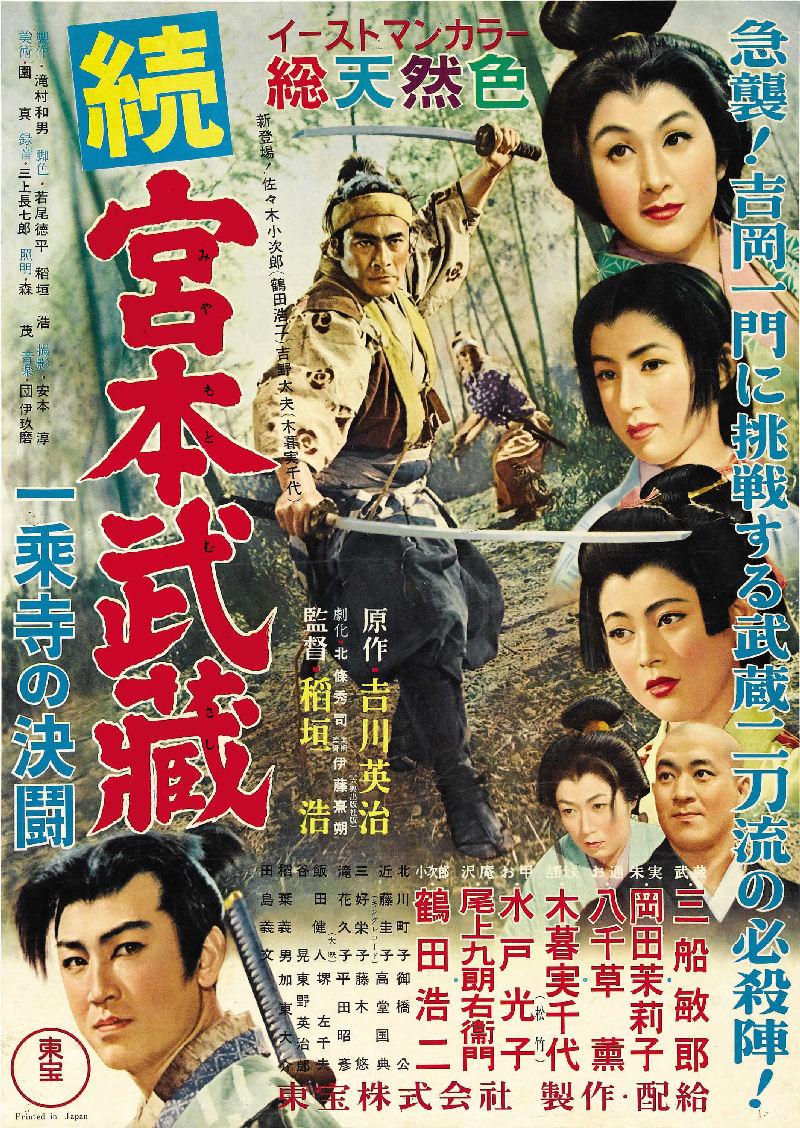
THE SAMURAI TRILOGY Samurai II: Duel at Ichijoji Temple - Review By Greg Klymkiw - Criterion Collection

Samurai I is a tough act to follow, but Samurai II: Duel at Ichijoji Temple delivers a thousand-fold.  When we last left Musachi Miyamoto, he'd become quite a skilled warrior and after some womanly dalliances, he declared his love to one very special lady, but in spite of this pulling at his heart strings, he decided to bugger off in search of his samurai mojo. This instalment features several spectacular duels, more romance, the return of Matahachi, our hero first meeting his ultimate nemesis and, if this isn't enough for you, he squares off against 80 - count 'em - 80 warriors. Will he survive? Well, as this is a trilogy, we certainly do hope so.

Samurai II: Duel at Ichijoji Temple (1955) *****

dir. Hiroshi Inagaki

Starring: Toshiro Mifune, Koji Tsuruta, Kaoru Yachigusa, Mariko Okada, Michiyo Kogure, Mitsuko Mito, Akihiko Hirata, Kenjin Iida Eijiro Tono

Review By Greg Klymkiw

Planned feature film trilogies tend to suffer most from sagging middles with sporadic touches so inspired that they still compel viewers to eagerly anticipate the final instalment (if they're good, that is - unlike say, a certain overrated Chriostopher Nolan trilogy). The most recent and salient example of the old faithful narrative sinkhole effect is the theatrical cut of Peter Jackson's Lord of the Rings: The Two Towers from 2002 (though not the extended home video version which proves that "longer" can actually quicken the pace of something).

The first part of Jackson's film trilogy of Tolkien's fantastical tall tale has the bonus of the origin story of the Ring's "Fellowship", whereas narratively, much time is spent in " The Two Towers with a lot of "to and fro" journeying that is only enlivened by a few astounding set-pieces. (And no, The Godfather Part II doesn't count as a middle because it really wasn't planned that way hence the genius of it and the disappointment generated by woeful, unnecessary Godfather III.)

Let us for a moment imagine Samurai I and III as beautiful thick-cut slices of Bagel World Caraway Seeded Rye Bread and Samurai II: Duel at Ichijoji Temple as nothing less than mouth-wateringly delectable Goldin's Montreal Smoked Meat - bursting with zesty peppercorn and pickling salt flavour and the scrumptious ooze of generously marbled beef fat (that you can get directly from the Goldin Boys in Toronto or dine exclusively upon at Free Times Cafe). While ace Japanese director Hiroshi Inagaki might have never imagined his masterpiece of cinema favourably likened to a Montreal Smoked Meat sandwich, I suspect that if he'd ever tasted one, he'd wholeheartedly agree. This movie is a corker of a samurai epic and still has the punch to thrill and delight audiences the world over.

Our tale begins with one of the best samurai duels in screen history (many of the others in this category are sprinkled throughout Inagaki's trilogy) Misashi (Toshiro Mifune) takes on the burly Baiken (Eijiro Tono), who in spite of his girth moves like Baryshnikov and uses a double weapon approach - wielding a deadly ball and chain (the ball, of course has sharp metal spikes) in one hand and a humungous scythe-like weapon in the other. Jitaro (Kenjin Iida), a little orphan boy looking for a mentor is ordered away by Misashi, but he stays to observe the final death thrust of the match, which, as per usual, ends with Misashi's victory.

Alas, this is not enough to vault our hero into the venerable tradition of the samurai. An old monk chastises him for being proficient, but lacking all the inner virtues a samurai needs. Dejectedly, Misashi continues on the road to enlightenment, now accompanied by the unwanted companion, Jitaro.


In Kyoto, the narrative spins itself out like the gorgeously woven web it is. Three- count'em - THREE gorgeous babes are vying for Musashi's love. His old friend Matahachi (Rentaro Mikuni) is now a sad-sack drunk married to the conniver he took off with in the first film. The conniver is trying to pimp her Musashi-obsessed daughter to the local samurai Master (who eventually rapes her anyway). Musashi, sets his sights on a duel with Seijuro (Akihiko Hirata) the aforementioned rapist and Master of Kyoto's leading Samurai school.


The school's administrative heads and pupils all act as buffers twixt their Master and Musashi. This is fine. It allows us the fortune of watching more duels. At one point even Seijuro's brother goes up against Musashi and is, of course, defeated.

Now Seijuro is shamed into fighting Musashi and demands no further interventions be made on his behalf. He asks the seemingly loyal, young swordsman Sasaki(Koji Tsuruta) to set the duel up. Sasaki, however, is a genuinely first-rate swordsman and he longs to duel Musashi himself. Even still, when Musashi is yet AGAIN attacked by Seijuro's men, Sasaki intervenes and the two warriors work together as a team to cut down the would-be assassins.

The plot thickens further with more duels, more betrayals and more romantic entanglements than you can shake a stick at - all building to a semi-climactic duel between Musashi and 80 men and eventually with Seijuro himself. Sasaki waits in the wings, studying and admiring Mishashi's skill. He knows they too will fight someday.

That someday awaits us in Samurai III: Duel at Ganryu Island. If Samurai I is the top slice of Bagel World Caraway Rye, swathed in delicious French's mustard, then Samurai III is the bottom slice of rye - the one that has soaked up all the natural, flavourful juices from the Goldin's Montreal Smoked Meat stuffing the middle of Samurai II.

"Samurai II: Duel at Ichijoji Temple" is part two of the glorious Criterion Collection set of Blu-rays and DVDs. The pictures have been digitally restored in eye-popping hi-def and happily, the sound is presented in wonderful uncompressed mono. In addition to the array of essays there's an especially interesting newly produced segment on the real Musashi Miyamoto."

Monday, 17 September 2012

THE SAMURAI TRILOGY Samurai I: Musashi Miyamoto Reviewed By Greg Klymkiw Criterion Collection Blu-Ray Box

Samurai I: Musashi Miyamoto is an Oscar-winning Samurai action epic by Hiroshi Inagaki that spawned two more films and such international success that it's oft been referred to as the Japanese Gone With The Wind.  

Samurai I: Musashi Miyamoto (1954) *****
dir. Hiroshi Inagaki
Starring: Toshiro Mifune, Rentaro Mikuni, Kaoru Yachigusa, Mariko Okada, Mitsuko Mito, Kuroemon Onoe

Review By Greg Klymkiw

Young men dream of going to war. I know I did. Then I read Stephen Crane's "The Red Badge of Courage" and Erich Maria Remarque's "All Quiet on the Western Front" and put that thought to rest mighty quick (in spite of my Sands of Iwo Jima John Wayne fetish).

Alas, the same cannot be said for young men living deep in the sleepy provinces of seventeenth-century Japan - especially not the devil-may-care orphan Takezo (Toshiro Mifune) who is perched up in a tree with his equally restless, though somewhat more rooted pal Matahachi (Rentaro Mikuni). They both gaze with equal dreams of glory upon their village and the picturesque countryside as a huge army assembles to go into battle.

Nothing is ultimately stopping the brash, Takezo, but Matahachi has ties that indeed bind him with his betrothal to the most desirable catch in their village - the kind, sexy and radiantly beautiful Otsu (Kaoru Yachigusa). Though he admits a ready willingness to join his lusty pal on the battlefield, it's Takezo who reminds his chum, with a mixture of benevolence and braggadocious bravado, that some men have commitments that must keep them behind. This, of course, inspires Matahachi to do the unthinkable and abandon all that is sacred. Takezo does what he was born to do, but Matahachi let's macho pride rule his decisions and a terrible price will eventually be paid for this.

So then begins Musashi Miyamoto, a tale of two friends who begin together on the same path, but eventually take separate forks in the road of life which results in a series of surprises in their respective love lives - none which either of them would have ever seen coming.

Mostly, though, the bulk of this stirring adventure charts the growth of the young, headstrong Takezo who bravely venerates himself on the fields of battle and develops into an extremely proficient, fame-hungry killer. Changing his identity to that of the title moniker Musashi Miyamoto, his modus operandi is to live as a masterless ronin warrior and indeed, to become respected as a full and true Samurai.

The road to the latter will prove more difficult - genuine Samurai must be imbued with the more noble qualities of honour and compassion - something our hero is decidedly bereft of.


Between battle scenes, duels, chases, narrow escapes and general derring-do, the picture is entertainingly peppered with several affairs of the heart involving three different babes - one virtuous, one not-so virtuous and another just plain villainous.

Musashi Miyato won an Oscar for Best Foreign Language Film and like its two sequels, the movie stands alone as great motion picture entertainment. When watched one after the other, these three classically structured and beautifully directed films comprise a genuinely sprawling epic. Musashi Miyato is bursting at the seams with first-rate melodrama, action scenes of unparalleled excitement and a deeply-felt rendering of a time, place and tradition now gone with the wind.


The proceedings are so passionately recreated by the elegant Inagaki that it's no surprise that this film and the entire Samurai Trilogy is oft-referred to as a Japanese Gone With The Wind. In terms of its scope, popularity, narrative drive and stratospheric levels of production value, the description is definitely on the mark.

"Musashi Miyamoto" is the first part of the glorious Criterion Collection set of Blu-rays and DVDs. The pictures have been digitally restored in eye-popping hi-def and happily, the sound is presented in wonderful uncompressed mono. In addition to the array of essays there's an especially interesting newly produced segment on the real Musashi Miyamoto."