Showing posts with label BDR. Show all posts

Saturday, 1 December 2012

UMBERTO D. - Review By Greg Klymkiw - The Criterion Collection Blu-Ray of Vittorio De Sica's heartbreaker is an absolute must-own. KLYMKIW CHRISTMAS GIFT IDEA 2012 #9


A mutt with intelligent eyes.

In this continuing series devoted to reviewing motion pictures ideal for this season of celebration and gift giving, here is KLYMKIW CHRISTMAS GIFT IDEA 2012 #9: The exquisite Criterion Collection Blu-Ray (or, if you must, DVD) of UMBERTO D., Vittorio De Sica's Neo-realist masterpiece about post-war loneliness and loss that faces a grumpy, financially-beleagured old man.

Umberto D. (1952) *****
dir. Vittorio De Sica
Starring: Carlo Battisti, Maria-Pia Casilio, Lina Gennari, Flike

Review By Greg Klymkiw

The old man Umberto (Carlo Battisti) must bid goodbye to the only thing he genuinely loves in the whole wide world, a tiny dog called Flike. He's so poor he must check himself into a hospital to treat a simple case of Tonsillitis. This allows him to get free meals for a few days so he can save enough money to avoid eviction.

Upon returning to his apartment he's well-rested and happily on the verge of clearing his debt to the horrid landlady (Lina Gennari) - one of the most despicable harridans in screen history. To his surprise, the room is not occupied by one of the many couples indulging in sordid extramarital bliss, courtesy of the landlady's entrepreneurial disrespect and abuse of Umberto's indebtedness to her by hiring the old man's bed out for boinking.

Instead, an invasion of busy tradesmen have rendered his usually neat and orderly digs topsy-turvy. In his absence the landlady feared he'd not return from the hospital and went ahead with preparing his room for new tenants.

The worst news of all is that his dog, his only true friend, his beloved Flike, is gone - carelessly let out into the streets by the landlady's friendly, warm-hearted maid (Maria-Pia Castillo) who is distracted by a three-month-old illegitimate child growing in her belly.

Umberto races to the municipal dog pound where he witnesses the stark reality of what happens to stray dogs like his sweet, little Flike. He witnesses the animals in cages, yelping for salvation. He sees the horrifying death chamber for dogs not claimed or whose owners cannot pay the fines to release them. He witnesses the sad faces of the poor, the downtrodden dregs of humanity, who, like Umberto, have been beaten down by poverty. Umberto is flush with rent money to rescue his Flike, if only his dog was there to be rescued. Others are not so lucky. They truly have nothing and can only shrug their shoulders in despair and resignation that without sufficient funds, their pets will not be saved from the deadly gas chamber.

In desperation, Umberto tries to describe Flike to the dog pound's cucumber-cool pencil pushing bureaucrat:

"He's a mutt, with intelligent eyes," Umberto gasps. "White, with brown spots."

It's an apt description - one to be expected from an intelligent man, though a man who's been discarded and forgotten by society. After a lifetime of service, of hard work, Umberto's been relegated to a strife-filled existence, receiving a measly pension that barely covers his rent.

Umberto's sad, desperate face and pleading eyes look for compassion, but most of all, seek the tiny dog he loves. For most, however, this is a cruel world, especially for those who are old and poor.

Post-war Italy during the late 1940s and early 1950s was director Vittorio De Sica's cinematic playing field. This is where he told tales of poverty, focussing upon the disenfranchised of society. The Bicycle Thief (AKA Bicycle Thieves), the immortal tale of a man searching for his only mode of trasnport and livelihood is De Sica's best remembered tale from this period. It's a great picture and so is Umberto D.

So many (mostly young) contemporary viewers (and even reviewers who should know better) have mistakenly attributed the sort of juvenile laziness permeating the mumble-core nonsense of recent times with the period of neorealism and what it represents. When they actually see the real thing, they're shocked, if not downright disappointed that neorealist movies have great, classically structured stories with performances (often by non-professional actors) that blow away many thespians of the pro variety and certainly the majority of losers who mumble their way through American indie pictures lauded by festival directors, pseuds and other supporters of self-indulgence.

Neorealism in Italy defined an entire generation of post-war filmmakers and created a style unique to its time and place and yet, in so doing, created work of lasting value. It also changed movies. Prior to this period, many films were studio bound, but the Italians, forced by budget and circumstance, shot on actual locations - something that did not take long to filter down to Hollywood.

The deeply moving screenplay by Cesare Zavattini would have worked beautifully if it had been made at an earlier juncture on the magnificent studio sets of Cinecitta with professional actors and all the lavish trappings of big budget Italian production from before World War II. Would it have been as good? Probably not. What roots Zavattini's finely wrought narrative and brilliantly etched characters is precisely how De Sica chose to make the film - in pure neorealist tradition. Real locations, real background extras and an utterly astounding performance by Carlo Battisti as the title character.

Battisti was NOT an actor. He was a linguist and university professor. Umberto D. was his first and last film as an actor - something that to this day seems utterly, almost unbelievably insane. He's got a great mug and his delivery (vocal and physical) is naturalistic in ways we expect from our greatest actors. (That said, the best university lecturers are brilliant performers and as such, can often make GREAT actors.)

The locations and background extras are all the real thing. The horrific aforementioned sequence at the dog pound is the real thing - a real pound, real dogs, real dog catchers, a real gas chamber, a real dog executioner, a real hose washing down the floors of butchery and most heartbreakingly, real people looking to claim their real animals.

During the film's opening, there's a stunning sequence where hundreds of old men protest the treatment seniors receive at the hands of an uncaring government. Again, the streets are real, the men are real and so are the police who disperse the crowds.

Then there is the reality of both character and narrative beats. Umberto's repeated attempts to sell his watch for money to pay his landlady are both sad and pathetic. We've seen this before (or even done it ourselves) in life. When Umberto meets a kind, friendly gentleman who could actually be his friend, we cringe when Umberto pulls out his watch and attempts to sell it.

Zavattini structures the film in a classic three-act mode of delivery. The actions driving each act are not mere plot devices, but seek to expose a sense of reality to Umberto's lot in life and in so doing, we're delivered a powerful series of beats that are recognizable to us as the sort of life trajectories that plague so many.

The three main actions of the story are separation, reunification and extrication. Within the context of an old man who essentially decides that suicide is his only way out of a cycle of misery, these actions are utterly devastating.

Love is what can save this man who lives a life without it. Unbeknownst to him, love is staring him in the face, but he sadly doesn't stare back - to see it, to recognize it, to feel it. Umberto is someone who always chose to live his life alone, dedicated to his work, but with dignity.

Alas, the world seems to become even harsher by the film's end and a life lived with grace and purity feels like a luxury.

De Sica takes us on the road of one man's life - a life that could belong to any one of us. Umberto's journey is harrowing, to be sure, but we're all the better for taking it with him.

"Umberto D." is available on the Criterion Collection as both Blu-Ray and DVD. The extra features are bounteous and the transfer is utter perfection. The added attraction is the superb 2001 documentary made for Italian TV entitled "That's Life: Vittorio De Sica".

Friday, 23 November 2012

ROSEMARY'S BABY - Review By Greg Klymkiw - CHRISTMAS GIFT IDEA FOR 2012 #1 - Criterion Collection Director Approved Blu-Ray & DVD

Abe Sapirstein Says:

"This Xmas, HAIL SATAN!

Give the gift that keeps on giving."

Here's your Greg Klymkiw Christmas Gift Suggestion #1 for 2012. Everyone you love will deserve this special treat to celebrate the birth of Jesus H. Christ, Our Lord. It's the magnificent Criterion Collection - Director Approved Blu-Ray (or, if you must, DVD) of Roman Polanski's masterpiece of utter horror, "Rosemary's Baby, brought to you with an all-new, restored digital transfer, that's been approved by director Roman Polanski, with (my favourite) an uncompressed monaural soundtrack. Add the following delectables: a new doc with interviews featuring Polanski, Mia Farrow and Robert Evans; an interview with the author of the bestselling novel the movie is based on, Ira Levin; "Komeda, Komeda", a feature-length doc on the life and work of Krzysztof Komeda, who wrote the chilling score for everyone's favourite cinematic buffet of Satan; A nifty booklet featuring an essay by Ed Park; Levin’s afterword to the 2003 New American Library edition of his novel; and Levin’s rare, unpublished character sketches of the Woodhouses and floor plan of their apartment, created in preparation for the novel.

Can it possibly get any better than this to commemorate Our Lord Baby Jesus being expunged from the virgin loins of Mother Mary? You bet it doesn't. This is the gift that keeps on giving, so give it with love to those you love.

Rosemary's Baby (1968) *****
dir. Roman Polanski
Starring: Mia Farrow, John Cassavetes, Ruth Gordon, Maurice Evans, Sidney Blackmer, Ralph Bellamy, Charles Grodin, Elisha Cook Jr.

Review By Greg Klymkiw

We've all had neighbours, friends, family and/or mere acquaintances who - no matter how well intentioned - just suck the life right out of you. Their ubiquitous presence and meddling (disguised as a helping hand) gets to a point where you just don't want to answer the door or telephone, or in this day and age, go online. In fact, you sometimes even contemplate killing these loathsome, hematophagous hirudinean parasites. And make no mistake, they come in all shapes, sizes and persuasions. Some of them might even worship - yup, you guessed it - Satan!

I must frankly admit I've always had a soft spot for devil worship.

In the movies, that is.

The cult aspect of devil worship is what's probably the most frightening. Val Lewton's The Seventh Victim is probably the first great horror movie to deal with the evil of cults and the insidious way they target their prospective members/victims, then suck them dry. Also great fun is The Devil Rides Out, that great Hammer Horror picture directed by Terence Fisher and starring Christopher Lee as the Satanist-battling hero and Charles Gray (the expert criminologist from The Rocky Horror Picture Show and Ernst Stavros Bloefeld, 007's nemesis in Diamonds Are Forever) as the perverse, evil devil worshipper who's into sacrificing any number of buxom beauties to his Lord and Master. And, of course, nobody in their right mind could ever forget Warren Oates and Peter Fonda in Jack Starret's brilliant and sadly unsung Race With The Devil wherein our heroes try to outrun Satanists in their (I kid you not!) Winnebago.

In the cinematic devil worship sweepstakes, nothing quite beats Roman Polanski's classic big-screen adaptation of Ira Levin's compulsive best-selling novel Rosemary's Baby. Produced by veteran horror director and producer William Castle, this movie was one of the biggest hits of the late 60s and has remained, for over forty years, one of the truly great horror thrillers of all time. A recent helping of the picture confirmed that it's still as terrific as it always was.


Opening under the strains of Krzysztof Komeda's score under ace cinematographer William Fraker's overhead shots of Manhattan, Rosemary's Baby immediately grips you with its off-kilter lullaby to a dead baby (as composed by Erik Satie in a REALLY foul mood) and featuring vocals more at home in an Oil of Olay commercial. The music plays over shots that make New York feel less like a bustling modern metropolis, but rather, some baroque, almost decrepit old world labyrinth of brick - adorned with turrets and rusting water towers.

The camera eventually settles above a gorgeous 19th century building and we soon focus our attention on a newlywed couple, Rosemary and Guy Woodhouse (Mia Farrow and John Cassavetes) who are about to be shown an apartment by the friendly, but slightly weasel-like caretaker (Elisha Cook Jr.). Of course Rosemary adores it, though Guy displays some trepidation over the rent - he's a struggling actor getting by on the occasional TV commercial and off-off-off-Broadway theatrical piece.

Soon they settle into their new home. A series of odd discoveries and strange noises are noted, but not fretted over too much. What there IS to fret about are their neighbours, a childless old couple, Minnie and Roman Castavet (Ruth Gordon and Sidney Blackmer). They seem friendly enough, but insinuate themselves immediately upon the couple - borrowing cups of sugar, endless dinner invitations, dropping by unannounced, recommending (rather insistently) all sorts of things that are really none of their business. Though it drives Rosemary bonkers, her hubby Guy is eating it up and spending all his free time with these batty old people.

A series of tragedies occur. A young woman jumps from the top of the building. Guy loses an important audition, but within days, he finds out that the actor who got the role instead of him has gone mysteriously blind. An old family friend (Maurice Evans) suffers a massive stroke.

Then Rosemary's dreams begin - nightmares, really. An especially horrific dream occurs when Guy purportedly has sex with her when she passes out.

And then she gets pregnant. All should be well. Guy has been offered the role he initially lost. His star begins to rise. The Castavets, with Guy's eager approval insist Rosemary switch doctors and send her to their old friend Abe Sapirstein (Ralph Bellamy), one of the most respected family doctors in the country.

Rosemary, however, is not happy. They've drifted away from every friend who was their contemporary. They are spending endless social evenings with the Castavets, Sapirstein and a whole bunch of old people. Worst of all, Rosemary is getting weaker and sicker with each passing day. Instead of gaining weight, she becomes anorexically skinny. The baby inside of her feels dead. Dr. Sapirstein keeps insisting nothing's wrong and she's forced to ingest a putrid herbal drink that Minnie Castavet prepares under the doctor's orders.

Oh, and then, there's the chanting. Every night. From the apartment of the Castavets.

Clues and research yield to the inevitability that everyone in Rosemary's life is a Satanist and that her baby is being groomed - not for life, but for sacrifice.

Or so Rosemary believes.

Sacrifice would be a blessing.

What's in store for her baby is a lot worse.

As Polanski has almost become the final word in thrillers infused with paranoia, Rosemary's Baby oozes creepy portent and when things get serious, the movie is unbearably scary. Polanski delivers a measured, slowly mounting sense of dread. When the terror shifts into fuel-injected overdrive, few thrillers can only hope to be even a fraction of this picture in terms of pure, unadulterated horror.

Every performance in this movie is a gem. Mia Farrow is suitably gamine and vulnerable, but where she really shines are those moments when WE know she's not crazy, but everyone (other than the Satanists) think she's completely bonkers. Cassavetes as her hubby, oozes slime - almost from the beginning, really. Where he really knocks the ball out of the park are those moments when he displays revulsion at the mere thought of having to touch his wife after she's pregnant. He's almost more frightening than the true evil all around her. Coming close to stealing the movie, however, is former golden age comedy star Ralph Bellamy as the kindly (on the surface) Abe Sapirstein. As the movie progresses, he seldom lets down his guise as the helpful family doctor - he plays it so straight that we begin to suspect he's deeply in cahoots with the Satanists. Some of his advice to Rosemary is so ludicrous in light of what WE see happening to her and what she herself feels, that he becomes the most malevolent of all the movie's antagonists. Bellamy's performance is so astonishing that it might be hard to trust any kindly old G.P. who's coming at you with a hypodermic.

(Oh, and as a sidenote: ABE SAPIRSTEIN!!! Is this not a GREAT character name? All the character names novelist Ira Levin conjured are brilliant, but "Abe Sapirstein" takes the cake big time!)

Rosemary's Baby is as close to perfection as any movie can come - every detail, every dramatic beat, every shudder-inducing moment and every knock-you-on-your-ass horror set piece is proof-positive of Polanski's genius. His work in Rosemary's Baby reminds me of that great speech Violet Venable gives in Tennessee Williams's "Suddenly Last Summer" when she describes her trip to the Encantadas and focuses on the "hatching of the great sea turtles and their race to the sea" and how the "flesh-eating birds ...hovered and swooped to attack" until finally, they turn over the newborn sea turtles in order to "attack their soft undersides, tearing their undersides open and rending and eating their flesh."

This is Polanski in a nutshell. He's the consummate filmmaker and as such, is a predator - rending and eating the flesh of his characters AND the audience.

In Rosemary's Baby, he takes the commonplace and slowly, creepily and nastily drags both his heroine and the audience through a bed of glowing hot coals. It's often the quiet that's so unsettling. When the quiet yields - ever so rarely, but effectively, to shrill, shrieking and almost unspeakable horror - you know, beyond a shadow of a doubt, that you're under the spell of a master.

Hail Cinema!

Hail Polanski!

Hail Satan!

Sunday, 7 October 2012

ROSETTA, a masterpiece by the Dardenne Brothers - Reviewed By Greg Klymkiw - Criterion Collection Blu-Ray and DVD

ROSETTA is the shattering portrait of a young girl who will go to any lengths to secure and keep her job in a world where the poor are disposable commodities. Thirteen years after its initial release, the film is as relevant to conditions that continue to plague the world today (and which seem to have no end in sight). It is, without question, a masterpiece, confirming the Dardenne Brothers as the leading cinematic voice of the disenfranchised.
Rosetta (1999) *****
dir. Luc Dardenne, Jean-Pierre Dardenne
Starring: Emilie Dequenne, Fabrizio Rongione, Anne Yernaux, Olivier Gourmet

Review By Greg Klymkiw
"Your name is Rosetta. My name is Rosetta. You found a job. I found a job. You've got a friend. I've got a friend. You have a normal life. I have a normal life. You won't fall in a rut. I won't fall in a rut. Good night. Good night." -- Rosetta (1999)
Rosetta (Emilie Dequenne) doesn't know the meaning of the word "privilege" and worst of all, if she's ever experienced love, it's not even a fleeting memory. It's been erased by years of poverty, abuse and neglect. She's 15-years-old, lives in a squalid trailer park with her slovenly alcoholic mother and holds down a job in a bakery to raise enough money to leave home and live her own life. She works herself to the bone for slave wages. Being underage allows her to be legally exploited by employers.

"Privilege" should, frankly, be a dirty word. Not much of consequence can really come from it and so often it leads to the exploitation and/or abandonment of those bereft of it. If "privilege" was part of her vocabulary, Rosetta would definitely foist it as a salty epithet.

She loses her job at the bakery - not because she isn't a good worker, but because her employer uses his prerogative to indulge in some nepotism to replace her.

She's back to square one. Her Mom is fed copious amounts of booze by the scumbag who runs the trailer park in exchange for sexual favours.

Things are definitely not looking up.

We are, of course, watching a movie by the Dardenne Brothers. And if the subject matter wasn't enough to tip us off, their unique verité approach to cinematic storytelling is the clincher.

The Brothers not only retain the effective point of view they employed in La Promesse, they up the ante bigtime. The camera is ALWAYS with Rosetta, but she's such a bundle of action and forward movement that we are, more often than not, following her (an approach Darren Aronofsky has successfully borrowed - most notably in his exquisite The Wrestler).

Not only is the camera following Rosetta, but very often, it (very intentionally) has a hard time keeping up with her. She's usually and literally a few steps ahead of us. Again and effectively, the Dardennes continue the technique of placing us within the central character's point of view that they so astonishingly handled in La Promesse.

Being just behind her adds tremendously to the realist conceit that allows us to discover the story with her. Curiously, when the camera catches up to her or is in close on the action, it's perched just above the shoulder near her head. It alternately establishes intimacy and urgency.

This consistency to the mise-en-scene is ideal in the telling of a very harrowing story. This is a child who is so desperate to work that she is capable of doing anything and everything to get and/or keep a job. Though one of her actions is borderline nasty, we always empathize with both her plight and actions.

For me, one of the fascinating choices the Dardenne Brothers made is in choosing the name Rosetta for our main character. It's primarily an Italian name given to women and translates as "beautiful rose".

There's no doubting the girl next door beauty of actress Emilie Dequenne (who plays the title character and also won the Best Actress Award at the Cannes Film Festival) and roses, in and of themselves are not only imbued with beauty, but most varieties have prickly stalks that protect them from being easily plucked. A number of varieties have such tight petals that it's virtually impossible to get at the rose hips - if, in fact, any actually exist.

And, of course, Rosetta is very closed off - both inscrutable and impenetrable. When she actually allows someone into her life, we're happy for her, but when she does something to remove this person from her life, we feel deflated (on one hand), but completely understanding (on the other).

Self-preservation does indeed drive her, but it's not the selfish variety displayed by Igor's father in the Dardennes' La Promesse. This is a child who seeks solace in both work and what work provides - a basic living, and one that is going to be sadly solitary, but at least on her own terms.

Rosetta is also another interesting choice for a name since it is a word used to describe a very specific orbit in space - one that seems so similar to how Rosetta moves as a character - especially when in peril or distress.

The Rosetta Orbit is when a particle revolves around the opening to a Black Hole - getting close, but never being completely sucked in. It's as if the orbit is responsible for near-suction and salvation. (If anyone had a Spirograph as a kid, the Rosetta orbit is similar to the sort of movement patterns created when a point in a circle revolves within another at a fixed point.)

When Rosetta is in distress she becomes extremely physical and never stops moving - so much like a Rosetta Orbit, it seems impossible to think this was not an intentional subtext on behalf of the Dardenne Brothers.

Finally, this is what makes the Dardennes so unique in contemporary cinema. Every move, every beat, every breath is infused with intent, but never, ever does it seem like they're overtly forcing the action. Rosetta is our way in and out of this extraordinary and quite perfect film.

It is, however, her indelible character who finally makes all the decisions and we discover them, whether we like them or not, when she does.

Rosetta is, like many of the disenfranchised of our world, ready to plunge into an abyss, but is saved by her clinging onto BASIC hopes and dreams - oscillating in a hypotrochoidal pattern with the Dardenne Brothers clinging to her with their lens. They observe her, almost macroscopically - as if her life, her state of being was a form of quantum mechanical existence.

Is the fate of Rosetta, and all those like her, to oscillate forever, just beyond a Black Hole? The humanity of the Dardenne Brothers and this tremendously moving film suggests otherwise. At least, that's what WE want it to suggest.

"Rosetta" is available in a brand new Director-Approved Special Edition Blu-Ray from the visionary Criterion Collection. It features a sumptuous restored high-def digital transfer that director of photography Alain Marcoen supervised, an interview between film critic Scott Foundas (who, not unlike the disc of "La Promesse", delivers his questions in a manner that feels too rarefied) and the directors Luc and Jean-Pierre Dardenne (who provide lengthy, informative and frankly, inspiring responses). There's also an interview with actors Emilie Dequenne and Olivier Gourmet, a trailer, a brand new English subtitle translation and an essay by film critic Kent Jones. This one's another Criterion Collection keeper.

Saturday, 6 October 2012

LA PROMESSE - Reviewed By Greg Klymkiw - The Criterion Collection Blu-Ray and DVD

The Dardenne Brothers exploded onto the scene with the moving realist drama "La Promesse", providing a kind of quiet revolution within the art of cinema. Their style has inspired many, but they're ultimately several notches above the best of the best with their unique brand of humanist storytelling.

La Promesse (1996) *****
dir. Luc Dardenne, Jean-Pierre Dardenne
Starring: Jérémie Renier, Olivier Gourmet, Assita Ouédraogo, Rasmane Ouédraogo

Review By Greg Klymkiw

To think of human behaviour in strictly genetic terms would completely ignore the notion of tabula rasa (a blank slate), wherein the primary influence upon mankind is not nature, but nurture. In La Promesse, the groundbreaking film by the Dardenne Brothers, we see nurture at work, but ultimately, it is nature which opens the door to redemption in this powerful story of a young man who allows that which resides within his very being to engage in a struggle with outside forces that seek to mould him into something he shouldn't be.

Igor (Jérémie Renier) is a young teen raised by Roger (Olivier Gourmet), a single Dad who has brought his son into a lucrative, though sleazy business. Igor is a smart kid and learns fast. He's an invaluable assistant to his Dad and takes to the job with a reasonable degree of zeal. That said, he picks and chooses when to be as zealous as his father.

At play, Roger seems like he's a pretty good Dad. He's got a good sense of humour and seems to love his son. At work - which sadly, is almost all the time, Roger is not unlike a monster. What shreds of humanity he might have ever had are stifled (if not completely eradicated) by a world that allows his innate sense of exploitation and just-plain-meanness to rise ever-so pervasively.

The style employed by the Dardenne Brothers allows us to feel, or at least hope, that this single father once had something resembling a soul. The directors do not shy away from the fact that it's a dirty, despicable world that provides certain "opportunities" to people like Roger. He clearly chose the wrong fork in the road to ply his talents rather than putting them to use in ways that could help the world. Alas, the business Roger has chosen to work in requires a thick enough skin to put self-preservation before any act of kindness. There's no difference, finally, between Roger and your standard variety corporate pig - save perhaps for attire and social standing. Both will never concede to any action that might result in chipping away at profit margins.

Though there are exceptions to the rule, they're extremely few and far between. At the end of the day, was there ever a time when a corporate lackey, whether a CEO, VP, Director, or a politician, whether a Mayor, Parliamentary Representative of the people or any Head of State, was anything more than a glorified version of gangsters, shysters and pimps?

For me, the eye of the Dardenne Brothers' camera almost allows for some kind of understanding of someone like Roger - a human being so low on the rung of scum-baggery that one wonders precisely what choices he really had (in direct contrast to the privilege of the more accepted scumbags in big business and politics).

"Almost", however is the key word here.

Igor, our prime vehicle into this tragic tale, is not only a good son but handles the duties his father expects of him with the sort of determination and acumen that's been drilled into him. On the surface, Igor looks to be a chip off the old block - a most worthy successor to Dad's nefarious enterprises. The worst thing Igor can do in the line of duty is display anything resembling a conscience.

When a moral sense rears its head, thrashings from Dad are sure to follow.

Right from the get-go, the Dardenne Brothers establish a superbly realized mise-en-scène. Our point of view is with Igor and the story unravels in such a way that we never know what's coming before he does. We're with him all the way. This allows us to always be with this character's inscrutable face and we experience his inner life through his actions. This, of course, is an extremely pure form of cinema - where action is the prime engine for the story and the ultimate manner in which it's told.

When the motherless Igor comes to observe the actions of Assita (Assita Ouédraogo), a beleagured illegal immigrant from Burkina Faso desperately searching for her missing husband, the observational style is truly heartbreaking. This 15-year-old boy who has never known, or has forgotten, the tender, nurturing touch of a mother, eventually eyes the actions of Assita with her baby.

It is ultimately the actions he witnesses (and those we witness from his perspective) that are the thing that inspire his true inner nature and reject the nurture of his father. It is also these maternal actions that I think are far more powerful persuaders than even his guilt over a horrendous action he's participated in with his father and a promise he's made much earlier to a dying man. They might be part of the equation, but the clincher is seeing what it's like for someone to provide love and care to a child and how, in turn, this affects the recipient of this tender nurturing.

Jérémie Renier's perfectly pitched performance blended with both the when and the how in which the Dardenne Brothers allow us to examine the face and actions of Igor are precisely what allow us to hope and/or intimate that he could, in fact, do the right thing. Most miraculous is that the screenplay is chock-full of conflicts for our central character to overcome, but that in the end, it is the inner moral conflicts that rise to the top - so extraordinarily and naturally that one realizes how damn difficult this must be to achieve and yet, how easily and fluidly these Dardenne guys make it seem. Their style is so original and consistent (while never feeling by rote) that one almost wishes every movie could be like this one (and their astounding work that followed).

That said, if every movie was like a Dardenne Brothers picture, we might, God Forbid (!!!) be salivating at the prospect of a new James Cameron, Garry Marshall or Christopher ("One Idea") Nolan movie.

Happily, we don't, we won't and we never will. At least not some of us, or as Col. Walter E. Kurtz says in Apocalypse Now, "That's my dream."

"La Promesse" is available in a brand new Director-Approved Special Edition Blu-Ray from the visionary Criterion Collection. It features a sumptuous restored high-def digital transfer that director of photography Alain Marcoen supervised, an interview between film critic Scott Foundas (whose manner of delivering a series of basic questions was a tad too precious for my tastes) and the directors Luc and Jean-Pierre Dardenne (who provide lengthy, informative and frankly, inspiring responses). There's also an interview with actors Jérémie Renier and Olivier Gourmet, a trailer, a brand new English subtitle translation and an essay by film critic Kent Jones. This one's a keeper. Run, do not walk to add this picture to your collection. In spite of seeing the picture many times before, I scoured this edition ravenously.

Thursday, 27 September 2012

Fritz Lang's SCARLET STREET with Edward G. Robinson - Reviewed By Greg Klymkiw - On Blu-Ray via Kino-Lorber

A timid cashier celebrates 25-rip-snorting-years of toil in a mens clothing store. Sauntering home to be with his harridan wife, he wonders what it would be like to have a young woman love him. He gets his wish. Sort of. A streetwalker cons him with expert assistance from her brutal pimp and lover. Can murder be far behind?

Scarlet Street *****
(1945) dir. Fritz Lang
Starring:
Edward G. Robinson,
Joan Bennett,
Dan Duryea

Review By Greg Klymkiw

"I've been waiting to laugh in your face ever since I met you. You're old and ugly and I'm sick of you. Sick! Sick! Sick!"
-Joan Bennett to Edward G. Robinson in Scarlet Street

If you've never felt - even once - that dreadful, sickening, soul-sucking feeling of digging yourself into a deeper hole, then good for you. You must obviously live a charmed life. Most of us know, however, when we're already in one of those holes and instead of clambering out while we still can, we shove our respective spades into God's good earth and just keep digging. Why do we do it? Especially when we know we're digging ourselves deeper than we can ever possibly hope to clamber out of? Well, sometimes one just hangs on to a wisp of hope that the thing you think you need is, like some buried treasure, just a few more feet below.

Once in awhile, a hand will thrust itself down and offer you a way out of the depths. Sometimes you'll take it but oft-times you won't. Even those who do accept the helping hand will, most of the time, do so with regret. They allow themselves to be hoisted up just long enough to grab a few fresh breaths, grab a bite to eat and maybe think about packing a box lunch and then dive back down into the open jaws of the hole.

When we first meet Christopher Cross (Edward G. Robinson) in Fritz Lang's Scarlet Street, we hear a boisterous, heartfelt group of men singing "For He's A Jolly Good Fellow" so loudly that their voices are spilling onto the wet, dark streets of New York. Once we're inside the brightly lit party room of a private gentleman's club, remnants of a sumptuous meal with liquor still flowing, the singing builds to a rousing climax of cheers. A meekly appreciative Chris, is clearly the recipient of this gleeful admiration. His boss delivers an extremely moving speech that extolls the virtues of honesty, loyalty and hard-work that Chris has displayed over the years as a cashier with the company - capping off the tribute by presenting his "old friend Chris" with a gorgeous gold watch encrusted with jewels.

It's when the boss departs early for the reason that one can "never keep a woman waiting", Chris looks out the window just as his employer exits the building and enters the awaiting limo below - its only other passenger being a stunning, young, platinum blonde.

Chris knows this is not the boss's wife and he wonders aloud: "I wonder what it's like to be loved by a young girl." Cue hole-digging just about here. Chris has picked up the spade and is eager to use it.

Later that evening, Chris walks the empty streets. He hears a scream. From a distance Chris sees a woman under a lamppost being slapped around by a man. Chris surprisingly bolts into action and rescues the beautiful young woman by beating the vile pig with his umbrella. The weasel scurries away, clutching the money he's robbed from the woman. Chris walks the young lady home and they stop for a drink in a basement dive. Anyone else would have realized that the sexy Kitty March (Joan Bennett) is a common streetwalker (and not a fashion model as she claims to be) and that the rat-faced thug who stole her money is not some random thief, but Johnny Prince (Dan Duryea), her pimp and lover.

That Chris is oblivious to this and swallows all her lies, exaggerations and vaguely disingenuous flirting is pretty much the beginning of the end. His spade plunges deep into the ground. The hole-digging begins in earnest.

It's also to actress Joan Bennet and director Fritz Lang's credit that we almost believe Kitty, too. She's packed tightly and curvaceously into her - ahem - Sunday go to meetin' time best and her straight, lush tresses that hang down to her shoulders, progressively unravel into schoolgirl-like curls and frame her soft, square face with a distinctively high forehead, pert nose, soulful eyes and ready-for-kissin-and-a-slurpin lips. Yup, she's Madonna and Whore, but discretely dolled-up like a teenage Catholic High School girl. Bennett's sultry voice and the dialogue (courtesy of the great screenwriter Dudley Nichols) veer from innocence to slutty, from genteel to crass and from surprising erudition to white trash street smarts. She's an incredible and indelible female character - a smart cookie in the wrong place at the wrong time and getting by as best she can in what is decidedly a man's world. Even more haunting is that there are more than enough hints that she's suffered a great deal of abuse over the short time she's been alive on this planet. She takes the foul Johnny Prince's beatings with a grain of salt since they're almost a small price to pay for his "support", companionship and first-rate cocksman-ship. In another instance, she only seems to be half-cracking a wiseacre when she describes her feelings about Chris, Edgar G. Robinson's staggering portrait of the jowly, hangdog white-knight-moneybags-meal-ticket in this way: "If he were mean or vicious or if he'd bawl me out or something, I'd like him better."

Robinson, of course, is great - an actor who's never delivered anything less than a brilliant performance throughout his long and distinguished career. In Scarlet Street, we're moved and repulsed by his character in equal measure. He toils away as a cashier at the high-end men's clothing store, surrounded by handsome, well-dressed colleagues who all seem content with their manhood and place in the world. Chris, on the other hand, goes home every night to his wife, a shrieking harridan who might best be described by quoting George about Martha in Albee's Who's Afraid of Virginia Woolf - she's neither a woman, nor much of a human being, but rather represents a kind of "slashing, braying residue that calls itself" his wife. Not that Chris is a prize catch. He admits to marrying her, almost in a whine, because he was afraid of being lonely. It's sad as all hell, but frankly, pretty damn pathetic. And God knows if Chris was even able to perform his husbandly duties in the boudoir when he admits with only the slightest hint of irony (so slight, it might not be ironic at all) that:

"I never saw a woman without any clothes."

Even more pathetic is that he's clearly a gifted artist, but creates his work in an atmosphere of his wife's verbal abuse and threats that she'll toss all his paintings in the trash. Granted his painting is the only escape he knows, but he thinks so little of his work that he doesn't even sign his paintings.

Worst of all, Chris displays inordinate stupidity and weakness when he allows himself to be duped by Kitty and Johnny. He not only keeps handing her scads of cash he's embezzling from his employer, but eventually allows her to take full credit for his artwork which eventually catches the eye of a prominent New York art dealer and visual arts critic. For all of this, he's getting no nookie and when he tries to hug or kiss her, she shrinks away in disgust.

One of the most complex, brilliant and emotionally wrenching scenes in movie history occurs when he realizes he's been duped and still professes his love for her. He begs her to marry him and Kitty's response is unbearably vicious. What's amazing about this moment is that we're moved by both characters (and performances). We're shocked and saddened by how mean she is to Chris, but at the same time, we sympathize with this young woman who's been dealt far too many bad hands in life and is surviving in way that stems directly from her social situation. Looking at the deep hurt in Chris's eyes is also profoundly moving, but we also want to slap that pathetic, jowly face of his and demand that he "man-up".

Scarlet Street is an American remake of Jean Renoir's equally wonderfully picture La Chienne, but for me, the main difference is that Lang's film descends even deeper than Renoir's into a pit of the most foul, ugly human behaviour. And even though it does, the film is infused with a high degree of humanity.

From dramatic beat to dramatic beat, Scarlett Street moves lower and lower on the rung of humanity's ladder. Just when you think the picture has reached the lowest depths, it plummets even deeper. As such, the film is both courageously relentless and astoundingly ahead of its time.

Recent Friedkin and Ulrich Seidl excepted, Fritz Lang - in 1945!!! - managed to pull off a picture that seems more fresh and vital than most anything made today. Scarlet Street feels like it could have been made just yesterday.

After many years languishing in the public domain, the movie has been digitally restored from materials on deposit at the Library of Congress and brought to Blu-Ray via Kino Lorber. The Bluray features a stills gallery and an audio commentary by David Kalat.


Monday, 24 September 2012

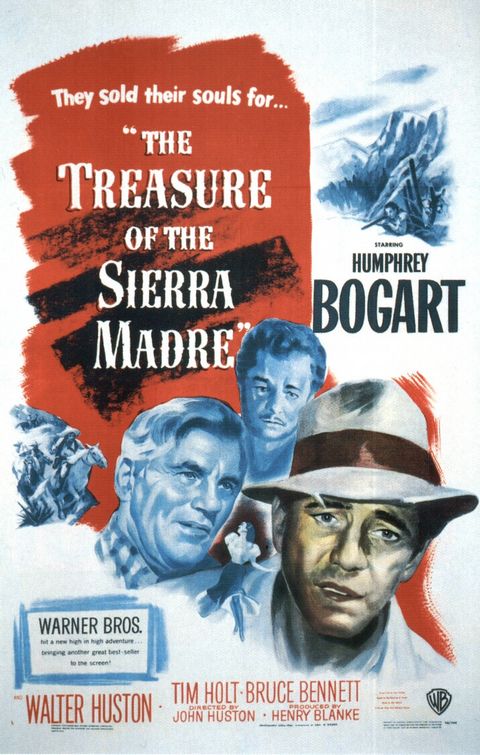
John Huston's "THE TREASURE OF THE SIERRA MADRE" - Review By Greg Klymkiw


Life's given Fred C. Dobbs (Humphrey Bogart) more than his fair share of hard knocks, but he’s not going to accept a fair share of anything, anymore. John Huston's great picture of B. Traven's book, "The Treasure of the Sierra Madre" gets better with every viewing.


The Treasure
of the Sierra Madre


(1948) dir. John Huston *****

Starring:
Humphrey Bogart,
Walter Huston, Tim Holt,
Bruce Bennett, Alfonso Bedoya,
Barton MacLane, Robert Blake
and John Huston

Review By Greg Klymkiw

"The creative person should have no other biography than his works." - B. Traven


I have always believed that the best movies are made by filmmakers – more often than not – who infuse their work with a combination of life experience, style and craft. While good, if not great movies can be made with one or two of the aforementioned elements, the stuff that stays with you and, in fact, lives well beyond the mere ephemeral is endowed with all three.

When great lives yield great works of literature, the next logical step is for great filmmakers to fashion great movies based on said works. It doesn't always pan out, but some filmmakers have a golden touch with screen adaptations.

John Huston lived a great life and made his fair share of great movies. The notion of great lives translating into great art was something he probably believed in more passionately and abundantly than most other American filmmakers. In fact, he held onto this belief until his final breath.

John Huston's life was bursting with the sort of adventure most of us only dream of. In addition to working as a screenwriter, playwright, actor and film/theatre director, Huston enjoyed a life that included light-middleweight boxing, journalism and, remarkably, a stint as a soldier in the Mexican cavalry.

As a film director, Huston often used a film’s production as an excuse to engage in exploits of the grandest variety. Peter Viertel, the un-credited scenarist of The African Queen wrote the terrific fact-based novel (later made by Clint Eastwood as the movie White Hunter Black Heart) which detailed Huston’s insistence upon shooting on location in the Congo, just so he could participate in an elephant safari.

With an enlarged heart and kidney disease in his early life and suffering from an aneurysm in later years, Huston never let these ailments stop him. He even steadfastly fought a battle with emphysema to keep alive in his last weeks on Earth to render one of his greatest films, The Dead, based upon James Joyce's exquisite story from the book "Dubliners.”

The Treasure of the Sierra Madre, Huston’s classic film from 1948 is based on the magnificent novel by the mysterious B. Traven. Without question, one the great movies of all time, it owes much to its source material.

Traven, unlike the very public Huston, lived his life in almost complete anonymity, writing primarily about the "working man", the downtrodden and, in general, the disenfranchised. His books, often of the two-fisted variety, are endowed with observations on human behaviour that are so brimming with the stuff of life, that it is, in spite of the aforementioned quotation, a bit of a shame that the author chose a life free of the public scrutiny that most other writers chose and/or endured.

Other than a few pungent quotations, Traven did not leave a body of observations, ideas and thoughts beyond his work. Granted, the work spoke volumes, but Traven was, no doubt, an incredible human being who lived the sort of high adventure life that someone like Ernest Hemingway experienced. What little is known about Traven ultimately suggests that his work is, at the very least, semi-autobiographical.

Few credible sources can claim to have known Traven – not even his publishers had ever met him face-to-face. That said, it is highly conceivable that Huston and Traven, who engaged primarily through correspondence, did actually meet. Traven was scheduled to visit the set, but in his place, sent a mysterious figure with written authorization from Traven that this individual had power-of-attorney to represent Traven’s interests. He then proceeded to spend a good deal of time on location.

It’s widely believed this man was, indeed, Traven himself. If he privately revealed himself to Huston, the great director never betrayed this confidence. Huston, given the sort of stories he loved to tell as a filmmaker believed in the fellowship of men, and in particular, honour above all.

The Treasure of the Sierra Madre is one of the great motion pictures about greed and as such, honour does indeed play a huge role in the proceedings.

Set in a small Mexican town during the mid 1920s, we’re introduced to Fred C. Dobbs (Humphrey Bogart), an itinerant down-on-his-luck labourer who is living off handouts, and in particular, more than one spare piece of change from a wealthy fellow American (played by a dapper and un-credited John Huston himself). When Dobbs encounters an amiable oilman and fellow countryman Barton MacLane (Pat McCormick), he and Curtin (Tim Holt), another downtrodden American, are hired as labourers on an oil-drilling rig.

After the backbreaking work, MacLane disappears and the two men are still penniless. Spending the night in a flophouse, they make the acquaintance of Howard (John Huston’s father Walter in his great Oscar-winning performance), a crusty, old prospector who fills the men’s heads with talk of gold - how with a modest stake and considerable elbow grease, a fortune can be found. Howard also declares that few people - especially honest working stiffs - can ever hope to keep their fortune since gold fever, once it sets in deeply, can instil both greed and insanity in even the best of men.

Though the tale has been plenty compelling to this point, it’s here that things get really interesting. One of the amazing things about the film is how our central protagonist quickly becomes an anti-hero and by a certain point, Fred C Dobbs becomes one of the most miserable, petty and reprehensible leading characters in film history. It takes a star of the highest order; one who is as great an actor as Humphrey Bogart to pull this off. (A recent example of this is Daniel Day Lewis in P. T. Anderson’s There Will Be Blood.)

Dobbs insists he’d never fall prey to such greed. Having recently scored a local numbers-racket lottery (he's sold a ticket by a grubby little boy played by future wife-killer Robert Blake), he even offers to add stake money to a gold prospecting expedition without recompense. It is, however, a steely obsessive look in Bogey’s eyes that betray his proclamations of generosity and goodwill. Even at this early stage we’re convinced that the contradiction of these assertions seem likely.

This, of course, is what makes the picture a fine example of storytelling. We’re sure from the outset that our hero will fall prey to greed, yet we’re rooting for him NOT to. And even when the worst happens and our hopes become so much dust in the wind, we're still hanging on to whatever wisp of the character's humanity that clings to him - praying that Bogey's going to turn around, but knowing all the while it's never going to happen. When Dobbs crosses an unmentionable line of foul behaviour much later in the film, he can only go down further than Hell itself.

Bogart is so great in this picture. He infuses the role with such personality – the tough, downtrodden workingman who just wants to score a fair buck for his labours that we’re also pulling for him.

After the night in the flophouse, Dobbs spies his erstwhile boss Barton MacLane. He demands his pay and when it’s clear he won’t get it, he beats the unscrupulous exploiter to a pulp (the brutality of this is still shocking). That said, when he retrieves the wad of cash from the unconscious profiteer, he takes only the amount owed to himself and Curtin and when he offers the bar owner recompense for damages, he takes it out of his share of the dough.

The actions after he beats Barton don’t seem like the actions of someone who will turn gold crazy against his partners - men who become the closest thing he has to friends. Again though, it is a combination of storytelling brilliance and Bogart’s extraordinary performance that leads us to believe that all will not be right. Bogart infuses the beating with such cool, nasty precision that he’s clearly not a simple working stiff with a clearly defined moral code – he’s a mean, two-fisted bastard. When push comes to shove, he doesn't just shove back, he'll cold-cock his opponent across the face with a two-by-four.

Yes, life’s given Dobbs more than his fair share of hard knocks, but he’s not going to accept a fair share of anything.


From here on in, working from his screenplay adaptation of Traven’s novel, Huston ups the ante. The following ensues with all the power and excitement one wants from such a tale;

- A thrilling gun battle from the train between our three prospectors and a group of bloodthirsty Mexican bandits (led by the grinning psychotically amiable Gold Hat and brilliantly played by Alfonso Bedaya),

- An arduous journey,

- The painstaking building of a mine,

- The retrieval of a fortune in gold dust,

- The growing paranoia and mistrust amongst the partners (especially the increasingly crazed Dobbs),

- The appearance of an interloper wanting a cut of the mine,

- The contemplation of cold-blooded murder (not once, but twice).

- Another thrilling gun battle with Gold Hat and his bandits,

- More paranoia,

- More violence,

- And last, but not least one of the greatest surprise endings in movie history and, for good measure – peace, hope and redemption - though not for one and all.

Treasure of the Sierra Madre simply cannot be beat as pure motion entertainment with heart, soul and a cornucopia of food for thought. Few American films deserve to share breathing space with it.

The picture is so great, I'm compelled to wonder: Where are our John Hustons, B. Travens and Humphrey Bogarts? Will we again see a time when our film artists will live great lives, write great stories and mount them for all eternity on the silver screen? Sure, there are a few out there still living, but they’re getting old. Who will take their places? Who will dazzle us with movies that will live for all time - movies that are the stuff of their own great lives?

"Treasure of the Sierra Madre" is available on Blu-Ray from Warner Home Entertainment. It’s jam packed with a whole mess of terrific extras. Oddly, while I cannot fault the pristine transfer to HD, I was occasionally disconcerted by a look that seemed untrue to the spirit of the picture. I find this happening more and with Blu-Ray and old classics. The transfers are great, but the fact remains that film negative was never designed for such close scrutiny and transfer – it was meant to stay as celluloid, be projected through light and thrown onto a huge screen. On occasion, a transfer manages (often by mistake and/or laziness and/or cheapness) to be more "cinematic". It’s not often enough, frankly, but if Blu-Ray transfers of classics in any form gets new generations thrilling to the material, I suppose that’s enough and the rest of us aging movie geeks can just shut up.


Wednesday, 19 September 2012

THE SAMURAI TRILOGY Samurai III: Duel at Ganryu Island - Review By Greg Klymkiw - Criterion Collection

Samurai III: Duel at Ganryu Island is, without question, a corker of a conclusion to this stunning Samurai Trilogy.  Our hero accepts the love of a good woman, settles down to a peaceful agrarian life, but just as he thinks he's out, they pull him back in again. He not only assists a group of helpless villagers to battle a gangster warlord, but he agrees to one more duel with the young man who has been itching to fight him for many years and might be the only swordsman skilled enough to take down the incomparable Musashi Miyamoto - Samurai of the highest order.

Samurai III: Duel at Ganryu Island (1956) *****
dir. Hiroshi Inagaki
Starring: Toshiro Mifune, Koji Tsuruta

Review By Greg Klymkiw

Honour and chivalry of the highest order permeate this stunning final chapter in Hiroshi Inagaki's Samurai Trilogy. It is the weight of these noble characteristics that make this the most emotional, romantic and profoundly moving film in the entire series.

It is ultimately a tale of how one extraordinary individual (Musashi Miyamoto, of course) achieves and maintains inner peace in a profession that calls for him to kill.

It's not as nutty as it sounds.

In William Saroyan's Pulitzer-Prize-winning play The Time of Your Life from 1939, the great Armenian-American writer opens his groundbreaking work with a prayer-like manifesto which insists, mantra-like that all of us in our lives must strive to find goodness everywhere, to place more value in the spiritual than the material, to encourage virtue in every heart, to ignore the obvious, to be the inferior of no other and yet, to also be the superior of no other. And though Saroyan ultimately asks us to not add to the world's misery and sorrow, but to rejoice in its infinite wonder and mystery, he includes the following words of wisdom:
"Remember that every man is a variation of yourself. No man's guilt is not yours, nor is any man's innocence a thing apart. Despise evil and ungodliness, but not men of ungodliness or evil. These, understand. Have no shame in being kindly and gentle but if the time comes in the time of your life to kill, kill and have no regret."
These words were written on the precipice of World War II - when the world shuddered at the rise to power of Adolph Hitler and the madness sweeping Europe, Asia and the rest of the world. Saroyan, like many writers before and after him, realized that war and violent conflict are a natural element of human existence and that if it was necessary to take a life in the preservation of goodness, then so be it. "Necessary" is a key word here and though there is a great degree of sadness attributable to the taking of a life, Samurai III is a film insists that if a life must be taken, it should never come easily, never BE easy and should NEVER be forgotten.

We, the audience, must not forget the fact that the Samurai Trilogy, though set in the seventeenth century and as true to the period as any cinematic rendering could be, is a film born out of the ashes of Hiroshima and Nagasaki, in an occupied country that was decimated by a force WITHOUT honour. The post-war period of Japan rendered these three great films set in an earlier century and yet, are films that speak so loudly and profoundly on notions of war, peace and honour in ways that are universal.

The sentiments attached to the gravity of taking a life will, by the end of this extraordinary film and trilogy, infuse you with waves of emotion and leave you with considerable thought on matters of life, love and war. Like all great works, its virtues are not ephemeral, but eternal. So many of Japan's historians, playwrights, poets, novelists and filmmakers looked to the heroic exploits of Musashi Miyamoto and saw in him the same struggle that has plagued mankind from its beginnings and does so to this day.

The narrative flow of Samurai III is devoted to the pursuit of peace, but a peace that can only be attained when one has mastered the art of killing and, in so doing, has experienced what it is to personally snuff out a life - to REALLY know and understand the gravity of such an action. In order for Musashi to achieve and understand this pure state of harmonic conciliation is to find love, which he does. However, he must ACCEPT this love - which he also does. For him to know love and to bring it so deeply into his heart is what informs his need to maintain peace, but also informs his deep understanding of what it means to kill.

Once he accepts the love of Otsu, the good woman spurned in the first film by her betrothed and throughout the trilogy by Musashi himself, he is able to settle down and live a peaceful agrarian life - not just with Otsu, but with the young orphan boy who looks to him as both mentor and father.

Musashi has numerous opportunities to kill, but instead, he turns the other cheek and offers forgiveness, but when a group of helpless villagers are besieged by a ruthless gangster warlord - the time comes in the time of Musashi's life to kill and have no regret.


Saddest of all is that Sasaki is the one young man who is Musashi's equal on so many levels, a young man who could have been his son or his best friend or his brother. They both know and respect the fact that they are inextricably linked to fight to the death so that they may do each other the greatest honour. The duel is inevitable. Sasaki might be the only swordsman skilled enough to take down the incomparable Musashi Miyamoto and if he does, he will have taken down a true Samurai of the highest order. And when the final death blow comes, its aftermath is genuinely one of the most profoundly moving sequences in all of cinema.

Samurai III is a great film within a great trilogy. Astoundingly, Inagaki created a hugely popular work, but what's especially magnificent is just how each part of the trilogy can stand separately and yet how together they form an even more enriching whole.

Inagaki is a great classical director. His eye is always on nailing the salient dramatic beats, but doing so with grace and an almost John-Ford-like painterly artistry. The choreography of the duels and battle scenes are balanced perfectly with the superb work Inagaki does with the dramatic aspects of the tale. His elegant eye sits back with incomparably sumptuous compositions and the fights take place with a balletic quality. Some have suggested that the lack of sound when metal connects with flesh is attributable mostly to the techniques and fashions of sound design when the film was made. I think this is nonsense. One of the aspects of every violent death in the film is that when a death blow finally comes, it is not only deadly, but silent.

It's chilling and ultimately far more powerful that hearing the rending of flesh.

It's utterly silent.

Just like a Samurai's heart when it ceases to beat.

"Samurai III: Duel at Ganryu Island" is part three of the glorious Criterion Collection set of "Samurai Trilogy" Blu-rays and DVDs. The pictures have been digitally restored in eye-popping hi-def and happily, the sound is presented in wonderful uncompressed mono. In addition to the array of essays there's an especially interesting newly produced segment on the real Musashi Miyamoto."

Tuesday, 18 September 2012

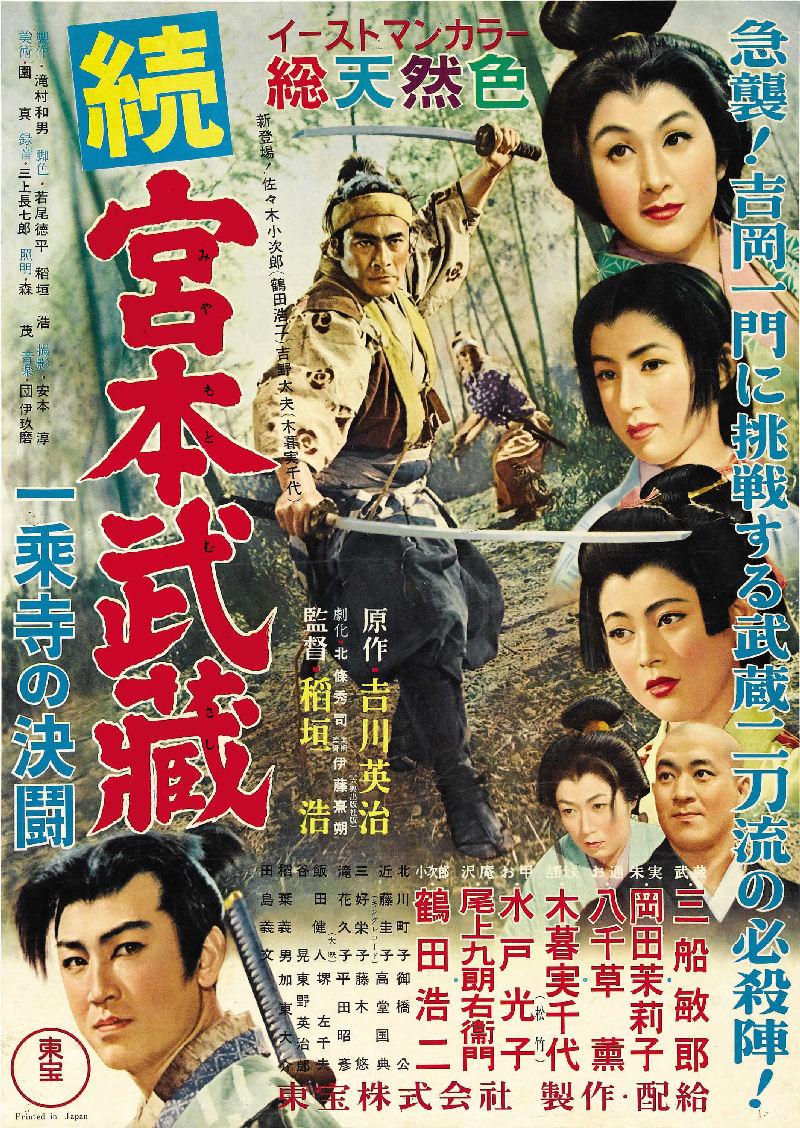
THE SAMURAI TRILOGY Samurai II: Duel at Ichijoji Temple - Review By Greg Klymkiw - Criterion Collection

Samurai I is a tough act to follow, but Samurai II: Duel at Ichijoji Temple delivers a thousand-fold.  When we last left Musachi Miyamoto, he'd become quite a skilled warrior and after some womanly dalliances, he declared his love to one very special lady, but in spite of this pulling at his heart strings, he decided to bugger off in search of his samurai mojo. This instalment features several spectacular duels, more romance, the return of Matahachi, our hero first meeting his ultimate nemesis and, if this isn't enough for you, he squares off against 80 - count 'em - 80 warriors. Will he survive? Well, as this is a trilogy, we certainly do hope so.

Samurai II: Duel at Ichijoji Temple (1955) *****

dir. Hiroshi Inagaki

Starring: Toshiro Mifune, Koji Tsuruta, Kaoru Yachigusa, Mariko Okada, Michiyo Kogure, Mitsuko Mito, Akihiko Hirata, Kenjin Iida Eijiro Tono

Review By Greg Klymkiw

Planned feature film trilogies tend to suffer most from sagging middles with sporadic touches so inspired that they still compel viewers to eagerly anticipate the final instalment (if they're good, that is - unlike say, a certain overrated Chriostopher Nolan trilogy). The most recent and salient example of the old faithful narrative sinkhole effect is the theatrical cut of Peter Jackson's Lord of the Rings: The Two Towers from 2002 (though not the extended home video version which proves that "longer" can actually quicken the pace of something).

The first part of Jackson's film trilogy of Tolkien's fantastical tall tale has the bonus of the origin story of the Ring's "Fellowship", whereas narratively, much time is spent in " The Two Towers with a lot of "to and fro" journeying that is only enlivened by a few astounding set-pieces. (And no, The Godfather Part II doesn't count as a middle because it really wasn't planned that way hence the genius of it and the disappointment generated by woeful, unnecessary Godfather III.)

Let us for a moment imagine Samurai I and III as beautiful thick-cut slices of Bagel World Caraway Seeded Rye Bread and Samurai II: Duel at Ichijoji Temple as nothing less than mouth-wateringly delectable Goldin's Montreal Smoked Meat - bursting with zesty peppercorn and pickling salt flavour and the scrumptious ooze of generously marbled beef fat (that you can get directly from the Goldin Boys in Toronto or dine exclusively upon at Free Times Cafe). While ace Japanese director Hiroshi Inagaki might have never imagined his masterpiece of cinema favourably likened to a Montreal Smoked Meat sandwich, I suspect that if he'd ever tasted one, he'd wholeheartedly agree. This movie is a corker of a samurai epic and still has the punch to thrill and delight audiences the world over.

Our tale begins with one of the best samurai duels in screen history (many of the others in this category are sprinkled throughout Inagaki's trilogy) Misashi (Toshiro Mifune) takes on the burly Baiken (Eijiro Tono), who in spite of his girth moves like Baryshnikov and uses a double weapon approach - wielding a deadly ball and chain (the ball, of course has sharp metal spikes) in one hand and a humungous scythe-like weapon in the other. Jitaro (Kenjin Iida), a little orphan boy looking for a mentor is ordered away by Misashi, but he stays to observe the final death thrust of the match, which, as per usual, ends with Misashi's victory.

Alas, this is not enough to vault our hero into the venerable tradition of the samurai. An old monk chastises him for being proficient, but lacking all the inner virtues a samurai needs. Dejectedly, Misashi continues on the road to enlightenment, now accompanied by the unwanted companion, Jitaro.


In Kyoto, the narrative spins itself out like the gorgeously woven web it is. Three- count'em - THREE gorgeous babes are vying for Musashi's love. His old friend Matahachi (Rentaro Mikuni) is now a sad-sack drunk married to the conniver he took off with in the first film. The conniver is trying to pimp her Musashi-obsessed daughter to the local samurai Master (who eventually rapes her anyway). Musashi, sets his sights on a duel with Seijuro (Akihiko Hirata) the aforementioned rapist and Master of Kyoto's leading Samurai school.


The school's administrative heads and pupils all act as buffers twixt their Master and Musashi. This is fine. It allows us the fortune of watching more duels. At one point even Seijuro's brother goes up against Musashi and is, of course, defeated.

Now Seijuro is shamed into fighting Musashi and demands no further interventions be made on his behalf. He asks the seemingly loyal, young swordsman Sasaki(Koji Tsuruta) to set the duel up. Sasaki, however, is a genuinely first-rate swordsman and he longs to duel Musashi himself. Even still, when Musashi is yet AGAIN attacked by Seijuro's men, Sasaki intervenes and the two warriors work together as a team to cut down the would-be assassins.

The plot thickens further with more duels, more betrayals and more romantic entanglements than you can shake a stick at - all building to a semi-climactic duel between Musashi and 80 men and eventually with Seijuro himself. Sasaki waits in the wings, studying and admiring Mishashi's skill. He knows they too will fight someday.

That someday awaits us in Samurai III: Duel at Ganryu Island. If Samurai I is the top slice of Bagel World Caraway Rye, swathed in delicious French's mustard, then Samurai III is the bottom slice of rye - the one that has soaked up all the natural, flavourful juices from the Goldin's Montreal Smoked Meat stuffing the middle of Samurai II.

"Samurai II: Duel at Ichijoji Temple" is part two of the glorious Criterion Collection set of Blu-rays and DVDs. The pictures have been digitally restored in eye-popping hi-def and happily, the sound is presented in wonderful uncompressed mono. In addition to the array of essays there's an especially interesting newly produced segment on the real Musashi Miyamoto."

Monday, 17 September 2012

THE SAMURAI TRILOGY Samurai I: Musashi Miyamoto Reviewed By Greg Klymkiw Criterion Collection Blu-Ray Box

Samurai I: Musashi Miyamoto is an Oscar-winning Samurai action epic by Hiroshi Inagaki that spawned two more films and such international success that it's oft been referred to as the Japanese Gone With The Wind.  

Samurai I: Musashi Miyamoto (1954) *****
dir. Hiroshi Inagaki
Starring: Toshiro Mifune, Rentaro Mikuni, Kaoru Yachigusa, Mariko Okada, Mitsuko Mito, Kuroemon Onoe

Review By Greg Klymkiw

Young men dream of going to war. I know I did. Then I read Stephen Crane's "The Red Badge of Courage" and Erich Maria Remarque's "All Quiet on the Western Front" and put that thought to rest mighty quick (in spite of my Sands of Iwo Jima John Wayne fetish).

Alas, the same cannot be said for young men living deep in the sleepy provinces of seventeenth-century Japan - especially not the devil-may-care orphan Takezo (Toshiro Mifune) who is perched up in a tree with his equally restless, though somewhat more rooted pal Matahachi (Rentaro Mikuni). They both gaze with equal dreams of glory upon their village and the picturesque countryside as a huge army assembles to go into battle.

Nothing is ultimately stopping the brash, Takezo, but Matahachi has ties that indeed bind him with his betrothal to the most desirable catch in their village - the kind, sexy and radiantly beautiful Otsu (Kaoru Yachigusa). Though he admits a ready willingness to join his lusty pal on the battlefield, it's Takezo who reminds his chum, with a mixture of benevolence and braggadocious bravado, that some men have commitments that must keep them behind. This, of course, inspires Matahachi to do the unthinkable and abandon all that is sacred. Takezo does what he was born to do, but Matahachi let's macho pride rule his decisions and a terrible price will eventually be paid for this.

So then begins Musashi Miyamoto, a tale of two friends who begin together on the same path, but eventually take separate forks in the road of life which results in a series of surprises in their respective love lives - none which either of them would have ever seen coming.

Mostly, though, the bulk of this stirring adventure charts the growth of the young, headstrong Takezo who bravely venerates himself on the fields of battle and develops into an extremely proficient, fame-hungry killer. Changing his identity to that of the title moniker Musashi Miyamoto, his modus operandi is to live as a masterless ronin warrior and indeed, to become respected as a full and true Samurai.

The road to the latter will prove more difficult - genuine Samurai must be imbued with the more noble qualities of honour and compassion - something our hero is decidedly bereft of.


Between battle scenes, duels, chases, narrow escapes and general derring-do, the picture is entertainingly peppered with several affairs of the heart involving three different babes - one virtuous, one not-so virtuous and another just plain villainous.

Musashi Miyato won an Oscar for Best Foreign Language Film and like its two sequels, the movie stands alone as great motion picture entertainment. When watched one after the other, these three classically structured and beautifully directed films comprise a genuinely sprawling epic. Musashi Miyato is bursting at the seams with first-rate melodrama, action scenes of unparalleled excitement and a deeply-felt rendering of a time, place and tradition now gone with the wind.


The proceedings are so passionately recreated by the elegant Inagaki that it's no surprise that this film and the entire Samurai Trilogy is oft-referred to as a Japanese Gone With The Wind. In terms of its scope, popularity, narrative drive and stratospheric levels of production value, the description is definitely on the mark.

"Musashi Miyamoto" is the first part of the glorious Criterion Collection set of Blu-rays and DVDs. The pictures have been digitally restored in eye-popping hi-def and happily, the sound is presented in wonderful uncompressed mono. In addition to the array of essays there's an especially interesting newly produced segment on the real Musashi Miyamoto."