Showing posts with label TIFF Bell Lightbox. Show all posts

Tuesday, 11 July 2017

Le Silence de la mer (The Silence of the Sea) - Review By Greg Klymkiw - Haunting portrait of French Resistance during wartime at TIFF Bell Lightbox Summer 2017 series "Army of Shadows: The Films of Jean-Pierre Melville" and available on the Criterion Collection.

A Nazi soliloquizes to silent listeners in Melville's debut.

Le Silence de la mer - The Silence of the Sea (1949)
Dir. Jean-Pierre Melville
Nvl. Vercors (Jean Bruder)
Starring: Howard Vernon, Nicole Stéphane, Jean-Marie Robain

Review By Greg Klymkiw

There are many forms of resistance during an occupation. As Jean-Pierre Melville's debut feature film proves, the most powerful of all is silence. When an old man (Jean-Marie Robain) and his niece (Nicole Stéphane) are forced to billet Nazi officer Werner von Ebrennac (Howard Vernon) in their own home, they choose to contribute to the French resistance of German occupation by going about their lives as if their unwelcome guest doesn't exist.

Silence proves to be a formidable weapon. Le Silence de la mer is based on the secretly published novel by Jean Bruder under the nom-de-plume "Vercors", published and circulated in France during the Occupation. So horrific is the power of Melville's adaptation that the film succeeds as one of the most chilling anti-war films ever made and this from a picture that seldom leaves the confines of a cozy, bourgeois country living-room. What a gloriously mad first feature film, but one that radiates the sheer abundant cinematic glory that is Jean-Pierre Melville.

The first two-thirds of the movie involves the old man and his niece sitting quietly - the old man reading and/or smoking his pipe whilst his niece intensely embroiders. The Nazi officer pays them nightly visits. He acknowledges and respects their resistance, their cold, borderline cruel silence.

Still, this does not deter him from trying to establish a human connection. He wanders about the living-room, speaking in soliloquy. His words are always gentle, mannered and cultured. It doesn't take long to figure out he isn't the usual garden variety Nazi Officer. It seems that Werner von Ebrennac has the soul of an artist and he holds a deep love and admiration for French culture.

Many of his monologues are heart-achingly beautiful observations on art, language, music and literature. He even reveals tidbits about his life in Germany, some very personal. When he tells the story about his one great love and how he was eventually driven from her when she displayed a deep-seeded cruelty he could have never before imagined, we are allowed to see the pain and disappointment in his eyes. We are allowed to feel for him as a human being. His hosts, however, remain unmoved - at least on the surface. No matter what he says, the old man and his niece remain impassive - and, silent.

Their silence does indeed border on cruelty, though our Nazi doesn't see it that way. He acknowledges their right to silence. Astonishingly he seems to welcome it as the right of any countryman to resist their occupation at the hands of an enemy.

He occasionally veers into political territory - dangerous territory indeed since he betrays considerable naiveté and in so doing he attempts to provide a perverse justification for Germany's occupation of France. This eventually proves to be his biggest mistake because eventually he comes face-to-face with the true reality of his country's motives, their final solution.

Eventually a word will indeed be spoken from the "resistance". When it comes, it's excruciatingly painful. I personally find myself gasping and on the verge of weeping every time I experience this moment.

There's something so perfect, so indelible about this motion picture. Melville, a French Jew who was a resistance fighter during WWII, made this film not long after the war. Given the horror, danger and cruelty he experienced, one might have expected a very different film on his feature debut, but no, he is, after all Jean-Pierre Melville. Le Silence de la mer seems to set the stage perfectly for the compassion and humanity he displayed throughout his career.

He's achieved the impossible. He allows us to see cruelty in resistance and humanity in a Nazi. Just thinking about this makes me want to weep with joy.

And sadness.

THE FILM CORNER RATING: ***** 5-Stars

Le Silence de la mer (The Silence of the Sea) plays at at the TIFF Bell Lightbox Summer 2017 series "Army of Shadows: The Films of Jean-Pierre Melville". It is also available on a gorgeous Criterion Collection Blu-Ray and DVD that comes complete with a new high-definition digital restoration, with uncompressed monaural soundtrack on the Blu-ray, Melville's first film, the short 24 Hours in the Life of a Clown (1946), a new interview with film scholar Ginette Vincendeau, Code Name Melville (2008), a seventy-six-minute documentary on Melville’s time in the French Resistance and his films about it, Melville Steps Out of the Shadows (2010), a forty-two-minute documentary about Le silence de la mer, an interview with Melville from 1959, a new English subtitle translation, plus a booklet featuring an essay by critic Geoffrey O’Brien and a selection from Rui Nogueira’s 1971 book "Melville on Melville".

Sunday, 9 July 2017

EXPERIMENT IN TERROR - Review By Greg Klymkiw - Restored nail-biter @ TIFF BellLightbox

Blake Edwards serves up the epitome of cool.
"Take off your clothes. You want me to take them off for you? Then take them off."
- Ross Martin as Red Lynch in Blake Edwards's Experiment in Terror.

Experiment in Terror (1962)
Dir. Blake Edwards
Scr. The Gordons (Mildred & Gordon)
Starring: Glenn Ford, Lee Remick, Ross Martin, Stefanie Powers

Review By Greg Klymkiw

The villain's name is Lynch. The heroine lives in a neighbourhood called Twin Peaks. The square-jawed, monkey-suited hero is an F.B.I. agent.

Doing the math, geek?

Don't worry. Even if it's not adding up for you, there's plenty more on display than mere cinema-geekery in Experiment in Terror, the consummate 1962 thriller by Blake Edwards that puts most contemporary nail-biters to shame. (Yeah, Get Out, I'm talking to YOU!)

Late one fine San Francisco evening, gorgeous bank teller Kelly Sherwood (Lee Remick, dolled-up in only the finest array of designer wear) is accosted in a suburban garage, from behind naturally, by a dark figure who manhandles her appropriately, guessing her measurements with dazzling precision.

He demands, through a gravely asthmatic voice, that she will steal $100K, following his instructions to the letter. Oh, and she better not go to the police. If she disobeys him, he plans to rape and murder both Kelly and her lithe little teenage sister Toby (Stefanie Powers). Hell, he might still do it anyway. Just for fun.

What's a girl like the impossibly gorgeous Kelly Lynch to do? Well, call the F.B.I. of course and be lucky enough to get the handsome agent John Ripley (Canada's own Glenn Ford) on the line. Big mistake. No sooner does she get off the blower when the predatory attacker suddenly appears, belts Kelly to the floor and crunches his nicely-polished black shoe on her throat. He knows everything. He sees everything. And she better not screw up.

What follows is a terror-infused cat and mouse game. Villain Red Lynch (Ross Martin) is quickly revealed to us (and the cops), but he's one slick dude and though he might be arrogant and totally bat-shit crazy, the man is a mastermind. Every step of the way he manages to outsmart the cops and the picture spins like a whirling dervish through several edge-of-the-seat set pieces and finally climaxes during a ball game in a packed-to-the-rafters Candlestick Park.

Some might find it a bit strange that such a crackling terrific thriller came from Blake Edwards. Yes, he did indeed deliver the hugely successful Breakfast at Tiffany's, the ubiquitous Pink Panther series, 10, one of the best romantic comedies of the 70s and the beloved gender-bending musical-comedy Victor/Victoria, so he's not the first guy one thinks of as someone who's going to deliver a picture as downright throat-catching as Experiment in Terror. But you know, Blake Edwards can and has been cool. He was, after all, the creator of the hard-boiled private-dick series Peter Gunn and here he assembled a top-flight cast, dazzling Phillip Lathrop black and white cinematography on location in San Francisco and a jazzy, jangling score from Henry Mancini.

And then there's Ross Martin as rapist, forger, armed robber and psycho killer Red Lynch - he's easily one of the nastiest, scariest villains in screen history. His thin lips, Cheshire grin, over-the-top wheezing and off-the-Richter-scales slime-bucket attitude all contribute to the creation of a gloriously chilling and, dare I say it, cooler-than-cool madman of the highest order.

He looks great in drag, too. Well, uh, not really "great", per se, but Jesus Christ, I'd hate to meet him in the Ladies Room. Oh, and in Experiment in Terror, we most certainly do meet him there. Damn, it's scary!

THE FILM CORNER RATING: **** 4-Stars

A restored digital print of Experiment in Terror plays at TIFF Bell Lightbox.

Saturday, 8 July 2017

OUTRAGE - Review By Greg Klymkiw - Ida Lupino's Groundbreaking 1950 Film About Sexual Assault and Its Aftermath on 35mm at TIFF Bell Lightbox

If you're rich, you can attend a special "Patrons Circle Silver + Event" at TIFF Bell Lightbox (July 10) of Ida Lupino's Outrage, the groundbreaking 1950 film about a woman's sexual assault and its aftermath. According to the TIFF bumph:

"In our continuing mission to transform the way people see the world through film, we are pleased to invite Patron Circle Members at the Silver Level and above to attend Outrage..."

Lovely!

So, what this means is that you can come to this special event IF you are a Silver+ patron of TIFF. So pull out your cheque book and feel free to shell out: $4000 for a Silver Membership or $6000 for a Gold Membership or $8000 for a Platinum Membership or, if you're especially well-heeled, please cough up $12000 for a Leadership Membership.

Here's what you'll get:

"The evening begins with a cocktail reception on the stunning TIFF Bell Lightbox rooftop terrace overlooking Toronto's skyline. Continuing in-cinema, the courageous activist, author, and educator Jane Doe will join us to delve into the film's subject matter through the lens of her expertise on sexual violence and its systemic connections. Be a part of the change you want to see in the world, and join us for what is sure to be an engaging, informative, and inspiring event."

Lovely!

If you can cough up $4K to $12K, you'll have the opportunity - just BEFORE a movie about RAPE - to slosh back cocktails whilst gazing upon TIFF's "stunning" view of the Toronto Skyline. If you can cough up $4K to $12K, you'll have the opportunity to join "the courageous activist, author, and educator Jane Doe" as she delves into film... "through the lens of her expertise on sexual violence and its systemic connections." If you can pull $4K to $12K out of your keister, you can "Be a part of the change you want to see in the world." (If you can manage to dredge up $2K for a Bronze Membership, you are welcome to attend, but alas, you will NOT be allowed to slosh back cocktails whilst gazing upon TIFF's "stunning" view of the Toronto Skyline just BEFORE a movie about RAPE.)

If you CAN'T cough up $4K to $12K to attend the July 10 event, you can STILL see Outrage on Thursday, August 24 during the TIFF Cinematheque retrospective "Ida Lupino: Independent Woman". There will be no cocktail party and, thus far, no word on a special presentation from Jane Doe. You will, however, eventually get to see this important film on 35mm, even IF you aren't loaded.

Lovely! The film, as always, should be the thing.


In 1950 Ida Lupino directed this important film
about sexual assault and its aftermath.

Outrage (1950)
Dir. Ida Lupino
Scr. Lupino, Malvin Wald, Collier Young
Starring: Mala Powers, Tod Andrews, Robert Clarke

Review By Greg Klymkiw

The grim stocky lunch counter clerk has had a long hard day serving up joe and burgers to a steady stream of warehouse district workers. Night is falling and though he tries to wipe the dank sweat from his pudgy face and hideously scarred neck, the stink of standing for hours on end has, no doubt, permeated into his grubby clothes and sticks to him like flies to shit.

Yeah, he's dirty, but not just in body. He's foul to the depths of his soul. And he needs to blow off some steam. He deserves it. He's a man, after all. But he is a man alone and has little more amidst the ennui of post-War America than to slink home to whatever squalid digs await him.

But hark! Opportunity comes sidling round the corner.

Whistling happily, striding along the empty alleyways after staying late at work, is pretty, young bookkeeper Ann Walton (Mala Powers). She's happy and confident. Why wouldn't she be? She's a strong, independent woman, heading home and infused with happiness that she's soon to be married to Jim Owens (Robert Clarke), a sweet young man who has just got a raise. Both of them are looking forward to an upwardly mobile life, eventually creating hearth, home and family - together.

Ah, if only life was so easy. Ann is about to be raped and everything she holds sacred is about to come crashing down upon her.

Welcome to the stunning, groundbreaking portrait of sexual assault and its aftermath from director Ida Lupino. Outrage was released in 1950 by RKO. It was only the second film ever made in Hollywood (the first was 1948's Johnny Belinda) to deal with this subject matter and though the themes and content would be enough to solidify its historical significance, it's an astonishing achievement of film art.

Lupino was a great director. She made six films (including Outrage, The Hitch-Hiker and The Bigamist) through the independent company she founded with her then-husband Collier Young and they stand as a testament to her commitment to presenting films about social issues - often about women and from a decidedly female standpoint. Here she brings all her vision to bear. It's a truly dazzling picture.

Lupino's eye is impeccable. Though this is clearly a product of its time (the word "rape", nor the phrase "sexual assault" are ever used), the universal properties of the film's perspective are, sadly and powerfully, as relevant today as they were in 1950.

When we first see the rapist and his initial encounter with Ann, his macho swagger is unmistakeable. There's a strange "innocence" to his flirting, at least initially. After all, she's a pretty lady patronizing his lunch counter and he notes that she's purchasing two takeout containers of cake to bring as a lunchtime treat for her "boyfriend".

He seems friendly at first, a bit of good-natured joshing about her dumping the dude and dating him instead. But ultimately, it's not good-natured at all. He's a fucking creep. He even begins to brag about his manly prowess. Brilliantly, Lupino allows the scene to play almost matter-of-factly, at least from Ann's perspective. She politely ignores his entreaties. She's a woman, after all, and must surely be hit on by most guys with a dick twixt their legs. Her response seems innocently a matter of course. What's not right is the way the clerk stares at her. She's a sex object - pure and simple.

During a seemingly sweet moment when she sits on a crowded park bench with Jim as he proposes marriage to her, Lupino focuses upon prying eyes. This time, it's not a guy who looks disapprovingly about the couple's open expression of love, but a woman. Society's disapproval is everywhere. Even after Ann is raped, disapproval comes under the guise of caring.

The rape scene, as directed by Lupino, still packs a punch - maybe even more now than it did in 1950. Conjuring every available filmmaking tool, she creates a visual and aural assault upon us as Ann is stalked through the labyrinthine warehouse district - canted angles, expressionistic shadows, eerily unsettling God-shots and the sounds of clicking heels on the pavement, leering wolf-whistles, the clatter of a tin can smashing on the pavement and a faulty blaring truck horn to drown out the sounds of her whimpering as the hulking mass of male dominance looms above her - to take from her what he wants.

Much later on in the film, after Ann's been assaulted and left town, there's a sequence almost more powerful than the harrowing rape scene Lupino previously depicts. Here Ann has tried to escape the "shame" and whispers her assault has engendered. She lives peacefully in a rural California enclave, surrounded by good, decent people, including Rev. Bruce Ferguson (Tod Andrews), a veteran haunted by the horrors of war who seeks his own escape by offering compassion, solace and ministry to those in need.

Under sunny skies, an outdoor harvest dance ensues. Ann is among friends and for the first time in a long time, she has some peace, some much-needed solace and company. What she doesn't need is a handsome predator, demanding a dance, insisting upon her attention. Yes, this man's pursuit is "innocent", but Lupino infuses his desires with a creepy, almost matter-of-fact predatory tone.

He wants what he wants.

He thinks he can take it.

And he doesn't understand the meaning of the word "No."

Outrage doesn't let up. Nor, it seems, do predators.

THE FILM CORNER RATING: ***** 5-Stars

Outrage plays in 35mm in the TIFF Bell Lightbox series "Ida Lupino: Independent Woman".

Thursday, 6 July 2017

TWO MEN IN MANHATTAN (Deux hommes dans Manhattan) - Review By Greg Klymkiw - Melville in Manhattan Classic on 35mm at TIFF Bell Lightbox Summer 2017 series "Army of Shadows: The Films of Jean-Pierre Melville" and via the Cohen Media Group Blu-Ray

Film Noir in 50s Manhattan: The only movie to feature director Jean-Pierre Melville in a starring role.

Two Men in Manhattan - Deux hommes dans Manhattan (1959)
Dir. Jean-Pierre Melville
Starring: Jean-Pierre Melville, Pierre Grasset

Review By Greg Klymkiw

The mission is clear. France's chief representative at the United Nations has gone missing. He must be found. This, of course, is a job made for two esteemed members of the press. Their journey is going to take them deep into the underbelly of Manhattan. On the grey well-worn streets, lit by the kind of neon one can only find in the city that never sleeps, dogged French reporter Moreau (Jean-Pierre Melville) and his sleazy pal, Paris Match photographer Delmas (Pierre Grasset), are all set to visit a first-class brothel in search of their quarry.

"It doesn't get much better than this," Delmas notes.

"You can judge a civilization by its level of prostitution," Moreau cracks.

Delmas responds with a wide grin: "Who said that?"

Moreau turns. With a knowing smile, he looks straight at his old friend Delmas.

"Delmas," he quips.

Well, of course. Moreau knows Delmas all too well. When a politician disappears, only a Paris Match photographer is going to know where to go. Oh, and do they go. They go-go-go into the backstage world of Broadway, dressing rooms, a recording studio at Capitol Records, only the finest gentlemen's clubs, the apartments of kept women, a furtive visit into a hospital housing a babe who's attempted to commit suicide and, of course, brothels.

The missing diplomat is, after all, French. Where else would two French dudes find another French dude? They must visit with actresses, singers, strippers and whores (of course). Their journey goes deep into the night and what they find is definitely the kind of sleazy mess tinged with tragedy that tests their mettle as men of honour (and dishonour).

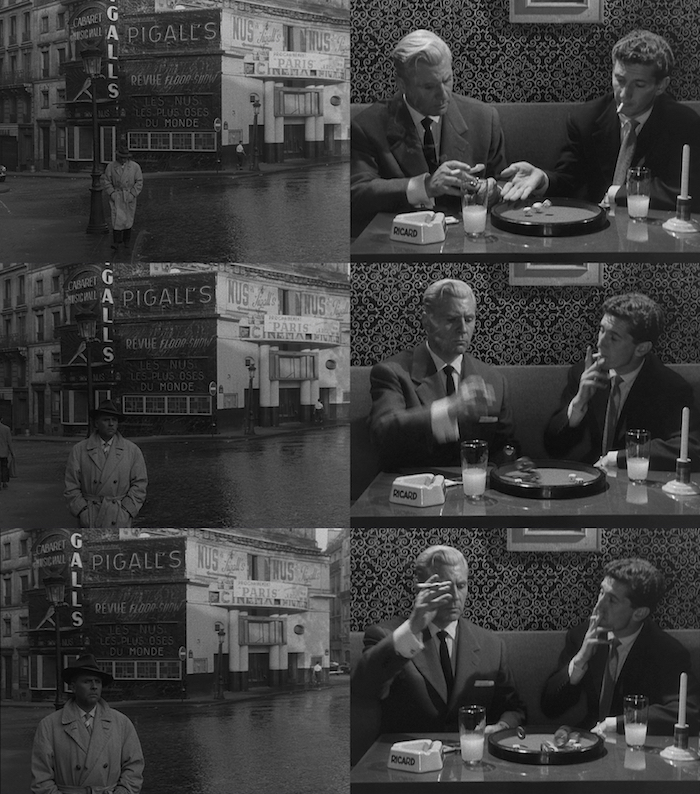
Jean-Pierre Melville knows a thing or two about honour. His previous film, Bob le flambeur (1955) was all about that. He takes it several steps further with Two Men in Manhattan.

With Bob le flambeur, Melville also pretty much defined La Nouvelle Vague and its groundbreaking use of gritty Montmartre locations. Here he solidifies the path for the likes of those who followed in his footsteps: François Truffaut, Jean-Luc Godard, Claude Chabrol, et al - these guys owe everything to Melville. Here he blends his love of all things American and does it on the mean streets of New York City.

Cool guys, babes galore, rumpled trench coats, plenty of cigarette smoke and lots of hot jazz. And in Manhattan, no less. Delmas's line is prescient indeed:

"It doesn't get much better than this."

It sure doesn't.

Two Men in Manhattan is pure film noir with a twist of the French New Wave. Indeed, not too many movies can deliver on this level. A single frame of this picture puts most movies to shame.

THE FILM CORNER RATING: ***** 5-Stars

Two Men in Manhattan - Deux hommes dans Manhattan plays on 35mm during the TIFF Bell Lightbox Summer 2017 series "Army of Shadows: The Films of Jean-Pierre Melville" and is available on a Cohen Media Group Blu-Ray that includes a conversation between critics Jonathan Rosenbaum and Ignatiy Vishnvetsky and an essay by Melville scholar Ginette Vincendeau.

Wednesday, 5 July 2017

THE EXORCIST - Review By Greg Klymkiw - Original Theatrical Version of Friedkin Horror Classic Perfect! No Need To See "Extended Director's Cut" at TIFF Bell Lightbox. Just watch the original theatrical version. At home. Alone. On Blu-Ray.

THE EXORCIST is the best horror movie ever made!

The Exorcist (1973)
Dir. William Friedkin
Scr. William Peter Blatty
Starring: Ellen Burstyn, Linda Blair, Jason Miller, Max von Sydow, Lee J. Cobb,
Father William O'Malley, Kitty Winn, Jack MacGowran, Peter Masterson

Review By Greg Klymkiw

No matter how many times I see William Friedkin's The Exorcist, it's like I'm seeing it for the very first time which, on a big screen, first-run, at the age of 14, beats pretty much any experience I've ever had. The picture not only chills to the bone, but it's so gorgeously crafted that seeing the movie is like being under hypnosis from beginning to end. I can't take my eyes off the screen - every beat, every cut, every shot, every sound infuses me with sheer, utter horror and its astonishing set pieces keep delivering a kind of explosive excitement that blows away the comparatively meagre joys bestowed via orgasm. Goddamn it, who needs orgasms when The Exorcist exists?

Thanks to William Peter Blatty's best-selling novel and screenplay adaptation, there is nobody alive on this earth who doesn't know what they're going to see - the simple, compulsive story about a demon that possesses 12-year-old Regan MacNeil (Linda Blair), then compels her to commit some of the most vile acts imaginable until her mother Chris (Ellen Burstyn), in desperation (having exhausted every medical "cure"), turns to Fathers Karras and Merrin (Jason Miller, Max von Sydow) priests from the Jesuit Order, to do battle with the evil that's invaded her child. On the surface, that's pretty much it, though Blatty also managed to flesh out the narrative coat hanger with a host of beautifully etched characters to keep our eyes glued via our hearts and minds.

Not to downplay Blatty's writerly achievements, but the movie is finally as great as it is because of William Friedkin's command of cinematic language. This man knows how to use his camera to rip our very guts out and there are few American directors who have been able to so as consistently and successfully as he has. Film after film (The French Connection, Sorcerer, To Live and Die in L.A., Cruising, Killer Joe), William Friedkin manages to slam us repeatedly in the face with a two-by-four and eventually send us soaring out of the cinema with a buoyancy most filmmakers can't even dream about, much less achieve.

My most recent helping of The Exorcist was, in this day and age, the best possible way to see it. I sat alone in my house, at night, with my telephone off, every light extinguished, the sound cranked and braced upright in a not-too-comfortable position (when we worship, we're not supposed to be comfy) in front of my HD monitor as the Blu-Ray player began spinning. Though I'd have loved to see it on a big screen, my only recent option would have been the TIFF Bell Lightbox special Cinematheque screening and alas, I'd have had, in that venue, to see it with other people in a rarefied atmosphere of "knowing" cineastes - a far cry from repeated screenings during the film's first year of release in a 2000-seat, packed-to-the-rafters picture palace and surrounded by audiences silently observing the proceedings - silently except for those moments when you'd hear hundreds of people gasping and screaming.

Even more problematic about seeing it at TIFF is their egregious choice to screen the "extended Director's Cut" (billed somewhat erroneously on their website sans the word "extended"). Nothing beats Friedkin's 121-minute theatrical cut. The near-horrendous 132-minute "extended Director's Cut" not only destroys the film's impeccable pace, but adds several sequences that should have remained as optional special features on Blu-Ray/DVD releases. The worst additions include the infamous "spider walk", a clunky dialogue scene between the exorcists twixt bouts in the little girl's bedroom and worst of all, an obvious "positive" ending.

Usually billed as The Exorcist: The Version You've Never Seen, this version of the film is only worth seeing for the exercise of viewing a director ruining what was already perfect (lest we forget Spielberg's not-so-special Close Encounters of the Third Kind: The Special Edition or George Lucas's nutty tinkering with Star Wars). This so-called "Director's Cut" of The Exorcist has no place in a Cinematheque - the version being screened is little more than a cash-grab and a perverse nod to appease original writer-producer Blatty.

Oh, but the original theatrical version is a treat - a treat to end all treats! The opening scenes in Northern Iraq as Father Merrin presides over an archeological dig is still one of the creepiest sequences ever committed to film. The blazing sun, the sand and grit, the sweat pouring off everyone's faces, the desperation with which the good Father shoves heart pills down his gullet, the discovery of an evil-infused artifact, horses charging out of nowhere down a narrow street, armed Iraqi soldiers cocking their rifles, wild dogs snarling, growling and fighting in the desert and Merrin's face-to-face regard of an oversized sculpture of the demon Pazuzu, its grim visage and huge, erect lance-like penis; images crafted to jangle and disorient us, naturalistic sounds to shred our eardrums and a documentary-like eye to make us believe - really believe!

And in the words of Al Jolson in The Jazz Singer: "You ain't seen nothing yet!"

Friedkin's cameras take us from these exotic sites and plunge us into the world of Washington D.C.'s leafy, "safe" Georgetown neighbourhood and he begins the ever-so slow burn as a happy child transforms into a hideous, scarred demon - spewing vomit and expletives and yes, eventually masturbating with a crucifix, shoving her mother's horrified face into her bleeding vagina, demanding she lick the crimson oozing from between her legs.

And almost as horrifying are the battery of medical assaults upon the child, as nasty and intrusive as those of the demon, captured with a clinical Neo-realist fervour by a director at the top of his game.

Oh, and the exorcism! The chants and Holy Water, so rhythmically entrancing that I found myself, time and time again, on the edge of my seat, filled with creepy-crawly gooseflesh and my eyes welling up with tears.

Oh, this is cinema! In all its glory!

And to watch The Exorcist is indeed the ultimate experience of giving oneself to the visceral, the spiritual, the kaleidoscopic joy and horror of worship.

This is what it's all about!

This is cinema!

THE FILM CORNER RATING:
(Theatrical Cut): ***** 5-Stars
(Extended Director's Cut): ** 2-Stars


The Exorcist (Extended Director's Cut) is a TIFF Cinematheque Special Screening at TIFF Bell Lightbox in Toronto. Skip it. Just see the original theatrical cut of The Exorcist on the Warner Bros. magnificent Blu-Ray "The Complete Anthology" which has everything you'd ever want - a completist's wet dream.

Tuesday, 4 July 2017

Bob le flambeur - Review By Greg Klymkiw - Classic Melville Heist Picture at Toronto's TIFF Bell Lightbox in summer 2017 series "Army of Shadows: The Films of Jean-Pierre Melville" and via the O.O.P. Criterion Collection DVD.

Aging high-roller takes the biggest gamble of them all.

Bob le flambeur (1956)
Dir. Jean-Pierre Melville
Scr. Melville & Auguste Le Breton
Starring: Roger Duchesne, Daniel Cauchy, Isabelle Corey, Guy Decomble, Gérard Buhr

Review By Greg Klymkiw

"I was 14 when I left my mother... I returned 10 years later, early one morning. I saw an old woman on her knees, scrubbing away, as she always had. That's how I recognised her. I left without a word. Then I sent her a postal order each month. One month it was sent back. She had stopped scrubbing." - Bob Montagné in Jean-Pierre Melville's Bob le flambeur

In the moments between night and day, by the dawn's early light, in Montmartre, that hallowed, hilly zone of solemnity and sleaze in Paris, resting somewhere between the Heaven of the Basilica of the Sacré-Cœur at its highest point and below it, the Hell of nightclubs, cheap hotels, cafes, whorehouses and gambling dens, the distinguished trench-coat-adorned silver-haired old fox Bob Montagné (Roger Duchesne) takes one last roll of the dice.

Craps.

It's been a long night and Bob's wiped out. He steps out onto the lonely morning streets, looks into a storefront reflection, straightens his tie and, taking in his weary visage, remarks aloud: "A real hood's face."

And so it is, but he's definitely not your run-of-the-mill garden variety miscreant. Bob Montagné is a class act. He's practically royalty, at least by the standards of magical Montmartre. Sure, he's been in an out of stir for most of his life, but amongst the post-war criminal class of France, he's pulled off some of the most daring heists, and as such, commands respect from thugs and cops alike.

He's a high-roller, you see, and everyone loves Bob: he's worshipped by the sweet young criminal Paulo (Daniel Cauchy), whilst the grizzled police lieutenant Ledru (Guy Decomble) considers him his best friend (and indeed owes his life to him) and, of course, there's a woman - the beautiful young Annie (Isabelle Corey), who adores him for his fatherly influence and generosity. Yes, everyone loves Bob, except for the foul pimp and stool pigeon Marc (Gérard Buhr). Bob has even less use for Marc, a piece of excrement on two legs who beats his women, sells anyone out for the right price and even tries to lure Annie into his stable.

Right from the opening frames of Jean-Pierre Melville's Bob le flambeur we know we're about to enter the world of the criminal class, but for the most part, "class" is the order of the day for men like our title character. Bob's also down for the count, but he's not there for long. He springs up with one last plan to restore himself. As an inveterate gambler, he knows all too well how much dough collects in a casino after a long night and he decides to put together a crack team to pull a heist on the mighty Deauville gaming emporium.

The magical world of Montmartre:
Wet streets, nightclubs, cigarettes and dice.

Best laid plans, however, can go awry, but the manner in which Melville explores this is one of the reasons why Bob le flambeur is a masterpiece. Let's put aside the fact that the picture's sense of atmosphere is so thick you can cut it with a knife, that its touches of Neo-realism make us feel like we're living, breathing and even smelling a world most of us will never know, that its eventual and shocking bursts of violence knock us on our butts and indeed influenced every crime picture that followed in its wake.

Let's put all that aside for a moment. Let's marvel at the sheer, brilliant simplicity of one key stroke of narrative genius:

Bob le flambeur is a heist film in which part of the caper itself involves its mastermind playing the tables of the casino he's going to rob and just as he's about to risk committing a crime that might land him in the hoosegow for a very long time, his rolls of the dice start to yield him a fortune that he's never seen in his life - a fortune that might indeed exceed that of what he could ever hope to rob from the joint.

Damn, this is genius.

THE FILM CORNER RATING: ***** 5-Stars

Bob le flambeur screens at Toronto's TIFF Bell Lightbox in the summer 2017 series "Army of Shadows: The Films of Jean-Pierre Melville" and, via the O.O.P. Criterion Collection DVD which includes an interview with Daniel Cauchy and an archival Gideon Bachman radio interview with Jean-Pierre Melville.

Monday, 3 July 2017

RIFIFI - Review By Greg Klymkiw - The greatest heist film ever made screens at Toronto's TIFF Bell Lightbox in the Summer 2017 series "Panique: French Crime Classics" and is also available on a gorgeous Criterion Collection Blu-Ray/DVD


Rififi (1955)
Dir. Jules Dassin
Scr. Dassin & René Wheeler
Nvl. Auguste Le Breton
Starring: Jean Servais, Carl Möhner,Robert Manuel,
Jules Dassin, Janine Darcey, Magali Noël, Claude Sylvain

Review By Greg Klymkiw

The major set piece of this extraordinary French crime film by blacklisted American director Jules Dassin is a breathless thirty-minute-long heist sequence that is shot with natural sound, no dialogue and no music.

It's pure cinema!

It's also one of the most nail-bitingly suspenseful scenes in movie history. We've come to know the characters, we understand the high stakes for all of them if they don't pull off the big steal and worst of all, we're well aware of what will happen if they're caught - especially the desperate old man, Tony "le Stéphanois" (Jean Servais). He's just served five years of hard time for a heist gone wrong and his only choices in life amount to petty crime, gambling and/or getting caught and being tossed back into the hoosegow until he's dead (or as close to dead as he'll ever get).

These men are criminals, but we want them to succeed. It's post-war France and the opportunities for men who've known only one way to survive are pretty much non-existent. They live by a strict code of honour and they'll steal, but they won't kill (at least until they are pushed to the limit to do so). There's clearly honour amongst these thieves (save for the slimy, greasy, lazy borderline pimps who weasel into the proceedings later on) and we never once feel like there are viable options for our main characters.

And so, we follow them willingly and almost complicitously into the breach - an insanely daring heist that requires split-second timing, impeccable teamwork and one hell of a massive whack of horseshoes worth of luck stuffed up their respective and collective keisters.


If the heist was only thing Rififi had going for it, there's no doubt the picture would be highly regarded, but that its bookends are as solid and compelling as all get out place Dassin's movie on s pedestal that holds some of the greatest crime pictures ever made. The manner in which Dassin shoots the heist is completely in keeping with his approach to the rest of the movie. Shooting almost exclusively on location captures the naturalistic feeling of the film's hard-boiled tale. Much like his groundbreaking American crime pictures (Naked City, Brute Force) which, broke American cinema out of the studio bound mould and took them onto the streets a la the Italian neorealist movement, Rififi is a glorious blend of stylized frissons within the framework of life itself.

Dassin, of course, had a tiny budget and little time to shoot the film, so he personally scouted all the locations in order to get a strong visual sense in advance to allow for impeccable planning. In many ways, Rififi is a model picture for independent, low budget approaches that are still infused with the highest degree of production value. Within Dassin's impeccable eye for visual detail, he's doubly blessed by working with the genius production designer Alexandre Trauner who manages to deliciously goose the look of the film.


Narratively, the tale is tough-minded and even romantic, but the attention to the details of the lives of the criminals and the heist itself (including the meticulous planning) give it the crank it needs to always keep us glued to the screen. As well, there's no overwhelming (and annoying) sense of the proceedings ever diving into moralistic waters. We believe in these men AND their criminal intent. We want them to succeed and if things go wrong and all becomes futile, Dassin sets the picture up in such a way that we're going to feel and care deeply about whatever plight the characters suffer. It helps, also, that the casting is impeccable - especially Servais as the world weary "le Stéphanois", Dassin himself as the funny, sprightly and finally, almost tragic figure of the ladies' man, as well as the other disparate and memorable members of the team.

The importance of Rififi as both dazzling entertainment, but as well, its place in laying the foundations for crime pictures that followed as well as the whole French New Wave that would come a few years later is, frankly, incalculable. All its historical significance aside, it's one hell of a good show! Rififi is brutal, harrowing and darkly funny and it seldom got better than this. The dames are dames, its heroes noble and the villains are pure filth. Sure, the movie trades in on the tropes of the genre, but does so expertly within its overwhelming naturalism that nothing ever feels cliched and is, in fact, far fresher than most films made today.

THE FILM CORNER RATING: ***** 5-Stars

Rififi screens at Toronto's TIFF Bell Lightbox in the Summer 2017 series "Panique: French Crime Classics" and is also available on a gorgeous Criterion Collection Dual Format Blu-Ray/DVD release complete with New 2K digital restoration, my favourite uncompressed monaural soundtrack, a very inspirational interview with director Jules Dassin, set design drawings by art director Alexandre Trauner, still, trailer, an optional English-dubbed soundtrack (especially handily for additional screenings to just study Dassin's visuals and a terrific essay by Jim Hoberman.

Sunday, 2 July 2017

ELEVATOR TO THE GALLOWS (Ascenseur pour l'échafaud) - Review By Greg Klymkiw - Louis Malle's Taut Fiction Feature Debut at Toronto's TIFF Bell Lightbox in the Summer 2017 series "Panique: French Crime Classics" and, of course, on a gorgeous Criterion Collection DVD

Babes. Hunks. Cigarettes. Murder. Paris. UNBEATABLE!!!

Elevator to the Gallows - Ascenseur pour l'échafaud (1958)
Dir. Louis Malle
Scr. Malle & Roger Nimier
Nvl. Noël Calef
Starring: Jeanne Moreau, Maurice Ronet, Georges Poujouly, Yori Bertin,
Jean Wall, Iván Petrovich, Elga Andersen, Félix Marten, Lino Ventura, Charles Denner

Review By Greg Klymkiw

Some movies demand the ingestion of popcorn. Others require mind-altering illicit substances. Louis Malle's stylish crime picture Elevator to the Gallows (Ascenseur pour l'échafaud) makes the insistent and peremptory request that you light up the strongest cigarettes imaginable and chain smoke your way through it from beginning to end. (For anyone planning a big-screen sojourn to see the picture at TIFF Bell Lightbox, you will sadly be shit out of luck on this front due to our city's regressive anti-smoking by-laws.)

Though Louis Malle (Au revoir les enfants, My Dinner with Andre, Atlantic City, Pretty Baby) had already garnered an Academy Award for his 1956 Jacques Cousteau documentary The Silent World, the French New Wave director wisely put together a sure-fire low-budget hit with this first dramatic feature film to solidify his place as a bankable filmmaker and damn, did he dazzle everyone with this très-cool crime thriller based on the pulpy Noël Calef novel. If it's a trifle cold and bereft of some of the hallmarks of Malle's later humanity, we can easily forgive that and just sit back and enjoy this delectable, unbeatable, suspensful indulgence replete with babes, hunks, plenty of cigarettes, zippy cars, cheap motels and murder most foul.

Our movie opens with the impossibly gorgeous couple Florence Carala (Jeanne Moreau) and Julien Tavernier (Maurice Ronet) passionately professing their love for each other over the telephone. A murder is committed, a mistake is made and our lovers are kept apart when our hero is caught in an elevator without power and the heroine is left alone waiting for him and forced to wander the streets of Paris, desperately looking for him. Tavernier's car is stolen by the impossibly handsome young thug Louis (Georges Poujoully) and his impossibly gorgeous girlfriend Véronique (Yori Bertin). The barely-out-of-their-teens couple goes on a joy ride and encounter the gregarious vacationing and champagne-armed German couple Horst (Iván Petrovich) and Frieda (Elga Andersen).

Partying and sex is assured. More murder is just round the corner.

Nail-biting suspense, mistaken identity and dogged detective work from cops Lino Ventura and Charles Denner follow in due course. Henri Decaë's gorgeous black and white cinematographic lensing of Paris and an astonishing music score by Miles Davis carry us along in one of the most delightful noir-tinged crime pictures of the period.

No need to spoil the proceedings with any further details. Just sit back with plenty of throat-shredding ciggies and enjoy!

THE FILM CORNER RATING: **** 4-Stars

Elevator to the Gallows (Ascenseur pour l'échafaud) plays on the big screen at Toronto's TIFF Bell Lightbox in the Summer 2017 series "Panique: French Crime Classics" and, of course, on a gorgeous Criterion Collection special edition double disc DVD that includes a new interview with Jeanne Moreau, archival interviews with Malle, Ronet, Moreau and soundtrack session pianist René Urtreger, footage of Miles Davis and Louis Malle from the soundtrack recording session, a new video program about the score with jazz trumpeter Jon Faddis and critic Gary Giddins, Malle’s student film Crazeologie, featuring the title song by Charlie Parker, Theatrical trailers and a booklet featuring a Terrence Rafferty essay, Malle interview and tribute by producer Vincent Malle.


Saturday, 1 July 2017

Les enfants terribles - Review By Greg Klymkiw - Melville and Cocteau make for strange bedfellows in this oddball 1950 effort at Toronto's TIFF Bell Lightbox in summer 2017 series "Army of Shadows: The Films of Jean-Pierre Melville" and, via the Criterion Collection DVD.

Can too much Cocteau be too much? Perhaps.

Les enfants terribles (1950)
Dir. Jean-Pierre Melville
Scr. Jean Cocteau & Melville
Starring: Nicole Stéphane, Édouard Dermit, Jacques Bernard, Renée Cosima

Review By Greg Klymkiw

God knows I love Jean-Pierre Melville, but sitting through his gun-for-hire directorial effort Les infants terribles is a bit like what a colonoscopy used to feel like before they knocked you out with happy drugs. In fact, it's not dissimilar to suffering through any movie directed by the lumberingly precious Jean Cocteau (Le Sang d'un poète, La Belle et la Bête, Orphée). Well, surprise-surprise, Les infants terribles is based upon the novel of the same title (and co-screenwritten) by Jean Cocteau. Even more appalling is that Cocteau himself, with a nasal, mannered delivery, narrates the movie with his sarcastic, obvious, on-point jackhammered prose.

At times, the movie feels like a Gallic-tinged Howard Hawks comedy with rapid-fire delivery and a score comprised mainly of Vivaldi, which, I'll admit, makes it sound more engaging than it actually is.

But no, it's often painful.

That, however, might be the point and in spite of often detesting the movie, I found it compulsively watchable - mostly because of Melville's direction and in spite of Cocteau's writing (not so much the narrative and dialogue, but the aforementioned narration, which often serves to rip us out of the picture's forward thrust).

Things begin well enough in the opening scenes at an all-male Catholic school where a bunch of boisterous lads roughhouse after a fresh snowfall. The dashing pretty-boy Dargelos (Renée Cosima) is leading the charge and at one point, he hurls a snowball tightly packed round a stone at the fey, aquiline-featured Paul (Édouard Dermit). Smacking him in the chest, it winds him to such an extent that he crashes to the ground, rendered unconscious and suffering from bruised ribs.

Melville's direction during this sequence is dazzling. We feel like we're in the midst of a war-like skirmish on the fields of Flanders and it's as sprightly and engaging an opening as one could hope for in any movie.

Eventually we're ensconced in the cramped middle-class quarters where Paul lives with his sister Élisabeth (Nicole Stéphane) and their infirm Mother (Maria Cyliakus). It's here where the film's annoyance-meter ramped up for me.

The picture plunges us into the obsessive, seemingly incestuous sibling rivalry/love and the pair engage in a series of tête-à-têtes that eventually reveal themselves to be an ongoing, deep-seededly perverse game. Paul is ordered by the doctor to stay home and in bed and Élisabeth becomes caregiver to both him and his Mother. Needless to say, the claustrophobia of the situation allows for plenty of nasty game-playing. Obsession rules the day - Paul is obsessed with pretty-boy Dargelos and misses him desperately and one of his school chums, Gérard (Jacques Bernard) visits regularly. He's obsessed with both the brother and sister and their games, but he also provides solace to Paul with news about the naughty Dargelos.

Things perk up when Mom dies (a magnificent cut and shot, pure Melville, reveals her to us and the characters). Enter the beautiful Agathe (also played by Renée Cosima) who Paul falls madly in love with since she's a dead ringer for his beloved naughty pal Dargelos. And yes, it's here where the movie hits its stride and ploughs us into the kind of madly delirious melodrama that Melville did so beautifully in the much-better and genuinely great melodrama Le silence de la mer (1949).

It's here wherein Élisabeth becomes so terrified that her brother will eventually marry Agathe and leave her alone (and hence, without the madly incessant game-playing) that what the nutty sister does next is sheer, delicious nastiness.

And you know what? As much as I profess(ed) to hate this movie, I must humbly, shamefully admit (in spite of Cocteau's influence) that I've now seen the picture three times. Well, like the old adage goes, "third time's the charm" and I find myself wanting to see the movie again. What a journey!

Vive Melville!

THE FILM CORNER RATING: **** Four Stars

Les enfants terribles screens at Toronto's TIFF Bell Lightbox in the summer 2017 series "Army of Shadows: The Films of Jean-Pierre Melville" and is available for home consumption via the Criterion Collection DVD which includes a new, restored high-definition digital transfer, an audio commentary by Gilbert Adair, interviews with producer Carole Weisweiller, actors Nicole Stéphane and Jacques Bernard and assistant director Claude Pinoteau, "Around Jean Cocteau", a 2003 short video by filmmaker Noel Simsolo discussing Cocteau and Melville’s creative relationship, the theatrical trailer, a gallery of behind-the-scenes stills and a booklet featuring a Gary Indiana essay, a tribute by Stéphane, an excerpt from Rui Nogueira’s "Melville on Melville" and drawings by Cocteau.

Thursday, 29 June 2017

Army of Shadows (L'armée des ombres) - Review By Greg Klymkiw - Grim, Haunting Portrait of Collaboration and Resistance at Toronto's TIFF Bell Lightbox in summer 2017 series "Army of Shadows: The Films of Jean-Pierre Melville" and, via a gorgeous (O.O.P. limited availability) Blu_Ray/DVD via the Criterion Collection

Collaboration is a dirty business. So is Resistance.

Army of Shadows AKA L'armée des ombres (1969)
Dir. Jean-Pierre Melville
Nvl. Joseph Kessel
Starring: Lino Ventura, Simone Signoret, Jean-Pierre Cassel,
Christian Barbier, Paul Crauchet, Claude Mann, Paul Meurisse, Serge Reggiani

Review By Greg Klymkiw

Collaboration is a dirty business. So is resistance. In an occupied country, both will thrive, yet seldom have either been more grim, mean and downright foul than in France during World War II.

Jean-Pierre Melville's film adaptation of Joseph Kessel's fictionalized version of his own real-life experience during this shameful period of 20th Century French History is not only a masterpiece, but it might be one of the most heroic depictions of the French Resistance ever made. That said, Melville's brand of heroism is replete with relentless outrage and deep, deep anguish.

Army of Shadows (L'armée des ombres) will be a bitter pill for any audience to swallow, but its necessity might be more urgent now than ever. "Occupation" of one country by another has become especially endemic to the ongoing and mounting political strife plaguing our world in this century and has resulted in the kind of "collaboration" and "resistance" that ripped the guts out of France and so many other European countries during the Second World War. One of the most fascinating features/attributes of Melville's picture is the fact that it stands before us as a film made almost half a century ago, about events that occurred almost one quarter of a century before the film itself was made, and yet here we sit, now, looking at it, our jaws agape over the cruelties and complexities the movie depicts, and realizing, ever-sadly, how so little, how so goddamn little in our world has actually changed.

It's a movie of universal qualities. The picture comes by them due to the strange narrative and stylistic structures Melville has chosen to infuse it with, all of which place us in a world that, from beginning to end, knock us off-kilter, keep us on edge and finally instil in us a dread that its events, which once happened, are indeed happening now and will happen again and again if we do not, by both acknowledgment and action, recognize and work towards ensuring that it stops.

Melville creates a film here that rubs our noses in the fact that our very nature as human beings is highly susceptible to the damage caused by occupation and how the inevitable resulting collaboration with occupying forces yields the kind of self-serving selfishness (the selfishness of survival, if you will) which gives way to the kind of inhumanity that even resistance can engender.

So how then, does he do this?

The first thing Melville chooses to greet us with are words.

Popping up from deep black, brilliant white typeface announces:

"Unhappy memories! Yet I welcome you...You are my long lost youth..."

My God, was there ever an epigram infused with more truth?

There is no elegant fade to black from these words, no gentle dissolve. Melville jolts us with a cut and the beautifully composed long shot he bestows upon us is that of the Arc de Triomphe de l'Étoile, that glorious symbol of France's victories over those who would dare profane French soil - a testament to the fallen warriors of the Revolutionary and Napoleonic Wars and, indeed, the resting place of the Tomb of the Unknown Soldier from World War I.

The Eiffel Tower might well be the ultimate symbol of Paris, but situated at one end of the Champs-Élysées, smack in the middle of the now-named Place Charles de Gaulle, but the more evocatively once-named Place de l'Étoile, the imposing Arch of Triumph remains, for most of us, the definitive apogee of France itself.

And we sense, immediately, that something is amiss. It's not the shot itself, nor is it the the drumbeats and marching feet from a line of soldiers on parade that slowly creep onto the soundtrack and intensify, but rather, it's the sky towering above the grand arch, so grey, so weirdly forbidding in the drabness of the clouds that makes us uneasy.

The camera never moves - or so it seems. Initially, the soldiers are so far away from us they're dwarfed by the Arch itself. As the parade gets closer and the music and marching become ever-cacophonous: beats, bleats, blasts and finally a blare - we're jolted into reality and the camera does indeed shift, ever-so subtly for us to realize that the soldiers are Nazis. As they get closer, filling the frame, defaming the composition of the Arch itself, our nerves are jangled.

And we are sickened.

Things don't get brighter. Melville bestows the rest of the opening of the film in swathes of dull blues, greens and greys as we're introduced to the well-groomed civil engineer Philippe Gerbier (Lino Ventura) who is being driven to a prison camp filled with "enemies" of the collaborationist Vichy government of France, the ruling bureaucracy which has prostrated itself before the Germans who have swallowed the country whole as an occupying force.

Dirty Nazis.

Dirtier still are the French - or rather, those Frenchmen who betray their soil, their nation and their people to serve the foul occupiers.

Phillipe is treated by his captors in a relatively gentlemanly fashion. Housed in a barracks that was ironically designed by the French to house German officers, but is instead now populated by Frenchmen, the pensive, almost bookish prisoner has little regard for his fellow captives, until he takes a shine to a bright young man who proposes a brilliant plan of escape.

This will be our (and Phillipe's) first taste of betrayal in the film. The vibrant youthful co-conspirator sells out our hero to the Vichy pigs and he soon finds himself transported to a Nazi facility. Phillipe escapes (quickly, efficiently and shockingly engineered) and we eventually find him ensconced on the Riviera where he leads the French Resistance movement.

From here, the film charts a series of resistance movements - some successful, and others scuttled by either circumstance or worse (and most often), betrayal. Occupying forces count on the Judas Kiss and Melville's film doesn't spare its characters from being forced to sell out. Then again, and most tragically, the film doesn't save several other characters from refusing to turncoat, and what awaits them is torture and inevitably, agonizing death. And though we see numerous instances of characters succumbing to the equivalents of the "death-by-a-thousand-cuts", Melville conversely doesn't spare an equal number of them from being snuffed out brutally and swiftly.

Throughout his career, Melville 's approach to on-screen violence was unique in its savage efficiency and in Army of Shadows, we are "treated" to several instances of this, so ferocious in the barbarity of the acts, that we're forced to cringe and gasp through several agonizing stranglings, stabbings, beatings and shootings. From a tea towel garrotte wrenching a traitor's last gasps of air to a cold, hard pistol appearing out of nowhere, pausing to give its intended victim a few moments of recognition and then, the inevitable, the blast of a gunshot, the piercing of flesh and death that is as merciful as it is cruel.

There are, of course, moments of tenderness, love, loyalty and yes, even hope. However, the film's overall tone is one of despair. The picture begins as it ends, beginning with one thing and allowing it to transform into something quite different - jolting us out of anything resembling comfort or complacency.

Yes, amongst the army of shadows in this horrific topsy-turvy world of collaboration and resistance, there is heroism, but nobody - nobody is a winner.

THE FILM CORNER RATING: ***** 5-Stars

Army of Shadows AKA L'armée des ombres is being screened during the TIFF Bell Lightbox series entitled "Army of Shadows: The Films of Jean-Pierre Melville" and is available on the Criterion Collection in a (limited availability O.O.P.) BLU-RAY and DVD that includes an audio commentary with film historian Ginette Vincendeau, an interview with editor Françoise Bonnot, On-set footage and excerpts from archival interviews with director Jean-Pierre Melville, cast members, writer Joseph Kessel, and real-life Resistance fighters, "Jean-Pierre Melville et L’armée des ombres” (2002) and "Le journal de la Résistance" (1944), a rare short documentary shot on the front lines during the final days of German-occupied France.

Wednesday, 28 June 2017

Le Samouraï - Review By Greg Klymkiw - Classic crime picture (on 35mm no less) at Toronto's TIFF Bell Lightbox in summer 2017 series "Army of Shadows: The Films of Jean-Pierre Melville" and, of course available on a gorgeous DVD via the Criterion Collection

Contract killer played by oh-so cool Alain Delon.

Le Samouraï (1967)
Dir. Jean-Pierre Melville
Scr. Melville & Georges Pellegrin
Starring: Alain Delon, François Périer, Nathalie Delon, Cathy Rosier

Review By Greg Klymkiw

Jef Costello is a contract killer. He's clearly good at his job, but he's also inordinately, almost ferociously cool. Oh yeah, he's cool as a cucumber - when you kill for money, you've gotta be, but the "cool" I'm really talking about here is more than his solitary reserve; Jef Costello is cool, as in: he's out of sight, man!

How can he not be?

In Jean-Pierre Melville's awesome 1967 crime thriller Le Samouraï, he's played by the epitome of cool, Alain Delon. When we first meet him, the dude is relaxing in his grungy, spartan Montmartre bachelor suite, smoking a butt on his bed while his tiny pet bird tweets in its cage. Titles appear over this strangely unsettling scene of repose:

"There is no solitude greater than a samurai's,
unless perhaps it is that of a tiger in the jungle."

The quotation is attributed to the "The Book of Bushido". As it turns out, this book is non-existent. It's Melville's invention - no doubt inspired by similar tomes - but that the great auteur chooses to open his film with a manufactured quotation is telling. We're about to enter a world in which the filmmaker is going to steep us in style of the highest order - the film's mise-en-scène proves to be copiously luxuriant in Melville's mastery of technique and appearance. We're going to feel his mitts all over this picture.

Astonishingly though, this will be no mere exercise in style for its own sake. Melville also infuses the work with oddly Neo-realist properties. We know we're watching a movie, but good goddamn, at times it feels like life itself.

And so it is that Jef Costello, attired in a grey trench coat and impossibly sexy fedora, eventually enters a nightclub and guns a man down in cold blood.

Jef's made some mistakes, or so it seems. He's not only been noticed, but at one point he comes face-to-face with a witness, Valérie (Cathy Rosier) the club's gorgeous, exotic piano player. But Costello is too steely and handsome. Valérie refuses to identify him in a police lineup.

This frustrates the Superintendent (François Périer) of the investigating homicide division because his gut is telling him Jef's his killer, in spite of the fact that our icy hitman appears to have crafted a reasonably iron-clad alibi, provided in part by the gorgeous ('natch) Jane Lagrange (Nathalie Delon) his "fiancé", a beautiful hooker with a heart of gold.

The Superintendent is not going to let go. He clamps his vice-like jaws upon Jef like a pit bull. using every available resource at his disposal. To make matters worse, our sleek hero is double-crossed by the men who hired him. They're welching on payment and want to take him out.

What French crime picture doesn't have babes?

What we get is 105 relentless minutes of cat and mouse - double your pleasure, of course, since the Superintendent is stalking his quarry whilst the quarry has his own quarry to stalk.

All of this is stylishly played out upon the grey streets of "Gay Paree". La Ville-Lumière has seldom looked as bleak as it does in Le Samouraï.

In one of the greatest set-pieces in movie history, Jef wends his way through the Knossos-like labyrinth within the bowels of the ancient Paris Metro. We're on the edge of our seat and then some.

Melville dazzles - yes, with sheer cinematic aplomb, but also with a meticulous attention to detail. Every step of the way, he makes us feel like what we're watching is real; whether we wait with Jef through the tedium of having his licence plates swapped in a clandestine garage or when two detectives painstakingly enter Jef's apartment, scour it and eventually plant a bug for audio surveillance.

And for all the cool, the tough-mindedness, the violence, Melville never lets go of his characters' humanity. The film is steeped in romance, star-crossed fate and ultimately, a kind of sad, desperate sense of doom. Damned if he doesn't move us to tears with the same fervour he manages to tantalize our eyes and thrill us to bits.

THE FILM CORNER RATING: ***** 5-Stars

Le Samouraï is playing in 35mm during the TIFF Bell Lightbox series entitled "Army of Shadows: The Films of Jean-Pierre Melville" and is available on the Criterion Collection in a DVD that includes video interviews with Rui Nogueira, author of "Melville on Melville" and Ginette Vincendeau, author of "Jean-Pierre Melville: An American in Paris" plus archival interviews with Melville, Alain Delon, François Périer, Nathalie Delon, and Cathy Rosier.

Thursday, 16 June 2016

DRESSED TO KILL - Review By Greg Klymkiw - De Palma Masterpiece June 17, 2016 at TIFF BELL LIGHTBOX in major series entitled: Split/Screen: The Cinema of Brian De Palma


Dressed To Kill (1980)
Dir. Brian De Palma
Starring: Michael Caine, Angie Dickinson, Nancy Allen,
Keith Gordon, Dennis Franz, David Margulies, William Finley

Review By Greg Klymkiw

If Dressed To Kill was merely a tartly effective thriller, it might have been enough to solidify its place in film history, but the fact that it goes so much further is what keeps it to the forefront, where all great cinema deserves to be.

The fact of the matter is that cruelty is the driving engine of the film - not just cruelty for cruelty's sake, but to expose our own need to wallow in richly delineated sadism, especially as it's perpetrated upon others (those characters in the film who are all examples of lives that have "become unnecessary" - lives, perhaps, not unlike those belonging to most all of miserable humanity).

READ GREG KLYMKIW'S FULL REVIEW OF BRIAN DE PALMA'S DRESSED TO KILL HERE

Tuesday, 31 May 2016

THE WAITING ROOM - Review By Greg Klymkiw - The Living Death of War *****


The Waiting Room (2015)
Dir. Igor Drljača
Starring: Jasmin Geljo, Zeljko Kecojevic, Cynthia Ashperger

Review By Greg Klymkiw

Even when a war is 20-years-ago and thousands of miles away, it sears its ugly imprint upon your soul forever. It's even worse if you've been forced to abandon all you know and love for a new country with few prospects for immigrants and refugees.

Jasmin (Jasmin Geljo, a tough, pug-faced Buster Keaton) knows this all too well. The popular actor and playwright fled the violent dismantlement of the former Yugoslavia and settled in Toronto. Estranged from his first wife, he still finds time to visit her in the terminal cancer ward, alternating the death-watch with his youthful adult daughter. Married to a much younger woman, with whom he's sired two children, Jasmin grows increasingly distant from her.

Eking out a living as a construction labourer whilst endlessly auditioning for stereotypical television roles requiring Eastern European gangster "types", he dreams of recapturing former glories (of the thespian kind) by returning to Sarajevo to mount the hilariously bawdy theatrical comedy he's been performing for Toronto's Yugoslavian community.


War, however, forces dreams to either die hard or at best, reside in a kind of purgatory. His attempts to move forward seem to create an ever-increasing stasis. Taking part in the filmed portion of a political avant-garde art installation about the turbulent events two decades earlier is what finally ignites memories of the war he's tried so hard to closet. One repression usually leads to another and Jasmin's purgatory intensifies.


Writer-director Igor Drljača has taken several astonishing leaps forward from his dazzling 2012 debut feature Krivina.

This sophomore effort is even more richly layered, but on this occasion, he's splashed the movie with healthy sprinklings of (mostly sardonic) humour amidst the angst. What consumes us, though, is Drljača's rich mise-en-scène - gorgeously composed still-life shots, the drab, grey Toronto juxtaposed with a fake backdrop of the gorgeous Yugoslavian countryside. The pace is miraculously measured and calculated; so much so that the picture's guaranteed to mesmerize.

Like his first feature, Drljača has crafted a devastating film about war with nary a single shot fired from a gun, nor a single bomb exploded. The echoes, explosions and shots heard round the world are burrowed in the film's devastating silence and the pain etched into the faces of those suffering strangers in a strange land are like silent screams ever-reminding us of the true casualties of war - those who live a living death.

THE FILM CORNER RATING: ***** Five Stars

The Waiting Room opens June 3 in Canada via A-71 Entertainment with its inaugural theatrical play date at the TIFF Bell Lightbox and additional dates to follow.

Friday, 25 December 2015

SON OF SAUL - Review By Greg Klymkiw - Best Film of the Year & theNewMillennium


Son of Saul (2015)
Dir. László Nemes
Scr. László Nemes, Clara Royer
Starring: Géza Röhrig

Review By Greg Klymkiw

After seeing Son of Saul, I thought, well, there's not much reason to see anything else. It's a feeling that's certainly followed me throughout the myriad of pictures I've watched since, and even though some are very good, if not even exceptional, this extraordinary film by László Nemes is even suppressing films from my consciousness that I have seen before it - not just in the recent past, either. What Nemes accomplishes here as an artist is what we hope and pray great art will do.

I've only seen the picture once and I simply cannot shake its devastating effects. It has been seared upon my brain and weeks after seeing it, I keep playing the film over and over in my mind. The picture is beyond recollection, beyond reminiscence.

I feel that the act of seeing it is to finally experience a dramatic work, which is as close to bearing witness to events, emotions and experiences as any film I've ever seen. I feel that the act of seeing it is to finally experience a dramatic work, which is as close to bearing witness to events, emotions and experiences as any film I've ever seen. It's so grippingly real the sights and sounds feel like they're accompanied by a smell - pungent, horrific odours of death, filth, fire, rot and decay.

We know what occurred during the Holocaust, we know how insane and reprehensible genocide of any kind is, we know these things. We've seen Night and Fog, Shoah and Schindler's List, but I cannot think of any film which will ever do what Son of Saul has done.

Nemes places us in the very eye of this hurricane of devastation, this Hellfire on Earth, this 20th Century abomination which forces us to question how and why we continue to accept any hatred which is responsible for genocide.


Nemes and his co-writer Clara Royer spare nothing to plunge us directly into the madness of Auschwitz-Birkenau by the astonishing mise-en-scene of never leaving the face of Saul (Géza Röhrig), a Hungarian-Jew who works an "enviable" concentration camp job in the Sonderkommando. This group of prisoners are worked to the same levels of exhaustion as other inmates, but they are afforded a slightly loftier place in the pecking order of eventual extermination. They get slightly increased rations and slightly more "humane" work-shifts for herding their fellow Jews into the gas chambers.

The film begins with a group of prisoners forced to strip, then shoved into a shower room. Throughout the whole process, Nazi guards offer words of solace - placating the doomed prisoners with lies of a better life. Once locked into the shower room, Saul and his fellow Sonderkommando madly rifle through the clothing to extract all items of value as the screams of the nude prisoners pierce through the steel walls of the gas chamber.

Once the screams dissipate, Saul and the others drag the bodies ("the meat") out of the chamber, stack them, clean the chamber of all "filth" (urine and faecal matter expunged in both horror and death) and, of course, point out prisoners who are still alive.

These poor souls are shot or strangled. Some of them are selected by the "mad scientists" for autopsy in order to glean information as to how they survived.

It's here where Saul discovers a young boy who appears to be his son. He watches as the child is snuffed out and then tagged for autopsy. As if we, through Saul, have not already experienced a living nightmare, Nemes ramps things up even further.

The Nazis are attempting to beat the clock as the allies are ever-approaching and everything begins over again as new groups of victims are herded, stripped, gassed, piled like meat and transported to be burned.

Saul's goal is to keep up appearances, but to also obtain a proper Jewish burial for his son. The rest of the film is devoted to this, in addition to the ever-increasing pace of destruction.


The camera almost never leaves actor Géza Röhrig's face through any of this. It occasionally arcs around for us to get Saul's point of view, but these moments are fleeting and we can never escape his look of mad determination, whilst in the background, we see and hear the endless factory of death.

There is no musical score. If anything, the score is the soundscape of destruction - clangs, screams, gunshots.

Our senses are jangled, as actor Röhrig manages to keep the same face throughout, modifying it only slightly to move through the madness and achieve his goal. This might well be one of the greatest works any actor has done in any film.

The horror never lets up, but there is one sequence involving mass shootings and burnings as Saul fiercely attempts to achieve his goal, but to also convince some over-zealous Nazis that he is not to be shot and burned, that he is Sonderkommando. This sequence might well be the only time we will witness Hell on a movie screen - any movie screen. We are beyond jangled and pummelled here. The mise-en-scene forces us to experience Saul's elevated levels of horror.

The film continues to build to ever-intensifying crescendos of terror and Nemes inflicts a final cut to black that we don't see coming and winds us so painfully and horrendously that we physically feel the need to gasp for air.

This is a first feature for Nemes. One can't even imagine where he goes next as an artist, but with what he's created here, he has extraordinarily vaulted himself into the position of a Master.

There is, within the context of Saul's story, no hope, but the very act of experiencing it and bearing witness allows it anyway. No matter how devastated one is by the end, an overwhelming sense of hope swirls over us. We have experienced a work of art that we have had to experience. This is a film that defines the word "necessary".

Anything and everything we can do to urge others to see the film is our mission.

This is the hope.

The world needs to see this film and maybe, just maybe, there will be hope that the world can, because of this film, because of bearing witness, because of its mere existence, become a better place.

THE FILM CORNER RATING: ***** 5-Stars

Son of Saul is a Mongrel Films release and currently playing in Canada at the TIFF Bell Lightbox.