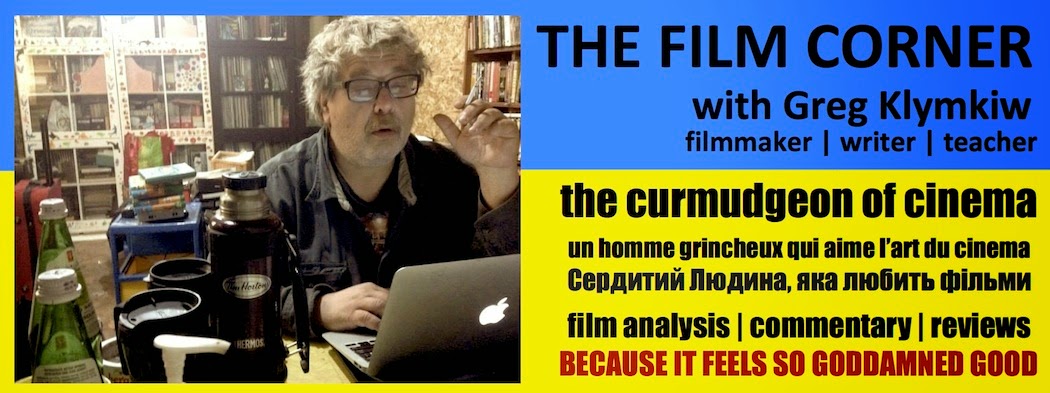
GREG KLYMKIW - THE CURMUDGEON OF CINEMA

Greg Klymkiw’s 35 years in the industry includes journalism, screenwriting, script editing, producing and 13 years of service to the Canadian Film Centre as its senior creative consultant and producer-in-residence. In addition to producing iconoclastic work by Guy Maddin, Cynthia Roberts, Bruno Lazaro Pacheco and Alan Zweig, his legendary guerilla campaigns as the Winnipeg Film Group’s director of distribution and marketing placed prairie post-modernist cinema on national and international stages. In addition to Klymkiw Film Corner, he writes for POV Magazine, Phantom of the Movies' VIDEOSCOPE and, among many others, Electric Sheep - a deviant view of cinema. He's writing a book about screenwriting entitled "Movies Are Action" featuring interviews with some of the world's best filmmakers and he is the subject of Ryan McKenna's documentary "Survival Lessons: The Greg Klymkiw Story". At last count he had seen over 30,000 feature films.

Wednesday, May 22, 2013

LOVE IS ALL YOU NEED - Review By Greg Klymkiw - Hubbies will snore. Wifeys will laugh and swoon. Yes folks, it's a post-menopausal chick-flick not unlike "HOPE SPRINGS". Only it's partly in Danish. This doesn't help.


Love is All You Need (2012) **
dir. Susanne Bier
Starring: Pierce Brosnan, Trine Dyrholm, Paprika Steen

Review By Greg Klymkiw

Some movies to me are just so utterly, reprehensibly, unrelentingly sickening I feel an immediate need to check myself into Emergency. Love is All You Need is just such a movie. There is, however, one salient difference between it and similar lumps of cinematic viscous like the Sex and the City movies, anything starring Sarah Jessica Parker and virtually every "chick flick" of both the pre-and-post-menopausal variety made by men.

Love is All You Need is almost good - or rather, made by a woman and aimed at women, it's good for what it is. This I'll admit, is not an especially ringing endorsement, as the movie appears to be aimed at a herd of dull, unimaginative and quite possibly stupid members of the female persuasion.

The picture carries the weighty pedigree of director Susanne Bier - a stalwart camera jockey who made a well written (by Anders Thomas Jensen), but boringly directed movie called Hævnen (AKA In a Better World) which, inexplicably won the Best Foreign Language Film Oscar in a year when it was up against a number of truly fine and challenging films. Then again, this was the immortal 83rd Academy Awards when the execrable The King's Speech swept all the major prizes, so chances are good Oscar was wearing his extra-strength Dunce-Cap with considerable gusto and pride. Still, Bier handles the slightly offbeat romantic comedy proceedings of Love is All You Need with the requisite skill one would expect from a first-rate camera jockey.

But, my God, the picture is sickening! So much so that I practically needed to nail my feet to the floor in order to stop me from bolting after ten minutes. What's even more sickening is realizing just how many people (of a certain persuasion) might actually enjoy it. (I have to keep reminding myself that we're in the Decline of Western Civilization.)

Basically, we've got ourselves a sexy, slightly post-menopausal Danish housewife who is recovering from breast cancer. Her nebbish hubby is boinking his insanely young bookkeeper and dumps wifey for the more decidedly pert pastures of a woman barely out of the cradle.

And wouldn't you know it?

All this is happening on the eve in which our middle aged Danish Treat and her chunky, loutish, bone-headed philandering hubby are about to jet off to Italy to marry their sexy daughter off to the hunky son of an incredibly rich fresh fruit magnate.

The Fruit Man is played by none other than Pierce Brosnan. In all fairness, he acquits himself very well as the romantic male lead just as Trine Dyrholm does as his female counterpart. For the life of me, though (and perhaps I was daydreaming about William Friedkin's Killer Joe and missed something), but I simply couldn't figure out how or why this Brit had a company in Denmark, had all sorts of co-workers yapping at him in Danish, while he replied in English. I mean really, now. At least we in the audience had English subtitles. Pierce had none. Nor, of course, did any of the happy Danes have English subtitles. In spite of this, both parties seemed to do quite well in the understanding-each-other-sweepstakes. Let's hear it for the United Nations!

Okay, now wait for it. I'm about to reveal something extra-sickening.

Are you ready?

Good.

The Sexy Fruit Man and the Sexy Danish Treat de la Hausfrau meet...

- Oh, Christ!

Dare I say it?

God, did I even believe it was happening when it was happening?

Was it really so hard for me to just get up and leave at this point?

I stayed, however, and can live to now tell you the tale.

Besides, you probably guessed it.

THEY MEET CUTE!!!

Both of them are in the airport parking lot on the way to Italy and whammo! Danish Lady slams her car into Fruit Man's. Hilarity ensues.

Can it get more sickening than this? Oh, you bet.

Once we get to Italy and the predictable romantic roundelays play out, I realized then and there just how skilfully simmered this bowl of oatmeal with flakes of bran (and a side of prune juice) actually was. No offence to the ladies, but the biggest and most sustained laughs came from the feminine persuasion in the audience (and believe me, none of them looked like they ventured too far from the suburbs).

Then it hit me - the nightmare scenario: Every middle aged hubby of the bourgeois persuasion will be dragged to this movie by their equally bourgeois middle aged wives. The wives will be yucking it up twixt having to violently elbow their hubbies to stop them from snoring. I experienced this horror all by my lonesome when I went to see the insufferable Hope Springs. Luckily my wife wouldn't be caught dead at a movie like that. She has, what is referred to by some as, taste. As I suffered through Meryl Streep trying to bring romance back into her marriage with Tommy Lee Jones, all I could hear was - you guessed it - the laughter of women and the snores of their hubbies and the occasional elbow slams into their ribs.

Love is All You Need is pretty much more of the same.

Only much of it is in Danish.

Not that it helps.

"Love is All You Need" is currently in theatrical release via Mongrel Media.

Tuesday, May 21, 2013

PICTURE DAY - Review By Greg Klymkiw - Canuck Feature Length After-School Special squeaks by (barely) with a passing grade thanks to its winning leads (who wrestle valiantly with a humdrum script and barely-by-the-numbers direction).


Picture Day (2012) **
Dir. Kate Melville
Starring: Tatiana Maslany, Henry Van Wyck, Jim McCarthy, Mark Debonis

Review By Greg Klymkiw

So you look like you're at least 25-years-old, but you're really 18 or 19 and though you're incredibly bright and funny, the public school system is holding you back from graduating so you can pass Physical Education - a public school system that in the real world will do everything in its power NOT to fail anyone, much less hold someone back for being slightly rebellious, a bit lazy, but genuinely on the ball.

Now, if I'm going to buy any of this in a movie, the proceedings better be so damn good I don't have time to think about nits to pick while I'm watching it. Alas, the movie gave me plenty of time to think. Hell, I've even got kinks in my back to prove it from assuming the pose of Auguste Rodin's famed bronze sculpture whilst Picture Day unspooled before my eyes. I try to reserve this position for time spent on the throne (that counts), but when I watch movies like this I might as well be perched on the porcelain (if you follow my drift, as it were).


Tatiana Maslany plays Claire, the aforementioned 18 or 19-year-old who looks about 25. Let's accept the improbability of her academic standing. Let's accept the movie's longueurs. Let's pretend we're not bored out of our skulls during any number of moments when we're forced to listen to sub-par "indie" music on the soundtrack while very little goes on visually before us - save perhaps for the scenes in inexplicably packed clubs where utterly dreadful pseudo-art-funk types play their tunes before wildly enthusiastic crowds of young folk while the horrendous lead singer (Jim McCarthy), painted in some ludicrous ghoul-like makeup, oozes about the stage like some bargain basement Lizard King.

Now, seeing as the audience (in the film, not the theatre you'll be watching this in) are grooving on this music, I'd assume we're watching a Lars Von Trier movies since anyone who could even remotely begin to enjoy this music must surely be of very little brain. But no, this is not Lars Von Trier. Last time I checked, he didn't make After School Specials. Besides, one of the enthralled audience members in the picture is Claire and she's definitely not a few bricks shy of a load (at least so the movie tells us).

That said, one's got to wonder about the character's state of mind since she clearly likes the treacle purporting to be music and even more felchingly (yes, you read that correctly), she's quite enamoured with the bodily charms of the lead singer as she ogles him lasciviously in the washroom.

Ugh!


At school, she's quite the Holy Terror. She skips classes. She's a tad mouthy. She's into leather. Horrors. When she's in school at all, she encounters a goofy freshman (Henry Vsn Wyck) that she actually used to babysit. Feeling sorry for him, she coaches him how to be cool and get chicks. Even still, he seems to have a thing for Claire. Not that she's what you'd call a MILF, but she is an 18 or 19-year-old who looks at least 25. Hmmm. Doing the math on this, I guess she could be a MILF.

Between coaching our freshie and boning the loser musician, we learn than her single parent Mom is in quite a funk, so perhaps this is reason enough for Claire to avoid growing up. Eventually, the meandering of the film's narrative reaches quite a head and bursts like an infected cyst.

Yes, Claire learns something.

Seriously, if the two leads, Maslany and Van Wyck weren't as winning as they are, I suspect my tolerance levels would not have been so tempered. Van Wyck has a pleasing, funny presence and I look forward to seeing him in a real comedy. Maslany has "star" written all over her. The camera loves her and she even makes most of the meant-to-be-funny dialogue vaguely amusing. Some day, I will see her in a real movie - perhaps something American (preferably a studio picture and not some loathsome fake indie).

It's also worth mentioning that Picture Day features a terrific supporting performance from Mark Debonis as a genuinely hilarious character who works as a bingo hall caller. (If the writing throughout had been up to this character's hilarity level for the entire movie, I might have been convulsing with yucks from beginning to end instead of just during his scenes.)


This is, overall, a pretty woeful teen comedy - the worst kind, actually, as it's trying very hard to be "different". Unfortunately, movies don't get points for trying hard, especially when we can actually see it labouring so heavily to be off the well-trodden path. Worst of all, I kept coming back to the same conclusion - the movie felt like I was watching an After School Special. They don't make those anymore, thank Christ, but I still wracked my brain while sitting through the picture as to why it felt like some bourgeois middle of the road TV movie pretending to be cutting edge.

As my readers know, I refuse to read any reviews or puff pieces or even watch trailers before I see movies - I like to be fresh as a daisy when I sit alone in the dark. (Unlike Roth's Portnoy, I try to perfume my Mounds wrappers.) All I knew is that it was Canadian, a comedy, featured a stellar leading lady and that some people (who probably should know better) were under the impression that it was good.

So, armed as I was with a relatively blank mind (yeah, feel free to take a cheap shot on that one - I've had plenty opportunity to volley my fair share of those in this piece), I couldn't help but let out a guffaw or two whilst slapping my knee after seeing the movie and deigning to read some of the P.R. bumph.

Why the mirth?

Because while I watched the movie, I eventually shoved the notion of an After School Special out of my mind and concluded that I was watching an episode of Degrassi. Lo and behold, it turns out that the writer and director of Picture Day has a myriad of television writing credits - Degrassi among them.

Well, gosh durn it, this fella be fit t'be tied!

I've seen a lot worse than this movie - especially in Canada. Picture Day certainly doesn't deserve an F or even a D, but it barely squeaks by with a C- (or C, to be charitable). And once again, I have suffered through a feature film that feels like a longer version of a TV show and I especially hate going to the movies to watch television.

Luckily, I had a nice palate cleanser after seeing this one and popped my Blu-Ray of Amy Heckerling and Cameron Crowe's Fast Times at Ridgemont High on. Phew! Thank Heaven for Tender Mercies!

"Picture Day" is in limited theatrical release including a run at TIFF Bell Lightbox before it winds up on - you guessed it - TV.

Friday, May 17, 2013

MICMACS - Review By Greg Klymkiw - Anytime is a good time to crap on French whimsy.


Micmacs (2009) *1/2
dir. Jean-Pierre Jeunet
Starring: Dany Boon, Jean-Pierre Marielle, Yolande Moreau, Julie Ferrier, Dominique Pinion, Michel Cremades, Marie-Julie Baup, Andre Dussolier, Nicolas Marie

Review By Greg Klymkiw

There is a particular brand of whimsy that forces me to eject globs of bilious half-digested food matter into whatever receptacle might be handy (and God forbid those around me if I am bereft of such a loving cup). My revulsion is so intense that even hearing the word "whimsy" (or seeing it or writing it) can inspire in me, at the very least, the dry heaves. In spite of this, there are many movies of a whimsical nature that I like or even love which leads me to believe that ultimately, not all whimsy is created equal.

Let's take Tim Burton, for example. If I ever have to see even one more frame from "Big Fish" again, I will find a water tower, climb atop it with a high-powered sniper rifle and start shooting innocent passersby at random. "Edward Scissorhands", however, is a movie I am always happy to see - not a steady diet, mind you, but enough to remind me of what I love about it (and to pinch me on occasion with respect to its occasional dollops of minor bile-inducement). Perhaps it's as simple as feeling that the whimsy is machine-tooled in the former and tied genuinely to emotional truth in the latter. Granted, we feel Burton's weighty hand in each movie, and his intentions might well have been true in both pictures, but one seems false, while the other seems perfectly natural in its use of magical realism.

Of late, Jean-Pierre Jeunet is a director who has sadly allowed whimsy to consume his work in a manner that is mind bogglingly sickening. His first major solo directorial effort after the thoroughly decent, but mildly overrated Caro collaborations "Delicatessen" and "City of Lost Children" was "Alien Resurrection", the third sequel to Ridley Scott's absolutely perfect blend of science fiction and horror. While all the sequels to Scott's near-masterpiece "Alien" seem ill-conceived, Jeunet's foray into the franchise was poppy, pulpy and, at times, downright scary - a far cry from the dour, humourless clamour of James Cameron's "Aliens" and Fincher's dour, humourless mess that was "Alien3". (While the first AVP was stupid, it was at least kind of fun.) So when "Amelie" finally came along, I was primed for more Jeunet - especially since "Alien Resurrection" was so solid.

I saw "Amelie" with my wife. We had (and continue to have) a silent code at the movies (which now extends to my daughter and I). When we both agree that a movie is intolerable, we leave the theatre and sneak into something else in the multiplex. The code is rather simple and not obtrusive to others in the cinema. I turn my head towards her and just stare until she turns her head and either nods (in which case, we totally walk the fuck out of there) or gently shakes it (and we give it more time). Sometimes it's vice-versa, but usually (and surprisingly, no doubt, to those who know me), I am usually the instigator of the courteous silent "let's hit the fuckin' road!" With "Amelie", I relentlessly drilled holes into the side of my wife's head for what seemed an eternity. She refused to look at me. Her eyes were transfixed upon the screen. Finally, I jabbed her with my elbow. She turned. I had the tell-tale "let's fuck off" look on my face. She returned my gaze with surprising confidence and whispered, "Please let me enjoy this movie." I relented and spent the entire time wanting to rip that idiotic grin off Audrey Tatou's bone-headedly whimsical face whilst swallowing cold lumps of vomit that needed to desperately escape my gullet.

I never bothered to see "A Very Long Engagement" but in order to make my Jeunet-hatred complete and most importantly, truly informed, I suppose I will, at some point, nail my feet to the floor and suffer through the damned thing. For now, however, Jeunet's latest dive into the cesspool that is whimsy, more than makes up for this omission in my cinema literacy.

Strangely enough, "Micmacs" opens rather promisingly. At the beginning, we find ourselves on a Moroccan desert where a group of soldiers are sweeping for mines. Sadly, one of the soldiers discovers a mine and carefully sweeps sand away from it. In doing so, the strangely embossed logo on it is the last thing he'll see as the mine explodes in his face.

Back in France, a dreamy young boy hears the jangling of a telephone. After his mother answers, he hears her grief-stricken sobs. He peers in to see her trembling, her face almost draining of sanity as he stares with a mixture of knowing dread and confusion.

After the funeral, the mourners gather in the family home of the fallen soldier. The boy's mother is catatonic. When presented with a box filled with his father's effects, the boy makes a mysterious find that will become important later in his life. Mom is carted off in an ambulance to the loony bin and the young boy is sent to a private school and orphanage run by the meanest nuns I've seen since my own childhood. At one point we see him forced to kneel for hours on end, his bare kneecaps resting painfully on a long square of thin wood. (For me, it was bare-kneed on uncooked rice, but that's another story.)

Thirty years later, our dreamy young orphan has grown to manhood and promisingly appears to us as Bazil, an even-more-dreamy sad sack working late night in a video store. Happily, Bazil is played by the truly brilliant actor/comedian Dany ("Joyeux Noel") Boon - his gentle poker-face endearing him to us immediately. Even more heartening (and heartbreaking in all the right ways) is how we find him sitting alone in the dusty, old store watching "The Big Sleep" in French and expertly mouthing all of Bogart's dialogue.

Great! So far! No whimsy alarm bells of note and a vaguely melancholy drama with one of the world's great actors.

Bazil's cinematic Heaven is rudely interrupted by a car chase outside the store. Two thugs speed along, shooting at each other. Bazil walks outside to survey the ensuing carnage worthy of a Luc Besson film.

So far, so good. Perhaps we'll be immersed in a noir-like thriller.

And then, my heart sinks. One of the thugs is shot. His gun flies in the air. It discharges as it hits the ground and a bullet propels across the street and directly into Bazil's skull. This would officially be whimsy alarm bell Number One!

In the operating room, the presiding surgeon explains that if they leave the bullet in, Bazil has a chance to live a normal life - but just a CHANCE. There will always be the threat that it could discharge in his brain. If they operate, he will possibly live, but as a vegetable.

Bazil's fate is then decided when the surgeon flips a coin. This would officially be whimsy alarm bell Number Two!

With bullet in brain, Bazil is discharged to find that all his worldly goods have been confiscated and/or stolen, that he has been evicted from his apartment for not paying rent and that he's lost his job at the video store to a cartoon-watching, big-breasted bubblehead who conveniently has found and bestows upon him the casing of the bullet in his brain which also bears the strange markings we've seen earlier. The plot, as it were, is thickening - like a salt-free split-pea soup.

Bazil is forced to become a street performer whose specialty is recreating silent movie comedy routines. He is, in essence, a mime artist.

Mime!

And yup, you guessed it, this would officially be whimsy alarm bell Number Three! Or, in the parlance of baseball enthusiasts the world over: "Three strikes and yerrrrrrrrr out!"

At this point, my only thought is, how bad can this possibly get?

Well, hold on a moment and you, like I did, will receive the answer.

After a mime performance in the street, he is hailed over to the table of a distinguished looking old rapscallion (Jean-Pierre Marielle) who introduces himself as Slammer (he's spent most of his life in prison - get it?). Bazil is convinced by Slammer that he needs a safe haven, a place to be useful, a family. Slammer bids Bazil follow him to what could be a new home and beginning.

Here is where the vomit-meter overloads. Within the bowels of a dank cave-like environ, Bazil is introduced to a group of fellow misfits who live happily together - away from the cruelty of the outside world, and spend their time assembling other people's junk and ever-so whimsically, transform the trash into a variety of magical contraptions and/or art. Jeunet stalwart Dominique Pinon plays some loser who wants to get himself into the world record books for being a cannonball artist. Claude Zidi regular Michel Cremades plays an especially offensive whimsy-poo who creates all manner of "magical" art and toys and has the stupidest bovine expression on a human face since Audrey Tatou in "Amelie". As if this wasn't sickening enough, there is a female contortionist who becomes Bazil's love interest and some idiotically whimsical young lady who can only communicate through complex calculations (Ulrich Seidl knows such a character needs to be treated disdainfully as a cretin - much like a similar character in the admirable Austrian iconoclast's "Dog Days").

If any of this hasn't invoked bile yet, I've saved the most disgustingly whimsical character for last - a cherry, so to speak, on an ice cream sundae, flavoured with waste-treatment-plant sludge for syrup. The matriarch of this utterly horrid "family" is the porcine Mama Chow who dotes over all the "children" (losers) since she moronically lost her own children when they entered a house of mirrors at the circus and never came out. I can only assume she is meant to be rather challenged in the brain department.

Oh yeah, and if you're still not convinced to avoid this grotesquerie, feel free to become Father Damien and hop onto the isle of Molokai that is "Micmacs" and thrill to this group of loveable spastic lunatics as they band together to destroy the arms manufacturers (yes, the companies bear the same mysterious logos we've seen earlier) who orphaned Bazil with the mine that killed his Dad and turned him into a walking dead man with the bullet that's lodged in his brain.

What finally drives me insane about this picture and "Amelie" (and no doubt, the one Jeunet I still have to force myself to see) is that Jeunet is clearly a born filmmaker. Cinema is hardwired into his DNA. He is not only an artist of the highest order, but he's proven that he also has proficiency, a sense of humour and the potential to make some great movies that will truly knock us on our ass, or, at the very least, scare the living wits out of us.

This horrendous phase of machine-tooled whimsy must end. Better Jeunet should instil vomit through the GENRE of horror rather than the horror that is this unrelentingly happy-happy-happy-let's-do-good-for-society nonsense. The first fifteen minutes of the picture suggested that greatness would follow. I try to imagine the picture it could have been, but I suppose that's completely unfair. Jeunet decided to crap where he sleeps and instead, delivered a bunch of "loveable" losers to make (a) losers feel good about themselves and (b) those who do not consider themselves losers to feel good about EMPATHIZING with losers.

There are many who will love this film. I'm not one of them. Give me the Caro-Jeunet collaborations or "Alien Resurrection" anytime over this whimsical sack of dung.

In the meantime, I pray that someday Jeunet will make a genuinely great picture. It's in him. He's just got to do it.

"Micmacs" is available on Blu-Ray and DVD via E-One.

Thursday, May 16, 2013

RIDER ON THE RAIN - Review By Greg Klymkiw - Terrific 70s Euro-Trash Art Thriller by René Clément.

All the public domain copies I tried to watch
were so abysmal - bad cropping, faded colours
& sloppy dubbing - that every attempt to get through
it was foiled by the poor presentation. Until recently,
I didn’t even make it as far as the rape scene.

Rider on the Rain - U.S. title
Le passager de la pluie - French Title (1970) ****
dir. René Clément
Starring: Marlene Jobert, Charles Bronson, Annie Cordie, Gabriele Tinti and Marc Mazza

Review By Greg Klymkiw

Discovering movies you’ve never seen before is always fun – especially when you, like me, have seen over 30,000 feature films and think (wrongly, of course) that you’ve seen everything worth seeing. When those undiscovered titles are gems like “Rider on the Rain”, A.K.A. “Le passager de la pluie,” the rise of tantalizing gooseflesh is all the more deliciously palpable as it overtakes your body and soul.

This thoroughly entertaining and creepy Euro-trash thriller from the 70s has been kicking around for a long time in North America in a variety of downright awful English-language public domain transfers on both VHS and DVD.

Until recently, however, I had no idea how good it actually it was.

This was not for lack of trying. Alas, the public domain copies I saw were truly abysmal - the cropping distracting, the faded colours hard on the eyes and the English dubbing so sloppy that, on each attempt, I didn’t even made it to the rape scene which, of course means, that I never sat through it long enough to even see Charles Bronson make his first appearance.

I recently, however, came across a Russian DVD release of the exquisite Studio Canal re-mastering of the French-language version with English subtitles (and for those inclined, subtitles in Russian, Spanish, German, Hebrew and a variety of Asian languages). I can now say I have watched the rape scene, Charles Bronson’s entrance and then some.

Directing over thirty films from the late 30s to late 70s, René Clément was truly one of the great French directors, but in recent years especially, his remarkable canon seems to have been largely ignored in favour of those of the Nouvelle Vague ilk and some of the more recent works of Breillat, Noë, Cantet, etc. This is not to say that any of the above needs to be dismissed in favour of Clément, but I do think some sort of major re-assessment and appreciation of his fine output is in order.

That said, he still is deservedly acclaimed in many quarters for the heartbreaking tale of childhood and war “Forbidden Games” (“Jeux interdits”) and the magnificently amoral Patricia Highsmith adaptation “Purple Noon” (“Plein soleil”) which reveals Anthony Minghella’s barely watchable, 1999 version of “The Talented Mr. Ripley” as the uninspired wank it really is. In addition to the above, Clément delivered the tense, claustrophobia of “Les maudits” and his marvelous post-war crime drama with Jean Gabin “Le mura di Malapaga”.

In this and his other pulp suspense pictures, Clément’s respect and debt to Hitchcock is clear, but subtle - unlike, say, DePalma. Not that I’d ever crap on Brian DePalma, whose work I love dearly, but his approach to Hitchcockian-styled suspense is clearly and deliciously over-the-top, whereas Clément adds a dollop here and a dollop there of Hitch, while maintaining a sense of ambiguity that is all his own. Chabrol, too, is a fine French suspense director, but I tend to find his films more workmanlike than Clément’s and his voice is certainly not as rich and distinctive.


Clément, like Hitch, is fond of recurring visual motifs, but Clément is careful (as Hitch always was) to make sure they are thoroughly integral to the world of HIS narrative. They’re not thrown in willy-nilly.

For example, the references to date and time as well as the clock shots – especially those focusing upon a pendulum either locking in or not moving – are dazzlingly evocative, but they are always used to move the story forward. Also, Clément’s use of colour, light and composition reveals a great visual stylist and, like Hitch, he wields his palette like a master – a born filmmaker, his very DNA hardwired to the art and business of creating cinema.

With “Rider on the Rain”, Clément even uses a stunningly gorgeous ice goddess (albeit a truly Gallic version of a Hitchcockian leading lady) as the central femme fatale. Gamine, red headed, lightly freckled beauty Marlene Jobert appears as Mélancolie Mau (gotta love that name), the beleaguered wife of Tony (the suitably nasty Gabriele Tinti), a downright horrendously repugnant old world sexist pig who questions her every move and keeps her in an iron-clad grip – in spite of his seemingly endless jaunts all over the world as an airline pilot. Mélancolie’s mother, Juliette (a brilliant Annie Cordy) is a self-hating drunk who operates a bar/bowling alley and turns her self-loathing into a weapon against her own child.

These happy people all live in a seaside resort town. As the movie begins, it is the off-season and few souls wander the empty streets. A nasty torrential downpour brings a tall, creepy, bullet-headed stranger (Marc Mazza) to town on a bus that normally wouldn’t even stop at this time of year. The stranger, whose name is Mac Guffyn (get it?), wanders about the town with seeming aimlessness, but soon it’s obvious he’s targeting our heroine, following her everywhere with a steely gaze.

For her part, Mélancolie runs a few errands, including a dress shop visit to pick up a fashionably hot number to adorn her sultry frame for a wedding she’ll be attending the following day. Speaking of hot numbers, it’s not just the clothing that’s delectable – the ravishing Jill Ireland (Mrs. Charles Bronson) has a small role as the dress shop proprietress, primping and preening our gamine heroine whilst Mac Guffyn stares salaciously through the store window. Mrs. Chuck doesn’t see him, but Mélancolie does. She freezes in terror, but does not reveal to anyone that she sees him.

Well, before you can say “rape”, Mélancolie is back home and the oval-domed Mac Guffyn enters quietly, throws her to the bed and savagely forces himself upon her. She eventually passes out, wakes up alone, considers calling the police, but mysteriously doesn’t. Mac Guffyn shows up again. He’s merely been resting up for sloppy seconds. Mélancolie engages in a brutal physical fight with him, grabs a double-barreled shotgun from the basement, shoots him and finally, blood gushing from his chest, he still attempts to get up and our plucky gamine beauty bludgeons the creep to death. Again, for very mysterious reasons, she does not call the police, but instead, drives his body out to a remote cliff and dumps it into the sea.

The next day, as if nothing has happened, she and her sexist pig husband attend a wedding. During the ceremony, she spies the smirking, gorgeously mustachioed Charles Bronson, drilling holes into her with his intense Slavic eyes. At the reception, Bronson introduces himself as Harry Dobbs (Christ! Another great character name that you’ve just gotta love!), an American colonel of seeming disrepute and predatory intentions. For some reason, he knows she’s murdered Mac Guffyn.

For the rest of the movie, a strange cat and mouse game plays out where Dobbs relentlessly tries to get Mélancolie to admit to murder and she does everything in her power to deflect his accusations. There is, of course, more to all this than meets the eye – one layer of mystery lies on top of yet another and Mélancolie finds herself mixed up in something very creepy, dangerous and well beyond her comprehension. As for Dobbs, his intentions remain murky, but as the film progresses, it becomes obvious that both characters are becoming inextricably drawn towards one another.

While the picture is far more ambiguous than Hitchcock would ever tolerate, it’s still a terrifically suspenseful and entertaining mystery thriller. It’s even been suggested in some quarters that the film inspired Jim Morrison to write his evocative hit “Riders on the Storm” and given certain images and plot elements of the picture, it’s not entirely inconceivable. The opening lyrics that comprise the song's eerie refrain definitely mirror Mélancolie’s situation:

Into this house we’re born
Into this world we’re thrown
Like a dog without a bone…

The “sins” of Mélancolie’s mother have definitely rubbed off on her, though she’s tried her whole life to live with them and “like a dog without a bone”, she seems ill-equipped to deal with the cards dealt her way, but still manages to persevere – with, of course, a little help from a grinning Cheshire-cat-like Harry Dobbs.

Mac Guffyn, of course, is the literal “rider on the rain” of the English title – a serial killer/sexual deviant who is not unlike Morrison’s evocation of:

… a killer on the road/his brain is squirming like a toad…

And finally, in spite of Mélancolie and Dobbs falling for each other, it’s clearly going to remain unrequited – so much so that they each admit their love to themselves, but not each other and Mélancolie stays with her brutish husband and Harry goes off alone in his sports car. Again, one can imagine Morrison seeing the film and penning the lyrics:

Girl ya gotta love your man
Take him by the hand
Make him understand…
Gotta love your man, yeah!

Certainly even the opening shot of the film feels like it could have inspired Morrison and team – a huge body of water looking like a lake or river as rain drops plop violently on the surface of the water until the wheels of a bus splash into frame, revealing that we’re actually looking at a rain soaked highway through a wide angle lens. This is followed by a series of shots of the bus itself - seemingly bereft of passengers until it stops, then drives away to reveal the trench-coat-adorned Mac Guffyn, standing in the rain and clutching a small ref leather bag.

Furthermore, if there is any truth to Morrison being inspired by the picture, surely such inspiration extended to other members of The Doors. The song “Riders on the Storm” is endowed with one major similarity to Clément’s picture – it’s superbly scored by Francis Lai with a number of evocative themes – many of which feature the kind of varied and sophisticated instrumentations favoured by the band itself. This, by the way, is an original soundtrack album worth owning – rare, but not impossible to track down. It works, not only as film score but also as music that bears both close scrutiny as well as its simple ability to create background mood for just about any social situation one finds oneself in.

In spite of the theorizing about the film’s influence upon Jim Morrison, the point might be moot if centred solely on the title since the English title “Rider on the Rain", translates from the French title “Le passager de la pluie” more literally into “The Passenger of the Rain”. While this, in and of itself, might have also been influential, it’s probably Clément’s images and themes that might have had an even greater impact upon the late, great Lizard King.

Another interesting aspect of Clément’s film is that it opens with the following quotation from Lewis Carroll’s “Alice in Wonderland”:

The pit was very deep, or she fell very slowly, because while she fell, she had time to look around and to wonder what was going to happen next.

This is an apt opening quotation for a number of reasons. Firstly, the movie is endowed with odd dream logic to its narrative structure. Secondly, Mélancolie does indeed experience a long, slow fall/descent. Thirdly, she wanders through the picture with a wide-eyed wonder of a naïf being led by a grinning Cheshire cat – none other than Harry Dobbs and Bronson’s charmingly sardonic visage and performance.

Bronson’s performance, by the way, will be a revelation to those ever who doubted his abilities as an actor. He’s always had considerable star power, but many have ignored the qualities he owned below the skin-deep tough guy exterior. His performance here is so compelling, one wishes he had more roles in his career like this one – roles that could have mined his myriad of thespian gifts.

Marlene Jobert as Mélancolie is also a revelation. In spite of her performance in this and Godard’s “Masculin feminin”, she never quite maintained the stardom of many of her contemporaries in France. Her Mélancolie is, however, nothing short of extraordinary. She takes a complex character and breathes the kind of life into it that makes both her and the role nothing less than unforgettable.

And what a role it is – so sexy and so mysterious, especially early on in the proceedings. For example, some of Mélancolie’s head-scratching moves at the beginning of the film (not calling the police and dumping Mac Guffyn's body – moves that set all the picture's wheels in motion – have often been mistakenly seen as either problematic storytelling and/or ambiguities.

I’d suggest they are neither.

This is, after all, the story of a woman who carries and tries to shed the sins of her mother and is locked in a marriage wherein she is constantly abused into submission and, by her very actions, her journey of self-discovery is responsible for finding what it was she loved in her man in the first place and she learns to work at mining those aspects rather than succumbing to his worst traits and/or running away from them. It’s a blossoming, a maturation process. She confronts everything head-on and takes us on a thrilling serpentine journey of sex, murder, mystery and suspense.

What more could one possibly ask for?

It’s a terrific picture!

See it!

This is a hard movie to get in the original French version. For my part, I wish to thank the Lord Jesus H. Christ for my obsessive frequenting of Russian video stores in North and West Toronto where I found the DVD. The release even appears legit, as I have seen it advertised on Amazon. The Studio Canal version is also available on Amazon. This is probably the best way to see the picture on this side of the Atlantic, especially since there appears no sign of a North American DVD or Blu-ray release of Studio Canal’s pressing.A

Wednesday, May 15, 2013

BLACKBIRD - Review By Greg Klymkiw - Harrowing indictment of repressive hate laws in the hands of the Status Quo as a weapon against individuality and free speech. A directorial debut that dazzles!


Blackbird (2013) ****
Dir. Jason Buxton
Starring: Connor Jessup, Alexia Fast, Alex Ozerov, Cory Arnold, Michael Buie, Tanya Clarke

Review By Greg Klymkiw

God Bless, Charles Dickens. Even his more detestable characters are often blessed with powers of analysis and reason that exposes the humanity inherent in all. Take, for example, the venerable constabulary beadle Mr. Bumble in "Oliver Twist". Presiding over the orphanage and workhouse, he's the famous literary personage whom the waif-like title character pleads - holding his empty gruel-bowl forward, "Please, Sir, may I have some more?" "More!!??" Bumble bellows incredulously. Aside from administering a variety of nasty corporal punishments and personally taking to the streets to sell "bad boys", Dickens places the following words of wisdom in his mouth:

"... the law is a ass- a idiot. If that's the eye of the law, the law is a bachelor; and the worst I wish the law is, that his eye may be opened by experience- by experience."

Bumble is, of course, referring to Mr. Brownlow's climactic line of questioning in the great book and looking for any way to get out of a sticky wicket he's placed himself in, Bumbles blames his wife. Brownlow asserts that Bumble is more guilty than his wife since "... the law supposes that your wife acts under your direction."

To this specific charge, Bumble is quite right. The law IS an ass! So it has always been and so it always will be - this "ass", this "bachelor" woefully lacking "experience".

Watching Blackbird, the feature length debut by writer-director Jason Buxton, I could not help be reminded of Bumble's words - especially since the mere act of viewing this fine and gripping drama inspired such anger and frustration within me over a system that often jerks its knee in defence of the status quo and has little use for free expression and those things that fall outside the assumption of (purported) normalcy.

How many of us in childhood have experienced the teasing and bullying of the supposedly "normal" amongst us and wondered, even as kids, why the absolute lowest common denominator amongst our peers and "betters" was something to aspire to? Why must we be like everyone else? Why must we be cogs in a machine that many consider to be humanity? Isn't humanity rooted in being oneself? Must we suffer derision - not just as kids, but as adults - taking little interest in the inanities of the water cooler conversations every morning at the office?

Aren't THEY, the "normal ones" the assholes?

Well, yes. THEY are! Unfortunately, we have to put up with them and seek solace in our individuality and search high and low for the like-minded until we find them. Unfortunately, in the wake of the massacres at Columbine, Montreal, Newtown, Aurora and Boston - ANYONE even slightly outside of the norm is viewed with suspicion by the general populace, any ACTIONS (most often involving alternative self-expression within the form of art) is viewed by the lunkheads of society as a threat and the law in such cases?

It's an ass.

This is the horrendous place where Sean (Connor Jessup) finds himself in Buxton's always compelling Blackbird. Sporting a Goth-lite look, obsessed with ultra-metal musical styling and blessed/cursed with a talent for writing, he's been booted from the city by his status-hungry Mom (Tanya Clarke) into the care of her ex-hubby and his long-estranged Dad (Michael Buie), a straight-up man's man in the country who loves bagging game, chugging a good brewski and relaxing to the cathode ray flicker of Hockey Night in Canada. Sean's new home life could be worse, though. Dad seems like a genuinely nice guy who desperately wants to connect with his son and offers a fair bit of room for the kid to move.

Alas, this is a rural community and Sean must contend with the dolts he's surrounded by at school. (This is no cliche. I had to eventually pull my own child from a small town school due to the bullying, misogyny, sexism and overall stupidity of her peers and so many of the teachers and administrators of the school.) What's truly valued amongst these drooling knuckle-draggers is being a jock (and the young ladies must be obedient, compliant and sexual). God help you if you aren't. And jocks absolutely despise kids like Sean. He's picked-on and pulverized by these morons and viewed by everyone as a freak.

His only friend is the most gorgeous babe in the school, Deanna (Alexia Fast). They clearly form a special bond, but she is forced to hide her attraction to Sean since she's also dating the star jock of the school Cory (Craig Arnold), one of Sean's prime tormentors. And let it be said that guys like Cory are a pathetic dime-a-dozen once they leave high school. They've got hockey pucks for brains and unless they're really exceptional in their sporting activities, they're eventual mantra will be (to quote a line from Slap Shot), "Fucking Chrysler plant! Here I come!"

Try explaining that to a kid like Sean - or anyone. They're years away from recognizing and realizing this. (Ironically, though, it's losers like Cory who form the majorities in our world and continue their bullying indirectly, through their bone-headed lack of imagination, kowtowing to the Status Quo and voting for the pawns of the New World Order like Georgie Bush (Sr. and Jr.) and Stevie Harper.)

Poor Sean is so desperate that a well-meaning guidance counsellor suggests he get his frustrations out on paper - he is, after all a burgeoning writer, and where better to express one's pain than in the realm of fiction? Makes sense to me.

Unfortunately, artistic expression is the beginning of a living nightmare for Sean. His online writings are taken as "uttering threats" and he's incarcerated in "juvie" by the "ass" of law to - I kid you not - await trial. Eventually, he's faced with an even more idiotic decision on the part of the narrow-minded inbred society of Man: plead guilty and be free. Plead not guilty and "lose".

Every step of the way Buxton grips the audience. Though not quite as dark and morbid as it could/should have been, it's impossible to take one's eyes off the screen. It's a superb narrative - designed to both reel us in, drag us through the muck and keep us affixed to the hook - no matter how much we thrash in protest over the situation we (via Sean's POV) find ourselves in. Solid, intelligent direction and a perfect cast are the delicious cherries on the sundae of a superbly wrought screenplay.

Having to experience the lack of understanding on the part of even those who believe in Sean angers us, since his personal expression is what leads to his pariah status in this backwards community. Even worse is seeing grown adults just hoping he'll lie and admit guilt - thinking he will ultimately better off, but also to remove the inconvenience this causes them. All this because a creative kid's writings are perceived - not as fiction, but genuine threats. Shiver me timbers, he's going to kill us all. Hell, maybe a good many of them deserve to be culled, but Sean isn't going to be the one to do it. It'll be their government that will create a fake war to make money for a few rich guys so young men can go off and think they're fighting to the death for truth, justice and freedom.

Beating down those we don't understand and then punishing them is just too prevalent in our world. Thematically, Buxton's film works hand in hand with both the narrative and the superbly etched characters. His mise-en-scène betrays what must have been a relatively modest budget - the world he creates feels lived in. Buxton is blessed with a great production design and camera team - the antiseptic qualities of both the school and the juvenile detention centre contrast beautifully with the bucolic countryside and genuine down-home warmth of the home Sean's Dad lives in. Especially impressive is the cutting which always moves the fine coverage forward, but at a pace that's always just short of the proverbial Col. Kurtz "snail crawling along the edge of a straight razor". This doesn't mean it's slow or tedious in any way shape or form, it captures rural life to a "T" and most importantly creates a creepy crawly feeling throughout - especially the sequences in the juvie centre where we get a sense of just how time passes within such institutions.

The tiniest of false notes creeps in here. I couldn't help but feel that the film shies away from the sexual abuse within such centres which, I think in the case of someone like Sean, would have been constant. Aside from taunts and beatings, I know from numerous sources that spent time in such institutions that people like him become cum receptacles - not just from fellow inmates, but in many cases from staff and even administrators. (This never really ended with the Catholics, folks. It's pretty endemic across the board.) Why the film doesn't take this extra step, is a mystery to me - especially given a subplot involving the juvie centre's prime bully who has an almost retaliatory need to extract sexual abuse etched ever-so deeply in his face.

I suppose this is a bit of a nitpick, but, I think a fair one. On the flipside, though, I often and genuinely felt the same sort of dread and frustration I experienced when I first saw Alfred Hitchcock's The Wrong Man. If Blackbird falls short of the kind of sickeningly harrowing experience delivered by the Master of Suspense, it's not reason enough to complain too much. Blackbird flirts with the surface of Hitch and this is a damn fine stone for any first time filmmaker to skip - so much so one can hardly wait for Buxton's next film and hope he'll fulfil the promise displayed here to completely toss us with abandon into hot coals.

"Blackbird" was the winner of this year's Claude Jutra Award and in limited theatrical release.

GUIDE TO STAR RATINGS

GUIDE TO STAR RATINGS

***** Masterpiece
**** Excellent
***1/2 Very Good *** Good
**1/2 Not Bad ** Whatever
*1/2 Poor * Raw Sewage

If a star rating is not quite up to earning "1/2", I will bestow, in rare instances, 1 Pubic Hair instead of the "1/2".

Hope this helps.!

Trailer for Ryan McKenna's upcoming documentary, Survival Lessons: The Greg Klymkiw Story

KLYMKIW FILM CORNER

Looking for a consumer report on movies?

Go away.

Looking forward to polite and/or politically correct analysis of movies?

Go away.

Looking for objective reportage?

Go away.

Looking for humourless mainstream film criticism?

Go away.

Looking for someone who knows as much about cinema as you do?

Please, stay.

You might not always like what you read, but you'll have something to say about it.

So, dear reader, let's engage in discourse.

Let's celebrate our mutual passion for the greatest artistic medium of modern civilization.

Most of all, let's have some fun!

About the Writer

My Photo
Greg Klymkiw has seen over 30,000 movies. For 13 years, as a Senior Creative Consultant and Producer-in-Residence at the Canadian Film Centre (founded by Norman Jewison) he nurtured, taught and mentored young Canadian filmmakers on all aspects of cinematic storytelling. At the CFC he was a substantial creative influence on over 50 short dramatic films, 100s of production exercises and 12 feature films. He has produced numerous films including the first 3 features by Guy Maddin (TALES FROM THE GIMLI HOSPITAL, ARCHANGEL and CAREFUL), THE LAST SUPPER by Cynthia Roberts (1995 Best Feature Film Teddy Award at the Berlin International Film Festival), CITY OF DARK by Bruno Lazaro Pacheco and VINYL by Alan Zweig. He has been a rep cinema programmer, a film buyer for small town theatres and as the Director of Distribution and Marketing for The Winnipeg Film Group he developed the campaign that created an international cult sensation out of TALES FROM THE GIMLI HOSPITAL and many other films from the rich tradition of Prairie Post-Modernist Cinema. He is currently co-writing several screenplays, a book on screenwriting and contributes to several noted publications on cinema.

Follow by Email

Popular Reviews - Past Week

Popular Reviews - All Time

Stuff I Read

Previous Articles

BUY MOVIES DIRECTLY FROM THESE LINKS AND HELP TO SUPPORT THIS SITE!