Friday, 21 September 2012

END OF WATCH - Review By Greg Klymkiw - Terrific Cop Picture now in Theatrical Release via VVS Films

Tough-as-nails cop thriller with 70s sensibilities, all the nasty mega-brutality one could ask for and a pleasing, saintly, sentimental Joseph Wambaugh-like approach to police on the killing fields of South Central Los Angeles. 


End of Watch **** (2012) dir. David Ayer
World Premiere: TIFF 2012 - Special Presentation
Now in theatrical release via VVS Films
Starring: Jake Gyllenhaal, Michael Peña, Anna Kendrick

Review By Greg Klymkiw

My Dad was a cop for ten years. When I was a kid it was always fun seeing movies with him - especially cop and crime pictures since he always had more than a few things to say about the "Hollywood bullshit" or happily, the lack thereof. Curiously, it was the crime pictures like Scorsese's Mean Streets and Peter Yates's The Friends of Eddie Coyle that Dad always gave high marks to for capturing the side of life he spent a decade of his life fighting.

Most cop pictures left him cold save for their occasional entertainment value, but a handful of pictures stand out as movies he loved on several levels. Richard Fleischer's adaptation of Joseph Wambaugh's The New Centurions was one that Dad always felt came closest to recreating "the life" of cops behind the scenes while Friedkin's The French Connection captured the dull, dirty, mundane aspects of police work and finally, how Don Siegel's Dirty Harry came closest to showing the frustrations inherent in the job and how sometimes, a good cop just had to say, "Fuck the system," and do what needed to be done.

Somehow, I think Dad would have liked David Ayer's End of Watch a lot. Hanging by the slenderest of plot threads, this mostly episodic nosedive into every harrowing moment street cops face, makes for an always jolting ride through the dangers our boys in blue face everyday. The other plus to this very fine picture is both the writing and playing of the two loyal partners Brian Taylor and Mike Zavata - beautifully rendered by Jake Gyllenhaal and Michael Peña.

A cop's partner is his lifeblood. It's become a cliche in movies and TV, but in reality, the level of loyalty, trust and love a cop has for his partner is treated by most filmmakers in cliched or archetypal ways. It's a testament to writer-director David Ayer that he captures this camaraderie by leaping beyond the by-the-numbers mismatched-partners-who-learn-to-love-and-respect-each-other. From the start, we know these guys are made for each other. If anything, their love deepens and becomes even more demonstrative as the danger and violence in the film intensifies.

Ayer achieves this by using a storytelling technique that in and of itself has become a cliche in recent years, but he pushes it to such extremes that as the movie progresses, we become less concerned with form because of the form and Ayer's clever use of it. The opening few minutes, for example, are shot via a windshield-eye-view of the mean streets of a patrol car, accompanied no less by a portentous reality-TV-styled voice-over. At first you briefly think Ayer's gone nuts until he reveals that cop Brian is a part-time law student putting himself through university as a cop and is studying filmmaking as an elective. As such, he is shooting everything on the job to make a documentary as a class project.

I bought this hook, line and sinker.

When Brian's character is not shooting (and sometimes even when he is on-camera with his rolling camera), the rest of the film is mostly pieced together with a variety of surveillance cams and even through the cams the young electronically obsessed villains use. Add great dialogue, superb realist detail, actual locations plus magnificent performances and it all adds up to a terrific neo-realist-styled slice of life.

Ayer's writing for the cops is dead-on, but what's especially great is how he does not shy away from the banalities and cliches used by the South Central villains who do the dirty work for the cartels. Criminals at this level are boneheads of the lowest order - raised on dreadful television in cultural isolation of the lower order. Ayer takes a big chance here - allowing loftier than thou critics to point fingers at his less-than-balanced portraits of these disgusting thugs. Just as many cops are "dirty", an equal number (if not higher) of the vermin infesting our city streets like rats are zero-brained followers with no minds of their own save for the crap they've ingested in popular culture and from each other.

The narrative itself focuses upon the close friendship of the two cops, their love lives and the importance of family in all its forms - blood, community and crime. Taylor and his Hispanic partner Mike, go about their day-to-day exploits until they happen upon a group of deadly local dealers who are tied to vicious drug cartels. The two cops begin investigating until they get so close to the source of criminal power that the cartel orders hits on them.

So many films in recent years (including those Ayer has written and/or directed) have focused up the "dirty" cops. Reversing this trend with End of Watch is not only welcome but, I think necessary to bolster those in the force who genuinely embrace the protection of the citizenry.

To be a good cop in a world where crime is escalating and when administrative shackles are getting tighter and where cops are even forced into plying their trade by the powers-that-be in ways they know are unfair to those they're supposed to protect is narratively and politically satisfying as it is savvy.

It's the best cop picture in years!

"End of Watch" premiered in a Special Presentation at the Toronto International Film Festival and is currently in wide theatrical release via VVS Films.

Thursday, 20 September 2012

LEGEND OF A WARRIOR - Review By Greg Klymkiw

"Legend of a Warrior" was one of my top 15 films at this year's Hot Docs . It's now playing theatrically at one of the coolest venues in Toronto, the Projection Booth East and their new location, The Projection Booth Metro on Bloor. It's a touching, well crafted father-son story set against the backdrop of martial arts and featuring plenty of real-life chopsocky in the gym where the director reconnects with his Dad, one of the most famous and respected martial arts trainers in the world.

Legend of a Warrior (2012) ***
dir. Corey Lee
Starring: Frank Pang Lee, Corey Lee, Billy Chow

Review By Greg Klymkiw

There's nothing more exciting on film than movement. Yeah, sounds nuts, right? Movies are movement. Moving pictures. Motion pictures. The movies.

The movement I'm referring to, is when the camera captures a great dance number or chase scene or fight. In recent years, however, all three of those actions have succumbed to supplicating the vile MTV-and-post-MTV generations with annoying ADHD-styled shooting and cutting. You know the kind - the camera never rests for more than a few seconds on some poorly composed shot and is cut montage-like to fake the rhythm. Sound drives the cuts, more often than not. Picture is secondary when it comes to conveying information, dramatic beats, emotional beats and/or to provide juxtapositional imagery to convey a thought or idea.

This drives me completely up the wall. It's lazy filmmaking and denies audiences the true power and beauty of an exquisitely choreographed dance, chase or fight.

Luckily, if Legend of a Warrior had nothing else going for it (and it has plenty to offer), it has the distinction of featuring a whole passel of terrific fight scenes (mostly within the context of training action in the gym). And Glory Be To The Mighty Lord of Cinema, the picture is shot the way pictures involving action should be shot - mostly in long, wide or medium shots and only punching in for anything closer when there's a reason to do so. Most of the time, the superb camera work hangs back and the editing is spare in all the right ways.

Given the film's title and the way I've chosen to lead my review, you might think I was describing a new action picture starring Jason Statham. Curiously, I first watched Legend of a Warrior at the previous instalment of the Hot Docs Festival just after seeing Statham's newest fight-fest Safe (which is now out on DVD and Blu-Ray). The latter featured some spectacularly choreographed action and fights that were almost completely ruined by a boneheaded "director" who had no idea where to place the camera and tried to create thrills by throwing in as many closeups as possible with a ridiculous number of cuts. The former, however, was like a breath of fresh air.

This is all the more gratifying when one realizes Legend of a Warrior is a documentary - with a simple and solid story. If anything, my second helping of Legend of a Warrior happened to fall within the same period when I was immersed in the classic 50s Inagaki Samurai Trilogy from Japan where issues of honour, brotherhood and, most importantly the craft of shooting action was simple, straight forward and as such, were very exciting and at the forefront.

With the feature length Legend of a Warrior, director Corey Lee delivers a very personal documentary. Corey was born in Edmonton, Alberta. He's half Chinese and worries that both he and furthermore, his kids, need to discover their ethnic roots while they still have time to do so. The ticking clock is Corey's Chinese father. He and Dad have, for much of their life as father and son, been estranged. Corey decides to not only change this state of affairs, but to document it on film.

His Dad is the legendary Frank Pang Lee, a great master of the martial arts who not only runs his own gym in Alberta, but was the personal trainer to the equally legendary Billy Chow, the reigning world kickboxing champion through much of the 80s and a stalwart actor in over 50 martial arts pictures (having co-starred with the likes of Jackie Chan, Sammo Hung, Jet Li, Jacky Wu and among many others, Donnie Yen). Frank's world famous self-designed White Crane technique is also the stuff of legend.

Speaking of legends, Frank is 70 years old. I can't actually believe he's 70. This guy is in stunning physical condition and to see him in action is utterly mind-blowing. Corey in contrast, is buff enough, but hasn't practiced martial arts for over twenty years. He decides the best way to get to know his father and reclaim his Chinese heritage is to train with Dad.

The training sequences are absolutely brutal - not in a nasty violent way, but in the visual/aural combination of punishing, almost obsessive physical exertion with the naturalistic sounds of the gym itself. And they are gorgeously shot and cut. (Someone give this director and his team an action picture to make.)

Through the film, we witness Corey getting into better shape and his kung fu seems to be progressing nicely during the weeks of training. What's not quite happening is the father-son thing he's been hoping for. This only starts to happen once the two of them take a trip to Hong Kong together. This leads to a scene in the film's final third which, in a drama, could have been machine tooled to pretty decent effect, but because this is a documentary, it takes on an added power. Suffice it to say that this aforementioned scene is tremendously moving. (I spewed more than a few geysers of liquid salt from my tear-ducts.)

Between training sessions and a glorious tournament sequence in Frank's gym, we get dollops of Frank's own story - his early years as a gang thug in China, the threat of communism and his eventual escape to Canada. Once in the New World, Frank's fighting prowess comes in mighty handy when he works a few local Edmonton dives as a waiter/bouncer. His exploits at tossing innumerable tough customers reach far and wide and soon, tough guys from all over Western Canada and the far north make their way to Edmonton to try their luck at NOT being turfed by Frank. It's like Frank became the gunfighter with a reputation that always needed to be challenged by young turks who thought they were tougher.

Ah, Alberta! Lotsa beef, lotsa horses and plenty of rough customers straight out of a Randolph Scott western (and in this case, cross-pollinated with some chop-socky).

Many of the early years of Frank's life are rendered via some very evocative animations (still drawings - almost like anime sketches with a few simple moves). These are deftly integrated into the film and even subtly cut into live action moments when necessary.

For the most part, this is a truly compelling TV doc, but the two things that, for me, keep it from crossing into the scope of a "theatrical" experience is that some of the narration is far-too on the nose (especially in the early going) and secondly, that the movie delivers on the emotional arc of the father-son story, but lacks a good visceral punch. I was expecting, but never got, a final match between Corey and an opponent of equal calibre. The narration sometimes drove me a bit nuts - often delivering stuff we didn't need to know and if we did need to know it, I think it might have been better to just let the audience piece it together all on their lonesome. Much of the voice-over was of the "I think this, I think that, I hope this happens, I hope that happens" variety. It often came over dynamic visuals and I'd have preferred a more cerebral approach to conveying these feelings.

This, however, is not ultimately going to deter anyone from enjoying the film at all. It's a terrific story.

Interestingly, if I were the producer of the film, I'd be doing everything in my power to be selling the dramatic remake rights to a studio. There's a great martial arts movie with some heart here. A few embellishments wouldn't hurt, mind you - like a big match at the end of the movie, or better yet, add an underworld subplot requiring father and son to kick some gangster butt together. Or better yet, just try to make the movie without a studio. Get Chow Yun Fat to play Frank and concoct a good villain role and cast Jackie Chan against type in it. Toss Tony Jaa into the mix as Corey. And hey, set the damn thing in Edmonton. There's plenty of Ukrainians there. Toss some Uke mob action into the mix. George Dzundza would be a fantastic Uke mob boss.

Yeah, I know - that's a different movie, and kind of cheesy, but crazier things have happened in this gloriously nutty business.

"Legend of a Warrior" is playing theatrically in Toronto on two screens - the Projection Booth East and the newly launched Projection Booth Metro. For information of showtimes, ticket information and theatre location, please visit the Projection Booth website HERE.

Wednesday, 19 September 2012

THE SAMURAI TRILOGY Samurai III: Duel at Ganryu Island - Review By Greg Klymkiw - Criterion Collection

Samurai III: Duel at Ganryu Island is, without question, a corker of a conclusion to this stunning Samurai Trilogy.  Our hero accepts the love of a good woman, settles down to a peaceful agrarian life, but just as he thinks he's out, they pull him back in again. He not only assists a group of helpless villagers to battle a gangster warlord, but he agrees to one more duel with the young man who has been itching to fight him for many years and might be the only swordsman skilled enough to take down the incomparable Musashi Miyamoto - Samurai of the highest order.

Samurai III: Duel at Ganryu Island (1956) *****
dir. Hiroshi Inagaki
Starring: Toshiro Mifune, Koji Tsuruta

Review By Greg Klymkiw

Honour and chivalry of the highest order permeate this stunning final chapter in Hiroshi Inagaki's Samurai Trilogy. It is the weight of these noble characteristics that make this the most emotional, romantic and profoundly moving film in the entire series.

It is ultimately a tale of how one extraordinary individual (Musashi Miyamoto, of course) achieves and maintains inner peace in a profession that calls for him to kill.

It's not as nutty as it sounds.

In William Saroyan's Pulitzer-Prize-winning play The Time of Your Life from 1939, the great Armenian-American writer opens his groundbreaking work with a prayer-like manifesto which insists, mantra-like that all of us in our lives must strive to find goodness everywhere, to place more value in the spiritual than the material, to encourage virtue in every heart, to ignore the obvious, to be the inferior of no other and yet, to also be the superior of no other. And though Saroyan ultimately asks us to not add to the world's misery and sorrow, but to rejoice in its infinite wonder and mystery, he includes the following words of wisdom:
"Remember that every man is a variation of yourself. No man's guilt is not yours, nor is any man's innocence a thing apart. Despise evil and ungodliness, but not men of ungodliness or evil. These, understand. Have no shame in being kindly and gentle but if the time comes in the time of your life to kill, kill and have no regret."
These words were written on the precipice of World War II - when the world shuddered at the rise to power of Adolph Hitler and the madness sweeping Europe, Asia and the rest of the world. Saroyan, like many writers before and after him, realized that war and violent conflict are a natural element of human existence and that if it was necessary to take a life in the preservation of goodness, then so be it. "Necessary" is a key word here and though there is a great degree of sadness attributable to the taking of a life, Samurai III is a film insists that if a life must be taken, it should never come easily, never BE easy and should NEVER be forgotten.

We, the audience, must not forget the fact that the Samurai Trilogy, though set in the seventeenth century and as true to the period as any cinematic rendering could be, is a film born out of the ashes of Hiroshima and Nagasaki, in an occupied country that was decimated by a force WITHOUT honour. The post-war period of Japan rendered these three great films set in an earlier century and yet, are films that speak so loudly and profoundly on notions of war, peace and honour in ways that are universal.

The sentiments attached to the gravity of taking a life will, by the end of this extraordinary film and trilogy, infuse you with waves of emotion and leave you with considerable thought on matters of life, love and war. Like all great works, its virtues are not ephemeral, but eternal. So many of Japan's historians, playwrights, poets, novelists and filmmakers looked to the heroic exploits of Musashi Miyamoto and saw in him the same struggle that has plagued mankind from its beginnings and does so to this day.

The narrative flow of Samurai III is devoted to the pursuit of peace, but a peace that can only be attained when one has mastered the art of killing and, in so doing, has experienced what it is to personally snuff out a life - to REALLY know and understand the gravity of such an action. In order for Musashi to achieve and understand this pure state of harmonic conciliation is to find love, which he does. However, he must ACCEPT this love - which he also does. For him to know love and to bring it so deeply into his heart is what informs his need to maintain peace, but also informs his deep understanding of what it means to kill.

Once he accepts the love of Otsu, the good woman spurned in the first film by her betrothed and throughout the trilogy by Musashi himself, he is able to settle down and live a peaceful agrarian life - not just with Otsu, but with the young orphan boy who looks to him as both mentor and father.

Musashi has numerous opportunities to kill, but instead, he turns the other cheek and offers forgiveness, but when a group of helpless villagers are besieged by a ruthless gangster warlord - the time comes in the time of Musashi's life to kill and have no regret.


Saddest of all is that Sasaki is the one young man who is Musashi's equal on so many levels, a young man who could have been his son or his best friend or his brother. They both know and respect the fact that they are inextricably linked to fight to the death so that they may do each other the greatest honour. The duel is inevitable. Sasaki might be the only swordsman skilled enough to take down the incomparable Musashi Miyamoto and if he does, he will have taken down a true Samurai of the highest order. And when the final death blow comes, its aftermath is genuinely one of the most profoundly moving sequences in all of cinema.

Samurai III is a great film within a great trilogy. Astoundingly, Inagaki created a hugely popular work, but what's especially magnificent is just how each part of the trilogy can stand separately and yet how together they form an even more enriching whole.

Inagaki is a great classical director. His eye is always on nailing the salient dramatic beats, but doing so with grace and an almost John-Ford-like painterly artistry. The choreography of the duels and battle scenes are balanced perfectly with the superb work Inagaki does with the dramatic aspects of the tale. His elegant eye sits back with incomparably sumptuous compositions and the fights take place with a balletic quality. Some have suggested that the lack of sound when metal connects with flesh is attributable mostly to the techniques and fashions of sound design when the film was made. I think this is nonsense. One of the aspects of every violent death in the film is that when a death blow finally comes, it is not only deadly, but silent.

It's chilling and ultimately far more powerful that hearing the rending of flesh.

It's utterly silent.

Just like a Samurai's heart when it ceases to beat.

"Samurai III: Duel at Ganryu Island" is part three of the glorious Criterion Collection set of "Samurai Trilogy" Blu-rays and DVDs. The pictures have been digitally restored in eye-popping hi-def and happily, the sound is presented in wonderful uncompressed mono. In addition to the array of essays there's an especially interesting newly produced segment on the real Musashi Miyamoto."

Tuesday, 18 September 2012

THE SAMURAI TRILOGY Samurai II: Duel at Ichijoji Temple - Review By Greg Klymkiw - Criterion Collection

Samurai I is a tough act to follow, but Samurai II: Duel at Ichijoji Temple delivers a thousand-fold.  When we last left Musachi Miyamoto, he'd become quite a skilled warrior and after some womanly dalliances, he declared his love to one very special lady, but in spite of this pulling at his heart strings, he decided to bugger off in search of his samurai mojo. This instalment features several spectacular duels, more romance, the return of Matahachi, our hero first meeting his ultimate nemesis and, if this isn't enough for you, he squares off against 80 - count 'em - 80 warriors. Will he survive? Well, as this is a trilogy, we certainly do hope so.

Samurai II: Duel at Ichijoji Temple (1955) *****

dir. Hiroshi Inagaki

Starring: Toshiro Mifune, Koji Tsuruta, Kaoru Yachigusa, Mariko Okada, Michiyo Kogure, Mitsuko Mito, Akihiko Hirata, Kenjin Iida Eijiro Tono

Review By Greg Klymkiw

Planned feature film trilogies tend to suffer most from sagging middles with sporadic touches so inspired that they still compel viewers to eagerly anticipate the final instalment (if they're good, that is - unlike say, a certain overrated Chriostopher Nolan trilogy). The most recent and salient example of the old faithful narrative sinkhole effect is the theatrical cut of Peter Jackson's Lord of the Rings: The Two Towers from 2002 (though not the extended home video version which proves that "longer" can actually quicken the pace of something).

The first part of Jackson's film trilogy of Tolkien's fantastical tall tale has the bonus of the origin story of the Ring's "Fellowship", whereas narratively, much time is spent in " The Two Towers with a lot of "to and fro" journeying that is only enlivened by a few astounding set-pieces. (And no, The Godfather Part II doesn't count as a middle because it really wasn't planned that way hence the genius of it and the disappointment generated by woeful, unnecessary Godfather III.)

Let us for a moment imagine Samurai I and III as beautiful thick-cut slices of Bagel World Caraway Seeded Rye Bread and Samurai II: Duel at Ichijoji Temple as nothing less than mouth-wateringly delectable Goldin's Montreal Smoked Meat - bursting with zesty peppercorn and pickling salt flavour and the scrumptious ooze of generously marbled beef fat (that you can get directly from the Goldin Boys in Toronto or dine exclusively upon at Free Times Cafe). While ace Japanese director Hiroshi Inagaki might have never imagined his masterpiece of cinema favourably likened to a Montreal Smoked Meat sandwich, I suspect that if he'd ever tasted one, he'd wholeheartedly agree. This movie is a corker of a samurai epic and still has the punch to thrill and delight audiences the world over.

Our tale begins with one of the best samurai duels in screen history (many of the others in this category are sprinkled throughout Inagaki's trilogy) Misashi (Toshiro Mifune) takes on the burly Baiken (Eijiro Tono), who in spite of his girth moves like Baryshnikov and uses a double weapon approach - wielding a deadly ball and chain (the ball, of course has sharp metal spikes) in one hand and a humungous scythe-like weapon in the other. Jitaro (Kenjin Iida), a little orphan boy looking for a mentor is ordered away by Misashi, but he stays to observe the final death thrust of the match, which, as per usual, ends with Misashi's victory.

Alas, this is not enough to vault our hero into the venerable tradition of the samurai. An old monk chastises him for being proficient, but lacking all the inner virtues a samurai needs. Dejectedly, Misashi continues on the road to enlightenment, now accompanied by the unwanted companion, Jitaro.


In Kyoto, the narrative spins itself out like the gorgeously woven web it is. Three- count'em - THREE gorgeous babes are vying for Musashi's love. His old friend Matahachi (Rentaro Mikuni) is now a sad-sack drunk married to the conniver he took off with in the first film. The conniver is trying to pimp her Musashi-obsessed daughter to the local samurai Master (who eventually rapes her anyway). Musashi, sets his sights on a duel with Seijuro (Akihiko Hirata) the aforementioned rapist and Master of Kyoto's leading Samurai school.


The school's administrative heads and pupils all act as buffers twixt their Master and Musashi. This is fine. It allows us the fortune of watching more duels. At one point even Seijuro's brother goes up against Musashi and is, of course, defeated.

Now Seijuro is shamed into fighting Musashi and demands no further interventions be made on his behalf. He asks the seemingly loyal, young swordsman Sasaki(Koji Tsuruta) to set the duel up. Sasaki, however, is a genuinely first-rate swordsman and he longs to duel Musashi himself. Even still, when Musashi is yet AGAIN attacked by Seijuro's men, Sasaki intervenes and the two warriors work together as a team to cut down the would-be assassins.

The plot thickens further with more duels, more betrayals and more romantic entanglements than you can shake a stick at - all building to a semi-climactic duel between Musashi and 80 men and eventually with Seijuro himself. Sasaki waits in the wings, studying and admiring Mishashi's skill. He knows they too will fight someday.

That someday awaits us in Samurai III: Duel at Ganryu Island. If Samurai I is the top slice of Bagel World Caraway Rye, swathed in delicious French's mustard, then Samurai III is the bottom slice of rye - the one that has soaked up all the natural, flavourful juices from the Goldin's Montreal Smoked Meat stuffing the middle of Samurai II.

"Samurai II: Duel at Ichijoji Temple" is part two of the glorious Criterion Collection set of Blu-rays and DVDs. The pictures have been digitally restored in eye-popping hi-def and happily, the sound is presented in wonderful uncompressed mono. In addition to the array of essays there's an especially interesting newly produced segment on the real Musashi Miyamoto."

Monday, 17 September 2012

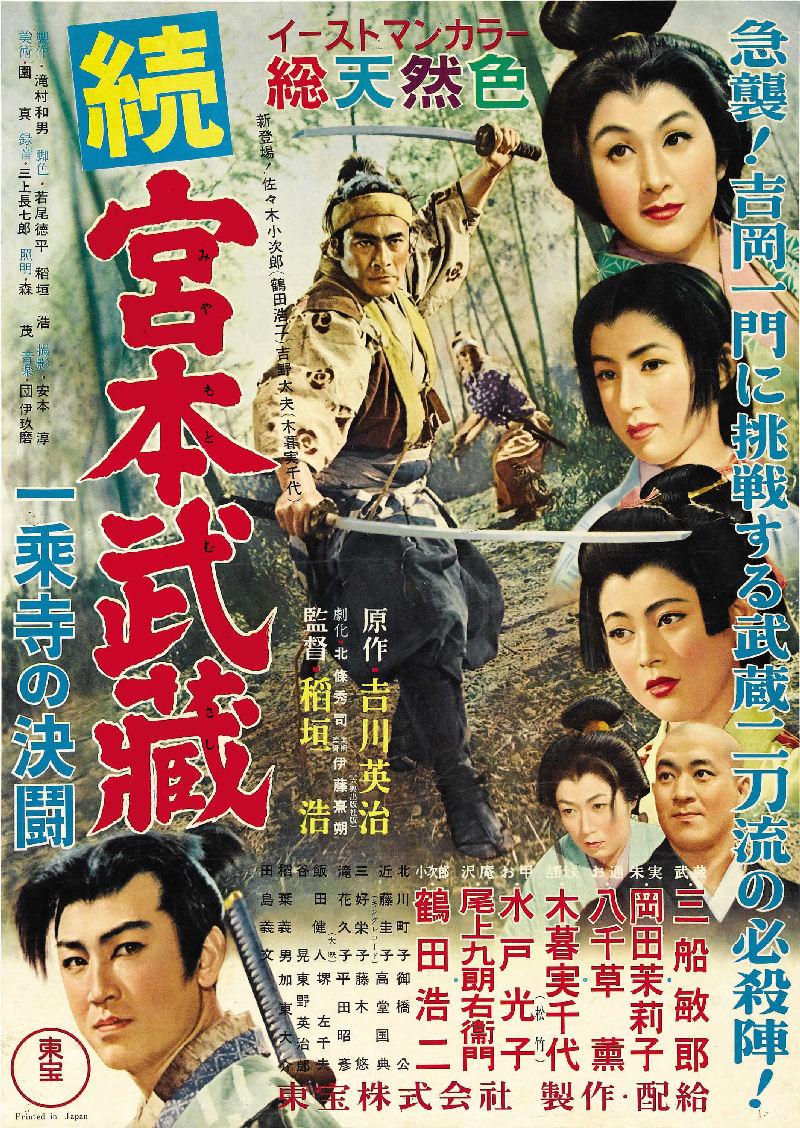
THE SAMURAI TRILOGY Samurai I: Musashi Miyamoto Reviewed By Greg Klymkiw Criterion Collection Blu-Ray Box

Samurai I: Musashi Miyamoto is an Oscar-winning Samurai action epic by Hiroshi Inagaki that spawned two more films and such international success that it's oft been referred to as the Japanese Gone With The Wind.  

Samurai I: Musashi Miyamoto (1954) *****
dir. Hiroshi Inagaki
Starring: Toshiro Mifune, Rentaro Mikuni, Kaoru Yachigusa, Mariko Okada, Mitsuko Mito, Kuroemon Onoe

Review By Greg Klymkiw

Young men dream of going to war. I know I did. Then I read Stephen Crane's "The Red Badge of Courage" and Erich Maria Remarque's "All Quiet on the Western Front" and put that thought to rest mighty quick (in spite of my Sands of Iwo Jima John Wayne fetish).

Alas, the same cannot be said for young men living deep in the sleepy provinces of seventeenth-century Japan - especially not the devil-may-care orphan Takezo (Toshiro Mifune) who is perched up in a tree with his equally restless, though somewhat more rooted pal Matahachi (Rentaro Mikuni). They both gaze with equal dreams of glory upon their village and the picturesque countryside as a huge army assembles to go into battle.

Nothing is ultimately stopping the brash, Takezo, but Matahachi has ties that indeed bind him with his betrothal to the most desirable catch in their village - the kind, sexy and radiantly beautiful Otsu (Kaoru Yachigusa). Though he admits a ready willingness to join his lusty pal on the battlefield, it's Takezo who reminds his chum, with a mixture of benevolence and braggadocious bravado, that some men have commitments that must keep them behind. This, of course, inspires Matahachi to do the unthinkable and abandon all that is sacred. Takezo does what he was born to do, but Matahachi let's macho pride rule his decisions and a terrible price will eventually be paid for this.

So then begins Musashi Miyamoto, a tale of two friends who begin together on the same path, but eventually take separate forks in the road of life which results in a series of surprises in their respective love lives - none which either of them would have ever seen coming.

Mostly, though, the bulk of this stirring adventure charts the growth of the young, headstrong Takezo who bravely venerates himself on the fields of battle and develops into an extremely proficient, fame-hungry killer. Changing his identity to that of the title moniker Musashi Miyamoto, his modus operandi is to live as a masterless ronin warrior and indeed, to become respected as a full and true Samurai.

The road to the latter will prove more difficult - genuine Samurai must be imbued with the more noble qualities of honour and compassion - something our hero is decidedly bereft of.


Between battle scenes, duels, chases, narrow escapes and general derring-do, the picture is entertainingly peppered with several affairs of the heart involving three different babes - one virtuous, one not-so virtuous and another just plain villainous.

Musashi Miyato won an Oscar for Best Foreign Language Film and like its two sequels, the movie stands alone as great motion picture entertainment. When watched one after the other, these three classically structured and beautifully directed films comprise a genuinely sprawling epic. Musashi Miyato is bursting at the seams with first-rate melodrama, action scenes of unparalleled excitement and a deeply-felt rendering of a time, place and tradition now gone with the wind.


The proceedings are so passionately recreated by the elegant Inagaki that it's no surprise that this film and the entire Samurai Trilogy is oft-referred to as a Japanese Gone With The Wind. In terms of its scope, popularity, narrative drive and stratospheric levels of production value, the description is definitely on the mark.

"Musashi Miyamoto" is the first part of the glorious Criterion Collection set of Blu-rays and DVDs. The pictures have been digitally restored in eye-popping hi-def and happily, the sound is presented in wonderful uncompressed mono. In addition to the array of essays there's an especially interesting newly produced segment on the real Musashi Miyamoto."

Sunday, 16 September 2012

GREG KLYMKIW'S 10 BEST FILMS AT TIFF 2012: ALL THE MOVIES I WAS ABLE TO SIT ALL THE WAY THROUGH AND LOVE WITHOUT RESERVATION AT THE TORONTO INTERNATIONAL FILM FESTIVAL (TIFF 2012) - By Greg Klymkiw


ALL THE MOVIES I WAS ABLE TO SIT ALL THE WAY THROUGH
DURING THE TORONTO INTERNATIONAL FILM FESTIVAL (TIFF 2012)
AND ACTUALLY ENJOY WITHOUT ANY RESERVATIONS WHATSOEVER


By Greg Klymkiw


In brief, here are my star ratings for the stuff I enjoyed at this year's orgy of cinema in Toronto. You can check out full reviews on a number of them here and soon, I'll be filing a full round-up of this year's festival over at the delightful UK-based "Electric Sheep - a deviant view of cinema".

So, in alphabetical order, here are:

Greg Klymkiw's 10 Best Films at TIFF 2012

ACT OF KILLING, THE - *****
BABY BLUES - **** (tied with Penance)
BEYOND THE HILLS - *****
BLACKBIRD - **** (tied with Krivina)
CAPITAL - ****
FILL THE VOID - *****
KRIVINA - **** (tied with Blackbird)
THE MASTER - ****
PARADISE: LOVE - **** (tied with Spring Breakers)
PENANCE - **** (tied with Baby Blues)
RHINO SEASON - ****
SPRING BREAKERS - **** (tied with Paradise: Love)
STORIES WE TELL - *****

Close Runners-Up (in alphabetical order):

FRANCES HA - ***
GINGER AND ROSA - ***1/2
LOVE, MARILYN - ***1/2
REBELLE (WAR WITCH) - ***1/2
ROOM 237 - ***1/2


The bottom line is this:

If I had to pick the absolute best movie at TIFF 2012 it would be a tie twixt Sarah Polley's STORIES WE TELL and Joshua Oppenheimer's THE ACT OF KILLING in the Documentary category and Cristian Mungiu's BEYOND THE HILLS and Rama Burshtein's FILL THE VOID in the Drama category.

Obviously, if anyone let me have my way, I'd be giving the Best Canadian Feature Award to Polley's STORIES WE TELL and the Best Canadian First Feature Award to Igor Drljaca's KRIVINA.

I'm exhausted.

Are you?

Tomorrow I'm going to cleanse my palate and see my lithe Ukrainian princess Milla Jovovich kick some zombie ass in RESIDENT EVIL: RETRIBUTION even though it's bound to be utterly dreadful.


Saturday, 15 September 2012

ROOM 237 - TIFF 2012 - Review By Greg Klymkiw - Blending cine-mania with conspiracy theory, Rodney Ascher's clever & funny documentary opens your eyes wide shut to new insights on Kubrick's "The Shining" that you never knew, and perhaps, were even afraid to ask.


Room 237 (2012) ***1/2
TIFF 2012 - Vanguard Series
dir. Rodney Ascher
Starring: Bill Blakemore,
Geoffrey Cocks, Juli Kearns,
John Fell Ryan, Jay Weidner

Review By Greg Klymkiw

Cineastes and those who follow conspiracy theorists have a lot of things in common. They're obsessive, slavishly devotional and frankly, almost fanatical in studying, appreciating and relentlessly imbibing in their respective fields of interest. Can their paths cross? You bet. I know. I am one of the afflicted (or blessed, depending on how you choose to look at it).

The engaging new documentary feature entitled Room 237 blends both cine-mania with conspiracy theory. Chances are, if you're a movie geek, you'll already understand the significance of this title and if you aren't, nor have you seen Stanley Kubrick's crazily scary, creepy and hypnotic film adaptation of Stephen King's The Shining, then let's just say it refers to a room in an isolated old hotel where something very, very horrific happened (and likely will again).


Using a treasure trove of clips and stills from Kubrick's canon, director Rodney Ascher interviews five people who have spent an unhealthy number of their waking hours (over an ever MORE unhealthy number of years) studying and dissecting the hidden meanings they purport are found buried within The Shining. Ascher's picture is not a traditional making-of documentary or even a critical appreciation in the usual sense. Instead, we examine each one of the subjects' theories.

All of them believe Kubrick used subliminal messages in the film and generated a high-profile horror movie to act as a mere foreground mask for its real meaning.

The most outrageous conspiracy theory presented in Room 237 is that Kubrick stuffed The Shining with numerous secret messages he hoped would work as both an apology and cinematic form of redemption to make up for the overwhelming guilt he carried for his part in faking all the Apollo Moon landings.

Say what?

Yes, Kubrick's filmmaking genius was contracted by the American government to fake the historic trips to the Moon. If, according to the conspiracy theorist, you look really hard, everything anyone would need to prove this is on-screen in The Shining.

Good to know.

In all fairness, those interviewed for Asxher's film spend a fair bit of time discussing Kubrick's obsessive attention to the most minute details of every inch, of every frame, of every shot. This is indisputable. Kubrick was indeed a meticulous control freak and he no doubt included numerous subliminal (or not so subliminal) images to bolster the drama, themes and/or style of his films.

I have some doubts, however, that The Shining is an apology to the world for faking the entire Apollo moon programme. So too should you, lest, of course you're planning to check yourself in for some electro-shock therapy. (Something my late barber, Bill Sciak did for many years. Not because he was insane, but because he enjoyed getting regularly zapped.)

Some of the other theories are definitely fruit-loopy, but those which suggest Holocaust allegory or the effects of colonization upon America's indigenous peoples are certainly not without interest. For me, though, the most intriguing presentation involves Kubrick playing with the space and time of his own sets by intentionally making sure the designs - and one room in particular - could not logically exist within the architectural setting of the Overlook Hotel.

This theory is kind of cool as it feels like the kind of perverse filmmaking trick Kubrick might use to help generate an overall sense of unease. The interviewee in question comes across as completely bonkers, but in spite of this, it provides considerable food for thought.

What I really appreciated about Rodney Ascher's approach to this material is that he himself never makes fun of these people. His entire mise-en-scène is quite clever. The interviewees never appear on camera - only in voice-over. The images are virtually all Kubrick all the time. They're used to tell the interviewees' stories and to provide as much visual evidence as possible to bolster the theories. Yes, Ascher uses the footage to occasionally buoy the film with a sense of humour, but it's never mean-spirited and it's often clever and in and of itself, a definite homage to Kubrick.

The movie will also make you think twice about Calumet Baking Soda. (I'll let you discover that nugget on your own.)

As I mentioned earlier, movies and conspiracy theory can be ideal bedfellows.

For me, my appreciation of conspiracy theory almost parallels my obsession with movies. It began in the 1960s, not long after experiencing a series of near-epiphanies upon first seeing films like 2001: A Space Odyssey, Planet of the Apes, Mario Bava's Black Sunday, Hammer Horror films, Sergio Leone westerns and Sam Peckinpah's The Wild Bunch. Movies not only became my whole life, they were, in fact, my life force.

At this time I read Erich von Daniken's "Chariots of the Gods", the first of a series of best selling "non-fiction" books that popularized the notion that extraterrestrials had been to Earth in our deep, dark past and were responsible for mankind's development. This wasn't classic conspiracy theory per se, but it was one of the first times I became enamoured with postulations that refuted traditional ways of thinking about the world. Not that von Daniken's theories were especially original - many of them had already been identified by other scientists (including Carl Sagan who had little use for the Swiss author's interpretations). His theories, to my child's minds eye, we forcefully and punchily conveyed.

Tellingly, my childhood fascination with von Daniken clearly sprouted from the magic of movies - most notably, Kubrick. The monolith in 2001: A Space Odyssey did a damn fine job transforming me into a true believer in extraterrestrial visitations in earlier eras of Earth's existence.

Years later, I became obsessed with the world of shortwave radio. Shortwave had always been an acquired taste - a niche market, if you will. (I had been introduced to it as a child by my cousin Paul who was an avid listener of "Radio Free Cuba.") In the pre-internet days of the 1990s, shortwave had become the haven for a wide variety of nut cases.

Needless to say, I was drawn to this like a fly to the proverbial dung heap.

Every manner of conspiracy theorist, right wing religious psycho and, allow me to add, heavy metal Christian Rockers managed to find a home on these oddball airwaves. It was here where I discovered one of the great conspiracy theorists of them all, the extremely entertaining Kurt Saxon, a survivalist based in Alpena, Arkansas. "Just let them Federal Boys try and find us here in these backwoods," was a common Saxon refrain.

Though Kurt's ruminations on impending social/economic collapse proved both sound and prescient, his theories regarding Eugenics were, shall we say, a tad too extreme for a reasonably tempered right-wing Communist and dyed-in-the-wool pseudo-Liberterian like myself.

The late 90s and beyond delivered the highest-rated talk radio in the world: "Coast-to-Coast-A.M. with the master of all things conspiratorial Art Bell and his eventual and current replacement George Noory.

Through these decades of avowed interest in conspiracy theory, I maintained my obsession with the movies - becoming, as I was once described by some anonymous blogger as, "a quite possibly clinically insane cinephile."

I suspect that with this history, it makes sense to have been positively disposed to a picture like Room 237. That said, it's a genuinely clever, compelling and funny look at one of the best movies of all time.

And that, my friends, is nothing to sneeze globs of blood-flecked snot at.

"Room 237" premiered at the Toronto International Film Festival (TIFF 2012). For information, visit the TIFF website HERE.


SIGHTSEERS - TIFF 2012 - Review By Greg Klymkiw


Sightseers (2012) **1/2
Dir. Ben Wheatley
Starring: Alice Lowe, Steve Oram

Review By Greg Klymkiw

They're not young.

They're pretty homely.

They're in love.

They're British.

They kill people.

Welcome to the world of Sightseers, a movie that's less than 90 minutes long and has about 30 minutes of really entertaining material and a whole lot of wheel spinning.

Chris (Steve Oram) and Tina (Alice Lowe) are not what any prospective in-law would traditionally consider a good "catch" for the apple of their eye. Then again, most parents of said individuals would probably have to agree.

Tina is a dullard living in middle-class emptiness with her abusive, mean-spirited harridan of a mother.

Granted, Mom has some reason to browbeat her unmarried, pasty-faced progeny since the twit was responsible for their frou-frou doggie getting impaled upon knitting needles.

Mom also has reason to dislike Tina's boyfriend Chris who has apparently killed someone - albeit by accident.

"I don't like you," says Mom to the bearded, beady-eyed sack of potatoes who is not only boinking her daughter, but about to embark upon a vacation through the dullest, ugliest part of England with her only begotten child in a motorhome.

The lovebirds take to the open road. After a bit of rockiness in their relationship, things seem to settle nicely until Tina notices that Chris's annoyance at fellow travellers manifests itself into pure, obsessive, unmitigated, psychopathic hatred for these miscreants who litter or look at him the wrong way or chide him for letting their dog crap on the lawn of a heritage site.


Chris does what any annoyed curmudgeon would do. He kills the fuckers. This appears to mildly concern Tina, but soon, she's all for it and even starts to kill people all on her lonesome. This annoys Chris to no end as he feels Tina has no acceptable justification for killing as he, uh, does.

Some of this is very, very funny. It's even mildly satisfying to see annoying people murdered. The problem with the movie is that our protagonists aren't especially interesting. The tagline on the ads and posters suggests they're "average". Wrong. They're ultimately way less than average.

What we're left with a satire-want-to-be that is little more than extended one-note sketch. What would have been perfectly acceptable as a short film, feels unnecessarily elongated in a feature length format.

Steve Oram is pretty darn amusing in his role - especially when director Ben (Kill List, Down Terrace) Wheatley focuses upon Chris's slow burns during the most mild of transgressions. Alice Lowe matches him quite nicely in her doormat-turned-woman-of-power. Alas, both of these performances, while consistent and solid, crush under the weight of the screenplay (that both actors wrote).

There's really nowhere for this story or characters to go that we don't see coming many beats in advance. The "surprise" ending, which isn't much of a surprise since any savvy viewer will figure out where things are headed long before, leaves us with the taste of inevitability in our mouths as we exit the cinema.

When the laughs come, they're big ones, but overall we're left feeling drained beyond the material's capacity to sustain our interest. There's nothing especially suspenseful about the proceedings and while the film is suitably muted when it needs to be, this tone is also the movie's eventual undoing.

"Sightseers" via Mongrel Media premieres at TIFF 2012.

-->
-->

Friday, 14 September 2012

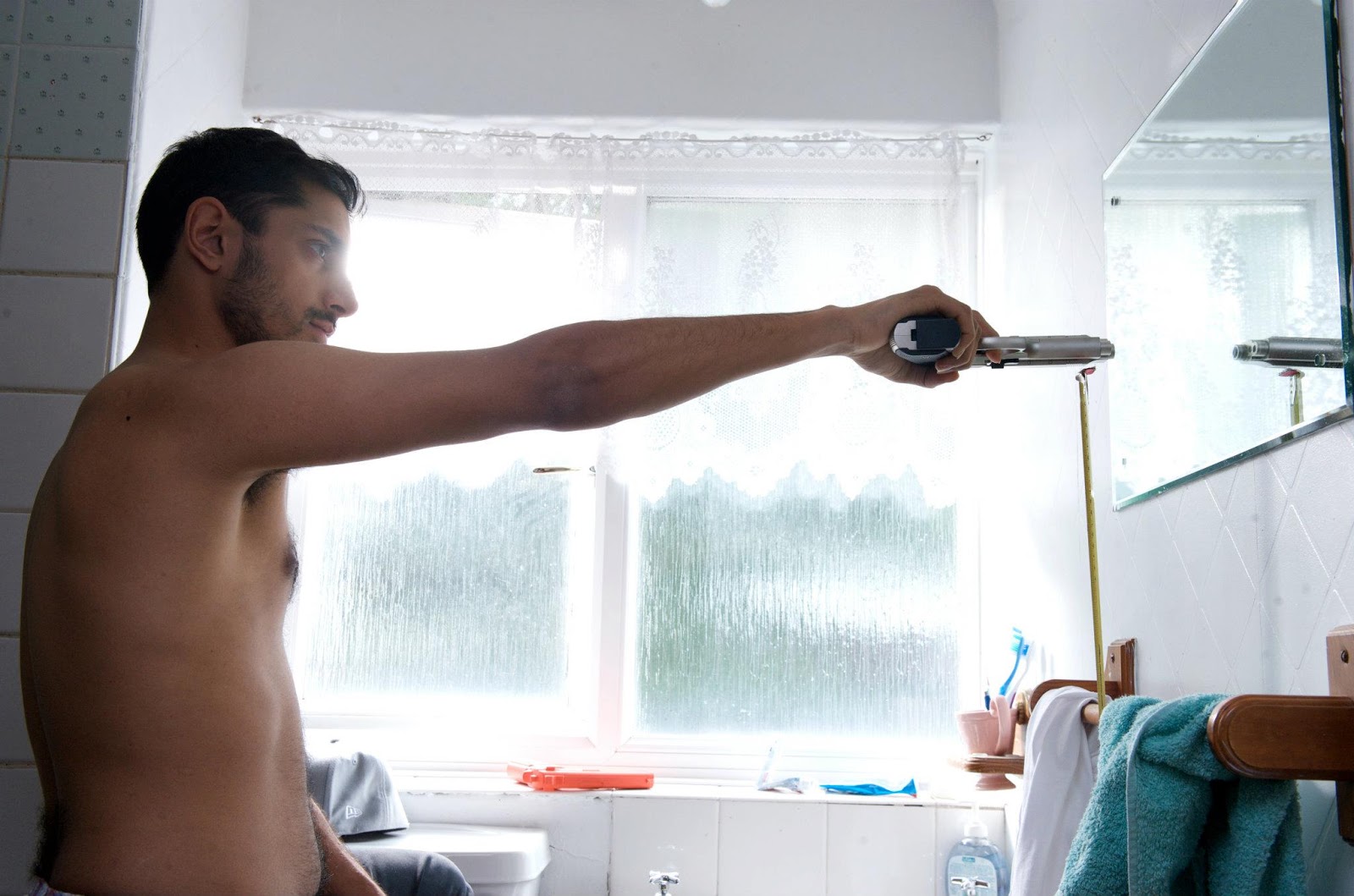
ILL MANORS - TIFF 2012 - Review By Greg Klymkiw


Ill Manors (2012) ****
Dir. Ben Drew
Starring: Riz Ahmed, Ed Skrein, Natalie Press, Anouska Mond, Lee Allen, Keef Coggins, Ryan De La Cruz, Nick Sagar

Review By Greg Klymkiw

Welcome to East End London. The manors are indeed, ill. Check it out:

A little boy of mixed race is left alone with a racist skinhead as his Mom gets porked by a gangster. The child's face gets mutilated by the skinhead. Children must be scarred forever to remind them and others how low their place in the world is.

A little boy wants to deal. He's 13. He's told to beat the shit out of his friend. He needs to prove his potential, his loyalty, his willingness to do anything it takes to build his street cred. He wants respect, He wants to be made. He does what he's told in the most horrendously brutal manner possible.

Two young men accuse a teenaged crack whore of losing a cel phone and she's forced into a harrowing night wherein she must raise 1000 big ones by offering herself to one john after another at 20 smackers-a-pop. These are not ordinary johns. She's led to every all night falafel joint, convenience store and other such establishments - staffed by poor new immigrants with their own unique cultural views on women - and specifically whores.

A young dealer and an innocent woman at the wrong place at the wrong time are gunned down in cold blood.

A young man is forced at gunpoint to carve up another.

A trembling, squealing young man has a gun shoved into his face and ordered to face death as a man.

A sex slave and her baby escape from Russian pimps, but she's tracked down pronto and forced to abandon her baby in a subway train. The baby winds up in the hands of a street thug. One things leads to another and the baby is sold. Eventually we see it tossed from a window.


Ben Drew, the UK rapper AKA Plan B has made a fine feature film debut with Ill Manors. Brits are notorious and especially adept at shoving our faces into kitchen sinks, toilet bowls and garbage cans. It's a fine tradition that really hit its stride during the early 1960s during the British New Wave period of "Angry Young Man" pictures.

UK has delivered any number of crime melodramas in recent years that the heroes of the halcyon New Wave days like Richard Burton, Tom Courtenay, Albert Finney, Richard Harris, Laurence Harvey, et all - spewing anger and pure venom, would just as easily have been at home in.

Here though, Drew populates his sprawling time-and-place-concentrated Ill Manors with a mix of professional and non-professional actors. A superb combination of brilliantly designed/chosen studio sets and locations allows Drew to place us completely in the palms of his cinematically virgin, though highly evocative hands. It's impossible to take one's eyes off the screen.

It's a cross between Martin Scorsese's Mean Streets in East End London and Quentin Tarantino's Pulp Fiction (if that film had REAL balls and wasn't so overtly "manufactured"). Grit, grime and blood mingle perfectly to create a portrait of violence and despair that for some might feel slightly derivative, but in actual fact, is blessed with a powerful new filmmaking voice.

Drew's lens whips about the environs and proceedings with an eye for detail. At times, the suspense during tension-filled criminal activity is unbearable. When violence hits us, Drew might as well be slamming a shovel in our faces.

This, however, is no sloppy, herky-jerky, rag-tag affair. Compositions are effectively appropriate to the dramatic action. Most chillingly is how subtly Drew draws our eyes to key implements of death and destruction - guns, blades, crack bowls, etc/. As such, his staging/blocking and camera directives are so visionary and proficient that often single shots can have us shuddering.

The structure of the film revolves around several rap songs which drew wrote and performed. He cuts them like extremely sophisticated music videos to provide background, back story and street philosophy.

Amidst the chaos and criminal activity, Drew roots his tale in humanity. He delivers a movie where some of the most despicable actions lead to greater depth of understanding. Given the grim, bleak, violent reality of this world he never provides easy answers and never ties up his narratives into neat bows, but we do experience redemption and through the haze of crack smoke and the blood that feels like it's being splashed in our eyes, we even get a glimmer of hope.

But, just a glimmer. For the wasted, forgotten and/or reviled young men and women of this world, there are few real choices. They're the true progeny of Margaret Thatcher. They live, not for the future, but for the moment.

It's a film that's ultimately very moving and no matter how despicable the actions of its protagonists, Drew never forgets to remind us how fallible we are as a species and that for some, choices - no matter hpw bad - are the only power many of our kids have.

As grippingly as the film forces us to watch, it just as easily forces us not to forget. Once humanity gets to a point of collective avoidance then good and bad become one.

That's even scarier shit.

"Ill Manors" via Berkshire Axis Media premieres at TIFF 2012.

RHINO SEASON - TIFF 2012 - Review By Greg Klymkiw - Exiled Iranian filmmaker Bahman Ghobadi delivers a heartbreaking love story that engages us in cinema's poetic qualities whilst making a plea for the rights of artists to be honoured and sanctified against the whims of all repressive government policies.


Rhino Season (2012) ****
dir. Bahman Ghobadi

TIFF 2012 - Special Presentation

Starring: Behrouz Vossoughi, Monica Bellucci, Yilmaz Erdogan, Belçim Bilgin

Review By Greg Klymkiw

Artists have always been prime targets in power-hungry repressive regimes. To destroy a nation, then rebuild it in a new image, the first line of attack is to decimate its existing culture. During the 20th Century, the world experienced this again and again in every Totalitarian regime - Nazis, Fascists, Communists, Fake Democracies fuelled by corporate dictatorships and religious fundamentalism are but a few instances of this war on art.

Given that the world is on the precipice of complete collapse, works like Bahman Ghobadi's film Rhino Season are more important and vital than ever. That said, I do wish to temper this statement, since such an assertion can be a dual edged sword - relegating a work's importance to the picture's backdrop and subject matter can also place it in a lofty enough position so as to render its considerable aesthetic gifts as the sum total of its merits. Therefore, in declaring that the film is essential, I wish to also stress that the film's political and thematic necessity is not the only reason it holds a fundamental place in the world.

The picture is, quite simply, dazzling - an original voice that yields a deeply moving, artistically daring and consummate demonstration of how cinema can work at the highest levels of the medium. In the case of Rhino Season, the medium is simply not the message, nor the message it conveys, but how the medium is pushed over the usually accepted boundaries. However, in so doing, the film provides its important political stance and challenging aesthetic framework in a manner that, if properly presented and distributed to wider audiences, has considerable potential to affect cinema-goers the world over.

The tale director Ghobadi relates is as simple and ages-old as time itself - a love story that spans decades - replete with suffering, longing and passion that knows no bounds. Behrouz Vossoughi, a mega-wattage Iranian movie star now exiled to an America that has little to offer a great actor like him from a Hollywood that is so bereft of ideas that the only roles he is asked to play are those of terrorists, is the star of Ghobadi’s film.

Vossoughi plays Sahel, a Kurdish writer who specializes in poetry. In spite of the fact that his writings are not political, he is arrested, tortured and interrogated until he receives an inhuman 30-year-long prison sentence.

Not content to destroy Sahel's life, the authorities do the same to his wife Mina (a heartbreaking performance by Monica Bellucci). She is incarcerated for 10 years and upon her release, she is told that Sahel is dead. He most certainly is not. Ghobadi then delivers the unforgettable scene of Mina making her way through a forlorn graveyard devoted to the burial of "heathen" and finally weeping before the weathered marker of her husband.

Sahel serves all 30 years of his sentence and devotes the rest of his existence to tracking down Mina.

If this tale doesn't move audiences to tears, nothing will. What contributes to rendering this simple, affecting narrative in the richest and most artistically complex mise-en-scène imaginable, is how Ghobadi peppers the tale with voiceovers reciting Sahel's clearly humanist (not politically didactic) poetry which contrast the horrendous words of his torturers. Blended with images of sublime beauty that convey resplendence of the most exquisite kind, they too provide a contrast to the visual realities of the dank, foul prison Sahel spends 30 years in.


Rhino Season accomplishes the extraordinary. It achieves the highest level of cinematic poetry, tells a great story and, by virtue of Ghobadi's approach, it achieves its goal of exposing us to the plight of artists in Iran whilst gently and metaphorically delivering the most powerful plea of all - that artists have no place in prisons for simply expressing themselves (politically or not) and that finally, this should extend to all people, of all walks of life, in all countries.

Expression is who we are. It is what defines our respective cultures and most of all, who we are as a species. Humanity IS expression. What places Ghobadi's great film on a pedestal of truth is that expression includes love.

Love is what drives his picture, his characters and by extension, the human race.

Love must be protected and sanctified at all costs.

When that ceases, so do we.

"Rhino Season" received its world premiere at the Toronto International Film Festival (TIFF 2012). For ticket information, please visit the TIFF website HERE.
-->

-->

-->

Thursday, 13 September 2012

HOW TO MAKE MONEY SELLING DRUGS - TIFF 2012 - Review By Greg Klymkiw


How To Make Money Selling Drugs (2013) ***
Dir. Matthew Cooke
Starring: Barry Cooper, Freeway Rick Ross, Brian O’Dea, Bobby Carlton, David Simon, 50 Cent, Eminem, Woody Harrelson, Susan Sarandon

Review By Greg Klymkiw

A day doesn't go by when I can't help but shake my head over how utterly moronic America seems. Its founding principles seem to be diametrically opposed to the actual manner in which the country is continually driven by the not-so-secret needs of its wealthiest few and how easily the vast majority of its populace accepts the country's endless human rights violations, lack of freedoms and the exploitation of the basic tenets of democracy.

It is a country that's essentially on the verge of being little more than a Third World Nation run by puppets and populated with a majority of boobs exploited for their willing acceptance of a system that continues to dumb them ever-downwards by any means necessary. The country's seemingly endless war-mongering - most notably its idiotic War on Terror - is matched by its War On Drugs.

Matthew Cooke's clever, funny and mildly subversive documentary How To Make Money Selling Drugs delivers a step-by-step, blow-by-blow how-to guide on the ins and outs of hawking marijuana and cocaine (and by extension, pretty much any illicit drug). Replete with all manner of flashy TV-styled cutting, sound effects and on-screen title cards, it is - on its surface - a fascinating look at how some of the best in the "business" ply (or have plied) their illicit trade and yielded oodles of cash. These individuals run the gamut of street dealers all the way up to cartel-leaders and through their experiences we learn the perils and pitfalls as much as we learn the ways to achieve success.

Some of the more seemingly successful practitioners of the trade, Barry Cooper, Freeway Rick Ross and Brian O’Dea are all incredibly open and informative as they detail their how-to approaches. These guys are on-camera, but off camera (with disguised voices) or in front of the camera (in disguise and/or with pseudonyms) we get additional tips. If we were to follow their advice, the movie suggests that we too can make ourselves a decent living.


Luckily, the film also presents these same subjects' downfalls (occasional or permanent) and some of it seems so convincing that we feel like IF we could avoid some of the mistakes made that led to incarceration, we could hit dizzying heights of financial success without penalty. This, of course, is tempered by reality and it's eventually obvious that selling drugs IS indeed a losing game - not because it's wrong, immoral or criminal (which to varying degrees it is and/or can be), but because the Status Quo has stacked the deck to allow it AND then deny/destroy it - all for personal gain at the political level.

In addition to focusing upon several real-life dealers, the picture also presents numerous law enforcement officials - cops, DEA agents, lawyers and judiciary. Their presence confirms and presents the ease with which one can make money selling drugs, but also how those on the other side of the coin make their "collars" - none of them, not surprisingly, all that imaginative. The law uses a variety of snitches, but also employs threats, intimidation, entrapment and even just plain planting drugs on suspected dealers.

One of the more interesting subjects is Bobby Carlton an ex-cop who details every single manner in which he willingly and even gleefully entrapped people. Astoundingly, the film follows his story to a point where he joins the "other side" and becomes an activist and advocate for the rights of dealers to the point where he is now forced to live in self-imposed exile to escape persecution by American law enforcement officials who frown up his change of heart and activities associated with it.

The filmmakers also present a wide variety of celebrity interviews - those who have dealt and/or used drugs to those who are fighting against the archaic and immoral anti-drug laws and campaigns. Interviews with the "real thing" former dealers and/or users include the stellar likes of 50-cent and Eminem. Celebrity activists include Little Mrs. Commitment herself Susan Sarandon and everyone's favourite wacko advocate Woody Harrelson.


Right from the start of the film, there's a subtle and eventually, not-so-subtle subtext which provides both a history of America's War On Drugs and exposes the utter hypocrisy of it. In so doing, the movie cleverly uses its how-to guide as a plea for saner American approaches to the "Drug Problem" - a problem that seems manufactured by the government with its Draconian approaches to the War On Drugs - so much so that David Simon, the creator of hit series The Wire, points out the irony that law enforcement agents and agencies (including straight-up cops themselves) place so much emphasis on how to entrap dealers that good, old-fashioned police work goes the way of the Dodo (to the detriment of many other serious crimes never being properly solved).

The movie cleverly manipulates itself to deliver one poignant and often heartbreaking sequence after another that details the fall of the aforementioned "criminals" in addition to those who are not dealers at all, but are in the wrong place at the wrong time. The dealers all seem to be at peace with the risks of the profession, but those caught up in the trade innocently and inadvertently suffer from wrongful arrest, incarceration and what often seem like utterly unconstitutional, if not illegal (and certainly immoral) raids, arrests and incarcerations.

At the end of the day, we have a film which uses a satirical approach to its subject to act as a plea for a saner approach to drugs and both the use and sales of said hallucinogens. Some of the satire is of the Lite persuasion and while at times, I might have preferred an even more subversive approach to the subject, it doesn't take away from the fact that this is yet another convincing and important expose of America's hypocrisy - not just in terms of drugs, but by extension, everything.

"How To Make Money Selling Drugs" via Berkshire Axis Media premieres at TIFF 2012.


END OF WATCH - TIFF 2012 - Review By Greg Klymkiw


Tough-as-nails cop thriller with 70s sensibilities, all the nasty mega-brutality one could ask for and a pleasing, saintly, sentimental Joseph Wambaugh-like approach to police on the killing fields of South Central Los Angeles. 

End of Watch **** (2012) dir. David Ayer
TIFF 2012 - Special Presentation
Starring: Jake Gyllenhaal, Michael Peña, Anna Kendrick

Review By Greg Klymkiw

My Dad was a cop for ten years. When I was a kid it was always fun seeing movies with him - especially cop and crime pictures since he always had more than a few things to say about the "Hollywood bullshit" or happily, the lack thereof. Curiously, it was the crime pictures like Scorsese's Mean Streets and Peter Yates's The Friends of Eddie Coyle that Dad always gave high marks to for capturing the side of life he spent a decade of his life fighting.

Most cop pictures left him cold save for their occasional entertainment value, but a handful of pictures stand out as movies he loved on several levels. Richard Fleischer's adaptation of Joseph Wambaugh's The New Centurions was one that Dad always felt came closest to recreating "the life" of cops behind the scenes while Friedkin's The French Connection captured the dull, dirty, mundane aspects of police work and finally, how Don Siegel's Dirty Harry came closest to showing the frustrations inherent in the job and how sometimes, a good cop just had to say, "Fuck the system," and do what needed to be done.

Somehow, I think Dad would have liked David Ayer's End of Watch a lot. Hanging by the slenderest of plot threads, this mostly episodic nosedive into every harrowing moment street cops face, makes for an always jolting ride through the dangers our boys in blue face everyday. The other plus to this very fine picture is both the writing and playing of the two loyal partners Brian Taylor and Mike Zavata - beautifully rendered by Jake Gyllenhaal and Michael Peña.

A cop's partner is his lifeblood. It's become a cliche in movies and TV, but in reality, the level of loyalty, trust and love a cop has for his partner is treated by most filmmakers in cliched or archetypal ways. It's a testament to writer-director David Ayer that he captures this camaraderie by leaping beyond the by-the-numbers mismatched-partners-who-learn-to-love-and-respect-each-other. From the start, we know these guys are made for each other. If anything, their love deepens and becomes even more demonstrative as the danger and violence in the film intensifies.

Ayer achieves this by using a storytelling technique that in and of itself has become a cliche in recent years, but he pushes it to such extremes that as the movie progresses, we become less concerned with form because of the form and Ayer's clever use of it. The opening few minutes, for example, are shot via a windshield-eye-view of the mean streets of a patrol car, accompanied no less by a portentous reality-TV-styled voice-over. At first you briefly think Ayer's gone nuts until he reveals that cop Brian is a part-time law student putting himself through university as a cop and is studying filmmaking as an elective. As such, he is shooting everything on the job to make a documentary as a class project.

I bought this hook, line and sinker.

When Brian's character is not shooting (and sometimes even when he is on-camera with his rolling camera), the rest of the film is mostly pieced together with a variety of surveillance cams and even through the cams the young electronically obsessed villains use. Add great dialogue, superb realist detail, actual locations plus magnificent performances and it all adds up to a terrific neo-realist-styled slice of life.

Ayer's writing for the cops is dead-on, but what's especially great is how he does not shy away from the banalities and cliches used by the South Central villains who do the dirty work for the cartels. Criminals at this level are boneheads of the lowest order - raised on dreadful television in cultural isolation of the lower order. Ayer takes a big chance here - allowing loftier than thou critics to point fingers at his less-than-balanced portraits of these disgusting thugs. Just as many cops are "dirty", an equal number (if not higher) of the vermin infesting our city streets like rats are zero-brained followers with no minds of their own save for the crap they've ingested in popular culture and from each other.

The narrative itself focuses upon the close friendship of the two cops, their love lives and the importance of family in all its forms - blood, community and crime. Taylor and his Hispanic partner Mike, go about their day-to-day exploits until they happen upon a group of deadly local dealers who are tied to vicious drug cartels. The two cops begin investigating until they get so close to the source of criminal power that the cartel orders hits on them.

So many films in recent years (including those Ayer has written and/or directed) have focused up the "dirty" cops. Reversing this trend with End of Watch is not only welcome but, I think necessary to bolster those in the force who genuinely embrace the protection of the citizenry.

To be a good cop in a world where crime is escalating and when administrative shackles are getting tighter and where cops are even forced into plying their trade by the powers-that-be in ways they know are unfair to those they're supposed to protect is narratively and politically satisfying as it is savvy.

It's the best cop picture in years!

"End of Watch" premiered in a Special Presentation at the Toronto International Film Festival 2012.