Monday, 16 September 2013

THE GREEN BERETS - Review By Greg Klymkiw - John Wayne No Jesus Christ. He is God The Father! Amen!

Is it Jesus Christ Almighty?
No! It's JOHN WAYNE!
The Green Berets (1968) ***
dir. John Wayne and Ray Kellogg

Starring: John Wayne, David Janssen,
Jim Hutton, Aldo Ray, George Takei

Review By Greg Klymkiw

For me, one of the best things about blu-ray discs is getting an opportunity to see favourite movies from one's childhood in a format as pristine and gorgeous as when I first saw them on a silver screen.

The Warner Home Entertainment blu-ray release of John Wayne's The Green Berets, a film that is as spectacular an action picture as it is a politically reprehensible war movie, has NEVER looked better, save for a time - over forty years ago - when I sat in a grand old 2000-seat picture palace with my Dad during the picture's first Friday showing in my hometown of Winnipeg.

John Wayne was and to some extent, still is, the perfect father and son idol. (Daughters can love Wayne, too, as witnessed with my own little girl who will sit with Dad and watch a John Wayne picture ANYTIME.) Even now, though, I remember that the majority of public screenings of Wayne movies I experienced with Dad were comprised of grown men and their bean-shaved boys and in fact, I think I saw almost every John Wayne picture ever made, old and new, western or war, on a creaky old black and white TV set with rabbit ear antennae or in the most opulent and now extinct temples to cinema - with Dad.

No Mom, no Sis and only with schoolboy chums for second, third or more helpings.

To my Dad, John Wayne WAS his screen father and for me, the feeling was mutual. Wayne represented the Father my Dad wanted to be and the Father he wanted. As a child, I shared the latter sentiment, though in reality, I can genuinely say, Dad did not ever really disappoint in the manhood stakes of patriarchy - especially during his years as a cop when he would proudly regale me with his tales of his head-busting daring-do, all in the service of protecting the good and punishing the bad.

John Wayne was the Father. And as any lad brought up in the Judeo-Christian tradition knows, GOD is the Father!

Along with The Searchers, True Grit, The Cowboys and some of the other Batjac productions of the 50s, 60s and 70s (Hondo, Chisum, The Alamo and Big Jake to name a few), The Green Berets was, for many years, the kind of picture Dad and I treated with the solemnity of a Sunday church service. For good reason, I might add.

Or at least, so we thought.

One of the many fascinating aspects of The Green Berets was the fact that it was one of the few war pictures actually set against the backdrop of Vietnam to be made DURING the Vietnam War itself. Stranger still, the picture was released several months after the TET offensive - one of the biggest U.S. debacles of the war. Though the Communist forces suffered huge losses during TET, this was something that was almost ignored and/or repressed by the media (who began blasting American involvement in the war more violently than ever before) and American power-brokers (this was the year when gung-ho Secretary of Defense Robert McNamara did an about face on his own battle escalation strategies and resigned his position).

With respect to TET, the scrutiny on behalf of media and public was clearly aimed at several factors that eventually forced many Americans to seriously re-evaluate their country's participation in the war:

1. American casualties were higher during this offensive than all the years of the war combined.

2. The Communists proved they were stronger in numbers than anyone thought.

3. America was completely unprepared for this offensive and only won technically through their sheer numbers.

4. The ambitious and complex battle plan on the part of the Communist forces was not successful in the cities, but - almost more importantly - gained considerable ground in "the country", the heartland of Vietnam.

5. America launched one of the largest draft policies of the entire war - further inspiring ire in both press and public. 15,000 American soldiers were killed and now, the government was demanding the forced conscription of close to 50,000 young Americans.

6. South Vietnam, the ones America was purportedly fighting for, was hardest hit by TET and its aftermath yielded thousands upon thousands of civilian casualties and such a massive destruction of homes that almost one million people were now refugees.

And then, amidst the above mentioned came John Wayne's The Green Berets, a thoroughly fictional (and loose adaptation of Robin Moore's bestselling book of the same name). Here was a movie that had absolutely NOTHING to do with the reality of what was happening and presented a scenario and style NOT unlike every run-of-the-mill war film ever made. In retrospect, what was even more jaw-dropping was how the movie-going public embraced Wayne's propagandistic rah-rah rally cry for continued American involvement in Vietnam.

The Green Berets was a huge hit at the box office!

As a kid, I certainly saw no dichotomy whatsoever. Though I'd occasionally see the rather graphic war footage on television news, it seemed "dull" compared to the daring-do of my Celluloid Dad. For my real Dad, any protests generated by TET and its aftermath, were, no-doubt, merely the product of dirty, long-haired hippie commies.

For me, my Dad and many like us, The Green Berets was a thrilling, kick-ass war picture with the sort of carnage and heroism that seemed to dwarf real life. To gain access to the finest American military hardware, Wayne needed to abandon most of Moore's book, which portrayed the Green Berets in a manner the government had issues with. As well, this was still in advance of Sam Peckinpah's classic western The Wild Bunch, a western that used the Old West as a metaphor for Vietnam, in addition to changing the way we looked at violence on-screen forever.

The simple narrative of The Green Berets begins with the sour castigation of those brave fighting men by lefty American journalists. Representing the Pinko hordes is none other than a reporter played by David Janssen (a huge T.V. star of The Fugitive fame and, lest we forget, Albert Zugsmith's utterly insane piece of sentimental war propaganda Dondi). His criticism of America's involvement in Vietnam, and most importantly, his assertion that the fighting men of the Green Berets are as unquestioning as those within Nazi Germany. This, of course, is in response to a soldier who admits that "foreign policy decisions are not made by the military. A soldier goes where he is told to go, and fight whom is told to fight." Janssen's comparison to a Totalitarian regime seems perfectly reasonable under the circumstances, but instead, inspires Green Beret head honcho John Wayne to foam at the mouth a bit before offering Janssen a free, uncensored, ground-zero view of what America is fighting for.

So, with his knapsack on his back, Janssen accompanies the likes of John Wayne, his tough beefy right hand man Aldo Ray, the noble South Vietnamese military ally (played by George "Mr. Sulu" Takei) and the lovably baby-faced and irascible Ensign-Pulver-like conman Jim Hutton. For close to three hours, Janssen's character and indeed, we the audience, are face-to-face with the utterly inhuman savagery of the Viet Cong and their dirty Commie ways and the noble, heroic and successful eradication of said Commie Pigs at the hands of John Wayne and his fighting men.

From the opening titles of the picture, the lyrics of Sgt. Barry Sadler's stirring hit song "The Ballad of the Green Berets", lead us on an odyssey devoted to extolling the virtues of those who would dare risk life and limb for the oppressed.

Sadler's lyrics tell us so:
Fighting soldiers from the sky
fearless men who jump and die
men who mean just what they say
the brave men of the Green Berets . . .
Back at home a young wife waits
her Green Beret has met his fate
he has died for those oppressed . . .
make him one of America's best.
As the movie progresses, we bear witness to Pinko journalist Janssen and his conversion to the cause - so much so, that he himself even engages in battle against the Commie Pigs. As a young lad, I bought this hook, line and sinker.

After all, we see baby-faced Jim Hutton befriend a Vietnamese orphan (not unlike the Short-Round character from Samuel Fuller's immortal and decidedly anti-war WWII drama Steel Helmet - a character who was later represented in homage by Spielberg in Indiana Jones and the Temple of Doom) and when Hutton dies a hero's death, it is John Wayne himself - everyone's surrogate Father - who picks up the torch and leads the little Vietnamese boy into the setting (or rising) sun, presumably adopting the lad and proudly intoning that it is the CHILD whom the entire war is being fought for. (Much derision has been levelled at the Sun setting in the East of Vietnam, but in fairness, the movie does not specifically state it is sundown, and could just as easily be sunrise - in which case, there's nothing technically wrong with the closing shot.)

This was indeed rousing stuff to experience as a kid; working on a level of propaganda, to be sure, but mostly, within the mythic elements of the genre which I had already been inundated with thanks to the likes of all the great WWII pictures I'd already seen (many of which starred John Wayne).

Amongst the many vicious pans the picture received at the time, none is more eloquent than Roger Ebert's now-legendary piece wherein he states:

"The Green Berets simply will not do as a film about the war in Vietnam. It is offensive not only to those who oppose American policy but even to those who support it. At this moment in our history, locked in the longest and one of the most controversial wars we have ever fought, what we certainly do not need is a movie depicting Vietnam in terms of cowboys and Indians. That is cruel and dishonest and unworthy of the thousands who have died there."

Ebert's assertion that the picture works on the level of a simple by-the-numbers Western is not far from the truth. When Janssen is led into the American camp in Vietnam, he raises his eyebrows at a handmade sign nailed at the entrance which says: "Dodge City" - that rough and tumble town of innumerable American westerns where the men were mean, violent and only able to be tamed at the end of a gun. This, however, is the only time in the picture where we get a glimpse of something that might lead us into the territory of M*A*S*H rather than a Rory Calhoun oater, but very quickly, we realize this is no touch of irony - the picture means it fair and square. When Janssen queries Wayne about the execution-style slaying of some Vietcong, Wayne replies - with the kind of venom only Wayne could spit out: "Out here, due process is a bullet!" Even now, I remember my Dad and the rest of the audience applauding this.

Wayne, after all, was the father of us all.
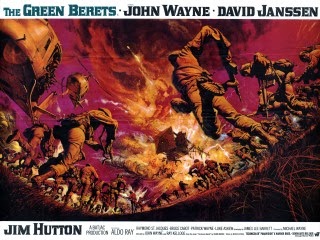
That The Green Berets is only one of two feature films Wayne directed (the other being The Alamo) is not without significance. Wayne was, and probably still is the biggest movie star of all time. In role after role, he embodied the values of both America and manhood.

One of the best books to ever deal with Wayne is Gary Wills's "John Wayne's America - The Politics of Celebrity" which presents a biographical portrait of Wayne as an instrument of propaganda. This, of course, is a point of view that would be impossible to refute. Wills asserts that Wayne "made an impact when he carried his Manifest Destiny assurance into compromising situations." Given the huge positive response of audiences to The Green Berets in spite of clear evidence that the values inherent in the picture are a complete bald-faced lie, it's not hard to believe just how important a figure Wayne was and, to a considerable extent, still is.

Granted, unlike a picture such as John Ford's The Searchers, where the clash of cultures is treated with several layers of complexity, the same clash in The Green Berets is about as complex as a square-holed puzzle with nothing but square pegs. When endlessly useless wars against Muslim countries are perpetrated, not in the name of freedom, but in the name of oil, when George W. Bush can outright steal the presidency under the noses of the American public, when an entire nation has no proper system of health care and probably never will, when too many people believe the results of the Warren Commission, when people are jailed and persecuted in a supposedly democratic society, when everyone in America believes that ONLY America was able to win both World Wars, it's obvious that Wayne's influence as a star and the kind of heroism he represents in over 150 pictures "seems", according to Wills, "to suggest that the need for this hero will call up again the kinds of story where he operated best." Wayne, of course, is not the only star to have been used in this fashion, but he was and still is, the most influential. He knew it, believed it and so did his adoring public. Wills maintains that Wayne, more than any other star reflected American society back upon itself which was "the source of his appeal, and of his danger."

I cannot, then, even for a second, defend The Green Berets on its politics and I am forced to separate them from the picture itself. Is that even possible? I'd suggest it is. It's a picture I enjoyed a lot as a kid and as an adult, I was certainly able to sit through it and gain some amusement value on a number of levels. As a movie in the context of a contemporary viewing, it's not without moments that are creaky and clunky - the first 45 minutes is especially a bit of a dull slog, but once the action revs itself up, the movie is as spectacular an entertainment in the war genre as many similar pictures which preceded it. To use the parlance of contemporary action pictures, "It blows up real good" and even its dollops of sentiment have the power to move. Does it go any places that GREAT war movies go? Not one bit. It's paint-by-numbers action. No more. No less.

As a director, Wayne doesn't display the surest hand in The Green Berets which probably isn't helped by the fact that he chose Ray Kellogg to be his co-director. Kellogg was the brilliant special effects designer and cinematographer for Twentieth Century Fox who, among other astounding accomplishments, worked on the first-ever CinemaScope production, The Robe. He was also a solid second-unit director of note. All of these accomplishments give us some sense of why the "blowing up real good" blows up, real good! As a solo director, it's probably important to note that he directed two feature films produced by and starring Ken (Festus on "Gunsmoke") Curtis, The Giant Gila Monster and The Killer Shrews. While Wayne had an uncredited Mervyn LeRoy wandering around the set of The Green Berets and lending a helping hand, Wayne's previous effort as a director, The Alamo was a happier experience - at least on an artistic level. He had none other than John Ford puttering around and lending his painterly eye to some of the proceedings (but when "Pappy" started to take over, Wayne sent him out to shoot some second-unit footage). Aside from some annoying longueurs, it's a pretty damn fine epic western with a great cast, a solid screenplay and magnificent battle sequences. It also features an unbelievably tear-wrenching death scene with the immortal Hank Worden (Ole' Mose from The Searchers). And how can one NOT enjoy seeing John Wayne and Richard Widmark as Davy Crockett and Jim Bowie? Alas, Jim Hutton in The Green Berets doesn't quite wrench as many tears in HIS death scene, but I suppose he can't be entirely blamed. After all, there IS only one Hank Worden.

The Green Berets is, no doubt, a dangerous, reprehensible and politically boneheaded picture, BUT it is ALL JOHN WAYNE!

And John Wayne is still the Father of us all. His very being is sacred and as a motion picture star, he is truly unparalleled. Gary Wills refers to Wayne's image as "mixed and terrifying... full of the unresolved contradictions" of America itself. True enough, but John Wayne was a star all over the world and as such, I'd suggest those "unresolved contradictions" resonated well beyond America - they permeated every square inch of our planet's ground. Wills wonders if America has, or will ever escape "the myth of the frontier, the mystique of the gun..." and again, I go wonder if we ALL will ever truly escape those things. To answer that, Wills leave us with a line from The Searchers, a line that was, after John Wayne's single greatest line of dialogue ever. It's one, I too, am happy to leave you with.

"That'll be the day!"

"The Green Berets" is currently available on the Blu-Ray format from Warners Home Entertainment.


Sunday, 15 September 2013

GREG KLYMKIW'S TIFF 2013 ACCOLADES AND EXCRETIONS - By Greg Klymkiw - Roundup of Best/Worst of Fest


TIFF 2013 ACCOLADES
By Greg Klymkiw

Best Feature Film at TIFF 2013:
Sébastien Pilote, Le démantèlement

Best Documentary at TIFF 2013:
Alan Zweig, When Jews Were Funny

Best Director (International) at TIFF 2013:
James Franco, Child of God

Best Director (Canada) at TIFF 2013:
Alan Zweig, When Jews Were Funny

Best Director (Quebec) at TIFF 2013:
Sébastien Pilote, Le démantèlement

Best Short Film at TIFF 2013:
Randall Okita, Portrait as a Random Act of Violence

Best Screenplay at TIFF 2013:
Simon Pasternak & Christoffer Boe,
Sex, Drugs & Taxation (Spies & Glistrup)

Best Cinematography at TIFF 2013:
Michel La Veaux, Le démantèlement

Best Editing at TIFF 2013:
Ti West, The Sacrament

Best Actress at TIFF 2013:
Mira Barkhammar, We Are The Best

Best Actress (Supporting) at TIFF 2013:
Sophie Desmarais, Le démantèlement

Best Actor at TIFF 2013:
Gabriel Arcand, Le démantèlement

Best Actor (Supporting) at TIFF 2013:
Gene Jones, The Sacrament

Worst Movies at TIFF 2013 (in alphabetical order):
ALL WORTHY RECIPIENTS OF THE ALL NEW
KLYMKIW ACCOLADE
FOR BAD MOVIES:
"TURD FOUND
BEHIND
HARRY'S CHARCOAL BURGERS
& DINING LOUNGE"

The Dark Matter of Love, Sarah McCarthy
Don Jon, Joseph Gordon-Leavitt
Gravity, Alfonso Cuarón
L'intrepido, Gianni Amelio
Prisoners, Denis Villeneuve

Saturday, 14 September 2013

WHEN JEWS WERE FUNNY - Review By Greg Klymkiw - ***** Alaz Zweig Premieres TIFF 2013, then Theatrically

Alan Zweig's latest film, WHEN JEWS WERE FUNNY, winner of the Best Canadian Feature Film Award at the 2013 Toronto International Film Festival (TIFF 2013) opens theatrically via KINOSMITH in Canada on Nov. 15 at the Bloor Hot Docs Cinema and to be followed by playdates across the country. To read my review (which also encompasses Zweig's entire feature canon, feel free to read my latest Colonial Report column at the very cool UK film magazine: Electric Sheep - a deviant view of cinema. Click HERE!

"When Jews Were Funny" is part of the TIFF Docs series at the Toronto International Film Festival 2013. Visit the TIFF website HERE.

InRealLife - Review By Greg Klymkiw - #TIFF2013 - Release via KinoSmith - Connected to Nothingingness

Are these your kids? Don't they have something better to do?
Of all the documentaries created - pro and con (mostly con) - about the dehumanizing power of the internet, few have had the exceptional craft and knock-you-on-your-ass power of this chilling portrait of kids in the deadly sights of the corporate scumbags seeking profits through acquiescence and addiction. - G.K.

InRealLife (2013) ***1/2
Dir. Beeban Kidron

Review By Greg Klymkiw

InRealLife might be the only science-fiction horror picture that is not fictional in any way, shape or form. It's solid cinematic storytelling and is in fact, a documentary feature that reels you into a genuinely creepy-crawly world. Director Beeban Kidron presents us with a reality in which children are stripped of humanity and it doesn't get scarier than this.

Here we witness how kids filter their contact and communication with others via an insidious online assault upon their individuality (or, as the best dystopian science fiction will always have us believe, their very souls). That this is a documentary that generally eschews boneheadedly dull journalistic balance for a sledge hammer to the face is totally the right move. Besides, I've long stopped believing in journalistic "balance" since it's mediated through the evil power of slanting stories to make you THINK that you're thinking for yourself and, more often than not, you aren't. Kidron's approach doesn't muddy the waters with fake objectivity, but rather, a subjective, personal point of view that keeps us watching, mouths agape and always wondering just how low the structural arc of the filmmaker's picture will take us.

The movie is so compelling and terrifying, I hesitate to stress the picture's considerable properties of entertainment value, but it's the very fact that the movie is as diverting as it is, that a door opens upon something we all need to face. The picture's importance as activist entertainment, if you will, cannot be denied. Though a 90-minute feature film can only glance upon the surface of such a huge subject, Kidron does so with such mesmerizing commitment and a deft juggling act of nicely selected tales of online addiction that the picture propels ever-forward and keeps our eyes glued to the screen.

Several of the stories are downright horrific and as such, Kidron wisely presents them with clear, simple compositions and just the right off-camera questions and conversation to let the kids do what they need to do and say. The same goes for the interviews with all the various experts in the fields of psychology, engineering, marketing and, of course, the various cyber worlds of texting, gaming, social networking, net surfing and face-to-face communications as explained and opined upon by said experts.

The atmosphere she creates during the various interviews smartly, subtly and appropriately dovetail into both the natural environments of the kids and their specific tales. The most pointed visual tone occurs during the sequence involving a young girl who so desperately wants a phone that she begins prostituting herself to raise enough money to get one. Kidron clearly needs to mask the teen child's identity and the room in enshrouded in deep, almost neo-noir-like high contrast blacks, white and shades of grey (with only brief muted dollops of other colours). Nowhere is Kidron's mise-en-scene more appropriate to the girl's tale than when she relates how, upon finally acquiring a cell phone it's snatched from her by a teenage boy who leads her back to a flat where she is forced to endure a gang-bang to get her phone back.

The direct contrast to this are the bright, warm hues attached to a gay teen who engages in a long-distance online relationship with another lad. Neither of the boys have met each other, yet when Kidron follows one of the boys on his long journey to finally meet his online lover, she makes superb use of the exigencies of production which, have yielded a travel day that is a more typically wet, rainy Blighty afternoon. Even the interiors, once the boys meet in person, match the exteriors - accentuating the sort of blue-grey dankness most rooms will naturally have during times of heavy precipitation. Here, though, the camera trains itself upon the two young lovers and their natural physical proximity and warmth cuts through the bleakness and we, like they, are infused with one of the few moments in the film of genuine warmth, of endearment and respect that offer a sense of hope to this otherwise bleak world of cyber communication.

These extremes almost provide a bracket to the myriad of visuals during other sequences that focus upon the tales related by so many other kids. And, for the most part, the stories cut through to bone marrow. We meet a variety of kids: for example, two young boys so addicted to internet porn that they happily and somewhat innocently expect women to look like porn stars and to perform sex acts identical to those they watch on their computer monitors. They express that anything less in real life would be a horrible disappointment.

There's a clearly brilliant young man who has messed up his otherwise promising academic standing at Oxford with his online addictions and now spends virtually every waking hour in front of a computer - social networking or gaming. When asked what he'd do if these options were not available, he admits, somewhat disappointedly, that he'd "probably" have to "read a book".

The tales continue, but are punctuated by a series of interviews with the experts who provide information and analysis that many of us probably know and/or ignore. Even scarier to me, if just how many parents are utterly clueless as to what their kids are up to and this is certainly reflected in a nasty case of cyber bullying Kidron shows us, one that escalates into every parent's worst nightmare.

In spite of the fact that I'm about 10 years older than the generations of parents who have spawned these slaves to the internet, part of me is shocked at their cluelessness and the other is not surprised at all - especially, I think, because I dove into the internet in the early 90s and experienced its growth first hand - using it as a tool, but not as a replacement for human contact. So many of my, or even younger generations, avoided online activity like the plague or until it was really too late for them. In spite of the fact that I don't really get how anyone in the modern world avoids things that can make life richer, I have to acknowledge that it's always important to grow with the advancements - especially if one's an adult because it's our growth that is responsible for the growth of our children.

The film hammers home a series of basic facts - most of which seem perfectly reasonable under the circumstances; that people look at their phones 150-200 times day, that material on the net is there to monetize, that the ever-new advancements online create natural Dopamine rushes and for me, most depressingly, that text is too much for most kids. One game designer acknowledges that older users will read instructions but younger users need one line or best, one word. Text is the worst thing. It means nothing to the kids. Even for discomfiting is when one of the interviewed "experts" notes that content drives traffic which, in turn, drives profits.

Websites are designed, pure and simple, to sell and worse, to track you. The threat to privacy has never been more insidious. The sites are there to collect date and with all this information comes REAL power. It's George Orwell and then some. Clouds, for example, or central data banks, are quickly replacing desktop information storage. Your personal information is "out there", not with you. Even more sickening is how social networking sites - especially FaceBook and the like, are training everyone, but mostly KIDS to undervalue their privacy. It's all about YOU unloading/uploading and the corporations COLLECTING, then USING the data to sell you, to control you, to DEFINE you.

Throughout the movie, like goose-flesh-inducing exclamation points are images of massive servers and cables accompanied by a soundscape that feels like some dystopian 70s science fiction film. At times we feel like we're being barraged with a kind of Danny Zeitlin Invasion of the Body Snatchers bed of aural terror.

There's no balance here - in spite of the film's brief nod or two to "positive" aspects of the internet and its effects upon young minds. Some might argue, it's just telling us something we already know. That might well be, but it does so with panache, skill and most of all, the powerful position that we never really know what we know until it's driven into us - again and again - with the power drill and jackhammer of an artist.

"InRealLife" is a Dogwoof Pictures presentation that plays at the Toronto International Film Festival. For further information about the TIFF showing click HERE.
"InRealLife" plays at the Bloor Hot Docs Cinema via KinoSmith. For further information click HERE.

Friday, 13 September 2013

DON JOHN - Review By Greg Klymkiw - #TIFF 2013 - White Trash Masturbation "Comedy" purports to be "smart".


I'm so cute and sexy
when I masturbate to internet porn,
especially with this sickening smirk
plastered perpetually across my face
and sporting this stupid haircut.
Don John (2013) *1/2
Dir. Joseph Gordon-Levitt
Starring: Joseph Gordon-Levitt, Scarlett Johansson, Julianne Moore, Tony Danza, Glenne Headley, Brie Larson, Rob Brown, Jeremy Luke, Anne Hathaway, Tatum Channing
Review By Greg Klymkiw

Go ahead, folks. Knock yourself out if alternating between the following resembles your idea of a good time:

90-or-so minutes of Joseph Gordon-Leavitt with a bad haircut and smirking like some malevolent ventriloquist's dummy (think Michael Redgrave's murderous wooden pal in Cavalcanti's segment of Dead of Night)
AND.....
Scarlett Johansson as a repulsively Bovine White Trash girlfriend constantly nagging and cockteasing Gordon-Leavitt whilst chewing gum with her mouth open - in a decidedly cud-like fashion.

Don Jon (nyuck-nyuck-nyuck, get it?) has first-time director Joseph Gordon-Leavitt starring in the title role - so named by his equally stupid, sexist, misogynistic Jersey buds (Rob Brown and Jeremy Luke) due to his prowess at picking up babes for one night stands. When he's not working aimlessly in the "service industry" as a bartender, or tearing about on his wheels exhibiting acute road rage, he hangs with his buds in a pick-up joint to rate the chicks on the 1-to-10 scale and eventually targets one of them as a bit of poontang-to-go. And damn, Jon is a genuine Don Juan (or, uh, Jon) as he scores all the time. He doesn't actually enjoy sex except with someone he really loves. The "someone he really loves", would, of course hark back to Woody Allen's great quip referring to palm action, or as Borat calls it, "the hand pleasure." Yup, he's an inveterate masturbator who beats his meat several times a day to internet porn. He goes to church every Sunday, says confession, gets the necessary absolution and penance (reserving his "Our Father" and "Hail Mary" recitations for the gym to keep his physique amply babe-magnet-ish), joins his equally stupid, sexist, misogynistic (and - ugh - sports obsessed) father (Tony Danza - who'd actually be funny if the script had given him good material to work with) and his dreary, subservient mother who dreams of the day Sonny Jon will bring home a marriage prospect to give her grandchldren (Glenne Headley - who'd actually be funny if the script had given her good material to work with) and his little sister (Brie Larson - who is genuinely funny since her sole "material" involves sitting at the dinner table with her mouth shut and her fingers tapping text messages on her smart phone). Jon's meagre life seems complete until - horrors! - he spots a perfect "10" at the Jersey meat market he and his buds hang in. With the introduction of this White Trash vision to rival the face that launched a thousand ships, we are forced to endure the ubiquitous presence of the increasingly intolerable Scarlett Johansson.

What follows is a fairly predictable chain of events. Jon starts to date the trashy lassie. She drags him to intolerable chick flicks (one of which stars Anne Hathaway and Tatum Channing). He spends less and less time with his buds. When he informs the folks he has a regular woman in his life, Mom is predictably overjoyed. His new girlie teases and tempts, but never delivers the goods. She's a wily minx, though, and knows all too well a case of blue balls might have a disastrous effect upon her long-term gain, so she does Jon the honour of allowing him to dry-hump her. Great! More cum-stains on his clothing. (Oh, an I kid you not, there's actually a scene wherein we get to enjoy the sight of all the dried cum stains in his pants before he tosses them into the laundry.)

Alas, before he's going to get any serious nookie out of this babe, he pretty much has to engage in the following checklist of annoying activities so he can get some honest-to-goodness nookie out of her. He must meet her friends. She must meet his friends. She must meet his parents. He must meet her parents. Oh, and most of all, he must seek to "better" himself and enrol in an evening college class to eventually work his way into a management position - either in the food and beverage industry or whatever loser industry will take him and/or provide enough dough to satisfy his girlie.

Once the checklist is successfully completed, she spreads 'em wide open - missionary, of course, no porn star action, certainly no money shot and not even a blowjob.

What's an inveterate masturbator to do?

He fires up the computer, of course.

When she catches our boy in the act, all Hell breaks loose.

Are you laughing yet? I wasn't. Do any of these story beats surprise you? None of them surprised me. Did the movie, in spite of these shortcomings offer a decent ride? Not at all. The very problem, you see, is that the movie pretty much stinks. Gordon-Leavitt and Johansson have no chemistry whatsoever. Granted, and with some fairness to the picture, this lack of onscreen fireworks is supposed to be the point - or something. After 30 minutes of blue balls, then another 30 minutes of bad sex, nagging and more masturbation, Jon eventually and conveniently discovers via an affair with a hot older woman he meets at night school (Julianne Moore) that to find true happiness with a life partner he's got to be true to himself and to have good sex he needs to "get lost" in the other person.

Do you feel like regurgitating yet? Well lemme tell ya, I shorely felt like letting loose.

Save for the always wonderful Julianne Moore (no matter how dreadful the role and/or writing is) and the aforementioned Brie Larson as Gordon-Leavitt's text-crazy sister who eventually talks and delivers the only real laughs (and common sense) in the whole movie, the performances of the other leads leave much to be desired. Half the blame rests with Gordon-Leavitt's fake, overwrought screenplay - jammed to the rafters with his idea of working-class Jersey-speak and the other half of the blame residing in his miscalculated direction which forces most of the actors, including himself, to spit and shout their lines with what he (and they) think is the stuff of life itself. It's not, of course. It feels like a whole lot of privileged actors pretending they know what it's like to be poor and ignorant. (I don't get offended easily, but when I see actors allowed to indulge in disingenuous crap like this, my P.C. Meter, usually set well below zero, skyrockets to the moons of Jupiter.)

The whole ugly, wretched mess, of course, is what lets pundits and players alike, congratulate the filmmakers (and by, extension, themselves) for being "smart". I've come to detest that word as it's used, abused and overused these days by those who are anything but, and almost always about material that's far from being even remotely endowed with the word's genuine attributes. A quick Google search that includes the title of the film and the word "smart" yields a veritable manna from Heaven of critics ejaculating all over the movie and all using the word "smart".

Here's a sickening sampling:

"... a smart filmmaking debut."
"... definitely smarter than your average R-rated comedy."
"... bracingly smart."
"... authentic and smart."
"... edgy and smart."
"... really smart and sharp."
"... a smart blend of comedic moments."
"... energetic, smart, stylish."
"... humour and smart observation."
"... smart writing."

A mere drop in the bucket and it just goes on and on.

Smart, my ass.

Interestingly, there already exist two fine and unsung Canadian films that deal with the subject matter a whole lot more entertainingly, intelligently and subversively than Gordon-Leavitt's sloppy feel-good fakery.

The first is the delightful romantic comedy Love, Sex and Eating the Bones (2003) by Sudz Sutherland and Jennifer Holness. It has an almost identical plot, but the big difference is that it's genuinely intelligent (as opposed to the aforementioned "smart"), very well written and directed with real pizzaz (as opposed to Gordon-Leavitt's wanna-be zip) and consummate craft, unlike the clear Dream Machine propping-up that inexperienced directors down South rely upon so they don't end up looking like complete morons. Though Sutherland's screenplay was a tad moralistic for my taste, it comes by its morality honestly and it naturally grows from within the context of the narrative - unlike the fake morality tale sloppily shoehorned into Don Jon.

The other terrific Canadian film that beat Gordon-Leavitt to the punch is the harrowing, hilarious personal documentary by Matthew Pollack, Run, Run, It's Him (2010) wherein the filmmaker, over the course of 7 years, explored his very real obsession with porn and, of course, sex with someone he really and truly loved.

Get thee to a video rental store or your favourite on-demand venue. These filmmakers are the real thing and their films deserve your support well beyond the meagre pleasures doled out by Don Jon.

"Don John" is a Special Presentation at the Toronto International Film Festival 2013. Visit TIFF's website HERE. The film opens theatrically via Remstar.


RUN, RUN, IT'S HIM - click HERE 4 more info

Thursday, 12 September 2013

PIONEER - Review By Greg Klymkiw - #TIFF 2013 - New thriller from INSOMNIA director

Pioneer (2013) ***
Dir. Erik Skjoldbjærg
Starring: Aksel Hennie, Wes Bentley, Stephen Lang, Stephanie Sigman, André Eriksen, Jonathan LaPaglia

Review By Greg Klymkiw

When the United States of America wants something that doesn't belong to them, they're the scariest, nastiest and most relentlessly corrupt power on this Earth. God help you if you try to fight back- your life will never be the same. You might even die.

In the 1980s, oil was discovered off the coast of Norway 500 meters at the bottom of the North Sea. A pipeline had never before been laid so deep and certainly not in deadly waters where the pressure was brutal and potentially crushing. America, of course, wanted a piece of the action. Norway wanted it, rightfully, for themselves. A compromise was struck and in director Erik Skjoldbjærg's fictional rendering of this deal with the devil, we're dragged to almost unfathomable depths below water and into the cesspool to which American-controlled multinational corporations will go to snatch what isn't rightfully theirs.

Skjoldbjærg is, of course, the father of modern Nordic thrillers with his chilling 1997 creep-fest Insomnia, ineffectively remade by the boneheaded Christopher Nolan in 2002. Hollywood will, no doubt, again be seeking remake rights to this new Skjoldbjærg property, though whomever they get to direct it, the likelihood is pretty high that America's complicity in the aforementioned conspiratorial manipulations will be dampened considerably. For now, though, we have the real thing. It's solid, but I wish it was better than it actually is.

What's good about it is Skjoldbjærg's superb direction of the suspense-filled set pieces. His work lessens the potentially irreparable impact of the mediocre screenplay (delivered by five writers no less) to tell what should actually have been a simple, streamlined story. The mechanics of the plot and characters, however, almost always veers into clunky and slightly predictable territory.

Luckily the film features a hypnotic performance from Aksel Hennie as a Norwegian diver who suffers a tragic loss when he takes an initial dive in the American submersible. He discovers that the Americans have cut a sleazy deal with a corrupt Norwegian and that the divers are all being poisoned/manipulated into doing their jobs in a manner that allows them to withstand the crushing pressure down below.

Unfortunately, the tragedy he suffers has been laid upon his shoulders and so he needs to do triple duty to clear his name, expose the Americans and bring honour to Norway by finishing the job he started. On the surface, all this seems quite reasonable on paper and certainly works in a perfunctory fashion to keep things moving. Often, though, the film feels like it's too bogged down in story details and doesn't leave quite enough breathing space for the political ramifications of the story.

In a sense, this potentially fascinating backdrop might well be based on actual facts, but the fictionalization of it is what hampers it. At times the movie feels like everything between the major action/suspense set pieces is shoehorned into the proceedings as the glue to bind one set piece after another.

That said, the film works splendidly when Skjoldbjærg is running our hero through some extremely harrowing paces. From the initial tests on land, to all the phenomenal footage at sea and below water are first-rate filmmaking. We're on the edge of our seats as Skjoldbjærg delivers one fine shot after another that wisely builds suspense with cuts that do in fact offer the sort of breathing space that builds nail-biting suspense.

If anything, the film not only offered several great sequences that were positively terrifying and gripping, but in the process, captured images and emotions that - for lack of any other clear description - induced a physical response. It wasn't the el-cheapo herky-jerky used in so many found footage horror movies and poorly directed action films, but superb compositions, movements and cuts designed to place us in the same psychological and even physical conditions that our main character finds himself within.

Pioneer might truly be the first film in motion picture history to induce sea sickness. This, I believe, is not without considerable merit.

"Pioneer" is part of the TIFF Special Presentation series at the Toronto International Film Festival 2013. Visit the TIFF website HERE.

THE MAJOR - Review By Greg Klymkiw - #TIFF 2013 - Did you know corruption exists in Russia? Now you do!

The Major (2013) ***
Dir. Yuri Bykov
Starring: Denis Shvedov, Yuri Bykov, Irina Nizin

Review By Greg Klymkiw

Did you know corruption runs rampant in Russia? Gotta tell ya', it sure came as a surprise to me. I always assumed a country run by a Totalitarian ex-KGB agent like, say, Vladimir Putin, would be clean - fresh as a handi-napped baby's anus. Alas, the truth of the matter has left me crestfallen - especially with the newly-gleaned tidbit that Russia's corruption extends even to the police force. Corruption in the police force? Yes, even in Mother Russia. Thanks, of course, to the art of cinema, we all get to learn something new everyday and what I really learned from the new movie The Major is the extent to which Russian cops will go to protect each other. Policemen protecting each other? In Russia? Sure. Let's take police major Sergey Sobolev (Denis Shvedov). Learning his wife's in labour, he hightails it to the hospital, blasting down an icy highway like it's his personal Indy 500. If truth be told, his aggressive behind-the-wheel shenanigans are typical of Russian drivers, but because he's a cop, he's not blind drunk like the civilians most certainly are.

As (bad) luck would have it, he sees a kid crossing the road. Instead of slowing down, he honks his horn, pedal to the metal. The child stops in his tracks - confused, disoriented and scared. In a matter of seconds, Sergey ploughs into the kid and turns the burgeoning proletarian into a huge wad of hamburger meat in front of his babe-o-licious Mom (Irina Nizin). Sergey does what any good police officer in Russia would do - he locks the sobbing, screaming mother into his car (keeping her from being with the child during his last burbles of life), then calls his loyal partner Kroshunov (writer-director Bykov) and waits for the true magic of Mother Russia to work its miracles.

And what magnificent Russkie magic Kroshunov orchestrates! Mom is plied with booze before a blood test is taken, the length of the skid marks are falsified, Mom's threatened with being a negligent parent (she was "drunk" after all) and then she watches her husband beaten to a pulp and facing arrest for assaulting a police officer. With her child's shredded slab o' pulp in the morgue, the distraught Mom signs a statement relieving Sergey of all responsibility and agrees her child moronically darted out in front of the vehicle.

Just when things look bright, Sergey shocks strings of undigested cabbage out of his colleagues butt holes when he announces he wants to face the music. Redemption is the salvation he now seeks. If his overwhelming guilt is allowed to be indulged, a lot of cops, including his superiors, are going down. As if this wasn't enough, the dead kid's Dad storms the police station bearing arms and proceeds to take hostages.

The real shit storm is only just beginning.

Director Bykov has pulled out all the stops and The Major is a tautly directed cop thriller that generates anxiety and cuticle-gnawing suspense. Even when Bykov's screenplay injects a potentially unearned redemption and slightly hard-to-swallow change of heart in Sergey's character, the action is as sharp as a Cossack's sabre and things clip along with such grim force that you almost don't notice a few of the gaping holes in the story's logic. Shvedov's intense performance is the one thing that makes the speed at which his character arrives to his unpopular decision a bit less bitter a pill to swallow. In fact, the overall mise en scène powerfully captures the genuine underbelly and reality of today's Russia - drab, lifeless backdrops with alternating harsh and murky lighting.

This is one grim thriller. Though the script falters a touch, the direction and performances always deliver a nasty, break-neck ride with plenty of 70s-style American genre tropes applied to the jaw-droppingly horrendous reality of contemporary Russia - a country run by gangsters with badges - the descendants of both Czarist extremes and Stalinist brutality. The players might change, but the song always remains the same.

"The Major" is part of the TIFF Contemporary World Cinema series at the Toronto International Film Festival 2013. Visit the TIFF website HERE.

Wednesday, 11 September 2013

WE ARE THE BEST - Review By Greg Klymkiw - #TIFF13 - Amidst the mediocrity of the 80s, one thing shone!


We Are The Best (2013) *****
Dir. Lukas Moodysson

Starring: Mira Barkhammar, Mira Grosin, Liv LeMoyne

Review By Greg Klymkiw

Three very special little girls on the cusp of puberty are horrifically surrounded by conformist girlie-girls and immature boys toying with societal expectations of machismo. Two of the young ladies are self-described punk rockers, while a third comes from a goody-two-shoes ultra-Christian background (but with punk desires roiling beneath her veneer).

Joyfully and with great satisfaction, the trio find each other in an otherwise antiseptic Sweden where most of their peers, teachers and family are still clinging to outmoded values, yet pathetically attempting to inject cliched tropes of modernism into their otherwise prissy protected worlds.

Our pre-teen rebels form a punk band which results in a happy hell breaking loose, which, however is threatened by a combination of their newfound overt expressions of non-conformity and all the normal conflicts of puberty (especially within the context of an antiseptic society that’s poised to become even more bereft of character). The journey these little girls take is fraught with all manner of conflicts that have a potentially disastrous effect upon their quest to prove, to themselves and the world, that, as the film’s title declares: We Are The Best!

I’ve read a lot of nonsense lately that claim this film is a “return to form”.

“Hogwash!” I say. “Harumph!”

As if one of the great contemporary filmmakers of our time needs to find his way back to his earlier roots when he has, in fact, never abandoned them. Moodysson is one of contemporary cinema’s great humanist filmmakers and all of his films have generated - at least for me - levels of emotion that are rooted ever-so deeply in the richness and breadth of humanity. We Are The Best is, however, Moodysson’s most joyous film and furthermore is an absolutely lovely celebration of a time long past and the virtues of non-conformity that - for better or worse - created a generation of really cool people.

The screenplay, co-written by Moodysson and his wife Coco Moodysson is based on the latter’s graphic novel “Never Goodnight” and though, I have yet to read it myself, the movie wisely feels like a top-drawer graphic novel on film - great characters, wry observations, keen wit , a perfect balance between visual and literary story beats and several entertaining layers of “Fuck You!”

On one hand, I feel like I might be reading far too much into the movie - that my take on it is based too closely upon my own experiences during the cultural cusp years of 1978-1982. You see, as fun and celebratory as the picture indeed is, I couldn’t help but feel while watching it - not just once, but twice on a big screen - a very gentle hint of melancholy running through the piece.

Ultimately, I do feel this melancholia is intentional since every aspect of the film’s setting is pulsating with the horrendous sort of conformity that needed to be challenged. Set in 1982, a period which for me felt very much like the beginning of the end - not just at the time, but certainly in retrospect (which must certainly be a place the Moodysson’s are coming from themselves), one felt like the world was entering an intense phase of conservatism to rival the 50s, but without the cool repressive iconography of the 50s. The 80s were all about stripping everything down, yet in a kind of tastelessly garish fashion. Film critic Pauline Kael titled her collection of reviews from this period “State of the Art” - a horrendous phrase that came to describe everything that was so appalling about the 80s.

In spite of it all, there was, during this cusp period, a blip of hope. While it lasted, it was beautiful. Moodysson’s protagonists, like so many of us during that period, needed to affirm our non-conformity by declaring that we were, indeed, the best. What’s special about the film, is that every generation of non-conformists discovers this and Moodysson has very delightfully and, I’d argue, importantly delivered a tale of considerable universality.

Video Services Corp. (VSC) is releasing We Are The Best theatrically across Canada. Theatrical rollout begins at TIFF Bell Lightbox May 30, 2014. For showtimes and tickets visit the TIFF website HERE.

THE SACRAMENT - Review By Greg Klymkiw - #TIFF 2013 - Scary-ass religious-cult thriller blessed with malevolence galore and an astonishing Oscar-calibre performance from character actor Gene Jones!!!

TIFF VANGUARD - #TIFF 2013
Programmed By Colin Geddes
The Sacrament (2013) ***1/2
Dir. Ti West
Starring: Joe Swanberg, AJ Bowen, Kentucker Audley, Amy Seimetz, Gene Jones

Review By Greg Klymkiw

Why would a Christian commune, dedicated to the creation of a Heaven on Earth in homage to the pacifist principles of Jesus Christ, require armed guards? Are they there to keep people out or keep them in? Well, as we discover during the creepy slow burn of Ti West's new thriller The Sacrament, it's clearly a little of both. The name of the game in Eden Parish is secrecy which, like all religious cults (including most mainstream organized religions), is what keeps them powerful. Indoctrination, coercion, exploitation, deception and brainwashing are the key elements of all faith-based ministries or, if you will, industries. Some, however. are more extremist than most and such is the case with the religion/cult that Patrick's (Kentucker Audley) sister Caroline (Amy Seimetz) has fallen in with. Accompanied by Sam (AJ Bowen) and Jake (Joe Swanberg), two pals/colleagues from a major online multimedia news outlet, the trio journey to a strange, undisclosed island on foreign soil to investigate her whereabouts and well-being.

Armed only with cameras, the three men are initially freaked out by the surly and burly machine-gun-toting guards who guide them into the compound, but as they explore the inner workings of the camp - populated with those like Caroline who lost their way in the world through various addictions and found their way back to what seems to be a clean and green way of life - it begins to seem like Eden Parish is not without merit.

The silver lining, however, is just that. Tranquility in the parish is only skin deep. As they slowly begin to notice an alarming number of aberrations, they fear for their own lives as well as those who are not quite fitting in to the extremist views of the charismatic cult leader, Father (Gene Jones). In addition to being charming, persuasive and highly intelligent, Father, an oft-cool-shades-adorned fleshy orator with definite fascist undertones is a downright creep - a skilfully malevolent manipulator and exploiter.

This is one chilling, scary-ass movie that grabs you very early in the proceedings and doesn't let up - steadily mounting in its intensity until a climax that will have you begging for mercy. There are no cheap shocks and the violence is always muted, roiling jus below the surface. I doubt Mr. West is a student of the late, great Val Lewton (most young contemporary filmmakers have yet to make his acquaintance), but if he is, I'm not surprised and if he isn't, he should be since he still has a few tricks to learn from a real master. (God knows, Scorsese, Friedkin and many other greats continue to acknowledge their debt to Lewton.) With this film and his previous effort, the fun and scary paranormal thriller The Innkeepers, West is proving to be a potential master of finding chills, thrills and evil in dark, yet unlikely corners and like Lewton, his genre indulgences are about so much more than the simple, but effective narrative coat hangers he adorns his explorations of humanity on.

One element that doesn't quite hold up in the movie is the inconsistencies with respect to the film within the film - the documentary that the trio is making on Eden Parish. Most of the time, we're carried along by the sheer force of West's fine direction, but occasionally, we're ripped out of the proceedings by some of the intrusive title cards that remind us we're watching a finished product that's already gone viral. It occasionally takes us a bit of time to get back into the otherwise riveting trajectory of the tale. It also suggests that someone will escape the evil, though in fairness, we're never sure who and just how many are getting out.

This is, though, a bit of a drag because the movie has a kind of paranoia-infused 70s sensibility that suggests we might be cascading into a completely hope-bereft conclusion. That we're treated to a tiny taste of hope so early and so consistently doesn't quite fit the form. I even wondered if, at any point during the post-production process, West and his team gave the old college try to mute the film within the film stuff, toss the title cards and use the more obvious doc-styled footage "naturally" within the narrative and actions of the characters rather than the manner in which they are employed. Part of me thinks, based upon the coverage that appears onscreen, that this might have been a worthy pursuit. Then again, I wasn't sitting in the fucking edit suite, so what the fuck do I know? Maybe it was a consideration and didn't work, but I do hate to think it wasn't at least tried.

My only other quarrel with the picture is that it's full of babes and there's a fair bit of talk and suggestion of boink-o-rama activity in Eden Parish. No offence, but the issue of sex within the compound is brought up and that we get nary a flash of said activity is a bit like introducing a loaded gun into a scene and not firing it. Let's not forget the immortal nude harvest dance in the original 70s The Wicker Man - totally creepy and hubba-hubba-sexy.

But, I digress.

Happily, the performances from all the leads in The Sacrament are top of the line and it's to West's undying credit and great eye that the picture features the finest use of extras and background performers I've seen in any recent movie. If, however, there is anything resembling justice, Jesus and/or the God of Abraham on Planet Hollywood, Gene Jones as Father deserves as many supporting actor accolades as it is possible to bestow upon someone - including an Oscar nomination. This is no chew-the-scenery nonsense that so many more established stars will barf up when they play a villain - Jones is malevolence-incarnate because his performance is brilliantly muted.

The camera loves the guy and it's impossible to take your eyes off him whenever he's onscreen - not just the hallmark of any charismatic cult leader, but he brings a depth of intelligence and understanding to the character that makes us (almost) like him. He also infuses the performance with an element of tragedy - he's no mere manipulator, but rather, a man who has come to believe so strongly in his beliefs that he's managed to convince even himself that his might is right and it's that very element of self-faith and self-love that Jones steadfastly nails to a cross that convinces us why such individuals are alternately on top of the world just as clearly as they're on a fast-track to destruction.

You might remember Gene Jones from the Coen Brothers' No Country For Old Men during the famous coin-toss scene which, for me, was the performance in that movie that set the bar and proved the old adage: "There are no small parts..." Here, though, West has given Gene Jones the role of a lifetime. I sincerely hope Jones's work in The Sacrament is recognized, acknowledged and propulsive. The world needs more character actors of his calibre and I demand that he become as gloriously ubiquitous as Edward Arnold, Lionel Barrymore, Walter Huston, Charles Durning, Ned Beatty, Hume Cronyn, Paul Giamatti and every other great actor who more than propped up their fair share of pictures, but also created a myriad of living, breathing human beings who somehow, with their very appearance made their own work and that of everyone else touched with a bit of that old silver screen immortality.

All in all, The Sacrament is a terrific little thriller and I'm looking forward to seeing it again. Maybe that will be enough to change my curmudgeonly nattering about the film within the film elements and the lack of sex. Probably not, but it won't matter. I like the picture - a lot!!!

"The Sacrament" is programmed by the brilliant Colin Geddes in the TIFF Vanguard series at the Toronto International Film Festival 2013 (#TIFF13). Get your tickets at the TIFF website HERE.

Tuesday, 10 September 2013

CONCRETE NIGHT - Review By Greg Klymkiw - #TIFF 2013 - Helsinki Hopes. Helsinki Dreams. Helsinki Despair.


TIFF MASTERS -
#TIFF 2013

Programmed By
Steve Gravestock

Concrete Night
(2013) ****

Dir. Pirjo Honkasalo
Starring:
Johannes Brotherus,
Jari Virman,
Juhan Ulfsak,
Anneli Karppinen

Review By
Greg Klymkiw


The sins of our fathers and mothers and their fathers and mothers before them have a way of swimming about the viscous fluids of creation as aberrant DNA and if the sins of society offer no escape, the cycles of aimlessness, desperation, pain, poverty, and violence keep repeating themselves ad infinitum.

Such is life in Helsinki.

Such is the portrait of despair painted with murkily exquisite monochrome by master Finnish filmmaker Pirjo Honkasalo, who last delivered The 3 Rooms of Melancholia, a devastatingly moving 2004 documentary portrait of the effects of the Chechen War upon the children of both Chechnya and Russia. In that documentary, she brought an extremely formal beauty to the proceedings - stunning compositions, gorgeous lighting (though most likely practical lights) and finally an overall sensitivity that indelibly captured the despair of the world by aestheticising it to such a degree that we could not help be plunged into the "3 Rooms" in a way that taking our eyes away from the frame was a near impossibility.

The more traditional documentary approach is a simpler, direct cinema style, but Honkasalo bravely and quite brilliantly made us feel her hand every stretch of the way. Within the context of presenting a drama, Concrete Night seems to allow for even greater stylized approaches to the material - never, in recent memory (save perhaps for that of Ulrich Seidl), has ugliness and despair seemed so beautiful.

Concrete Night is based upon the 1981 novel of the same name by Pirkko Saisio. Honkasalo wrote the screenplay adaptation to update the period to the present, though to be blunt, the movie feels like it's set in some kind of timeless never-never land. Shot in a striking monochrome by cinematographer Peter Flinckenberg, the movie pulses with squalid expressionism and a kind of street poetry that feels like a cross between Charles Bukowski and a skewed Byronic romanticism. This is, of course, exemplified by the film's main character Simo (Johannes Brotherus), a young man who lives in a horrendously cramped apartment with his alcoholic single mother (Anneli Karppinen) and his older brother Ikko (Jari Virman). Simo is plagued by nightmares of suffocation and drowning whilst Ikko and his mother seek the solace of booze. In Finland, it would seem that despair is a family affair - as it should be!

Much of the film takes place over the course of one day and night. Ikko is about to serve a prison term on a drug charge and Simo's duty is to keep a kind of suicide watch over his older brother. Ikko imparts fatherly wisdom upon Simo, though none of it is especially progressive, but rooted in both selfishness and fatalism. As the brothers journey into the heart of a dark Helsinki night, the portent becomes almost unbearable and it's only a matter of time before we're plunged into an explosion of numbing, excruciatingly vicious violence. Most extraordinary of all is how Honkasalo drags us over the hot coals in such a cerebral manner and yet, for every clear touch of her directorial hand, we never feel like we're watching anything less than something raw and real.

Part of this is probably due to Simo's point of view - that of an artistic sensibility that will never have a chance to exploit itself outside of this nasty, brutish world of poverty and dog-eat-dog. The other, is how clearly Honkasalo explores several layers of utter self loathing amongst these characters who all represent differing levels of said hatred. Her mise-en-scène throughout all this is rife with mirror imagery - most of it tied to Simo, but when he chooses to acknowledge his own reflection, his expression is blank - as if he's not even sure what he's supposed to be looking for within himself.

His only hope lies in choosing one of three roads - one of the imagination, another of self-destruction and yet another representing the snuffing out of anything even remotely threatening. So often, though, his expression betrays a void.

We, however, sit watching the film in utter dread - hoping that of all the characters in it, Simo does make the right choice. Life, of course, is never that simple. Then again, neither are great films. Yes, they all begin with a relatively simple framework to allow solid support for the necessary layering, but in the case of Concrete Night, nothing is as it seems. Thankfully, filmmakers like Honkasalo still exist to remind all of us that cinema, as a reflection of life, should never offer an easy way out. Sometimes, for viewers to hold on to what is dear, we need to stumble out of the cinema infused with the horror, the unalterable truth that cycles of violence, poverty and abuse are seldom broken - that in order to break free requires more than personal choice, it demands societal intervention.

And that, is often easier said, than done.

"Concrete Night" is part of the TIFF Masters series at the Toronto International Film Festival (TIFF #2013). Visit the TIFF website HERE.