Saturday, 26 April 2014

UKRAINE IS NOT A BROTHEL - Review By Greg Klymkiw - Film Corner Hot Docs 2014 MUST-SEE Movie

UKRAINE AND WOMEN at Hot Docs 2014 PART TWO: UKRAINE IS NOT A BROTHEL

Ukraine is Not a Brothel (2014) ****
Dir. Kitty Green Review By Greg Klymkiw

Preamble 1 - The Bug
So there we were in "the Old Country". Upon entering a nondescript government office building in Kyiv, my wife and I both required immediate use of the, uh, facilities. I spotted the Men's washroom at once, its door adorned with the telltale Cyrillic letter pronounced "Ch" for "Choloveek" (Man), but I couldn't see where the women's washroom was. I asked Sasha, our fixer-translator-driver (don't go to Ukraine without one) the whereabouts of the ladies' "convenience". He pointed down the hallway. "When you get to end, turn right," he said in slightly broken English, then laughed and added, "Look for bug." I guffawed heartily in response. It's a good, old fashioned joke amongst Ukrainian men. The Cyrillic letter emblazoned upon the doors of female water closets represents the Ukrainian word "zheenka". Pronounced "zh", the word's first letter, printed or hand-written, does indeed look like a bug. Most tellingly, the word "zheenka" not only means "woman", but is in fact the word used for "wife". They are, essentially, one and the same. If you're married or otherwise significantly-othered, your wife is your woman. Yes, in a virulently patriarchal society and culture, women in Ukraine, at least in abbreviation, are little more than bugs - to be squashed, of course, as Sasha's "look for bug" joke suggested. "This is my woman," you would say whilst introducing someone to your wife if, in fact, you bothered to introduce your "bug" at all.

Preamble 2 - Sexual Slavery
Ukraine's sex industry since the collapse of Communism was huge. Brothels and strip clubs filled (and continue to fill) every city. All of it is run by gangsters (or, if you will, most government officials). The sex slavery business, as first identified in Victor Malarek's seminal book "The Natashas" was, during most of the 90s and early 2000s, especially prevalent in snatching its victims from Ukraine. Poverty runs rampant and women are often looked upon as property. During those dark days, we personally observed the especially horrific sex slave underground running out of the nation's orphanages where pimps and their vans, the windows painted black in the rear holding areas, would wait daily for the latest teenage girls being officially released into a world of poverty. As they'd stagger, stunned and terrified, into a brave new world, the pimps would herd them into the vans and off they'd go - sold into sex slavery the world over.

Preamble 3 - Femen
This, then, is the world that inspired "Femen", one of the most influential performance art and activist movements in the world. "Femen" gained fame and notoriety for their protests in public places. This clutch of gorgeous, young Ukrainian women, a la Russia's "Pussy Riot", but somehow far bolder and decidedly feminist in their approach, would show up in places often tied to Ukraine's patriarchy (the bell tower at Kyiv's Orthodox Vatican-styled ancient city, The Lavra, for instance) and tear their clothes off and nakedly, brazenly, bare their breasts in the name of Ukrainian womanhood to declare, first and foremost, that Ukraine is NOT a brothel.

The Film - Kitty Green's brave, inspiring and ultimately shocking film Ukraine is Not a Brothel feels, for its first half, like a fun and freewheeling look at these cool, young Ukrainian women with a profoundly pro-female-empowerment message. Opening with the ballistic missile fire of Boney M's "(Rah, Rah) Rasputin" and the aforementioned breast-baring protest shenanigans, Green's got us hooked (line and sinker) into the rhyme, reason and rhythm of this delectable bevy of "Ukraine Girls (to borrow from the Beatles) who leave the West behind." For much of its running time, the picture's as fun, fresh and provocative as one would expect - nay, demand, of any movie entitled Ukraine is Not a Brothel.

This is a beautifully shot and finely observed film that takes us behind the scenes as the women prepare for their protests, then follows them to a variety of said protests, covers the savage responses of both the public and authorities and is finally, chockfull of insightful interviews dolloped throughout, zeroing in on these clearly very intelligent and vibrant young women.

The politics and feminism are freewheeling and fun, but as the movie progresses, danger does lurk behind every corner. Protest patriarchy in a patriarchal (and frankly corrupt, if not downright criminal) society, trouble is sure to follow, especially as demonstrated upon discovering the horrific tale of Femen's protest field trip to Belarus where the ladies are stripped naked and shoved into a forest on the border of Ukraine - forced at gunpoint to march their way back to their homeland.

Where the film begins to shock - yes, at least for me - is with the introduction of a genuinely malevolent force behind the Femen movement. There are hints throughout, to be sure, but we tend to file them under, "Yeah, let's ignore this and have fun with the lassies instead." Once the noxious influence is revealed in its full and grotesquely foul form, we begin to realize that something is a tad rotten in the state of the birthplace of Kyivan-Rus. What's revealed to us (as it was, ultimately to Green as she was making the film), seems diabolically nefarious. The activities of Femen become infused with the sort of foul patriarchal manipulations that began to remind me of the horrendous discoveries I was making in Ukraine during my own sojourns. What's revealed as the motivating force behind the feminist performance artists feels like the very thing designed to keep women in their place in Ukraine.

Once we come face to face with a Rasputin-like evil (no more "rah, rah"), Ukraine is Not a Brothel becomes sickeningly creepy. This, of course, is what makes for great drama and great cinema - when the bed of roses is growing from within a fetid fertilizer of rank manipulation.

In spite of this surprising element, director Green, girds all her resolve and plunges forward, taking her exploration of these women well beyond the unexpected creep factor. Finally, she sticks to the women with a loyalty that can ONLY come from building enough trust in her subjects that she can begin to ask EXTREMELY tough questions.

The answers the Femen ladies provide are full of self reflection, self analysis and the sort of intelligence we first fell for - in spite of what we discover about them a little past the halfway point. If anything, the film is almost perfectly structured to mirror the actual events that transpired in chronological order. The film transforms, quite miraculously and once we become aware of it. we're cascaded along with the kind of magic that's not only unique to the form of documentary, but organically inherent in cinema at its most profound levels. Green's film is, finally, as much an exploration for us, as it is for its filmmaker and most profoundly, for the brilliant young women of Femen.

Ukraine is currently on the precipice of disaster or glory. If Green's film proves anything (and believe me, it proves a whole LOT), it especially suggests that Ukraine's future MUST include both women and youth. The old shackles of patriarchy need to be shaken free and if anything, it's women who might well be the force necessary to maintain Ukraine's freedom in the face of the greatest threat to the nation's sovereignty.

Shevchenko's Kateryna
No beguiling Mona Lisa smile
One of the most profound artistic symbols of Ukraine is the astonishing work by the legendary visual artist and great Ukrainian poet Taras Shevchenko. "Kateryna" is probably the closest Ukrainian equivalent to the mysterious "Mona Lisa" in terms of its artistry, cultural significance to Ukraine and overall impact in terms of capturing a sense of Ukrainian womanhood. There is, however, no beguiling "Mona Lisa" smile, but a sense of almost complacent sorrow in the subject's face. She is front and centre, barefoot upon the rich earth of Ukraine and bookended by two masculine entities - a dashing soldier riding off to war and the stay-at-home lout, smoking, drinking and ogling her lazily in repose. Painted in 1842, this is the image that has endured - perhaps more significantly than any other work of Ukrainian visual art, save perhaps for the quiet impressionism of Olexandr Murashko and his notable 1911 "Annunciation" portrait which presents a young woman cast as the angel Gabriel, telling yet another about the birth of Christ.

In both these seminal works, Ukrainian women are either flanked by patriarchs, or indeed, represent patriarchal elements of Christianity. In contrast to this, the performance art as activism of Femen might well be the future of art and its place as a weapon, the final blow, if you will, against Ukraine's patriarchal dominance that keeps, not only its women at bay, but by extension, its youth, its very future.

Murashko's Annunciation, Shevechenko's Kateryna
Patriarchy all consuming: Imbuing the spirit,
surrounding the body of Ukrainian womanhood

In this sense, both the film and subjects of Ukraine is Not a Brothel, via the commitment and artistry of the movie's director, indeed seeks, I think, to prove that Ukraine is not ONLY not a brothel, but a country as a state of being rooted in its real power. Ukraine, personified as matriarchal, rather than patriarchal, is possibly the key to its future survival. As such, the country must not be bought and sold, but will need, in order to stave off the horse trading at every level, the kind of commitment and political will to change all that might only come via very concerted efforts to reflect upon what the goals must be and how to achieve them beyond all shackles, beyond all influence, save for that which comes from within.

Ukraine is Not a Brothel is playing at Toronto's Hot Docs 2014. ALL UKRAINIANS BUY YOUR TICKETS NOW. UKRAINIANS MUST, AS THEY ALWAYS DO, BUY EVERY AVAILABLE TICKET, THEN THEY MUST, AS UKRAINIANS ALWAYS DO, SHOW UP AT THE CINEMA SEVERAL HOURS BEFORE THE SHOW BEGINS, LINE-UP, AND THEN, TAKE THEIR SEATS THE SECOND THE DOORS OPEN AND SIT THERE UNTIL THE BITTER END. HOWEVER, UNLIKE EVENTS IN UKRAINIAN CHURCH BASEMENTS, THERE WILL NOT BE TORTES AND KAVA SERVED UP, SO BRING YOUR OWN TO EAT IN THE LOBBY AFTER THE MOVIE. UKRAINIANS WHO ACTUALLY HAVE INTERNET, CAN BUY THEIR TICKETS by visiting the Hot Docs website HERE. UKRAINIANS WITHOUT INTERNET MUST GO DOWNTOWN TO THE HOT DOCS BOXOFFICE AND BUY THEIR TICKETS IN PERSON. (Then again, those Ukrainians without internet won't be reading this, so perhaps there will be plenty of tickets for NON-Ukrainians.) Distributed by Kinosmith.

HERE IS A SPECIAL SURPRISE BONUS FOR UKRAINIANS AND
NON-UKRAINIANS VISITING THE HOT DOCS 2014 FESTIVAL IN TORONTO
WHO NEED A FEW SHOTS OF UKRAINIAN CULTURE - CANADIAN STYLE

These are a few Ukrainian points of interest in Toronto. Alas, most of them are located on the west end of Toronto and are best accessed by car. If you are a filmmaker or other guest of the festival, insist that HOT DOCS let a bunch of you pile into official Hot Docs vehicles (and in Ukrainian tradition, with jars of open liquor - for you, not the drivers) and take you all over the city for these delectables. I also recommend you buy an extra suitcase to pack it with a care package of Ukrainian Food to take back with you to wherever you're coming from (unless you're coming from Ukraine). Here then are a few joints worth considering:

1. Fresh and Tasty
99 Advance Rd, Toronto, ON M8Z 2S6
(416) 234-8063

This joint is owned by relatively recent Uke immigrants from Western Ukraine. They love it when you speak Uke to them. If you don't speak Uke, they DO speak English. They have the most amazing delectables at their meat counter. Your best bets are:

Ternopilska Kubassa: Cherry smoked, garlic overload, only the finest and freshest meat, innards and fat of pig.

Bukovynska Kubassa: Tangy, garlic-infused kubassa,

Kishka: This is the non-Jewish Uke kishka. Nobody in Toronto makes it as well. It's ALMOST as good as my Babunia's. Crushed garlic, mashed buckwheat and, of course, only the finest and freshest Blood of Pig.

Real Ukrainian Halvah in plastic containers on top of meat counter made from sunflower and honey.

The best fucking sweet cheese crepes known to man.

Real Ukrainian potato pancakes (in the Jewish parlance, latkes)

2. Future Bakery (NOT the ho-hum joint near the Bloor Cinema, though it'll do in a pinch), but rather the main store at:

106 North Queen, Etobicoke, ON M8Z 2E2
(416) 231-1491

Fucking unbelievable selection of Uke breads and baked goods,
small or humungous tubs of real Uke Sour Cream,
homemade borscht in jars

3. Starsky - 2040 Dundas Street East (just east of HWY 427

Okay, they're Polish, but we won't hold this against them.
This is a humungous big box supermarket with every conceivable
Eastern European food product known to man - Polish, Uke, Russian

4. Astra Deli - 238 Bloor St W, Toronto, ON M6S 3B4
(416) 763-1093, near Runnymede Station

Smaller version of stuff available at the above, but it's specialty is
HOT FOODS for takeout.

5. KOOTA OOMA - 42 The Queensway Toronto, Ontario Canada M8Z 1N7
Great Ukrainian Kids Bookstore which also has pysanky supplies
to make your very own Uke Easter Eggs.

6. Ukrainian National Federation = 145 Evans Ave #210, Toronto, ON M8Z 5X8
The insane organization my family were founding members of. Hard to say if the Toronto version is worth visiting these days. If there are events scheduled, this could be fun. They have a bar inside and you can juice it up with Ukrainians. They have Ukrainian Saturday School and Ukrainian Dancing, but I suspect these will be of absolutely no use to you.

7. There are a shitload of Uke churches in the west end, but I can't imagine they'll be of interest, though the cathedral on Queen West and Bellwoods is kinda nice. Also, every one of these churches sells freshly prepared varenyky (perogies/pyrohy) prepared by old Uke ladies. Alas, they only sell them on Wednesdays, so you are possibly S.O.L. on this one.

8. St. Vladimir Institute -
620 Spadina Ave, Toronto, ON M5S
(416) 923-3318

Kind of a smaller version of the Ukrainian National Federation, but mostly a residence for Ukrainian U of T students. Still, they sometimes have events, a great Uke library and if head honcho Lida is around, she heads up a lot of the cultural stuff there, so she might be worth meeting. I shot Zabava there, a vile short drama I wrote and directed (with GOVERNMENT MONEY from the Ontario Media Development Corporation) about young Ukrainian men being fucking pigs. I'm not sure I've ever been forgiven for this.

9. Baby Point Catering and Hall
343 Jane St, north of the Jane Street TTC station. (416) 767- 2623

Have a humungous Ukrainian meal catered for you and your Hot Docs pals. If Hot Docs is too cheap to send someone to pick up the food and bring it to your hotel, send a cab driver down there.

Just give them a call and ask for Ivanka or Petro or send an e-mail to ivanka@babypointlounge.com

Your best bets are the Pyrohy (get with potato and kapusta), Cabbage rolls, Knyshi, Patychky, Nalesnyky, Lots of Kapusta, Buckets of Mushroom Gravy and the Beef Roll-ups with pickle and bacon.

Here's the Baby Point Menu:


Well, even if you don't make it out to any of these, save this guide for your next trip to Hot Docs or TIFF.

UKRAINE IS NOT A BROTHEL Review By Greg Klymkiw - HOT DOCS 2014, Breasts VS Patriarchy, HotDocsMustSee

UKRAINE AND WOMEN at Hot Docs 2014 PART TWO: UKRAINE IS NOT A BROTHEL
Beyond the myriad of films focusing upon Ukraine that are screening in the Toronto Hot Docs 2014 International Festival of Documentary Cinema, the past few years have yielded a ludicrous number of pictures training their lens upon the beleaguered nation. For all intents and purposes, Ukraine has always remained a colonized entity, even in its years of "freedom" since the fall of communism. With the recent and miraculous revolution in Kyiv's Maidan and the subsequent assault upon Ukraine's borders by Russia, the country's most powerful enemy (and frankly, the greatest threat to all of Eastern Europe), one can only imagine the floodgates opening full throttle on Ukraine-centred docs. My hope, however, is that two of the very best films to focus on Ukraine, Ukraine is Not a Brothel, by Kitty Green and Love Me by Jonathon Narducci stay first and foremost ahead of what is, and will be, an over-crowded pack.


Ukraine is Not a Brothel (2014) ****
Dir. Kitty Green

Review By Greg Klymkiw

Preamble 1 - The Bug
So there we were in "the Old Country". Upon entering a nondescript government office building in Kyiv, my wife and I both required immediate use of the, uh, facilities. I spotted the Men's washroom at once, its door adorned with the telltale Cyrillic letter pronounced "Ch" for "Choloveek" (Man), but I couldn't see where the women's washroom was. I asked Sasha, our fixer-translator-driver (don't go to Ukraine without one) the whereabouts of the ladies' "convenience". He pointed down the hallway. "When you get to end, turn right," he said in slightly broken English, then laughed and added, "Look for bug." I guffawed heartily in response. It's a good, old fashioned joke amongst Ukrainian men. The Cyrillic letter emblazoned upon the doors of female water closets represents the Ukrainian word "zheenka". Pronounced "zh", the word's first letter, printed or hand-written, does indeed look like a bug. Most tellingly, the word "zheenka" not only means "woman", but is in fact the word used for "wife". They are, essentially, one and the same. If you're married or otherwise significantly-othered, your wife is your woman. Yes, in a virulently patriarchal society and culture, women in Ukraine, at least in abbreviation, are little more than bugs - to be squashed, of course, as Sasha's "look for bug" joke suggested. "This is my woman," you would say whilst introducing someone to your wife if, in fact, you bothered to introduce your "bug" at all.

Preamble 2 - Sexual Slavery
Ukraine's sex industry since the collapse of Communism was huge. Brothels and strip clubs filled (and continue to fill) every city. All of it is run by gangsters (or, if you will, most government officials). The sex slavery business, as first identified in Victor Malarek's seminal book "The Natashas" was, during most of the 90s and early 2000s, especially prevalent in snatching its victims from Ukraine. Poverty runs rampant and women are often looked upon as property. During those dark days, we personally observed the especially horrific sex slave underground running out of the nation's orphanages where pimps and their vans, the windows painted black in the rear holding areas, would wait daily for the latest teenage girls being officially released into a world of poverty. As they'd stagger, stunned and terrified, into a brave new world, the pimps would herd them into the vans and off they'd go - sold into sex slavery the world over.

Preamble 3 - Femen
This, then, is the world that inspired "Femen", one of the most influential performance art and activist movements in the world. "Femen" gained fame and notoriety for their protests in public places. This clutch of gorgeous, young Ukrainian women, a la Russia's "Pussy Riot", but somehow far bolder and decidedly feminist in their approach, would show up in places often tied to Ukraine's patriarchy (the bell tower at Kyiv's Orthodox Vatican-styled ancient city, The Lavra, for instance) and tear their clothes off and nakedly, brazenly, bare their breasts in the name of Ukrainian womanhood to declare, first and foremost, that Ukraine is NOT a brothel.

The Film - Kitty Green's brave, inspiring and ultimately shocking film Ukraine is Not a Brothel feels, for its first half, like a fun and freewheeling look at these cool, young Ukrainian women with a profoundly pro-female-empowerment message. Opening with the ballistic missile fire of Boney M's "(Rah, Rah) Rasputin" and the aforementioned breast-baring protest shenanigans, Green's got us hooked (line and sinker) into the rhyme, reason and rhythm of this delectable bevy of "Ukraine Girls (to borrow from the Beatles) who leave the West behind." For much of its running time, the picture's as fun, fresh and provocative as one would expect - nay, demand, of any movie entitled Ukraine is Not a Brothel.

This is a beautifully shot and finely observed film that takes us behind the scenes as the women prepare for their protests, then follows them to a variety of said protests, covers the savage responses of both the public and authorities and is finally, chockfull of insightful interviews dolloped throughout, zeroing in on these clearly very intelligent and vibrant young women.

The politics and feminism are freewheeling and fun, but as the movie progresses, danger does lurk behind every corner. Protest patriarchy in a patriarchal (and frankly corrupt, if not downright criminal) society, trouble is sure to follow, especially as demonstrated upon discovering the horrific tale of Femen's protest field trip to Belarus where the ladies are stripped naked and shoved into a forest on the border of Ukraine - forced at gunpoint to march their way back to their homeland.

Where the film begins to shock - yes, at least for me - is with the introduction of a genuinely malevolent force behind the Femen movement. There are hints throughout, to be sure, but we tend to file them under, "Yeah, let's ignore this and have fun with the lassies instead." Once the noxious influence is revealed in its full and grotesquely foul form, we begin to realize that something is a tad rotten in the state of the birthplace of Kyivan-Rus. What's revealed to us (as it was, ultimately to Green as she was making the film), seems diabolically nefarious. The activities of Femen become infused with the sort of foul patriarchal manipulations that began to remind me of the horrendous discoveries I was making in Ukraine during my own sojourns. What's revealed as the motivating force behind the feminist performance artists feels like the very thing designed to keep women in their place in Ukraine.

Once we come face to face with a Rasputin-like evil (no more "rah, rah"), Ukraine is Not a Brothel becomes sickeningly creepy. This, of course, is what makes for great drama and great cinema - when the bed of roses is growing from within a fetid fertilizer of rank manipulation.

In spite of this surprising element, director Green, girds all her resolve and plunges forward, taking her exploration of these women well beyond the unexpected creep factor. Finally, she sticks to the women with a loyalty that can ONLY come from building enough trust in her subjects that she can begin to ask EXTREMELY tough questions.

The answers the Femen ladies provide are full of self reflection, self analysis and the sort of intelligence we first fell for - in spite of what we discover about them a little past the halfway point. If anything, the film is almost perfectly structured to mirror the actual events that transpired in chronological order. The film transforms, quite miraculously and once we become aware of it. we're cascaded along with the kind of magic that's not only unique to the form of documentary, but organically inherent in cinema at its most profound levels. Green's film is, finally, as much an exploration for us, as it is for its filmmaker and most profoundly, for the brilliant young women of Femen.

Ukraine is currently on the precipice of disaster or glory. If Green's film proves anything (and believe me, it proves a whole LOT), it especially suggests that Ukraine's future MUST include both women and youth. The old shackles of patriarchy need to be shaken free and if anything, it's women who might well be the force necessary to maintain Ukraine's freedom in the face of the greatest threat to the nation's sovereignty.

Shevchenko's Kateryna
No beguiling Mona Lisa smile
One of the most profound artistic symbols of Ukraine is the astonishing work by the legendary visual artist and great Ukrainian poet Taras Shevchenko. "Kateryna" is probably the closest Ukrainian equivalent to the mysterious "Mona Lisa" in terms of its artistry, cultural significance to Ukraine and overall impact in terms of capturing a sense of Ukrainian womanhood. There is, however, no beguiling "Mona Lisa" smile, but a sense of almost complacent sorrow in the subject's face. She is front and centre, barefoot upon the rich earth of Ukraine and bookended by two masculine entities - a dashing soldier riding off to war and the stay-at-home lout, smoking, drinking and ogling her lazily in repose. Painted in 1842, this is the image that has endured - perhaps more significantly than any other work of Ukrainian visual art, save perhaps for the quiet impressionism of Olexandr Murashko and his notable 1911 "Annunciation" portrait which presents a young woman cast as the angel Gabriel, telling yet another about the birth of Christ.

In both these seminal works, Ukrainian women are either flanked by patriarchs, or indeed, represent patriarchal elements of Christianity. In contrast to this, the performance art as activism of Femen might well be the future of art and its place as a weapon, the final blow, if you will, against Ukraine's patriarchal dominance that keeps, not only its women at bay, but by extension, its youth, its very future.

Murashko's Annunciation, Shevechenko's Kateryna
Patriarchy all consuming: Imbuing the spirit,
surrounding the body of Ukrainian womanhood

In this sense, both the film and subjects of Ukraine is Not a Brothel, via the commitment and artistry of the movie's director, indeed seeks, I think, to prove that Ukraine is not ONLY not a brothel, but a country as a state of being rooted in its real power. Ukraine, personified as matriarchal, rather than patriarchal, is possibly the key to its future survival. As such, the country must not be bought and sold, but will need, in order to stave off the horse trading at every level, the kind of commitment and political will to change all that might only come via very concerted efforts to reflect upon what the goals must be and how to achieve them beyond all shackles, beyond all influence, save for that which comes from within.

Ukraine is Not a Brothel plays Toronto's Hot Docs 2014. For tickets, showtimes and playmates, visit the festival's website HERE. Distributed by Kinosmith.

Friday, 25 April 2014

LOVE ME - Review By Greg Klymkiw - HOT DOCS 2014 - Ukrainian Mail OrderBrides a HOT DOCS MUST-SEE

UKRAINE AND WOMEN at Hot Docs 2014 - PART ONE: LOVE ME

Beyond the myriad of films focusing upon Ukraine that are screening in the Toronto Hot Docs 2014 International Festival of Documentary Cinema, the past few years have yielded a ludicrous number of pictures training their lens upon the beleaguered nation. For all intents and purposes, Ukraine has always remained a colonized entity, even in its years of "freedom" since the fall of communism. With the recent and miraculous revolution in Kyiv's Maidan and the subsequent assault upon Ukraine's borders by Russia, the country's most powerful enemy (and frankly, the greatest threat to all of Eastern Europe), one can only imagine the floodgates opening full throttle on Ukraine-centred docs. My hope, however, is that two of the very best films to focus on Ukraine, Love Me, by Jonathon Narducci and Ukraine is Not a Brothel, by Kitty Green, stay first and foremost ahead of what is, and will be, an over-crowded pack.


Love Me (2014) ****
Dir. Jonathon Narducci

Review By Greg Klymkiw

The world of mail-order brides is the focus of Jonathon Narducci's thorough and affecting film. Using the online dating service "A Foreign Affair" as the door into this world, Love Me focuses upon five men (3 schlubs, 2 not-so-much) who dump thousands upon thousands of dollars on the company's services. From membership fees to per-transaction fees for the online aspect of the service to the actual whirlwind guided tours to Ukraine, Narducci expertly wends his way through a massive amount of material and subjects, but does so with impeccable skill and movie-making savvy.

The company is run by a real-life married couple (the fella's American, the lady's his Russian "mail-order" bride) and it surely looks like a license to print money with all the come-hither ads of scrumptious young Ukrainian ladies beckoning Western fellas to marry them. And in case anyone has any doubt prior to gazing at the swimsuit photos of these Babunya-to-be, let's never forget the Beatles' immortal lines from the song "Back in the U.S.S.R." which clearly declares:

"Those Ukraine girls really knock me out, they leave the West behind…"

Well, in the case of a few of the Ukrainian gals the movie focuses upon, they literally leave the West behind since a great many of these braided-ladies adorned in veenoks-masquerading-as-devil-horns are clearly looking for Western men to come over, dump wads of dough on them, then dump the guys when things get way too serious. Yes, it's a scam, but given the poverty in Ukraine as well as the country's backwards patriarchy, I couldn't actually blame these ladies as they scored scads of greenbacks from mostly middle-aged, paunchy Mama's Boys from North America.

One of the men is from Australia and the manner in which he gets taken for a ride is so ludicrous (on his part) that it's almost laughable. Not that Narducci is ever unfairly slanting his POV to engender feelings of mockery and/or derision at these men (and the old Aussie in particular). His camera rolls from a perfectly positioned fencepost and captures the obvious that seems beyond the purview of the fellas.

The woman who takes the Oz-dweller for a ride is, in every shot, so clearly bored, contemptuous, disgusted and borderline hateful towards him, you keep saying to yourself, "Uh, mate, are you really that blind?" When she has to hug or kiss him, she's in total recoil-mode. In a horrific sequence where they actually get married, her utterance of the matrimonial vows might as well be, "Well, let's toss another kubassa on the barbie." However, when our mate from Down Under eventually reveals, long after the wedding and not hearing from her for months after she stays in Ukraine, that he's a trifle concerned that the marriage has never been consummated, I can't say I felt at all sorry for him. Then again, I've seen first-hand the horrific conditions many Ukrainian women live in over there, the exploitation and lack of regard for them as human, so perhaps I'm a tad biased when well-to-do old men from the Western World get soaked. My only response was, "Well, let's chalk up another win for Ukrainian women."


I do, however, place a bit too much emphasis on the scam-aspect of the mail-order business, though, because Narducci also features a couple of prominent examples where the service provided by "A Foreign Affair" actually works. Chemistry and luck play a humungous part in the process and this, frankly, is how it works out in real life anyway. Using "A Foreign Affair", however, can speed up the luck and chemistry thing by presenting an atmosphere for romance to blossom. One couple seem genuinely suited to each other and though there might be a bit more "convenience" going on for both parties than deep love, there's certainly compatibility taking front seat and for now, in terms of what we experience within the context of the film, the new hubby and wife look like they're going to be happy - at least for awhile.

The highlight of the film, though, is a genuine Prince Charming and Cinderella romance which is so tender, so sweet, so moving, that it feels like it has Hollywood chick-flick written all over it. The gent is handsome, well-to-do, good-humoured and intelligent. The lady is his female counterpart in all these things. One sequence has her visiting the Lavra (a kind of Orthodox Vatican in Kyiv) to offer blessings and prayers of thanks to God when it is clear she's on her way to a new life in American with a man she really loves. It's so damn moving, I know at least one Ukrainian film critic from Canada who squirted geysers of tears.

I suspect there might be a few others who will also shed a few pickle-barrels full of tears and they don't necessarily have to be Ukrainian, nor film critics.

Love Me is playing at Toronto's Hot Docs 2014. ALL UKRAINIANS BUY YOUR TICKETS NOW. UKRAINIANS MUST, AS THEY ALWAYS DO, BUY EVERY AVAILABLE TICKET, THEN THEY MUST, AS UKRAINIANS ALWAYS DO, SHOW UP AT THE CINEMA SEVERAL HOURS BEFORE THE SHOW BEGINS, LINE-UP, AND THEN, TAKE THEIR SEATS THE SECOND THE DOORS OPEN AND SIT THERE UNTIL THE BITTER END. HOWEVER, UNLIKE EVENTS IN UKRAINIAN CHURCH BASEMENTS, THERE WILL NOT BE TORTES AND KAVA SERVED UP, SO BRING YOUR OWN TO EAT IN THE LOBBY AFTER THE MOVIE. UKRAINIANS WHO ACTUALLY HAVE INTERNET, CAN BUY THEIR TICKETS by visiting the Hot Docs website HERE. UKRAINIANS WITHOUT INTERNET MUST GO DOWNTOWN TO THE HOT DOCS BOXOFFICE AND BUY THEIR TICKETS IN PERSON. (Then again, those Ukrainians without internet won't be reading this, so perhaps there will be plenty of tickets for NON-Ukrainians.)

GLOSSARY TO UKRAINIAN TERMS USED IN REVIEW ABOVE:

BABUNYA
VEENOK
KOVBASSA
TORTE
are you a moron?
this is not a Uke word
KAVA

Thursday, 24 April 2014

DIVIDE IN CONCORD - Review By Greg Klymkiw - HOT DOCS 2014 - Film Details the Important Environmental Revolution in America led by an 84-Year-Old Granny in the heart of where the American Revolution began.

1775 - Concord, Massachusetts - The Shot Heard Round The World

Divide in Concord
(2014) Dir. Kris Kaczor ***1/2
Review By Greg Klymkiw

“Time is but the stream I go a-fishing in. I drink at it; but while I drink I see the sandy bottom and detect how shallow it is. Its thin current slides away, but eternity remains.”
― Henry David Thoreau, Walden

Throughout the 20th Century, the quaint burgh of Concord, Massachusetts was as peaceful and bucolic as the late 19th Century when Henry David Thoreau experienced and eloquently wrote about nearby Walden Pond, bringing environmental concerns into the consciousness of thinking people the world over.

It wasn't always this way, though.

In 1775 the famous "shot heard round the world" rang out there, signalling the beginning of the American Revolution. As such, its cairns, monuments and flags waving in the wind are ultimately representative of America's sanguineous birth.

The 21st Century, however, yielded the firing of an altogether new shot in this fancifully historic tourist-magnet and one that will, no doubt, be heard round the world thanks to Divide in Concord, an inspiring and vital feature documentary by Kris Kaczor. Focusing upon the trigger finger belonging to the unlikeliest of all candidates to lead an altogether new Blue Coat charge, the film's protagonist Jean Hill looks, at first glance, like she'd be more at ease baking pies for the church, knitting sweaters for loved ones and presiding over quilting bees. These stereotypes melt away as we follow her tenacious battle to get her hometown to become a leader in the beginnings of an environmental revolution that will ban the sale of single-serve plastic bottles of water.

Jill Appel and Jean Hill
2012 - Concord, Massachusetts
Hit the World With Their Best Shot
Jean Hill, the octogenarian Mom and Granny is a firebrand. She's aided by her young friend, lawyer Jill Appel in going up against a massive corporate lobby, downright hostile Concord citizenry and stubborn retailers who are blind to the blight of plastic bottle pollution outside of the narrow parameters of greed and convenience. Jean Hill believes Concord can become an important example to other communities and get the ball rolling on eradicating what is, perhaps, the most egregious contribution to pollution from plastic bottles. Jean Hill is 110% right on this. What is the point of manufacturing, selling and consuming single serving bottles of WATER. Water, for God's sake, the elixir of life. How can something so pure and nourishing be contained in these environmentally hazardous receptacles?


As a philanthropist, a mommy,
a model, a celebrity publicist and an
AMERICAN
I believe in choice and I choose
SINGLE SERVE PLASTIC BOTTLES
For me, it's not rocket science. I was on Jean's side within seconds of hearing her plea in the film. Not that I've ever wasted money on single serving plastic bottles of anything. Being a cheap Ukrainian, I believe in filtered tap water, one's own non-plastic receptacle to place it in and for other beverages, the bigger the receptacle, the CHEAPER it is to buy. (As well, for much of the year, I consume nice fresh well water when I'm up at the farm and away from the filthy concrete hole that Toronto is.)

For two years running, Jean has unsuccessfully presented a bylaw to the municipal council during an open town hall assembly. That said, her second bid was lost by a mere seven votes. She feels like 2012 is her year to help Concord make history by being the first community in the world to ban the sale of single bottles. Given how close she came to winning in 2011, her adversaries not only bare their sharpened fangs and claws, but they're going to use them.

The movie's villains are, on one hand, faceless corporations represented by the ominous sounding International Bottled Water Association which uses all its money and power to mount a huge marketing and publicity campaign against Jean. The real antagonist is embodied by a kind of Yummy-Mommy Cruella De Ville, one Adriana Cohen. Her place in this world, in the following order, is thus: Philanthropist, mother, model and celebrity publicist. Let's ignore the last three. They're not that significant for our discussion, save maybe for the "publicist" part, which comes in mighty handy when she chews Jean to bits on a right-wing talk radio show. In all reality, though, it's the "Philanthropist" label that irks me. Who in this world can even begin to identify themselves as a "Philanthropist" first?

Uh, like, rich people, eh.

And, wow! What a mouthpiece for privilege this woman turns out to be. Like some broken record she keeps spouting the same tune: that the rights of Americans to have and make choices are paramount over Hill's environmental concerns. At one point she even argues that if people are against the use of single-serving plastic bottles they can make the choice not to buy them. Yeah, right on, babe! Kinda like homeless people, right? They can make the choice NOT to be homeless.

Ugh.

The ebbs and flows of this battle are exhaustively captured, yet smartly and pointedly edited into a thoroughly captivating true-life drama. Surprises abound, but so do a few shockers. The movie genuinely hits us in the solar plexus with the sort of things that dazzlingly raise us up, but also drag us down.

Divide in Concord is yet another important film in the ongoing canon of environmental feature documentaries, but in some ways, it cleverly places itself at the beginnings of a movement that must truly expand - not to just single-serving plastic bottles, but to the horrendous, disposable use of plastic and not just in a small community like Concord, but worldwide. The film presents some pretty irrefutable evidence as to how our world is being destroyed by these useless receptacles. Many of us know this. We know that much of the plastic is NOT properly recycled. We also know it's one of a myriad of things that are going to kill the world (and in so doing, all of humanity).

Sadly, too many are ignorant to this, but even worse are those who would dare place convenience and profits before survival. Jean Hill is a Saint. And this, is her story.

Divide in Concord is enjoying its World Premiere at Hot Docs 2014. For ticket, time, venue and playdate information, please visit the festival's website HERE.

Wednesday, 23 April 2014

OLGA, TO MY FRIENDS - Review By Greg Klymkiw - HOT DOCS 2014 - Visually sumptuous contemplations.


Olga - To My Friends (2013) Dir. Paul Anders-Simma ***

Review By Greg Klymkiw

Life in Lapland's Russian district has its own special pace. Oft-ascribed stereotypes like "slow as molasses" might spring to mind when considering its day-in-day-out solitude, but the reality is something else altogether. Paul-Anders Simma's gorgeously photographed Olga - To My Friends captures the beauty of silence through the eyes and words of its title protagonist.

Dumped in an orphanage and raised there for most of her childhood and early adolescence, Olga was eventually removed by her Mother when it became convenient for her to "provide" for the family. For some time, Olga has worked in the northernmost reaches of the continent and the film focuses upon her time working with trappers, hunters and herdsman in an isolated outpost. Her primary duties include keeping the food supplies secure and general upkeep. These duties don't necessarily take an eternity, so it seems Olga has plenty of time on her hands.


This is a good deal for both Olga and the audience. It allows her a lot of time to contemplate the north and her life in it (before and beyond). Furthermore, the film allows us to share in these few glimpses into both her inner life and the world that surrounds it. This is a special opportunity because Olga is very sweet, down-to-earth. Her stocky solid frame puts her in good stead to handle the more arduous tasks and her eyes, so sparkling and alive, betray a soul at peace with the world and herself.

We get a few sad glimpses into her past life (one heartbreaking tale from the orphanage moves us to tears), but she doesn't dwell on unhappiness for too long, nor does she ever display the kind of self-pity someone in her position might. She loves the north, she loves nature and she even seems to love the revolving door of solitary men passing through on their way to somewhere, anywhere - just so long as they're not in one place too long - and we're allowed to love all this too.

Simma's picture is barely an hour long. Its running time feels perfectly appropriate as we never feel like it has overstayed its welcome. If anything, the entire experience is so uplifting and engaging, it seems like maybe we don't get as much time as we'd like.

This is another good thing. The best artists always understand the value of leaving an audience wanting more.

Olga - To My Friends plays Toronto's Hot Docs 2014. For further information, contact the festival website HERE.

Tuesday, 22 April 2014

THE ENGINEER - Review By Greg Klymkiw - HOT DOCS 2014 - Excavation inEl Salvador, Hot Docs Must-See Powerful Documentary executive producedby none other than Wikileaks' Julian Assange.


The Engineer (2014) ****
Dir. Juan Passarelli, Mathew Charles

Review By Greg Klymkiw

In a country with the highest murder rate in the world, most of it gang-related, how does the government prove they're winning the war on crime when they're not? Well, it's simple, really. The majority of gangland slayings, especially in said country, involve dumping the bodies in old wells and septic tanks all over the country, not to mention the fine assortment of unpopulated bush areas, perfect for shallow graves. If bodies aren't found, there can't possibly be as many murders, hence more positive statistics. How then does the country make absolutely sure the stats continue in this fashion? Easy. Make sure the entire country has only one - COUNT 'EM - ONE (!!!) forensic criminologist.

It's through the eyes of the central subject of The Engineer, Israel Ticas, that we learn the aforementioned tidbits and more. With his criminology background in addition to systems engineering, Israel has been charged with the important job of tracking down the bodies of all those who have gone missing. He's pretty savvy to the near-futility of the efforts, but he attacks his duties with passion and meticulous attention to detail - not with any special duty to his country, but to the mothers and grandmothers of all the sons and husbands and fathers of his country who are being murdered, then disappeared into the black holes of this godforsaken, ignored and almost-forgotten corner of the planet.

We are, of course, talking about El Salvador, the physically tiny, but densely populated Central American country that suffered during a bloody civil war that raged through the 80s and early 90s, resulting in a massive genocide perpetrated against its left wing by (who else?) the American-financed military dictatorship. In its wake was a country even more divided and poverty-stricken. Thanks again, America! We couldn't keep making people suffer without you.

Gratefully, it is the bravery and fortitude of filmmakers like directors Passarelli and Charles, in addition to their entire producing team and crew, that we have this superbly wrought motion picture to focus upon one horrific aspect of America's legacy in this country. The suffering experienced in El Salvador these days is palpable. The country is ruled, on one hand, by a corrupt, inept, nest-feathering government and on the other, powerful criminal gangs - engaged in major turf battles to control the underground economy of crime. As the murder rate laughably goes down, the missing person rates climb astronomically.


Israel Ticas is up to the challenge, though. He attacks every exhumation with the careful attention to detail an archaeologist might bring to their work. Israel personifies all the bodies he finds and brings to the surface. His meticulous methods are not only to merely extract corpses, but do so in such a way that he can get a sense of how the body was disposed of, in what shape it was in when it was dumped, how long it took to die, how it died - all this and more provides the details needed to both identify the corpse and amass the information needed just in case someone might want to launch a criminal investigation.

Especially poignant to me is how the film captures Israel's careful, considered work in such a manner that one is overcome with the strange feeling of wanting to get a sense of the body as a living spirit just before death. One thinks about the loving families left behind and wonders what thoughts might have cascaded at the speed of light through the victim's mind just before death and/or disposal? We not only feel this, but sense this is something Israel is grasping for himself.

If Israel were merely a proud man rather than the humanitarian he is, one senses he'd pride himself, not so much on his astonishingly detailed, brilliant work, but his relationships with the survivors of the victims. Every grandmother and mother in every town and city he visits, knows they can talk to him directly about their missing sons, husbands and grandsons. They hope he will recover the missing bodies. He listens and makes note of what they have to say. He WANTS to find the bodies for THEM. The humanity he displays, the commitment he makes to all these victims seems almost superhuman.

And so it is. In a world of madness, poverty and violence, sometimes it's precisely what mankind needs - someone who will listen, care and do everything in his power to help - above and beyond the call of mere duty. In a place like El Salvador. where life is cheaper than the dirt a body will rot in, compassion at a level Israel Ticas displays - especially from someone in government and law enforcement - seems like natural grounds for canonization.

Screw the comic book heroes, Israel Ticas is the real thing.

So's the film.

The Engineer plays at Toronto's Hot Docs 2014. For ticket info visit the festival website HERE.

Monday, 21 April 2014

THE CONDEMNED - Review By Greg Klymkiw - Hot Docs 2014 - Russian Prison Doc a Hot Docs 2014 MUST-SEE

The Condemned (2014) *****
Dir. Nick Read
Review By Greg Klymkiw

The screen is pitch black and the sickening sounds of a metal door clanging shut are followed by the hollow echo of footsteps upon a concrete floor and the jangling of keys that are opening yet another door.
Under the malevolent seemingly single note score, slowly and subtly increasing with a nerve-jangling intensity, a voice from the deep chasm of dishearteningly grim opacity chills us to the bone:

"All of a sudden,
I feel a wave of horror.
I dreamt I was with my friends."

As we fade up upon a bleak view of chain link fences adorned with barbed wire and snow-covered barracks and a sky brimming with a tell-tale sub-arctic blue, the voice continues:

"How could they be alive?"

Another fade to black and then a quick fade up on an image distinguished only by a patch of murky light, the sounds of more keys and footsteps accompany the final sickening words:

"I'd killed them."

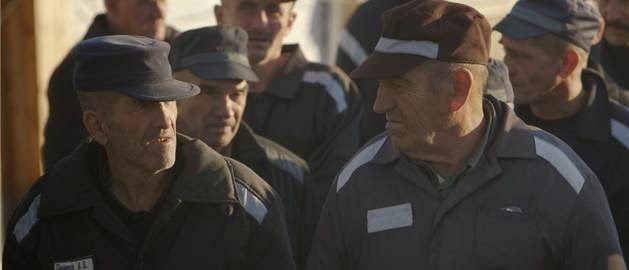
We are in Russia, or if you will, Hell. For many who are enclosed within the perimeter of fencing and locked gates, this will be their Purgatory until death takes them to the fiery eternal abode of Mephistopheles. Those who are not here for life, came in as young men and will leave as old men. This is the Federal Penal Colony No. 56 in Central Russia, surrounded by hundreds of square miles of deep forest in the Russian taiga. There's only one road in and one road out. The nearest populated community is a seven-hour drive away. The temperatures here frequently dip to 40 below zero.

There's no escape.


Director/Cinematographer Nick Read and producer Mark Franchetti introduce us to two sets of prisoners in this compulsive, staggeringly well crafted and downright great film. The Condemned are split between the most dangerous and the dangerous-but-less-so. The former live in solitary confinement, monitored by video 24-hours per day, not allowed to rest on their bed during the day time, forced to an eternity of pacing back and forth in the tiniest cell imaginable and allowed one hour per day of being outdoors in an chilly outdoor chicken run-styled enclosure not much bigger than their cells. The latter group live in a communal compound wherein they endure endless hard labour and an extremely rigid caste system that reduces many of the men to lives that are perhaps even more worthless than they could already be living.


Aside from capturing the day-to-day drudgery and monotony, Read expertly gets the prisoners to open up and bare their souls about the crimes they committed, their victims, their families, their thoughts and philosophies on forgiveness and redemption. Even more powerful is how the men give us personal glimpses into how they continue to live in a world that is, for the most part, hopeless and how some construct life out of what they can within the rigid construct of the penal system.


A great many of the men were originally on death row, but when Russia abolished capital punishment in 1997, their sentences were commuted to life. What a life. The Russian parliament made sure to enact specific wording in the laws so that daily, gruelling punishment is the order of these men's lives. Even worse is how so many of them men committed their crimes in that period when communism collapsed and the poverty was so overwhelming that the only mode of survival was crime or worse, numbing their pain with so much booze and drugs that many of their violent crimes occurred under the influence.

What's impossible to ignore in this powerful and moving film is a sense of humanity within the most inhuman/inhumane conditions. A handful of scenes involving visitations from family are downright wrenching. Even more brutal is discovering how so many of the prisoners are men of thought and intellect. The discourse of many is not the stereotypical tough-guy talk we expect, but is in fact, deeply thoughtful and philosophical.

There have been many documentaries about prison life, but almost none of them are produced with the kind of eye for cinematic artistry that The Condemned is imbued with. Part of this success comes from Read's direction which is coupled with his superb visual eye as a cinematographer, but also the meticulous pace and cutting from editor Jay Taylor who astoundingly makes monotony compelling and, on occasion, treats us to cuts that are breathtaking in their virtuosity.

The film drains us physically, but what remains is pure spirituality as we are allowed to connect with the souls of men whose actions on the outside include some of the most horrendous acts of violence. This might be the film's greatest strength and one that pretty much ensures its life as a masterpiece - a picture that will live long beyond the usual ephemeral concerns of most movies today.

The Condemned is screening at Hot Docs 2014 in Toronto. For further info, visit the festival website HERE. World Sales by Films Transit International.

Sunday, 20 April 2014

THE BOY FROM GEITA - Review By Greg Klymkiw - HOT DOCS 2014 - Harrowing Tale of Tanzanian Albino Killings - HOT DOCS 2014 MUST-SEE

Adam and Peter. One is Tanzanian, the other Canadian.
Both have albinism. One's called a ghost, the other's a businessman.
Together they're a formidable force against
Ignorance, Hatred and Prejudice.

The Boy From Geita (2014) Dir. Vic Sarin ****
Review By Greg Klymkiw

In Tanzania, if you're born with albinism, a rare genetic condition that severely lightens the pigmentation of your skin and renders you susceptible to dangerous, damaging effects from the sun's rays, you are less than zero. You're considered a living ghost and the only thing you're good for is what can be extricated from you in death by witch doctors who make use of your body parts for all manner of good luck potions. For as long as albinos have existed in this part of the African continent, they have been subject to prejudice at best and at worst, mutilation or murder.

Call me a Western Colonial Pig, if you will, but from where I sit, there's simply no room in the world for this sort of ignorance and hatred. I don't care how intellectually or financially impoverished the nation is, I don't care about the cultural significance of superstition in said nation. I am sickened by the rampant inhuman beliefs that foster the agony of prejudice. Through the world's kaleidoscopic shards of horrific actions inspired by religion, culture and/or belief systems, the butchery of those suffering from a medical condition is possibly one of the most, if not THE most stomach-churning abominations inflicted by man towards his fellow man.

The legendary cinematographer and filmmaker Vic Sarin presents a story that is, at once appallingly grotesque, yet also, out of the dark side of the human spirit is a tale of profound and deep compassion. The Boy From Geita focuses upon Adam, a 12-year-old albino who is attacked in the middle of the night whilst his father stands nearby and does nothing as his son is hacked mercilessly with a machete. The child miraculously survives this atrocity, but he has been mutilated so severely that if he's not attacked and killed again, he will live a life of the most unbearable hardship.

On the other side of the world in Canada, we meet the successful businessman Peter Ash. Like Adam, he is also afflicted with albinism. Though he recounts the sort of prejudices he faced in childhood, we also learn of his early tenacity and eventual ability to live triumphantly with this condition - how the unconditional love and acceptance via his mother and educational opportunities both allowed him the freedom to surmount all challenges.

These two extraordinary men, against all odds, find each other and the journey we take with them is deeply and profoundly moving.

Heartbreak, however, is a huge component of this tale and there are several moments where I defy anyone to not be wracked with sobs when we hear the stories recounted by albinos who have survived the most vicious attacks - always with machetes. We also share several huge moments of almost nail-biting suspense where we hope against hope that the opportunities to alter the lives of those who've suffered so horribly can come to fruition.

This is a superbly crafted motion picture that finally instills in us and its subjects some semblance of hope for the future. I can think of no better reason to praise the art of cinema for allowing such work to live and breathe so that we all can embrace the true joy inherent in humanity.

The Boy From Geita will enjoy its World Premiere at Hot Docs 2014. For further info, visit the festival website HERE.

Saturday, 19 April 2014

JUST EAT IT: A FOOD WASTE STORY - Review By Greg Klymkiw - HOT DOCS 2014 - Experiment an eye-opener.

Idiot Food Stores Reject Edible Food Because Idiot Customers
want the food to LOOK aesthetically pleasing. All this goes to a landfill
because there are simply far too many stupid people in the world.

Just Eat It: A Food Waste Story (2014) ***
Dir. Grant Baldwin, Prod. Jenny Rustemeyer

Review By Greg Klymkiw

Vancouver residents Grant Baldwin and Jenny Rustemeyer seem like your normal garden variety bourgeois couple, replete with a fix-it-upper older home with trendily remade/remodelled interior design/decor, so why, you might ask, do they eat from garbage bins? Well, to make this film, of course.

Appalled by the statistics of how much perfectly edible food is wasted in both farms and retail outlets, they undertake a grand and thoroughly worthwhile six-month-long experiment to not consume any food they have to buy. Along the way, we experience their endless search for good quality food dumped by stores in bins, product headed for dumping on the final best-before date and on occasion, seeing director Baldwin and producer Rustemeyer paying for severely marked down food that will be dumped if not purchased (this is the one exception to the "do-not-buy" rule).

Some stores refuse to give and/or sell the food, using the stupid excuse that their policy is to sell only the freshest product. Some of them even deliver the bald-faced lie that it's a healthy department by-law (which does not, for all intents and purposes actually exist). Chances are that many of the grocers dump perfectly good food in the moronic fear that they'll be liable for lawsuits if the food has gone bad. Of course, the food we see, has not gone bad at all. One of my local grocers - a franchise chain owned by Sobey's - slaps a "manager's special" sticker on such food and I buy it all the time. I'm not dead yet and as I write this, my fridge is stocked with several cartons of freshly squeezed orange juice, not from concentrate, all past the best-before date. They set me back a whopping $1.79 per carton and taste just fine. They'll continue to do so until every last drop goes down my family's gullets - unless, of course, I guzzle them all back first.

If I have a tiny quarrel with the movie, it's that it doesn't clearly identify the stores that pull this sort of crap and part of me wishes there was some Roger and Me-styled stalking and shooting of CEOs of the chain stores that encourage blatant food waste. It's not really enough to get worker-dweebs and store managers to address the issue - the big boys need to been taken down a few notches. The movie is a mere 75 minutes and I suspect no audience would have had an objection to a slightly longer running time if one could have had the added value of nailing the corporate dicks to a few crosses.

At the farms, the film demonstrates how perfectly fine vegetables and fruits are dumped strictly for "aesthetic" reasons. If the food doesn't "look" good, retailers won't buy it because most of their stupid customers won't buy anything with slight bumps, bruises, "off" colouring or even worse, that don't look identical to all the other foodstuffs available.

The movie introduces us to a variety of experts in the field of ecology and it's here we get a sense of just how ridiculous the waste of food actually is in North America. The worst part is that the tossed edibles are not even properly recycled as compost, but end up in landfills.

Yeah, really great for the environment, dork-wads.

An entire dumpster full of hummus.
Best Before Dates A-Okay!
Just Eat It: A Food Waste Story is an informative and entertaining look at an environmental issue so many of us might never think about. I must admit, though, that as an el-cheapo Ukrainian, I'm always looking for stuff at reduced prices once it's past the best before date. El-cheapos are often the best environmentalists. One of the most shocking things to see in the movie - especially to me, because I love the stuff - is when Baldwin comes across an ENTIRE dumpster full of hummus that's NOT even past the best before date.

You know, most people who sell food and those who shop for it, are complete and utter morons. For those of us who aren't, hopefully the movie will be a massive clarion call to do exactly what our filmmaking couple do. You'll save a ton of dough AND help the environment. Better yet, let's hope the movie cracks open the craniums of those who have little brain to begin with and allows the importance and urgency of this issue to filter through their dim-bulb cerebella.

Better yet, ask your grocery store what they do with stuff on or past the best-before date. If they lie and say it's a health department issue, (or worse, simply use the "best quality product" policy excuse) boycott the store. Let them know you're doing it, though. You might get some coupon incentives, gift cards and/or other valuable incentives to keep shopping there. Use up the freebies and discounts, to be sure, but keep shopping loyally at stores that give you what you want. It works for me!!!

Just Eat It: A Food Waste Story is playing at Hot Docs 2014. Visit the festival website for ticket, playmate and venue info HERE.

THE SECRET TRIAL 5 - Review By Greg Klymkiw - HOT DOCS 2014 - Legacy of Canada's Thinly Veiled Fascists. This chilling, important documentary that details Unconstitutional Incarceration is a HOT DOCS 2014 MUST-SEE


STOCKWELL DAY:
CREATIONIST, SPORTSMAN, POLITICIAN
A MAN AMONG MEN
The Secret Trial 5 (2014) Dir. Amar Wala ****

Review By Greg Klymkiw

Before we take some time to consider Amar Wala's chilling and important motion picture The Secret Trial 5, which details the Canadian government's horrendous abuse of five men who were incarcerated for spurious and most likely racist reasons, let us consider Stockwell Day. He ultimately plays a large role in this film since he held the lofty Minister of Public Safety position during a crucial time in the lives of these men, their families and, frankly, all of Canada.

Stockwell Day was an avid supporter of the idiotic security certificate, a 50-year-old immigration tool that can imprison non-Canadians living in Canada for reasons of - ahem - national security. Evidence is never fully revealed, trials are held in secret and the real hope is that those arrested under them, will agree to just go back to whatever country it is they came from.

Unfortunately, since the security certificate became an anti-terrorism tool in Canada after 9/11, people arrested under their auspices would have been committing suicide by agreeing to scurry back. We're talking about political refugees here. Going back meant, and still means, torture and execution. Besides, these were people who'd already made lives here with family, friends, bright futures and contributing to the fabric of Canada's multicultural society.

In the film, however, we're treated to numerous instances of Stockwell Day defending the use of the security certificate and even finding ways to get around a Supreme Court decision that these tools were (and are) constitutional. The bottom line for those like Day and his ilk is that these people are under arrest, stripped of their freedom and pretty much have to rot until they make the "right decision" and bugger off.

Stockwell Day, an avid sportsman, preacher and believer in Creationism (Yup, mankind walking with the dinosaurs) was the Minister presiding over the horrendous incarceration of these five men at a time when they needed a champion in that portfolio instead of an enemy. Then again, this was the same man who suggested that legalizing abortion could lead to child abuse. Injusticebusters.org quotes Day from the Calgary Herald with the following tidbit:

"If you can cut a child to pieces or burn them alive with salt solution while they're still in the womb, what's wrong with knocking them around a little when they're outside the womb."

On homosexuality, the same source quotes Day from the Edmonton Journal with the following nugget of wisdom:

"Homosexuality is a mental disorder that can be cured by counselling [and is] not condoned by God."

Day also expressed that sex education might lead to teen pregnancy:

"There is a growing body of literature suggesting that, as sex education becomes more comprehensive, there is a corresponding increase in sexual activity."

These five guys never had a chance.

Watching this stunning film, I was actually feeling ashamed to be Canadian. That our country could be governed by the likes of Day and the other fascists currently in power is simply beyond the pale. We watch, helplessly, as the film details the abuses these men suffered. Adil Charkaoui, was incarcerated for 21 months and forced to live under house arrest for four years - WITHOUT CHARGES. Hassan Almrei was in jail for seven years, plus forced into three more years under house arrest - WITH NO CHARGES LAID. Mahmoud Jaballah was working as a principal in a Scarborough school when he was arrested, then incarcerated for six years and continues to live under house arrest - AGAIN, NO CHARGES WHATSOVER!!! Mohamed Harkat spent a relatively breezy 43 months in jail and has lived under house arrest since 2006!!!!! Guess what? No charges. The fifth individual, Mohammad Zeki Mahjoub, chose not to participate in the film, but we learn that he was imprisoned for seven years and has continued to live under the strictest house arrest since 2007.

The house arrest is especially harrowing to experience while watching the film. For an individual to be forced to suffer the indignities the film details is yet another aspect that made me ashamed to be Canadian. The aforementioned non-participant in the film has publicly requested to be returned to prison, insisting the cruel and unusual suffering under house arrest is worse than incarceration in a jail. What the film details here in the house arrest of the other participants is indeed, so sickening, it's almost impossible to blame him.

Sometimes, the importance of a film can take precedence over its importance as film art. Such is not the case here. Wala's picture is meticulously researched, surprisingly balanced (given its cinematic activism) and superbly crafted. But most of all, it IS an important work. On the eve of yet another Supreme Court challenge to the unconstitutionality of security certificates that could hopefully result in the release of Mohamed Harkat, every Canadian needs to see this film and raise the hugest ruckus imaginable.

In fact, audiences all over the world need to see this film. It's proof that IF a so-called benign democratic stronghold like Canada is willing to engage in such fascist activities, imagine just how horrendous the whole wide world is becoming with respect to the thug-like imposition of Orwellian measures to keep everyone in their place.

The Secret Trial 5 premieres at Toronto's Hot Docs 2014. For ticket info, contact the festival website HERE.