Showing posts with label 1968. Show all posts

Tuesday, 13 February 2018

NIGHT OF THE LIVING DEAD - Review By Greg Klymkiw - Romero Zombies on Criterion!!!


Night of the Living Dead (1968)
Dir. George A. Romero
Starring: Duane Jones, Judith O'Dea

Review By Greg Klymkiw

"Kill the brain, and you kill the ghoul." - Scientist

"If you have a gun, shoot 'em in the head. That's a sure way to kill 'em. If you don't, get yourself a club or a torch. Beat 'em or burn 'em. They go up pretty easy." - Sherriff

Science and law enforcement make for good bedfellows - especially when the unburied dead come to life and seek out the living to snack upon.

The late George A. Romero's 1968 horror classic worked like a charm when I first saw it as a kid and continued to cast its magic spell as I continued to watch it umpteen zillion times over the decades. No matter what format I viewed Night of the Living Dead on - 35mm prints, 16mm prints, tv broadcasts, the myriad of bootleg public domain VHS tapes that floated around forever and a very decent Elite Entertainment DVD release from 2009, this was a movie that never failed to creep me out.

However, seeing it on the brand new Criterion Collection Blu-Ray, it feels like I'd never seen the film ever before - what an amazing experience it was to watch this beautifully restored edition supervised by Romero himself before his tragic, untimely death. Seeing it this way was at least as thrilling, shocking and supremely entertaining as when I was first slammed in the face with the two-by-four that is this genuinely great motion picture.

Of course, zombie and living dead extravaganzas have become so ingrained upon the collective psyches of movie-goers that most of them must view each movie with an air of been-there-done-that, but his original film is so infused with an acute political consciousness and clever satire, that the only movies that come remotely close to its power are Romero's first two sequels Dawn of the Dead and Day of the Dead.

Shot in beautiful black and white, we follow the mousy Barbra (Judith O'Dea) as her obnoxious older brother Johnny (Russell Streiner) drives her out to a graveyard in a remote rural location outside of Pittsburgh. When a pasty-skinned old man lopes onto the scene, Johnny teases his sister that the lumbering dude is "coming to get her". It turns out Johnny's right. He's viciously attacked by the ghoulish septuagenarian and then, Barbra becomes the quarry once her brother's been handily dispatched. She madly races to an old farmhouse and as night falls, the house becomes surrounded by similarly psychotic ghouls.

They have only one thing on their pea-brained minds - to kill the living and eat them.

Yes! Eat them!

Turns out there are other people in the house. They barricade themselves in, attempting to survive this onslaught of ravenous creatures. And what an onslaught it turns out to be.

Of course via television and radio, they discover that a plague of mass murder is occurring right across the state and yes, the unburied dead are rising to feed (literally) upon the living.

The dynamic in the house is fascinating, a microcosm of humanity. From the trembling Barbra to an obnoxiously selfish father, his caring wife, their sick daughter and a perky young couple, Romero's simple, but deft script delivers a group of survivors we are delighted to follow. And no such film would be complete without a hero. The resourceful, brave Ben (Duane Jones), kicks ass with the best movie heroes. And, astonishingly, Romero employed "colour-blind" casting - the film's hero is played by a terrific, handsome young actor and he is African-American. This was a big deal in 1968. That there are colour blind aspects to the character himself, makes it, even now, STILL a big deal.

Throughout the film, Romero paints a vivid portrait of redneck America as hayseed local yokels wander the highways and byways, taking sport in blasting the brains of the "living dead". It's a world gone crazily to Hell. Most tellingly, it's not really all that crazy. This is America in all its danger and "glory".

And that, might be the scariest thing of all.

THE FILM CORNER RATING: ***** 5-Stars

Night of the Living Dead is available on a super-deluxe new edition on the Criterion Collection which includes a new 4K digital restoration, supervised by director George A. Romero, coscreenwriter John A. Russo, sound engineer Gary R. Streiner, and producer Russell W. Streiner, a new restoration of the monaural soundtrack, supervised by Romero and Gary Streiner and presented uncompressed on the Blu-ray, Night of Anubis, a never-before-presented work-print edit of the film, new program featuring filmmakers Frank Darabont, Guillermo del Toro, and Robert Rodriguez, never-before-seen 16 mm dailies reel, new program featuring Russo on the commercial and industrial-film production company where key Night of the Living Dead filmmakers got their start, Two audio commentaries from 1994 featuring Romero, Russo, producer Karl Hardman, actor Judith O’Dea, and others, Archival interviews with Romero and actors Duane Jones and Judith Ridley, New programs about the film’s style and score, New interview program about the direction of ghouls, featuring members of the cast and crew, New interviews with Gary Streiner and Russell Streiner, Newsreels from 1967, Trailer, radio spots, and TV spots, plus an essay by critic Stuart Klaxons.

Monday, 1 February 2016

UPTIGHT - Review By Greg Klymkiw - Blacklisted 40s Noir Director updates John Ford classic "The Informer" from the Irish "troubles" to post-Martin Luther King assassination Cleveland.


Uptight (1968)
Dir. Jules Dassin
Scr. Jules Dassin, Ruby Dee, Julian Mayfield
Nvl. Liam O'Flaherty
Starring: Julian Mayfield, Max Julien, Ji-Tu Cumbuka, Raymond St. Jacques, Ruby Dee, Roscoe Lee Browne, Frank Silvera, Juanita Moore, Robert DoQui

Review By Greg Klymkiw

Liam O'Flaherty's classic 1925 novel was the basis for his cousin John Ford's immortal 1935 film The Informer, the simple, powerful story about an alcoholic cellar-dwelling brute in the Rebel-cause who betrays his best-friend to the authorities during the Irish War of Independence. Uptight is a 1968 remake by blacklisted film noir director Jules Dassin (Brute Force, The Naked City, Night and the City) faithfully transplanting O'Flaherty's story to the civil rights revolutionary movement in America by replacing the burgeoning Irish Republican Army with a fictionalized rendering of the Black Panthers in Cleveland.

To say Uptight is a forgotten masterwork of 60s/70s American Cinema would not, in spite of its lower-budget pedigree and a few bits of roughness around the edges, be an exaggeration. It's an endlessly fascinating, evocative take on the tragic implications of Martin Luther King's assassination amongst African Americans who chose violence to meet the injustices of the "Ruling" class, diametrically opposing King's peaceful actions (which, of course, were met with violence).

Dassin, the American son of Russian-Jewish immigrants, had long-dreamed of setting the book in just this fashion and miraculously managed to successfully pitch the property to Paramount Pictures during the rich "Easy Riders Raging Bulls" period wherein the artist/inmates were briefly allowed to run the studio/asylums. Alas, the film appears to have been barely released and has indeed been largely forgotten.

Dassin's greatest successes as a filmmaker were to carefully blend legendary producer Mark Hellinger's heavy-duty combo of gritty location work with carefully matched studio art direction. Fleeing the House of Un-American Activities for his involvement in the Communist Party, he carried on this same tradition in Europe and made the heist film Rififi, inarguably one of the greatest crime pictures in the history of French Cinema.

With Uptight, Dassin assembled an absolute dream team with impeccable results.

In addition to a cast of America's greatest African American actors of the time (or any time), Dassin was blessed with a rich script he co-wrote with the film's Black stars Ruby Dee and Julian Mayfield, stunningly gritty cinematography on the mean streets of Cleveland by Boris Kaufman (On the Waterfront, 12 Angry Men, The Pawnbroker), first-rate production design by Alexandre Trauner (Children of Paradise, Port of Shadows, The Man Who Would Be King) that astonishingly matched studio sets with the locations, the expert cutting of editor Robert Lawrence (Spartacus, El Cid, Fiddler on the Roof), costumes by Theoni V. Aldredge (1974's The Great Gatsby, Network, The Rose) and last, but never, ever least, a GREAT musical score by Booker T. Jones, including his massive 1962 Stax Records hit "Green Onions". (If you don't know Jones, or at the very least, Booker T. and the MGs, then you know NOTHING.)


Eschewing the redemptive approach chosen by John Ford and his screenwriter Dudley Nichols in 1935, Dassin and team use O'Flaherty's underlying literary material to drag us through a dramatically tragic and stylistically (albeit borderline) example of neorealism which is shaken (not stirred) with dollops of expressionism. Other than a sentimental death for a traitor on the steps of a church and the updated setting, Uptight is strangely familiar to the Ford picture (at least on a simple narrative level).

After a gorgeously edited montage of the immediate Memphis aftermath to King's assassination (all in glorious, grainy colour) and expertly blended with scenes introducing the anger of the Cleveland Black-Panther-like revolutionaries, we plunge immediately into the familiar tale (which won Victor McLaglen his 1936 Best Acting Oscar as the doomed informer Gypo Nolan). His counterpart in Dassin's film is Tank (Julian Mayfield, making a phenomenal acting debut, ignored not only by the 1969 Oscars, but like the film, most everyone).

The burly booze-hound is drunkenly responsible for a major screw-up during an arms heist. His best friend Johnny Wells (Max Julien) is identified as the ringleader and murderer of a security guard. Johnny's parter Rick (Ji-Tu Cumbuka) and head revolutionary B.G. (Raymond St. Jacques, adorned stylishly in a Nehru jacket) are so disgusted with Tank's repeated incompetence that they kick him out of the organization.

Since Tank lost his job at a steel mill, Laurie (Ruby Dee), the love of his life is forced to prostitute herself. Cut loose by the revolutionaries, he's got little to live for and is especially susceptible to the influence of the silver-tongued gay police informant Clarence (Roscoe Lee Browne). Seeing the reward money for Johnny Wells as a way out for himself and Laurie, Tank does the unthinkable and rats out his old friend.

Ah, but just one little drink is needed.

Instead of using the dough as a nest-egg for flight and a better life for Laurie, Tank is pumped up into thinking that for once in his life, he can be seen as a "big man", and he trolls from bar to bar, buying multiple rounds for himself and all his "friends". All he has left is $20 to put in a collection plate during Johnny's funeral (his old pal's been gunned down by the cops thanks to Tank's loose lips).

The inevitable demise awaits him - not on the steps of a church, but upon the slag heaps of a steel mill.

The picture is a heartbreaker, to be sure, but even though it's a period piece, Uptight is as resonant to race relations in America today as it was in the 60s/70s. A good part of this is thanks to Dassin's dazzling direction. The opening heist scene is tension-filled and reminiscent of the "silent" heist in Rififi, the dirty streets of Cleveland seem as foul as those in The Naked City and the violence as raw and unyielding as that seen in Brute Force. The locations and production design, so beautifully lit, pulsate with realism of the neo and expressionistic variety - everything from tenement back alleys to a shuttered old bowling alley (and, of course, the slag heaps of Cleveland). You'll also be treated to a horrifying distorted mirror sequence where Tank drunkenly stumbles amidst freakish bourgeois White folk - a thoroughly unforgettable series of shots.

Dassin's montages are also a thing of foul beauty. Not unlike Slavko Vorkapich's legendary montages, they're infused with the weight of social injustice and the sadness inherent in a world where slavery is still slavery, but with a different name - the status quo, a world in which one of the film's characters opines: "a nigger is still just a nigger".

THE FILM CORNER RATING: **** 4-Stars

Uptight is available on a bare-bones Blu-Ray from Olive Films, but the transfer gorgeously reproduces the film's glorious grain and dapples of saturated colour. Given that most people have not seen this important work about the African American revolutionary movement (rooted in Irish literature and remade from a great John Ford masterpiece), it's well worth buying - for those who care about cinema.


If you buy UPTIGHT or any of other related Jules Dassin/John Ford films directly from the Amazon links below, you'll be supporting the ongoing maintenance of The Film Corner:

Sunday, 6 October 2013

10 Terrific Space Movies to see instead of GRAVITY or 10 Reasons NOT to see GRAVITY - By Greg Klymkiw

There's really no need to see this movie!
October 4, 2013 saw the release of Gravity, a dull, predictable, badly written and clearly expensive space thriller which opened wide on several thousand screens in uselessly annoying 3-D. It has already amassed a ludicrously high "Fresh" rating on Rotten Tomatoes and this highly touted trifle will be a huge hit. To the former, most critics aren't real critics and the real critics who've ejaculated on the film are probably so depressed over all the crap they have to see that Gravity did indeed feel special to them. The reality is this - it's really not very good. There exist, however, a clutch space travel movies that offer far more than what's on display in Alfonso Cuarón's trifle of a picture. Buy, rent, VOD or if, God willing, they're in rep somewhere, see them as they're meant to be seen. Any of these suckers deliver the real thing rather than wimpy, weepy eye candy. The most recent and obvious choice for this list is Europa Report, the phenomenal picture from this very same year that's received virtually no release of any consequence.
SEE IT! NOW!
Europa Report (2013) ****
Dir. Sebastián Cordero
Starring: Anamaria Marinca, Daniel Wu, Karolina Wydra, Michael Nyqvist, Sharlto Copley, Christian Camargo, Embeth Davidtz, Dan Fogler, Isiah Whitlock Jr.

Easily one of the best science fiction films I've seen in years. It had me charged with excitement from beginning to end. A private corporation launches a historic manned flight to Jupiter's Moon of Europa, a huge orb covered completely with ice and most probably having one of the likelier possibilities of life in our solar system due the presence of water. An international crew of six astronauts are onboard for the mission and director Sebastián Cordero astonishingly covers every key detail of the trip via an insane number of POVs from the cameras set up by the corporation. Europa is, of course, fraught with danger and the filmmakers work overtime to keep us on the edge of our seats. What drives the film is the potential to discover life - it might be simple or complex, benevolent or dangerous, but there will be life. And it will be awe-inspiring.

Here are more top picks for space travel movies (in alphabetical order):

SEE IT! NOW!

2001: A Space Odyssey (1968) *****
Dir. Stanley Kubrick
Starring Keir Dullea, Gary Lockwood, Douglas Rain

This is truly the greatest of them all. A collaboration between Arthur C. Clarke and Stanley Kubrick, this monumental picture is still ahead of its time and delivers what feels like the closest approximation of what it must be like to travel in space. Spanning the Dawn of Man through to a deep space journey to Jupiter, Kubrick takes all the time he needs to lavish attention over the simplest, though most gorgeous elements of space travel. In addition to the dazzling opening involving prehistoric man, we occasionally meet up with mysterious ancient alien monoliths which inspire continued leaps in mankind's evolution (or devolution) and its ability to traverse the universe in traditional spacecraft and by more spiritual means. 2001 is partially a muted thriller involving the famous robot HAL who attempts to murder the entire crew to carry on a mysterious mission into the netherworld of deep space. On the other side of the coin, it's a glorious head film that inspires audiences to accept the purely experiential aspects of Kubrick's visual genius - whether one chooses to see it stoned or straight. It also proves that 3D is completely unnecessary. In fact, it proves that 2-D is, in the hands of a real artist - multi-dimensional. I'm happy to say that my first few helpings of the film were as a kid in an old National General Cinerama theatre with the huge, deep, curved screen. Take that, IMAX!!!!!

SEE IT! NOW!
Armageddon (1998) ****
Dir. Michael Bay
Starring: Bruce Willis, Ben Affleck, Billy Bob Thornton, Liv Tyler, Owen Wilson, Will Patton, Peter Stormare, William Fichtner, Michael Clarke Duncan, Steve Buscemi

Pure roller coaster ride, but what a ride! A huge all-star cast propels this taut disaster epic wherein a team of pure testosterone blasts into outer space to drill into the core of a mighty asteroid hurtling towards Earth and to nuke the bugger to kingdom come before life as we know it ceases to exist. Visceral thrills of the highest order and loaded with plenty of true grit and heart. Critics crap on this, but audiences knew and still know the score. The movie rocks big-time!

SEE IT! NOW!
Journey to the Far Side of the Sun AKA Doppelgänger (1969) ***1/2
Dir. Robert Parrish
Starring: Roy Thinnes, Ian Hendry, Lynn Loring, Patrick Wymark

Moody and creepy space thriller from Britain's Gerry Anderson and Co. doing their first live-action feature after a successful canon of animated sci-fi TV shows like Thunderbirds which used marionettes in place of actors. No puppets here, though. Two terrific, underrated character actors play a pair astronauts who discover a planet in an identical orbital position to that of Earth located directly on the opposite side of the Sun. Well written and very strange. It certainly pre-dates the notion of parallel universe and is as fascinating now as it was in the 60s.

SEE IT! NOW!
Marooned (1969) ***1/2
dir. John Sturges
Starring: Gregory Peck, David Janssen, Richard Crenna, James Franciscus, Gene Hackman

Cool optical effects (as opposed to antiseptic digital F/X) rule the day in this genuinely suspenseful sci-fi melodrama involving a ship with major mechanical failures that's trapped in outer space. Three astronauts are sardine-tinned in the ship while mission control does what it can to bring the boys home and the wives weep and fret down below (as good wives should do). Though the movie inexplicably errs on a number of key technical elements of space travel, it gets far more of them absolutely dead-on. The film's release pre-dated the somewhat similar disaster that befell Apollo 13 and was spectacularly presented in 70mm, 6-track sound (which, Thank Christ, I had the joy of seeing a few times as a kid). The movie even inspired the Apollo-Soyuz Test Project in 1975 which was a result of the Apollo 13 disaster. Kick-ass manly-man director John Sturges (The Great Escape, The Magnificent Seven, Bad Day at Black Rock) handled the claustrophobic action brilliantly and a good deal of the picture is genuinely nail-biting. The performances are first-rate, but it's Gene Hackman who steals the show as a space flyer who starts to crack-up big-time. There's also absolutely no musical score. The interior soundscapes within the ship, and back on Earth works just fine, but one does have to ignore the exterior sound in zero gravity since it doesn't exist out there.

SEE IT! NOW!
Moon (2009) ****
dir. Duncan Bell
Starring: Sam Rockwell, Kevin Spacey

Space is thrilling, exciting and full of adventure, but when you get right down to it, the whole experience has got to be extremely creepy and Duncan Bell exploits this notion to terrifying effect as Sam Rockwell plays the sole human being presiding over a mining project on the dark side of Earth's Moon. His only companion is the Über-Creepy GERTY the robot (Kevin Spacey's voice, 'natch!). Shit is slowly hitting the fan and the entire movie plunges into nightmare territory.


SEE IT! NOW!
The Right Stuff (1983) *****
dir. Philip Kaufman
Starring: Fred Ward, Dennis Quaid, Ed Harris, Scott Glenn, Sam Shepard, Barbara Hershey, Lance Henriksen, Veronica Cartwright, Jeff Goldblum, Kim Stanley, Levon Helm

One of America's greatest living directors crafted one of America's greatest motion pictures about outer space. Based upon Tom Wolfe's book, Kaufman plunged us into a gorgeous, thrilling, supremely entertaining and utterly fascinating look at the history of modern space flight - telling the story of test pilot Chuck Yeager and the seven brave men who were part of America's Mercury space program. Every aspect of this film is pure perfection and it's not only infused with epic sweep, but it's deliriously romantic. One of a handful of genuinely great motion pictures from the otherwise horrendous decade of the 80s.

SEE IT! NOW!
Silent Running (1975) ***1/2
dir. Douglas Trumbull
Starring: Bruce Dern

A huge convoy of spaceships loaded with plant life floats amongst the stars to regenerate what's been lost to pollution on Earth. When Mission Control decides to abort the mission due to funding and general lack of interest in environmental concerns, Botanist Bruce Dern goes insane ('Natch!), murders the whole crew and jettisons in the netherworld to preserve the plant life. The whole movie is pretty much Bruce Dern, two drones he names Huey and Dewey, Joan Baez singing about flowers, trees, birds and bees (gotta love the 70s) and endless shots of whole forests under huge domes in outer space. You kind of need to ignore the fact that the Earth apparently has NO plant life at all, yet appears to be perfectly functioning. Just imagine that the interplanetary greenhouses are to build up plant life on the verge of extinction - or something - because it's a pretty damn fine movie in all other respects from F/X whiz Trumbull (2001).

SEE IT! NOW!
Solaris (1972) *****
dir. Andrei Tarkovsky
Starring: Natalya Bondarchuk, Donatas Banionis, Anatoli Solonitsyn, Sos Sargsyan, Vladislav Dvorzhetsky

From one of the great masters of Russian Cinema, you'll not see a space travel movie quite like it - steeped in sorrow, melancholy and a brand of cinematic humanity that could only have been achieved by Andrei Tarkovsky. A psychologist travels into deep space to investigate the mental health of a crew on an interstellar station perched above the planet Solaris - comprised of no known land mass and seemingly an orb of pure ocean. The crew has stopped communicating with each other. When our head doctor arrives, the space station is a complete disaster area, the crew of two ignores him, a third crew member has committed suicide prior to his visit, the space station appears to be full of crew members who shouldn't be there (and who don't communicate with anyone) and in the middle of the night, the doc wakes up in his room (which he's barricaded) to find himself in the company of his late wife. Things begin to get strange. Prepare to be alternately creeped out and moved to tears. One of the greatest movies of all time.

SEE IT! NOW!
A Trip To The Moon (1902) *****
dir. Georges Méliès

Scientists blast off to the Moon, its bright side adorned with the face of a man. The rocket lands in the eye of the Moon's face. The scientists are assailed by grotesque moon creatures. They're pretty easy to kill, but eventually they acquire strength in overwhelming numbers and a desperate fight ensues to safely board the ship and return to Earth. 18 minutes of pure movie magic from the great early magician of cinema, Georges Méliès - this film and its creator immortalized in Martin Scorsese's Hugo. Though shot and released primarily in black and white, Méliès generated and presented a limited number of painstakingly hand-coloured prints. They were all said to be lost. One was found and restored - frame by frame. One frame of this film has more magic, imagination and innovation than the entire running time of Gravity and, for that matter, most contemporary movies.


Here is the color restoration of A TRIP TO THE MOON - Please BUY the BLU-RAY - it Kicks Mega-Ass:


Monday, 16 September 2013

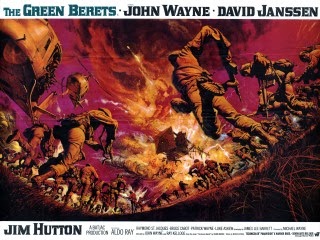
THE GREEN BERETS - Review By Greg Klymkiw - John Wayne No Jesus Christ. He is God The Father! Amen!

Is it Jesus Christ Almighty?
No! It's JOHN WAYNE!
The Green Berets (1968) ***
dir. John Wayne and Ray Kellogg

Starring: John Wayne, David Janssen,
Jim Hutton, Aldo Ray, George Takei

Review By Greg Klymkiw

For me, one of the best things about blu-ray discs is getting an opportunity to see favourite movies from one's childhood in a format as pristine and gorgeous as when I first saw them on a silver screen.

The Warner Home Entertainment blu-ray release of John Wayne's The Green Berets, a film that is as spectacular an action picture as it is a politically reprehensible war movie, has NEVER looked better, save for a time - over forty years ago - when I sat in a grand old 2000-seat picture palace with my Dad during the picture's first Friday showing in my hometown of Winnipeg.

John Wayne was and to some extent, still is, the perfect father and son idol. (Daughters can love Wayne, too, as witnessed with my own little girl who will sit with Dad and watch a John Wayne picture ANYTIME.) Even now, though, I remember that the majority of public screenings of Wayne movies I experienced with Dad were comprised of grown men and their bean-shaved boys and in fact, I think I saw almost every John Wayne picture ever made, old and new, western or war, on a creaky old black and white TV set with rabbit ear antennae or in the most opulent and now extinct temples to cinema - with Dad.

No Mom, no Sis and only with schoolboy chums for second, third or more helpings.

To my Dad, John Wayne WAS his screen father and for me, the feeling was mutual. Wayne represented the Father my Dad wanted to be and the Father he wanted. As a child, I shared the latter sentiment, though in reality, I can genuinely say, Dad did not ever really disappoint in the manhood stakes of patriarchy - especially during his years as a cop when he would proudly regale me with his tales of his head-busting daring-do, all in the service of protecting the good and punishing the bad.

John Wayne was the Father. And as any lad brought up in the Judeo-Christian tradition knows, GOD is the Father!

Along with The Searchers, True Grit, The Cowboys and some of the other Batjac productions of the 50s, 60s and 70s (Hondo, Chisum, The Alamo and Big Jake to name a few), The Green Berets was, for many years, the kind of picture Dad and I treated with the solemnity of a Sunday church service. For good reason, I might add.

Or at least, so we thought.

One of the many fascinating aspects of The Green Berets was the fact that it was one of the few war pictures actually set against the backdrop of Vietnam to be made DURING the Vietnam War itself. Stranger still, the picture was released several months after the TET offensive - one of the biggest U.S. debacles of the war. Though the Communist forces suffered huge losses during TET, this was something that was almost ignored and/or repressed by the media (who began blasting American involvement in the war more violently than ever before) and American power-brokers (this was the year when gung-ho Secretary of Defense Robert McNamara did an about face on his own battle escalation strategies and resigned his position).

With respect to TET, the scrutiny on behalf of media and public was clearly aimed at several factors that eventually forced many Americans to seriously re-evaluate their country's participation in the war:

1. American casualties were higher during this offensive than all the years of the war combined.

2. The Communists proved they were stronger in numbers than anyone thought.

3. America was completely unprepared for this offensive and only won technically through their sheer numbers.

4. The ambitious and complex battle plan on the part of the Communist forces was not successful in the cities, but - almost more importantly - gained considerable ground in "the country", the heartland of Vietnam.

5. America launched one of the largest draft policies of the entire war - further inspiring ire in both press and public. 15,000 American soldiers were killed and now, the government was demanding the forced conscription of close to 50,000 young Americans.

6. South Vietnam, the ones America was purportedly fighting for, was hardest hit by TET and its aftermath yielded thousands upon thousands of civilian casualties and such a massive destruction of homes that almost one million people were now refugees.

And then, amidst the above mentioned came John Wayne's The Green Berets, a thoroughly fictional (and loose adaptation of Robin Moore's bestselling book of the same name). Here was a movie that had absolutely NOTHING to do with the reality of what was happening and presented a scenario and style NOT unlike every run-of-the-mill war film ever made. In retrospect, what was even more jaw-dropping was how the movie-going public embraced Wayne's propagandistic rah-rah rally cry for continued American involvement in Vietnam.

The Green Berets was a huge hit at the box office!

As a kid, I certainly saw no dichotomy whatsoever. Though I'd occasionally see the rather graphic war footage on television news, it seemed "dull" compared to the daring-do of my Celluloid Dad. For my real Dad, any protests generated by TET and its aftermath, were, no-doubt, merely the product of dirty, long-haired hippie commies.

For me, my Dad and many like us, The Green Berets was a thrilling, kick-ass war picture with the sort of carnage and heroism that seemed to dwarf real life. To gain access to the finest American military hardware, Wayne needed to abandon most of Moore's book, which portrayed the Green Berets in a manner the government had issues with. As well, this was still in advance of Sam Peckinpah's classic western The Wild Bunch, a western that used the Old West as a metaphor for Vietnam, in addition to changing the way we looked at violence on-screen forever.

The simple narrative of The Green Berets begins with the sour castigation of those brave fighting men by lefty American journalists. Representing the Pinko hordes is none other than a reporter played by David Janssen (a huge T.V. star of The Fugitive fame and, lest we forget, Albert Zugsmith's utterly insane piece of sentimental war propaganda Dondi). His criticism of America's involvement in Vietnam, and most importantly, his assertion that the fighting men of the Green Berets are as unquestioning as those within Nazi Germany. This, of course, is in response to a soldier who admits that "foreign policy decisions are not made by the military. A soldier goes where he is told to go, and fight whom is told to fight." Janssen's comparison to a Totalitarian regime seems perfectly reasonable under the circumstances, but instead, inspires Green Beret head honcho John Wayne to foam at the mouth a bit before offering Janssen a free, uncensored, ground-zero view of what America is fighting for.

So, with his knapsack on his back, Janssen accompanies the likes of John Wayne, his tough beefy right hand man Aldo Ray, the noble South Vietnamese military ally (played by George "Mr. Sulu" Takei) and the lovably baby-faced and irascible Ensign-Pulver-like conman Jim Hutton. For close to three hours, Janssen's character and indeed, we the audience, are face-to-face with the utterly inhuman savagery of the Viet Cong and their dirty Commie ways and the noble, heroic and successful eradication of said Commie Pigs at the hands of John Wayne and his fighting men.

From the opening titles of the picture, the lyrics of Sgt. Barry Sadler's stirring hit song "The Ballad of the Green Berets", lead us on an odyssey devoted to extolling the virtues of those who would dare risk life and limb for the oppressed.

Sadler's lyrics tell us so:
Fighting soldiers from the sky
fearless men who jump and die
men who mean just what they say
the brave men of the Green Berets . . .
Back at home a young wife waits
her Green Beret has met his fate
he has died for those oppressed . . .
make him one of America's best.
As the movie progresses, we bear witness to Pinko journalist Janssen and his conversion to the cause - so much so, that he himself even engages in battle against the Commie Pigs. As a young lad, I bought this hook, line and sinker.

After all, we see baby-faced Jim Hutton befriend a Vietnamese orphan (not unlike the Short-Round character from Samuel Fuller's immortal and decidedly anti-war WWII drama Steel Helmet - a character who was later represented in homage by Spielberg in Indiana Jones and the Temple of Doom) and when Hutton dies a hero's death, it is John Wayne himself - everyone's surrogate Father - who picks up the torch and leads the little Vietnamese boy into the setting (or rising) sun, presumably adopting the lad and proudly intoning that it is the CHILD whom the entire war is being fought for. (Much derision has been levelled at the Sun setting in the East of Vietnam, but in fairness, the movie does not specifically state it is sundown, and could just as easily be sunrise - in which case, there's nothing technically wrong with the closing shot.)

This was indeed rousing stuff to experience as a kid; working on a level of propaganda, to be sure, but mostly, within the mythic elements of the genre which I had already been inundated with thanks to the likes of all the great WWII pictures I'd already seen (many of which starred John Wayne).

Amongst the many vicious pans the picture received at the time, none is more eloquent than Roger Ebert's now-legendary piece wherein he states:

"The Green Berets simply will not do as a film about the war in Vietnam. It is offensive not only to those who oppose American policy but even to those who support it. At this moment in our history, locked in the longest and one of the most controversial wars we have ever fought, what we certainly do not need is a movie depicting Vietnam in terms of cowboys and Indians. That is cruel and dishonest and unworthy of the thousands who have died there."

Ebert's assertion that the picture works on the level of a simple by-the-numbers Western is not far from the truth. When Janssen is led into the American camp in Vietnam, he raises his eyebrows at a handmade sign nailed at the entrance which says: "Dodge City" - that rough and tumble town of innumerable American westerns where the men were mean, violent and only able to be tamed at the end of a gun. This, however, is the only time in the picture where we get a glimpse of something that might lead us into the territory of M*A*S*H rather than a Rory Calhoun oater, but very quickly, we realize this is no touch of irony - the picture means it fair and square. When Janssen queries Wayne about the execution-style slaying of some Vietcong, Wayne replies - with the kind of venom only Wayne could spit out: "Out here, due process is a bullet!" Even now, I remember my Dad and the rest of the audience applauding this.

Wayne, after all, was the father of us all.

That The Green Berets is only one of two feature films Wayne directed (the other being The Alamo) is not without significance. Wayne was, and probably still is the biggest movie star of all time. In role after role, he embodied the values of both America and manhood.

One of the best books to ever deal with Wayne is Gary Wills's "John Wayne's America - The Politics of Celebrity" which presents a biographical portrait of Wayne as an instrument of propaganda. This, of course, is a point of view that would be impossible to refute. Wills asserts that Wayne "made an impact when he carried his Manifest Destiny assurance into compromising situations." Given the huge positive response of audiences to The Green Berets in spite of clear evidence that the values inherent in the picture are a complete bald-faced lie, it's not hard to believe just how important a figure Wayne was and, to a considerable extent, still is.

Granted, unlike a picture such as John Ford's The Searchers, where the clash of cultures is treated with several layers of complexity, the same clash in The Green Berets is about as complex as a square-holed puzzle with nothing but square pegs. When endlessly useless wars against Muslim countries are perpetrated, not in the name of freedom, but in the name of oil, when George W. Bush can outright steal the presidency under the noses of the American public, when an entire nation has no proper system of health care and probably never will, when too many people believe the results of the Warren Commission, when people are jailed and persecuted in a supposedly democratic society, when everyone in America believes that ONLY America was able to win both World Wars, it's obvious that Wayne's influence as a star and the kind of heroism he represents in over 150 pictures "seems", according to Wills, "to suggest that the need for this hero will call up again the kinds of story where he operated best." Wayne, of course, is not the only star to have been used in this fashion, but he was and still is, the most influential. He knew it, believed it and so did his adoring public. Wills maintains that Wayne, more than any other star reflected American society back upon itself which was "the source of his appeal, and of his danger."

I cannot, then, even for a second, defend The Green Berets on its politics and I am forced to separate them from the picture itself. Is that even possible? I'd suggest it is. It's a picture I enjoyed a lot as a kid and as an adult, I was certainly able to sit through it and gain some amusement value on a number of levels. As a movie in the context of a contemporary viewing, it's not without moments that are creaky and clunky - the first 45 minutes is especially a bit of a dull slog, but once the action revs itself up, the movie is as spectacular an entertainment in the war genre as many similar pictures which preceded it. To use the parlance of contemporary action pictures, "It blows up real good" and even its dollops of sentiment have the power to move. Does it go any places that GREAT war movies go? Not one bit. It's paint-by-numbers action. No more. No less.

As a director, Wayne doesn't display the surest hand in The Green Berets which probably isn't helped by the fact that he chose Ray Kellogg to be his co-director. Kellogg was the brilliant special effects designer and cinematographer for Twentieth Century Fox who, among other astounding accomplishments, worked on the first-ever CinemaScope production, The Robe. He was also a solid second-unit director of note. All of these accomplishments give us some sense of why the "blowing up real good" blows up, real good! As a solo director, it's probably important to note that he directed two feature films produced by and starring Ken (Festus on "Gunsmoke") Curtis, The Giant Gila Monster and The Killer Shrews. While Wayne had an uncredited Mervyn LeRoy wandering around the set of The Green Berets and lending a helping hand, Wayne's previous effort as a director, The Alamo was a happier experience - at least on an artistic level. He had none other than John Ford puttering around and lending his painterly eye to some of the proceedings (but when "Pappy" started to take over, Wayne sent him out to shoot some second-unit footage). Aside from some annoying longueurs, it's a pretty damn fine epic western with a great cast, a solid screenplay and magnificent battle sequences. It also features an unbelievably tear-wrenching death scene with the immortal Hank Worden (Ole' Mose from The Searchers). And how can one NOT enjoy seeing John Wayne and Richard Widmark as Davy Crockett and Jim Bowie? Alas, Jim Hutton in The Green Berets doesn't quite wrench as many tears in HIS death scene, but I suppose he can't be entirely blamed. After all, there IS only one Hank Worden.

The Green Berets is, no doubt, a dangerous, reprehensible and politically boneheaded picture, BUT it is ALL JOHN WAYNE!

And John Wayne is still the Father of us all. His very being is sacred and as a motion picture star, he is truly unparalleled. Gary Wills refers to Wayne's image as "mixed and terrifying... full of the unresolved contradictions" of America itself. True enough, but John Wayne was a star all over the world and as such, I'd suggest those "unresolved contradictions" resonated well beyond America - they permeated every square inch of our planet's ground. Wills wonders if America has, or will ever escape "the myth of the frontier, the mystique of the gun..." and again, I go wonder if we ALL will ever truly escape those things. To answer that, Wills leave us with a line from The Searchers, a line that was, after John Wayne's single greatest line of dialogue ever. It's one, I too, am happy to leave you with.

"That'll be the day!"

"The Green Berets" is currently available on the Blu-Ray format from Warners Home Entertainment.


Thursday, 3 January 2013

VILLA RIDES - Review By Greg Klymkiw - Yet another picture Sam Peckinpah was supposed to make, but didn't. Yup, he was fired.


Villa Rides (1968) dir. Buzz Kulik
Starring: Robert Mitchum, Yul Brynner and Charles Bronson

**1/2

Review By Greg Klymkiw

Does the name Buzz Kulik ring a bell? Well, it probably shouldn’t because he’s essentially a proficient hack who delivered thousands of hours of American series television, a few forgettable features and a handful of decent made-for-television movies. On the plus side, most of his television work is from the Golden Age and anyone who camera-jockeyed shows like “The Twilight Zone”, “Gunsmoke”, “Perry Mason” and, among many, many others, “Have Gun – Will Travel” can’t be dismissed entirely. He also delivered the goods on two of the best dying-sports-star TV-weepers of all time, “Brian’s Song” and “Babe” as well as an extremely memorable movie-of-the-week thriller called “Bad Ronald”.

In spite of the abovementioned, however, it’s still a disappointment that he is the director of the all-star feature western “Villa Rides” – not because his work is bad, but because the material suggests just how good the picture might have been if its original screenwriter, Sam Peckinpah, had had a shot directing it.

After the studio butchery of “Major Dundee” and his unfair firing from “The Cincinnati Kid”, Peckinpah, that late, great iconoclast of contemporary cinema, took a few gun-for-hire jobs during an extremely low point in his career when he was essentially persona-non-grata in the business. One of these jobs was to write a screenplay about the legendary Pancho Villa.

Watching the picture, one is occasionally distracted from the proceedings by constantly trying to imagine the picture it could have been. On the surface, it tells a relatively simple tale wherein a barn-storming American aviator (Robert Mitchum) runs guns to the Mexican army, witnesses a genocidal slaughter of a Mexican village (a result of his sale of the guns) and his eventual switchover to fight the good fight during the Mexican Revolution with Pancho Villa (Yul Brynner) and trusty right hand (Charles Bronson). From that point on, lots of things blow up real good.

But that’s about all they do in Kulik’s hands. Blow up.

This is unfortunate. Few American filmmakers had just the right feel for Mexico and could bring equal amounts of sentiment, sorrow and brutality to the proceedings. Peckinpah was at the top of this very small list. Considering that Peckinpah’s script (rewritten by Robert “Chinatown” Towne) is replete with tougher-than-nails men’s men who begin on opposite sides of the fence and eventually bond by causing violence for the greater good, one looks in vain for the sadness and obsession that infused much of Peckinpah’s work.

Alas, it is not really there in the final product.

What remains is an engaging stalwart cast and some not-unexciting action scenes. “Villa Rides” has a good amount of entertainment value and makes for fine Saturday afternoon home viewing. One can’t sneeze at this in any, way shape or form. However, knowing who wrote the film and seeing, from time to time, almost-trademark Peckinpah themes and situations within it, one longs for more. Even the extreme proficiency and entertainment value of the action scenes pales in comparison to the mere THOUGHT of what Peckinpah might have brought to them if he were at the helm.

We’ll never get it, of course. It’s not there. It’s solid western action – no more, no less. If you’re able to forget the pedigree of the screenwriter, a rollicking good time can still be had.

And that, finally, ain’t nothin’!

It’s just not Peckinpah.

“Villa Rides” is available on DVD from Legend Films.

Feel free to order from the direct links below and assist with the maintenance of this review site:


-->
-->

Friday, 23 November 2012

ROSEMARY'S BABY - Review By Greg Klymkiw - CHRISTMAS GIFT IDEA FOR 2012 #1 - Criterion Collection Director Approved Blu-Ray & DVD

Abe Sapirstein Says:

"This Xmas, HAIL SATAN!

Give the gift that keeps on giving."

Here's your Greg Klymkiw Christmas Gift Suggestion #1 for 2012. Everyone you love will deserve this special treat to celebrate the birth of Jesus H. Christ, Our Lord. It's the magnificent Criterion Collection - Director Approved Blu-Ray (or, if you must, DVD) of Roman Polanski's masterpiece of utter horror, "Rosemary's Baby, brought to you with an all-new, restored digital transfer, that's been approved by director Roman Polanski, with (my favourite) an uncompressed monaural soundtrack. Add the following delectables: a new doc with interviews featuring Polanski, Mia Farrow and Robert Evans; an interview with the author of the bestselling novel the movie is based on, Ira Levin; "Komeda, Komeda", a feature-length doc on the life and work of Krzysztof Komeda, who wrote the chilling score for everyone's favourite cinematic buffet of Satan; A nifty booklet featuring an essay by Ed Park; Levin’s afterword to the 2003 New American Library edition of his novel; and Levin’s rare, unpublished character sketches of the Woodhouses and floor plan of their apartment, created in preparation for the novel.

Can it possibly get any better than this to commemorate Our Lord Baby Jesus being expunged from the virgin loins of Mother Mary? You bet it doesn't. This is the gift that keeps on giving, so give it with love to those you love.

Rosemary's Baby (1968) *****
dir. Roman Polanski
Starring: Mia Farrow, John Cassavetes, Ruth Gordon, Maurice Evans, Sidney Blackmer, Ralph Bellamy, Charles Grodin, Elisha Cook Jr.

Review By Greg Klymkiw

We've all had neighbours, friends, family and/or mere acquaintances who - no matter how well intentioned - just suck the life right out of you. Their ubiquitous presence and meddling (disguised as a helping hand) gets to a point where you just don't want to answer the door or telephone, or in this day and age, go online. In fact, you sometimes even contemplate killing these loathsome, hematophagous hirudinean parasites. And make no mistake, they come in all shapes, sizes and persuasions. Some of them might even worship - yup, you guessed it - Satan!

I must frankly admit I've always had a soft spot for devil worship.

In the movies, that is.

The cult aspect of devil worship is what's probably the most frightening. Val Lewton's The Seventh Victim is probably the first great horror movie to deal with the evil of cults and the insidious way they target their prospective members/victims, then suck them dry. Also great fun is The Devil Rides Out, that great Hammer Horror picture directed by Terence Fisher and starring Christopher Lee as the Satanist-battling hero and Charles Gray (the expert criminologist from The Rocky Horror Picture Show and Ernst Stavros Bloefeld, 007's nemesis in Diamonds Are Forever) as the perverse, evil devil worshipper who's into sacrificing any number of buxom beauties to his Lord and Master. And, of course, nobody in their right mind could ever forget Warren Oates and Peter Fonda in Jack Starret's brilliant and sadly unsung Race With The Devil wherein our heroes try to outrun Satanists in their (I kid you not!) Winnebago.

In the cinematic devil worship sweepstakes, nothing quite beats Roman Polanski's classic big-screen adaptation of Ira Levin's compulsive best-selling novel Rosemary's Baby. Produced by veteran horror director and producer William Castle, this movie was one of the biggest hits of the late 60s and has remained, for over forty years, one of the truly great horror thrillers of all time. A recent helping of the picture confirmed that it's still as terrific as it always was.


Opening under the strains of Krzysztof Komeda's score under ace cinematographer William Fraker's overhead shots of Manhattan, Rosemary's Baby immediately grips you with its off-kilter lullaby to a dead baby (as composed by Erik Satie in a REALLY foul mood) and featuring vocals more at home in an Oil of Olay commercial. The music plays over shots that make New York feel less like a bustling modern metropolis, but rather, some baroque, almost decrepit old world labyrinth of brick - adorned with turrets and rusting water towers.

The camera eventually settles above a gorgeous 19th century building and we soon focus our attention on a newlywed couple, Rosemary and Guy Woodhouse (Mia Farrow and John Cassavetes) who are about to be shown an apartment by the friendly, but slightly weasel-like caretaker (Elisha Cook Jr.). Of course Rosemary adores it, though Guy displays some trepidation over the rent - he's a struggling actor getting by on the occasional TV commercial and off-off-off-Broadway theatrical piece.

Soon they settle into their new home. A series of odd discoveries and strange noises are noted, but not fretted over too much. What there IS to fret about are their neighbours, a childless old couple, Minnie and Roman Castavet (Ruth Gordon and Sidney Blackmer). They seem friendly enough, but insinuate themselves immediately upon the couple - borrowing cups of sugar, endless dinner invitations, dropping by unannounced, recommending (rather insistently) all sorts of things that are really none of their business. Though it drives Rosemary bonkers, her hubby Guy is eating it up and spending all his free time with these batty old people.

A series of tragedies occur. A young woman jumps from the top of the building. Guy loses an important audition, but within days, he finds out that the actor who got the role instead of him has gone mysteriously blind. An old family friend (Maurice Evans) suffers a massive stroke.

Then Rosemary's dreams begin - nightmares, really. An especially horrific dream occurs when Guy purportedly has sex with her when she passes out.

And then she gets pregnant. All should be well. Guy has been offered the role he initially lost. His star begins to rise. The Castavets, with Guy's eager approval insist Rosemary switch doctors and send her to their old friend Abe Sapirstein (Ralph Bellamy), one of the most respected family doctors in the country.

Rosemary, however, is not happy. They've drifted away from every friend who was their contemporary. They are spending endless social evenings with the Castavets, Sapirstein and a whole bunch of old people. Worst of all, Rosemary is getting weaker and sicker with each passing day. Instead of gaining weight, she becomes anorexically skinny. The baby inside of her feels dead. Dr. Sapirstein keeps insisting nothing's wrong and she's forced to ingest a putrid herbal drink that Minnie Castavet prepares under the doctor's orders.

Oh, and then, there's the chanting. Every night. From the apartment of the Castavets.

Clues and research yield to the inevitability that everyone in Rosemary's life is a Satanist and that her baby is being groomed - not for life, but for sacrifice.

Or so Rosemary believes.

Sacrifice would be a blessing.

What's in store for her baby is a lot worse.

As Polanski has almost become the final word in thrillers infused with paranoia, Rosemary's Baby oozes creepy portent and when things get serious, the movie is unbearably scary. Polanski delivers a measured, slowly mounting sense of dread. When the terror shifts into fuel-injected overdrive, few thrillers can only hope to be even a fraction of this picture in terms of pure, unadulterated horror.

Every performance in this movie is a gem. Mia Farrow is suitably gamine and vulnerable, but where she really shines are those moments when WE know she's not crazy, but everyone (other than the Satanists) think she's completely bonkers. Cassavetes as her hubby, oozes slime - almost from the beginning, really. Where he really knocks the ball out of the park are those moments when he displays revulsion at the mere thought of having to touch his wife after she's pregnant. He's almost more frightening than the true evil all around her. Coming close to stealing the movie, however, is former golden age comedy star Ralph Bellamy as the kindly (on the surface) Abe Sapirstein. As the movie progresses, he seldom lets down his guise as the helpful family doctor - he plays it so straight that we begin to suspect he's deeply in cahoots with the Satanists. Some of his advice to Rosemary is so ludicrous in light of what WE see happening to her and what she herself feels, that he becomes the most malevolent of all the movie's antagonists. Bellamy's performance is so astonishing that it might be hard to trust any kindly old G.P. who's coming at you with a hypodermic.

(Oh, and as a sidenote: ABE SAPIRSTEIN!!! Is this not a GREAT character name? All the character names novelist Ira Levin conjured are brilliant, but "Abe Sapirstein" takes the cake big time!)

Rosemary's Baby is as close to perfection as any movie can come - every detail, every dramatic beat, every shudder-inducing moment and every knock-you-on-your-ass horror set piece is proof-positive of Polanski's genius. His work in Rosemary's Baby reminds me of that great speech Violet Venable gives in Tennessee Williams's "Suddenly Last Summer" when she describes her trip to the Encantadas and focuses on the "hatching of the great sea turtles and their race to the sea" and how the "flesh-eating birds ...hovered and swooped to attack" until finally, they turn over the newborn sea turtles in order to "attack their soft undersides, tearing their undersides open and rending and eating their flesh."

This is Polanski in a nutshell. He's the consummate filmmaker and as such, is a predator - rending and eating the flesh of his characters AND the audience.

In Rosemary's Baby, he takes the commonplace and slowly, creepily and nastily drags both his heroine and the audience through a bed of glowing hot coals. It's often the quiet that's so unsettling. When the quiet yields - ever so rarely, but effectively, to shrill, shrieking and almost unspeakable horror - you know, beyond a shadow of a doubt, that you're under the spell of a master.

Hail Cinema!

Hail Polanski!

Hail Satan!

Wednesday, 13 June 2012

A QUIET PLACE IN THE COUNTRY - Review By Greg Klymkiw - Vanessa Redgrave's nude scenes and Ennio Morricone's score are the only items of considerable merit in this convoluted, pretentious thriller.

A Quiet Place In The Country (1968) dir. Elio Petri
Starring: Franco Nero, Vanessa Redgrave
**


Review By Greg Klymkiw

This is a strange, perverse, but ultimately pretentious Repulsion-styled thriller with Franco Nero as an artist who is going completely out of his mind and may or may not be haunted by the ghost of a woman he may or may not have murdered. His patron is a wealthy woman played by Vanessa Redgrave. He may or may not be having sex with her. The movie is replete with plenty of cool images, an amazing Ennio Morricone score and more nudity from Vanessa Redgrave than I ever thought humanly possibly. And it's great nudity, too. What a babe!

That said, I really couldn't make any sense of this. It's not suspenseful enough to work fully as a thriller - especially since its plot is such a mess - and it's not much of an art house item (or is, depending upon how you feel about arthouse picture) as it feels annoyingly, boneheadedly precious. Shockingly, it received a Silver Bear at the Berlin Film Festival in the late 60s. Must have been a slow year.

As a "head" film in the tradition of Alejandro Jodorowsky's El Topo or Holy Mountain, it also doesn't really cut the mustard since it never feels like it's about ANYTHING. Whether one is willing to acknowledge that Jodorowsky makes movies that ARE about something is not at issue here, they at least feel like they MIGHT be about something.

A Quiet Place in the Country is an overwrought acid trip that I ultimately didn't "get", but it's a definite curiosity piece and well worth seeing on that basis alone.

I might actually even watch it again.

Just to see if I missed something.

Just to see if it might be better than I'm giving it credit for. Or not.

It still makes for compelling viewing. One can't say that about too many movies as flawed and head-scratching as this one is. And it's one of the only films I find Vanessa Redgrave to be really sexy in.

Genuinely sexy.

That's something, mais non?

"A Quiet Place in the Country" is part of the MGM DVD-R on-demand series. It's a decent transfer from excellent source material and available either through special order online or at specialty video retailers. In Toronto, Canada the best place to purchase such titles directly in a retail setting is at the Sunrise Records flagship store at Yonge and Dundas.

Thursday, 22 December 2011

ROSEMARY'S BABY - Review By Greg Klymkiw - The greatest sacrifice is giving birth...

Anticipating the release of "Carnage", Roman Polanski's nasty, insanely hilarious four-hander, The Toronto International Film Festival's TIFF Bell Lightbox presents an astonishing mini-retrospective of everyone's favourite genius child rapist that focuses upon his continued obsession with paranoia within the context of closed spaces. Films that are still left in the series include: "Rosemary's Baby" (Friday December 23 09:00 PM) and "The Ghost Writer" (Sunday December 25 04:00 PM).

Rosemary's Baby (1968) dir. Roman Polanski
Starring: Mia Farrow, John Cassavetes, Ruth Gordon, Maurice Evans, Sidney Blackmer, Ralph Bellamy, Charles Grodin, Elisha Cook Jr.

****

By Greg Klymkiw

We've all had neighbours, friends, family and/or mere acquaintances who - no matter how well intentioned - just suck the life right out of you. Their ubiquitous presence and meddling (disguised as a helping hand) gets to a point where you just don't want to answer the door or telephone, or in this day and age, go online. In fact, you sometimes even contemplate killing these loathsome, hematophagous hirudinean parasites. And make no mistake, they come in all shapes, sizes and persuasions. Some of them might even worship - yup, you guessed it - Satan!

I must frankly admit I've always had a soft spot for devil worship.

In the movies, that is.

The cult aspect of devil worship is what's probably the most frightening. Val Lewton's The Seventh Victim is probably the first great horror movie to deal with the evil of cults and the insidious way they target their prospective members/victims, then suck them dry. Also great fun is The Devil Rides Out, that great Hammer Horror picture directed by Terence Fisher and starring Christopher Lee as the Satanist-battling hero and Charles Gray (the expert criminologist from The Rocky Horror Picture Show and Ernst Stavros Bloefeld, 007's nemesis in Diamonds Are Forever) as the perverse, evil devil worshipper who's into sacrificing any number of buxom beauties to his Lord and Master. And, of course, nobody in their right mind could ever forget Warren Oates and Peter Fonda in Jack Starret's brilliant and sadly unsung Race With The Devil wherein our heroes try to outrun Satanists in their (I kid you not!) Winnebago".

In the cinematic devil worship sweepstakes, nothing quite beats Roman Polanski's classic big-screen adaptation of Ira Levin's compulsive best-selling novel Rosemary's Baby. Produced by veteran horror director and producer William Castle, this movie was one of the biggest hits of the late 60s and has remained, for over forty years, one of the truly great horror thrillers of all time. A recent helping of the picture confirmed that it's still as terrific as it always was.

Opening under the strains of Krzysztof Komeda's score under ace cinematographer William Fraker's overhead shots of Manhattan, Rosemary's Baby immediately grips you with its off-kilter lullaby to a dead baby (as composed by Erik Satie in a REALLY foul mood) and featuring vocals more at home in an Oil of Olay commercial. The music plays over shots that make New York feel less like a bustling modern metropolis, but rather, some baroque, almost decrepit old world labyrinth of brick - adorned with turrets and rusting water towers.

The camera eventually settles above a gorgeous 19th century building and we soon focus our attention on a newlywed couple, Rosemary and Guy Woodhouse (Mia Farrow and John Cassavetes) who are about to be shown an apartment by the friendly, but slightly weasel-like caretaker (Elisha Cook Jr.). Of course Rosemary adores it, though Guy displays some trepidation over the rent - he's a struggling actor getting by on the occasional TV commercial and off-off-off-Broadway theatrical piece.

Soon they settle into their new home. A series of odd discoveries and strange noises are noted, but not fretted over too much. What there IS to fret about are their neighbours, a childless old couple, Minnie and Roman Castavet (Ruth Gordon and Sidney Blackmer). They seem friendly enough, but insinuate themselves immediately upon the couple - borrowing cups of sugar, endless dinner invitations, dropping by unannounced, recommending (rather insistently) all sorts of things that are really none of their business. Though it drives Rosemary bonkers, her hubby Guy is eating it up and spending all his free time with these batty old people.

A series of tragedies occur. A young woman jumps from the top of the building. Guy loses an important audition, but within days, he finds out that the actor who got the role instead of him has gone mysteriously blind. An old family friend (Sidney Blackmer) suffers a massive stroke.

Then Rosemary's dreams begin - nightmares, really. An especially horrific dream occurs when Guy has sex with her when she passes out.

And then she gets pregnant. All should be well. Guy has been offered the role he initially lost. His star begins to rise. The Castanets, with Guy's eager approval insist Rosemary switch doctors and send her to their old friend Abe Sapirstein (Ralph Bellamy), one of the most respected family doctors in the country.

Rosemary, however, is not happy. They've drifted away from every friend who was their contemporary. They are spending endless social evenings with the Castanets, Sapirstein and a whole bunch of old people. Worst of all, Rosemary is getting weaker and sicker with each passing day. Instead of gaining weight, she becomes anorexically skinny. The baby inside of her feels dead. Dr. Sapirstein keeps insisting nothing's wrong and she's forced to ingest a putrid herbal drink that Minnie Castanet prepares under the doctor's orders.

Oh, and then, there's the chanting. Every night. From the apartment of the Castanets.

Clues and research yield to the inevitability that everyone in Rosemary's life is a Satanist and that her baby is being groomed - not for life, but for sacrifice.

Or so Rosemary believes.

Sacrifice would be a blessing.

What's in store for her baby is a lot worse.

As Polanski has almost become the final word in thrillers infused with paranoia, Rosemary's Baby oozes creepy portent and when things get serious, the movie is unbearably scary. Polanski delivers a measured, slowly mounting sense of dread. When the terror shifts into fuel-injected overdrive, few thrillers can only hope to be even a fraction of this picture in terms of pure, unadulterated horror.

Every performance in this movie is a gem. Mia Farrow is suitably gamine and vulnerable, but where she really shines are those moments when WE know she's not crazy, but everyone (other than the Satanists) think she's completely bonkers. Cassavetes as her hubby, oozes slime - almost from the beginning, really. Where he really knocks the ball out of the park are those moments when he displays revulsion at the mere thought of having to touch his wife after she's pregnant. He's almost more frightening than the true evil all around her. Coming close to stealing the movie, however, is former golden age comedy star Ralph Bellamy as the kindly (on the surface) Abe Sapirstein. As the movie progresses, he seldom lets down his guise as the helpful family doctor - he plays it so straight that we begin to suspect he's deeply in cahoots with the Satanists. Some of his advice to Rosemary is so ludicrous in light of what WE see happening to her and what she herself feels, that he becomes the most malevolent of all the movie's antagonists. Bellsamy's performance is so astonishing that it might be hard to trust any kindly old G.P. who's coming at you with a hypodermic.

(Oh, and as a sidenote: ABE SAPIRSTEIN!!! Is this not a GREAT character name? All the character names novelist Ira Levin conjured are brilliant, but "Abe Sapirstein" takes the cake big time!)

Rosemary's Baby is as close to perfection as any movie can come - every detail, every dramatic beat, every shudder-inducing moment and every knock-you-on-your-ass horror set piece is proof-positive of Polanski's genius. His work in Rosemary's Baby reminds me of that great speech Violet Venable gives in Tennessee Williams's "Suddenly Last Summer" when she describes her trip to the Encantadas and focuses on the "hatching of the great sea turtles and their race to the sea" and how the "flesh-eating birds ...hovered and swooped to attack" until finally, they turn over the newborn sea turtles in order to "attack their soft undersides, tearing their undersides open and rending and eating their flesh."

This is Polanski in a nutshell. He's the consummate filmmaker and as such, is a predator - rending and eating the flesh of his characters AND the audience.

In Rosemary's Baby, he takes the commonplace and slowly, creepily and nastily drags both his heroine and the audience through a bed of glowing hot coals. It's often the quiet that's so unsettling. When the quiet yields - ever so rarely, but effectively, to shrill, shrieking and almost unspeakable horror - you know, beyond a shadow of a doubt, that you're under the spell of a master.

Hail Cinema!

Hail Polanski!

Hail Satan!