Showing posts with label Literary Adaptation. Show all posts

Sunday, 17 September 2017

THE BREADWINNER, DARKEST HOUR, THE DISASTER ARTIST - TIFF 2017 - Roundup of 4-Star **** Capsule Reviews By Greg Klymkiw


The terrific pictures at TIFF 2017, keep on coming.

3 Four-Star Capsule Reviews of
The Breadwinner, Darkest Hour & The Disaster Artist


By Greg Klymkiw

BREADWINNER, THE (2017) ****
Dir. Nora Twomey
From Aircraft Pictures and director Nora Twomey comes The Breadwinner, a harrowing, thrilling and inspiring film (blessed with a great screenplay adaptation by Anita Doron) of the young adult novel by Deborah Ellis in which a young girl in Afghanistan must pose as a boy in order to help her family when their patriarchal head is imprisoned. The suspense during the final third is almost unbearable. This is one of the best animated feature films I've seen in years.

DARKEST HOUR (2017) ****
Dir. Joe Wright
Starring: Gary Oldman,Ben Mendelsohn, Kristin Scott Thomas
In Darkest Hour, director Joe Wright expertly weaves the tale of Prime Minister Winston Churchill during the early days of WWII - from his appointment as PM and through to his historical "we shall fight on the beaches" speech to parliament. Gary Oldman plays the irascible orator with verve and passion. In many ways, Oldman is the movie. The film is little more than war propaganda, but it's first-rate war propaganda and the fictional sequence involving old Winnie riding the London Underground is insanely, gloriously stirring and moving. His performance overall, moved me to tears.

DISASTER ARTIST, THE (2017) ****
Dir. James Franco
Starring: James Franco, Greg Franco, Seth Rogen
Based on the memoir by actor Greg Sestero, director-leading-man James Franco and co-star (his real-life brother Dave Franco) take us into similar territory Tim Burton occupied with his glorious biopic Ed Wood. Here we get the strangely moving, heartfelt and often hilarious tale of Tommy Wiseau, the "auteur" who made The Room (often considered the best bad movie ever made). I still haven't seen Wiseau's film, but it hasn't been an impediment to my thorough enjoyment of Franco's film.

The Breadwinner, Darkest Hour and The Disaster Artist are TIFF 2017 presentations.

Wednesday, 30 August 2017

REBECCA - Review By Greg Klymkiw - Hitchcock/Selznick Classic on the Criterion Collection


Joan Fontaine, Laurence Olivier, Judith Anderson
in creepy crawly Hitchcock/Selznick romance.

Rebecca (1940)
Dir. Alfred Hitchcock
Prd. David O. Selznick
Nvl. Daphne du Maurier
Scr. Robert E. Sherwood, Joan Harrison
Starring: Laurence Olivier, Joan Fontaine, Judith Anderson,
George Sanders, Gladys Cooper, Nigel Bruce

Review By Greg Klymkiw

"She was incapable of love or tenderness or decency." - Maxim de Winter (Laurence Olivier) in Alfred Hitchcock's Rebecca

Rebecca is a creepy-crawly romance. Make no mistake, though - it is indeed a romance, but damn (!), the picture makes your flesh squirm and the cherry on the sundae is that it's often so suspenseful that you occasionally feel like being one big screaming-sissy-pants-baby.

There aren't many American feature films as great as this one - it's in a class all its own. The finished product is the result of easily the most combustible producer-director partnerships in movie history. Auteur American producer David O. Selznick (Gone With The Wind) teamed up with auteur British director Alfred Hitchcock to adapt the wildly best-selling gothic romance novel by Daphne du Maurier and in so doing, yielded a film that was as modern and sophisticated for its period that has also stood the test of time - so well, that it's still more dazzlingly original than most films made these days, or for that matter - ever!

Hitchcock, however, seemed to downplay the worth of Rebecca, going so far as to say that "it's not really a Hitchcock film", but rather David O. Selznick's picture. Hitch couldn't have been more wrong, though. The movie is pure Hitchcock. He just didn't realize it.

The story that unfurls is one of obsession and on the surface, pure gothic romance. When the ultra-rich widower Max de Winter (Laurence Olivier) meets a plain, nameless (yes, nameless!) travelling companion (Joan Fontaine) at a Mediterranean seaside resort, he falls madly in love with her and whisks the young woman off to be his wife and preside over his mansion Manderley. Of course, the rambling old estate is haunted - mostly by the lingering memories (and perhaps even the ghost) of de Winter's dead first wife Rebecca.

Once ensconced in the stately manse, Max is often busy with business matters and it's up to his fresh new wife to take up her duties as "lady of the house". This is easier said than done. The house is still adorned with all the touches bestowed upon it by the late Rebecca (who died tragically in a boating accident on the raging seas that the mansion overlooks). Even her bedroom, with all its clothing and accoutrements has been preserved as she left it the night she died.

The creepy old housekeeper Mrs. Danvers (the chillingly dour Judith Anderson) does everything she can to remind the young woman what a pale shade she is to the deceased former lady of the house. The new bride assumes Max wants her to replace Rebecca, but in actuality, the title character, as we are reminded constantly, can never really be replaced. If the young bride is to keep both her sanity and her new husband, she needs to create herself in her own image, not that of a dead woman.

As the film progresses, more and more hints are dropped that things, as they so often are in life, are never what they seem. Madness, infidelity and, perhaps, murder most foul lurk in ever dark corner and the picture stealthily makes its way to a climax that is as nail-bitingly suspenseful as it is wildly and gloriously romantic.

This was indeed a great producer-director collaboration. Many of Selznick's instincts about the material were right and he insisted upon fidelity to the original writing of Daphne Du Maurier - something Hitchcock had a clear distaste for, but ultimately acquiesced to. Good thing. What this resulted in was not only a great picture, but whether Hitchcock could ever admit it or not, Rebecca proved to be an important transition picture in his development as a filmmaker and led the way to his rich period during the 50s and eventually gave way to the other great and perfect tale of obsession, Vertigo. I'd go so far as to suggest that without Selznick, Vertigo might have never eventually happened, or at least not as successfully.

Selznick was a filmmaker. A real filmmaker. So too was Hitchcock. The combination was explosive, but yielded a work of lasting value.

Rebecca is available on a new Criterion Collection Blu-Ray/DVD and easily one of the greatest home entertainment triumphs in years. This stunning new 4K digital restoration of the Hitchcock/Selznick classic features an audio commentary from 1990 featuring film scholar Leonard J. Leff, an isolated music and effects track, a new conversation between film critic and author Molly Haskell and scholar Patricia White, a new interview with film historian Craig Barron on Rebecca’s visual effects, Daphne du Maurier: In the Footsteps of “Rebecca,” an extraordinary 2016 French television documentary, a making-of documentary from 2007, footage of screen, hair, makeup, and costume tests for actors Joan Fontaine, Anne Baxter, Vivien Leigh, Margaret Sullavan and Loretta Young, a casting gallery with notes by director Alfred Hitchcock and producer David O. Selznick, Hitchcock interviewed by Tom Snyder on a 1973 episode of NBC’s Tomorrow, a Tomorrow interview with Fontaine from 1980, audio interviews from 1986 with actor Judith Anderson and Fontaine, three radio versions of Rebecca, from 1938, 1941, and 1950, including Orson Welles’s adaptation of the novel for the Mercury Theatre, the theatrical rerelease trailer, an essay by critic and Selznick biographer David Thomson and selected Selznick production correspondence, including with Hitchcock and on the box, a gorgeous cover painting by Robert Hunt.

Tuesday, 11 July 2017

Le Silence de la mer (The Silence of the Sea) - Review By Greg Klymkiw - Haunting portrait of French Resistance during wartime at TIFF Bell Lightbox Summer 2017 series "Army of Shadows: The Films of Jean-Pierre Melville" and available on the Criterion Collection.

A Nazi soliloquizes to silent listeners in Melville's debut.

Le Silence de la mer - The Silence of the Sea (1949)
Dir. Jean-Pierre Melville
Nvl. Vercors (Jean Bruder)
Starring: Howard Vernon, Nicole Stéphane, Jean-Marie Robain

Review By Greg Klymkiw

There are many forms of resistance during an occupation. As Jean-Pierre Melville's debut feature film proves, the most powerful of all is silence. When an old man (Jean-Marie Robain) and his niece (Nicole Stéphane) are forced to billet Nazi officer Werner von Ebrennac (Howard Vernon) in their own home, they choose to contribute to the French resistance of German occupation by going about their lives as if their unwelcome guest doesn't exist.

Silence proves to be a formidable weapon. Le Silence de la mer is based on the secretly published novel by Jean Bruder under the nom-de-plume "Vercors", published and circulated in France during the Occupation. So horrific is the power of Melville's adaptation that the film succeeds as one of the most chilling anti-war films ever made and this from a picture that seldom leaves the confines of a cozy, bourgeois country living-room. What a gloriously mad first feature film, but one that radiates the sheer abundant cinematic glory that is Jean-Pierre Melville.

The first two-thirds of the movie involves the old man and his niece sitting quietly - the old man reading and/or smoking his pipe whilst his niece intensely embroiders. The Nazi officer pays them nightly visits. He acknowledges and respects their resistance, their cold, borderline cruel silence.

Still, this does not deter him from trying to establish a human connection. He wanders about the living-room, speaking in soliloquy. His words are always gentle, mannered and cultured. It doesn't take long to figure out he isn't the usual garden variety Nazi Officer. It seems that Werner von Ebrennac has the soul of an artist and he holds a deep love and admiration for French culture.

Many of his monologues are heart-achingly beautiful observations on art, language, music and literature. He even reveals tidbits about his life in Germany, some very personal. When he tells the story about his one great love and how he was eventually driven from her when she displayed a deep-seeded cruelty he could have never before imagined, we are allowed to see the pain and disappointment in his eyes. We are allowed to feel for him as a human being. His hosts, however, remain unmoved - at least on the surface. No matter what he says, the old man and his niece remain impassive - and, silent.

Their silence does indeed border on cruelty, though our Nazi doesn't see it that way. He acknowledges their right to silence. Astonishingly he seems to welcome it as the right of any countryman to resist their occupation at the hands of an enemy.

He occasionally veers into political territory - dangerous territory indeed since he betrays considerable naiveté and in so doing he attempts to provide a perverse justification for Germany's occupation of France. This eventually proves to be his biggest mistake because eventually he comes face-to-face with the true reality of his country's motives, their final solution.

Eventually a word will indeed be spoken from the "resistance". When it comes, it's excruciatingly painful. I personally find myself gasping and on the verge of weeping every time I experience this moment.

There's something so perfect, so indelible about this motion picture. Melville, a French Jew who was a resistance fighter during WWII, made this film not long after the war. Given the horror, danger and cruelty he experienced, one might have expected a very different film on his feature debut, but no, he is, after all Jean-Pierre Melville. Le Silence de la mer seems to set the stage perfectly for the compassion and humanity he displayed throughout his career.

He's achieved the impossible. He allows us to see cruelty in resistance and humanity in a Nazi. Just thinking about this makes me want to weep with joy.

And sadness.

THE FILM CORNER RATING: ***** 5-Stars

Le Silence de la mer (The Silence of the Sea) plays at at the TIFF Bell Lightbox Summer 2017 series "Army of Shadows: The Films of Jean-Pierre Melville". It is also available on a gorgeous Criterion Collection Blu-Ray and DVD that comes complete with a new high-definition digital restoration, with uncompressed monaural soundtrack on the Blu-ray, Melville's first film, the short 24 Hours in the Life of a Clown (1946), a new interview with film scholar Ginette Vincendeau, Code Name Melville (2008), a seventy-six-minute documentary on Melville’s time in the French Resistance and his films about it, Melville Steps Out of the Shadows (2010), a forty-two-minute documentary about Le silence de la mer, an interview with Melville from 1959, a new English subtitle translation, plus a booklet featuring an essay by critic Geoffrey O’Brien and a selection from Rui Nogueira’s 1971 book "Melville on Melville".

Monday, 10 July 2017

L'ARGENT - Review By Greg Klymkiw - Bresson's final film gets the Criterion treatment.

Robert Bresson's last film might be his greatest...
and the Dude made one great picture after another.

L'Argent (1983)
dir. Robert Bresson
Starring: Christian Patey, Caroline Lang, Sylvie Van den Elsen, Vincent Risterucci

Review By Greg Klymkiw

Robert Bresson died in 1999. During his forty years as a director, he made only 15 feature films. He was uncompromising.

On one hand, it seems disgraceful it was so difficult for him to secure financing. On the other, when one looks at filmmakers of equal genius (albeit very different filmmakers), the ease with which they were able to grind out film after film left quite a few stinkers in their canons and as their careers progressed into their august years, the work itself adhered strictly to the law of diminishing returns. For me, Ford and Capra (who, in fairness often took gun-for-hire gigs with studios) are those who fall into this category. There were exceptions to the rule like John Huston, who made his fair share of stinkers, but in his last years generated several terrific pictures and in the case of The Dead, his last film, a bonafide masterpiece.

L'Argent was Bresson's last film and made 15 years before his death. I hate to imagine what those final 15 years were like NOT making a film, but one hopes he took some solace in the fact that this was exactly the sort of final work that every artist dreams of leaving behind.

Not only is this picture the ultimate Bresson film - a culmination of his deeply original approach to cinematic storytelling - but is, in fact, a deeply important film; artistically and morally. This is a film that, on its surface seems utterly stripped of redemption for its lead character, for the world and finally, for humanity. This, I believe, IS purely surface. L'Argent may well be one of the great humanist works of the 20th century - up there with the greatest films of Jean Renoir, if not in a stratosphere far above.

While Bresson's work was always secular in its humanism, there was also an adherence to faith - lapsed or otherwise and importantly, never in the sense of religious humanism. L'Argent presents a world where any sense of faith is betrayed and/or quashed and yet, in spite of this (and in spite of the almost cold, calculatingly precise manner in which the tale is rendered), this might well be Bresson's most emotional and affecting film - his most profoundly moving work.

It should probably come as no surprise that L'Argent is based on a literary work by Leo Tolstoy - a writer who practically defined the modern art of narrative (as I'd argue Bresson did with cinema), a great thinker/philosopher (again, not unlike Bresson) and a believer in both faith and a higher power, but ultimately eschewing the corruption and hypocrisy of organized religion (and again, Bresson being cinema's Tolstoy in this regard). Where Bresson and Tolstoy appear to part, at least literally, is that Bresson chose to base his film upon only Part I of Tolstoy's novella "The Forged Coupon" and not touch Part II of the work - the part wherein redemption was sought and found.

For Bresson's great film, this was a brave, brilliant and strangely apt choice.

There is, finally, something mysteriously affecting in Bresson's almost under-a-microscope study of how one immoral action sets off a chain of events, domino-like, of one unethical act after the other until we are faced with the ultimate evil, actions of the most viciously immoral kind - conducted with no remorse, no feeling (not even hate, it seems) and certainly - no redemption.

The tale Bresson spins is relatively faithful to Tolstoy's (though updated to contemporary France). A forged bill is passed on to a hapless soul who is powerless to fight the punishment he receives after unwittingly passing on the fake money. Losing his job and any reasonable prospect of employment to support his wife and child, he takes on the job of a getaway driver during a heist. He is caught, sentenced to prison and loses his child to a fatal illness and his wife who decides to move on and begin a new life. Upon his eventual release from prison, he has nothing. His soul seems drained and his actions become increasingly violent.

Upon committing an utterly heinous and unpardonable sin/crime, he calmly turns himself in - not out of redemption or guilt or compassion, but to further an opportunity to be incarcerated with the person who passed him the bill in the first place - to exact cold, calculated revenge (and by this point, without even the extreme emotion of hatred - revenge becomes almost a base need).

It is here where Bresson offers one of the most astonishing final images and cleaves it off literally with a picture cut to black that is so exquisite, so precise, so emotionally and viscerally powerful, that experiencing it invokes a physical response that is literally breathtaking.

Tolstoy offered us redemption. Bresson denies it to us. Two different approaches to the same material, however, yield similar results. We so desperately cling to the hope that redemption will come to Bresson's central character, that it's our hope, that is, finally, the redemption. Bresson allows us to seek humanity in ourselves through the inhuman actions of another.

This is a masterpiece.

To not see it, to not acknowledge this, to not revisit this great work again and again and again is to deny cinema and the power of cinema - one that even Tolstoy himself in his final years lamented not having an opportunity to tackle.

Cinema is a great gift.

Bresson, however, was the greatest gift to cinema and L'Argent is his greatest film.

THE FILM CORNER RATING: ***** 5-Stars

L'Argent is now available via the Criterion Collection with a new restored 4K digital transfer, with uncompressed monaural soundtrack on the Blu-ray, the press conference from the 1983 Cannes Film Festival, a new video essay by film scholar James Quandt, the trailer, a new English subtitle translation, an essay by critic Adrian Martin and a newly expanded 1983 interview with director Robert Bresson.

Wednesday, 5 July 2017

THE EXORCIST - Review By Greg Klymkiw - Original Theatrical Version of Friedkin Horror Classic Perfect! No Need To See "Extended Director's Cut" at TIFF Bell Lightbox. Just watch the original theatrical version. At home. Alone. On Blu-Ray.

THE EXORCIST is the best horror movie ever made!

The Exorcist (1973)
Dir. William Friedkin
Scr. William Peter Blatty
Starring: Ellen Burstyn, Linda Blair, Jason Miller, Max von Sydow, Lee J. Cobb,
Father William O'Malley, Kitty Winn, Jack MacGowran, Peter Masterson

Review By Greg Klymkiw

No matter how many times I see William Friedkin's The Exorcist, it's like I'm seeing it for the very first time which, on a big screen, first-run, at the age of 14, beats pretty much any experience I've ever had. The picture not only chills to the bone, but it's so gorgeously crafted that seeing the movie is like being under hypnosis from beginning to end. I can't take my eyes off the screen - every beat, every cut, every shot, every sound infuses me with sheer, utter horror and its astonishing set pieces keep delivering a kind of explosive excitement that blows away the comparatively meagre joys bestowed via orgasm. Goddamn it, who needs orgasms when The Exorcist exists?

Thanks to William Peter Blatty's best-selling novel and screenplay adaptation, there is nobody alive on this earth who doesn't know what they're going to see - the simple, compulsive story about a demon that possesses 12-year-old Regan MacNeil (Linda Blair), then compels her to commit some of the most vile acts imaginable until her mother Chris (Ellen Burstyn), in desperation (having exhausted every medical "cure"), turns to Fathers Karras and Merrin (Jason Miller, Max von Sydow) priests from the Jesuit Order, to do battle with the evil that's invaded her child. On the surface, that's pretty much it, though Blatty also managed to flesh out the narrative coat hanger with a host of beautifully etched characters to keep our eyes glued via our hearts and minds.

Not to downplay Blatty's writerly achievements, but the movie is finally as great as it is because of William Friedkin's command of cinematic language. This man knows how to use his camera to rip our very guts out and there are few American directors who have been able to so as consistently and successfully as he has. Film after film (The French Connection, Sorcerer, To Live and Die in L.A., Cruising, Killer Joe), William Friedkin manages to slam us repeatedly in the face with a two-by-four and eventually send us soaring out of the cinema with a buoyancy most filmmakers can't even dream about, much less achieve.

My most recent helping of The Exorcist was, in this day and age, the best possible way to see it. I sat alone in my house, at night, with my telephone off, every light extinguished, the sound cranked and braced upright in a not-too-comfortable position (when we worship, we're not supposed to be comfy) in front of my HD monitor as the Blu-Ray player began spinning. Though I'd have loved to see it on a big screen, my only recent option would have been the TIFF Bell Lightbox special Cinematheque screening and alas, I'd have had, in that venue, to see it with other people in a rarefied atmosphere of "knowing" cineastes - a far cry from repeated screenings during the film's first year of release in a 2000-seat, packed-to-the-rafters picture palace and surrounded by audiences silently observing the proceedings - silently except for those moments when you'd hear hundreds of people gasping and screaming.

Even more problematic about seeing it at TIFF is their egregious choice to screen the "extended Director's Cut" (billed somewhat erroneously on their website sans the word "extended"). Nothing beats Friedkin's 121-minute theatrical cut. The near-horrendous 132-minute "extended Director's Cut" not only destroys the film's impeccable pace, but adds several sequences that should have remained as optional special features on Blu-Ray/DVD releases. The worst additions include the infamous "spider walk", a clunky dialogue scene between the exorcists twixt bouts in the little girl's bedroom and worst of all, an obvious "positive" ending.

Usually billed as The Exorcist: The Version You've Never Seen, this version of the film is only worth seeing for the exercise of viewing a director ruining what was already perfect (lest we forget Spielberg's not-so-special Close Encounters of the Third Kind: The Special Edition or George Lucas's nutty tinkering with Star Wars). This so-called "Director's Cut" of The Exorcist has no place in a Cinematheque - the version being screened is little more than a cash-grab and a perverse nod to appease original writer-producer Blatty.

Oh, but the original theatrical version is a treat - a treat to end all treats! The opening scenes in Northern Iraq as Father Merrin presides over an archeological dig is still one of the creepiest sequences ever committed to film. The blazing sun, the sand and grit, the sweat pouring off everyone's faces, the desperation with which the good Father shoves heart pills down his gullet, the discovery of an evil-infused artifact, horses charging out of nowhere down a narrow street, armed Iraqi soldiers cocking their rifles, wild dogs snarling, growling and fighting in the desert and Merrin's face-to-face regard of an oversized sculpture of the demon Pazuzu, its grim visage and huge, erect lance-like penis; images crafted to jangle and disorient us, naturalistic sounds to shred our eardrums and a documentary-like eye to make us believe - really believe!

And in the words of Al Jolson in The Jazz Singer: "You ain't seen nothing yet!"

Friedkin's cameras take us from these exotic sites and plunge us into the world of Washington D.C.'s leafy, "safe" Georgetown neighbourhood and he begins the ever-so slow burn as a happy child transforms into a hideous, scarred demon - spewing vomit and expletives and yes, eventually masturbating with a crucifix, shoving her mother's horrified face into her bleeding vagina, demanding she lick the crimson oozing from between her legs.

And almost as horrifying are the battery of medical assaults upon the child, as nasty and intrusive as those of the demon, captured with a clinical Neo-realist fervour by a director at the top of his game.

Oh, and the exorcism! The chants and Holy Water, so rhythmically entrancing that I found myself, time and time again, on the edge of my seat, filled with creepy-crawly gooseflesh and my eyes welling up with tears.

Oh, this is cinema! In all its glory!

And to watch The Exorcist is indeed the ultimate experience of giving oneself to the visceral, the spiritual, the kaleidoscopic joy and horror of worship.

This is what it's all about!

This is cinema!

THE FILM CORNER RATING:
(Theatrical Cut): ***** 5-Stars
(Extended Director's Cut): ** 2-Stars


The Exorcist (Extended Director's Cut) is a TIFF Cinematheque Special Screening at TIFF Bell Lightbox in Toronto. Skip it. Just see the original theatrical cut of The Exorcist on the Warner Bros. magnificent Blu-Ray "The Complete Anthology" which has everything you'd ever want - a completist's wet dream.

Friday, 23 September 2016

VALLEY OF THE DOLLS - Review By Greg Klymkiw - Soap, Sex, Sin and Susann on CRITERION

In the Valley of the Dolls, there are BABES, BOOZE, BEDS
and CATFIGHTS - Oh, the Catfights! The glorious catfights!

Valley of the Dolls (1967)
Dir. Mark Robson
Scr. Helen Deutsch, Dorothy Kingsley
Starring: Barbara Parkins, Patty Duke, Sharon Tate, Susan Hayward,
Paul Burke, Martin, Milner, Toni Scotti, Lee Grant, Alexander Davion

Review By Greg Klymkiw

Oh, glorious melodrama! Glorious, glorious, glorious melodrama! How Do I Love Thee? Let me count the ways! Or rather, forget that! I'd be sitting here counting all goddamn day! Why? Because I love melodrama - a perfectly legitimate storytelling form that too often gets the bad rap of knee-jerk dismissal, like it's a dirty word or something. Screw THAT! In my books, there is only good melodrama and bad melodrama. Sometimes, there's even GREAT melodrama, and Mark Robson's gorgeous film adaptation of the pot boiling Jacqueline Susann bestseller is nothing if not great melodrama.

I will admit, as would any red-blooded lad growing up in the late-60s-early-70s, to reading the book upon which this film was based. What self-respecting suburban mother didn't have a copy of this novel in her library of fine literature? What self-respecting 10-year-old boy wouldn't secret the paperback away to peruse its contents late at night under a blanket with a flashlight? It's a dirty book, eh.

Mark Robson's movie is one lollapalooza of sudsy filth!
Susan Hayward replaced Judy Garland. PERFECT!!!
Susann's book was a compulsive piece of trash that had made-for-the-movies written all over it. Her swill was done proud by screenwriters Helen (National Velvet, I'll Cry Tomorrow) Deutsch, Dorothy (Pal Joey) Kingsley and - I kid you not - Harlan (A Boy and His Dog) Ellison. He's uncredited for a reason. He had his name removed from the credits due to the studio-imposed "happy" (though plenty melancholy) ending.

The whole affair, as it were, was clearly under the watchful gaze of the stylish Canadian-born-raised-educated Robson who not only served up some of the finest Golden Age Cinema in the form of a clutch o' terrific Val Lewton horror items, most notably the super-creepy-super-scary The Seventh Victim, then the great film noir boxing pictures Champion and The Harder They Fall, and eventually delivered first-rate slam-bang commercial entertainments like the mega-soap Peyton Place and the two-fisted Sinatra WWII adventure of Von Ryan's Express. (Years later Robson would give us the pinnacle of disaster movies, Earthquake, which amongst its ridiculously huge all-star cast, featured Lorne Greene as Ava Gardner's father.)

Robson directs Valley of the Dolls with a perverse blend of poppy 60s psychedelia and an old fashioned studio-style stodginess. It works perfectly for this sex and soap saga.

In a nutshell, we follow the lives of three "dolls" (mega-babes) through the "valley" (all the highs and lows of life) of the "dolls" (pills of every mind-altering stripe and colour).

Anne Welles (Barbara Parkins) shows up in New York from her sleepy hometown in New England, immediately lands a job as a secretary in a show business agency, has a torrid affair with Lyon Burke (Paul Burke), the agency's chief lawyer and perennial bachelor and eventually succumbs to booze and "dolls" to ease the pain of emptiness.

Neely O'Hara (Patty Duke) is about to break out in a supporting role in a big Broadway musical, but is fired by the jealous wrath wreaked by the boozy old star of the show Helen Lawson (a great Susan Hayward in a role Judy Garland was supposed to until she was fired for succumbing to booze and drugs in real life). Neely's agent/boyfriend Mel Anderson (Martin Milner) works his butt off and she becomes a huge nightclub sensation and movie star. Mel's career eventually dissipates in the shadow of Neely and she not only has a torrid open affair with the swings-both-ways Ted Casablanca (Alexander Davion), but succumbs to booze and "dolls" to ease the pain of emptiness.
We didn't see THIS on "The Patty Duke Show".
Jennifer North (the late Sharon Tate, victim of the Manson Clan and Roman Polanski's beloved) has only one talent - her body. She eventually falls in love with nightclub crooner Tony Polar (Tony Scotti) and for the first time in her life, she knows true happiness (in spite of Tony's domineering sister/manager played with bile-spitting aplomb by Lee Grant). Unfortunately, Tony is stricken with Huntington's Disease and poor Jennifer is reduced to "acting" in French "art films" (pornography) to support her beloved. Naturally, she succumbs to booze and "dolls" to ease her deep, deep pain. She turns out to be the purest and least "empty" of the trio.

Oh, how they all suffer.

And oh, how gloriously.

THE FILM CORNER RATING: **** Four Stars

Valley of the Dollars has been released on a sumptuous, extras-laden Criterion Collection Blu-Ray (and, if you must, DVD). The whole package includes a new 2K digital restoration, with 3.0 LCR DTS-HD Master Audio soundtrack on the Blu-ray, a 2006 audio commentary featuring actor Barbara Parkins and journalist Ted Casablanca, new interviews with writer Amy Fine Collins about author Jacqueline Susann and the costumes in the film, footage from "Sparkle Patty Sparkle", a 2009 gala tribute to actor Patty Duke at the Castro Theatre in San Francisco, two promotional films from 1967, a 2001 episode on the film from the television program "Hollywood Backstories", screen tests, trailers, a booklet featuring an essay by film critic Glenn Kenny, gorgeous new cover art by Phil Noto and BEST OF ALL, a superb, passionate, informative and deliciously over-the-top video essay by film critic Kim Morgan. Morgan's appreciation is so heartfelt it's deeply moving.

My review of Russ Meyer's insane "sequel" Beyond the Valley of the Dolls is HERE.

Wednesday, 11 May 2016

SUNSET SONG - Review By Greg Klymkiw - Oh Dear, Another Terence Davies Masterpiece. What else is new? UK's Greatest Living Director Serves Up Epic of Romance and War.


Sunset Song (2015)
Dir. Terence Davies
Nvl. Lewis Grassic Gibbon
Starring: Agyness Deyn, Peter Mullan, Kevin Guthrie, Jack Greenlees, Daniela Nardini, Douglas Rankine, Ian Pirie, Linda Duncan McLaughlin, Mark Bonnar

Review By Greg Klymkiw

To my mind, Terence Davies is a National Treasure and easily the United Kingdom's greatest living director. Over the course of 30+ years, he's brought us eight feature length diamonds. Some have been exquisitely in the rough like 1983's The Terence Davies Trilogy of short films, the 1993 Southern Gothic of The Neon Bible and the shimmering 2008 Liverpool documentary Of Time and the City.

The carefully hewn diamonds are something else altogether - one picture after another to take their rightful place as cinematic equivalents to the priceless Persian Koh-I-Noor diamond. Blending painterly tableaux, to-die-for lighting, sweetly breathtaking camera moves (often slow and subtle), replete with Davies's virtually trademark recurring themes of time and memory, are, with few peers, amongst the best films of all time.


The masterpieces include 1988's Distant Voices, Still Lives, the gulp-and-tear-inducing exploration of a family seeking solace in "old songs" at the local pub to allay the constant physical, verbal and psychological assaults from a brutal patriarch, 1992's The Long Day Closes, a ravishing ode to movies in post-war Britain, 2000's The House of Mirth, the finest Edith Wharton film adaptation anyone will ever make, and 2011's The Deep Blue Sea, the finest film adaptation of any Terence Rattigan play that (you guessed it) anyone will ever make. (That said, Anthony Asquith's adaptation of The Browning Version with Michael Redgrave is a pubic-hair-close-second in the Rattigan movie sweepstakes.)

And now, a new masterpiece can be added to the pile.


Sunset Song is the ravishing, romantic story of a young woman who gives up her dreams of a higher education to care for farm and family. Her father is a brute who physically abuses his eldest son and demands constant sex from his wife, turning her into a breeding machine long after she is physically able to handle it. Upon the matriarch's death, Daddy Dearest gets a stroke and attempts to demand sexual favours from his only daughter. As she always has, she fights back against the unfairness and evil of patriarchy. Though her dreams of teacher's college were dashed, she discovers that her real dream consists of a deep love for the land, its people and the sweet-faced kindness offered by marrying a handsome, caring young man.

All seems well and then, war.

What's precious about her life is about to flip topsy turvy, but her strength, indomitable courage and intelligence will constantly be set upon the greatest of life's challenges. Davies charges this simple, yet complex tale with an astonishing mise en scène. Never has an on-screen courtship been sweeter and the love experienced by the young man and woman beats its heart constantly through joyous events, strife and hardships of the most devastating order and beyond.

We're faced with a myriad of life's moments with Davies's masterly direction: a deliriously romantic exchange amidst a sea of sheep, a glorious wedding sequence and barn dance, the cruelties of shell shock and the horrors of war.


There's a sequence in Sunset Song which is blessed with one of the most moving series of images and sounds that you're likely to see in any films - period. It's pure Terence Davies, yet also worthy of the very best of John Ford. The sequence is especially reminiscent of those stirring moments from Ford's screen adaptation of novelist Richard Llewellyn's How Green Was My Valley - a cornucopia of knockout moments wherein Welsh miners sing songs of sadness and joy at key points in Ford/Llewellyn's narrative of the land and its people.

Davies, of course, is not in Ford's Wales, but delivers his narrative of the land and people of Scotland in this heartbreaking, but ultimately moving and soaring film adaptation of Lewis Grassic Gibbon's immortal book "Sunset Song", the first in his important trilogy, "A Scots Quair".

As this is a Terence Davies film, music and song carry us to euphoric and elegiac heights. Using what might be the ultimate contemporary recording of Hugh Robertson's arrangement of Katherine Tynan's gut wrenching "All in the April Evening" (performed by The Glasgow Orpheus Choir), Davies and cinematographer Michael (Winter's Bone) McDonough's dazzling camera follow the people of the Estate of Kinraddie in Kincardineshire Mearns of northeastern Scotland as they slowly make their way over the rolling fields of yellow grasses until they converge upon the parish cathedral to prepare for a very solemn Sunday Service.


As beautiful and rich as the images are, along the country road and past the ancient rock buttressing the House of God, the camera, then dollying slowly backwards inside the cathedral as the townsfolk sit whilst sun streams through the majestic windows, waiting for the words of Reverend Gibbon (Mark Bonnar), there is a portent we cannot help but feel to our very core. It doesn't seem lost upon the townspeople either - what begins as a happy parade to worship, soon betrays visages of both melancholy and trepidation and the gait of the assembled, is ultimately not unlike a funeral march.

Tynan's song tells the tale of Christ's Passion, but given that Scotland has been corralled into war by England against The Hun, we cannot help but ascribe the meaning of the lyrics to reflect what really awaits the folk of Kinraddie:

The sheep with their little lambs
Pass'd me by on the road;
All in an April evening
I thought on the Lamb of God.

The lambs were weary, and crying
With a weak human cry;
I thought on the Lamb of God
Going meekly to die.


As the camera passes by the newly, happily married couple, Chris (Agyness Deyn) and Ewan (Kevin Guthrie), the lyrics are timed thusly:

. . . but for the lamb, The Lamb of God
Up on the hill-top green;

Here, Davies and McDonough reverse the angle upon the pulpit as the grim-faced Reverend slowly makes his way to the "holy" perch above the people. And the lyrics lament:

. . .Only a cross, a cross of shame
Two stark crosses between.


The Reverend ascends the stairs to his lectern of doom, lowers his head, then raises it, staring straight out at the congregation as the final lyrics hang in the air like a harbinger of death:

I saw the sheep with their lambs,
And thought on the Lamb of God.

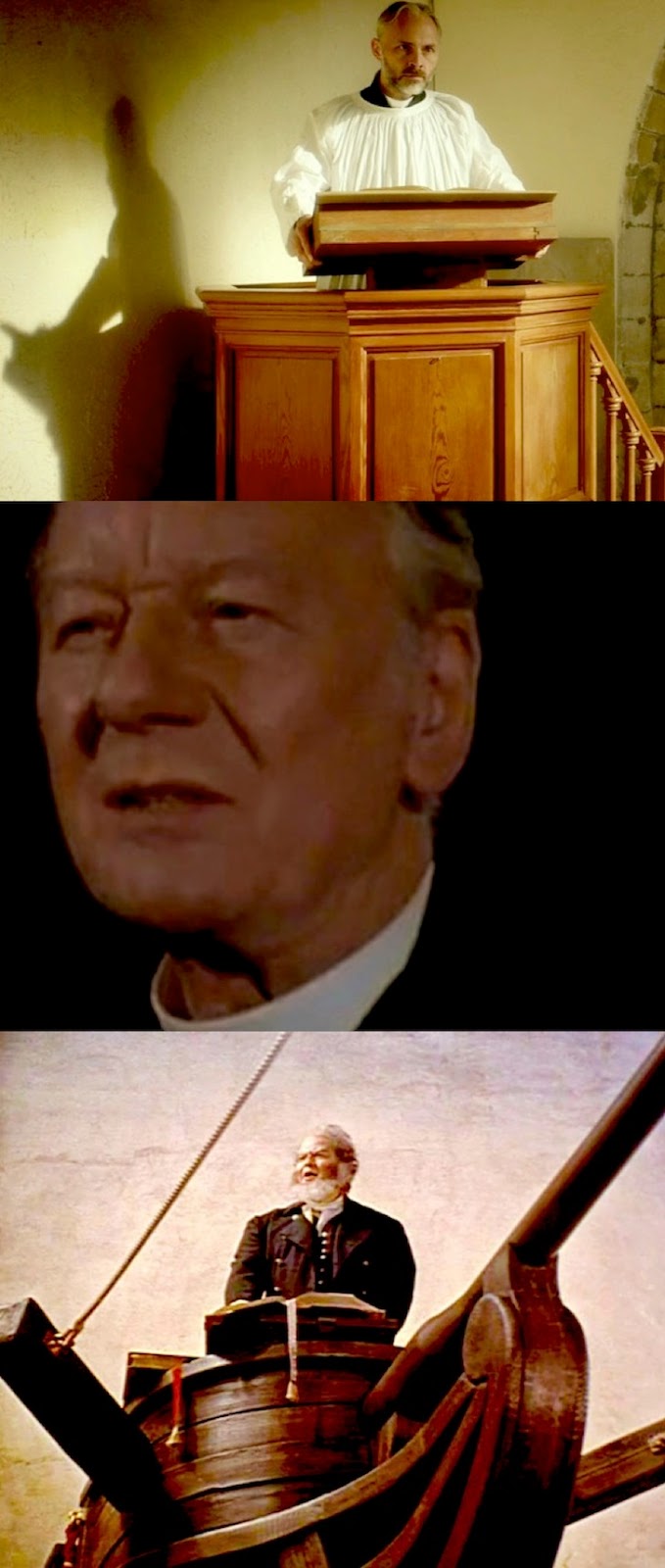
The light then shines upon the suitably creepy Reverend as if it's been cranked-up by God Himself. Taking its place amongst such hellfire and brimstone cinematic sermons like John Gielgud in Joseph Strick's 1977 film of James Joyce's A Portrait of the Artist as a Young Man and Orson Welles in John Huston's film of Herman Melville's Moby Dick, Davies is blessed with the casting of Mark Bonnar to have us (and the congregation), quaking with horror.


With his brogue pitched to hysteria and meanness, Bonnar's rendering of the sermon seems to be the very core of the film (even though the picture is essentially a grand coming of age story). It goes thusly:

"As you know, we are now at war with Germany. This NEW BABYLON has as many corruption as the old one. How long it will rage is what God in His wisdom will only know. But it's a chastisement by blood and fire that the nations must arise and prevail against this enemy. And Scotland, not the least of these, in its ancient health and humility to tread again the path of peace and courage that will ultimately lead to our victory.

Their King, which they also call Kaiser, is the Antichrist - a foul evil upon this Earth that must be swept away by the righteous.

Those who will not fight to defend their country, must be exposed for that they truly are.

Cowards. And pro-German cowards at that."

History proves that the needs of the state are always bolstered by organized religion. Worse yet, World War I notoriously sacrificed the youngest and largest number of men from Scotland, Ireland and the colonies (including Canada, Australia, etc.) to ensure victory. Whole swaths of generational promise were sacrificed in this dirty war fought between the "ruling classes".

God forbid Davies should ever be politically obvious in a didactic fashion, but in so far as he chooses his material and presents it, he still exposes as many terrible truths about humanity as only the best filmmakers/artists do. Sunset Song is a love story, a coming-of-age story, but most of all, it serves as one of the most heartbreaking and potent antiwar films of the new millennium.

And here's my guarantee, you will shed copious tears.

THE FILM CORNER RATING: ***** 5-Stars

Sunset Song Opens in Canada via Unobstructed View:
May 13: Toronto, Cineplex Cinemas Varsity and VIP (55 Bloor St. W)
Toronto Holdover, Magic Lantern Carlton Cinemas
May 27: Vancouver, Vancity Theatre (1181 Seymour St.)
May 28: Winnipeg, Cinematheque (100 Arthur St.)
June 3: Calgary, Globe Cinema (617 8 Ave SW)
June 3: Waterloo, Princess Twin (46 King St. N)
June 17: Montréal, Cinéma du Parc (3575, av. du Parc)
Cinéma Beaubien (2396, rue Beaubien Est)
June 17: Ottawa, ByTowne Cinema (325 Rideau St.)
June 17: Québec City, Cinéma Le Clap (2360, chemin Sainte-Foy)
June 17: Cobourg, The Loft Cinema (201 Division St.)

Thursday, 5 May 2016

NATASHA - Review By Greg Klymkiw - Stellar Opener for Toronto Jewish Film Festival 2016


Natasha (2015)
Dir. David Bezmozgis
Starring: Alex Ozerov, Sasha K. Gordon, Aidan Shipley, Deanna Dezmari

Review By Greg Klymkiw

Given the ongoing richness of the immigrant experience in Canada, a country with an official policy of multiculturalism, it's so important for our cultural industries to tell these stories and reflect our mosaic as it shifts across time. Natasha, written and directed by Canadian filmmaker David Bezmozgis is an especially layered, intelligent and evocative portrait of immigrant life in Canada.

To think of the utter waste of Canadian taxpayer dollars on a mind-numbingly mainstream and mediocre international co-production like Brooklyn (uh, a period piece about an Irish colleen finding romance in post-war New York) leaves a bitter taste, especially considering all the great stories to be told by talented filmmakers in Canada. Thankfully, the bilious sapidity forced upon our country's cultural palate by the sickeningly twee Brooklyn is replaced very nicely with the exquisite taste of Natasha.


Based on an original story by Bezmozgis, he has skillfully adapted it from a 90s setting to the contemporary northern suburbs of Toronto. Using the rich backdrop of the Eastern European (primarily Russian) Jewish community, we follow the story of handsome 16-year-old Mark (Alex Ozerov) as he whiles away his summer days amidst the relatively affluent greenery of the pleasantly sleepy enclave of wide streets, big garages and the seemingly endless rows of tastefully-designed (though unexceptional in their very modernity) homes.

Into this world comes the beautiful 14-year-old Natasha (Sasha K. Gordon). She is the daughter of a recent middle-aged immigrant from Moscow who will be marrying Mark's nebbishy Uncle. Family is family, though and Natasha will be Mark's cousin, if only by marriage. As such, he's recruited to be a tour guide to this seemingly shy young girl who speaks only Russian. She's not shy for long, though - at least not in Mark's presence.

It seems inevitable that they should fall for each other, but as the film progresses, deep secrets of Natasha's life in Russia are parcelled out and several family conflicts begin to rear their ugly heads to threaten the relationship. What's especially telling is the differences between the "new" immigrants (Natasha's Mother) and those who've had time to establish themselves in the "New World" (Mark's family). These contrasts are brilliantly juggled throughout the film since it is the differences which tend to provide the greatest conflict, but they do so in tandem with "old world" values which tend to creep into the proceedings.

The film is gorgeously written, most notably in terms of charting its narrative and rich characters in ways you never expect. Its very surface simplicity is what yields so many layers of complexity, humanity and rich, believable surprises. The film's subplots involving Mark's family and his friend, an amiable wealthy young man with a not-so straight-up interior, are also woven perfectly into the fabric of the story in ways that always surprise us.

There is, ultimately, no denying that Natasha is a love story within a coming-of-age tale, but in spite of its occasional forays into the familiar (that come with the territory of the genre) and the delightful gymnastics of youthful romance, Bezmozgis delivers a film that is as bitter as it is sweet. Bittersweet qualities in this genre can also be a dime a dozen, but happily the film shies away from the all the aforementioned tried and true elements by etching story beats that twist the familiar, all in ways closer to life itself.

As well, the movie is blessed with a stylistic adherence to letting drama play out naturally and the picture succeeds because of the filmmaker's very deft approach to neorealism.


Visually, Bezmozgis seeks simple, but dramatically resonant shots. With expert cinematography by Guy Godfree and first-rate production design elements (in particular the nice, subtle touches in the interior set dressing) and in addition to the very real locations, Bezmozgis allows his drama to play out with flourishes that are always discriminating. What's nice, and not unlike so many of Vittorio De Sica's masterful visual approaches, is that the film blends very classical shot structures with those that are as equally naturalistic (especially inherent in Godfree's lighting).

As a director with far more experience than this sophomore effort implies, Bezmozgis blocks the action of his cast so that they seem genuinely rooted in the place and time they occupy and the occasional plumes of breathtaking visuals occur in terms of both camera and the gorgeously paced and narratively effective editing by Michelle Szemberg. Like the best neorealism, we always feel like we're in a real place and time with equally real people (thanks also to a perfect cast), but, when dramatically necessary, our filmmaker sneaks a delicious frisson into the film to tantalize us and move us forward.


Bezmozgis achieves this by investing his imagery with several important visual signposts which have the effect of working on us inconspicuously - rooted naturally in setting and, most saliently, in the dramatic language of the film. Perhaps the most glorious example of this is the basement window of Mark's home, one which looks into his living quarters and reflects the light of day (or night) as the story proceeds. It's so evocative that it eventually becomes a kind of deliriously romantic image via Mark's point of view in the basement. When Bezmozgis reveals this point of view in reverse, the effect is heartbreaking.

Darkness is what ultimately wends its way through this moving, romantic tale. It makes the light seem brighter when it needs to be, but on occasion the light of day - in both exterior and interior settings - take on a portent which ultimately delivers on a classical coming-of-age story that hurts as much as it offers hope.

The hurt, is familiar - not familiar in terms of the filmmaking, but in the haunting and decidedly unidealistic experiences felt by the film's characters that we, as an audience, recognize in our own experience.

This, of course, is what makes terrific pictures. Natasha is one of them.

THE FILM CORNER RATING: **** 4-Stars

Natasha is the opening night film of the 2016 Toronto Jewish Film Festival and opens theatrically May 6, 2016 in Canada via Mongrel Media.

Friday, 11 December 2015

MACBETH - Review By Greg Klymkiw - Grand, blood-spewing adaptation of Shakespeare

This is NOT Ruprecht from
Bedtime Story/Dirty Rotten Scoundrels
It IS the THANE of CAWDOR!!!

Hail MACBETH!!!

Macbeth (2015)
Dir. Justin Kurzel
Starring: Michael Fassbender, Marion Cotillard, Paddy Considine,
David Thewlis, Sean Harris, Jack Reynor, Elizabeth Debicki,
Seylan Baxter, Lynn Kennedy, Kayla Fallon, Amber Rissmann

Review By Greg Klymkiw

Lots of war paint, but no mooning the enemy.

With "Macbeth", William Shakespeare delivered one rip-snorting bloodbath with his immortal tale of the ambitious Thane of Cawdor and his ascendancy to the throne of Scotland by butchering everyone/everything in his path. The play has more than ably been adapted into any number of kick-ass pictures - most notably, The Tragedy of Macbeth, Roman Polanski's astonishing and still unbeatable adaptation from 1971 (you can read my review/memoir HERE).

Justin Kurzel, who gave us the chilling Aussie 2011 true-crime shocker Snowtown (aka The Snowtown Murders), does not disappoint with his adaptation of Macbeth. Though it may lack Polanski's sophistication, genuine rage and grimy, gritty visuals, Kurzel handles the material admirably and it's surely an entertaining roller coaster ride through 15th century royal carnage and intrigue.

Kurzel and his three screenwriters Jacob Koskoff, Todd Louiso, and Michael Lesslie take a few liberties with the original text, but they're all quite engaging and surely won't bother eggheads too much. It's still the familiar tale of how the great warrior Macbeth (Michael Fassbender) valiantly overthrows the hordes and traitors attempting to take out King Duncan of Scotland (David Thewlis).

"Yes darling, I'm quite mad. Damn, killing is fun, though."

Filled with prophecies of kinghood from a gaggle of witches he meets after the battle (Seylan Baxter, Lynn Kennedy, Kayla Fallon, Amber Rissmann) and with his hottie wife Lady Macbeth (Marion Cotillard) egging him on, Macbeth slaughters Duncan, casts suspicion upon Duncan's son Malcolm (Jack Reynor) and eventually aims murderous eyes upon his pals Banquo (Paddy Considine) and MacDuff (Sean Harris) and, in fact their entire families. Macbeth goes increasingly bunyip with Fassbender raging about like Mad Ruprecht from Bedtime Story and its remake Dirty Rotten Scoundrels.

Blood gushes, spurts and flows with considerable abandon. Macbeth spares nobody. Alas, he ends up fucking over the wrong guy when he slaughters the wife and kids of MacDuff. Payback's on its way and then some. We, the audience, are the happy recipients of more carnage including the burning of Birnham Wood and one kick-ass mano a mano twixt MacBeth and MacDuff.

The entire cast scores big-time here, the picture looks gorgeous and Kurzel's direction is robust and intelligent. Most delightfully, the picture plays itself out like a thrilling big-studio action extravaganza, only with, uh poetry, eh. All that's missing here is a scene where MacBeth and his boys lift their kilts and moon the enemy. I doubt the Bard would have been spinning in his grave if they'd ripped off Braveheart a wee bit more than they do.

THE FILM CORNER RATING: **** 4-Stars

Macbeth is released in North America by The Weinstein Company and can be seen at TIFF Bell Lightbox in Toronto. Alas, its theatrical engagements won't last too long as the picture will be going to Amazon Instant Video too quickly. A pity, really. It's a genuine big-screen extravaganza.

Saturday, 22 August 2015

ROOM - Review By Greg Klymkiw - FRANK director delivers another winner - TIFF 2016


Room (2016)
Dir. Lenny Abrahamson
Scr. Emma Donoghue
Starring: Brie Larson, Jacob Tremblay, Joan Allen, Tom McCamus, William H. Macy, Sean Bridgers, Wendy Crewson

Review By Greg Klymkiw

Lenny Abrahamson turned out to be the best director imaginable for this screen rendering of Emma Donoghue's novel of the same name. His last film Frank, created a wondrous, expansive world within the isolated confines of the country cottage wherein the title character's band creates music for a new album. Abrahamson then shifted us, ever-so deftly to a constrained, insular and painful emotional domain once Frank and company attend the SXSW music festival in Austin, Texas. Finally, we were plopped, alongside the film's characters onto the flat, open, limitless landscape under a big American sky, dwarfing, as it always does, everything and everyone.

Room shares a similar story structure to the aforementioned gem of a film. Like Donoghue's book, the first half of Abrahamson's new picture confines us to the tiny space that Ma (Brie Larson) and her 5-year-old son Jack (Jacob Tremblay) live in. Having been kidnapped and held hostage by Old Nick (Sean Bridgers), a sexual predator who has repeatedly raped Ma until she became pregnant with Jack, the isolated room of the title has been turned into a wide open world by Ma to keep her sanity, as well as that of her child.

Ma has used what meagre means she has at her disposal to educate her child. For example, every item in the room is ascribed qualities akin to humanity which not only describe said items, but allows Jack to offer salutations upon first laying eyes upon them every morning. Personification in fiction is one thing, but in real life, it's clearly quite another.

At the midway point of the picture, a harrowing escape delivers us into the world outside the room and in spite of the new expanse, Ma especially suffers as a free woman - her incarceration and the repeated sexual abuse (not to mention relentless media attention) has somehow dwarfed everything that could be seen as healthy and positive to her.

The two halves of the film are rendered with an astonishingly brilliant mise en scène, which indeed creates expanse in isolation and isolation in expanse. The first half, in spite of the one "room" setting, never really seems claustrophobic as the film roots the mother and son's relationship in a limitless love and deep imagination. Conversely (and not unlike Frank), freedom takes us to drearily grey exteriors and "normal" interiors that bear so much in common with everything that is so unbearably "normal" to anyone with huge imaginations (like Ma and Jacob).


Luckily, Abrahamson has the source material of Donoghue's novel to draw upon, as well as her screenplay adaptation. Oddly, Donoghue's screenwriting mostly eschews the novel's great "voice" (the story in the book is told by the five-year-old Jack) and Abrahamson must render it visually, without relying upon Jack's "voice" (except in tiny dollops). The lighting utilized in the room is especially evocative during daytime wherein the lone glimpse Ma and Jack have at the outside world is a small, dirty and unreachable skylight, casting a variety of eerie glows upon the proceedings. This genuinely great filmmaker pulls off the first half of the picture with flying colours, especially in the manner he blocks the movement within the interior of the "room", then eventually, outside of it - maintaining superb compositions to tell the story by cinematically capturing the evocative "voice" of the novel.

One other aspect which plays beautifully in the film is how it actually downplays the book's rather obvious allusions to the legend of Perseus. Donoghue makes use of an evocative epigraph of Simonides's (c. 556-468 BCE) poem "Lamentation of Danaë" which does help set the overall tone:
My child
Such trouble I have
And you sleep, your heart is placid;
you dream in the joyless wood;
in the night nailed in bronze,
in the blue dark you lie still and shine.
Alas, perhaps it sets the tone too well.

It's difficult to read Donoghue's book without thinking heavily about the woman in the Simonides poem being both confined to a tiny space and unmoored upon unfamiliar waters, and, of course, Jack's brave actions during a harrowing escape sequence wherein, like Perseus, he essentially slays the gorgon Medusa - or rather, is responsible for the undoing of Old Nick. (In spite of the character's inherent evil, Abrahamson manages to do a great job of extracting a great performance from Bridgers which, in turn, adds a layer of humanity that far exceeds that of the book.)

Luckily for most audiences, the film subtly mutes Simonides. It's there if we want it, but I trust most eggheads will repress its use in the book once seeing the movie. And speaking of repression, one of the most moving aspects of the film is how Ma represses her pain rather than facing it. This is in direct contrast to her son Jack, whom she's sheltered from as much pain as possible so that he can hoover up every aspect of the great wide world. Ma's sacrifices and both Jack's support for his mother and his unyielding quest for knowledge are guaranteed to extract copious tears from even the most blinkered eyes.

Room is deeply moving, thanks to its evocative source material, an odd, but effective screenplay adaption by the novel's original author, to-die-for performances (especially Brie Larson as Ma) and Lenny Abrahamson's delicate direction. He's the real thing and then some. I suspect we're going to see many genuine masterpieces from Lenny Abrahamson over the next decade (or two, or three, or four, etc.).

Well, here's hoping, anyway.

Room is a Special Presentation at TIFF 2014 and is the lucky recipient of thr Grolsch People's Choice Award, and as such, will screen for free.

Thursday, 30 July 2015

THE GARDEN OF THE FINZI-CONTINIS - Review By Greg Klymkiw - Haunting De Sica Holocaust Drama in Digital Restoration at TIFF Bell Lightbox Series, "More Than Life Itself"


The Garden of the Finzi-Continis (1970)
Dir. Vittorio De Sica
Starring: Dominique Sanda, Helmut Berger,
Lino Capolicchio, Fabio Testi, Romolo Valli

Review By Greg Klymkiw

The grandly sprawling walled estate of the wealthy, powerful and aristocratic Finzi-Continis family in Ferrara, Italy has always been a world unto itself, but with the rise of Fascism in the 30s, it becomes a hermetically sealed paradise, a refuge from the madness of a country turning topsy turvy with prejudice, hatred and on the brink of world war. The Finzi-Continis are no ordinary family. They're Jewish in a country rapidly embracing virulent Antisemitism, but even amongst the Jews of Ferrara, they've always been set apart, living upon a pedestal of great intellect and seemingly high above those Jews amongst the middle and working class.

As always, though, prejudice and class seem to be the domain of older generations and the youth have always held the highest regard and friendship for each other, so that even when the wealthiest, most aristocratic Jews have been banned from the elite tennis clubs of Ferrara, its youngest, both Jew and Gentile, secret themselves away within the walls of the Finzi-Continis gardens to carry-on their traditions of weekly tennis matches and friendship.

Based on the novel by Ferrara's own Giorgio Bassani, one of Italy's great authors, it made perfect sense that one of Italy's great filmmakers, Vittoria De Sica would craft a movie adaptation of The Garden of the Finzi-Continis. One of De Sica's last films, it was not only honoured with one of a multitude of Academy Awards his work garnered, but was indeed a triumph of the style and sensitivity he'd become known for with such great works as Bicycle Thieves, Shoeshine, The Children Are Watching Us and amongst so many others, the immortal Umberto D.

Bassani was a Jew who managed to survive the Holocaust and continued to teach, write (pseudonymously, of course) and fight the fascist movement as a member of the Italian underground. Many of his books, like this one, dealt with life under Fascism for the Jews of Italy, but thematically, he found himself drawn to the notion of memory and its ability to act as both a balm and a force of great sadness and danger.

This is what De Sica so beautifully captures in this simple love story between childhood lovers, the aristocratic Micol Finzi-Contini (Dominique Sanda) and Giorgio (Lino Capolicchio), the son of Jewish family of the middle class. Though they're love is deep, Micol looks upon Giorgio as a brother-figure and breaks his heart when she takes up with the ruggedly handsome gentile Bruno Malnate (Fabio Testi). For Micol, the memories of childhood should not be tarnished by "romance" and instead she believes she must instead court the sexy socialist who is her opposite in every way, but as such, provides the kind of spark she can't get from her pea-in-the-pod Giorgio.

De Sica places considerable emphasis on the romantic entanglements and yearnings of this triangle, as well as Micol's deep love for her own brother, the sickly Alberto (Helmut Berger). Though every so often, the realities of fascism and Antisemitism creep in (the young intellectuals are terrified they'll not be allowed to graduate from the universities they're enrolled in), the Finzi-Continis. especially Micol, drive themselves deeper within the walls of their estate. Giorgio's father (Romolo Valli) attempts to ease his son's sorrow by suggesting that the Finzi-Continis have always lived in such an elevated station that he never even considered them Jewish.

He's certainly right about the family's elevated station since their garden seems to not only be a physical enclosure from the rest of the world, but that the entire family, especially Micol, live in a garden that exists in their minds. This is, of course one of De Sica's greatest triumphs as a filmmaker. He so indelibly captures a sense of enclosure that we, as an audience are lulled by it as well.


When Fascism in Ferrara explodes, it comes with such a fury and so swiftly that we, as viewers, seem as unprepared for the film's final, devastating minutes as the Finzi-Continis family are. As Jews are rounded up and separated for deportation to the death camps, we can't help but feel a horrendous catch in our throats, especially as Micol and her aged grandmother huddle together in a cramped classroom converted into a waiting room for death. Memory rears both its beautiful and ugly heads as Micol realizes she's in the classroom of her childhood.

Looking out the hazy windows upon the grey, grim world, De Sica fills his soundtrack with "Kel Maleh Rachamim", the Jewish prayer of mercy for the souls of the departed.

And yes, we weep for the departed and their memories of a world that once seemed so innocent, so beautiful.

De Sica was and still is one of the greatest. Even in his last years as an artist, he continued to make us weep for the disenfranchised, the exploited and the hated, but all the while, still managing to infuse us with humanity and with love itself.

THE FILM CORNER RATING: ***** 5-Stars

The digital restoration of The Garden of the Finzi-Continis plays at the TIFF Bell Lightbox. For Tix, times and dates, visit the TIFF website HERE. For those unable to attend this screening, one assumes the restored film will soon be available on Blu-Ray. In the meantime, there is a Sony Pictures Classics DVD out there with a passable transfer until this new one is released more widely.

Sunday, 5 July 2015

THE KILLERS (1964) - Review By Greg Klymkiw - Don ("Invasion of the Body Snatchers") Siegel. Gene ("Star Trek") Coons. Ronald Reagan. Lee Marvin. John Cassavetes. Angie Dickinson. Clu Gulager. Criterion Collection. Blu-Ray. 'Nuff Said.


The Killers (1964)
Dir. Don Siegel
Scr. Gene L. Coon
Starring: Lee Marvin, John Cassavetes,
Angie Dickinson, Ronald Reagan, Clu Gulager, Claude Akins, Norman Fell

Review By Greg Klymkiw

"It's not only the money. Maybe we get that and maybe we don't. But I gotta find out what makes a man decide not to run... why, all of a sudden, he'd rather die." - Charlie Storm (Lee Marvin) in Don Siegel's The Killers

Two hit men, the steely Charlie Storm (Lee Marvin) and his young, wisecracking partner Lee (Clu Gulager), pay a visit to their quarry Johnny North (John Cassavetes). He knows they're coming. He waits for the inevitable, and it's brutal beyond belief. His body jerks, flinches and arches in agony with every bullet hit as the killers empty their guns in as many painful and deadly spots imaginable.

The aforementioned represents the opening minutes of the first American film ever made exclusively for television. The picture doesn't get any gentler. Broadcaster NBC was so appalled they refused delivery. It's not surprising. I also neglected to mention that the opening scene is set in an educational rehabilitation centre for the blind and the killers terrorize a sight-challenged secretary to get the location of their quarry, then summarily pistol whip her into unconsciousness. Luckily for Universal Pictures, the movie was released theatrically instead and was a huge hit at the box-office.

Nineteen sixty-four was just on the cusp of the new permissiveness in American cinema - Arthur Penn's Bonnie and Clyde, for example, was just round the corner and helmsman Don Siegel was already no stranger to tough-minded thrills with such genre classics under his belt as Riot in Cell Block 11, Invasion of the Body Snatchers, Baby Face Nelson, The Lineup and among many others, Hell is for Heroes. That Siegel would eventually give us Dirty Harry, Charley Varrick, Two Mules for Sister Sara, The Black Windmill, Coogan's Bluff and Escape From Alcatraz should come as no surprise to anyone watching The Killers for the first time.


Like Robert Siodmak's 1946 film noir version of Ernest Hemingway's great short story, Siegel's film builds up a story around the central idea of two hit men and a victim who has no desire to run. Siegel, however, wished to eschew all obvious references to Hemingway and hoped the film would be entitled Johnny North (after the washed-up race car driver turned criminal played by Cassavetes).

Siegel was also interested in telling the entire tale through the perspective of the killers; a wise choice which veteran writer Gene L. Coon handled magnificently. Coon was a prolific TV scribe, and in fact, was the actual creative brains behind so much of what made the original Star Trek series so immortal - in particular the clever banter, humour and his creative input on some of the most immortal episodes like "Space Seed", "The City of the Edge of Forever" and "The Doomsday Machine".

Coon's dialogue in The Killers is exceptional. Though the film has even less to do with Hemingway than Siodmak's version, the words Coon has spitting out of the mouths of all the characters are clearly inspired by Papa's terse word smithing. As well, the sense of doom which pervades Siegel's film is directly linked to Coon's obvious love for the original short story. The entire backdrop of the car racing circuit was an especially brilliant touch as it adds the sense of daredevil bravado to the character of the doomed Johnny, but also provides a perfect world to attract the film's femme fatale Sheila Farr (Angie "Hubba Hubba" Dickinson) to the hapless hero.

Siegel handles the entire film with his trademark economy and viciously hilarious aplomb. He even makes grand use of the rapid TV shooting schedule to create a tremendous look to both the interior and exterior locations. Veteran TV cinematographer Richard L. Rawlings (Sea Hunt, Gilligan's Island) flooded most of the interiors with light to capture the garish colours of 60s decor and for the exteriors, he superbly harnessed the dazzling California sunshine (doubling as Miami) to wash the film in a strangely harsh glow. Even the dank basements and grungy chop-shops where the criminals plan their heist, are only occasionally pooled with high contrast and, more often than not, are imbued with a flat, even lighting to accentuate the grunge of the settings. The compositions are full of Siegel's sparing, but effective use of canted angles.


The cast, personally selected and approved by Siegel, deliver immortal performances - everyone from the "romantic" leads down to the scuzzy supporting lowlife. One of the more astounding performance comes from eventual Governor of California and President of the United States of America, Ronald Reagan. As the scumbag criminal mastermind-turned-property-developer, Reagan played the only villain of his entire movie career. (This was also his last feature film as an actor.) He oozes evil, but not in any Snidely Whiplash moustache-twirling manner, but rather in his coolness. It's impossible to forget his chilly delivery of the line "I approve of larceny; homicide is against my principles" (knowing he doesn't really mean the latter) and it's inconceivable one could ever clear one's memory banks of Reagan's creepy smile right before he belts Angie Dickinson in the face for "disobeying" him.

The other standouts, of course, are the two hit men; Clu Gulager (whom most will remember as Burt the sleazy warehouse proprietor in Return of the Living Dead) comes across like a handsome Dan Duryea with an oddball "Der Bingle" tone to his deliveries of the acidic lines he's given and Lee Marvin as the laconic, but obsessed hit man gives as great a performance as he's ever given. Marvin's meanness mounts steadily as the film progresses and he's got one of the great moments in movie history when a potential victim attempts a bit of sweet talk to avoid being hit and Marvin half-growls-half-whines, "Lady, I don't have the time.".

And so he does not. If there's one thing which ultimately drives The Killers it's the overwhelmingly haunting sense that time is running out for everyone in the world of the film. The sands keep trickling and only stop once every conceivable body lies dead - as a doornail, of course.

THE FILM CORNER RATING: *****

The Killers (1964) is available on a great Criterion Collection Blu-Ray. In addition to including Robert Siodmak's 1946 classic film noir adaptation with Burt Lancaster and Ava Gardner. The Blu-Ray is loaded with great stuff including a new high-definition digital restoration, with uncompressed monaural soundtracks, a wonderful 2002 on-camera interview with Clu Gulager reminiscing about the 64 version, readings from Don Siegel's autobiography, Tarkovsky’s short 1956 student-film adaptation of Hemingway’s story, a terrific 2002 interview with Stuart Kaminsky, the Screen Directors’ Playhouse radio adaptation from 1949 starring Burt Lancaster and Shelley Winters plus, ever-so delectably, a 2002 audio recording of actor Stacy Keach reading Hemingway’s "The Killers".

Order directly from the links below and contribute to the ongoing maintenance of The Film Corner.

In Canada, order HERE


In USA, order HERE


In UK, order HERE