Showing posts with label True Crime. Show all posts

Wednesday, 8 March 2017

Yet Another Reason Why The Royal in Toronto is the BEST Indie Cinema, not just in Toronto, but Canada (and one of the best in the world). The fabulous ongoing Royal series RETROPATH presents Leonard Kastle's brilliantly lurid THE HONEYMOON KILLERS - on the big screen, where it's meant to be seen! The Royal has the best sound and picture in the city (by day, it's Theatre D Digital, a sound mixing studio for the movies) and the Weegie-like monochrome of this great film is going to look more gorgeous than ever. The seats are super-comfy too.!!! Review By Greg Klymkiw

CELEBRATE the 66th Anniversary of the EXECUTION
of The Honeymoon Killers Ray and Martha
at the Royal Cinema on March 10, 2017
On March 8, 1951, the loving couple of Martha Beck and Ray Fernandez were electrocuted at Sing-Sing Prison. On March 10, 2017, you can CELEBRATE the 66th anniversary of their EXECUTION at Toronto's illustrious Royal Cinema during a RETROPATH screening of Leonard Kastle's THE HONEYMOON KILLERS. At 7:00 PM there will be a special pre-show featuring some of cinema's deadliest duos, and a pop-up in the lobby featuring local artists with incredible work for sale! Artists present are: ALEXANDRIA ANN WIDGERY GIAMOS is a part time witch, full time queer feminist who makes handmade magical goods, ALEXA TRILLI, an internationally collected glitter artist and Toronto illustrator TREVOR HENDERSON. And then, the lights will go down low for the screening of the movie proper at 8:00 PM. The Royal Cinema is located at 608 College Street, Toronto, Ontario.

The Honeymoon Killers (1969)
Dir. Leonard Kastle
Starring: Shirley Stoler, Tony Lo Bianco, Doris Roberts,
Dortha Duckworth, Marilyn Chris, Barbara Cason,
Mary Jane Higby, Kip McArdle, Mary Breen

Review By Greg Klymkiw

Though one wishes to imagine the movie Martin Scorsese might have made from Leonard Kastle's screenplay of The Honeymoon Killers, it's probably best left unimagined. Scorsese was quickly fired by the producer for being too pokey on the shoestring $150K budget, whereupon Kastle was selected to replace him.

What remains is still one of the most mouthwateringly lurid films of the 20th century. Not that Kastle's approach to this take on the true-crime drama of the "lonelyhearts killers" was exploitative, but it derives its layers of scum quite honestly due to the realistic, monochrome and almost documentary-like approach to the material. Yet, in spite of the neo-realist flavour infusing the picture, Kastle also bathes the material in a perverse romanticism and we get, first and foremost, a love story - albeit one in which its lovers are psychopaths.


Spring boarding from events which originally took place during the post-war years of the 40s and setting them in the 60s when the film was shot, we're told the tale of Martha Beck (Shirley Stoler), a morbidly obese nurse from Mobile, Alabama who meets the sexy, charming conman Ray Fernandez (Tony Lo Bianco) from a lonely hearts club correspondence. Long before internet dating sites, those in need of love would write good, old fashioned love letters to each other via clubs which advertised their services in sleazy "women's" magazines and tabloid newspapers.

The flowery correspondence twixt the two leads Ray to make a trip down to Mobile from New York. Martha lives with her dementia-addled mother (Dortha Duckworth) and has only one real friend, the libidinous Bunny. Ray has come to dupe Martha into emptying her bank account, but instead, he falls madly in love with her, and she with him.

Eventually he reveals his "business" to Martha and the two of them carry on as lovers, but pose as brother and sister, which makes them an ideal team to perpetrate fraud upon lonely spinsters. In no time, however, simple fraud turns to murder and the pair begin to kill their victims. Committing murder seems to spark their libidos even more. After Martha gruesomely, brutally and repeatedly smashes a seventy year old woman's head to a pulp with a hammer, the two retire to the boudoir as Ray, hard-on raging, orders Martha to keep the lights on. "I want to make love," he coos.


Their love knows no bounds, it seems. However, the scams they're perpetrating often place Ray in positions where the "lonely hearts" are demanding sex from him. Worse yet, Ray even seems attracted to some of the women which only causes Martha to become both jealous and even more brutally murderous.

It's only a matter of time until they're caught and as in the real-life case, both of them are put to death in Sing Sing Prison's electric chairs. Kastle, as writer and director, never lets up on the romantic connection between Ray and Martha. Sacrifices are made for love and in spite of the horrific nature of their crimes, the film actually moves us during its final moments. In fact, we're moved quite deeply.

One of the interesting aspects of creating a borderline melodrama of this love is the brilliant notion to use Gustav Mahler's alternately heart-wrenching and sweetly beautiful 6th Symphony as the only score. Written by Mahler during a period of considerable strife in his marriage to Alma Mahler, the work has often been referred to as "The Death of Love" symphony. What makes it work so beautifully is that it needs to convey deep love in order to detail the death of love and used as score in The Honeymoon Killers, it carries us along with as much joyous emotion as it does with its disturbing, dissonant riffs.


There isn't a performance in the film that ever seems out of place. but ultimately, it's Stoler (she played the concentration camp commandant in Lina Wertmuler's Seven Beauties) and Lo Bianco (oft cast as a gangster and cop who transcended the cliches he was forced to inhabit and delivered the brilliantly complex performance in Larry Cohen's God Told Me To) who both keep our eyes glued to the screen. In another time and place, these two render performances that would at least have garnered major nominations and possibly even awards, but in 1969, were relegated to a few decent critical notices and little else.

There have, of course, been a number of film versions of this story, but none of them have the power of Kastle's version to both horrify and move us. It's an extraordinary work and one which continues to live on as a genuine classic.

THE FILM CORNER RATING: ***** 5-Stars

AFTER YOU SEE The Honeymoon Killers at the Retropath screening at Toronto's Royal Cinema, DON'T FORGET that it is available on a gorgeously transferred Criterion Collection Blu-Ray which comes complete with an all new 4K digital restoration, with uncompressed monaural soundtrack on the Blu-ray, a detailed interview with writer-director Leonard Kastle from 2003, interviews with actors Tony Lo Bianco and Marilyn Chris and editor Stan Warnow and a genuinely great new video essay, “Dear Martha . . . ,” by writer Scott Christianson, author of "Condemned: Inside the Sing Sing Death House". Feel free to order the film directly from the Amazon links below and contribute to the ongoing maintenance of The Film Corner:

Friday, 26 August 2016

I, OLGA HEPNAROVA ***** 5-Star Contemporary Masterpiece - Revised Fantasia 2016 Review By Greg Klymkiw at Electric Sheep Magazine

The astonishing young actress Michalina Olzanska delivers one of the great screen performances of the new millennium.
I, OLGA HEPNAROVA
Dir. Petr Kazda, Tomas Weinreb
Starring: Michalina Olszanska

Review By Greg Klymkiw

A grim, superbly realized feature-length dramatic biography about the last person ever executed in Czechoslovakia. Writer-directors Petr Kazda and Tomas Weinreb have crafted a compulsive, moving and shocking film about mental illness as a genuine affliction. It can result in evil actions, but the perpetrators are, more often than not, sick in mind, body and soul. Healing and caring has escaped them. I, Olga Hepnarová speaks not just for one, but all of them.

THE FILM CORNER RATING: *****

Read the full review at Electric Sheep HERE.

Tuesday, 3 November 2015

IN COLD BLOOD - BluRay Review By Greg Klymkiw - Capote stuns on stunning Criterion

Perry Smith (Robert Blake, top and bottom),
Dick Hickock (Scott Wilson, middle):
friends, travel mates, thieves, KILLERS!

In Cold Blood (1967)
Dir. Richard Brooks
Starring: Robert Blake, Scott Wilson, John Forsythe, Paul Stewart,
Jeff Corey, Gerald S. O'Loughlin, Will Geer, John McLiam, Brenda C. Currin

Review By Greg Klymkiw

There's a passel o' reasons to heap a few bucketfuls of laurel leaves upon the Criterion Collection for creating an astonishing Blu-Ray disc of In Cold Blood, the 1967 Richard Brooks film adaptation of Truman Capote's immortal bestseller. First and foremost is that it's a great motion picture - one that knocked audiences to the floor when it first came out and now, archived for home viewing some 50 years after it was made, continues to wrench emotion.

Told in a series of flashbacks which eventually merge into a chilling, straight-ahead crime drama, the film details the slaughter of an entire family (Mom, Dad and two teenagers) in an isolated Holcomb, Kansas farmhouse. While not ignoring the fear and pain of the victims, the film's primary goal is to explore the two men who perpetrated this shocking act of violence.

Mistakenly assuming the Clutter family was loaded to the hilt, keeping most of their fortune in an onsite safe, the men could not have been more misled by a tip-off one of them got in prison. The princely take for this horrific act of savagery was a portable radio, binoculars and fifty smacks in cash. Director Brooks handles the murders with stark, almost matter-of-fact brutality, but punctuated with a few strange elements which directly relate to the more humane elements of the killers. He creates moments and images which tend to haunt one forever.

Perry Smith (Robert Blake) and Dick Hickock (Scott Wilson) were apprehended, tried, convicted and then, after spending six years on death row, they were finally hung from their respective necks - until dead, of course.

Brooks touches upon the procedural aspects involving a detective (John Forsyth) and crime reporter (Paul Stewart), the former trying to maintain professional composure due to the especially vicious/senseless nature of the crime in an uncommon locale and the latter offering wry, cynical, straight-up dispassionate realism to the proceedings (well, after all, he is played by Paul Stewart). Scenes involving visits to the families of the killers offer a few additional cold, hard truths, but they're also weighted with considerable sadness.

Cinematographer Conrad Hall's "happy" accident of
raindrops reflecting upon Robert Blake's face as teardrops.

The story of the Clutter Massacre has been the subject of two films in recent years, both from the perspective of Truman Capote, but neither of them really made much of an impact upon me since Perry and Dick's story seemed far more interesting than that of Capote's obsession to write the book about it. Bennett Miller's Capote (2008) received considerable acclaim and an Oscar for the late Philip Seymour Hoffman's onscreen impersonation of the title character, remaining the go-to-picture for the writer's POV upon the story, but I much prefer the equally flawed, but far more interesting Infamous from 2006, which features a no-holds-barred performance by UK actor Toby Jones as the fey, diminutive author.

Capote broke considerable literary ground with his true-crime book, written as a non-fiction novel. He got to know the killers as they made their way through a myriad of trials and appeals until they exhausted all avenues and faced their death sentences. His personal perspective made for compulsive reading, yielding one of the hottest literary commodities during the 60s and ripe for film adaptation. When a movie version loomed, Capote personally chose Richard Brooks to write and direct it.

This proved to be a canny decision. After his service in the Marines during WWII, Brooks quickly rose to the top of his own substantive literary and film career. He wrote the powerful 1945 novel "The Brick Foxhole", dealing with discrimination against homosexuals in the military. The novel morphed into the acclaimed Edward Dmytryk-directed film noir feature Crossfire, swapping homosexuality (still verboten by the studios) for anti-Semitism. The novel itself was enough to launch Brooks into the movie business. His work included penning the scripts for Jules Dassin's violent noir prison drama Brute Force and the Bogart/Bacall classic Key Largo. Co-written with director John Huston, Brooks was welcomed on-set everyday to learn filmmaking from the irascible Master himself.

In 1952, Brooks wrote the original screenplay for Deadline - U.S.A., also starring Humphrey Bogart and directed by Brooks himself. It's still one of the most prescient and important films of the 50s, tackling the subject of corporate partnerships in the media and threatening free speech in the newspaper business. This led to the huge box-office hit Blackboard Jungle (dealing with juvenile delinquency) and the virtually perfect film version of Sinclair Lewis's Elmer Gantry.

The exemplary effort invested in this disc reflects the sort of passion invested into the film itself. Both truly hit home during the famous scene in which Perry Smith (Robert Blake's greatest work onscreen), one of the condemned killers, delivers a heartbreaking pre-execution monologue about his father, "that poor old man and his hopeless dreams." It is here where Conrad Hall's gorgeous black and white cinematography cold-cocks the wind out of you. A happy "accident" occurred when light, shining through a window pelted with strong rain, resulted in a reflection of the water upon actor Robert Blake, creating a jaw-droppingly emotional image as the water takes on the properties of a veritable flood of tears.

Seeing this on Criterion's magnificent 4K restoration is the next best thing to experiencing the picture on a big screen in its original monochrome 35mm film.

THE FILM CORNER RATING ***** Five Stars


In Cold Blood is available on BluRay and DVD via a gorgeous new 4K digital restoration, with 5.1 surround DTS-HD Master Audio soundtrack on the Blu-ray. The disc is Laden with superb extra features including interviews with cinematographer John Bailey about director of photography Conrad Hall’s work in the film, film historian Bobbie O’Steen on the film’s editing, film critic and jazz historian Gary Giddins about Quincy Jones’s music for the film, writer Douglass K. Daniel on director Richard Brooks, Brooks himself from a 1988 episode of the French television series "Cinéma cinemas". The disc is additionally fleshed out with With Love from Truman, a first rate short 1966 documentary with novelist Truman Capote, directed by Albert and David Maysles, two archival NBC interviews with Capote: one following the author on a 1966 visit to Holcomb, Kansas, and the other conducted by Barbara Walters in 1967 (the latter is especially astounding), the trailer and an essay by critic Chris Fujiwara.

Feel free to purchase In Cold Blood directly from the Amazon links below and in so doing support the ongoing maintenance of The Film Corner.


Friday, 25 September 2015

THE HONEYMOON KILLERS - Review By Greg Klymkiw - Lurid Crime: Glorious Criterion


The Honeymoon Killers (1969)
Dir. Leonard Kastle
Starring: Shirley Stoler, Tony Lo Bianco, Doris Roberts,
Dortha Duckworth, Marilyn Chris, Barbara Cason,
Mary Jane Higby, Kip McArdle, Mary Breen

Review By Greg Klymkiw

Though one wishes to imagine the movie Martin Scorsese might have made from Leonard Kastle's screenplay of The Honeymoon Killers, it's probably best left unimagined. Scorsese was quickly fired by the producer for being too pokey on the shoestring $150K budget, whereupon Kastle was selected to replace him.

What remains is still one of the most mouthwateringly lurid films of the 20th century. Not that Kastle's approach to this take on the true-crime drama of the "lonelyhearts killers" was exploitative, but it derives its layers of scum quite honestly due to the realistic, monochrome and almost documentary-like approach to the material. Yet, in spite of the neo-realist flavour infusing the picture, Kastle also bathes the material in a perverse romanticism and we get, first and foremost, a love story - albeit one in which its lovers are psychopaths.


Spring boarding from events which originally took place during the post-war years of the 40s and setting them in the 60s when the film was shot, we're told the tale of Martha Beck (Shirley Stoler), a morbidly obese nurse from Mobile, Alabama who meets the sexy, charming conman Ray Fernandez (Tony Lo Bianco) from a lonely hearts club correspondence. Long before internet dating sites, those in need of love would write good, old fashioned love letters to each other via clubs which advertised their services in sleazy "women's" magazines and tabloid newspapers.

The flowery correspondence twixt the two leads Ray to make a trip down to Mobile from New York. Martha lives with her dementia-addled mother (Dortha Duckworth) and has only one real friend, the libidinous Bunny. Ray has come to dupe Martha into emptying her bank account, but instead, he falls madly in love with her, and she with him.

Eventually he reveals his "business" to Martha and the two of them carry on as lovers, but pose as brother and sister, which makes them an ideal team to perpetrate fraud upon lonely spinsters. In no time, however, simple fraud turns to murder and the pair begin to kill their victims. Committing murder seems to spark their libidos even more. After Martha gruesomely, brutally and repeatedly smashes a seventy year old woman's head to a pulp with a hammer, the two retire to the boudoir as Ray, hard-on raging, orders Martha to keep the lights on. "I want to make love," he coos.


Their love knows no bounds, it seems. However, the scams they're perpetrating often place Ray in positions where the "lonely hearts" are demanding sex from him. Worse yet, Ray even seems attracted to some of the women which only causes Martha to become both jealous and even more brutally murderous.

It's only a matter of time until they're caught and as in the real-life case, both of them are put to death in Sing Sing Prison's electric chairs. Kastle, as writer and director, never lets up on the romantic connection between Ray and Martha. Sacrifices are made for love and in spite of the horrific nature of their crimes, the film actually moves us during its final moments. In fact, we're moved quite deeply.

One of the interesting aspects of creating a borderline melodrama of this love is the brilliant notion to use Gustav Mahler's alternately heart-wrenching and sweetly beautiful 6th Symphony as the only score. Written by Mahler during a period of considerable strife in his marriage to Alma Mahler, the work has often been referred to as "The Death of Love" symphony. What makes it work so beautifully is that it needs to convey deep love in order to detail the death of love and used as score in The Honeymoon Killers, it carries us along with as much joyous emotion as it does with its disturbing, dissonant riffs.


There isn't a performance in the film that ever seems out of place. but ultimately, it's Stoler (she played the concentration camp commandant in Lina Wertmuler's Seven Beauties) and Lo Bianco (oft cast as a gangster and cop who transcended the cliches he was forced to inhabit and delivered the brilliantly complex performance in Larry Cohen's God Told Me To) who both keep our eyes glued to the screen. In another time and place, these two render performances that would at least have garnered major nominations and possibly even awards, but in 1969, were relegated to a few decent critical notices and little else.

There have, of course, been a number of film versions of this story, but none of them have the power of Kastle's version to both horrify and move us. It's an extraordinary work and one which continues to live on as a genuine classic.

THE FILM CORNER RATING: ***** 5-Stars

The Honeymoon Killers is available on a gorgeously transferred Criterion Collection Blu-Ray which comes complete with an all new 4K digital restoration, with uncompressed monaural soundtrack on the Blu-ray, a detailed interview with writer-director Leonard Kastle from 2003, interviews with actors Tony Lo Bianco and Marilyn Chris and editor Stan Warnow and a genuinely great new video essay, “Dear Martha . . . ,” by writer Scott Christianson, author of "Condemned: Inside the Sing Sing Death House". Feel free to order the film directly from the Amazon links below and contribute to the ongoing maintenance of The Film Corner:

Sunday, 13 September 2015

BLACK MASS - Review By Greg Klymkiw - TIFF 2015: A solid cast in search of a good movie


Black Mass (2015)
Dir. Scott Cooper
Starring: Johnny Depp, Joel Edgerton, Benedict Cumberbatch,
Kevin Bacon, Jesse Plemons, Peter Sarsgaard, Rory Cochrane,
Adam Scott, Dakota Johnson, Mary Klug, Corey Stoll

Review By Greg Klymkiw

Joe Berlinger's Whitey: The United States of America V. James J. Bulger (2014) is a modern masterpiece. It tells the same story as Scott Cooper's Black Mass, but aside from a genuinely solid cast working overtime and a few directorial frissons, the latter is little more than a derivative, often dull dramatic exercise in style. This ultra-violent homage to much better pictures like Goodfellas, which it desperately wants to be, really has little going for it, save for its stalwart performances.

Berlinger's modern classic is an alternately terrifying and heartbreaking documentary exposé of Boston mobster Whitey Bulger, his protection at the hands of the FBI and the suffering of his hundreds of victims. It's the perspectives of the victims which gives Berlinger's film its oomph, but alas, Cooper's picture is saddled with a by-the-numbers screenplay by Jez Butterworth and Mark Mallouk which does little more than blast through key high points of Bulger's "career".

Bulger was an asshole and psychopath of the first order. This places Black Mass immediately at a disadvantage. There's clearly no room for redemption and the only change of any consequence is just how appalling Bulger's actions become. Though Cooper interestingly (albeit too briefly) focuses on the odd family dynamic between Bulger, his Massachusetts State Senator brother Billy (Benedict Cumberbatch) and their tough, accepting Mom (Mary Klug), all that's really left to target is Bulger's 30-year history as an FBI informant, set-up by his old neighbourhood chum, FBI agent John Connolly (superbly played by Joel Edgerton). Bulger is given complete immunity to commit horrific crimes so the FBI can get the dope on the Italian mob whom our "hero" is attempting to rub out so his Winter Hill Gang can completely control all criminal activities in Boston.


Much will be made of Depp's performance as Bulger and he does indeed seem to be having the time of his life mugging malevolently under a variety of insane makeup designs. It's hardly a departure from most of his flamboyant excess and though it delivers prime entertainment value (to a point), the fact remains that he has delivered much better work in pictures like Fear and Loathing in Las Vegas, The Ninth Gate, Donnie Brasco and especially Ed Wood and, for that matter, most of his collaborations with Tim Burton. Hell, I even love his work as Tonto in The Lone Ranger.

Unfortunately his toils here are merely showy. The ho-hum screenplay doesn't really provide a strong-enough adversary for Bulger to play against. This wasn't a problem in Berlinger's great documentary since he placed the lion's share of focus upon one of Bulger's victims who delivers some of the most chilling moments in the film and all throughout the picture fears for his life (and indeed was rubbed out during the film's shooting and Bulger trial). All Depp has to work with here are his enablers, henchmen and virtually faceless rivals whom he stylishly dispatches.


It's the human factor that's missing right across the board and without it, both Depp and his talented director Cooper are lost at sea in a dinghy with no oars. Though I have little use for his overrated Crazy Heart, Cooper previously infused his superb crime film Out of the Furnace with a scary creep factor as well as considerable humanity. All that's left in Black Mass is plenty of creepy.

Creepy is always good, but when it's really the only thing driving a picture, it eventually loses steam and by extension, so too does Black Mass.

THE FILM CORNER RATING: ** Two Stars

Black Mass enjoys its Canadian Premiere as a TIFF Special Presentation at TIFF 2015. For tix, times, venues, dates visit the TIFF website HERE. The film opens wide on September 18, 2015 via Warner Bros.

Thursday, 3 September 2015

JACK - Review By Greg Klymkiw - Portrait of the artist as a Serial Killer ***TIFF TOP PICK***

Jack (2015)
Dir. Elisabeth Scharang
Starring: Johannes Krisch, Corinna Harfouch,
Birgit Minichmayr, Sarah Viktoria Frick, Paulus Manker

Review By Greg Klymkiw

Jack is a pimp and poet.

He's also a ladykiller in both the amorous and literal meanings of the word.

As such, the opening ten minutes of Jack are so shocking, scary, creepy and exhilarating - Yes! EXHILARATING! - you feel like director Elisabeth Scharang's mise-en-scène has been designed to take a two-by-four to your face, guts and privates with equal force (and a bit of sadistic glee for added sprinklings of seasoning).

In short order we see the automatically malevolent title character (the perversely sexy and almost cadaverous Johannes Krisch) and his frizzy-haired, pudgy-cheeked girlfriend (Sarah Viktoria Frick) running out of an isolated country liquor mart, which they've clearly just jacked. Slipping and sliding along snow-packed, icy ruts on the ground, then piling into their big old car, they blast down the empty, rural highway as the somewhat Missy Piggy-like lassie greedily, happily guzzles from a bottle of hootch whilst Jack looks straight ahead, puffing maniacally and oh-so stylishly on cigarette after cigarette as the propulsive drone of music blasts from the car radio.

Yes, Ms. Scharang, Madame Director Extraordinaire, we're ready for action and then some. And she does not disappoint. We get a bout of rough sex twixt Jack and Miss Piggy, followed by a sequence in which his lady love procures a beautiful, innocent and young acquaintance for Jack to abuse, terrify and eventually, murder - just for fun, mind you.

And that, I reiterate, is the first ten minutes! The film doesn't let up from there. It keeps us riveted with its strange goings-on and bizarrely achieves this with an almost cryptically choppy, but evocative structure. All the while it never gives us a moment to guess where this demented, roughly-hewn, hard-boiled virtually Jim Thompson-like tale of crime, punishment and more crime, will take us.

All you know for sure is that it's impossible to avert your eyes, no matter how strange and icky things get.


There is a bit of a flip side to the creep-fest.

We're treated to some genuinely soulful voiceover poetry with images of a deer bounding through snow and Jack being ass-fucked forcibly in a prison shower (amongst other salient and prurient snippets of his life) as we learn he's been convicted and sentenced for his crime. Spending many long years in prison he churns out oodles of great poetry, stories and his prison memoirs, corresponds with hundreds of women (all of whom send him their photos, many of then nude) and finally, after charming a beautiful literary editor (Birgit Minichmayr), he's pardoned and sprung from the hoosegow.

Here the movie turns into a strange "star is born" rise-to-the-top as Jack adorns himself like an ever-so stylish pimp daddy, becoming a successful author, crime reporter and public speaker. He's the toast of Viennese society - a dashing literary figure, feted by the intelligentsia, appearing on television in heartfelt roundtable discussions on crime, punishment and redemption and engaged in a torrid affair with a sexy, married society gal (Corinna Harfouch) whom he corresponded with on a very deep level while in prison.


A great deal of the film's success is due to the great actor Johannes Krisch whom most will remember from Götz Spielmann's harrowing crime picture Revanche. Here, though, he's dazzling - working his charm and malevolence at the drop of a hat. He's a kind of perverse cross between a sinewy Robert Mitchum as Max Cady in Cape Fear, a kind of elegant Christopher Plummer Baron Von Trapp from The Sound of Music with healthy dollops of Dan Duryea tossed in for good measure.

Krisch is the lynch-pin for the sequences in which we revel in his success and even feel empathy for a man who eventually faces the mother (Inge Maux) who took a powder on him as a child and now suckers him into a position where she absconds with a whack of his dough. While director Scharang spends an inordinate amount of energy lavishing her camera upon Krisch's sexy, manly, tattooed body and reptilian facial features and a smile like a gleaming, white-toothed vampire, she also drops hints along the way that all might NOT be right with Jack. As prostitutes are grimly dropping like flies in whatever city Jack finds himself in, the police begin to surveil him and his paranoia ramps up. So does ours. At times we're in his corner, at others, we're thinking he might be getting away with serial killings.

Things are, as per the rest of this bold, brilliant feature film, never quite what they seem, which is, as it should be. And man, the picture just plain scares the fuck out of you.

THE FILM CORNER RATING: ***** 5 Stars

***NOTE*** SPOILER ALERT IN WHICH I WILL NOT SPOIL ANYTHING FOR YOU! There is an element to this film which I believe Scharang has expertly avoided addressing. Subsequent to seeing the film and writing this review, I've finally read a few reviews which exposed this element. Because I normally try to watch films as fresh and virginal as possible, I was delighted with this suppressed element which is perhaps one of the most honest and pure ways of approaching the subject matter. HOWEVER, if you're NOT AWARE of this element in any way, shape or form, TRY NOT READING ANY REVIEWS BEFORE SEEING THIS FILM. So far, every single review I've read has oh-so cleverly revealed this element. Yes, once I read about it, it all came flooding back to me, BUT, I'm glad I did not have to experience the film with these ULTIMATE SPOILERS. It wouldn't have ruined the film, but it sure made it one hell of a great ride NOT KNOWING in advance.

Jack receives its North American Premiere in the TIFF Contemporary World Cinema series during TIFF 2015. For dates, times and tix, visit the TIFF website HERE.

Sunday, 21 June 2015

THE ONION FIELD - Review By Greg Klymkiw - 70s Cop Classic Now on Kino-Lorber Blu-Ray


The Onion Field (1979)
Dir. Harold Becker
Starring: James Woods, Franklyn Seales, John Savage, Ronny Cox,
Ted Danson, Christopher Lloyd, David Huffman, Priscilla Pointer, Dianne Hull

Review By Greg Klymkiw

Given recent media exposure to the wholesale murder of unarmed American citizens by trigger-happy policemen, it seems appropriate to take a fresh look at the flip side in Harold Becker's 1979 film adaptation of The Onion Field, a harrowing 1973 true crime book by Joseph Wambaugh, the famed cop-turned-bestselling-novelist who created an important body of work devoted to the danger and drudgery of being a cop.

Though many are under the assumption that Wambaugh's books were little more than literary canonizations of policemen, the fact of the matter is that he tried to create balanced, sympathetic portraits of all his characters and most of all he was never shy about etching warts-and-all portraits of his lawmen. This book was no different, save for one detail. The Onion Field was not fiction and Wambaugh was actually familiar with the police officers he decided to write about. He'd laid eyes upon one of them on numerous occasions before and after the incidents depicted in his eventual book, but most importantly, he experienced first-hand how the said events were implemented into police policy and training.

The movie is now 35+ years old. At that point, it was depicting events that had occurred 15 years prior to its release. Seeing the picture now astonishingly places all police brutality in America over the past half century or so in a fresh context, since the events depicted in both the book and film inspired so many law enforcement agencies' hardline philosophies with respect to police work.

Rooted in the actions of the real-life cops in this story were the following strict policies:

1. Never give up your gun. Only cowards give up their guns.

2. Defend your life and the lives of all officers everywhere by always shooting under threat.

To witness an often first-rate dramatization of what led to the aforementioned inflexibilities, which began (not surprisingly) with the LAPD is a testament to Wambaugh's unyielding faith in the material. Unsatisfied with the severely flawed film adaptation of his first book The New Centurions, he was driven to self-finance this story that was near and dear to his heart. For the most part, his gamble and efforts paid off.


During a seemingly routine spot-check in 1963, LAPD plainclothes officers Karl Hettinger (John Savage) and Ian Campbell (Ted Danson) were kidnapped by Greg Powell (James Woods) and Jimmy "Youngblood" Smith (Franklyn Seales), two armed sociopaths on their way to a liquor store robbery. The officers were driven to an isolated farm near Bakersfield where one cop was shot repeatedly, execution-style, while the other managed to scramble away and tear madly across several miles of an onion field with the criminals in pursuit.

The officer survived and the petty hoodlums (turned cold-blooded cop killers) were captured. However, as the powerful tagline from the film's ads announced, what happened afterwards "was the real crime". The film painstakingly takes us through the initial investigation, the first trial (which results in a guilty verdict and death sentence) and then, like some labyrinthian Kafka-like nightmare, endless appeals and new trials continue - for years. In many instances, the courtroom turns topsy-turvy and endless retrials and mistrials are declared.

The surviving cop, suffering from post traumatic stress disorder, is forced to repeat the same horrific testimony to the point in which he loses count of how many times he's had to do so. Grotesquely, the court allows the jury not one, but several recreations of the killing at the exact time and in the precise spot in which the event took place, with, of course, the traumatized officer in tow. Add to this all the nightmares he experiences on a nightly basis, an overwhelming sense of guilt (placed on him by his LAPD superiors) that he was responsible for his partner's death and even being scapegoated by the LAPD to repeat said events at morning roll calls and training session with rookies. He's told this will help other officers to avoid mistakes that could lead to similar events in their own careers.

The cop's grief, deep shame and guilt mount steadily and overwhelmingly - so much so that he turns to alcohol, becomes a kleptomaniac and even physically abuses his own newborn baby before seriously contemplating suicide (and one night, caught by his eldest child as he places a gun in his mouth). Not only does he become a walking textbook case in which policies are changed, but the department offers no psychiatric assistance. Adding insult to injury, he's eventually caught redhanded while shoplifting and forced to resign, leaving him jobless and bereft of any benefits like medical insurance. His wife is forced to take work while he becomes a stay-at-home Dad with plenty of time on his hands to recount the tragic and terrifying events of that one night.

Yes, these actions perpetrated by the system not only bordered on criminality, but it's a perfect example of how institutions like the police department punished their own men instead of supporting them after traumatic incidents like this and how the wheels of justice often became an endless joke which had little to do with real justice, but rather, endless bureaucratic wheel spinning under the guise of providing the best defence for the perpetrators of crime.

Seeing this play out is both gruelling and haunting.


The Onion Field is, for the most part, an extremely fine film, but it's also saddled with a few glaring flaws, many of which are clearly the result of its producer (Wambaugh) having, perhaps, too much power and losing a clear sense of perspective in the pursuit of reality. There is, for example, a dreadful musical score which creeps in with jangling mediocrity during many of the "domestic" sequences and yet, is spare and effective during so much of the rest of the movie. How this inconsistency was allowed by Wambaugh is still a head-scratcher. Though the vast majority of the performances are flawless, there are a handful of smaller roles acted so badly that they stick out like sore thumbs. Harold (Sea of Love) Becker's direction wildly, unpredictably bounces between effective, subtle and chilling whilst alternately slipping into by the numbers TV-style camera jockeying.

One finally forgives these creative inconsistencies and instead admires what's great about the film: a genuine attempt to capture the complexities of the criminals and what led them to lives of criminality, the almost docudrama attention to the details of the initial interrogations, the strange machinations of the trials, the horrific day-to-day lifestyle on death row (including a horrendous suicide attempt by a man slated for a trip to the gas chamber), the unrelenting seediness of the motels, streets and cheap rooming houses the two main sociopaths lived in and most successfully, the film's successful rendering of a sense of family amongst the criminal class - one that's alternately false and deeply felt as real.


The leading performances are, without question, first-rate, but it's James Woods who steals the show with his crazy, scary performance as the most psychopathic of the duo. He chills to the bone in ways he's been able to mimic over the years, but here with a sense of razor sharp reality that has you on the edge of your seat.

There are moments in the film that are so moving that they're not only unforgettable, but are examples of the kind of filmmaking which is now so rare in American film, but was virtually de rigueur during the 70s - little details like when one of the cops, his hands up, slowly touches his partner's fingers when he realizes he's going to die, hoping to have one last touch of life before it all ends, or when one of the cops appears to be crying and his partner points out that it's a physical reaction to the fields of onions and later on, as the surviving cop brutally punches his baby in the back to make it stop crying and then, almost immediately fills up with horror and self-loathing over what he's done. The movie is full of moments like this which force you to catch your breath - again and again - as these heart-wrenching moments of sadness and brutality repeatedly knock the wind out of you.

Two especially powerful moments on opposite ends of the emotional and legal spectrum haunted me long after I first saw the movie first-run and knocked me flat when seeing it again on Blu-Ray are as follows:

1. When the most "sane" of the two criminals is asked if he feels guilty, he responds: "I think that is something that rich white guys dreamed up to keep guys like me down. I honestly don't believe there is such a thing... such a feeling. Guilty? That's just something the Man says in court when your luck runs out."

2. When the District Attorney, after endless trials and appeals decides to leave the law profession altogether upon realizing that the cop who died is long forgotten and that the one who survived is a mere ghost and that all that really remains with any meaning at all is the legal process. He states, with no irony at all that if it was in his power, he'd let the criminals go free. "…I'd just drop all the charges. Let 'em walk. If only I could send some lawyers and judges to the gas chamber."

The Onion Field, maybe now more than ever, is one of the most moving and truthful indictments of the American justice system ever put on film. It's neither dated, nor irrelevant to America today. It allows us to weep for the men on the beat as much as those behind bars and most of all, for the mess this incident inspired which transformed law enforcers into cold-hearted killers.

THE FILM CORNER RATING: ****

The Onion Field is currently available on a new Blu-Ray from Kino-Lorber with an excellent selection of extras including a fine commentary track by director Harold Becker.

Friday, 6 March 2015

KIDNAPPING MR. HEINEKEN - Review By Greg Klymkiw - True-Life Hostage Drama Opens Today in Limited Theatrical in Toronto and VOD in the rest of Canada Via VVS FIlms


Kidnapping Mr. Heineken (2015)
Dir. Daniel Alfredson
Starring: Anthony Hopkins, Jim Sturgess, Sam Worthington, Ryan Kwanten, Mark van Eeuwen, Tom Cocquerel, Jemima West

Review By Greg Klymkiw

By 1986, many young North American lads of distinction had abandoned the domestic brands of beer their fathers drank and opted for the prissy Dutch elixir of hops and brewers' yeast in the imported long-necked green glass bottles which adorned the majority of tables in many a university pub throughout the 80s. After all, its dashing founder Freddy Heineken had himself become a household name a mere three years earlier when he'd been kidnapped and held for ransom in a daring caper pulled off by five good friends with no criminal experience whatsoever and elicited the highest payout of the time.

All this would change, though, when David Lynch released Blue Velvet, which featured the notorious exchange of dialogue between upright young whippersnapper Jeffrey Beaumont (Kyle McLachlan) and the sexually deviant thug Frank Booth (Dennis Hopper). It went thus:
Frank Booth: What kind of beer do you like?
Jeffrey Beaumont: Heineken.
Frank Booth: Heineken? Fuck that shit! Pabst Blue Ribbon!
This oft-quoted exchange, rather than sending the European brew of choice for North American academic effete elites even further into the stratosphere, managed to inspire a healthy return to the working class American beer of American Dads. No matter, though, as the aforementioned daring kidnapping and the dogged pursuit of the kidnappers and meticulous research of crime journalist Peter R. de Vries worked considerable magic upon the Heineken brand's worldwide sales for many years nonetheless.

It's taken over 30 years for a big-screen feature film to be made of this notorious abduction, but alas, the wait has yielded mixed results. A decent screenplay by William Brookfield condenses the intricacies of the massive de Vries text superbly and focuses mostly upon the close friendship of the five kidnappers as well as the claustrophobic and tense setting of the holding cell Heineken is held in.

The direction by camera jockey Daniel Alfredson, who helmed The Girl Who Played with Fire and The Girl Who Kicked the Hornets' Nest, the two remaining parts of the original Lisbeth Salander Millennium Trilogy based on Stieg Larson's bestselling novels, here, as in the two uneven followups to Niels Arden Oplev's superbly directed The Girl with the Dragon Tattoo, yields mixed results.

Alfredson pulls of the early going rather well as he introduces us to the five young pals attempting to establish their own business during the early 80s economic downturn. Upon being turned down for bank loans, the men come up with a plan to kidnap Heineken.

Realizing they'll be pegged as amateurs by the authorities, the friends pull off a huge bank robbery to finance the perfect crime of abduction in order to make law enforcement believe they're a well-funded criminal organization. So long as Alfredson sticks to the intricacies of character, the film is reasonably compelling - especially during the sequences in their hiding spot one they have Heineken in their grasp.

As he did with the two Dragon/Millennium pictures, Alfredson displays his utter ineptitude with action and hard-core suspense. His herky-jerky, sloppily shot and edited action throw the film completely off-kilter and render a finished product that's infuriating since the writing and performances are so genuinely fine. (Anthony Hopkins, not chewing the scenery as per usual, delivers an especially engaging and revelatory performance as Heineken - maybe one of the best he's delivered in years.)

Kidnapping Mr. Heineken is pretty much a mixed bag of nuts. It's a story worth telling as a film, but as directed, the picture is spoiled by a few too many unripe or rotten ingredients.

THE FILM CORNER RATING: ** 2-Stars

Kidnapping Mr, Heineken opens today in a limited theatrical release day-and-date with access to VOD via VVS Films.

Friday, 4 July 2014

WHITEY: THE UNITED STATES OF AMERICA V. JAMES J. BULGER - Review By Greg Klymkiw

A modern masterpiece of chilling criminal shenanigans by Master filmmaker Joe Berlinger is now playing at the Hot Docs Bloor Cinema via Video Services Corp. (VSC) DARE NOT MISS IT ON THE BIG SCREEN!
Alcatraz Mugshot of Boston Mob Boss Whitey Bulger

Whitey: The United States of America V. James J. Bulger
Dir. Joe Berlinger (2014) *****

Review By Greg Klymkiw

Movies seldom open with the kind of chilling first few minutes that Joe Berlinger's new picture delivers. Stephen Rakes, a gentle white haired teddy bear of a man speaks with a born and bred South Boston accent - the tail-end "r" becomes the telltale "ah", "ing" is always the contraction "'in" and the letter "o", a slightly elongated "aahh". His first few words are an immediately identifiable amalgam of long-ago-lost hope and sadness:
"30 years ago my wife and I purchased a liquor licence and we had the liquor store up and runnin' by Christmas. We poured our heart and soul into it."
A young couple's dream come true becomes a nightmare.
Then lo and behold I gets a knock on my door one night. I'm at the house and my wife is down at the liquor store workin'. And there's Kevin Weeks and Whitey Bulger at the door. . . what the hell did they want? He [Whitey] says 'Ya gotta problem.' I says, 'What problem?' He says, 'Listen, we were hired to kill you. . . you gotta understand, the other liquor stores, they hired us to kill you. . . but what we're gonna do instead of that is we're gonna become your partners.'
Deadly tools of the trade
I says, 'No, you're not becomin' my partners.' And Bulger's just starin' at me and he's grindin' his teeth: 'You don't understand, we're takin' the fuckin' liquor store.' I says, 'It's not for sale.' [Then he says] 'I'll fuckin' kill you. I'll stab you and then I'll kill you.' And then they pulled out a gun and I was like, 'Holy Fuck'. They picked up my kid, my daughter's only a year old. He says, 'It'd be terrible for this kid to grow up without a Father.'"
Stephen Rakes Imitates Whitey Bulger
From here, we're slam-bang even deeper into one of the most harrowing crime pictures ever made. This is no drama, however, but it's certainly imbued with a compulsive narrative expertly unfurled by ace documentary filmmaker Berlinger, co-director with Bruce Sinofsky of the classic West Memphis Three trilogy: Paradise Lost: The Child Murders at Robin Hood Hills (1996) Paradise Lost 2: Revelations (2000) Paradise Lost 3: Purgatory (2011) and his powerful solo effort Crude (that exposed Chevron and its part in destroying the health and lives of tens of thousands of Ecuadorians when a huge chunk of the Rain Forest was irretrievably polluted by oil drilling).

Focusing on the extraordinary trial of Whitey Bulger, Berlinger's new film film works on several levels. First and foremost, it's a savage indictment of the extent to which the F.B.I.'s involvement in Bulger's crime kingdom went far over the line and, in fact, assisted with his reign of terror. Secondly, Berlinger has seemingly unfettered access to archival footage, F.B.I. surveillance film, the prosecution and defence teams, key witnesses (including Bulger's trusty right hand, killer Kevin Weeks) and the myriad of Bulger's victims. Finally, the picture superbly, nerve-shreddingly yields the shocking rags-to-riches rise of Bulger - an epic, Scorsese-like crime thriller presented with the rat-a-tat-tat of a 30s Warner Bros' Slavko Vorkapitch/Robert Wise-edited Gangster movie montages and a kind of jack-hammering "News On The March" coldcock to the face.

Now this is filmmaking!

The picture leaves you breathlessly agog at the utter brutality and sordid corruption of a system that allowed a monster like Bulger to get away with his crimes for so long. The human factor, as represented by Bulger's victims, is often heartbreaking to the point where one is moved to tears. Even more stunning is that Berlinger followed the convoluted trial for so long and with such dogged persistence, that we, the filmmaker and a friend of a key witness are actually present for the sickening on-camera revelation that a victim of Bulger's evil is rubbed out before he gets a chance to testify.

Bulger's kingdom of crime lasted 30 years without a single indictment thanks to the corruption of America's Federal Bureau of Investigation. It's a blight upon the institutional crime fighting apparatus of a government long notorious for looking the other way when it served the most nefarious needs for both individuals to feather their own nests and to shield a country fraught with pure evil in its highest echelons of power and supposed enforcement.

Fidelity, Bravery and Integrity, indeed.

As far as I'm concerned, Whitey: The United States of America V. James J. Bulger already has masterpiece status affixed to it and will, no doubt remain a classic of great American cinema long after all of us have gone from this Earth. It's what cinema should be - it's for the ages.

Whitey: The United States of America V. James J. Bulger is now playing at The Bloor Hot Docs Cinema via the visionary Video Services Corp. (VSC). For further information about playmates, showtimes and tickets, please contact the Hot Docs website HERE. The film's international premiere was held at Hot Docs 2014 after its world premiere at Sundance.

Here is a lovely selection of VSC (Video Service Corp.) titles you buy directly from the links below, and in so doing, contribute to the ongoing maintenance of The Film Corner:

Monday, 21 April 2014

THE CONDEMNED - Review By Greg Klymkiw - Hot Docs 2014 - Russian Prison Doc a Hot Docs 2014 MUST-SEE

The Condemned (2014) *****
Dir. Nick Read
Review By Greg Klymkiw

The screen is pitch black and the sickening sounds of a metal door clanging shut are followed by the hollow echo of footsteps upon a concrete floor and the jangling of keys that are opening yet another door.
Under the malevolent seemingly single note score, slowly and subtly increasing with a nerve-jangling intensity, a voice from the deep chasm of dishearteningly grim opacity chills us to the bone:

"All of a sudden,
I feel a wave of horror.
I dreamt I was with my friends."

As we fade up upon a bleak view of chain link fences adorned with barbed wire and snow-covered barracks and a sky brimming with a tell-tale sub-arctic blue, the voice continues:

"How could they be alive?"

Another fade to black and then a quick fade up on an image distinguished only by a patch of murky light, the sounds of more keys and footsteps accompany the final sickening words:

"I'd killed them."

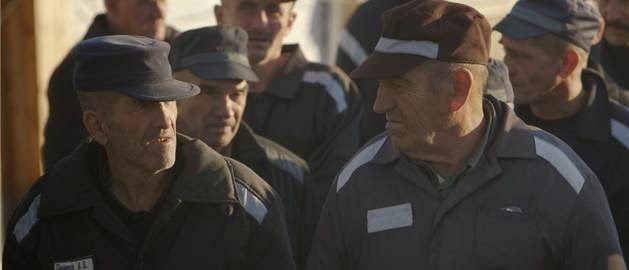
We are in Russia, or if you will, Hell. For many who are enclosed within the perimeter of fencing and locked gates, this will be their Purgatory until death takes them to the fiery eternal abode of Mephistopheles. Those who are not here for life, came in as young men and will leave as old men. This is the Federal Penal Colony No. 56 in Central Russia, surrounded by hundreds of square miles of deep forest in the Russian taiga. There's only one road in and one road out. The nearest populated community is a seven-hour drive away. The temperatures here frequently dip to 40 below zero.

There's no escape.


Director/Cinematographer Nick Read and producer Mark Franchetti introduce us to two sets of prisoners in this compulsive, staggeringly well crafted and downright great film. The Condemned are split between the most dangerous and the dangerous-but-less-so. The former live in solitary confinement, monitored by video 24-hours per day, not allowed to rest on their bed during the day time, forced to an eternity of pacing back and forth in the tiniest cell imaginable and allowed one hour per day of being outdoors in an chilly outdoor chicken run-styled enclosure not much bigger than their cells. The latter group live in a communal compound wherein they endure endless hard labour and an extremely rigid caste system that reduces many of the men to lives that are perhaps even more worthless than they could already be living.


Aside from capturing the day-to-day drudgery and monotony, Read expertly gets the prisoners to open up and bare their souls about the crimes they committed, their victims, their families, their thoughts and philosophies on forgiveness and redemption. Even more powerful is how the men give us personal glimpses into how they continue to live in a world that is, for the most part, hopeless and how some construct life out of what they can within the rigid construct of the penal system.


A great many of the men were originally on death row, but when Russia abolished capital punishment in 1997, their sentences were commuted to life. What a life. The Russian parliament made sure to enact specific wording in the laws so that daily, gruelling punishment is the order of these men's lives. Even worse is how so many of them men committed their crimes in that period when communism collapsed and the poverty was so overwhelming that the only mode of survival was crime or worse, numbing their pain with so much booze and drugs that many of their violent crimes occurred under the influence.

What's impossible to ignore in this powerful and moving film is a sense of humanity within the most inhuman/inhumane conditions. A handful of scenes involving visitations from family are downright wrenching. Even more brutal is discovering how so many of the prisoners are men of thought and intellect. The discourse of many is not the stereotypical tough-guy talk we expect, but is in fact, deeply thoughtful and philosophical.

There have been many documentaries about prison life, but almost none of them are produced with the kind of eye for cinematic artistry that The Condemned is imbued with. Part of this success comes from Read's direction which is coupled with his superb visual eye as a cinematographer, but also the meticulous pace and cutting from editor Jay Taylor who astoundingly makes monotony compelling and, on occasion, treats us to cuts that are breathtaking in their virtuosity.

The film drains us physically, but what remains is pure spirituality as we are allowed to connect with the souls of men whose actions on the outside include some of the most horrendous acts of violence. This might be the film's greatest strength and one that pretty much ensures its life as a masterpiece - a picture that will live long beyond the usual ephemeral concerns of most movies today.

The Condemned is screening at Hot Docs 2014 in Toronto. For further info, visit the festival website HERE. World Sales by Films Transit International.