Showing posts with label HBO. Show all posts

Monday, 15 September 2014

TERROR AT THE MALL - Review By Greg Klymkiw - Klymkiw Watches TV: HBO Canada Docs


Terror at the Mall (2014)
Dir. Dan Reed

Review By Greg Klymkiw

In a strictly Orwellian sense, the preponderance of closed circuit surveillance footage is not only creepy, but it's clearly the very thing which proves how little privacy any of us have. There's something very wrong with being monitored by camera from every vantage point no matter where we are.

Then again, public spaces are not private and as such, none of us have anything we can object to if we choose to avail ourselves of such spaces. At least this is how the proponents of said Big Brother eyeballing of our every move will always argue. The greater public good, they say, will always trump personal desires for privacy - especially in terms of both crime detection and prevention. However, when the perpetrators of said crimes have no intention of surviving, how necessary is it? Such must certainly be the case with the scumbag cowards of the Somalian terrorist group Shabab who, one year ago, marched into the Westgate shopping mall in Nairobi, Kenya and began to gun down innocent civilians in the name of Allah, or whatever screwy reason they had to do so.

Caught on over 100 mall surveillance cameras in addition to cel phone cameras, the amount of footage which exists with respect to this act will never be a deterrent to such mindless acts of violence and it's doubtful there's even a good reason for its existence in terms of crime solving. These idiots continue to dive into these sickening, moronic actions dreaming of virgin conquest in an afterlife or whatever dopey, boneheadedly ignorant belief systems they've allowed themselves to swallow in order to justify their brutal violence.

Without this footage, however, we would not be privy to filmmaker Dan Reed's harrowing HBO documentary Terror at the Mall which is clearly an important document of this heinous event. On one hand, Reed's film superbly blends the existing surveillance (and private cel phone) footage with post-event interview footage of survivors identified in said footage. On the other, it feels like a carefully mediated testament.

First and foremost, though, the film is a document of incredible acts of heroism, sacrifice and an examination of the thought process of normal human beings under the duress of armed assault in the unlikeliest of places. Surely for this reason alone, the existence of such footage has served an important historical purpose. In spite of this, does not such footage profane the memory of those caught digitally who are seen cowering in terror, running madly in panic and/or cut down by the bullets of the terrorists? Is this stealing of their images somehow not, as many cultures believe, a theft of the souls, the spirits, the inherent humanity of the victims?

These are worthwhile questions.


Reed appears to have no interest, at least overtly, in answering or at least addressing them. This will probably be a far better approach for a completely different film, but that Reed's work inspires these questions suggests it had to have been an element he chose to play with - perhaps not at the forefront, but always there in the background.

One other element with respect to the "creep factor" of surveillance footage is the specific aesthetic of it. There's nothing especially human and most often, not mediated by the perspective, or, if you will, the hearts, hands, eyes and minds of humans. The footage is raw. It is what it is - cameras perched, usually from God's eye view (the notion of which is especially creepy). It's an otherworldly perspective - a purely digital mapping of events. Reed clearly understands this and if anything, his superbly chosen juxtaposition of real-life interviews with the surveillance footage does apply a sense of humanity to the proceedings - one that is as humane as it is clearly the work of a genuine film artist. If I had one minor quibble, it's that the scope of this film is so large that I almost didn't want it to end. This, of course, is probably a compliment rather than a quibble, but the fact remains that the film could well have survived a substantially longer length, yet still delivered the goods with the same power.

What finally remains for us in Terror at the Mall is the horrific experience of knowing we are seeing actual footage of terrorism and that what Reed is most interested in, is ultimately, courage. There is fear, to be sure, but in many ways, true courage can only be borne out of fear and one ultimately must salute Reed and his team for giving these people a voice in light of actions that will be seared upon them forever.

And perhaps, that very thing emblazoned upon the minds of the victims is the very thing that will never leave our consciousness so that we might all be ready and prepared to face the worst this mad world has to offer us and, in turn, to realize it's okay to be scared.

For out of fear, comes courage and from courage, comes life.

The importance of this production cannot be stressed enough. Terror at the Mall is, finally, must-see viewing for everyone - adults and children. (My own little girl was deeply moved by this experience in ways that only kids can be moved.) So screw whatever crap you were planning to watch on TV as this terrific film is being broadcast. Nothing that's on can come close to how your life and those you love will be touched by the subjects, events and themes of this picture. It'll be an hour out of your life, but one that will contribute a lifetime of thought and consideration.

THE FILM CORNER RATING: **** 4-Stars

Terror at the Mall premieres on HBO and HBO Canada in North American broadcast territories. Check your local listings for dates and times.

Monday, 8 September 2014

TALES OF THE GRIM SLEEPER (TIFF 2014 - TIFF DOCS) - Review By Greg Klymkiw

KILLER.
CRACK WHORE.
FILMMAKER.
Tales of the Grim Sleeper (2014)
Dir. Nick Broomfield

Review By Greg Klymkiw

It's quite possible Lonnie Franklin Jr. murdered over 100 women. Undetected for at least 25 years, he ran amuck through South Central Los Angeles as the Grim Sleeper serial killer and even now, under arrest, charged with 10 murders and still awaiting trial, the idiot police are trying to piece everything together, now, rather than during the heyday of this madman. The police knew they had a serial killer on their hands in the 80s. They even had a forensic sketch, but they did nothing. After all, why should the police have bothered to make a serial killer connection between so many unsolved murders? Hell, why bother to make anything resembling a concerted effort at all? Most of the victims were poor African-American women and many of them were prostitutes, drug addicts, homeless, abused and/or alcoholics. These weren't women anyone should care about, least of all, the Los Angeles Police Department. The LAPD have always had bigger fish to fry. You know, like being on the take and/or randomly beating and/or killing young Black men.

So who ya' gonna call when you need answers?

Well, you don't need to call maverick investigative documentarian Nick Broomfield. Chances are, he'll call you or as is his wont, the surly, dogged, sniping Brit will drop by all on his lonesome. All this crusading pit bull needs is a whiff of incompetence, laziness, ignorance, racial inequality and/or social injustice.

So was the aromatic stench from the Grim Sleeper a Broomfield alarm bell.

The director of Aileen Wuornos: The Selling of a Serial Killer, Heidi Fleiss: Hollywood Madam, Kurt & Courtney, Biggie and Tupac, Aileen: Life and Death of a Serial Killer and host of other penetrating documentaries, has never let anything stop him, though sometimes he's placed himself in harm's way to get answers.

Usually, Broomfield goes it alone. He operates his own sound and has one cameraman. His research is often done on the fly with cell phones. Here though, Broomfield secures a full-fledged partner, a former (and self-identified) "crack whore" by the name of Pam Brooks who first falls in his lap as a subject.

She quickly and simply joins him at the hip, drumming up clues, additional subjects for interviews and essentially becoming Watson to Broomfield's Holmes. She's a marvel and joy to behold and in spite of the utterly sickening backdrop, it's incredibly uplifting and yes, entertaining, to see this woman quickly gain a sense of her own pride, self-worth, talents, intelligence and doggedness to rival that of Broomfield.

This Dynamic Duo end up doing a far better job than the LAPD, digging up a whole whack of people who knew Franklin but who now, in retrospect are able to shed light on his suspicious behaviour from the past (he loved boastfully waving his handgun before neighbours, friends and acquaintances). Most importantly, the pair discover more women who might well have murdered or, extraordinarily escaped being murdered by Franklin's choice methods of snuffing out his victims - a point blank shot from a .25 calibre handgun or just good, old fashioned strangulation. Franklin, you see, was a hobbyist extraordinaire. He photographed hundreds of unclothed women in provocative poses who all appear to be dead, or asleep. Some of these photos might even be more victims.

What Broomfield's film ultimately sheds a huge light upon is how a killer openly went about his tireless, prodigious business - pretty much in plain view. The LAPD, not surprisingly, refused Broomfield's requests to be interviewed. We only see the cops on camera through news footage wherein they're extolling their "genius" at cracking the case through good, old-fashioned police work. As Broomfield's film more than ably proves, the police pretty much did nothing, save for bragging about how much they did. "Hypocrites", "liars" and "pigs" are words that come appropriately to mind.

The real story here is how nobody did much of anything while one woman, after another and another and another, ad nauseam, were brutally murdered.

THE FILM CORNER RATING: **** 4-Stars

Tales of the Grim Sleeper is in the TIFF Docs series at TIFF 2014. Financing and sales come from HBO Documentaries.


PLEASE FEEL FREE TO ORDER ANYTHING FROM AMAZON BY USING THE LINKS BELOW. CLICKING ON THEM AND THEN CLICKING THROUGH TO ANYTHING WILL ALLOW YOU TO ORDER AND IN SO DOING, SUPPORT THE ONGING MAINTENANCE OF THE FILM CORNERBUY MOVIES HERE FOR SOMEONE YOU LOVE! OR HELL, BE SELFISH, JUST FOR YOURSELF.

AMAZON.CA


AMAZON.COM


AMAZON.UK


Tuesday, 20 May 2014

THE NORMAL HEART - Review By Greg Klymkiw - Klymkiw Watches TV: Heartbreaking HBO Film of Larry Kramer's Modern Classic of Theatre a genuine masterwork.

The Normal Heart, the important and immortal play by Larry Kramer is now a movie which will make its broadcast launch on HBO Canada day-and-date with HBO in the USA on Sunday, May 25, 2014. It will also receive its Canadian Premiere at the Inside Out Toronto LGBT Film Festival on Friday, May 23, 2014 with co-star Matt Bomer in attendance. The fundraising screening is preceded by a cocktail reception and all proceeds will benefit both Inside Out and the Canadian Foundation for AIDS Research (CANFAR).

The Normal Heart (2014) *****
Writ. Larry Kramer, Dir. Ryan Murphy
Starring: Mark Ruffalo, Julia Roberts, Matt Bomer, Taylor Kitsch, Jim Parsons, Alfred Molina, Jonathan Groff, Joe Mantello

Review By Greg Klymkiw

The Normal Heart is as close a dramatic rendering as we're likely to get (at least for now) of how tragic and horrifying those early days of the AIDS epidemic were during the 1980s. Riveting and deeply moving, the picture is both a love story and a snapshot of how a sharply divided community fought amongst itself within its common goal to address the ignorance and prejudice of a society refusing to pay attention to the swift near-annihilation of an entire generation of young men.

While watching the film, there are times when anger, sadness and frustration will consume your spirit. With equal weight, however, your soul is alternately fed with love, compassion and joy. This extraordinary picture, shocking in terms of what it details to be sure, also evokes more than a little stupefaction that the journey of this important story to the silver screen took as long as it did. Larry Kramer's play first opened in New York in 1985 and has subsequently been performed all over the world.


In the 90s, Barbra Streisand acquired the motion picture rights, then spent over two decades unsuccessfully attempting to raise the financing. The roadblocks included the controversial material, but also, writer Kramer's eventual and seeming bid to sabotage Streisand with outrageous demands for a production fee for the underlying rights to his screenplay. In reality, it seems clear he felt Streisand had unfairly brought another writer on board to render the property more cinematic, as frankly, would have been her right, but might also have made more sense if she, in fact, did want to direct it to the best of her considerable power as a filmmaker.

Finally, it took the unlikeliest champion of the material to get The Normal Heart made into a film. Ryan Murphy, the creator of the ludicrous but compulsively watchable TV series Glee and the semi-abominable Julia Roberts vehicle Eat, Pray, Love, starkly directs this material with spartan skill, urgency and a simple but effective mise-en-scène which highlights character, narrative, historical high (and low) points in the war on AIDS and maybe, most importantly, the sheer ferocity of Kramer's writing which is levelled at all the ignorance, hatred and suspicion towards the gay community in those ever-so dark days. Given the current idiotic attempts of governments to welch on various human rights issues relating to the LGBT nation, recently with respect to gay marriage, one is grateful to Murphy for weaving a critical stance into his dramatic approach.

Many critics easily, lazily and bone-headedly slapped the word "pamphleteering" to Kramer's writing when the play first hit the stage. I suspect we might see more than a few idiot film (and TV) "critics" do the same with Murphy's film of Kramer's screenplay adaptation, but for me, there's absolutely nothing wrong when a drama wears a heart of didacticism on its sleeve. What's wrong is when the potential for holier-than-thou speechifying becomes the be-all, end-all of the piece to the point where the work suffers narratively. This is simply NOT the case in Murphy's rendering of Kramer's material.

Given the fact that the story relates the political backdrop of both the gay and straight sides of the coin (though clearly and always through Kramer's POV), it seems ludicrous to even try avoiding the sermonic characteristics of the time, place, situation and personae of the film's content and approach. If anything, it makes sense to co-opt the modes of communication rooted in non-secular practice to preach beyond (though also including) the converted, especially given how much of the prejudice levelled at gay culture, lifestyle and society has been so bastardized and exploited by virtually all organized religion to the point where it's seeped insidiously into the secular aspects of existence and thought.

The main character of The Normal Heart is Ned Weeks, a thinly disguised version of Kramer himself, beautifully played by Mark Ruffalo. As the film progresses we see that what fuels him, at least on the surface, is his steadfast belief in fighting fire with fire. At first though (and speaking of fire), we're introduced to Ned during a magnificently rendered depiction of a glorious, fun, disco-music-infused, dick-waggingly, ass-cheek-promenadingly and thoroughly delirious sex-drenched weekend on Fire Island, the traditional gay playground away from the concrete jungle of Manhattan.

Ned seems shy and out of place. He observes the bacchanalian revelry, but can't seem to be part of it himself. If he has a problem with his "skin", it turns out to have nothing to do with prudery or confusion, but when he meets the New York Times "gay" fashion/party columnist Felix Turner (Matt Bomer), Ned realizes that what he's craved as a gay man has little to do with indulging in a sexual revolution that's wildly, inclusively scattershot, but that rather, what he's sought is a revolution that allows gay men to find love.

Love, is indeed what he finds, but it comes during a time when gay men are dropping like flies from a mysterious "gay illness". Ned dives into the issue with the ferocity of a pit bull. He forms a group devoted to exposing, educating and lobbying for research into the disease which, of course becomes known as the HIV-virus which causes AIDS. Given Ed's histrionics, he agrees to be the silent leader and instead lets Bruce Niles (Taylor Kitsch), a gorgeous closeted muffin to be the public president of the organization. He befriends Dr. Emma Brookner (Julia Roberts) who appears to be the only medical practitioner taking the disease seriously on the Isle o' Manhattan and then Ned launches an all-out attack upon media, the medical profession, several levels of government (included that of the closeted New York Mayor Ed Koch), the straight community and yes, even the gay community (many of who equate their newfound freedom with rampant sexual expression).

Driving the narrative is Ned's commitment to the cause and his deepening love for Felix, but along the way, the film increasingly adds several exclamatory elements touching upon the disease itself: the suffering, the death, the outright rejection of AIDS patients by the medical community (everyone from hospital maintenance guys up to doctors and administrators), the continued efforts of politicians to ignore - mostly via prejudice - what is seen to be a disease that "only" attacks homosexuals.

We even experience dramatically the horrendous number of months and/or years that so many gay men of this generation genuinely believed there was something wrong with them and how they agreed to unhelpful and often ruinous psychotherapy. Ned admits he subjected himself to analysis and desperately looks to his rich older brother (Alfred Molina) to not only help "the cause", but to finally accept that Ned has eschewed the notion of being "sick". He wants what anyone would want - for his closest blood relative to look upon him as a "normal" brother.

There are times in the picture when we're outright jangled with the horror of this disease. Murphy never pulls punches here and there are several set pieces that are infused with the kind of urgency and outright fear, panic and sheer monstrosity of the disease. True to the material's theatrical roots, though employed here organically to the medium of film, are additional exclamatory elements when many of the major characters (and a perfectly pitched cast), launch into monologues that are as stirring and dramatically harrowing as anyone is likely to experience on-screen. These might even become the moments where some scribes take aim at the material's seeming didacticism, but they will be wrong - dead wrong (as per usual).

The Normal Heart is a film that must be seen as widely as possible. My own thirteen-year-old daughter was devastated and awakened to the reality that faced so many family friends in their youth and that face new generations even now. She was raised to believe homosexuality was "normal", has loved her "uncles" as much as they loved her, but upon seeing the extremity of prejudicial events detailed in the film, she was unequivocally shocked. She understood that "some" were ignorant about homosexuality, but not until seeing Murphy and Kramer's film did the severity of it, historically and contemporaneously, hit her like a ton of bricks. She laughed and wept all through the picture, as did her parents, but the next day she went to school with additional resolve to fight even harder for the rights of kids her own age STILL suffering from hatred, prejudice and ignorance.

Yes, gay or straight, this is a film for all who hold humanity dear, but what I really, really hope is that kids see The Normal Heart. I don't care what their age is so long as they're mature enough to grasp adult drama pure and simple. It's the kids who are our future and who might benefit the most from seeing this great film. They're the future that was denied the millions of brave victims of this horrible disease, but most of all, they're the real future of love and acceptance in a world still fraught with prejudice. See it for them. See it with them. See it for hope, for a future where hatred will never replace and/or deny care, compassion, devotion and respect for all.

The Normal Heart receives it Canadian Premiere at the Inside Out Toronto LGBT Film Festival on Friday, May 23, 2014 with co-star Matt Bomer in attendance. The film makes its broadcast launch across North America on HBO Canada day-and-date with HBO in the USA on Sunday, May 25, 2014. In Eastern Canada, the film will be available on TMN GO and HBO Canada OnDemand. In Western Canada, episodes are available on HBO Canada OnDemandHBO Canada HD, on the go with Shaw Go Movie Central app, Bell TV app, Telus Optik on the go, and HBO Canada On Demand.

Sunday, 30 March 2014

Klymkiw WatchesTV (HBO Canada) - THE UNIVERSITY OF SING SING - Education=Salvation, not the systemic genocide America continues to penetrate upon its people of colour - Review By Greg Klymkiw

Can someone explain to me how America, the supposed bastion of freedom in Western history and culture, continues to be little more than a borderline Third World country that preys on the weakest amongst its own populace to enrich, uh, nobody? I use the word "nobody" only because the country's ruling elite - the rich - really ARE nobody. Even more appalling is the country's systemic racism and frankly, its ongoing genocide of its people of colour. "The University of Sing Sing" offers hope, but for me, it also demonstrates how despicable the ruling elites of the country truly are. Read on...

Harlem
By Langston Hughes

What happens to a dream deferred?

Does it dry up
like a raisin in the sun?
Or fester like a sore—
And then run?
Does it stink like rotten meat?
Or crust and sugar over—
like a syrupy sweet?

Maybe it just sags
like a heavy load.

Or does it explode?

The University Of Sing Sing (2014) ***1/2
Dir. Tim Skousen, Starring: Joel Jimenez, Denis Martinez, Dewey Bozella, Douglas Duncan, Harry Belafonte, Ice-T

Review By Greg Klymkiw

In the span of 40 minutes, you will see a group of men learn and graduate from university. They're no ordinary students. They're all prisoners of Sing Sing, the notorious New York state maximum security prison for violent offenders. They are enrolled in Mercy College through a charitable program called Hudson Link which operates a campus onsite and offers the same rigorous academic program that runs concurrently at their nearby university beyond the walls of the prison. At least half of Sing Sing's prisoners return after they're released. A mere 2% of the program's participants find themselves back behind bars.

This sounds like a pretty good deal to me. Good for the prisoners, good for society and, as much as they might not be able to admit it, it's good for the victims of the crimes perpetrated against them by the men who graduate.


Several things knocked me on my ass while watching this picture.

There isn't a single man enrolled in the program who is anything less than intelligent, personable, deeply ashamed of the horrendous crimes they committed to get themselves in prison, genuinely repentant, sensitive beyond words and such exceptionally gifted human beings one wishes they could be released in order to serve the world in ways they could have if not forced into making the kind of mistakes in their youth that, frankly, have more to do with America's (and society's) treatment of its most vulnerable members of the human race to place them in positions wherein they made the very wrong decisions in the first place.

I'd be happy to break bread with these guys anytime, anywhere.

Another element that struck me is that I did not notice a whole lot of men in the program and, for that matter, amongst the general population of Sing Sing, who weren't people of colour - Americans of African, Mexican, Puerto Rican and among other hues of the rainbow, Asian, dotted the landscape of this world. If Whitey exists within the prison's walls, I can only assume they were on view every time I blinked. This doesn't surprise me, the stats on this are pretty clear.

I was also agog to learn that the program exists with no government support. This is easily the most moronic thing I've ever heard. Sure, it's probably not politically popular, but who gives a shit? Supporting endeavours like this only helps EVERYONE. Luckily, the funding comes from the aforementioned Hudson Link which was founded by several former prisoners who benefitted so greatly from this education that they decided to give back. Thank God for people as opposed to the automatons in government.

The truly inspirational thing about the picture is probably the biggest force that had me off the chair and buttock-clinging the ground is having the whirlwind opportunity to witness the progress of a select group of prisoners in their educational journey - in class, doing homework and finally, graduating with a full-on ceremony under the harsh glare of Sing Sing's fluorescent lights. Along the way, we meet family, friends, teachers, former grads and a number of the philanthropists involved in the program.

Most importantly, we get a chance to the know the men, see their fine work in the program, hear their stories, get a taste of their hopes and dreams and in one far-too-short scene we get to sit in on a round circle chat between the prisoners and rapper Ice-T. I'd have given anything to be a fly on the wall for the whole session. Maybe if it was shot in its entirety this is something we'll get as a bonus extra on a DVD/BluRay release. It's also cool that Ice-T is a big supporter of this program. The tough-minded musician/actor still gets my undying admiration for his powerful "Body Count" album blending rap and heavy metal, which addresses the systemic racism in the crime prevention and justice system. His anthem "Cop Killer" (the uncensored version) is still a work that raises gooseflesh.

Speaking of a DVD/BluRay version, I kind of hope this is a possibility. The film is only 40 minutes long and within the context of the story it tells, it's certainly well structured and edited for maximum impact on television, BUT, I wanted more. Wanting more is probably the best thing any filmmaker can hope for in an audience response, IF the film is working (which this one most certainly is). That said, it feels like the material is worthy of a feature length version with added scope and possibly even a re-think with the available footage to bring an even more personal style to a longer version that the clearly talented director Tim Skousen is more than capable of doing.

In recent years, the bar was significantly raised by the brilliant auteur Alan Zweig for the genre of documentaries about the prison system; why it exists, what led to incarceration and what hopes and dreams guided its inmates to lives outside of the box (as it were). The film Zweig gave us was his feature length A Hard Name, a picture with a specific mise-en-scene and tone that placed its audience into an almost poetic rhythm which delivered a structure to place us squarely within the notion of pain and forgiveness. The bar for documentaries dealing with the racism involved in keeping those of colour down was set by Angad Singh Bhalla's Herman's House the alternately tragic and uplifting tale of the late Herman Wallace.

And look, I don't expect Skousen to make something out of his material that's already been done, but I do suspect he's got a different film in him to make about this program and these men. Here's hoping that happens. In the meantime, we all have a chance to experience this fine picture thanks to the vision of its subjects, filmmakers and broadcaster to make it a reality in the first place.

The University of Sing Sing will air in the Great White North via HBO Canada. For more info, visit HERE.

Friday, 14 March 2014

Klymkiw watches TV (HBO CANADA) - It's nice when rich people produce films about poverty. Kudos to Maria Shriver for this one. PAYCHECK TO PAYCHECK: THE LIFE AND TIMES OF KATRINA GILBERT - Review By Greg Klymkiw


Paycheck To Paycheck: The Life and Times Of Katrina Gilbert (2014) ***
Dir. Nick Doob, Shari Cookson, Prod. Maria Shriver, Starring: Katrina Gilbert

Review By Greg Klymkiw

I can't help it, but trying to remove the taste of bile in my mouth is near-impossible when super-rich White People manage to weasel their way into arts and culture, based primarily upon their wealth, blue-blood family pedigree, celebrity and all the luxuries afforded to them and then make films about poor people. Such is the case of this latest production by Maria Shriver, daughter of Eunice Kennedy Shriver (hence, JFK's niece) and ex-wife of the nanny-defiling movie-star-body-builder-former-California-Governor Arnold Schwarzenegger.

Still, I'm happy enough to assess the 75 minute feature film Paycheck To Paycheck: The Life and Times Of Katrina Gilbert on its own terms since co-director Nick Doob has the distinction of being a real filmmaker and a longtime member of the unimpeachable Pennebaker Hegedus Films team, whilst his directorial partner Cookson, has a prolific c.v. which, includes the popular, though somewhat spurious doc series "Real Sex" (with its audience grabbing emphasis upon soft-hard-core antics and personalities).

Doob and Cookson had a whole year to dip into Shriver's access to O.P.M. (said access also generously applied, in fairness, to her many charitable activities) and follow around a Chattanooga, Tennessee nursing assistant to examine the life of the working poor - most specifically an example of America's most vulnerable and largest targets of poverty, single mothers.

Katrina Gilbert has three children and toils for 9 bucks an hour in an extended care facility. It's back-breaking, flat-footing work, but Gilbert genuinely seems to enjoy the daily human contact she has with the old and infirm. Still, she'd prefer to "better herself" and continue her post-secondary studies in the health care field, but in spite of her meagre salary and needing to support three kids, she is turned down - shockingly and inexplicably - for financial aid to further her education and perhaps get a better paying job.

Welcome to America.

Gilbert also has on-going medical conditions which, could well eventually morph into something life-threatening, yet when she goes to get an overdue check-up, she's hit with a doctor bill for over $300 as opposed to the $120 she was initially quoted. In America, there is no socialized medicine - it's big business in the Land of the Free and most people, including the working poor, have to cough up. (Obama Care doesn't appear to be in full implementation during the shooting, but even if it were, it's such a mess I can't imagine it would really help her.) Even more horrifying is that the list of medications she requires to keep her health on the up-and-up are so ludicrously expensive, she needs to make the decision of what drugs she can afford during a last-minute tabulation at the pharmacy.

Welcome to America.

She has three kids to feed, but since her ex is unemployed and often in arrears with his childcare payments, she not only has to lend him gas money to visit the kids, but her ration of food stamps to actually feed her progeny is shockingly and inexplicably cut-off.

Welcome to America.

The film itself is pretty compelling stuff and as a subject, Gilbert is pleasing, kind-hearted and smart. That being said, the movie presents her story in a what-you-see-is-what-you-get style, but I did find a few editing choices somewhat dubious - perhaps even downright unfair to her struggle.


For example, after discovering she doesn't qualify for educational assistance AND forced to choose what drugs she can actually afford, the filmmakers follow her into a beauty parlour so she can "do a little something" for herself. When she drops a healthy whack of dough for her new hair-do, I began to wonder, uh, lady - you have no money for drugs, yet you're dumping 70 or so smackers on what looks to be a (not-especially) flattering makeover. Given how much we feel for this woman, I felt this artistic choice - no matter how "true" - was simply cruel (intentional or not). Maybe it's the filmmakers' desire to make viewers have a similar response to the salon scene and intentionally plant a seed that grows into guilt for even having such a thought.

Whatever the reason it somehow feels out of place, just as a breakfast scene in the family's squalid home is shot and included wherein we watch the kids scarf down grease-laden plates of bacon and eggs, then guzzle-back bottles of pop. Yeah, we know that nutrition-choices are, for the poor, dictated by their poverty, but by continually including such sequences, one occasionally suspects there's a deeper agenda at play here - even if there isn't.

The choice to do this kind of thing might be true to the filmmakers's adherence to a direct cinema approach, but it's almost to the detriment of the film's forward trajectory since you, as a viewer, almost waste more time thinking about the rather mean-spirited approaches than what really counts. I suspect mean-spiritedness was not the intent and that the adherence to a direct cinema approach was paramount. However, even within that context, these moments stick out like sore thumbs rather than integrating with the whole. Greater attention needed to be paid to the desire to present an unfettered reality that should have addressed these important and clearly dichotomous moments in this woman and her family's life.

For example, the movie occasionally interviews individuals on the sidelines of the activities captured - in one case, a man who works as a clerk in a money-lending firm and in another, a clerk in a tax preparation office. In both instances, these brief side trips address the issues at hand - a woman who can't get credit anywhere else other than a usurious money lending service is acknowledged and treated like a human being who knows how hard she's trying to manage her debt and another who seems to even sense the absurdity of poor people needing to pay for a third party to report an income that, for all intents and purposes, is at the poverty line.

Where then is an individual to advocate for the "poor" or even simply acknowledge how easy it is to choose ephemeral pleasure over medical well-being and how prevalent it is in the lower financial strata of society? Where is the same perspective in terms of the grotesquely unhealthy breakfast the family is eating?

I think it's important we see these elements of Katrina's life - especially since it's presented as an individual sampling of the kind of thing millions of Americans are living through. I hate to make generalizations, but I think there's some truth to this one. Poor people see the world through the eyes of hardship and life experience. Some even acquire a modicum of wealth, but they've had to WORK - really WORK for it. Their sense of observation and even balance seem far more aware and open. The rich, generally, are criminals and/or assholes who most always see things from an elevated position. Some are neither, but I'd suggest that even the well meaning ones have prejudices that temper their observations.

Since the directors have not addressed this, I have to ask:

Where, in this film, is the producer (who especially in television has a very strong creative hand) to address the weird perspectives I point out above? And let me be clear, where is that strong hand, NOT to censor, but to address the shortfalls in the direct cinema approach and to do so aesthetically within the context of the whole film and its style/POV?

There wasn't one. She's a Shriver. Why would she even think about it? Sure, her credentials as a journalist, filmmaker and philanthropist cannot be ignored, BUT there is a perspective she has not been able to bring to bear upon this film that her directors also ignore. Direct cinema, in its purest forms and as we know them today were, in fact, rooted in colonialism, prejudice, poverty, working-class values and very little access to post-secondary education in the Canadian province of Quebec. (Though, it would also be remiss of me to not acknowledge the influence of Dziga Vertov's "Truth of Cinema" movement in the 1920 - born out of repression, revolution and the eventual sad march to another form of repression with a different name.)

Look, I'm not suggested Shriver nor her directors must have tasted subjugation to utilize this form, BUT it's of utmost importance for all artists - especially those working in documentary - to leave as few stones unturned in their quest for truth.

While the journey of Katrina Gilbert moved and inspired me, I could only feel saddened and defeated by the end of the film - not just as a viewer, but for her, those like her and the world as a whole. One of the very last things the film leaves us with is the knowledge that Gilbert is finally getting her first raise at work - ever! It's in the amount of a few cents. Chances look good she'll continue living in a trailer park.

All the film really leaves me with, especially because it does such a good job of detailing her struggle and allowing us to get to know her as well as we can, is one overwhelming annoyance. With one pen-stroke upon a check book, Executive Producer Shriver (who lives in a $10 million dollar Brentwood mansion) could make this woman's life turn around.

Instead, Shriver made this movie. On other people's money.

Welcome to America, indeed.

Paycheck To Paycheck can be seen on HBO Canada. For Dates and Times, visit the HBO Canada website HERE.

Monday, 11 November 2013

MIKE TYSON: UNDISPUTED TRUTH - Review By Greg Klymkiw - Spike Lee serves up a brilliant document of boxer Mike Tyson's astounding one-man-show.

HBO Films presents Spike Lee's latest Joint, a biographical portrait of boxer "Iron Mike" Tyson via his hit one-man stage production which wends its way through the triumph and turmoil of his storied life.


Mike Tyson: Undisputed Truth (2013) ****
Dir. Spike Lee
Starring: Mike Tyson

Review By Greg Klymkiw

Most boxers are genuinely great natural story-tellers. So many of them, it seems, spring from tough, colourful, Runyonesque mean streets of various squalid, crime-ridden urban jungles and no matter how punch-drunk they've become, no matter how many decades have passed, they all seem to remember every single detail worth recounting about their rich lives in and out of the ring.

In fact, I've personally never met a boxer who couldn't spin compelling autobiographical yarns. That said, one doesn't need to actually be sitting face-to-face with one of these grand old guys in a booth at some greasy diner to enjoy their tales of glory since there's a wealth of interview material out there with any number of pugilists.

These guys seem to have the hard-wired DNA to recount stirring narrative accounts that are as humorous as they are heartbreaking, as hiply cool as they are harrowing. Mike Tyson: Undisputed Truth is a magical thing all unto itself - at least when it comes to documentary portraits of boxing and bluntly, it's impossible to imagine anyone other than the scrappy stylist Spike Lee to so perfectly capture the essence of one of the world's greatest boxing legends.

One of the aspects of Lee's film that was most apparent to me was the notion that its scope and style of presentation was not just the work of a genuine filmmaker (as opposed to the typical camera jockey that captures such events for television), but that it indeed, did not feel like a television special at all, but rather, a bonafide feature film. Like a previous HBO Film, Steven Soderbergh's astonishing Liberace biopic Behind the Candelabra, my immediate response to Mike Tyson: Undisputed Truth was just how much I would have loved to see the movie theatrically - in a real movie theatre, with a real audience.

With this film in particular, I was reminded of the terrific tradition in theatrical exhibition of presenting work that can collectively be typified as "concert/live performance films." Unlike classic rock concert films, however, like Gimme Shelter from the Maysles Brothers and Charlotte Zwerin or Monterey Pop by D. A. Pennebaker, Spike Lee's film is more in the tradition of stand-up style concert films like the immortal Richard Pryor: Live in Concert, Eddie Murphy Delirious, but crossed with Jonathan Demme's groundbreaking Spalding Gray monologue masterwork Swimming To Cambodia.

All of these films shared a number of elements with Lee's film. First of all, they were shot before live audiences. Secondly, the stage presentations were conceived with being captured on film. Thirdly, as theatrical feature films, they shared the unique viewing experience wherein the movie audience watched a cinematically rich approach to filming an event that included on-screen audiences responding to the material. Sitting in a huge movie theatre with hundreds of people laughing in unison with audiences reacting to the show on-screen was an experience unique to cinema and one that was so special, so indelible that watching Mike Tyson: Undisputed Truth at home, on television with a very small (albeit delightful) audience that included my wife and twelve-year-old daughter made me immediately yearn to have seen this terrific movie (with said wife and child) in a real movie theatre, with real people and a larger-than-life screen.

Lee's mise-en-scene is certainly larger-than-life and this, given the subject, is as it should be and could only be. Mike Tyson was the undisputed heavyweight boxing champion of the world and the youngest man to ever win several coveted titles. Most of his fights were won by completely knocking out his opponents and usually in the first or second round. For many years, he seemed unstoppable, but a series of turbulent personal travails wreaked enough havoc upon him that he did, indeed, start to lose. During one losing bout, Tyson savagely bit off part of his opponent's ear - not once, but twice. Add to this the blight of various domestic disputes, bankruptcy and a rape conviction leading to three years in prison and Tyson has a story as huge as that of any immortal God of Ancient Greece.

Using a series of simple, but evocative lighting effects, still images, film footage and a great music track, Lee shoots Tyson as he sits and struts upon the huge stage like a lion in a cage - his very life forming the bars and the appreciative audience providing the eventual redemption within the tale he weaves. We learn about Tyson's rough childhood - a beloved mother who was a substance abuser and sometime street hooker, an abusive step-father, an irascibly flamboyant pimp as his birth father and a huge juvenile criminal record. Tyson seems thankful for these early years of crime and incarceration, as his time in juvenile detention led to a relationship with a trainer and mentor who promised Tyson that he would indeed groom the lad into becoming the youngest world boxing champ.

Tyson comes across as a plain-spoken orator - an entertainer from the streets of life and the school of hard knocks. He's pretty damn riveting and Lee clearly knows how and where to place the camera - the lens of which that truly, madly and deeply loves the ex-champ. Unfortunately, it's impossible to be completely sold on his redemption - the physically brutality he exacted upon his young wife Robin Givens is avoided in favour of exposing her "gold digging" ways and the manner in which Tyson represents his rape conviction is full of denial and mean-spiritedness towards his victim. Instead, we get a parade of all the celebrities who came to visit him in prison. (Shame on all of them!) These are big hurdles to get over and I'm not sure if most audiences will be able to do so. I suspect, however, that Lee's dazzling direction will indeed keep them watching at the very least.

Ultimately, what the film achieves is not so much myth-making since Lee knows that this ground's already been tread upon (via James Toback's excellent, though surprisingly straightforward feature doc Tyson). Instead, we get "Iron Mike" up close, personal and almost oxymoronically, bigger than life. As the camera scrutinizes the big man, there's no denying that there will be plenty of room for audiences to see what they need or want to see. Most will see a young man from a hellhole, his rise to the top and his rock-bottom crash. We'll see a man in denial and yet, this is what we'll clearly see and believe. Finally, we'll see a man, a human being - one who looks ahead to new beginnings and new challenges.

And for all the achievements and all his fame, he'll still be a thug - a thug who parlayed his gifts as a thug into becoming a much-beloved hero and celebrity - an American Icon.

Only in America. No wonder the country is collapsing.

"Mike Tyson: Undisputed Truth" can be seen on HBO Canada. For info, visit the website HERE.
Playdates in Canada are as follows:
Saturday Nov.16 8:01PM ET / MT
Sunday Nov.17 2:16AM ET / MT
Saturday Nov.30 11:45PM ET / MT
Sunday Dec.8 9:40AM ET / MT
Sunday Dec.8 6:30PM ET / MT

For info on U.S. dates and times, visit HERE.

Friday, 2 August 2013

CLEAR HISTORY - Review By Greg Klymkiw - Horrors! I've finally discovered something good on TV.


Clear History (2013) ***1/2
Dir. Greg Mottola

Starring: Larry David, Jon Hamm, Bill Hader, Philip Baker Hall, Kate Hudson, Michael Keaton, Danny McBride, Eva Mendes, Amy Ryan

Review By Greg Klymkiw

I think some context might be necessary before I begin with my thoughts on the movie at hand. In 2009 I saw Woody Allen's Whatever Works - a picture I loved thoroughly, even though it was probably a script he'd piled up in a desk drawer with a whole mess of others he'd never managed to get around to shooting. It featured Boris Yelnikoff, a typically misanthropic Allen character I'd come to know, love and trust over the decades - mostly because it made me feel less alone knowing that other people felt as bemusedly disdainful of their own species as I usually did.

Aside from looking into a mirror, it was fun seeing a by-now almost de rigueur stand-in for Allen in the form of another actor. In this case, it was Larry David. What hit me like a ton of bricks was just how much I loved this hilariously rancourous dude who, ensconced somewhere in the half century point of his life was clearly an enormous talent who'd only now been discovered by the inimitable Woody Allen. I thought, how could someone as brilliant as this Larry David guy fallen below the world's radar? How could I have never remembered him from any of the 30,000+ feature films I'd seen over the course of my life? Ah well, I doffed my proverbial cap in Allen's direction for sniffing out and showcasing him to the world.

When I did an internet search later that evening, I was agog - simply agog! Larry David, was already a star. As someone who pretty much stopped watching television in 1982, why would I know this unless the guy had appeared in a substantial role in a real movie? This was, after all, only 2009 and though I should have remembered his cameos in Allen's Radio Days and the "Oedipus Wrecks" segment of New York Stories, I did not. At that point, we were still three years away from the Farrelly Brothers monumental work of art, The Three Stooges, wherein Mr. David appeared as the beleaguered Sister Mary Mengele - a phenomenal gender-bending performance that made utter mincemeat out of Dustin Hoffman in Tootsie, Robin Williams in Mrs. Doubtfire and Emma Thompson in Nanny McPhee (and pretty much every other movie Thompson appeared in).


I discovered Mr. David was the creator and chief writer of the TV series Seinfeld, but as I had only seen one episode of that show (in a hotel room during a channel hopping spree) and had never even heard of Curb Your Enthusiasm until that fateful internet search, all I knew was that Woody Allen discovered Larry David and cast him in the lead role of the laugh-out-loud non-stop knee-slap-fest called Whatever Works.

So, let us now fast forward to 2013. I was very much interested in seeing Steven Soderbergh's Behind the Candelabra with Michael Douglas as Liberace. Alas, I was not free to see it on a big screen during the Inside Out GLBT Film Festival and was forced to watch it - egads! - on a screener on television. I reviewed it (HERE) and loved it and even lamented that it was not being released theatrically as it was a real movie - something TV stopped doing well in the 1970s (Spielberg's Duel, et al).

Perhaps I was being too harsh. In spite of endless recommendations from friends and colleagues that there were things on contemporary TV I would like, if not love, I kept experiencing one disappointment after another like The Sopranos (bargain basement Scorsese), Deadwood (bargain basement Peckinpah), Mad Men (a bargain basement amalgam of Sirk, Tashlin and Sweet Smell of Success), Dexter (a false, foul and unfunny black comedy for people who only pretend to like black comedy) and last, but not least, Mildred Pierce (the most dull, uninteresting work from the great director Todd Haynes that I'd ever seen in my life).

Kvetch, kvetch, kvetch! The mind is a terrible thing to waste. I decided my mind required some spring cleaning. With the very kind assistance of a publicist from Canada's The Movie Network, Ellery Ulster (who also bears one of the greatest names in the western world - I mean, really - Ellery Ulster!!??!! I'd kill to have a monicker like that!!! Second only to J.J. Hunsecker and/or Sidney Falco, mais non?) I was generously barraged this summer with a bevy of made for TV delights.

Among them, the first episodes of the final season of Dexter did not sway me to think positively about it, The Newsroom does little for me (though I suppose it could, yet) and whilst the first four episodes of Ray Donovan feature astonishing performances from the great Liev Schreiber as a sleaze ball Hollywood celebrity "fixer" and especially Stephen Bauer as a Russian-Jewish thug who does most of the title character's real dirty work, the jury is still out on that show for me since Jon Voight is absolutely godawful as Schreiber's Dad and I'm not really fond of the serial elements of the show's structure.

(For a more in-depth explanation of why I prefer "Golden Age" TV, feel free to read my insanely exhaustive piece at Electric Sheep HERE.)

Amidst immersing myself in the most contemporary HBO-Showtime-styled television, a lone figure appeared on the vast-prairies-that-are-my-flat-screen-HD-monitor. No, it wasn't The Lone Ranger, but someone so equally unrecognizable that I was compelled to yelp out, "Who IS that masked man?" For at least the first third of Clear History, the "masked man" is none other than LARRY DAVID.


Clear History is, without a doubt, one of the funniest feature length comedies I've seen in quite some time. Directed by the Über-talented Greg (Superbad, The Daytrippers, Paul) Mottola, co-written by David and featuring a sensational all-star cast, it feels like a genuinely indie-spirited feature film (sans the usual holier-than-thou trappings that make films like The Way, Way Back so utterly sickening to me).

This is a MOVIE! And damn, just like Soderbergh's great Liberace-o-rama, I'm still scratching my head as to why Clear History did not first grace big screens in real movie theatres. No matter. It's a terrific picture and worth seeing any way you can.

David plays Nathan Flomm, a whining, opinionated, long-haired old-hippy Marketing Guru who owns a ground floor 10% of a brand new eco-minded car manufacturing corporation where he serves, (partially) in his own mind, but (more likely) in reality, as the real vision behind this revolutionary smart-car-like mode of transport. The company's head honcho is his old friend Will Haney (Jon Hamm), a slick, handsome and amiable Steve Jobs type who clearly loves and respects his pal, but also has his own ideas about how best to represent the company's products to the world.

All goes to seed when Will reveals to the team his "visionary" plans to roll out their product to the world. The car has been christened with the name, "Howard".

Howard? Who in their right mind would call a car "Howard"?

Will, that's who.

Nathan is open-mouthed with shock and disdainfully barb-tongued in front of the entire boardroom full of hip, youthful and typically insufferable "team players". Though Will has named the car after his own son, a deeply personal legacy-building move based upon love and family, Nathan could care less and spews globs of venom upon the idea. In anger, Nathan demands he get an immediate buyout of his 10% and quits.

This is an unbelievably stupid move. The Howard is a hit and Nathan becomes the media's whipping boy as the nutcase who gave up a multi-million-dollar stake. Not only does he lose his fame-and-fortune-driven wife, but it takes no time at all for him to lose what little money and property he really has.

Abandoning his unkempt hippie look, he moves to Martha's Vineyard with a new identity and lives out his life in obscurity and poverty. That said, he's found peace and contentment, until his happily insular world is shattered with the arrival of his nemesis - the wildly rich and successful Howard Car magnate. Will buys an opulently distasteful mansion that he's made even MORE distasteful and he loves his wife to death.

Nathan's hatred and jealousy boil over to absurd proportions.

Will, on the other hand has no idea that Nathan is Nathan. This is good. For Nathan, that is. Revenge, you see, is just around the corner. And Nathan aims for it to be sweet.

This is the stuff of great comedy and under Mottola's assured direction, the movie is a corker. It's adult, sophisticated and hugely entertaining. The picture clips along with an alternately breezy and introspective pace and the cast is to die for. Larry David and Jon Hamm are never less than engaging, Bridget Fonda is sexy and funny as Will's wife and both Michael Keaton and David Hader will have you on the floor (they almost steal the show) as crazed small town redneck survivalist-anarchist types who devise an evil plan with Nathan to take everything from Will that's sacred to him.

The postscript to all of this is that I'll never watch more than the one episode I've seen of Seinfeld, but I'm now, FINALLY, halfway through Season One of Curb Your Enthusiasm. It's a great show and all I want now is to get my clutches on the remaining seasons.

In the meantime, Clear History rocks. I've watched it three times now. And counting.

"Clear History" can be seen on HBO Canada, a multiplex channel of Bell Media’s The Movie Network (Eastern Canada) and Corus Entertainment’s Movie Central (Western Canada). The movie will be available in High Definition and on TMN GO, HBO Canada OnDemand and HBO Canada OnLine.

Tuesday, 28 May 2013

BEHIND THE CANDELABRA - Review By Greg Klymkiw - Soderbergh Earns Liberace Title of "MR. SHOWMANSHIP"


Behind The Candelabra (2013) ****
(I'm predicting I'll be upping this to ***** after a few more screenings and/or years)
Dir. Steven Soderbergh
Starring: Michael Douglas, Matt Damon, Dan Aykroyd, Scott Bakula, Rob Lowe, Debbie Reynolds

Review By Greg Klymkiw

I have a troubled relationship with Steven Soderbergh.

I was not, for example, on the bandwagon that touted his first feature Sex, Lies and Videotape as God's Gift to independent cinema. I found it dour, pretentious and surprisingly moralistic in all the worst ways. Though there was something to be said for viewing it a few more times over the 24 years since its release to give the picture a chance to work magic upon me, my original response, in spite of occasionally more charitable look-sees remains, like the Led Zeppelin song, the same. My decidedly less-than-impressed opinion of Soderbergh continued: Kafka was a complete mess, King of the Hill and Underneath seemed original enough, but both were strangely unappealing and the much touted Out of Sight drove me up the wall with its showy styling and utter inconsequence.

The Limey, however, represented a major turning point and the showy style, blended with great performances (notably that of Terence Stamp) and a wonderful almost-Mike-Hodges-like-Get-Carter quality delivered a movie I finally loved - obsessively, I might add. Erin Brockovich proved to be a highly entertaining work blessed with first-rate craftsmanship, whilst Traffic delivered a riveting drug thriller - a remake, no less, of the British television production that more than rivalled its source material.

After this, however, it's a strangely disappointing mixed bag - from dreadful (Ocean's Eleven, Ocean's Twelve, Ocean's Thirteen, Full Frontal) to close-but-no-cigar (Solaris, The Good German) to utterly inconsequential (Magic Mike, Haywire, The Informant) to superbly crafted but lacking any passion (Che: Parts One and Two, Contagion, Side Effects). This all kept me wondering: Who is Steven Soderbergh and when will he make the genuinely great movie (and/or movies) he was obviously flirting with?

Or is Steven Soderbergh just a hack in auteur's clothing?


Behind the Candelabra has, at least for me, changed everything. It might be the closest thing to a masterpiece Soderbergh has made - or will ever make. This Made-For-HBO TV movie is based upon the true-life love story between one of America's most beloved show business personalities and a sweet, anonymous, aimless young man. The film is so thrilling, so perfect, so in-your-face great, I was severely disappointed not to see it on a big screen with a huge, appreciative audience and now, I'm feeling more than a little sad that Soderbergh has recently been threatening to retire from directing films.

Maybe he wants this picture to be his swan song just as it's a movie that depicts a swan song of one of our most indelible figures of stage and screen.

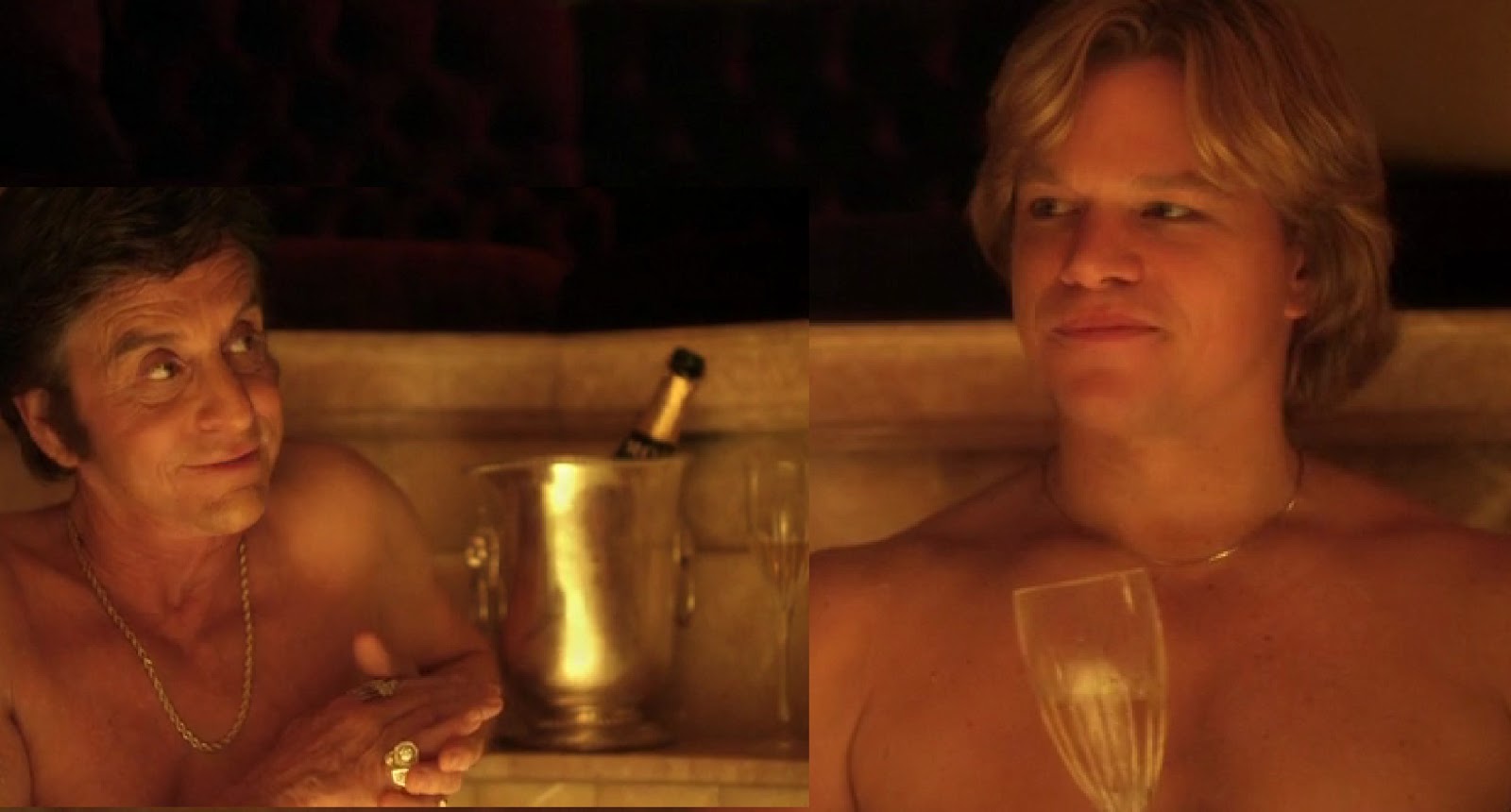
From the stunning simplicity of the movie's first moments - introducing a young Scott Thorson (Matt Damon) making sex-drenched eye contact in a bar with a hunky Bob Black (Scott Bakula), through to an overwhelmingly anticipatory stroll within a palatial Vegas hotel and into its grand auditorium, where the flamboyant fur-and-jewel-adorned entertainer Liberace (Michael Douglas) mesmerizes his appreciative audience (and us, frankly) as he tinkles the ivories of his majestic Grand Piano - Soderbergh takes us on an unforgettable ride through one of the creepiest and, at the same time most strangely romantic rollercoasters of late 20th Century Pop-Culture History.


There's not a dull moment in this insane love story and astonishingly, the story sets up the inevitability of the eventual demise of this May-December romance that begins almost immediately following the aforementioned stage performance. Within Liberace's dressing room, we see him riveted to the yummy, young Thorson, his impatience with his young, but only slightly long-in-tooth current boy-toy and his none-too-subtle brunch invitation.

Thorson's first blow job from Liberace's eager lips follows a chaste evening of conversation in a hot tub and before you can say "Candelabra!", Thorson's pounding his schwance into Mr. Showmanship's receptive rectum. The film follows a genuinely passionate love affair through the myriad of ups and downs any relationship goes through. The difference, of course, is that Liberace, as played devilishly by Michael Douglas (in the performance of a lifetime) is completely out of his gourd. He not only enlists the services of a pasty plastic surgeon (Rob Lowe) to stretch his visage freakishly to maintain a "youthful" look, he insists that Thorson undergo similar butchery in order to transform the lad into a younger version of Liberace himself.

"Mr. Showmanship" clearly desired the ultimate fuck - himself.


Richard LaGravenese's compelling screenplay allows Soderbergh the opportunity to constantly dazzle us in ways we've yet to see from him. The film is relentless in detailing the freakish quality of Liberace's celebrity-infused madness and all the craft Soderbergh has honed over the years finally imbues a work that seems possessed with a sense of personal obsession in terms of style and an emotional connection - one that extends beyond the filmmaker himself and to the audience.

The performances Soderbergh coaxes are nothing short of brilliant. Douglas has never been better - this is no mere impersonation, but a living, fire-breathing madman hooked on fame, fortune, fucking and flights of fancy to tickle his every whim and desire. The performance sequences are also a revelation - Douglas, at least to an untrained musical eye, looks like he's really playing - and all the musical set pieces are pure movie magic.

Damon as Thorson, who in many ways is the true central figure of this film, is sad, almost soulless and as such, deeply moving as this young man whose life has been marked by a childhood and adolescence of pain and rejection. There is a seemingly endless hurt in the eyes of this young man shunted from foster home to orphange and back again and it dominates this character and Damon's extraordinary performance. He so clearly wants love and mentorship and a father figure - and for a time, he gets it all from Liberace, but there's also a desperation in Damon's performance - the character never seems completely convinced he'll continue to get the love and nurturing he desires and it's a heartbreaker to see the unfolding of Thorson's demise - by his own hand (he becomes hooked on the drugs prescribed to him by the plastic surgeon) and Liberace's (who starts to tire of the boy-toy-turned-freak-and-addict).


Soderbergh's direction of the many intimate scenes between the characters is marked with the same obsessive showmanship he brings to the musical performance sequences and the movie is beautifully paced and structured (again, much of this thanks to a great script) so that Soderbergh also delivers several beautifully directed montages that leap us forward through the story with considerable aplomb.


In supporting roles, Scott Bakula as an old friend of both Thorson and Liberace brings a kind of Sam Elliot-like calm to the crazed proceedings, Dan Aykroyd as Liberace's manager Seymour invests a chilling malevolence only hinted at in this terrific actor's comic performances and Debbie Reynolds completely embraces the role of Liberace's beloved mother so astoundingly she's virtually unrecognizable. (I didn't know she was in the movie and while watching it, I kept wondering who this great elderly actress was. My jaw thudded to the floor when her name popped up during the end titles.)


The film is replete with much in the way of black humour, but it's so dark, so borderline demonic that one is always second-guessing one's self after releasing gales of laughter - not in a moralistic way, either, but the kind that is rooted in one's own sense of humanity and finally, in the humanity that Soderbergh invests in this sad, mad and ferocious plunge into celebrity culture.

I really mean it when I say that this picture is so terrific that I want to see as many new Soderbergh films as I can before either he or I, bite the bullet. My relationship is troubled no more. He is clearly a gifted artist who will continue to dazzle me as much as he pisses me off.

This, I think, is what makes greatness.

And it's a good thing.

A very good thing, indeed.

"Behind The Candelabra" can currently be seen via HBO Canada and HBO. It's so good, that in spite of how many people have seen it upon its inaugural television showing, I hope it's enterprising sales company E-One will undertake a theatrical release anyway. It's meant to be seen on big, big screens.

Sunday, 22 July 2012

VITO - Review By Greg Klymkiw


Vito (2011) dir. Jeffrey Schwarz

****

Review By Greg Klymkiw

Growing up in New Jersey during the 1950s, young Vito knew early on that he wasn't like the other boys. Though warm and quick-witted, he was smack in the middle of post-war Italian Catholic machismo and always felt out of place amidst the rough, and tumble posturing of his peers.

Besides, Vito loved movies more than anything.

At an almost insanely early age, he was the first in his family to figure out how to use public transit. Most of his relatives and their friends never bothered to leave the neighbourhood. Vito, on the other hand, had little use for the insular world afforded to him by Jersey. Venturing into Manhattan yielded unrestricted access to his first love - the movies.

Following closely behind his passion for celluloid was Vito's burgeoning manhood - all the normal hormones raging, this led to an even greater discovery. In New York's Central Park, a seemingly endless line of park benches were filled with other men - all ages, shapes and sizes.

And they were all looking for the same thing.

It was here that Vito found acceptance amongst his "own kind" and discovered the joys of fleshly love. Mad, passionate, anonymous encounters were just what the doctor ordered. Alas, the doctor's name was Jekyll, furtively hiding the "beast" within - the Mr. Hyde of sexuality.

In the 50s and 60s, "aberrant" desires alone were enough to represent the influence of Beelzebub himself, but the very fulfilment of said desires not only instilled shame and a need for secrecy amongst the denizens of this secret club, but the one place that should have offered understanding, compassion and sanctuary did nothing of the kind.

Vito began confessing his "sinful" dalliances every week to the parish priest who gravely warned him that eternal hellfire would be the result of saluting the Rainbow Flag. Eventually, the less-than-kindly man of God blew his top (not the one that "counts") and declared he would no longer grant absolution to our young, gay Vito. He would be denied the flesh and blood of Christ until resolving to stop these sinful practises.

Though Vito always knew he was different, he had now found those who were likeminded, but instead of celebration, he and so many other homosexuals discovered that discrimination, disdain and outright hatred was packed into the pot at the end of the rainbow.

This, decided young Vito Russo, was wrong.

And he was going to do something about it.


Jeffrey Schwarz's superbly crafted feature documentary is dazzling! Vito, an always-compelling biography of a young man who became the most important activist for the rights of gay people in America is a movie that crackles with intense dramatic resonance. With peerlessly selected and edited archival footage, blended with new interview material, Schwarz delivers a movie that's as entertaining as it’s incendiary, as soaringly joyful as it is profoundly moving.

Following Vito’s incredible story in any way, shape or form would hold one’s interest, but Schwarz assembles the material with such drive and passion that watching the movie inspires the same feelings one gets whenever one is utterly smitten with a call to arms. Here, though, it’s a veritable cross-country road race of emotion. Schwarz places you so expertly in the various periods of Vito’s life while at the same time he manages to carve out actual nuance of character so that we’re embroiled in the narrative, swept along with the tide that is Vito and at times, impelled to action (or at least to imagine we are).

Granted, Schwarz has a phenomenal subject, but he delves into said subject with all the skill and artistry he can muster to deliver a movie that’s part biographical narrative, part history lesson (albeit a very thrilling one) and finally, utilizing all the skills and craft of a seasoned documentarian, he blasts through the barriers of expectation in the genre to keep us on the edge of our seats.

Astonishingly, for anyone who knows the arc of Russo's life, you're still sitting there hoping, almost demanding it will not go where you know it's going to go. And even when it gets there, Schwarz deals his cinematic cards so deftly that he delivers a climax and denouement that even the "converted" will be thrilled with.

Vito Russo's brilliance, understanding, wit, sensitivity and desire to bring people together were instrumental in rallying the Gay Nation to demand the same rights afforded to ALL Americans and allow them a safe, free and fulfilling life. Almost every major rally and protest involving gay rights was led with the commanding presence of Russo - brave, articulate, visionary, strong as steel and an orator of considerable panache and persuasion.

His love for movies, let to groundbreaking research in the field of gay images in film and resulted in "The Celluloid Closet", one of the most important books in the canon of cinema scholarship (and a bestseller to boot). Russo turned the book into a live performance/lecture with clips and toured it for 10 years. This resulted in his stirring activism that inspired a whole movement that challenged and examined gay imagery in popular culture.

And lest we forget Russo's most important and passionate fight during the AIDS epidemic when an entire generation of young men suffered, died and did so mercilessly when the American government and pharmaceutical companies turned a blind eye to this horrendous disease and the Right Wing Bible Thumping psychos used it as proof positive that God was punishing these aberrant sinners.

Russo, of course, would reject it from the grave, but if anyone deserves canonization in recent history, it's Vito.

Vito Russo fought for Gay rights, but in so doing, he fought for all of those who felt marginalized, disenfranchised, ignored, bullied and condemned. The Queer Nation is such a vital segment of the human experience that it's impossible to think where civilization would be without the input and influence of Queer Culture.

Jeffrey Schwarz, in making this important film is part of that contribution. This is a movie that MUST be seen by as wide an audience as possible and frankly, it's not enough for the film to appeal to only the "converted". Vito's story and the manner in which it's rendered by Schwarz yields a film that DEMANDS being utilized by every educator as an audio visual teaching aid within the syllabi of every middle school and high school. It is history, and as such should be presented with all the vitality educators can muster when they present overviews of how our lives were shaped by individuals and events of the 20th Century.

As a film, Vito places emphasis on what is, at least for me, the most important element that imbued Russo with the strength to fight - to the death - for basic human rights. Time and time again throughout the narrative, whatever strife or conflict Vito faced in his life, he did so secure in the knowledge that he had the support and, most importantly, the unconditional love of his family.

Love, ultimately, is what seems to drive Vito to greater and greater heights. Love for his fellow man, love for his family, and in turn, the love he was given by those who would often be the first to turn their backs on those who were Gay.

Not so for Vito.

The love and respect he received from his whole family was unconditional and this, might be the greatest lesson the film can impart on all who see it.

That said, those who need it the most are our youth - they're the future. If new generations, Gay and straight, can be infused with the notion of unconditional love, full acceptance and tolerance for ALL things, can't be too far behind.

See it, embrace it and demand that your Board of Education include it in their media libraries and demand that it be used in the social studies syllabi of all schools. It's one hell of a picture, but it also has the power to effect change for the better.

"Vito" is an HBO documentary that has been on the festival circuits and in limited theatrical release. In Toronto, it is currently playing at the Magic Lantern Carlton Cinemas via Vagrant Films.