|
Is it Jesus Christ Almighty?
No! It's JOHN WAYNE! |
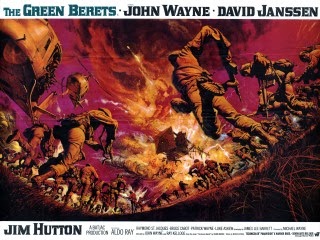
The Green Berets (1968)
***
dir. John Wayne and Ray Kellogg
Starring: John Wayne, David Janssen,
Jim Hutton, Aldo Ray, George Takei
Review By Greg Klymkiw
For me, one of the best things about blu-ray discs is getting an opportunity to see favourite movies from one's childhood in a format as pristine and gorgeous as when I first saw them on a silver screen.
The Warner Home Entertainment blu-ray release of John Wayne's
The Green Berets, a film that is as spectacular an action picture as it is a politically reprehensible war movie, has NEVER looked better, save for a time - over forty years ago - when I sat in a grand old 2000-seat picture palace with my Dad during the picture's first Friday showing in my hometown of Winnipeg.
John Wayne was and to some extent, still is, the perfect father and son idol. (Daughters can love Wayne, too, as witnessed with my own little girl who will sit with Dad and watch a John Wayne picture ANYTIME.) Even now, though, I remember that the majority of public screenings of Wayne movies I experienced with Dad were comprised of grown men and their bean-shaved boys and in fact, I think I saw almost every John Wayne picture ever made, old and new, western or war, on a creaky old black and white TV set with rabbit ear antennae or in the most opulent and now extinct temples to cinema - with Dad.
No Mom, no Sis and only with schoolboy chums for second, third or more helpings.
To my Dad, John Wayne WAS his screen father and for me, the feeling was mutual. Wayne represented the Father my Dad wanted to be and the Father he wanted. As a child, I shared the latter sentiment, though in reality, I can genuinely say, Dad did not ever really disappoint in the manhood stakes of patriarchy - especially during his years as a cop when he would proudly regale me with his tales of his head-busting daring-do, all in the service of protecting the good and punishing the bad.
John Wayne was the Father. And as any lad brought up in the Judeo-Christian tradition knows, GOD is the Father!
Along with
The Searchers, True Grit, The Cowboys and some of the other Batjac productions of the 50s, 60s and 70s (
Hondo, Chisum, The Alamo and
Big Jake to name a few),
The Green Berets was, for many years, the kind of picture Dad and I treated with the solemnity of a Sunday church service. For good reason, I might add.
Or at least, so we thought.
One of the many fascinating aspects of The Green Berets was the fact that it was one of the few war pictures actually set against the backdrop of Vietnam to be made DURING the Vietnam War itself. Stranger still, the picture was released several months after the TET offensive - one of the biggest U.S. debacles of the war. Though the Communist forces suffered huge losses during TET, this was something that was almost ignored and/or repressed by the media (who began blasting American involvement in the war more violently than ever before) and American power-brokers (this was the year when gung-ho Secretary of Defense Robert McNamara did an about face on his own battle escalation strategies and resigned his position).
With respect to TET, the scrutiny on behalf of media and public was clearly aimed at several factors that eventually forced many Americans to seriously re-evaluate their country's participation in the war:
1. American casualties were higher during this offensive than all the years of the war combined.
2. The Communists proved they were stronger in numbers than anyone thought.
3. America was completely unprepared for this offensive and only won technically through their sheer numbers.
4. The ambitious and complex battle plan on the part of the Communist forces was not successful in the cities, but - almost more importantly - gained considerable ground in "the country", the heartland of Vietnam.
5. America launched one of the largest draft policies of the entire war - further inspiring ire in both press and public. 15,000 American soldiers were killed and now, the government was demanding the forced conscription of close to 50,000 young Americans.
6. South Vietnam, the ones America was purportedly fighting for, was hardest hit by TET and its aftermath yielded thousands upon thousands of civilian casualties and such a massive destruction of homes that almost one million people were now refugees.
And then, amidst the above mentioned came John Wayne's
The Green Berets, a thoroughly fictional (and loose adaptation of Robin Moore's bestselling book of the same name). Here was a movie that had absolutely NOTHING to do with the reality of what was happening and presented a scenario and style NOT unlike every run-of-the-mill war film ever made. In retrospect, what was even more jaw-dropping was how the movie-going public embraced Wayne's propagandistic rah-rah rally cry for continued American involvement in Vietnam.
The Green Berets was a huge hit at the box office!
As a kid, I certainly saw no dichotomy whatsoever. Though I'd occasionally see the rather graphic war footage on television news, it seemed "dull" compared to the daring-do of my Celluloid Dad. For my real Dad, any protests generated by TET and its aftermath, were, no-doubt, merely the product of dirty, long-haired hippie commies.
For me, my Dad and many like us,
The Green Berets was a thrilling, kick-ass war picture with the sort of carnage and heroism that seemed to dwarf real life. To gain access to the finest American military hardware, Wayne needed to abandon most of Moore's book, which portrayed the Green Berets in a manner the government had issues with. As well, this was still in advance of Sam Peckinpah's classic western The
Wild Bunch, a western that used the Old West as a metaphor for Vietnam, in addition to changing the way we looked at violence on-screen forever.
The simple narrative of
The Green Berets begins with the sour castigation of those brave fighting men by lefty American journalists. Representing the Pinko hordes is none other than a reporter played by David Janssen (a huge T.V. star of
The Fugitive fame and, lest we forget, Albert Zugsmith's utterly insane piece of sentimental war propaganda
Dondi). His criticism of America's involvement in Vietnam, and most importantly, his assertion that the fighting men of the Green Berets are as unquestioning as those within Nazi Germany. This, of course, is in response to a soldier who admits that "foreign policy decisions are not made by the military. A soldier goes where he is told to go, and fight whom is told to fight." Janssen's comparison to a Totalitarian regime seems perfectly reasonable under the circumstances, but instead, inspires Green Beret head honcho John Wayne to foam at the mouth a bit before offering Janssen a free, uncensored, ground-zero view of what America is fighting for.
So, with his knapsack on his back, Janssen accompanies the likes of John Wayne, his tough beefy right hand man Aldo Ray, the noble South Vietnamese military ally (played by George "Mr. Sulu" Takei) and the lovably baby-faced and irascible Ensign-Pulver-like conman Jim Hutton. For close to three hours, Janssen's character and indeed, we the audience, are face-to-face with the utterly inhuman savagery of the Viet Cong and their dirty Commie ways and the noble, heroic and successful eradication of said Commie Pigs at the hands of John Wayne and his fighting men.
From the opening titles of the picture, the lyrics of Sgt. Barry Sadler's stirring hit song "The Ballad of the Green Berets", lead us on an odyssey devoted to extolling the virtues of those who would dare risk life and limb for the oppressed.
Sadler's lyrics tell us so:
Fighting soldiers from the sky
fearless men who jump and die
men who mean just what they say
the brave men of the Green Berets . . .
Back at home a young wife waits
her Green Beret has met his fate
he has died for those oppressed . . .
make him one of America's best.
As the movie progresses, we bear witness to Pinko journalist Janssen and his conversion to the cause - so much so, that he himself even engages in battle against the Commie Pigs. As a young lad, I bought this hook, line and sinker.
After all, we see baby-faced Jim Hutton befriend a Vietnamese orphan (not unlike the Short-Round character from Samuel Fuller's immortal and decidedly anti-war WWII drama
Steel Helmet - a character who was later represented in homage by Spielberg in
Indiana Jones and the Temple of Doom) and when Hutton dies a hero's death, it is John Wayne himself - everyone's surrogate Father - who picks up the torch and leads the little Vietnamese boy into the setting (or rising) sun, presumably adopting the lad and proudly intoning that it is the CHILD whom the entire war is being fought for. (Much derision has been levelled at the Sun setting in the East of Vietnam, but in fairness, the movie does not specifically state it is sundown, and could just as easily be sunrise - in which case, there's nothing technically wrong with the closing shot.)
This was indeed rousing stuff to experience as a kid; working on a level of propaganda, to be sure, but mostly, within the mythic elements of the genre which I had already been inundated with thanks to the likes of all the great WWII pictures I'd already seen (many of which starred John Wayne).
Amongst the many vicious pans the picture received at the time, none is more eloquent than Roger Ebert's now-legendary piece wherein he states:
"The Green Berets simply will not do as a film about the war in Vietnam. It is offensive not only to those who oppose American policy but even to those who support it. At this moment in our history, locked in the longest and one of the most controversial wars we have ever fought, what we certainly do not need is a movie depicting Vietnam in terms of cowboys and Indians. That is cruel and dishonest and unworthy of the thousands who have died there."
Ebert's assertion that the picture works on the level of a simple by-the-numbers Western is not far from the truth. When Janssen is led into the American camp in Vietnam, he raises his eyebrows at a handmade sign nailed at the entrance which says: "Dodge City" - that rough and tumble town of innumerable American westerns where the men were mean, violent and only able to be tamed at the end of a gun. This, however, is the only time in the picture where we get a glimpse of something that might lead us into the territory of
M*A*S*H rather than a Rory Calhoun oater, but very quickly, we realize this is no touch of irony - the picture means it fair and square. When Janssen queries Wayne about the execution-style slaying of some Vietcong, Wayne replies - with the kind of venom only Wayne could spit out: "Out here, due process is a bullet!" Even now, I remember my Dad and the rest of the audience applauding this.
Wayne, after all, was the father of us all.
That
The Green Berets is only one of two feature films Wayne directed (the other being
The Alamo) is not without significance. Wayne was, and probably still is the biggest movie star of all time. In role after role, he embodied the values of both America and manhood.
One of the best books to ever deal with Wayne is Gary Wills's "John Wayne's America - The Politics of Celebrity" which presents a biographical portrait of Wayne as an instrument of propaganda. This, of course, is a point of view that would be impossible to refute. Wills asserts that Wayne "made an impact when he carried his Manifest Destiny assurance into compromising situations." Given the huge positive response of audiences to
The Green Berets in spite of clear evidence that the values inherent in the picture are a complete bald-faced lie, it's not hard to believe just how important a figure Wayne was and, to a considerable extent, still is.
Granted, unlike a picture such as John Ford's
The Searchers, where the clash of cultures is treated with several layers of complexity, the same clash in
The Green Berets is about as complex as a square-holed puzzle with nothing but square pegs. When endlessly useless wars against Muslim countries are perpetrated, not in the name of freedom, but in the name of oil, when George W. Bush can outright steal the presidency under the noses of the American public, when an entire nation has no proper system of health care and probably never will, when too many people believe the results of the Warren Commission, when people are jailed and persecuted in a supposedly democratic society, when everyone in America believes that ONLY America was able to win both World Wars, it's obvious that Wayne's influence as a star and the kind of heroism he represents in over 150 pictures "seems", according to Wills, "to suggest that the need for this hero will call up again the kinds of story where he operated best." Wayne, of course, is not the only star to have been used in this fashion, but he was and still is, the most influential. He knew it, believed it and so did his adoring public. Wills maintains that Wayne, more than any other star reflected American society back upon itself which was "the source of his appeal, and of his danger."
I cannot, then, even for a second, defend
The Green Berets on its politics and I am forced to separate them from the picture itself. Is that even possible? I'd suggest it is. It's a picture I enjoyed a lot as a kid and as an adult, I was certainly able to sit through it and gain some amusement value on a number of levels. As a movie in the context of a contemporary viewing, it's not without moments that are creaky and clunky - the first 45 minutes is especially a bit of a dull slog, but once the action revs itself up, the movie is as spectacular an entertainment in the war genre as many similar pictures which preceded it. To use the parlance of contemporary action pictures, "It blows up real good" and even its dollops of sentiment have the power to move. Does it go any places that GREAT war movies go? Not one bit. It's paint-by-numbers action. No more. No less.
As a director, Wayne doesn't display the surest hand in
The Green Berets which probably isn't helped by the fact that he chose Ray Kellogg to be his co-director. Kellogg was the brilliant special effects designer and cinematographer for Twentieth Century Fox who, among other astounding accomplishments, worked on the first-ever CinemaScope production,
The Robe. He was also a solid second-unit director of note. All of these accomplishments give us some sense of why the "blowing up real good" blows up, real good! As a solo director, it's probably important to note that he directed two feature films produced by and starring Ken (Festus on "
Gunsmoke") Curtis,
The Giant Gila Monster and
The Killer Shrews. While Wayne had an uncredited Mervyn LeRoy wandering around the set of
The Green Berets and lending a helping hand, Wayne's previous effort as a director,
The Alamo was a happier experience - at least on an artistic level. He had none other than John Ford puttering around and lending his painterly eye to some of the proceedings (but when "Pappy" started to take over, Wayne sent him out to shoot some second-unit footage). Aside from some annoying longueurs, it's a pretty damn fine epic western with a great cast, a solid screenplay and magnificent battle sequences. It also features an unbelievably tear-wrenching death scene with the immortal Hank Worden (Ole' Mose from
The Searchers). And how can one NOT enjoy seeing John Wayne and Richard Widmark as Davy Crockett and Jim Bowie? Alas, Jim Hutton in
The Green Berets doesn't quite wrench as many tears in HIS death scene, but I suppose he can't be entirely blamed. After all, there IS only one Hank Worden.
The Green Berets is, no doubt, a dangerous, reprehensible and politically boneheaded picture, BUT it is ALL JOHN WAYNE!
And John Wayne is still the Father of us all. His very being is sacred and as a motion picture star, he is truly unparalleled. Gary Wills refers to Wayne's image as "mixed and terrifying... full of the unresolved contradictions" of America itself. True enough, but John Wayne was a star all over the world and as such, I'd suggest those "unresolved contradictions" resonated well beyond America - they permeated every square inch of our planet's ground. Wills wonders if America has, or will ever escape "the myth of the frontier, the mystique of the gun..." and again, I go wonder if we ALL will ever truly escape those things. To answer that, Wills leave us with a line from
The Searchers, a line that was, after John Wayne's single greatest line of dialogue ever. It's one, I too, am happy to leave you with.
"That'll be the day!"
"The Green Berets" is currently available on the Blu-Ray format from Warners Home Entertainment.