Showing posts with label Canadian Co-production. Show all posts
Sunday, 16 March 2014
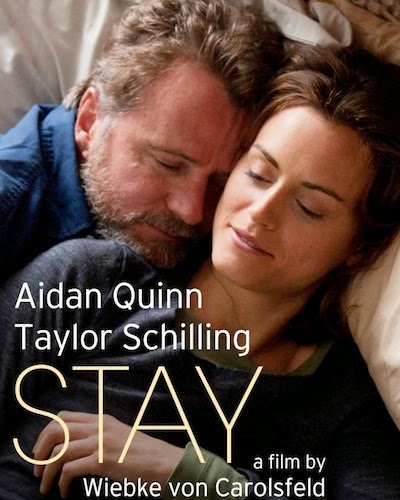
STAY - Review By Greg Klymkiw - No matter how much one tries to gussy it up, twee is as twee is and always will be. Twee, that is.
Stay (2014) Dir. Wiebke von Carolsfeld *½
Starring: Aidan Quinn, Taylor Schilling, Michael Ironside
Review By Greg Klymkiw
I always liked Aidan Quinn, but he really hasn't had a decent role since Barry Levinson's Avalon almost one quarter of a century ago. As such, I was kind of looking forward to seeing him in this movie - one I knew little about, save for the fact that he was in it and had a starring role opposite Taylor Schilling (an actress of dubious gifts, but not without some screen presence displayed in a clutch of bad movies like The Lucky One, Argo and (Ugh!) Atlas Shrugged). Alas, my heart sank a tiny bit when a head credit popped up which read: "With the financial participation of Telefilm Canada". I thought, oh, perhaps this won't be a real movie after all, but a Canadian movie pretending to be a foreign film with pig-in-a-poke "names" as window dressing to sucker audiences in to see it. Still, I was willing to give this a shot. Unfortunately, the movie's staggeringly stereotypical Canadian preciousness announced itself right at the outset as Quinn kicks a tin can along the ground as he walks along a lovely big-sky aquatic vista.
Great way to open a movie - kicking a can, looking forlorn against a topographical backdrop that might as well have been some Maritime Canadian locale. Luckily, it's not Canada, but Ireland. I recall thinking, "Well, at least I won't have to listen to Maritime fiddle music or Newfie rugby songs."
Well, maybe luck isn't with me. The soundtrack began to swell with some sickeningly twee folk song with the twittering voice of an Irish lass as Quinn enters his home, prepares a lovely tray of breakfast-in-bed and saunters gently into the boudoir where a gorgeous, young Taylor Schilling sleeps ever-so soundly.
Ack!
The movie then veered into territory I fully expected it to (based upon the initial letdown of the Telefilm Canada credit) and it does so with all the typical, uh, flair of a Canadian movie that values studied, ambrosial flatness.
Based upon a novel I haven't read by Aislin Hunter, I think perhaps I can't heap all my disdain for this flaccid movie and its ho-hum narrative upon screenwriter-director Wiebke von Carolsfeld since she did a perfectly decent job with Daniel MacIvor's Marion Bridge. But damn! This is one rink-dink sojourn into Dullsville that not even the presence of Aidan Quinn can quite save.
Quinn plays a semi-retired Archeology professor who lives in this relatively obscure small Irish community with his best gal, the supple late-20-something Schilling whose cradle he robbed during a trip to nearby Galway. It turns out the lassie is preggers with Aidan's seed and due to a deep, dark secret (revealed later on), he's not too keen on having kids. Schilling, conveniently from Montreal (allowing for a co-production twixt Canada and Ireland for this movie), decides to travel back to La Belle Province to engage in some soul searching with her Dad (Michael Ironside, looking very uncomfortable without automatic weaponry in his arms). Quinn does his fair share of soul searching too. We basically bounce back and forth between the Emerald Isle and French Canada's very own City of Lights as both characters spend a lot of time thinking about their relationship as well as the notion of having a child.
The lion's share of this whole-lotta-ruminating-going-on takes place in the Land o' Leprechauns where we get treated to subplots involving a young lad who is fatherless, a young preggers Momma who is motherless and Quinn learning a few lessons from both of them. Schilling learns a few lessons from friends and relatives in Montreal and even more sickeningly, we discover that her own Momma buggered off long ago because she didn't want a child. Wow! So many people abandoned by their Mamas and Papas. It's no wonder all these conveniently converging plot lines require a fair bit of mulling over.
If any of this had been treated with some good old fashioned passion and panache, it might have been palatable - maybe even, uh, good - but of course, since the movie is ultimately Canadian and not directed with any of the oomph Canadians can deliver (Cronenberg, Maddin, Veninger, the Soska Sisters, etc.), we're treated to little more than a limp, precious meander that doesn't even have the sort of TV-movie watchability that many Canadian dramas are infused with. In spite of some potential for roiling melodrama, all we get is a movie that's not edgy enough to be art, nor narratively competent enough to be entertaining.
Like many Canadian films (and, in fact, resembling much of the country's ethos), Stay sits rigidly on a fence post - the tip of it, and beyond, lodged firmly in that place where the sun don't shine.
"Stay" is distributed by Alliance VivaFilm in Montreal and is enjoying a limited run in that otherwise magical city and the not-so-magical city of Toronto at the TIFF Bell Lightbox.
Labels:
*1/2
,
2013
,
Alliance VivaFilm
,
Canada
,
Canadian Co-production
,
Drama
,
Greg Klymkiw
,
Ireland
,
Romance
,
TIFF Bell Lightbox
,
Wiebke von Carolsfeld
Friday, 8 June 2012
IN DARKNESS - Review By Greg Klymkiw - Now on DVD and Blu-Ray Via Mongrel Media and Sony, Agnieszka Holland's Academy Award Nominated Polish-Canadian Co-production tells the harrowing tale of Jews hiding in the sewers of Lviv during World War II

In Darkness (2011)
dir. Agnieszka Holland
Starring:
Robert Wieckiewicz,
Benno Fürmann,
Michal Zurawski,
Kinga Preis,
Agnieszka Grochowska,
Maria Schrader,
Herbert Knaup
****
Review By
Greg Klymkiw
Whenever a new film about the Holocaust appears, the oft-heard refrain is, "Not another one!" It's as if the subject itself is enough to inspire such dismissive reactions - which, frankly, I've never understood. Genocide is one of the greatest blights upon mankind as a species and given the especially horrific events of the 20th century, stories such as In Darkness must be told.
Set in the Ukrainian city of Lviv during World War II, we're introduced to the Polish plumber and sewer-worker Leopold Socha (Robert Wieckiewicz) who supplements his livelihood during the Nazi occupation by thieving and black marketeering. A group of people in the Jewish ghetto have burrowed into the sewers in order to escape the impending horrors that await them. Socha happens upon the Jews and agrees to hide them beneath the old city where nobody will find them - for a price, of course.
A major payday awaits when Socha's old friend Bortnick (Michal Zurawski), a member of the Ukrainian SS, mentions the substantial reward available for pointing officials to Jews in hiding. Socha gets the bright idea of soaking his Jewish charges until their money runs out and THEN betraying them for the bounty.
War, however, has different effects upon different people. Some take the easy road, while others face up to who they really are and make sacrifices with their very lives.
Much of the film takes place in the dank, dark sewers of Lviv and we are privy to the horrendous conditions the Jews must live in order to survive. While we follow Socha's adventures above ground, life for the Jews is presented in clear juxtaposition.
Here is where David F. Shamoon's screenplay adaptation of Robert Marshall's book really shines. Given the number of characters, above and below ground that must be juggled, he presents a series of evocative portraits on both sides of the divide. Above ground, not everyone is a villain, whilst below ground, not everyone is a saint. The screenplay provides humanity with a layered dramatic resonance.
The fine script allows for a flawless cast to deliver a series of performances that will burn in your memory long after seeing the film. Holland's direction is precise and classical. She doesn't miss any dramatic beats and it's finally a movie that never lets up - it's compelling, surprising, shocking and finally, profoundly moving from beginning to end.
I have one major quibble, however. I will admit that it would probably not even be a problem if I was NOT of Ukrainian heritage, but luckily I am, because it allowed me to pinpoint a missing political element that might well have added an even deeper layer to this fine film.
Here's the problem, as I see it. The city of Lviv was, prior to the Nazis marching in, already an occupied city. Poland had claimed a huge portion of Western Ukraine as its own and parachuted (so to speak) huge numbers of Polish citizens to populate and run the city. Many Ukrainians were forced out and eventually settled in outlying areas of the Oblast. Being in the midst of researching my own family tree, I have discovered that a great many of my blood ancestors were driven out of Lviv by the Poles. Ironically, many of them formed their own village which also bore my surname. The village was subsequently destroyed by the Poles when they decided to build a dam and flood the whole village. From there, my ancestors split up and settled even further West in and around Ternopil.
I have to admit that in light of this research I was troubled that the script ignored the fact that this "Polish" city was, in fact, already an occupied city prior to the Nazis. I was further disturbed that the only Ukrainian character in the tale was portrayed as a vile Jew-hating pig who doesn't collaborate with the Nazis for the usual reasons Ukrainians collaborated (many were duped into believing the Nazis would be their liberators from both Polish and Russian oppression). These are issues of ethnocentric ignorance that are hurtful, but let's cast them aside for a moment and think about this otherwise compelling story if it had added the element of Poles being an occupying force to begin with who were, in turn occupied. From a narrative standpoint, I'd argue this might have made the piece far more interesting and added an additional layer of complexity to one in which the filmmakers do not present easy Hollywood-style answers to the dilemmas facing all the characters.
It's the fact that the screenplay so diligently creates drama and conflict by presenting a myriad of complexities within the characters that it disappoints me the film did not take the time or effort to explore this avenue also.
This will no doubt be seen as an easily dismissed and biased quibble, but the fact remains that World War II and the Holocaust are fraught with horrendous sufferings and issues that are not black and white.
Some biases, it seems, are acceptable, while others are not.
The bottom line though, is that it's a terrific film. That said, even great pictures have potential to be greater and I believe my "bias" might well have improved the tale considerably.
"In Darkness", 2011 Oscar nominee for Best Foreign Language Film is currently available on Blu-Ray and DVD via Mongrel Media. The transfer is especially exquisite - capturing every detail and the deep blacks. Though a commentary by a WWII history specialist and Holland seems kind of a no-brainer for a picture like this, no such additional featur exists. We have to suffice with a half hour video Q and A with Holland and a pretty interesting half hour video doc wherein Holland meets one of the actual survivors of the story.
Labels:
****
,
2011 Films
,
Agnieszka Holland
,
Arthouse
,
BD
,
Blu-Ray
,
Canadian Co-production
,
CFC
,
Drama
,
DVD
,
Greg Klymkiw
,
Holocaust
,
Mongrel Media
,
Poland
,
Ukraine
,
War
Monday, 13 February 2012
IN DARKNESS - Review by Greg Klymkiw - This powerful true story of the Holocaust, a Canadian-Polish co-production, has been nominated for a Foreign Language Oscar. The true story of a Polish war profiteer in the Ukrainian city of Lviv during WWII is replete with great performances, a fine screenplay by David F. Shamoon and expert direction from Agnieszka Holland.
In Darkness (2011) dir. Agnieszka Holland
Starring: Robert Wieckiewicz, Benno Fürmann, Michal Zurawski, Kinga Preis, Agnieszka Grochowska, Maria Schrader, Herbert Knaup
****
By Greg Klymkiw
Whenever a new film about the Holocaust appears, the oft-heard refrain is, "Not another one!" It's as if the subject itself is enough to inspire such dismissive reactions - which, frankly, I've never understood. Genocide is one of the greatest blights upon mankind as a species and given the especially horrific events of the 20th century, stories such as In Darkness must be told.
Set in the Ukrainian city of Lviv during World War II, we're introduced to the Polish plumber and sewer-worker Leopold Socha (Robert Wieckiewicz) who supplements his livelihood during the Nazi occupation by thieving and black marketeering. A group of people in the Jewish ghetto have burrowed into the sewers in order to escape the impending horrors that await them. Socha happens upon the Jews and agrees to hide them beneath the old city where nobody will find them - for a price, of course.
A major payday awaits when Socha's old friend Bortnick (Michal Zurawski), a member of the Ukrainian SS, mentions the substantial reward available for pointing officials to Jews in hiding. Socha gets the bright idea of soaking his Jewish charges until their money runs out and THEN betraying them for the bounty.
War, however, has different effects upon different people. Some take the easy road, while others face up to who they really are and make sacrifices with their very lives.
Much of the film takes place in the dank, dark sewers of Lviv and we are privy to the horrendous conditions the Jews must live in order to survive. While we follow Socha's adventures above ground, life for the Jews is presented in clear juxtaposition.
Here is where David F. Shamoon's screenplay adaptation of Robert Marshall's book really shines. Given the number of characters, above and below ground that must be juggled, he presents a series of evocative portraits on both sides of the divide. Above ground, not everyone is a villain, whilst below ground, not everyone is a saint. The screenplay provides humanity with a layered dramatic resonance.
The fine script allows for a flawless cast to deliver a series of performances that will burn in your memory long after seeing the film. Holland's direction is precise and classical. She doesn't miss any dramatic beats and it's finally a movie that never lets up - it's compelling, surprising, shocking and finally, profoundly moving from beginning to end.
I have one major quibble, however. I will admit that it would probably not even be a problem if I was NOT of Ukrainian heritage, but luckily I am, because it allowed me to pinpoint a missing political element that might well have added an even deeper layer to this fine film.
Here's the problem, as I see it. The city of Lviv was, prior to the Nazis marching in, already an occupied city. Poland had claimed a huge portion of Western Ukraine as its own and parachuted (so to speak) huge numbers of Polish citizens to populate and run the city. Many Ukrainians were forced out and eventually settled in outlying areas of the Oblast. Being in the midst of researching my own family tree, I have discovered that a great many of my blood ancestors were driven out of Lviv by the Poles. Ironically, many of them formed their own village which also bore my surname. The village was subsequently destroyed by the Poles when they decided to build a dam and flood the whole village. From there, my ancestors split up and settled even further West in and around Ternopil.
I have to admit that in light of this research I was troubled that the script ignored the fact that this "Polish" city was, in fact, already an occupied city prior to the Nazis. I was further disturbed that the only Ukrainian character in the tale was portrayed as a vile Jew-hating pig who doesn't collaborate with the Nazis for the usual reasons Ukrainians collaborated (many were duped into believing the Nazis would be their liberators from both Polish and Russian oppression). These are issues of ethnocentric ignorance that are hurtful, but let's cast them aside for a moment and think about this otherwise compelling story if it had added the element of Poles being an occupying force to begin with who were, in turn occupied. From a narrative standpoint, I'd argue this might have made the piece far more interesting and added an additional layer of complexity to one in which the filmmakers do not present easy Hollywood-style answers to the dilemmas facing all the characters.
It's the fact that the screenplay so diligently creates drama and conflict by presenting a myriad of complexities within the characters that it disappoints me the film did not take the time or effort to explore this avenue also.
This will no doubt be seen as an easily dismissed and biased quibble, but the fact remains that World War II and the Holocaust are fraught with horrendous sufferings and issues that are not black and white.
Some biases, it seems, are acceptable, while others are not.
The bottom line though, is that it's a terrific film. That said, even great pictures have potential to be greater and I believe my "bias" might well have improved the tale considerably.
"In Darkness", 2011 Oscar nominee for Best Foreign Language Film is currently in theatrical release and now playing in Canada via Mongrel Media.
Labels:
****
,
2011 Films
,
Agnieszka Holland
,
Arthouse
,
Canadian Co-production
,
CFC
,
Drama
,
Greg Klymkiw
,
Holocaust
,
Mongrel Media
,
Poland
,
Ukraine
,
War
Subscribe to:
Posts
(
Atom
)


