Showing posts with label Russia. Show all posts

Wednesday, 6 April 2016

HARDCORE HENRY - Review By Greg Klymkiw - Russian Vid-game-as-movie delivers the gore


Hardcore Henry (2015)
Dir. Illya Naishuller
Prd. Timur Bekmambetov
Starring: Haley Bennet, Sharlto Copley, Danila Kozlovsky,
Tim Roth, Andrey Dementiev, Dasha Charusha

Review By Greg Klymkiw

Though it's nowhere near as funny, original, audacious and intelligent as Zachary Ramelan's Dead Rush, the no-budget first person POV Canadian zombie horror feature, which had its premiere at the 2016 Canadian Film Festival in Toronto, Russkie musician-turned-writer-director Illya Naishuller still manages to serve up some wildly entertaining first-person POV ultra-gore with Hardcore Henry (which premiered in TIFF's 2015 Midnight Madness series and which, is now theatrically unspooling across North America).

Working with producer Timur Bekmambetov (a great producer, but woeful director), the whole affair is a goofily stupid non-stop amusement park ride (which would definitely make for a fine shooter game) and will especially appeal to girlfriend-bereft 20-45-year-old nerd fan-boys living in their parents' basements.

Without wasting too much time, the picture begins with Henry waking up in a sterile white lab to find his babe-o-licious scientist wifelet (Haley Bennet) putting finishing touches to his Robocop-like cyber-body. Alas, she doesn't quite get around to fitting our hapless hero with a voice.

At this point, the lab is almost immediately besieged by a passel of killer Russkies attempting to snatch Henry for a crazed albino (Danila Kozlovsky), bent upon the nefarious goal of (what else?) world wide domination. Henry is rescued by a quipping Brit-accented spy (Sharlto Copley) who keeps our hero alive to rescue babe-wifey from the clutches of the mad albino.

That's pretty much the plot, save for a couple of obvious and predictable twists you'll sniff out almost from the beginning of the movie. No biggie, really. What drives this nutzoid picture is the non-stop first-person POV action as Henry kills hundreds of Russkie henchmen. Aside from the admittedly enjoyable and often hilarious blood splashing violence, the best reason to see the movie is the nuttily engaging performance of Copley. His character keeps getting blown to bits and he's perpetually resurrected in different guises (he even delivers a first-rate musical number, expertly crooning Cole Porter's "I've Got You Under My Skin".)


Add a trio of superb elements to the mix: a cool Tim Roth cameo, a first-rate propulsive music score by Dasha Charusha and a genuinely superb action set-piece in a Moscow brothel (replete with a seemingly endless supply of nude Russkie babes, many of whom eventually cradle firearms which they fire ever-so sexily).

Naishuller also offers a ludicrous number of nods, homages and references to classic and contemporary actioners, many of which will offer fan-boys something to do if they get bored/exhausted with the proceedings (and, no doubt, deliver far more masturbation fantasies than the aforementioned Slavic hookers). The first-time Russkie director even features a prominently displayed poster of Robert Montgomery's 1947 POV grandaddy The Lady in the Lake which will give major movie geeks mega-hard-ons.

Ultimately, this is what a movie like Hardcore Henry is all about: Hardcore hard-ons for fan-boy losers. But hey, the fellas deserve some solid meat to beat and I will not deny them their meagre pleasures. You might even enjoy it, too.

It's fun for the whole family.

THE FILM CORNER RATING: *** 3-Stars

Hardcore Henry is in wide theatrical release via VVS Films.

Wednesday, 23 April 2014

OLGA, TO MY FRIENDS - Review By Greg Klymkiw - HOT DOCS 2014 - Visually sumptuous contemplations.


Olga - To My Friends (2013) Dir. Paul Anders-Simma ***

Review By Greg Klymkiw

Life in Lapland's Russian district has its own special pace. Oft-ascribed stereotypes like "slow as molasses" might spring to mind when considering its day-in-day-out solitude, but the reality is something else altogether. Paul-Anders Simma's gorgeously photographed Olga - To My Friends captures the beauty of silence through the eyes and words of its title protagonist.

Dumped in an orphanage and raised there for most of her childhood and early adolescence, Olga was eventually removed by her Mother when it became convenient for her to "provide" for the family. For some time, Olga has worked in the northernmost reaches of the continent and the film focuses upon her time working with trappers, hunters and herdsman in an isolated outpost. Her primary duties include keeping the food supplies secure and general upkeep. These duties don't necessarily take an eternity, so it seems Olga has plenty of time on her hands.


This is a good deal for both Olga and the audience. It allows her a lot of time to contemplate the north and her life in it (before and beyond). Furthermore, the film allows us to share in these few glimpses into both her inner life and the world that surrounds it. This is a special opportunity because Olga is very sweet, down-to-earth. Her stocky solid frame puts her in good stead to handle the more arduous tasks and her eyes, so sparkling and alive, betray a soul at peace with the world and herself.

We get a few sad glimpses into her past life (one heartbreaking tale from the orphanage moves us to tears), but she doesn't dwell on unhappiness for too long, nor does she ever display the kind of self-pity someone in her position might. She loves the north, she loves nature and she even seems to love the revolving door of solitary men passing through on their way to somewhere, anywhere - just so long as they're not in one place too long - and we're allowed to love all this too.

Simma's picture is barely an hour long. Its running time feels perfectly appropriate as we never feel like it has overstayed its welcome. If anything, the entire experience is so uplifting and engaging, it seems like maybe we don't get as much time as we'd like.

This is another good thing. The best artists always understand the value of leaving an audience wanting more.

Olga - To My Friends plays Toronto's Hot Docs 2014. For further information, contact the festival website HERE.

Monday, 21 April 2014

THE CONDEMNED - Review By Greg Klymkiw - Hot Docs 2014 - Russian Prison Doc a Hot Docs 2014 MUST-SEE

The Condemned (2014) *****
Dir. Nick Read
Review By Greg Klymkiw

The screen is pitch black and the sickening sounds of a metal door clanging shut are followed by the hollow echo of footsteps upon a concrete floor and the jangling of keys that are opening yet another door.
Under the malevolent seemingly single note score, slowly and subtly increasing with a nerve-jangling intensity, a voice from the deep chasm of dishearteningly grim opacity chills us to the bone:

"All of a sudden,
I feel a wave of horror.
I dreamt I was with my friends."

As we fade up upon a bleak view of chain link fences adorned with barbed wire and snow-covered barracks and a sky brimming with a tell-tale sub-arctic blue, the voice continues:

"How could they be alive?"

Another fade to black and then a quick fade up on an image distinguished only by a patch of murky light, the sounds of more keys and footsteps accompany the final sickening words:

"I'd killed them."

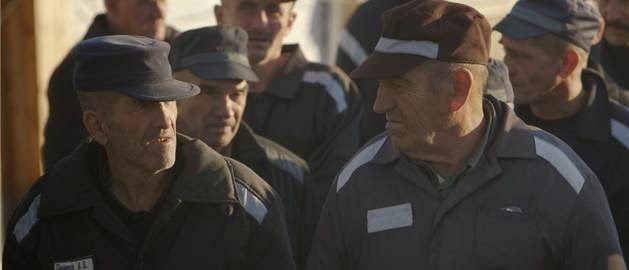
We are in Russia, or if you will, Hell. For many who are enclosed within the perimeter of fencing and locked gates, this will be their Purgatory until death takes them to the fiery eternal abode of Mephistopheles. Those who are not here for life, came in as young men and will leave as old men. This is the Federal Penal Colony No. 56 in Central Russia, surrounded by hundreds of square miles of deep forest in the Russian taiga. There's only one road in and one road out. The nearest populated community is a seven-hour drive away. The temperatures here frequently dip to 40 below zero.

There's no escape.


Director/Cinematographer Nick Read and producer Mark Franchetti introduce us to two sets of prisoners in this compulsive, staggeringly well crafted and downright great film. The Condemned are split between the most dangerous and the dangerous-but-less-so. The former live in solitary confinement, monitored by video 24-hours per day, not allowed to rest on their bed during the day time, forced to an eternity of pacing back and forth in the tiniest cell imaginable and allowed one hour per day of being outdoors in an chilly outdoor chicken run-styled enclosure not much bigger than their cells. The latter group live in a communal compound wherein they endure endless hard labour and an extremely rigid caste system that reduces many of the men to lives that are perhaps even more worthless than they could already be living.


Aside from capturing the day-to-day drudgery and monotony, Read expertly gets the prisoners to open up and bare their souls about the crimes they committed, their victims, their families, their thoughts and philosophies on forgiveness and redemption. Even more powerful is how the men give us personal glimpses into how they continue to live in a world that is, for the most part, hopeless and how some construct life out of what they can within the rigid construct of the penal system.


A great many of the men were originally on death row, but when Russia abolished capital punishment in 1997, their sentences were commuted to life. What a life. The Russian parliament made sure to enact specific wording in the laws so that daily, gruelling punishment is the order of these men's lives. Even worse is how so many of them men committed their crimes in that period when communism collapsed and the poverty was so overwhelming that the only mode of survival was crime or worse, numbing their pain with so much booze and drugs that many of their violent crimes occurred under the influence.

What's impossible to ignore in this powerful and moving film is a sense of humanity within the most inhuman/inhumane conditions. A handful of scenes involving visitations from family are downright wrenching. Even more brutal is discovering how so many of the prisoners are men of thought and intellect. The discourse of many is not the stereotypical tough-guy talk we expect, but is in fact, deeply thoughtful and philosophical.

There have been many documentaries about prison life, but almost none of them are produced with the kind of eye for cinematic artistry that The Condemned is imbued with. Part of this success comes from Read's direction which is coupled with his superb visual eye as a cinematographer, but also the meticulous pace and cutting from editor Jay Taylor who astoundingly makes monotony compelling and, on occasion, treats us to cuts that are breathtaking in their virtuosity.

The film drains us physically, but what remains is pure spirituality as we are allowed to connect with the souls of men whose actions on the outside include some of the most horrendous acts of violence. This might be the film's greatest strength and one that pretty much ensures its life as a masterpiece - a picture that will live long beyond the usual ephemeral concerns of most movies today.

The Condemned is screening at Hot Docs 2014 in Toronto. For further info, visit the festival website HERE. World Sales by Films Transit International.

Monday, 24 February 2014

TARAS BULBA (2009) - Review By Greg Klymkiw - Sub-Par Russian Version of classic Ukrainian tale of revolt is little more than a pallid made-for-tv-miniseries-styled slab of propaganda that might stir the loins of Putin-lovers-and-apologists, but it doesn’t come close to mining the stirring potential of Gogol's great story.


Taras Bulba (2009) **
dir. Wolodymyr Bortko
Starring: Bohdan Stupka, Ihor Petrenko, Vladimir Vdovichenkov, Magdalena Mielcarz, Sergei Dryden

Review By By Greg Klymkiw

In light of the recent events in Ukraine, it seems appropriate to turn our attention to one of the more egregious displays of cinematic propaganda I have seen in a long time. The charge of disinformation is, for once, not levelled against Hollywood, but Russia. This is not the Russia of the butcher Joseph Stalin, but that of contemporary Russia, a country rife with the sad, evil remnants of Stalin in the guise of its leader Vladimir Putin who, in his previous career was a nasty little KGB spy who specialized in rooting out those who opposed the supposed glories of Communism and prior to that, when he, as a teacher and academic, disgracefully used his position to carry out surveillance on students.

The film on view is Taras Bulba, a relatively recent and expensive (by Russian standards) screen adaptation of the legendary Ukrainian writer Nikolai Gogol’s great novella of the same name and a film that chooses to use Gogol’s pro-Russian version as its base rather than his original manuscript. Gogol bowed to the will of Czarist Russia and delivered a revised product more in keeping with the country’s own version of Manifest Destiny throughout Eastern Europe.

Propaganda in the cinema is nothing new. In fact, many knee-jerkers will look for any excuse to trash Hollywood for this very thing. Since its very beginnings, a common charge against Uncle Sam’s cinema has been the preponderance of propagandistic elements to extol the virtues of truth, glory and the capitalistic American way in terms of cultural/political superiority and to defend the country’s constant need to engage in warfare. One cannot disagree with this common assertion; however, America ALONE has not propagated the myths of their “superiority” using the most powerful medium of artistic expression – the cinema.

The most common example of this would be the vicious work of Nazi Germany’s Minister of Propaganda Joseph Goebbels, who utilized cinema to spread anti-Semitism with The Eternal Jew, a foul “documentary” that goes so far as to trace and equate the spread of Judaism with that of rats and the spread of the Black Plague. Of course, no mention of Nazi propaganda would be complete without referring to the work of the brilliant Leni Riefenstahl – a truly great artist who delivered one of the most stunning, yet reviled works of the 20th century, her stirring document of the Nuremburg Rallies, The Triumph of the Will.

Strangely, the work of Russian propagandists has not seen the same kind of vitriolic bile heaped upon it and yet, Sergei Eisenstein, (surely as brilliant a filmmaker as Leni Riefenstahl) was happy enough to wear extremely comfortable knee-pads as he knelt before the dictatorial powers of Russia to continually afford him the opportunities to make movies. Eisenstein delivered one film after another that not only propagated the myth of Communism and the notion of Russian superiority, but eventually even extolled the virtues of an even bigger butcher than Hitler, Joseph Stalin. (For more on this, see my review of the Kino DVD release of Battleship Potemkin by visiting HERE.)

This new version of Taras Bulba received a substantial portion of its financing from the Russian Ministry of Culture and while it may bear the trademarks of typical old-Soviet-style propaganda, it is hardly a work that bears the hallmarks of superior filmmaking. At least Eisenstein, Riefenstahl and any number of American directors who generated similar propaganda (Steven Spielberg with Saving Private Ryan is a good example) are great artists who created landmarks of cinema that expanded the boundaries of the medium. The mediocre, though clearly competent television director Wolodymyr Bortko (who prefers the Russian transliteration “Vladimir” in spite of his Ukrainian heritage) serves up some sumptuous production value, elicits some fine performances and seasons his celluloid broth of borscht with all the clichés of epic cinema, but none of the depth one might find in the work of masters of the elephantine genre like David Lean. Bortko’s screenplay adaptation unimaginatively catalogues, almost by rote, the events of Gogol’s Russified version of the novella, but somehow manages to completely miss the spirit of the original writing.

Telling the classical tale of a Cossack Chief, Taras Bulba (majestically portrayed by the great Ukrainian actor Bohdan Stupka) who sends his beloved sons Andriy (Ihor Petrenko) and Ostap (Vladimir Vdovichenkov) to the Polish-ruled university in Ukraine’s capitol city Kyiv to not only get a well rounded education, but to acquaint them with the “enemy”. He eventually takes his sons to the legendary Cossack “Sich” (fortress) of Zaporozhia to train them in the skill of Cossack barbarism.

Bulba’s hatred for Poland flares even more intensely when he learns that his farm has been destroyed and his wife is murdered by the Poles. He manages to get the Cossack nation to march against Poland and soon the Ukrainians are wreaking havoc and decimating their Polish rulers. Things come to a head when Bulba and the Cossacks attack the Ukrainian city of Dubno which is under Polish rule. Unbeknownst to our title character, when Bulba’s most beloved son Andriy was at school in Kyiv, he fell in love with Elzhbeta (the eye-poppingly stunning Magdalena Mielcarz) a member of Polish royalty. As bad luck would have it, her father is now the governor of Dubno and Andriy realizes that he is laying siege to the city of his beloved. Love, it would seem, becomes the ultimate enemy as Andriy betrays his country and father to be with her.

It’s a great story! One of its biggest fans was Ernest Hemingway who proclaimed its genius whenever he could. Too bad, then, that this film version is so by-the-numbers. That said, even a mediocre rendering such as this one is no match for the power of Gogol’s literary prowess and for this we are dealt some tender mercies. Finally though, the movie is a bit of a slog – plodding along its way, but without any of the spark of the original writer. In fact, the tone of the movie is resolutely dour. This is no surprise since screenwriter-director Bortko has chosen to amplify the Russified version of the novella. Without that glorious spark of Gogol’s wonderful sense of boys’ adventure and his delightfully, deliciously and resolutely Ukrainian sense of humour (so beautifully captured in J. Lee Thompson's 1964 Hollywood version), the movie has all the spark of a funeral dirge.

By over-emphasizing the Russification of the original text what we have is a brutal glorification of Russian superiority. This grotesque mockery of a story that, in actuality is a rousing depiction of Ukraine’s never-ending fight for freedom from subjugation leaves us with a very foul taste in our mouths. We are handed one ultra-violent set piece after another – all in the service of boosting Russia’s own notion of might as right. By appropriating this very Ukrainian story by one of its great writers and turning it into grotesque Russian propaganda to try and suggest that the Cossacks and in turn, the Ukrainians, consider themselves little more than barbarians doing the bidding of those who would subjugate, exploit and even perpetrate genocide against them (as Stalin did) is thoroughly reprehensible.

Historically, even the occasional guarded loyalty the Zaporozhian Cossacks paid to the Russian Empire was betrayed by both Czar Peter I and Catherine the Great, the former forcing them to scatter or face death, the latter ordering a full-on genocide of the Zaporozhian Sich. None of this would have been lost on Gogol - especially with his first, but suppressed edition of the novel and even within the Russified version, this healthy distrust of the Empire boils just below the novel's surface.

Bortko’s mediocrity as a director reaches its nadir, however, in his lame handling of the fighting, action and battle scenes which is, in a word, dull. With fabulous locations, thousands of extras and impeccable production and costume design, he cannot direct action. His shooting style is cudgel-like, but it never has the thrilling and freewheeling quality the action needs. Bortko appears to have everything that money can buy – everything that is, except the genuinely distinctive artistic voice that would allow him to rise above his own mediocrity.

I do reiterate, though, that such propagandistic shenanigans would ultimately not be as problematic if this was actually a good movie, but it isn’t. Saddled with a clumsy flashback structure, a lazy use of prose narration from the novel and a dull television-mini-series mise-en-scene, Taras Bulba might stir the loins of Putin-lovers-and-apologists, but it doesn’t come close to mining the stirring potential of the story.

Let’s not forget that Gogol came from Cossack stock and that he was inspired by the very moving Ukrainian nationalist “dumy” (folk ballads) of the Cossacks themselves. Also, one of Hohol/Gogol’s chief literary inspirations was the great Scottish writer Sir Walter Scott and that “Taras Bulba” was conceived as a Ukrainian version of those swashbuckling tales of Scottish Highlanders battling their British oppressors/occupiers (especially notable in "Rob Roy"). A cool historical footnote is that Cossacks themselves might have had some roots in Scotland at a much earlier historical juncture. Another interesting correlation between Scott and Gogol is that both portrayed strong, sympathetic Jewish characters in their respective swashbucklers - Scott created Rebecca in "Ivanhoe" and Gogol gave us Yankel in "Taras Bulba". (The latter character seems to fit the fact that Catherine the Great effected a genocide upon the Ukrainian Cossacks whose administrative power was actually presided over by Ukrainian-Jews - all the record-keeping discovered in archeological digs at the Sich was found to be written in Hebrew.)

Not surprisingly, the best film version of Taras Bulba is the fabulous aforementioned J. Lee Thompson epic from Hollywood in the 1960s. It captures the derring-do, the humour and the stirring, romantic nationalism of the story by adhering the book’s Ukrainian roots as opposed to Bortko’s ill-conceived attempt to please Vladimir Putin. The American treatment of the character of Andriy, the son who betrays father and country is far closer, I think to the spirit of what Gogol intended. Ihor Petrenko’s portrayal of Andriy is so dull and serious. It especially lacks the boyish charm that Tony Curtis with his swarthy Hungarian-Jewish looks and magnificent sense of humour brought to the role.

The other idiotic attempt to Russify this story is how Bortko has commissioned a musical score so lacking in any spirit whatsoever. At least in the Hollywood version, legendary composer Franz Waxman based his entire score on traditional Ukrainian music and delivered a score that was cited by even Bernard Herrman as one of the great scores of all time. (For my full review of the Hollywood version, feel free to visit HERE.)

In fairness to Bortko, however, his screenplay, unlike the Hollywood version restores the odd symbiotic friendship from Gogol’s novella between Bulba and the Jewish money lender Yankel (yielding a stellar performance by Sergei Dryden) and, most importantly, he includes the whole aftermath involving the capture, torture and execution of Ostap at the hands of the Poles and Bulba’s revenge and final noble sacrifice. These are all stirring story beats and while I am grateful for their inclusion, I am less grateful that they are present almost solely to provide Russian propaganda.

This version of Taras Bulba no doubt has poor Gogol spinning in his grave. I’m sure he never would have imagined that so many generations later his work would be bastardized as a piece of propaganda for the country that even now seeks to consume his Motherland whole and tries continually to repress its spirit, culture, language and people.

Worse yet, that it should be a version that reeks of Made-for-TV miniseries mediocrity.

FEEL FREE TO ORDER THE FOLLOWING TARAS BULBA ITEMS DIRECTLY FROM THE LINKS BELOW AND YOU WILL BE CONTRIBUTING TO THE ONGOING MAINTENANCE OF THIS WEBSITE:

Saturday, 15 February 2014

PUSSY RIOT: A PUNK PRAYER - Review By Greg Klymkiw - Important Documentary details protests against Russia and Vladimir Putin's blending of patriarchal Eastern Rite religious Dogma with the heinous strategies of Joseph Stalin.

The Threat to Putin
Pussy Riot: A Punk Prayer (2013) ****
Dir: Mike Lerner, Maxim Pozdorovkin
Starring:
Nadezhda (Nadia) Tolokonnikova
Yekaterina (Katia) Samutsevich
Maria (Masha) Alyokhina

Review By Greg Klymkiw

On the day Vladimir Putin, the most vile Russian totalitarian leader since Joseph Stalin was allowed to control the country by "appointment", not election, a clutch of intelligent young women immediately formed the Pussy Riot protest movement.

Not unlike the Stalinist show trials of 1937, Nadezhda (Nadia) Tolokonnikova, Yekaterina (Katia) Samutsevich and Maria (Masha) Alyokhina, three members of the Pussy Riot collective were charged with the criminal act of hooliganism, forced to endure months of incarceration between public legal proceedings, tried in what amounted to little more than a kangaroo court and sentenced to hard labour in Siberia. As the world is well aware, their "crime" involved storming the historic Christ the Saviour Cathedral, taking to the altar (where women are not allowed to go, apparently on God's orders) and singing a few bars of their anti-Putin song for about 30 seconds before being dragged away by burly security goons into the shackles of the Moscow police.

Ladies and gentlemen, welcome to Modern Russia!


Unlike Stalin's show trials, Putin's war against women and free speech, completely backfired. Like all sexist, misogynistic Russian patriarchs, Putin and his thugs assumed these young ladies would fold under pressure and display simpering, submissive remorse for their "crimes" and beg for the court's mercy. Instead, the members of Pussy Riot remained defiant, committed and intelligent beyond their years and certainly far more progressive than their brain-dead captors.

Mike Lerner and Maxim Pozdorovkin's fine documentary feature film Pussy Riot: A Punk Prayer wastes no time in presenting a stirring portrait of the trial that captured the world's imagination. The picture lays out the political context, the act of defiance itself and the ludicrous legal proceedings wherein the three young women so passionately and intelligently condemn the Totalitarian regime that, in the name of God (and Putin), seeks to keep its populace under the thumb of subjugation by blending the Czarist-style coalition between Church and State with the Terror Tactics of Joseph Stalin's Communist Dictatorship. Utilizing actual trial footage, news reports, archival materials and new interviews, the filmmakers give us a stirring and expertly edited portrait of these women as individuals and though their journey is harrowing, it equally inspirational in spite of the film ending with their final conviction and sentencing.


Though Putin attempted to save face in December by releasing the women from prison, it was clearly a cynical move meant to deflect attention away from his horrendous new laws that seek to discriminate and criminalize homosexuality - this on the eve of the Sochi Olympics. The frustration one feels watching the film is palpable. Putin and his lawmakers are clearly condemning the Stalinist destruction of religion, yet equating the attempts at free speech employed by Pussy Riot with the heinous actions of a Totalitarian Butcher. Anyone familiar with Orthodox Eastern Rite traditions (which - full disclosure - I was brought up with) realizes how backwards and patriarchal the religion actually is. The very nature of organized religions is to subjugate and the Slavic Orthodox traditions are there as a control mechanism. That Putin, a former Communist KGB thug is all of a sudden so concerned with religious freedoms he once repressed seems just so obvious and disingenuous.

To vilify and criminalize the actions of these young women is appalling and there's no doubt the film, though slanted in their favour, is choosing the proper high ground in this controversy. That Putin is using religion to further the subjugation of the Slavic people - not only in Russia, but in Ukraine and other countries - makes perfect sense, but it doesn't make it right. The film might well be detailing the plight of artists and free-thinkers in Russia under this dictatorship, but the film stands as an important testament to how this tactic is being employed right across the board - not just in the East, but the West as well.

The women of Pussy Riot are, frankly, heroes. My own daughter - NOT in Russia, but in a publicly funded school in Canada - was subjected to the most horrendous patriarchal abuse at the hands of Eastern Rite religion. Singled out by a teacher as a sinner, this sweet, bright (then ten-year-old) girl who "dared" to ask questions in an educational institution was ordered to kneel in the centre of the classroom while the rest of the students encircled her and prayed for her soul - to keep her from going to Hell.

(Note: Another example of this idiocy perpetrated against her in a Toronto school is detailed in Alan Zweig's brilliant documentary 15 Reasons To Live, released by Kinosmith.)

What's happening in Russia can and does happen everywhere. Religion is an opiate, but it's becoming, more and more, a weapon. Pussy Riot is a symbol of all women - and men - who refuse to kowtow to the Status Quo, especially in the spurious name of God. Pozdorovkin and Lerner's film is just the sort of weapon free-thinkers will need to battle the scourge attempting to drown all of us.

Pussy Riot: A Punk Prayer should be required viewing in ALL schools for all young people - as both inspiration and a springboard for greater dialogue as to fighting the forces that want us all to be cogs in a machine - slaves to the power brokers who seek ever more wealth and power.


"Pussy Riot: A Punk Prayer" is currently in theatrical release via Kinosmith. It's begun its run at the Bloor Hot Docs Theatre in Toronto and will roll out across the rest of Canada.

Tuesday, 24 September 2013

ANNA KARENINA - Review By Greg Klymkiw - Of all people, the Russians can never get Anna Karenina right.


Anna Karenina (2009) **½
dir. Sergei Solovyov
Starring: Tatyana Drubich, Oleg Yankovskiy and Yaroslav Boyko

Review By Greg Klymkiw

Hailed as one of the great novels of all-time, Lev Tolstoy’s Anna Karenina has been adapted into so many film and television versions, one wonders if we will ever get the ultimate cinematic rendering of this great story. It has not happened yet, and this new Russian mini-series, whilest blessed with sumptuous production design and decent performances, is ultimately, at its best, not much more than watchable.

This oft-told tale of tragic romance, infidelity and social commentary is, on the page, an extremely complex work, yet when one boils it down to its essentials, Tolstoy hung the layers of the world he created on a very solid and simple narrative coat rack and delivered a subtle stylistic use of language to create the feeling of a steam engine hurtling its characters in steady forward motion with all the requisite jostles, twists, turns and abrupt, though always temporary stops.

The simple love triangle involves Anna, the title character (played beautifully in this version by Tatyana Drubich) and how she escapes a loveless marriage to the bureaucrat Aleksei (Oleg Yankovskiy) when she meets and begins a passionate, scandalous affair with the dashing Count Vronsky (Yaroslav Boyko – definitely dashing, supremely charming and a most excellent choice for this role). A brief reconciliation with her husband eventually gives way to a return to the Count and the two lovers are ostracized by the society they both were once an integral part of. Anna, fearing the Count is unfaithful to her, eventually, and in despair, hurtles herself in front of an oncoming train.

That, in a nutshell, is the narrative coat hanger and after seeing many film and television adaptations of the novel, I am inclined to think that the best attempts to render the story visually are the ones where the filmmakers do not stray too far from the simplicity of Tolstoy’s dramatic story structure and leave the dense novelistic complexities aside. To date, my favourite versions of this tale remain David O. Selznick’s production of the Clarence Brown-directed film starring Greta Garbo and Alexander Korda’s production of the Julien Duvivier-directed rendering that stars Vivien Leigh.

Oddly enough, it is the two Russian versions I’ve seen that I like least (though don't get me started on the pretentious Joe Wright/Tom Stoppard version from 2012). The 1967 Mosfilm production is not without merit, especially with its elephantine 70mm treatment, but it feels like a half-epic; not long enough to flesh out the aspects of the novel usually left out of the film adaptations and long enough to be tedious. This might have a lot to do with the disjointedness of the film and the fact that it’s caught in the horrible middle of including too much and not enough.

This, of course, does not seem to be the problem with Solovyov’s TV mini-series version. In many ways, it might actually be the ultimate version in terms of remaining as faithful to the events of Tolstoy’s novel. And though it is well made and is endowed with an adherence to the text, there is something lacking in the medium it presents itself in. With an episodic structure that features numerous fades-to-black and fades-up-from-black for what appear to be outs and ins around commercial breaks, it lacks the kind of bigger-than-life sweep one wants from the story. While the production seems perfectly serviceable for television consumption, it just does not have what it takes to raise itself to the stylistic heights of either Brown or Duvivier’s versions which both have the stylistic, very theatrical (big-screen) and expressionistic flourishes of cinema.

It is interesting that late in life Tolstoy lamented the fact that he had yet to find a medium of artistic expression that would be ideal for what he really wanted to do. I always find this lament so strange given his ground-breaking literary achievements, but it is a fact that he did indeed feel this way and even dabbled with using the stage to create a multi-dimensional rendering of his prose. Alas, he found that the proscenium was also too constricting. When he finally realized that the medium of film was just what the doctor ordered for presenting stories in a truly multi-dimensional platform, he was in his final years and the medium was still at its earliest stages.

I look back at most of the film and television adaptations of Tolstoy’s work, including this new version of Anna Karenina, and it is with a considerable degree of wistfulness that I dream and wonder what magic Lev Tolstoy might have wrought if God had given us another century of this great artist to ply his trade as an auteur of cinema.

This all said, I had an engaging discourse on Anna Karenina with a number of talented screenwriters over at Karen Walton's writing forum "inkcanada" which, got me to thinking about how, what and why a truly great film adaptation of this kept eluding us. Writer Lisa Hunter seemed to think that the claustrophobic aspects of Tolstoy's tale were always ignored by the filmmakers and that an approach to the material similar to that which was employed by director Frank Perry and screenwriter Eleanor Perry on Diary of a Mad Housewife might be just what the doctor ordered. I can't say I disagree completely. The prolific husband and wife team of Frank/Eleanor yielded some of the best American films of the 60s and 70s including The Swimmer (hunky Burt Lancaster bedding down suburban housewives as he makes a tour of backyard pools), David and Lisa (the classic teen-nutbars-in-love drama with Keir Dullea and Janet Margolin), Last Summer (the ultimate sad swinging' threesome picture of the hippie era) and, of course, Ladybug Ladybug (still one of the most powerful indictments of nuclear war ever made). Thinking on the matter, I believe Ms. Hunter's assertion that the sort of style and approach the Perrys brought to Mad Housewife (and ALL their work, frankly) might well have been the ideal approach to something like Anna Karenina.

In spite of this, though, I'm still holding out for a Russian to do this picture properly. No offence to my non-Slavic types, but there is something about the soul, the ethos, the DNA of Slavs (or at least Europeans from especially repressed, patriarchal cultures) that makes them the ideal choices in translating great works of Eastern European literature to the screen (and you also don't get better actors in the world than thespians of the Russian/Ukrainian/Polish/Ashkenazy persuasions).

Interestingly, filmmaker, Rama makes the point that there have been no (and yes, even to my normally encyclopaedic film geekery) decent adaptations of Karenina by women. That said, I suspect if the brilliant Ukrainian director Larissa Shepitko hadn't died at such a tragically young age, we might well have seen her tackle Karenina. Her feature output was limited to the astonishingly moving feminist (well before its time) Wings (aka Krylya) and one of the greatest, most savage anti-war films - ever - The Ascent. Both of these are imbued with an especially "Slavic" sense of claustrophobia which, as Lisa pointed out, would have been ideally suited to Tolstoy's narrative.

However, I do think Anna Karenina NEEDS the "external glamour", but it needs to (a) be there in contrast to the more stifling qualities of the work and (b) to be deftly handled so that the "open" sense of glamour takes on stifling qualities. With The Ascent, Shepitko rooted us on the snowy Belarus expanse of its WWII battlegrounds and yet, she focused quite brilliantly on the gruelling and, yes, claustrophobic sense of being pinned down by enemy bullets.

For me, there's no ifs, ands or buts. It takes a Slavic soul to dive into Tolstoy - or, at least, someone who understands the Slavic soul in order to render its qualities in universal ways. I think that if Sergei Paradjanov (Shadows of Forgotten Ancestors) had had an interest in such stories, his poetic (and Gay) qualities might have been ideally suited to Anna Karenina as frankly, so would have Olexandr (Earth/Zemlya) Dovzhenko's. Alas, most of the Russians who've tackled Karenina have been of the bargain basement Grigiori Chukrai (Ballad of a Soldier) variety and more suited to classical styles of cinematic storytelling. Worse, of course, are the relatively contemporary Russian TV directors who are little more than style-bereft camera jockeys not dissimilar to those who primarily work in American/Canadian television.

This, of course, is why I object to ANY assertion that the miniseries might be an ideal form for the tale. Aside from the potential of being saddled with a by-the-numbers director, the very structure of miniseries teleplays would be ill-suited to the material and render the scope of the story to its detriment - placing too much emphasis on the cliff-hanging rather than philosophical/poetical qualities. I think theatrical approaches, but of the more epic variety (Bondarchuk's umpteen hour theatrical version of Tolstoy's War and Peace being a good example) would be the ideal way to go. Even the theatrical sensibilities of someone like Philip Kaufman seemed better suited to the epic sweep of CHARACTER which, he demonstrated so ably in his almost idiotically romantic adaptation of The Unbearable Lightness of Being.

As far as Brits go, they've done their fair share of fine, but still insubstantial TV version and I maintain THEATRICAL sensibilities are the ideal approach. The ideal LIVING contemporary choice to direct a great version of Anna Karenina would probably be Terence Davies. His film adaptation of Edith Wharton's House of Mirth still seems to be one of the greatest approaches to the "stifling" worlds of patriarchal society and their effect upon independent-minded women. That film, along with The Deep Blue Sea, place Davies in the same powerful pantheon of such subject matter as Carl Dreyer (most notably The Passion of Joan of Arc and Gertrud).

Ah well, a great film of Anna Karenina will still come. Hopefully it will be in my lifetime. Maybe also in my lifetime we'll see a truly great adaptation of Tolstoy's Resurrection (with apologies to Rouben Mamoullian's close-but-no-cigar MGM epic from 1934 and a really cool Solares-directed version from Mexico!!!!). At the end of the day, though, discussing Tolstoy's cinema-ready literature as opposed to what passes for writing these days seems a worthy pursuit - even if this 2009 Russian version seems a few bricks short of the load the tale needs.

Thursday, 12 September 2013

THE MAJOR - Review By Greg Klymkiw - #TIFF 2013 - Did you know corruption exists in Russia? Now you do!

The Major (2013) ***
Dir. Yuri Bykov
Starring: Denis Shvedov, Yuri Bykov, Irina Nizin

Review By Greg Klymkiw

Did you know corruption runs rampant in Russia? Gotta tell ya', it sure came as a surprise to me. I always assumed a country run by a Totalitarian ex-KGB agent like, say, Vladimir Putin, would be clean - fresh as a handi-napped baby's anus. Alas, the truth of the matter has left me crestfallen - especially with the newly-gleaned tidbit that Russia's corruption extends even to the police force. Corruption in the police force? Yes, even in Mother Russia. Thanks, of course, to the art of cinema, we all get to learn something new everyday and what I really learned from the new movie The Major is the extent to which Russian cops will go to protect each other. Policemen protecting each other? In Russia? Sure. Let's take police major Sergey Sobolev (Denis Shvedov). Learning his wife's in labour, he hightails it to the hospital, blasting down an icy highway like it's his personal Indy 500. If truth be told, his aggressive behind-the-wheel shenanigans are typical of Russian drivers, but because he's a cop, he's not blind drunk like the civilians most certainly are.

As (bad) luck would have it, he sees a kid crossing the road. Instead of slowing down, he honks his horn, pedal to the metal. The child stops in his tracks - confused, disoriented and scared. In a matter of seconds, Sergey ploughs into the kid and turns the burgeoning proletarian into a huge wad of hamburger meat in front of his babe-o-licious Mom (Irina Nizin). Sergey does what any good police officer in Russia would do - he locks the sobbing, screaming mother into his car (keeping her from being with the child during his last burbles of life), then calls his loyal partner Kroshunov (writer-director Bykov) and waits for the true magic of Mother Russia to work its miracles.

And what magnificent Russkie magic Kroshunov orchestrates! Mom is plied with booze before a blood test is taken, the length of the skid marks are falsified, Mom's threatened with being a negligent parent (she was "drunk" after all) and then she watches her husband beaten to a pulp and facing arrest for assaulting a police officer. With her child's shredded slab o' pulp in the morgue, the distraught Mom signs a statement relieving Sergey of all responsibility and agrees her child moronically darted out in front of the vehicle.

Just when things look bright, Sergey shocks strings of undigested cabbage out of his colleagues butt holes when he announces he wants to face the music. Redemption is the salvation he now seeks. If his overwhelming guilt is allowed to be indulged, a lot of cops, including his superiors, are going down. As if this wasn't enough, the dead kid's Dad storms the police station bearing arms and proceeds to take hostages.

The real shit storm is only just beginning.

Director Bykov has pulled out all the stops and The Major is a tautly directed cop thriller that generates anxiety and cuticle-gnawing suspense. Even when Bykov's screenplay injects a potentially unearned redemption and slightly hard-to-swallow change of heart in Sergey's character, the action is as sharp as a Cossack's sabre and things clip along with such grim force that you almost don't notice a few of the gaping holes in the story's logic. Shvedov's intense performance is the one thing that makes the speed at which his character arrives to his unpopular decision a bit less bitter a pill to swallow. In fact, the overall mise en scène powerfully captures the genuine underbelly and reality of today's Russia - drab, lifeless backdrops with alternating harsh and murky lighting.

This is one grim thriller. Though the script falters a touch, the direction and performances always deliver a nasty, break-neck ride with plenty of 70s-style American genre tropes applied to the jaw-droppingly horrendous reality of contemporary Russia - a country run by gangsters with badges - the descendants of both Czarist extremes and Stalinist brutality. The players might change, but the song always remains the same.

"The Major" is part of the TIFF Contemporary World Cinema series at the Toronto International Film Festival 2013. Visit the TIFF website HERE.

Monday, 13 May 2013

IVAN'S CHILDHOOD - Review By Greg Klymkiw - Perhaps the greatest film about war and childhood ever made, Andrei Tarkovsky's first feature film is indelibly presented on Blu-Ray via the visionary Criterion Collection


Ivan's Childhood (1962) *****
Dir. Andrei Tarkovsky
Starring: Nikolai Burlyaev, Valentin Zubkov, Yevgeni Zharikov, Stepan Krylov, Valentina Malyavina, Irina Tarkovskaya

Review By Greg Klymkiw
Before the war Ivan would walk down the stream
Where there grew a willow, no one knew whose.

No one knew why it loomed over the stream;
No one knew this was Ivan’s willow tree.

In his canopied raincoat, killed in combat,
Ivan came back to his willow’s shade.

Ivan’s willow,
Ivan’s willow,
Like a white boat, it floats downstream.

-"Ivan's Willow" by Arseny Tarkovsky, father of Andrei Tarkovsky
According to a recent study published March 13, 2013 by the non-profit organization Save The Children, the ongoing Syrian conflict (now entering its third year) "has led to the collapse of childhood".

Though there are many situations that can lead to such a "collapse", war has invariably proven to be the most powerful assault upon a time in all lives wherein innocence should prevail.

The report, entitled "Childhood Under Fire", details how societal breakdown during this war is yielding strife in terms of malnutrition, sanitation, lack of medical supplies, no schooling, improper access to heat, shelter, clothing and, not surprisingly, constant physical assaults upon children resulting in both physical and psychological trauma and death.

Most sickening are the huge statistics revealing separation from family (including being orphaned), experiencing and/or knowing about the death of friends and loved ones and in many cases being recruited as pawns or active participants in the conflict.

This, of course, is one of just many conflicts happening worldwide - currently, recently or impending. Idiotically, all such conflicts are rooted in religious/cultural fundamentalism, economics or both. We all need to know it has to stop, but there is this overwhelming sense of being individually or even collectively helpless in the face of war and this becomes even more acute amongst our children - so much so that it instils an even more sorrowful response in them - the need to join the conflict if it can't be beaten.


Ivan's Childhood, the first feature by the acclaimed Soviet director Ivan Tarkovsky, is perhaps the greatest film about war and childhood ever made. Forming an almost Holy Trinity of international cinema devoted to the "collapse of childhood" during wartime (specifically, World War II), it joins two other great films that focus on this theme: René Clément's 1952 masterwork from France, Forbidden Games (Jeux interdits) and Steven Spielberg's 1987 adaptation of J.G. Ballard's Empire of the Sun.

Clement's is set on a farm wherein a recent war orphan and the boy who befriends her, seek solace from the horrors of war by building a secret graveyard for animals and stealing crosses from the local church cemetery to mark the resting places of all the creatures that have expired in the area (including the girl's little white dog).

Spielberg with the clarity of distance and imagination, delivers a near epic exploration of a young British lad's descent into madness when separated from his parents after the takeover of Shanghai by Japanese forces and subsequently falls in with a pair of unscrupulous American war profiteers.


All three films view the horrors of war through the eyes of children, but it is Tarkovsky who plunges into the deep waters of dream, memory and poetry - all of it tempered with a realism that veers from the muck and grime of warfare to backdrops tinged with bursts of expressionism. In Ivan's Childhood, the title character works prodigiously in the field of battleground espionage - driven by his hatred for Germany, an enemy responsible for the loss of his beloved parents to Nazi bullets - whilst amassing several lifetimes of experience on the fields of battle. He's not only good at his job, but because he's tiny, quiet and can slip into enemy territory unnoticed, he's become invaluable to the Russian battalion he serves.

The job becomes increasingly dangerous and his commanding officers become so wracked with guilt over using a child that they wish to ship him away to safe haven and enrol him in military school. This notion of being packed off does not sit well with Ivan. Yes, he is a child, but his sense of childhood has long since collapsed and he is - first and foremost - a soldier. His experience and prowess is equal to that of his colleagues - in some instances, he proves to have moved into a realm of soldiering that might even exceed that of many of the men in the battalion.

What little is left of Ivan's childhood is what remains in his dreams.


It's probably safe to say that no country suffered the horror of WWII more devastatingly than the Soviet Union. Nearly 3,000,000 children were orphaned in Russia and Ukraine. Doing the math on that in terms of the loss of immediate family, then tossing in extended family for good measure, represents a mere fraction of the loss of human life. That said, the sheer brute power and resiliency of the nations born from the ancient Kyivan Rus eventually made mincemeat of the Germans on the Russian front.

Russians and Ukrainians paid dearly, however, and the biggest losses were suffered by the millions of orphans who lived through the utter depravity of war. Tarkovsky was wise beyond his years when he made this film as a relatively young man. Using dreamscapes to counter the sheer terror of death and destruction allows the audience (and yes, even Ivan himself) the ability to experience - if only during sleep - what childhood innocence must be like.


There are moments in this film that are imbued with a heartbreaking beauty - both in reality and dream. None will forget the sheer romance of a young soldier and the woman he loves straddling a trench in a clutch of passion whilst surrounded by Russia's glorious birch trees. And in what is perhaps the film's most memorable dream sequence (and one that is probably one of the most indelible in screen history) involves a ride in the back of an apple cart in the rain. Tarkovsky creates such magic here that we soar like the children laughing in the piles of glistening apples.

Even then, though, all is never too sun-dappled since the dreams have the ability to morph into pure nightmare. And it is finally the nightmare of war that becomes the reality children have always had to face and that whatever respite dreams can offer are fleeting - especially when the dreams of childhood are ultimately death dreams.

The Criterion Collection Blu-Ray of "Ivan's Childhood" is a monumental must-own item. The film has never looked nor sounded so exquisite as it does here. There are a number of fine extra features including: an unparalleled Hi-Def restoration and my special favourite, an uncompressed monaural soundtrack. There are several worthy interviews with the likes of Tarkovsky specialist Vida T. Johnson, cinematographer Vadim Yusov and Ivan actor himself, Nikolai Burlyaev. The added booklet is lovely and features essays by Dina Iordanova and Tarkovsky himself.

To Download the PDF of the devastating Save The Children report entitled CHILDHOOD UNDER FIRE, click HERE

Wednesday, 1 May 2013

WINTER, GO AWAY - Review By Greg Klymkiw - Klymkiw HOT DOCS 2013 HOT PICK


Winter, Go Away (2013) ***1/2
Producer: Marina Razbezhkina
Dir: Sofia Rodkevich, Anton Seregin, Madina Mustafina, Elena Khoreva, Anna Moiseenko, Dmitry Kubasov, Askold Kurov, Nadezhda Leonteva, Alexey Zhirayakov, Denis Klebleev

Review By Greg Klymkiw

Vladimir Putin is evil. He is the worst thing to happen to Russian since the Butcher Stalin. He is potentially another Hitler. Or at the very least, Stalin. And believe me, that's bad enough since Putin believes in nothing but himself and his cronies. He has no beliefs save for the fake sense of nationalism he uses as a public relations ploy to keep himself in power. Oh, actually, I erred somewhat in that last statement. He believes in brute force and open corruption.

This very cool and brilliantly edited documentary comes to us courtesy of Producer Marina Razbezhkina who, for my money, directed one of the genuinely great Russian films of the past twenty-or-so years - the exquisite and poetic avant-garde drama Harvest Time, 2004's ode to and very odd reworking of Dovzhenko's immortal farm collective celebration Zemlya.

Assembling 10 filmmakers to shoot events for the two months preceding Putin's third re-election, Winter, Go Away is not only a stunning portrait of a Russia ideologically and politically sliced in half with two diametrically opposed forces, but it's a harrowing up close and in your face exposé of a police state. If you didn't know or believe it before, the film makes it clear that all those whom Putin has bought and paid for to swing the election in his favour are utter filth. It's the worst Soviet style of wrapping peacekeepers and bureaucrats around one's finger.

The film's "balanced" portrait clearly demonstrates how those who believe in Putin seem as deluded as the Christian Right Wing in the United States. That said, we also see how splintered and disorganized the anti-Putin camp is - all their hearts are in the right place, but none of their bodies and minds come together at the right time.


Moreover the one thing that simply cannot be denied is the content during numerous sequences involving a near-litany of infuriating, flagrant disregard for basic human rights and free expression. With this, the filmmakers expose their agenda quite openly and in fact, the approach taken with the whole film is not unlike the kind of "balanced" portraiture the pro-Putin camp employs (albeit with far more money and power behind it than those who are against him). As far as I'm concerned, this is fine - the film, in spite of ten directors, has a powerful, cohesive and forceful point of view.

The movie on paper might sound like a patchwork quilt, but editor Yuri Geddert fashions a painful and frustrating narrative wherein Putin's win seems like a done deal from the beginning. And yet, we are introuced to so many brave and committed young voters who exude a collective belief system in a Russia free of the yoke of Putin's gangsterism. Just as maddening, however, is how disparate they all seem, but what unites the anti-Putin demonstrators and activists - at least within the context of the film - is seeing their hopes dashed as they are over and over again are beaten and incarcerated by policemen who care only about the status quo and their own, no doubt, healthy pay-offs to keep the peace - Putin Style.

By the time we get to election day, the flagrant abuses multiply exponentially and Putin will once more reign supreme. It's not especially hopeful, but the pure "fuck you" attitude of Russia's youth is something to embrace and champion,

"Winter, Go Away" is playing at the Hot Docs 2013 Film Festival. For tickets and showtimes visit the Hot Docs website HERE. The film is preceded by a short satirical piece entitled "Vladimir Putin in Deep Concentration" which, at just under ten minutes is about five minutes too long to achieve the effect it's trying for.

Sunday, 3 February 2013

THE EDGE - Review By Greg Klymkiw


The Edge (2010) ***
dir. Alexey Uchitel
Starring: Vladimir Mashkov, Yulia Peresild, Anjorka Strechel and Sergey Garmash

Review By Greg Klymkiw

While it is unfair to condemn a film for what it isn't. one is almost tempted to do so with Alexey Uchitel's The Edge. "Almost" is the operative word, however, because its achievements in a number of areas are considerable and yet, given its setting and, in particular, the vast political ramifications of said time and place, it's somewhat disappointing that the film makes no real attempt to undo the almost criminal negligence on the part of filmmakers (both Russian and American) to tackle one of the most heinous legacies of Communism.

Most of us are familiar with Russia's notorious Siberian exile and forced labour camps via Olexandr Solzhenitsyn's monumental literary works such as "One Day in the Life of Ivan Denisovich" or his monumental two-volume work of non-fiction, "The Gulag Archipelago" among many other great works. Alas, the butchery and genocide of 60 million innocents in the Siberian death camps of the Communist regime remains a setting virtually untouched by filmmakers.

A great and sadly neglected Norwegian-British 70s adaptation of "Ivan Denisovich" by Caspar Wrede is really the only worthy film in existence dealing directly with this tragedy of immense proportions. Aside from a handful of mostly poor features and MOWs, a few documentaries and Serhey Paradjanov's unfinished feature The Confession, the Communist Holocaust perpetrated against Christian and Jewish anti-communists and socialists critical of the regime itself in the extreme northern region of the Gulag, account for all that exists in the cinema about this shameful period of Russian history.

At the beginning of The Edge, a title explaining the Russian-German pact with respect to northern labour camps devoted housing Germans in the Gulag, set up the expectations that this might be the first serious Russian film from an established filmmaker to deal with the subject of the forced incarceration of political prisoners.

Alas, it turns out not to be. In its stead is a brawny, macho adventure film about a shell shocked war hero who is relocated to command the only working train in the region and the rivalry between the two men who are the only ones with the ability to drive the sole lifeline between the Gulag and the rest of the world. Battling for rail superiority and the two most desirable female prisoners is the film's central conflict.

This overlong film is endowed with moments of greatness and cinematic virtuosity. but the screenplay by Aleksandr Gonorovsky spends far too much time dealing with the more melodramatic romance rivalries instead of what it seems to really want to do which is - to deliver a bunch of great set-pieces involving the hair-raising, break-neck steam engine races. In this sense, the script needed considerable simplification to bring it into the territory of existential male angst which, in turn. might have actually yielded far more layering instead of the hodge-podge of story strands and character relationships that merely bog things down.

All this said, when Uchitel focuses on the trains and the men who drive them (not unlike how H.G. Clouzot and William Friedkin lavished similar attention upon the trucks of nitroglycerin in Wages of Fear and its underrated remake Sorcerer), then - and only then - does The Edge truly shine. Its fierce, obsessive and relentless.

The action set-pieces which are bereft of annoying CGI effects are harrowing and exciting - all the more so because we're seeing real men drive real trains at utterly insane speeds. Even the long sequence involving the restoration of a train lost in a tangle of Taiga foliage and the subsequent rebuilding of a crumbling train trestle have the same energy as the magnificent train races.

But then there's the love interest - completely unnecessary save for passing acknowledgement. These boys love their trains - not their women. The long hunks of metal powered by fire and steam power are, in a sense (and not so subtly), extensions of their penises - dick swinging of the highest order.

This is first-rate boys' adventure stuff and if the filmmakers had left well enough alone to focus on just that, The Edge, they might have had a great slam-banging action picture instead of a good one. And that might have gone a long way to account for and forgive a film set in the Gulag that all but ignores what that region truly represents.

Than again, even that would only go so far. After all, could one imagine a film set in and around any number of Nazi death camps and all but ignore what they represent to serve the needs of a macho ass-kicker?


-->
-->

Monday, 5 November 2012

PUTIN'S KISS - Review By Greg Klymkiw - Love, Russian Style

Doc earns marks for sticking with its subject for four years, but ultimately feels like it's been overly contrived to present a full narrative arc for a young, beautiful former poster child for "Nashi", a Russian Hitler-Youth-styled group devoted to the glories of Vladimir Putin, Russia's most vile ruler since Josef Stalin.


Putin's Kiss (2012) **1/2
dir. Lise Burke Pedersen

Review By Greg Klymkiw

Russia has almost always been ruled by thugs. Call them Czars, Communists, Dictators, Stalin or the Mob. They're one and the same.

Other than the Butcher Josef Stalin, there is no greater gangster to have taken the helm of the Russian Motherland than Vladimir Putin. Whereas relatively recent rulers like Mikhail Gorbachov and, to a certain extent, Boris Yeltsin, both worked towards democratizing the Soviet Union during the transition from Communism to the post-communist era; addressing the economy, allowing for freedoms of the press and cultural expression and forging greater ties with the west, Putin has instituted a reign of insular Totalitarian nationalism (masked as democracy) and a subtle, insidious return to Soviet-styled colonization of free states (Ukraine being the prominent example).

Out of Putin's thug rule was born the Hitler-Youth-Styled group called Nashi which has been an overwhelming force in extolling the glories of Putin, the superiority of Russian purity, a perverse form of Manifest Destiny (Russian Style, of course), the restoration of Russia as a dominant Eastern world power, the rejection of Western influence and among other heinous activities, spying on rival movements, instigating hooliganism within rival events, not tolerating any criticism of Putin and by extension, the suppression of a free press.

Pure and simple, this is a movement designed to instil the same dangerous nationalism amongst Russian youth and future generations of the Motherland that will, no doubt, see a return to the Stalinist-style terrors of forced Russification in vulnerable states on its borders, colonial control over independent countries like Ukraine, purges and genocides (like those that led) to the extinction of millions of people, the suppression of free thought, a free press and any cultural expression that is NOT Russian and/or toting the thuggery of the Putin line.

In fact, the Nashi movement (the English translation of the word is "OURS!", exclamation mark included) was formed in response to the "Orange Revolution" in Ukraine that resulted in the eventual election of Victor Yuschenko (after his poisoning at the hands of Russian thugs) and briefly scuttling Putin's attempts to place one if its puppets, Viktor Yanukovych in control of the former "colony" of Russia.

Nashi, has recently undergone organizational difficulties, but prior to its current state, the Motherland's Hitler Youth held a huge rally around the Ukrainian embassy in Moscow to congratulate Putin's right-hand thug in Ukraine, Viktor Yanukovych, who imprisoned all his political rivals on trumped-up charges (including Yulia Tymoshenko) and finally stepped into the leadership role after a series of fixed elections.

Lise Burke Pederson's feature documentary Putin's Kiss is a worthwhile effort that examines the phenomenon of Nashi through the eyes of one of its most loyal followers, Masha Drokova, the dynamic young poster child of Russian Youth who became a sensation after receiving a public smooch from Putin himself. Pederson had the means and tenacity to follow Drokova for four years and charted her idealistic beginnings, her rise to power (including a whole whack of perks from the Putin purse-strings), her rivalries with anything or anyone even vaguely anti-Putin and eventually entering into a tentative friendship with Oleg Kashin, a virulent anti-Putin writer. When Kashin is brutally assaulted and left for dead by Nashi thugs, Drokova begins to re-evaluate the man and the movement that was once her very lifeblood.

One can see why Pederson was drawn to following Drokova - she's smart, lively and gorgeous. The camera loves her. What made Drokova valuable to the likes of Putin and Nashi is pretty much the same thing that made her a compelling subject for Pederson's documentary eye.

Alas, what is of value initially, also becomes a flaw the movie doesn't quite recover from. Drokova's appeal is ultimately skin-deep and her rivalry and eventual friendship with the journalist Kashin signals a shift in the picture. At first, it's a welcome one, both narratively and politically, but it becomes clear that Kashin is probably a far more interesting and intelligent subject. While he is not imbued with the strength of a narrative arc as defined as Drokova's (he begins anti-Putin, continues to be anti-Putin and remains anti-Putin), his commitment and intelligence overwhelms the film's primary subject and by keeping its focus on Drokova, the movie feels like it's spinning its wheels.

In fact, Drokova comes across as an actress - a personality born to work the camera. Her gradual change feels false - as if manipulated by the filmmakers, or worse, as if she decides to control this shift herself for the benefit of the cameras. The latter might have been interesting, but it never feels like something Pederson is consciously aware of and/or interested in pursuing.

The movie is ultimately disjointed and unintentionally disingenuous. It's not without revealing moments of yet another shameful period of Russian history, but by its conclusion, one feels cheated with what appears to be an obvious manipulation and somewhat empty-bellied from a mere taste of far more interesting subject matter than the film ultimately delivers on.

The movie would want us to believe it is the story of a woman succumbing to Russian patriarchy and eventually breaking free of the shackles to be her own person.

As in life, however, wanting to believe in something can often be a bigger falsehood than wanting to believe in nothing at all.

"Putin's Kiss" is part of the Hot Docs subscription series "Doc Soup" at the Bloor Hot Docs Cinema. For more info, visit the cinema's website HERE.