Showing posts with label DVD. Show all posts

Wednesday, 30 August 2017

REBECCA - Review By Greg Klymkiw - Hitchcock/Selznick Classic on the Criterion Collection


Joan Fontaine, Laurence Olivier, Judith Anderson
in creepy crawly Hitchcock/Selznick romance.

Rebecca (1940)
Dir. Alfred Hitchcock
Prd. David O. Selznick
Nvl. Daphne du Maurier
Scr. Robert E. Sherwood, Joan Harrison
Starring: Laurence Olivier, Joan Fontaine, Judith Anderson,
George Sanders, Gladys Cooper, Nigel Bruce

Review By Greg Klymkiw

"She was incapable of love or tenderness or decency." - Maxim de Winter (Laurence Olivier) in Alfred Hitchcock's Rebecca

Rebecca is a creepy-crawly romance. Make no mistake, though - it is indeed a romance, but damn (!), the picture makes your flesh squirm and the cherry on the sundae is that it's often so suspenseful that you occasionally feel like being one big screaming-sissy-pants-baby.

There aren't many American feature films as great as this one - it's in a class all its own. The finished product is the result of easily the most combustible producer-director partnerships in movie history. Auteur American producer David O. Selznick (Gone With The Wind) teamed up with auteur British director Alfred Hitchcock to adapt the wildly best-selling gothic romance novel by Daphne du Maurier and in so doing, yielded a film that was as modern and sophisticated for its period that has also stood the test of time - so well, that it's still more dazzlingly original than most films made these days, or for that matter - ever!

Hitchcock, however, seemed to downplay the worth of Rebecca, going so far as to say that "it's not really a Hitchcock film", but rather David O. Selznick's picture. Hitch couldn't have been more wrong, though. The movie is pure Hitchcock. He just didn't realize it.

The story that unfurls is one of obsession and on the surface, pure gothic romance. When the ultra-rich widower Max de Winter (Laurence Olivier) meets a plain, nameless (yes, nameless!) travelling companion (Joan Fontaine) at a Mediterranean seaside resort, he falls madly in love with her and whisks the young woman off to be his wife and preside over his mansion Manderley. Of course, the rambling old estate is haunted - mostly by the lingering memories (and perhaps even the ghost) of de Winter's dead first wife Rebecca.

Once ensconced in the stately manse, Max is often busy with business matters and it's up to his fresh new wife to take up her duties as "lady of the house". This is easier said than done. The house is still adorned with all the touches bestowed upon it by the late Rebecca (who died tragically in a boating accident on the raging seas that the mansion overlooks). Even her bedroom, with all its clothing and accoutrements has been preserved as she left it the night she died.

The creepy old housekeeper Mrs. Danvers (the chillingly dour Judith Anderson) does everything she can to remind the young woman what a pale shade she is to the deceased former lady of the house. The new bride assumes Max wants her to replace Rebecca, but in actuality, the title character, as we are reminded constantly, can never really be replaced. If the young bride is to keep both her sanity and her new husband, she needs to create herself in her own image, not that of a dead woman.

As the film progresses, more and more hints are dropped that things, as they so often are in life, are never what they seem. Madness, infidelity and, perhaps, murder most foul lurk in ever dark corner and the picture stealthily makes its way to a climax that is as nail-bitingly suspenseful as it is wildly and gloriously romantic.

This was indeed a great producer-director collaboration. Many of Selznick's instincts about the material were right and he insisted upon fidelity to the original writing of Daphne Du Maurier - something Hitchcock had a clear distaste for, but ultimately acquiesced to. Good thing. What this resulted in was not only a great picture, but whether Hitchcock could ever admit it or not, Rebecca proved to be an important transition picture in his development as a filmmaker and led the way to his rich period during the 50s and eventually gave way to the other great and perfect tale of obsession, Vertigo. I'd go so far as to suggest that without Selznick, Vertigo might have never eventually happened, or at least not as successfully.

Selznick was a filmmaker. A real filmmaker. So too was Hitchcock. The combination was explosive, but yielded a work of lasting value.

Rebecca is available on a new Criterion Collection Blu-Ray/DVD and easily one of the greatest home entertainment triumphs in years. This stunning new 4K digital restoration of the Hitchcock/Selznick classic features an audio commentary from 1990 featuring film scholar Leonard J. Leff, an isolated music and effects track, a new conversation between film critic and author Molly Haskell and scholar Patricia White, a new interview with film historian Craig Barron on Rebecca’s visual effects, Daphne du Maurier: In the Footsteps of “Rebecca,” an extraordinary 2016 French television documentary, a making-of documentary from 2007, footage of screen, hair, makeup, and costume tests for actors Joan Fontaine, Anne Baxter, Vivien Leigh, Margaret Sullavan and Loretta Young, a casting gallery with notes by director Alfred Hitchcock and producer David O. Selznick, Hitchcock interviewed by Tom Snyder on a 1973 episode of NBC’s Tomorrow, a Tomorrow interview with Fontaine from 1980, audio interviews from 1986 with actor Judith Anderson and Fontaine, three radio versions of Rebecca, from 1938, 1941, and 1950, including Orson Welles’s adaptation of the novel for the Mercury Theatre, the theatrical rerelease trailer, an essay by critic and Selznick biographer David Thomson and selected Selznick production correspondence, including with Hitchcock and on the box, a gorgeous cover painting by Robert Hunt.

Monday, 31 July 2017

PULSE - Review By Greg Klymkiw - Profound Kurosawa J-Horror Classic gets Arrow Blu-Ray

Now I'm alone
with my last friend in the world
and I have found happiness.

Pulse/Kairo (2001)
Dir. Kiyoshi Kurosawa
Starring: Kumiko Aso, Haruhiko Kato, Koyuki, Kurume Arisaka, Koji Yakusho

Review By Greg Klymkiw

About 15 years ago I saw Kiyoshi Kurosawa's Pulse. It's stayed with me these many long years. I just finished watching the Arrow Films Blu-ray. I hadn't seen the movie since it scared the living shit out of me first-run on the big screen in 2002 and this recent viewing was like seeing it for the first time. Upon its conclusion and for some time afterwards I continued to shudder and weep. Not only because of the content of the movie, its profundity and deeply moving qualities, but because I felt so grateful that cinema exists to have afforded a genuine artist like Kurosawa the opportunity to unleash it upon us. And of course, when I see a picture this great, it reminds me, yet again, that I love cinema so very, very much. No matter how bad movies are these days, work like this exists and can continue to be made in spite of everything going against the medium now.

Pulse (aka Kairo) is a ghost story, but unlike any ever made. It deals with the notion that there's no more room in that place whereever the spirits of the dead go and now they are crossing over into our world, our living world. As people slowly begin to realize what's happening, it causes mass despair because what the ghosts communicate to the living is that death is eternal loneliness. People in the billions begin to commit suicide.

We follow two people who eventually find each other and realize that the only way they can survive is to be with each other, to never be alone. Of course, it takes some time and plenty of creepy and often downright shocking scares for this to happen.

Michi (Kumiko Aso) works in a plant shop. One of her co-workers has been missing for days. She goes to investigate and what she witnesses is ghastly. Her other co-workers become afflicted with a depressive malaise and she's eventually left to fend for herself.

Kawashima (Haruhiko Katô) is a university student who signs up for the internet (when the film was made, remember these were still relatively early days for the world wide web) and he discovers something online that's both ghoulish and more than a little disturbing. He befriends Harue (Koyuki), a computer science student, to help him get to the bottom of this ominous mystery. What they slowly begin to discover is truly shuddersome.

Yes, Michi and Kawashima's stories converge and as Tokyo's population dwindles to virtually nothing, they find each other. As Tokyo burns, covered with a thick, soupy haze (at one point, a flaming jet crashes into the middle of the city) they flee, pledging to go as far as they can go.

Throughout the film, Kurosawa assails us with moaning, wailing, desperate apparitions. A strange website called "The Forbidden Room" offers curious advice involving red duct tape (never has red duct tape been as hair-raisingly nightmarish as it is here). Recently departed humans turn into grim ectoplasmic black shadows on walls, floors and sidewalks (creepily conjuring images of similar shadows after the Hiroshima/Nagasaki bombings). At times we hear these shadows crying out, "Help me." All of this is delivered with a slow, macabre pace. dread ever-mounting.

At one point, it's explained:

"Ghosts won't kill people, because that would just make more ghosts. Instead they will try to make people immortal by quietly trapping them in their own loneliness."

This provides little solace to both the viewer and the characters.

Pulse has a truly unique look via cinematographer Junichiro Hayashi (gorgeously captured on the Arrow Films' Blu-Ray). Film grain is readily apparent and dances upon the screen ever-so delectably. The colour palette is made up of greys, pale browns and sickeningly bleached greens. Shadows and darkness run rampant - at times it seems like we can see virtually nothing, but shots will hold long enough to reveal tiny dollops of light and detail.

Kurosawa presents a world of loneliness, disconnection and deep, numbing and increasing pain. To say the film is prescient, would be an understatement. And yes, Pulse moves us to tears. When a character eventually declares:

"Now I'm alone with my last friend in the world and I have found happiness;"

We simply don't believe it. We can't.

THE FILM CORNER RATING: *****

Pulse/Kairo is available on a tremendous Special Edition from Arrow Films (this company is truly the Criterion Collection of genre cinema). It includes a High Definition digital transfer on Blu-ray (1080p) and a Standard Definition DVD, the Original 5.1 audio (DTS-HD on the Blu-ray), New optional English subtitle translation, New interview with writer/director Kiyoshi Kurosawa, New interview with cinematographer Junichiro Hayashi, "The Horror of Isolation": a new video appreciation featuring Adam Wingard & Simon Barrett (Blair Witch, You’re Next), an Archival ‘Making of’ documentary, four archival behind-the-scenes featurettes, Premiere footage from the Cannes Film Festival, Cast and crew introductions from opening day screenings in Tokyo, Trailers and TV Spots.

Tuesday, 4 July 2017

Bob le flambeur - Review By Greg Klymkiw - Classic Melville Heist Picture at Toronto's TIFF Bell Lightbox in summer 2017 series "Army of Shadows: The Films of Jean-Pierre Melville" and via the O.O.P. Criterion Collection DVD.

Aging high-roller takes the biggest gamble of them all.

Bob le flambeur (1956)
Dir. Jean-Pierre Melville
Scr. Melville & Auguste Le Breton
Starring: Roger Duchesne, Daniel Cauchy, Isabelle Corey, Guy Decomble, Gérard Buhr

Review By Greg Klymkiw

"I was 14 when I left my mother... I returned 10 years later, early one morning. I saw an old woman on her knees, scrubbing away, as she always had. That's how I recognised her. I left without a word. Then I sent her a postal order each month. One month it was sent back. She had stopped scrubbing." - Bob Montagné in Jean-Pierre Melville's Bob le flambeur

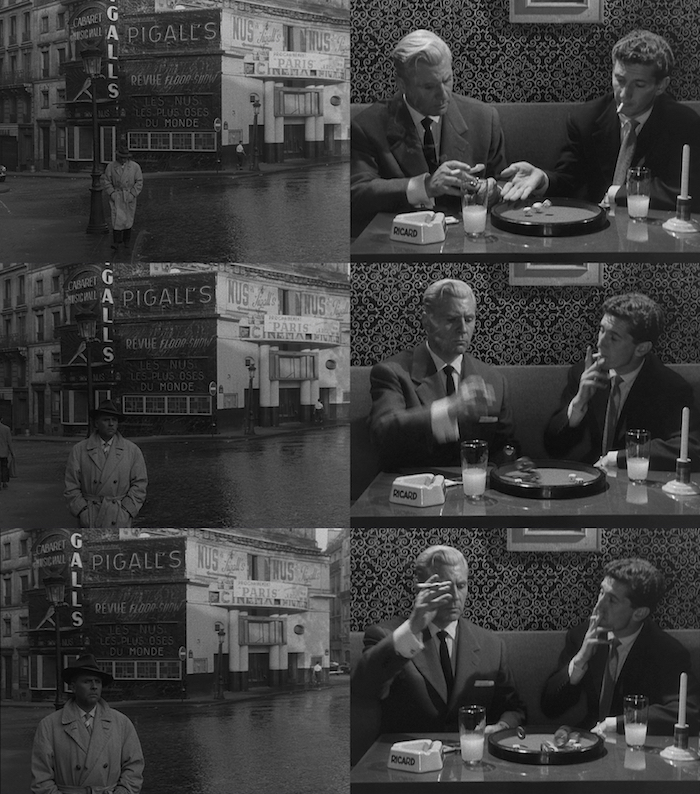
In the moments between night and day, by the dawn's early light, in Montmartre, that hallowed, hilly zone of solemnity and sleaze in Paris, resting somewhere between the Heaven of the Basilica of the Sacré-Cœur at its highest point and below it, the Hell of nightclubs, cheap hotels, cafes, whorehouses and gambling dens, the distinguished trench-coat-adorned silver-haired old fox Bob Montagné (Roger Duchesne) takes one last roll of the dice.

Craps.

It's been a long night and Bob's wiped out. He steps out onto the lonely morning streets, looks into a storefront reflection, straightens his tie and, taking in his weary visage, remarks aloud: "A real hood's face."

And so it is, but he's definitely not your run-of-the-mill garden variety miscreant. Bob Montagné is a class act. He's practically royalty, at least by the standards of magical Montmartre. Sure, he's been in an out of stir for most of his life, but amongst the post-war criminal class of France, he's pulled off some of the most daring heists, and as such, commands respect from thugs and cops alike.

He's a high-roller, you see, and everyone loves Bob: he's worshipped by the sweet young criminal Paulo (Daniel Cauchy), whilst the grizzled police lieutenant Ledru (Guy Decomble) considers him his best friend (and indeed owes his life to him) and, of course, there's a woman - the beautiful young Annie (Isabelle Corey), who adores him for his fatherly influence and generosity. Yes, everyone loves Bob, except for the foul pimp and stool pigeon Marc (Gérard Buhr). Bob has even less use for Marc, a piece of excrement on two legs who beats his women, sells anyone out for the right price and even tries to lure Annie into his stable.

Right from the opening frames of Jean-Pierre Melville's Bob le flambeur we know we're about to enter the world of the criminal class, but for the most part, "class" is the order of the day for men like our title character. Bob's also down for the count, but he's not there for long. He springs up with one last plan to restore himself. As an inveterate gambler, he knows all too well how much dough collects in a casino after a long night and he decides to put together a crack team to pull a heist on the mighty Deauville gaming emporium.

The magical world of Montmartre:
Wet streets, nightclubs, cigarettes and dice.

Best laid plans, however, can go awry, but the manner in which Melville explores this is one of the reasons why Bob le flambeur is a masterpiece. Let's put aside the fact that the picture's sense of atmosphere is so thick you can cut it with a knife, that its touches of Neo-realism make us feel like we're living, breathing and even smelling a world most of us will never know, that its eventual and shocking bursts of violence knock us on our butts and indeed influenced every crime picture that followed in its wake.

Let's put all that aside for a moment. Let's marvel at the sheer, brilliant simplicity of one key stroke of narrative genius:

Bob le flambeur is a heist film in which part of the caper itself involves its mastermind playing the tables of the casino he's going to rob and just as he's about to risk committing a crime that might land him in the hoosegow for a very long time, his rolls of the dice start to yield him a fortune that he's never seen in his life - a fortune that might indeed exceed that of what he could ever hope to rob from the joint.

Damn, this is genius.

THE FILM CORNER RATING: ***** 5-Stars

Bob le flambeur screens at Toronto's TIFF Bell Lightbox in the summer 2017 series "Army of Shadows: The Films of Jean-Pierre Melville" and, via the O.O.P. Criterion Collection DVD which includes an interview with Daniel Cauchy and an archival Gideon Bachman radio interview with Jean-Pierre Melville.

Monday, 3 July 2017

RIFIFI - Review By Greg Klymkiw - The greatest heist film ever made screens at Toronto's TIFF Bell Lightbox in the Summer 2017 series "Panique: French Crime Classics" and is also available on a gorgeous Criterion Collection Blu-Ray/DVD


Rififi (1955)
Dir. Jules Dassin
Scr. Dassin & René Wheeler
Nvl. Auguste Le Breton
Starring: Jean Servais, Carl Möhner,Robert Manuel,
Jules Dassin, Janine Darcey, Magali Noël, Claude Sylvain

Review By Greg Klymkiw

The major set piece of this extraordinary French crime film by blacklisted American director Jules Dassin is a breathless thirty-minute-long heist sequence that is shot with natural sound, no dialogue and no music.

It's pure cinema!

It's also one of the most nail-bitingly suspenseful scenes in movie history. We've come to know the characters, we understand the high stakes for all of them if they don't pull off the big steal and worst of all, we're well aware of what will happen if they're caught - especially the desperate old man, Tony "le Stéphanois" (Jean Servais). He's just served five years of hard time for a heist gone wrong and his only choices in life amount to petty crime, gambling and/or getting caught and being tossed back into the hoosegow until he's dead (or as close to dead as he'll ever get).

These men are criminals, but we want them to succeed. It's post-war France and the opportunities for men who've known only one way to survive are pretty much non-existent. They live by a strict code of honour and they'll steal, but they won't kill (at least until they are pushed to the limit to do so). There's clearly honour amongst these thieves (save for the slimy, greasy, lazy borderline pimps who weasel into the proceedings later on) and we never once feel like there are viable options for our main characters.

And so, we follow them willingly and almost complicitously into the breach - an insanely daring heist that requires split-second timing, impeccable teamwork and one hell of a massive whack of horseshoes worth of luck stuffed up their respective and collective keisters.


If the heist was only thing Rififi had going for it, there's no doubt the picture would be highly regarded, but that its bookends are as solid and compelling as all get out place Dassin's movie on s pedestal that holds some of the greatest crime pictures ever made. The manner in which Dassin shoots the heist is completely in keeping with his approach to the rest of the movie. Shooting almost exclusively on location captures the naturalistic feeling of the film's hard-boiled tale. Much like his groundbreaking American crime pictures (Naked City, Brute Force) which, broke American cinema out of the studio bound mould and took them onto the streets a la the Italian neorealist movement, Rififi is a glorious blend of stylized frissons within the framework of life itself.

Dassin, of course, had a tiny budget and little time to shoot the film, so he personally scouted all the locations in order to get a strong visual sense in advance to allow for impeccable planning. In many ways, Rififi is a model picture for independent, low budget approaches that are still infused with the highest degree of production value. Within Dassin's impeccable eye for visual detail, he's doubly blessed by working with the genius production designer Alexandre Trauner who manages to deliciously goose the look of the film.


Narratively, the tale is tough-minded and even romantic, but the attention to the details of the lives of the criminals and the heist itself (including the meticulous planning) give it the crank it needs to always keep us glued to the screen. As well, there's no overwhelming (and annoying) sense of the proceedings ever diving into moralistic waters. We believe in these men AND their criminal intent. We want them to succeed and if things go wrong and all becomes futile, Dassin sets the picture up in such a way that we're going to feel and care deeply about whatever plight the characters suffer. It helps, also, that the casting is impeccable - especially Servais as the world weary "le Stéphanois", Dassin himself as the funny, sprightly and finally, almost tragic figure of the ladies' man, as well as the other disparate and memorable members of the team.

The importance of Rififi as both dazzling entertainment, but as well, its place in laying the foundations for crime pictures that followed as well as the whole French New Wave that would come a few years later is, frankly, incalculable. All its historical significance aside, it's one hell of a good show! Rififi is brutal, harrowing and darkly funny and it seldom got better than this. The dames are dames, its heroes noble and the villains are pure filth. Sure, the movie trades in on the tropes of the genre, but does so expertly within its overwhelming naturalism that nothing ever feels cliched and is, in fact, far fresher than most films made today.

THE FILM CORNER RATING: ***** 5-Stars

Rififi screens at Toronto's TIFF Bell Lightbox in the Summer 2017 series "Panique: French Crime Classics" and is also available on a gorgeous Criterion Collection Dual Format Blu-Ray/DVD release complete with New 2K digital restoration, my favourite uncompressed monaural soundtrack, a very inspirational interview with director Jules Dassin, set design drawings by art director Alexandre Trauner, still, trailer, an optional English-dubbed soundtrack (especially handily for additional screenings to just study Dassin's visuals and a terrific essay by Jim Hoberman.

Sunday, 2 July 2017

ELEVATOR TO THE GALLOWS (Ascenseur pour l'échafaud) - Review By Greg Klymkiw - Louis Malle's Taut Fiction Feature Debut at Toronto's TIFF Bell Lightbox in the Summer 2017 series "Panique: French Crime Classics" and, of course, on a gorgeous Criterion Collection DVD

Babes. Hunks. Cigarettes. Murder. Paris. UNBEATABLE!!!

Elevator to the Gallows - Ascenseur pour l'échafaud (1958)
Dir. Louis Malle
Scr. Malle & Roger Nimier
Nvl. Noël Calef
Starring: Jeanne Moreau, Maurice Ronet, Georges Poujouly, Yori Bertin,
Jean Wall, Iván Petrovich, Elga Andersen, Félix Marten, Lino Ventura, Charles Denner

Review By Greg Klymkiw

Some movies demand the ingestion of popcorn. Others require mind-altering illicit substances. Louis Malle's stylish crime picture Elevator to the Gallows (Ascenseur pour l'échafaud) makes the insistent and peremptory request that you light up the strongest cigarettes imaginable and chain smoke your way through it from beginning to end. (For anyone planning a big-screen sojourn to see the picture at TIFF Bell Lightbox, you will sadly be shit out of luck on this front due to our city's regressive anti-smoking by-laws.)

Though Louis Malle (Au revoir les enfants, My Dinner with Andre, Atlantic City, Pretty Baby) had already garnered an Academy Award for his 1956 Jacques Cousteau documentary The Silent World, the French New Wave director wisely put together a sure-fire low-budget hit with this first dramatic feature film to solidify his place as a bankable filmmaker and damn, did he dazzle everyone with this très-cool crime thriller based on the pulpy Noël Calef novel. If it's a trifle cold and bereft of some of the hallmarks of Malle's later humanity, we can easily forgive that and just sit back and enjoy this delectable, unbeatable, suspensful indulgence replete with babes, hunks, plenty of cigarettes, zippy cars, cheap motels and murder most foul.

Our movie opens with the impossibly gorgeous couple Florence Carala (Jeanne Moreau) and Julien Tavernier (Maurice Ronet) passionately professing their love for each other over the telephone. A murder is committed, a mistake is made and our lovers are kept apart when our hero is caught in an elevator without power and the heroine is left alone waiting for him and forced to wander the streets of Paris, desperately looking for him. Tavernier's car is stolen by the impossibly handsome young thug Louis (Georges Poujoully) and his impossibly gorgeous girlfriend Véronique (Yori Bertin). The barely-out-of-their-teens couple goes on a joy ride and encounter the gregarious vacationing and champagne-armed German couple Horst (Iván Petrovich) and Frieda (Elga Andersen).

Partying and sex is assured. More murder is just round the corner.

Nail-biting suspense, mistaken identity and dogged detective work from cops Lino Ventura and Charles Denner follow in due course. Henri Decaë's gorgeous black and white cinematographic lensing of Paris and an astonishing music score by Miles Davis carry us along in one of the most delightful noir-tinged crime pictures of the period.

No need to spoil the proceedings with any further details. Just sit back with plenty of throat-shredding ciggies and enjoy!

THE FILM CORNER RATING: **** 4-Stars

Elevator to the Gallows (Ascenseur pour l'échafaud) plays on the big screen at Toronto's TIFF Bell Lightbox in the Summer 2017 series "Panique: French Crime Classics" and, of course, on a gorgeous Criterion Collection special edition double disc DVD that includes a new interview with Jeanne Moreau, archival interviews with Malle, Ronet, Moreau and soundtrack session pianist René Urtreger, footage of Miles Davis and Louis Malle from the soundtrack recording session, a new video program about the score with jazz trumpeter Jon Faddis and critic Gary Giddins, Malle’s student film Crazeologie, featuring the title song by Charlie Parker, Theatrical trailers and a booklet featuring a Terrence Rafferty essay, Malle interview and tribute by producer Vincent Malle.


Saturday, 1 July 2017

Les enfants terribles - Review By Greg Klymkiw - Melville and Cocteau make for strange bedfellows in this oddball 1950 effort at Toronto's TIFF Bell Lightbox in summer 2017 series "Army of Shadows: The Films of Jean-Pierre Melville" and, via the Criterion Collection DVD.

Can too much Cocteau be too much? Perhaps.

Les enfants terribles (1950)
Dir. Jean-Pierre Melville
Scr. Jean Cocteau & Melville
Starring: Nicole Stéphane, Édouard Dermit, Jacques Bernard, Renée Cosima

Review By Greg Klymkiw

God knows I love Jean-Pierre Melville, but sitting through his gun-for-hire directorial effort Les infants terribles is a bit like what a colonoscopy used to feel like before they knocked you out with happy drugs. In fact, it's not dissimilar to suffering through any movie directed by the lumberingly precious Jean Cocteau (Le Sang d'un poète, La Belle et la Bête, Orphée). Well, surprise-surprise, Les infants terribles is based upon the novel of the same title (and co-screenwritten) by Jean Cocteau. Even more appalling is that Cocteau himself, with a nasal, mannered delivery, narrates the movie with his sarcastic, obvious, on-point jackhammered prose.

At times, the movie feels like a Gallic-tinged Howard Hawks comedy with rapid-fire delivery and a score comprised mainly of Vivaldi, which, I'll admit, makes it sound more engaging than it actually is.

But no, it's often painful.

That, however, might be the point and in spite of often detesting the movie, I found it compulsively watchable - mostly because of Melville's direction and in spite of Cocteau's writing (not so much the narrative and dialogue, but the aforementioned narration, which often serves to rip us out of the picture's forward thrust).

Things begin well enough in the opening scenes at an all-male Catholic school where a bunch of boisterous lads roughhouse after a fresh snowfall. The dashing pretty-boy Dargelos (Renée Cosima) is leading the charge and at one point, he hurls a snowball tightly packed round a stone at the fey, aquiline-featured Paul (Édouard Dermit). Smacking him in the chest, it winds him to such an extent that he crashes to the ground, rendered unconscious and suffering from bruised ribs.

Melville's direction during this sequence is dazzling. We feel like we're in the midst of a war-like skirmish on the fields of Flanders and it's as sprightly and engaging an opening as one could hope for in any movie.

Eventually we're ensconced in the cramped middle-class quarters where Paul lives with his sister Élisabeth (Nicole Stéphane) and their infirm Mother (Maria Cyliakus). It's here where the film's annoyance-meter ramped up for me.

The picture plunges us into the obsessive, seemingly incestuous sibling rivalry/love and the pair engage in a series of tête-à-têtes that eventually reveal themselves to be an ongoing, deep-seededly perverse game. Paul is ordered by the doctor to stay home and in bed and Élisabeth becomes caregiver to both him and his Mother. Needless to say, the claustrophobia of the situation allows for plenty of nasty game-playing. Obsession rules the day - Paul is obsessed with pretty-boy Dargelos and misses him desperately and one of his school chums, Gérard (Jacques Bernard) visits regularly. He's obsessed with both the brother and sister and their games, but he also provides solace to Paul with news about the naughty Dargelos.

Things perk up when Mom dies (a magnificent cut and shot, pure Melville, reveals her to us and the characters). Enter the beautiful Agathe (also played by Renée Cosima) who Paul falls madly in love with since she's a dead ringer for his beloved naughty pal Dargelos. And yes, it's here where the movie hits its stride and ploughs us into the kind of madly delirious melodrama that Melville did so beautifully in the much-better and genuinely great melodrama Le silence de la mer (1949).

It's here wherein Élisabeth becomes so terrified that her brother will eventually marry Agathe and leave her alone (and hence, without the madly incessant game-playing) that what the nutty sister does next is sheer, delicious nastiness.

And you know what? As much as I profess(ed) to hate this movie, I must humbly, shamefully admit (in spite of Cocteau's influence) that I've now seen the picture three times. Well, like the old adage goes, "third time's the charm" and I find myself wanting to see the movie again. What a journey!

Vive Melville!

THE FILM CORNER RATING: **** Four Stars

Les enfants terribles screens at Toronto's TIFF Bell Lightbox in the summer 2017 series "Army of Shadows: The Films of Jean-Pierre Melville" and is available for home consumption via the Criterion Collection DVD which includes a new, restored high-definition digital transfer, an audio commentary by Gilbert Adair, interviews with producer Carole Weisweiller, actors Nicole Stéphane and Jacques Bernard and assistant director Claude Pinoteau, "Around Jean Cocteau", a 2003 short video by filmmaker Noel Simsolo discussing Cocteau and Melville’s creative relationship, the theatrical trailer, a gallery of behind-the-scenes stills and a booklet featuring a Gary Indiana essay, a tribute by Stéphane, an excerpt from Rui Nogueira’s "Melville on Melville" and drawings by Cocteau.

Thursday, 29 June 2017

Army of Shadows (L'armée des ombres) - Review By Greg Klymkiw - Grim, Haunting Portrait of Collaboration and Resistance at Toronto's TIFF Bell Lightbox in summer 2017 series "Army of Shadows: The Films of Jean-Pierre Melville" and, via a gorgeous (O.O.P. limited availability) Blu_Ray/DVD via the Criterion Collection

Collaboration is a dirty business. So is Resistance.

Army of Shadows AKA L'armée des ombres (1969)
Dir. Jean-Pierre Melville
Nvl. Joseph Kessel
Starring: Lino Ventura, Simone Signoret, Jean-Pierre Cassel,
Christian Barbier, Paul Crauchet, Claude Mann, Paul Meurisse, Serge Reggiani

Review By Greg Klymkiw

Collaboration is a dirty business. So is resistance. In an occupied country, both will thrive, yet seldom have either been more grim, mean and downright foul than in France during World War II.

Jean-Pierre Melville's film adaptation of Joseph Kessel's fictionalized version of his own real-life experience during this shameful period of 20th Century French History is not only a masterpiece, but it might be one of the most heroic depictions of the French Resistance ever made. That said, Melville's brand of heroism is replete with relentless outrage and deep, deep anguish.

Army of Shadows (L'armée des ombres) will be a bitter pill for any audience to swallow, but its necessity might be more urgent now than ever. "Occupation" of one country by another has become especially endemic to the ongoing and mounting political strife plaguing our world in this century and has resulted in the kind of "collaboration" and "resistance" that ripped the guts out of France and so many other European countries during the Second World War. One of the most fascinating features/attributes of Melville's picture is the fact that it stands before us as a film made almost half a century ago, about events that occurred almost one quarter of a century before the film itself was made, and yet here we sit, now, looking at it, our jaws agape over the cruelties and complexities the movie depicts, and realizing, ever-sadly, how so little, how so goddamn little in our world has actually changed.

It's a movie of universal qualities. The picture comes by them due to the strange narrative and stylistic structures Melville has chosen to infuse it with, all of which place us in a world that, from beginning to end, knock us off-kilter, keep us on edge and finally instil in us a dread that its events, which once happened, are indeed happening now and will happen again and again if we do not, by both acknowledgment and action, recognize and work towards ensuring that it stops.

Melville creates a film here that rubs our noses in the fact that our very nature as human beings is highly susceptible to the damage caused by occupation and how the inevitable resulting collaboration with occupying forces yields the kind of self-serving selfishness (the selfishness of survival, if you will) which gives way to the kind of inhumanity that even resistance can engender.

So how then, does he do this?

The first thing Melville chooses to greet us with are words.

Popping up from deep black, brilliant white typeface announces:

"Unhappy memories! Yet I welcome you...You are my long lost youth..."

My God, was there ever an epigram infused with more truth?

There is no elegant fade to black from these words, no gentle dissolve. Melville jolts us with a cut and the beautifully composed long shot he bestows upon us is that of the Arc de Triomphe de l'Étoile, that glorious symbol of France's victories over those who would dare profane French soil - a testament to the fallen warriors of the Revolutionary and Napoleonic Wars and, indeed, the resting place of the Tomb of the Unknown Soldier from World War I.

The Eiffel Tower might well be the ultimate symbol of Paris, but situated at one end of the Champs-Élysées, smack in the middle of the now-named Place Charles de Gaulle, but the more evocatively once-named Place de l'Étoile, the imposing Arch of Triumph remains, for most of us, the definitive apogee of France itself.

And we sense, immediately, that something is amiss. It's not the shot itself, nor is it the the drumbeats and marching feet from a line of soldiers on parade that slowly creep onto the soundtrack and intensify, but rather, it's the sky towering above the grand arch, so grey, so weirdly forbidding in the drabness of the clouds that makes us uneasy.

The camera never moves - or so it seems. Initially, the soldiers are so far away from us they're dwarfed by the Arch itself. As the parade gets closer and the music and marching become ever-cacophonous: beats, bleats, blasts and finally a blare - we're jolted into reality and the camera does indeed shift, ever-so subtly for us to realize that the soldiers are Nazis. As they get closer, filling the frame, defaming the composition of the Arch itself, our nerves are jangled.

And we are sickened.

Things don't get brighter. Melville bestows the rest of the opening of the film in swathes of dull blues, greens and greys as we're introduced to the well-groomed civil engineer Philippe Gerbier (Lino Ventura) who is being driven to a prison camp filled with "enemies" of the collaborationist Vichy government of France, the ruling bureaucracy which has prostrated itself before the Germans who have swallowed the country whole as an occupying force.

Dirty Nazis.

Dirtier still are the French - or rather, those Frenchmen who betray their soil, their nation and their people to serve the foul occupiers.

Phillipe is treated by his captors in a relatively gentlemanly fashion. Housed in a barracks that was ironically designed by the French to house German officers, but is instead now populated by Frenchmen, the pensive, almost bookish prisoner has little regard for his fellow captives, until he takes a shine to a bright young man who proposes a brilliant plan of escape.

This will be our (and Phillipe's) first taste of betrayal in the film. The vibrant youthful co-conspirator sells out our hero to the Vichy pigs and he soon finds himself transported to a Nazi facility. Phillipe escapes (quickly, efficiently and shockingly engineered) and we eventually find him ensconced on the Riviera where he leads the French Resistance movement.

From here, the film charts a series of resistance movements - some successful, and others scuttled by either circumstance or worse (and most often), betrayal. Occupying forces count on the Judas Kiss and Melville's film doesn't spare its characters from being forced to sell out. Then again, and most tragically, the film doesn't save several other characters from refusing to turncoat, and what awaits them is torture and inevitably, agonizing death. And though we see numerous instances of characters succumbing to the equivalents of the "death-by-a-thousand-cuts", Melville conversely doesn't spare an equal number of them from being snuffed out brutally and swiftly.

Throughout his career, Melville 's approach to on-screen violence was unique in its savage efficiency and in Army of Shadows, we are "treated" to several instances of this, so ferocious in the barbarity of the acts, that we're forced to cringe and gasp through several agonizing stranglings, stabbings, beatings and shootings. From a tea towel garrotte wrenching a traitor's last gasps of air to a cold, hard pistol appearing out of nowhere, pausing to give its intended victim a few moments of recognition and then, the inevitable, the blast of a gunshot, the piercing of flesh and death that is as merciful as it is cruel.

There are, of course, moments of tenderness, love, loyalty and yes, even hope. However, the film's overall tone is one of despair. The picture begins as it ends, beginning with one thing and allowing it to transform into something quite different - jolting us out of anything resembling comfort or complacency.

Yes, amongst the army of shadows in this horrific topsy-turvy world of collaboration and resistance, there is heroism, but nobody - nobody is a winner.

THE FILM CORNER RATING: ***** 5-Stars

Army of Shadows AKA L'armée des ombres is being screened during the TIFF Bell Lightbox series entitled "Army of Shadows: The Films of Jean-Pierre Melville" and is available on the Criterion Collection in a (limited availability O.O.P.) BLU-RAY and DVD that includes an audio commentary with film historian Ginette Vincendeau, an interview with editor Françoise Bonnot, On-set footage and excerpts from archival interviews with director Jean-Pierre Melville, cast members, writer Joseph Kessel, and real-life Resistance fighters, "Jean-Pierre Melville et L’armée des ombres” (2002) and "Le journal de la Résistance" (1944), a rare short documentary shot on the front lines during the final days of German-occupied France.

Monday, 26 June 2017

THE BIRD WITH THE CRYSTAL PLUMAGE - Review By Greg Klymkiw - Argento Debut on Arrow

The birth of a horror master, and it was a good birth.

The Bird With the Crystal Plumage (1970)
Dir. Dario Argento
Starring: Tony Musante, Suzy Kendall, Enrico Maria Salerno, Eva Renzi, Reggie Nalder

Review By Greg Klymkiw

Why do beautiful women insist upon walking home alone at night, especially when the city's been plagued by a serial killer targeting beautiful women walking home alone at night? Well, in the movies, the answer is simple. So we get to watch a potential victim furtively step into occasional pockets of light, surrounded mostly by pitch-black shadows whilst being spied upon and followed by a butcher-knife-wielding psychopath adorned in black leather and an oh-so-stylish wide-brimmed hat until eventually, she's followed home and then, once resting easy in her see-through nightie, the whack-job stalker enters her boudoir and exacts some vicious handiwork.

Why, you ask?

That's why!

And so it is that the entire aforementioned stalk-and-slash sequence is accompanied by the following bon bons:

- a creepy Ennio Morricone score that veers from off-kilter nursery-rhyme tones to discordant jazz riffs;

- the sumptuously scintillating incandesce of cinematographer Vittorio Storaro and;

- in his debut feature as a director, the gloriously fetishistic mise-en-scène of Dario (Suspiria) Argento.

Add to all of this, a gorgeous smash cut from the first appearance of the killer to an extreme closeup of the insides of the victim's moist screaming maw as the camera then pulls out of its intimate perch, the lens like some penis withdrawing from a delectable orifice of penetration.

Oh yes, we are most definitely in Argento Land!

The Bird With The Crystal Plumage is a first-rate giallo classic of the highest order and though it's a bit light on Argento's later trademark cerebral qualities in favour of more standard mystery thriller tropes, there's plenty of dazzling visual nuttiness on display to signal the arrival of one of horror cinema's true masters. (And, there are plenty of fetishistic Argento closeups of the psycho's black-leather-gloved hands, cradling steely implements of death and performing divinely appetizing acts of violence.)

Loosely based, and oddly uncredited, upon "The Screaming Mimi", a lurid 1949 pulp novel by Fredric Brown, Argento's screenplay details the adventures of American writer Sam Dalmas (Tony Musante) who's been residing in Rome with his gorgeous squeeze Julia (Suzy Kendall). When he witnesses the attempted murder of Monica (Eva Renzi), a beautiful (naturally) redheaded art gallery employee, homicide detective Morosini (Enrico Maria Salerno) scoops Sam's passport, preventing him from leaving the country, not because he suspects any nefarious activities, but because he's convinced our hero might hold a key to the investigation, buried (of course) in his psyche. For his part, Sam's having some troubles in the manly-performance department and thinks he'll be able to get "it" back up again if the murders can be solved. Needless to say, he begins to play detective all on his lonesome. Conveniently, for the film, this places both him and his dazzlingly gorgeous girlfriend in peril.

These are characteristically delightful giallo twists and turns, all served-up marvellously by the tasty side-dishes of Argento's baroque crazy-ass styling. The suspense set pieces are genuinely scary and the whole affair not only signals what was eventually to come from the great auteur, but works perfectly well as a dazzling, horror thriller all on its own. The absurdity of the narrative doesn't disappoint and even offers up some wonderful red-herrings to spice up a few surprising revelations that most of us should see coming from a mile away. (And even if you do, you won't quite spot them coming exactly the way they do.)

Any movie with Reggie Nalder is worth its weight in gold.

As a tasty side note, any film that features the magnificent character actor Reggie Nalder as a yellow-jacket-adorned hired killer who disappears within a convention of former prize-fighters after a scary stalk-and-chase sequence, is almost, in and of itself, worth the price of admission.

Luckily, the movie itself has a lot more to offer.

My first taste of The Bird With The Crystal Plumage was on film during a dusk-to-dawn show at a drive-in movie theatre in the late 70s and my memories were fond enough of the picture that I was eventually disappointed and disgusted by the poor video transfer I eventually caught up with on VHS in the 80s.

Now, my life is complete

The Arrow Films Blu-Ray deluxe edition not only serves up a lovely 4K digital restoration, but comes complete with a bevy of superb extra features including a Gold Standard audio commentary from Troy Howarth who jams his sprightly presentation with everything you always wanted to know about the making of this film, and then some - his delightful delineation of every arcane piece of Italian giallo lore is a genre geek's wet dream. It's really a pleasure to listen to someone who knows his shit and displays his "wares" with intelligence and passion.

THE FILM CORNER RATING:
**** 4-Stars (for the film)
***** 5-Stars for the Arrow Films Blu-Ray.

Sunday, 25 June 2017

THEY LIVE BY NIGHT - Review By Greg Klymkiw - Ray Debut Gets Criterion Deluxe Treatment

Depression-era novel yields perfect post-war Film Noir.

They Live By Night (1948)
Dir. Nicholas Ray
Scr. Charles Schnee, Nicholas Ray
Nvl. Edward Anderson
Starring: Cathy O'Donnell, Farley Granger, Howard Da Silva,
Jay C. Flippen, Helen Craig, Will Wright, Marie Bryant

Review By Greg Klymkiw

You know the kid is doomed. That's usually the way it is in the grand tradition of film noir crime pictures, but there's a lot more to it than mere genre expectation. Nicholas Ray's debut feature film They Live By Night is so immersed in despair that the pain experienced by the viewer is matched only by our hope against hope that the sweet, young escaped convict Bowie (Farley Granger) is somehow, someway going to find a way out of the hole that both he and circumstance are digging - deeper and deeper and ever-deeper, right from the opening frames.

But we know, we just know, it ain't gonna be so. In this world, hope is a stacked deck and the dealer holds all the good cards. The wide-eyed look of both fear and expectation in Bowie's eyes as he waits in the darkness of night with a sweet, stray dog is enough to tell us that no matter what brief glimmers of hope get tossed his way, he's going to be swallowed whole by a hard, cruel world that has it in for the disenfranchized in the post-war ennui that pervades the world of the film (but in its universal prescience, stands in so sadly for a world that continues to assault those who are the most vulnerable).

And so it is, like Edward Anderson's depression-era novel (and Robert Altman's great 1974 film version Thieves Like Us), that Bowie breaks out of a life-sentence in stir with the older, though hardly wiser thugs, the one-eyed Chicamaw (Howard DaSilva) and the grizzled T-Dub (Flippen). The three convicts hide out in the ramshackle rural home of old drunkard Mobely (Will Wright) and his daughter Keechie (Cathy O'Donnell). With the financial and moral support of T-Dub's sister-in-law Mattie (Helen Craig), the trio plan a major bank robbery.

The core of the story is where director Ray excels. (Ray's entire career seems devoted from this film onwards to movies focusing upon disenfranchised outsiders - Rebel Without a Cause, anyone?) Thanks to producer John Houseman and RKO studio chief Dore Schary, this might be the only film that Ray had unfettered freedom. The movie charges with passion and energy, unlike Altman's equally brilliant take which focused upon the sheer monotony of life-on-the-lam.

Ill-fated lovers on the lam: Claustrophobia to Flight.
Nicholas Ray brilliantly tosses in every cinematic tool at his disposal to keep us enthralled. The helicopter "God" shots are especially dazzling and his groundbreaking use of sound places us firmly in a world that pulsates with a terrible beauty - at once real and alternately, hyper-real, borderline expressionism (especially in his use of Christmas Carols during the most heartrending perversion of domestic bliss and a knockout nightclub sequence with Marie Bryant performing "Your Red Wagon").

Of course, the film's narrative nucleus is the doomed love story between Bowie and Keechie and, oh, it's a heartbreaker. Not only is Bowie doomed from the first glimpse of him, so too is the love twixt this sad, broken couple. When we first meet them as a pair, the sparks are clear, but so's their downfall. Whatever shards of joy they're going to share, they're ultimately bound to wind up on a clear path to sheer and utter despair.

In many ways, both characters have been prisoners. Bowie was incarcerated as a teenager, railroaded by a system that had no time to mete genuine justice upon a poor abused kid. Keechie has lived her entire life helping her alcoholic Dad in the middle of nowhere. Neither of these people have done anything resembling "living" and what life they're going to experience together is most definitely not bound for glory.

So much of the movie is "on the road" - getaway cars and buses. Flight certainly offers an alternative to the claustrophobia that infused the lives of the film's young lovers, but one of the most astonishing set pieces offers a strangely moving repast for Bowie and Keechie when the couple takes one day - ONE DAY - to live out their lives as a "normal" couple.

When the heist occurs early on, it yields a whack of dough, but the troubles start there. Every step of the way, from this point forward, is a misstep and the movie can do little more than toss a crumb or two of happiness in our protagonists' way, and then, bury it with shovelfuls of cold, grimy dirt.

They Live By Night is a movie that seems to be digging a grave and maybe, just maybe, the best we can do as observers is experience its sad inevitabilities so that we never close our eyes to the plight of those who need more than mere sympathy, but action, so that we can all live in a world that extends something resembling compassion.

THE FILM CORNER RATING: ***** 5-Stars

They Live By Night is available on the Criterion Collection and comes replete with a new 2K digital restoration, with uncompressed monaural soundtrack on the Blu-ray, an audio commentary featuring film historian Eddie Muller and actor Farley Granger, a great video interview with film critic Imogen Sara Smith, a short piece from 2007 with film critic Molly Haskell, filmmakers Christopher Coppola and Oliver Stone, and film noir specialists Alain Silver and James Ursini, plus a dazzlingly eye-opening (and nicely illustrated) audio interview from 1956 with producer John Houseman in conversation with Gideon Bachmann.

Wednesday, 21 June 2017

THE DAUGHTER OF DAWN - Review By Greg Klymkiw - Milestone restores important lost film.

Any day is a great day to watch and rejoice in this important "lost" piece of cinema history, but Canada's NATIONAL ABORIGINAL DAY is a pretty good reason to celebrate the gorgeous Milestone Cinematheque's Blu-Ray of The Daughter of Dawn, an independent 1920 silent picture that stars over 300 members of Oklahoma's Comanche and Kiowa nations.
When it comes to film restoration and preservation,
it doesn't get better than Milestone Film and Video.
The Daughter of Dawn (1920)
Dir. Norbert A. Myles
Starring: Esther LaBarre, Hunting Horse,
White Parker, Jack Sankeydoty, Wanada Parker

Review By Greg Klymkiw

Mysteries abound from the period we know as the dawn of cinema and they almost always centre upon the multitude of films which existed ever-so-fleetingly, then disappeared from the face of the earth due to the vagaries of distribution and exhibition - not to mention the highly combustible nature of nitrate film stock (eventually eschewed after cinema's first fifty-or-so years in favour of more stable stocks). The bottom line is that most major studios considered films as "disposable" product and far too many pictures simply disappeared, going the way of the majestic Dodo Bird - forever.

One of the biggest mysteries is the production of The Daughter of Dawn, which was manufactured by The Texas Film Company in 1920. Shot on location in a wildlife refuge near Lawton, Oklahoma and starring over 300 members of the Kiowa and Comanche Nations, it probably makes even more sense that it became lost to the sands of time given that it was a genuinely independent film, bereft of the usual barnstorming entrepreneurial showmanship oft-applied during those early days.

In fairness to producer Richard Banks, he had enough vision to secure actor/director Norbert A. Myles to write a script based on a Comanche legend and then mount a spectacular production in a tough location, using local Native Americans, not only as actors, but as the primary artisans of the costumes, sets and props. The film's existence was never in question, nor were the obviously prodigious efforts to make it, but given the popularity of similar works of the period (such as the films of Merian C. Cooper, Ernest B. Schoedsack, Robert Flaherty, Edward S. Curtis, et al), why it didn't follow similar footsteps is a major head-scratcher.

As far as we know, The Daughter of Dawn had one public screening at a sneak preview in Los Angeles, followed one year later with a screening in Topeka, Kansas and then, completely falling off the map. Its spotty distribution/exhibition history might be one of the greatest mysteries of all. When one compares its aesthetic attributes to the vast number of ethnographic documentaries, docudramas and straight-up dramas shot on location during this period, with real people in front of the cameras, The Daughter of Dawn easily holds its own against seminal works like Chang: A Drama of the Wilderness, Grass: A Nation's Battle For Life and In the Land of the Head Hunters.

The picture is a rip-snorter of the highest order. It's a classic love triangle set against the backdrop of war. Dawn (Esther La Barre) is the daughter of a powerful Kiowa Chief (Hunting Horse) and she's madly in love with the handsome White Eagle (White Parker). Alas, the sly, lumpy, bumbling Black Wolf (Jack Sankeydoty) is in love with Dawn and because he's imbued with considerable wealth (he owns a whole whack of ponies), the Chief is torn over bestowing his daughter to an ideal match. Will it be love that wins out over wealth or vice versa? Neither. The Chief decides that bravery is the greatest attribute, so he sets a challenge to both men to prove their worth.

Simple, yes? Well, there are spanners in the works. Red Wing (Wanada Parker), a not-so-fetching "catch", is madly in love with dopey Black Wolf and her jealousy knows no bounds. Worse yet, some neighbouring Comanches are fixing to go to war with the Kiowa Nation and plan to make a raid in order to steal women and goods. When Black Wolf proves to be no match for the brave White Eagle in the competition, he grabs his "lesser" paramour Red Wing and hightails it over to the Comanche side to turncoat his way into an act of ultimate revenge.

There will be war.

The Daughter of Dawn proves to be a supremely entertaining western adventure. Director Myles trains his camera upon the action with a first-rate eye for staging and detail. We not only get a fascinating glimpse into the lives of the Native Americans (thanks mostly to their cultural/artistic contributions), we're treated to nice dollops of romance and some truly spectacular action scenes (including a buffalo hunt, no less).

How and why this movie fell through the cracks is beyond me. Is it possible that neither the film industry nor audiences were ready for a movie about Native Americans taking centre stage? (A cool bit of historical trivia is that actors White Parker and Wanada Parker were the children of leading Comanche leader Quanah Parker.) Well, whatever kept this film from finding its true place at the time, the point is now moot, because now is the time.

Extraordinarily, though the film was long lost, an Oklahoma private detective was paid for his services with a few cans of nitrate film stock which, as it turned out, was the only extant print of The Daughter of Dawn. It eventually found its was into the hands of the Oklahoma Historical Society who commissioned an all-new original musical score by noted Comanche composer David Yeagley and eventually, for all of us who love movies, it was happily placed in the hands of the visionary Milestone Film and Video who have made it available to the world - ninety years after it was first made.

THE FILM CORNER RATING: ***** 5-Stars

The Daughter of Dawn is available on a sumptuous Blu-Ray/DVD via Milestone Film and Video on their Milestone Cinematheque label. It looks gorgeous, of course, thanks to a beautiful 35mm restoration and 2K transfer and the home entertainment package is replete with an informative introduction by Dr. Bob Blackburn, the featurette "Finding the Film: with Bill Moore of Oklahoma Historical Society", interviews with Comanche Darren Twohatchet, Kiowa Dorothy Whitehorse, William D. Welge of The Oklahoma Historical Society and featurettes on the musical score.

Tuesday, 20 June 2017

MADHOUSE (1981) - Review By Greg Klymkiw - Notorious Video Nasty Gets Arrow Lovin'

Arrow, the Gold Standard of Genre Home Entertainment,
serves up delectable Blu-Ray/DVD of notorious "nasty"!

Madhouse (1981)
Dir. Ovidio G. Assonitis
Scr. Assonitis, Stephen Blakeley, Peter Sheperd. Roberto Gandus
Starring: Trish Everly, Dennis Robertson, Allison Biggers,
Michael Macrae, Morgan Hart, Edith Ivey, Jerry Fujikawa

Review By Greg Klymkiw

A little girl gently rocks another little girl in a big old chair whilst a somewhat dissonant nursery rhyme is crooned. It's the dissonance of the ditty that prepares us for the worst. As the camera pushes in slowly upon the action, we're eventually treated to a brick being smashed repeatedly in the face of the lulled child. And so begins one of the most notorious "video nasties" of the the early 80s, so named because it was one of numerous pictures that were outright banned in Britain for their attention to excruciatingly graphic violence.

Directed by the prolific Italian producer-director-distributor of such works as The Exorcist rip-off Beyond The Door, James Cameron's debut feature Piranha II: The Spawning (which the Titanic director was fired from) and the compulsively, brilliantly godawful Jaws rip-off Tentacles, Ovidio G. Assonitis might well have managed to barf up something resembling, by his standards, a masterpiece.

Madhouse is one marvellously entertaining Giallo slasher picture and though Assonitis will never be mistaken for the likes of Dario Argento, Lucio Fulci or Mario Bava, he acquits himself handily here with this fun, surprisingly well-acted (especially by its leading lady), super-creepy gore-fest (that is also blessed with a totally bonkers Riz Ortolani score).

Glorious Gore-Galore in MADHOUSE. Yummy-yum-yum!

And the narrative itself? It took four screenwriters to generate the plot, and while there's no writing here that's ever going to be acclaimed for its virtuosity, it manages to juggle a whole passel of strange jaw-droppers, many bordering on originality, in addition to all the requisite tropes the genre demands.

Julia (Trish Everly) teaches deaf kids in Savannah, Georgia and rents a room from the eccentric Amantha Beauregard (Edith Ivey) who owns a sprawling old house that was once a funeral parlour. The caretaker of this sumptuous manse is Mr. Kimura (Jerry Fujikawa), an Asian-American who manages to give Mickey Rooney's Mr. Yunioshi from Breakfast at Tiffany's a run for the money in the grotesquely-racist-portraits-of-Asians Department - quite a feat considering he's played, not by a short white dude in "yellow-face", but a real Asian-American actor.

It seems Julia is the twin sister of Mary (Allison Biggers), a completely bunyip psychopath who lies suffering from a degenerative skin disease in a nuthouse. Julia suffered horrible abuse at the hands of her sister as a child and seeing as their mutual birthday is just round the corner, she is more than a little creeped-out after a harrowing hospital visit in which the batty sis promises to celebrate with some extra-vicious lovin'.

Making matters worse is that the ladies' Uncle James (Dennis Robertson) seems to think that bonkers Mary is simply "misunderstood" and that the seemingly together Julia is unhinged. That the "kindly" Uncle is a Catholic priest does not bode well and though some might consider this a "spoiler", it's pretty damn obvious from the second we meet him that he might be even more off his rocker than the deformed abusive sister. (And yeah, one of the more delightful set pieces involving our wing-nut Priest is a birthday party replete with cake, candles and corpses.)

Needless to say, as the movie creeps ever closer to the celebratory date of birth, Assonitis gives us one vomit-inducing display of violence after another. It's a glorious thing, really! We not only get one butcher-knife hacking after another, but just to keep things interesting we're treated to bludgeoning, Rottweiler attacks, a truly magnificent hatchet wielding and, in one of the more inspired moments, you will jump out of your seat and fill your drawers when something/someone smashes through a door and is then dispatched with a power drill to the skull.

And if this doesn't tickle your fancy, allow me to remind you that you'll actually revel in an oh-so-yummy scene in which a sweet, little deaf boy gets his throat torn out.

That'll teach the little nipper to stay away from strange Rottweilers.

THE FILM CORNER RATINGS: ***½ (film), **** (Blu-Ray/DVD)

Madhouse is brought to us on a first-rate two-disc Blu-Ray/DVD by Arrow Films (these dudes really set the Gold standard for genre home entertainment releases) that not only offers a gorgeous 2K restoration of the film from the original camera negative, but a whole whack of wonderful extra features including an entertaining audio commentary with genre podcasters The Hysteria Continues, some extremely informative, in-depth interviews with cinematographer Roberto D'Ettorre Piazzoli, veteran actress Edith Ivey and, the man himself Ovidio G. Assonitis. Add a trailer, alternate opening titles, a lovely booklet and terrific box-cover art, and this is one worthy addition to any horror fan's home entertainment collection.

Monday, 19 June 2017

GHOST WORLD - Review By Greg Klymkiw - 2001 Zwigoff & Clowes masterpiece on Criterion

Shirtless Nunchuck Master fortifies with beef jerky.
A sad old man waits for a bus that never comes.
Teenage girls in this GHOST WORLD see it all.

Ghost World (2001)
Dir. Terry Zwigoff
Scr. Daniel Clowes and Zwigoff
Starring: Thora Birch, Scarlett Johansson, Steve Buscemi, Illeana Douglas, Pat Healy, Brad Renfro, Bob Balaban, Teri Garr, Dave Sheridan and Charles C. Stevenson Jr.

Review By Greg Klymkiw

"I used to think about one day, just not telling anyone, and going off to some random place. And I'd just, disappear. And they'd never see me again." - Enid (Thora Birch) in Ghost World

The sad old man in a dark suit and gray tie stares at nothing in particular as he sits on a bench at a long-discontinued transit line, waiting for a bus that will never come. His name is Norman (Charles C. Stevenson Jr.). Though a touch distracted, he seems friendly enough when recent high school grads Enid (Thora Birch) and Rebecca (Scarlett Johansson) stop to talk with him, but when they assert that the bus route was cancelled two years ago, he expresses mild annoyance, even outright dismissal when he growls, "You don't know what you're talking about."

On the surface, Ghost World, director Terry (Crumb) Zwigoff's film adaptation of the Daniel Clowes graphic novel seems to be about the gradual drift that occurs between these two longtime girlfriends during their first summer of true freedom after twelve-long-years of school, and yes, so it is - on the surface. In reality, though, the picture seems rooted firmly in the character of Norman, someone who appears only briefly in three scenes.

Norman, you see, has a dream and so does young Enid. It is a dream of longing, a dream of escape - leaving behind the ghosts of a town that's become too small to hold anyone there with the desire for flight, the gnawing need to migrate towards a fresh life and new adventures.

One night, Enid visits Norman at the bus stop with the following confession: "You're the only person in this world I can count on, because no matter what, I know you will always be here."

This is Enid's problem. She can't count on anyone or anything to remain in her life. Oh sure, she's surrounded by a handful of constants. Her bestie Rebecca has long been an appendage. The two have remained super-glued together through a life of quips and wry, cynical observations on everyone and everything that seems so ordinarily below their lofty station - "normal" is a dirty word in their vocabularies. They've shared a dream of getting jobs and rooming together in their very own apartment, but when the reality of settling down creeps into their friendship, Enid turns to the geeky middle-aged 78 collector Seymour (Steve Buscemi) for solace and inspiration.

Enid meets Seymour when she's concocted a nasty little ruse after reading his plea in a "personals" column and she responds to it, pretending to be a potential paramour. Instead, she and Rebecca show up to the prescribed meeting place, a faux-50s-style diner in a strip mall and cruelly sit back and watch him arrive and wait in vain for the date that never shows up. They follow the dejected schlub to his nondescript low-rise apartment dwelling and even patronize his garage sale one Saturday morning.

The first signs of a shift in the girls' friendship is apparent. Rebecca thinks Seymour is a creepy nerd (especially after the girls attend a party in his apartment populated by middle-aged 78/vinyl geeks). Enid however, becomes a woman obsessed. She finally admits that Seymour represents "the exact opposite of everything I hate".

But even Seymour won't remain long in Enid's life - it's partially her own doing. She plays teenage matchmaker and when he finally lands a girlfriend, she jealously attempts to break it up by coming on to the poor schlub and eventually dumps him once she realizes that life with him isn't what she's cut out for.

When Enid talks to old Norman at the bus stop, he declares: "I'm leaving town." When a bus mysteriously appears, he boards it and disappears from her life, probably forever. Every anchor in Enid's life continues to dissipate. Even her single dad (Bob Balaban) is planning to get married. They're all dropping like flies. This is a coming-of-age via abandonment, but maybe, just maybe, a bit of self-abandonment is necessary.

New Criterion cover-art by Daniel Clowes.

Zwigoff and Clowes have created one of the most compelling female characters in all of cinema. Enid comes to life in ways that so many characters (no matter what their sex) have ever done. From the opening scene in which the camera tracks along the open windows of an apartment complex, we hear the sounds of a rousing Bollywood tune whilst each window gives us a glimpse into a series of seemingly empty lives: a lone Asian woman staring forlornly into the night, a shirtless dude with a mullet sitting alone in his kitchen, a dinner table bereft of anyone in sight to enjoy the booze, uneaten food and exercise bicycle next to it, a dopey bovine couple watching their stupid kid whack his toys with a plastic baseball bat, and then...

Enid! A raven-haired young beauty in a red kimono-like bathrobe, dancing madly and identically to a woman in a Bollywood video that plays on her television, is revealed to us as someone who is clearly cut of her own unique cloth. (When Enid dyes her hair green and begins sporting period punk-wear, she's even more ravishing and definitely, cooler-than-cool.) Thora Birch attacks the role with a vengeance - as if it were the role of a lifetime, which, it probably will end up being.

The film captures the ennui, the downright melancholy of adolescence with deadpan fervour. The muted colour-pallette created by cinematographer Affonso Beato, the perfection of the movie's cast and an astonishing score comprised of the heartbreaking strains of David Kitay's music and a terrific whack of songs (including the legendary "Devil Got My Woman" by Skip James), all combine to deliver a work that's as riotously funny as it is deeply and profoundly moving.

The film has not dated in the sixteen years since its first release. Though the period details of its late 20th Century never-never-land are omnipresent, the picture's perspective feels downright universal. I was delighted that during my most recent helping of the film, my own 16-year-old daughter was completely blown away by the movie and can't stop watching it - over and over again. We've talked at length about it, but she actually observed something I couldn't have put better myself.

Referring to the haunting final moments of the film, my daughter remarked, "You know, Dad, sometimes we all just need to get on that bus and disappear."

I won't argue with that.

THE FILM CORNER RATING: ***** 5-Stars

Ghost World is available in a sumptuous Criterion Collection DIRECTOR-APPROVED SPECIAL EDITION on Blu-Ray/DVD and includes a new, restored 4K digital transfer, supervised by Zwigoff, a 5.1 surround DTS-HD Master Audio soundtrack on the Blu-ray, a great commentary featuring Zwigoff, Clowes and producer Lianne Halfon, new interviews with actors Thora Birch, Scarlett Johansson, and Illeana Douglas, an extended excerpt from Gumnaam (1965) featuring the Bollywood number that appears in the movie’s opening title sequence (and with a wonderful commentary about the film itself), some terrific deleted scenes (including alternate takes of the nunchuck wielding madman played by Dave Sheridan), the trailer, an essay by critic Howard Hampton, a 2001 piece by Zwigoff on the film’s soundtrack and reprinted excerpts from Clowes’s comic "Ghost World". The Blu-Ray/DVD includes gorgeous new cover art by Daniel Clowes himself.