Showing posts with label Rodney Ascher. Show all posts
Sunday, 31 May 2015
THE NIGHTMARE - Review By Greg Klymkiw - Room 237 Director yields soil-your-pants Doc
The Nightmare (2015)
Dir. Rodney Ascher
Review By Greg Klymkiw
I'm not sure what's scarier -- seeing this movie if you've never experienced sleep paralysis, or if you have. Either way, Room 237 director Rodney Ascher has knocked one right out of the park with this chilling documentary focusing upon one of the most horrific experiences anyone can have in one's sleep (or anytime for that matter) and, of course, the terror one experiences during the light of day, dreading sleep itself. He chose well to make The Nightmare his sophomore feature. Happily, there's absolutely nothing self-indulgent or navel-gazing about it, even though the picture represents a deeply personal endeavour for him to explore experiences people have had with sleep paralysis that were similar to his own bouts with this most unenviable of all night terrors.
His magnificent debut feature, an exploration of those mad obsessives and their theories behind purported hidden symbols in Stanley Kubrick's The Shining, now seems like a mere appetizer to the main course of his new picture. Herein, he interviews eight subjects who've experienced lifetimes of sheer terror, sometimes appearing onscreen himself in conversation with them (and certainly within the context of his own experience), Ascher recreates their "nightmares" with the assured touch of a true master of suspense.
The Nightmare is a documentary designed to curdle the blood and its director pulls it off with piercing, unsettling aplomb.
Sleep paralysis is a genuine physiological/psychological experience -- it usually occurs in those strange periods just before settling into REM or on the tail end of a deep sleep. I experienced it quite relentlessly in the early 80s and it's something I've never forgotten, but luckily, in the past two decades I've not been assaulted by it. I hope it never, ever happens again.
What happens during sleep paralysis is simple -- you're awake in your mind, but not in your body and experience a living nightmare that's seemingly impossible to wake from. You become completely immobile, weighted down as if you've lost all power to move. Often you feel like someone or something is holding you in a vicelike grip -- physically pinning you to your bed.
A number of the participants in the film describe the inability to move, but eventually, Ascher structures his interviews so that a number of them reveal and then describe the pain inflicted by creepy visitors to their respective psyches. People all over the world have seen similar figures, three dimensional shadows: some resembling humans, but many bearing the physical properties of living beings that are decidedly not human.
The film delves into a variety of areas surrounding this horrible phenomenon, the numerous hows, whys, wheres, whens and whats, but most phenomenally, delivering several compelling real-life dramatic arcs - everything from acceptance to full-on battle with whatever sleep paralysis really is. Far too many physicians look upon it as a mental illness or as the severest form of sleep apnea. The MDs and specialists try, unsuccessfully, to treat it as such.
Those who do beat sleep paralysis, often find ways to do it all on their own, succumbing intentionally into experiencing the terror, allowing themselves, in their dream states to open themselves up to the experiences of sleep paralysis to the absolute fullest of their abilities to do so. Such confrontations can prove so cathartic that they can literally be healing forces. In other instances, they don't go away, but can be managed. Sadly, in others, though, the song (as it were) remains the same.
For me, I love that one of the film's participants acknowledges the great physicist Michio Kaku (I'm a huge fan of his writing). Kaku's theories regarding the notion that the universe and its inhabitants live within several dimensions at once, but most often not being aware of it and that in all waves of being, entities, including ourselves, wander unwittingly into other reaches, other planes of reality. (Most sickeningly, though, is the thought that some do it quite willingly.)
Whatever the real reasons for sleep paralysis, though, I'm delighted a serious, artistically stellar documentary has finally been made to address it.
As a filmmaker, Ascher's also proven here to be no one-trick pony after his uniquely compelling first feature. His eye is impeccable and he's layered this film with one of the creepiest soundscapes in many a picture. Ascher's the real thing and then some.
As such, The Nightmare is, in and of itself, the real thing and then some -- a great documentary and one of the scariest pictures of the year.
Prepare to soil yourself.
THE FILM CORNER RATING: **** 4 Stars
The Nightmare is playing theatrically in Toronto at the Royal Cinema -- a great venue to experience some of the most dazzling displays of picture and sound in the country, especially with this visually and aurally rich film. I understand the management of the Royal will provide Depend Adult Diapers to those who fear they might unload in, uh, fear. This will hopefully save the plush, comfortable seats of the cinema from the, uh, shall we say, leakages.
Labels:
****
,
2015
,
Documentary
,
Greg Klymkiw
,
Horror
,
Rodney Ascher
,
The Royal Cinema
,
The Royal Theatre
Saturday, 18 October 2014
THE ABCs OF DEATH 2 - Review By Greg Klymkiw - Canadian Premiere at Toronto After Dark Film Festival 2014, followed by a wide Canadian release on October 31, 2014 via VSC
![]() |
| A whole whack of directors to deliver 26 whacks (and then some) |
Dirs. Evan Katz, Julian Barratt, Julian Gilbey, Robert Morgan, Alejandro Brugués, Aharon Keshales, Navot Papushado, Jim Hosking, Bill Plympton, Erik Matti, Dennison Ramalho, Kristina Buozyte, Bruno Samper, Lancelot Imasuen, Robert Boocheck, Larry Fessenden, Hajime Ohata, Todd Rohal, Rodney Ascher, Marven Kren, Juan Martinez Moreno, Jen Soska, Sylvia Soska, Vincenzo Natali, Jerome Sable, Steven Kostanski, Julien Maury, Alexandre Bustillo, Soichi Umezawa, Chris Nash.
Starring: Tristan Risk, Conor Sweeney, Béatrice Dalle and shitloads of others
Review By Greg Klymkiw
This second followup to the popular anthology feature The ABCs of Death is a marked improvement over the previous outing, but it shares similar, albeit less egregious obstacles to total appreciation.
This is a full-length amalgam of 26 thematically-linked shorts, each representing letters of the English alphabet which stand for a word that delivers a solid "kill" within a short narrative, each of which expunged upon celluloid by 26 directors.
Sounds interesting enough, but the whole package is a serious slog. Amidst the stuff that works, you're forced to watch a whack o' titles that range from ambition-exceeding-their-delivery (but worth seeing) to just plain middle-of-the-road (but watchable) to sucking a dirty, sweaty scrotum.
With this in mind, I'm going to primarily concentrate on letters of the alphabet that deliver good, better than good or just plain terrific short genre films.
And, of course, kills of the highest order. Jesus, for all of my kvetching, what's not to like?
"D" is for Deloused is UK director Robert Morgan's delightfully baroque animated short about a repulsive bug assisting a creepy gent get some mega-payback upon those who were responsible for his execution. Morgan's palette is wadded with globules of the most odious colours which he's skilfully wielded with abandon, aplomb and appropriate nausea appeal. Lots of disgusting viscera on display and a whack of decidedly dark laughs are the hallmarks of this outlandishly imaginative cartoon for kiddies of all ages who desire plenty of viscous fluids with their breakfast cereal (or as their breakfast cereal).
The Film Corner Rating: ****
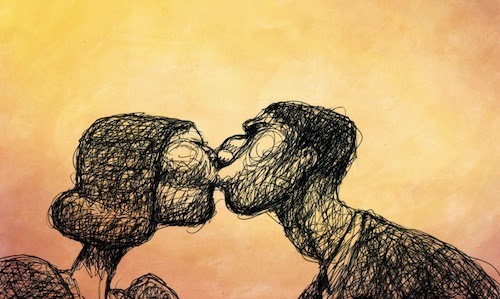
"H" is for Head Games has been spewed from whatever orifices Master Animator Bill Plympton chooses to release his brilliantly unhinged images and ideas. Here, two people engage in the simple, passionate act of kissing. Imagine if you will, the scandal caused by all 47-seconds of Edison's famous 1896 filmed re-enactment depicting a kiss twixt the somewhat disgusting May Irwin and John Rice then blend it together with Raymond Carver's short story "Popular Mechanics" in which two parents play tug-of-war with their child. You get the drift.
The Film Corner Rating: *****
"Q" is for Questionnaire is belched out from the ultra-cool Rodney Ascher who delivered the phenomenal conspiracy theory documentary Room 237 about the more brilliantly psychotic theories behind Stanley Kubrick's much-loved and oft-debated horror masterpiece The Shining. In the grand tradition of documentary direct cinema, cross-pollinated with zero-budgeted 50s/60s "brain" genre films, he presents two sides of a delightful coin as he bounces twixt an intelligence test and a man's brain being transplanted into the head of a gorilla. The only thing missing is the gorilla leeringly emitting a Jack Nicholson-like "Heeeeeeerrrrrrreeeee's Johnny!"
The Film Corner Rating: ***1/2
"S" is for Split is an ideal short genre film and makes clever, literal and metaphorical use of its title. Juan Martinez Moreno creates a numbing nightmare involving a cel phone conversation twixt a hubby and wife whilst a killer invades the family home and proceeds to search out and murder one of the significant others on view in a series of horrifically effective split screens that would make Brian De Palma proud if they didn't give the man a run for his money.
The Film Corner Rating: ***
![]() |
| Astron-6 Stud-Thesp Conor Sweeney is about to learn the meaning of PAYBACK!!! |
The Film Corner Rating: ***1/2
"U" is for Utopia is pure Vincenzo (Cube, Splice, Haunter) Natali. The man has a distinctive voice you can detect within seconds of seeing his seemingly cold, clinical, horrifying and mordantly funny work. Here we face a dystopian world of public execution (in malls, no less) and for the most egregious of crimes (in a perfect world, of course). Imagine, if you will, a dash of Kubrick, a sprinkling of Jean-Baptiste Leonetti, a few drops of Harlan Ellison via L.Q. Jones ('natch) and a few buckets o' Pure Natali. It's tasty!
The Film Corner Rating: ***1/2
"W" is for Wish is the latest cinematic chub o' kielbassa from that Winnipeg Wunderkind of the Astron-6 persuasion, the one, the only, Steven Kostanski. The madman behind Manborg serves up a delicious blend of his delightfully retro special effects and the kind of wonder we all felt as kids (and that those of us, who've never grown up, still feel). Kostanski's operating on similar ground to the Soskas here by wearing metaphor proudly (and entertainingly on his sleeve). The less said about this gem, the better. Suffice to say, we're given a dose, through the eyes of children, of how the things we wish for might come terrifyingly true. Mega-Bravo!
The Film Corner Rating: ****
"X" is for Xylophone by Julien Maury and Alexandre Bustillo features Béatrice Dalle, the still sexy Betty Blue girl herself, the incomparable muse of Jean-Jacques Beineix and every strapping young 70s/80s lad's mega-masturbation fantasy. Here, she's a somewhat long-in-tooth babysitter being driven to places she'd rather not traverse to, courtesy of an annoying child plunking on a fucking xylophone. Xylophone's in the hands of babes are fine, but only in moderation and this goddamn kid just doesn't know the meaning of the word.
The Film Corner Rating: ***
![]() |
| Refrain from ingesting your guitar. |
The overriding question is this: Is fantasy reality? O! Land of Nippon! I love thee!
The Film Corner Rating: ***
"Z" is for Zygote is the last short in the anthology and it's the surprise treat of ABCs of Death 2. The less said about the plot and/or content of Chris Nash's creepily eerie and downright brilliant shocker, the better. Just let it work its savoury magic upon you whilst rivalling the pus sucks hanging from Samantha Eggar's tummy in David Cronenberg's The Brood.
Storytelling and shocks at their very best.
The Film Corner Rating: ****
So there you have it: 10 fine films out of 26. Titles where the ambition of the filmmakers either exceeds their reach as filmmakers and/or falls short in the delivery department, but are worth seeing include "C" is for Capital Punishment, "F" is for Falling, "J" is for Jesus, "L" is for Legacy and "O" is for Ochlocracy. Adding these titles to the list increases the watchability-factor to 15 out of 26 titles. Adding middle of the road mediocrity (no need to point fingers on this inevitability) increases watchability to 19 out of 26 titles. The most horrendously disappointing film is master filmmaker Larry Fessenden's lazy effort "N" is for Nexus. The number of shorts that suck dirty, sweaty scrotum (including Fessenden's) are a mere 7 out of 26 titles. Not too bad at all when you get right down to it. Add to this mix cool opening and closing title sequences to the whole anthology and The ABCs of Death 2 yields a fine genre treat for horror lovers - especially as Halloween is looming.
THE FILM CORNER RATING for all 10 titles in the 3-5-Star Range: **** 4-Stars
THE FILM CORNER RATING for all 19 titles in the 2-5-Star Range: *** 3-Stars
THE FILM CORNER RATING for the whole 26-title package: **½ 2-and-a-half Stars
The ABCs of Death 2 had its Canuck launch at the 2014 edition of the Toronto After Dark Film Festival. It will be released theatrically in Canada (and via VOD and digital platforms) on October 31, 2014 through everyone's have Canuck indie distributor VSC. Playdates include the following:
On Demand and iTunes October 20, In Theatres October 31
Opens October 31
Toronto – Carlton Cinema, 20 Carlton Street
Calgary – Globe Cinema, 617 8th Avenue Southwest
Opens November 1
Vancouver – Rio Theatre, 1660 East Broadway
Opens November 5
Montreal – Centre PHI, 407 Rue Saint Pierre
Opens November 7
Ottawa – The Mayfair Theatre, 1074 Bank Street
Magnet Releasing is handling the distribution honours in USA
Labels:
****
,
*****
,
***1/2
,
2014
,
Bill Plympton
,
Chris Nash
,
Jen Soska
,
Juan Martinez Moreno
,
Robert Morgan
,
Rodney Ascher
,
Soichi Umezawa
,
Steven Kostanski
,
Sylvia Soska
,
TADFF 2014
,
Vincenzo Natali
,
VSC
Thursday, 9 May 2013
ROOM 237 - Review By Greg Klymkiw - COOL KUBRICK CONSPIRACY Theories in Feature Documentary
Room 237 (2012) ***1/2
TIFF 2012 - Vanguard Series
dir. Rodney Ascher
Starring: Bill Blakemore, Geoffrey Cocks, Juli Kearns, John Fell Ryan, Jay Weidner
Review By Greg Klymkiw
Cineastes and those who follow conspiracy theorists have a lot of things in common. They're obsessive, slavishly devotional and frankly, almost fanatical in studying, appreciating and relentlessly imbibing in their respective fields of interest. Can their paths cross? You bet. I know. I am one of the afflicted (or blessed, depending on how you choose to look at it).
The engaging new documentary feature entitled Room 237 blends both cine-mania with conspiracy theory. Chances are, if you're a movie geek, you'll already understand the significance of this title and if you aren't, nor have you seen Stanley Kubrick's crazily scary, creepy and hypnotic film adaptation of Stephen King's The Shining, then let's just say it refers to a room in an isolated old hotel where something very, very horrific happened (and likely will again).
Using a treasure trove of clips and stills from Kubrick's canon, director Rodney Ascher interviews five people who have spent an unhealthy number of their waking hours (over an ever MORE unhealthy number of years) studying and dissecting the hidden meanings they purport are found buried within The Shining. Ascher's picture is not a traditional making-of documentary or even a critical appreciation in the usual sense. Instead, we examine each one of the subjects' theories.
All of them believe Kubrick used subliminal messages in the film and generated a high-profile horror movie to act as a mere foreground mask for its real meaning.
The most outrageous conspiracy theory presented in Room 237 is that Kubrick stuffed The Shining with numerous secret messages he hoped would work as both an apology and cinematic form of redemption to make up for the overwhelming guilt he carried for his part in faking all the Apollo Moon landings.
Say what?
Yes, Kubrick's filmmaking genius was contracted by the American government to fake the historic trips to the Moon. If, according to the conspiracy theorist, you look really hard, everything anyone would need to prove this is on-screen in The Shining.
Good to know.
In all fairness, those interviewed for Ascher's film spend a fair bit of time discussing Kubrick's obsessive attention to the most minute details of every inch, of every frame, of every shot. This is indisputable. Kubrick was indeed a meticulous control freak and he no doubt included numerous subliminal (or not so subliminal) images to bolster the drama, themes and/or style of his films.
I have some doubts, however, that The Shining is an apology to the world for faking the entire Apollo moon programme. So too should you, lest, of course you're planning to check yourself in for some electro-shock therapy. (Something my late barber, Bill Sciak did for many years. Not because he was insane, but because he enjoyed getting regularly zapped.)
Some of the other theories are definitely fruit-loopy, but those which suggest Holocaust allegory or the effects of colonization upon America's indigenous peoples are certainly not without interest. For me, though, the most intriguing presentation involves Kubrick playing with the space and time of his own sets by intentionally making sure the designs - and one room in particular - could not logically exist within the architectural setting of the Overlook Hotel.
This theory is kind of cool as it feels like the kind of perverse filmmaking trick Kubrick might use to help generate an overall sense of unease. The interviewee in question comes across as completely bonkers, but in spite of this, it provides considerable food for thought.
What I really appreciated about Rodney Ascher's approach to this material is that he himself never makes fun of these people. His entire mise-en-scène is quite clever. The interviewees never appear on camera - only in voice-over. The images are virtually all Kubrick all the time. They're used to tell the interviewees' stories and to provide as much visual evidence as possible to bolster the theories. Yes, Ascher uses the footage to occasionally buoy the film with a sense of humour, but it's never mean-spirited and it's often clever and in and of itself, a definite homage to Kubrick.
The movie will also make you think twice about Calumet Baking Soda.
(I'll let you discover that nugget on your own.)
As I mentioned earlier, movies and conspiracy theory can be ideal bedfellows.
For me, my appreciation of conspiracy theory almost parallels my obsession with movies. It began in the 1960s, not long after experiencing a series of near-epiphanies upon first seeing films like 2001: A Space Odyssey, Planet of the Apes, Mario Bava's Black Sunday, Hammer Horror films, Sergio Leone westerns and Sam Peckinpah's The Wild Bunch. Movies not only became my whole life, they were, in fact, my life force.
At this time I read Erich von Daniken's "Chariots of the Gods", the first of a series of best selling "non-fiction" books that popularized the notion that extraterrestrials had been to Earth in our deep, dark past and were responsible for mankind's development. This wasn't classic conspiracy theory per se, but it was one of the first times I became enamoured with postulations that refuted traditional ways of thinking about the world. Not that von Daniken's theories were especially original - many of them had already been identified by other scientists (including Carl Sagan who had little use for the Swiss author's interpretations). His theories, to my child's minds eye, we forcefully and punchily conveyed.
Tellingly, my childhood fascination with von Daniken clearly sprouted from the magic of movies - most notably, Kubrick. The monolith in 2001: A Space Odyssey did a damn fine job transforming me into a true believer in extraterrestrial visitations in earlier eras of Earth's existence.
![]() |
| Erich von Daniken (Top Left), Kurt Saxon (Top Right), Art Bell (Bottom Left), George Noory (Bottom Right) |
Years later, I became obsessed with the world of shortwave radio. Shortwave had always been an acquired taste - a niche market, if you will. I had been introduced to shortwave as a child by my influential cousin Paul Klymkiw the subject of the bestselling non-fiction book "Paul in Perspective and brother of Slawko Klymkiw, former head of CBC English Programming and current Executive Director of Norman Jewison's Canadian Film Centre. Paul was an avid listener of "Radio Free Cuba" and we'd listen to it late into the night. He even showed me all the excellent literature he sent away for and received at his parents' home (and this, during the Cold War). I, of course, followed suit and also received this fine communist literature.
God only knows how many watch lists we're on, but to this day I'm still obsessed with all things shortwave. In the pre-internet days of the 1990s, shortwave had especially become the haven for a wide variety of nut cases and it was here where my loyal listenership to it blossomed.
I was drawn to it like a fly to the proverbial dung heap.
Every manner of conspiracy theorist, right wing religious psycho and, allow me to add, heavy metal Christian Rockers managed to find a home on these oddball airwaves. It was here where I discovered one of the great conspiracy theorists of them all, the extremely entertaining Kurt Saxon, a survivalist based in Alpena, Arkansas. "Just let them Federal Boys try and find us here in these backwoods," was a common Saxon refrain.
Though Kurt's ruminations on impending social/economic collapse proved both sound and prescient, his theories regarding Eugenics were, shall we say, a tad too extreme for a reasonably tempered right-wing Communist and dyed-in-the-wool pseudo-Liberterian like myself.
The late 90s and beyond delivered the highest-rated talk radio in the world: "Coast-to-Coast-A.M." with the master of all things conspiratorial Art Bell and his eventual and current replacement George Noory.
Through these decades of avowed interest in conspiracy theory, I maintained my obsession with the movies - becoming, as I was once described by some anonymous blogger as, "a quite possibly clinically insane cinephile."
I suspect that with this history, it makes sense to have been positively disposed to a picture like Room 237. That said, it's a genuinely clever, compelling and funny look at one of the best movies of all time.
And that, my friends, is nothing to sneeze globs of blood-flecked snot at.
"Room 237" first premiered at the Toronto International Film Festival (TIFF 2012) and is currently being released theatrically via Mongrel Media. The film is playing theatrically at the Bloor Hot Docs Cinema and the TIFF Bell Lightbox Theatre.
Labels:
*** 1/2
,
2012
,
Conspiracy Theory
,
Documentary
,
Greg Klymkiw
,
Hot Docs Bloor Cinema
,
Mongrel Media
,
Rodney Ascher
,
Stanley Kubrick
,
The Shining
,
TIFF Bell Lightbox
Saturday, 15 September 2012
ROOM 237 - TIFF 2012 - Review By Greg Klymkiw - Blending cine-mania with conspiracy theory, Rodney Ascher's clever & funny documentary opens your eyes wide shut to new insights on Kubrick's "The Shining" that you never knew, and perhaps, were even afraid to ask.
Room 237 (2012) ***1/2
TIFF 2012 - Vanguard Series
dir. Rodney Ascher
Starring: Bill Blakemore,
Geoffrey Cocks, Juli Kearns,
John Fell Ryan, Jay Weidner
Review By Greg Klymkiw
Cineastes and those who follow conspiracy theorists have a lot of things in common. They're obsessive, slavishly devotional and frankly, almost fanatical in studying, appreciating and relentlessly imbibing in their respective fields of interest. Can their paths cross? You bet. I know. I am one of the afflicted (or blessed, depending on how you choose to look at it).
The engaging new documentary feature entitled Room 237 blends both cine-mania with conspiracy theory. Chances are, if you're a movie geek, you'll already understand the significance of this title and if you aren't, nor have you seen Stanley Kubrick's crazily scary, creepy and hypnotic film adaptation of Stephen King's The Shining, then let's just say it refers to a room in an isolated old hotel where something very, very horrific happened (and likely will again).
Using a treasure trove of clips and stills from Kubrick's canon, director Rodney Ascher interviews five people who have spent an unhealthy number of their waking hours (over an ever MORE unhealthy number of years) studying and dissecting the hidden meanings they purport are found buried within The Shining. Ascher's picture is not a traditional making-of documentary or even a critical appreciation in the usual sense. Instead, we examine each one of the subjects' theories.
All of them believe Kubrick used subliminal messages in the film and generated a high-profile horror movie to act as a mere foreground mask for its real meaning.
The most outrageous conspiracy theory presented in Room 237 is that Kubrick stuffed The Shining with numerous secret messages he hoped would work as both an apology and cinematic form of redemption to make up for the overwhelming guilt he carried for his part in faking all the Apollo Moon landings.
Say what?
Yes, Kubrick's filmmaking genius was contracted by the American government to fake the historic trips to the Moon. If, according to the conspiracy theorist, you look really hard, everything anyone would need to prove this is on-screen in The Shining.
Good to know.
In all fairness, those interviewed for Asxher's film spend a fair bit of time discussing Kubrick's obsessive attention to the most minute details of every inch, of every frame, of every shot. This is indisputable. Kubrick was indeed a meticulous control freak and he no doubt included numerous subliminal (or not so subliminal) images to bolster the drama, themes and/or style of his films.
I have some doubts, however, that The Shining is an apology to the world for faking the entire Apollo moon programme. So too should you, lest, of course you're planning to check yourself in for some electro-shock therapy. (Something my late barber, Bill Sciak did for many years. Not because he was insane, but because he enjoyed getting regularly zapped.)
Some of the other theories are definitely fruit-loopy, but those which suggest Holocaust allegory or the effects of colonization upon America's indigenous peoples are certainly not without interest. For me, though, the most intriguing presentation involves Kubrick playing with the space and time of his own sets by intentionally making sure the designs - and one room in particular - could not logically exist within the architectural setting of the Overlook Hotel.
This theory is kind of cool as it feels like the kind of perverse filmmaking trick Kubrick might use to help generate an overall sense of unease. The interviewee in question comes across as completely bonkers, but in spite of this, it provides considerable food for thought.
What I really appreciated about Rodney Ascher's approach to this material is that he himself never makes fun of these people. His entire mise-en-scène is quite clever. The interviewees never appear on camera - only in voice-over. The images are virtually all Kubrick all the time. They're used to tell the interviewees' stories and to provide as much visual evidence as possible to bolster the theories. Yes, Ascher uses the footage to occasionally buoy the film with a sense of humour, but it's never mean-spirited and it's often clever and in and of itself, a definite homage to Kubrick.
The movie will also make you think twice about Calumet Baking Soda. (I'll let you discover that nugget on your own.)
As I mentioned earlier, movies and conspiracy theory can be ideal bedfellows.
For me, my appreciation of conspiracy theory almost parallels my obsession with movies. It began in the 1960s, not long after experiencing a series of near-epiphanies upon first seeing films like 2001: A Space Odyssey, Planet of the Apes, Mario Bava's Black Sunday, Hammer Horror films, Sergio Leone westerns and Sam Peckinpah's The Wild Bunch. Movies not only became my whole life, they were, in fact, my life force.
At this time I read Erich von Daniken's "Chariots of the Gods", the first of a series of best selling "non-fiction" books that popularized the notion that extraterrestrials had been to Earth in our deep, dark past and were responsible for mankind's development. This wasn't classic conspiracy theory per se, but it was one of the first times I became enamoured with postulations that refuted traditional ways of thinking about the world. Not that von Daniken's theories were especially original - many of them had already been identified by other scientists (including Carl Sagan who had little use for the Swiss author's interpretations). His theories, to my child's minds eye, we forcefully and punchily conveyed.
Tellingly, my childhood fascination with von Daniken clearly sprouted from the magic of movies - most notably, Kubrick. The monolith in 2001: A Space Odyssey did a damn fine job transforming me into a true believer in extraterrestrial visitations in earlier eras of Earth's existence.
Years later, I became obsessed with the world of shortwave radio. Shortwave had always been an acquired taste - a niche market, if you will. (I had been introduced to it as a child by my cousin Paul who was an avid listener of "Radio Free Cuba.") In the pre-internet days of the 1990s, shortwave had become the haven for a wide variety of nut cases.
Needless to say, I was drawn to this like a fly to the proverbial dung heap.
Every manner of conspiracy theorist, right wing religious psycho and, allow me to add, heavy metal Christian Rockers managed to find a home on these oddball airwaves. It was here where I discovered one of the great conspiracy theorists of them all, the extremely entertaining Kurt Saxon, a survivalist based in Alpena, Arkansas. "Just let them Federal Boys try and find us here in these backwoods," was a common Saxon refrain.
Though Kurt's ruminations on impending social/economic collapse proved both sound and prescient, his theories regarding Eugenics were, shall we say, a tad too extreme for a reasonably tempered right-wing Communist and dyed-in-the-wool pseudo-Liberterian like myself.
The late 90s and beyond delivered the highest-rated talk radio in the world: "Coast-to-Coast-A.M. with the master of all things conspiratorial Art Bell and his eventual and current replacement George Noory.
Through these decades of avowed interest in conspiracy theory, I maintained my obsession with the movies - becoming, as I was once described by some anonymous blogger as, "a quite possibly clinically insane cinephile."
I suspect that with this history, it makes sense to have been positively disposed to a picture like Room 237. That said, it's a genuinely clever, compelling and funny look at one of the best movies of all time.
And that, my friends, is nothing to sneeze globs of blood-flecked snot at.
"Room 237" premiered at the Toronto International Film Festival (TIFF 2012). For information, visit the TIFF website HERE.
Labels:
*** 1/2
,
2012
,
CFC
,
Colin Geddes
,
Documentary
,
Greg Klymkiw
,
KFC
,
Rodney Ascher
,
TIFF
,
TIFF 2012
,
TIFF Vanguard Series
,
Toronto International Film Festival 2012
Subscribe to:
Posts
(
Atom
)