Showing posts with label Crime. Show all posts

Sunday, 16 July 2017

LOWLIFE - Review By Greg Klymkiw - A Luchador Thug in Tarantinoville at Fantasia 2017

El Monstruo worships a grand Luchador at a Holy Shrine!

Lowlife (2017)
Dir. Ryan Prows
Scr. Prows, Tim Cairo, Jake Gibson, Shaye Ogbonna, Maxwell Michael Towson
Starring: Ricardo Adam Zarate, Nicki Micheaux, Santana Dempsey,
Mark Bunrham, Jon Oswald, Shaye Ogbonna

Review By Greg Klymkiw

Luchadores, those glorious masked wrestlers of Mexico (popularized in the 20th century by the likes of El Santo and The Blue Demon) are emblematic of all that is good and evil - heroes and villains to the common man, performing great feats of gymnastic warfare in the ring and dazzlingly costumed in ancient Aztec tradition. Most notable is that the greatest artists amongst the lucha libre will, more often than not, never remove their masks. Once a luchador dons his public visage, he has a sacred duty to keep it affixed to his face forever.

In Lowlife, the dazzling feature debut of director Ryan Prowse, El Monstruo (Ricardo Adam Zarate) has a considerable legacy to uphold. His father was not only Mexico's greatest wrestler, but revered as a legendary freedom fighter. Too bad then that El Monstruo has been relegated to working as a waiter and low-level thug at a Taco Restaurant in Los Angeles, a business front for Teddy 'Bear' Haynes (Mark Bunrham), a scumbag gringo hoodlum who kidnaps illegal aliens for the purposes of illegal organ harvesting, baby-selling and prostitution.

El Monstruo has another problem. His pregnant wife Kaylee (Santana Dempsey) is a heroin addict and Teddy has designs on selling her baby once she gives birth. Kaylee's mother Crystal (Nicki Micheaux), who now runs a sleazy motel, was also once similarly afflicted and sold her child to feed her habit. Crystal pines for the daughter she never knew and watches Kaylee from afar. When Teddy hires two thugs (Jon Oswald, Shaye Ogbonna) to kidnap the luchador's drug-addled wife, they take her to Crystal's motel, a known drop-off and pick-up point for his nefarious activities.

Hell, vengeance and sacrifice are just round the corner. A climactic blood bath awaits.

Though Prows has borrowed a story-telling structure quite liberally from Quentin Tarantino and occasionally infuses the tale with dialogue of a similar nutty hardboiled kind, the film never feels derivative. The picture is brimming with touches that tantalize and delight; a grand monologue on the tradition of the Luchas libres that reveals a sweet, innocent recipient of the words and eventually yields a horrific act of violence, is a crime picture set-piece of the highest order. Prows is clearly in Tarantino's debt, but he wisely places most of the emphasis upon mad, operatic melodrama. The movie is as moving as it is grittily shocking and deeply, darkly funny.

Humanity ultimately rules the day in this sleazy world and though a luchador can only remove his mask in death, the legacy will continue if he makes his sacrifice in the name of all that is good and true. Such is the driving force of Lowlife and we are blessed with a film that allows us to soar.

THE FILM CORNER RATING: ****

LOWLIFE enjoys its World Premiere at Fantasia 2017.

Wednesday, 12 July 2017

BABY DRIVER - Review By Greg Klymkiw - Lead Character Needs to be Punched in the Face.

Baby needs to be punched in the face - and often.

Baby Driver (2017)
Dir. Edgar Wright
Starring: Ansel Elgort, Kevin Spacey, Lily James, Jamie Foxx,
Eiza González, Jon Hamm, Jon Bernthal, Paul Williams, Sky Ferreira

Review By Greg Klymkiw

Baby (Ansel Elgort) is an ace getaway driver for Doc (Kevin Spacey), an Atlanta crime kingpin who never uses the same crew for the bank heists he masterminds, but happily breaks from protocol by using Baby each and every time. The kid is the best. He also owes Doc a whack of "tribute" dough and is paying down the debt. The kid suffers from the tinnitus he acquired in a car accident that spared him, but munched his Mommy and Daddy. He's perpetually plugged into classic R&B to drown out "the hum in his drum" and provide the necessary inspiration to put the pedal to the metal. When Baby isn't driving, he pretty much comports himself the same way. With tunes blasting through earphones, Baby bobs his head with the same metronomic rhythm that a cow chews its cud.

Baby might be the most annoyingly insufferable big-screen figure since Jar-Jar Binks (or, perhaps, Patch Adams or Sam Witwicky) and there isn't a moment this cutesy bonehead doesn't inspire me to want to punch him in the face - repeatedly, I might add. Almost as sickening is Baby's love interest Debora (Lily James), a vapid, toothy waitress who's clearly as empty as he is since she falls in love with him at first sight. Yes, she too needs to be punched in the face.

Look, I love Edgar Wright's Shaun of the Dead as much as the next fella, but his output ever since has adhered to the law of diminishing returns and Baby Driver is the nadir. Jam-packed with by-rote crime movie cliches in the guise of "homage", the picture seems machine-tooled to appeal to audiences as bovinely-brained as its lead character.

None of the endless car chases have any narrative urgency, nor are they ever rooted in anything resembling genuine desperation. I could almost accept this if Wright handled the heists and chases with some kind of genuine panache, but they're all a compendium of the usual contemporary ADHD editing with cameras all over the place and cuts driven by sound rather than picture. It's deathly dull. The stunt work is fine, but it seems to be captured by sight-bereft filmmakers.

A few nights after seeing this piece of shit I re-watched William Friedkin's To Live and Die in L.A. and had the hairs standing up on the back of my neck during some of the most hair-raising, dramatically urgent car chase footage ever committed to film. No such hairs stood up for me during Baby Driver. In fact, I was often so bored that my mind wandered to the notion of shaving my flaccid pubic hairs to give me something to do whilst watching the tedious proceedings.

Even more egregious is that the whole thing is so moronically sun-dappled that Wright can't even muster up enough balls to generate the kind of gloriously downer ending a great crime picture demands. Baby is involved in several high-profile robberies and is an accessory to a whack of murders, but so many of the film's supporting characters attest to his goodness as a human being that he barely serves any prison time and by the end of the picture hops into some hot wheels with his moron girlfriend to trip the highways fantastic.

Leaving the cinema as Baby Driver ended, I not only wanted to punch Baby in the face, I just wanted to punch everyone happily leaving the cinema. The stupid grins plastered upon their satisfied visages all seemed worthy of rearrangement via my fists.

THE FILM CORNER RATING: * One-Star

Baby Driver is in wide release via Tri-Star and Sony Pictures.

Monday, 10 July 2017

L'ARGENT - Review By Greg Klymkiw - Bresson's final film gets the Criterion treatment.

Robert Bresson's last film might be his greatest...
and the Dude made one great picture after another.

L'Argent (1983)
dir. Robert Bresson
Starring: Christian Patey, Caroline Lang, Sylvie Van den Elsen, Vincent Risterucci

Review By Greg Klymkiw

Robert Bresson died in 1999. During his forty years as a director, he made only 15 feature films. He was uncompromising.

On one hand, it seems disgraceful it was so difficult for him to secure financing. On the other, when one looks at filmmakers of equal genius (albeit very different filmmakers), the ease with which they were able to grind out film after film left quite a few stinkers in their canons and as their careers progressed into their august years, the work itself adhered strictly to the law of diminishing returns. For me, Ford and Capra (who, in fairness often took gun-for-hire gigs with studios) are those who fall into this category. There were exceptions to the rule like John Huston, who made his fair share of stinkers, but in his last years generated several terrific pictures and in the case of The Dead, his last film, a bonafide masterpiece.

L'Argent was Bresson's last film and made 15 years before his death. I hate to imagine what those final 15 years were like NOT making a film, but one hopes he took some solace in the fact that this was exactly the sort of final work that every artist dreams of leaving behind.

Not only is this picture the ultimate Bresson film - a culmination of his deeply original approach to cinematic storytelling - but is, in fact, a deeply important film; artistically and morally. This is a film that, on its surface seems utterly stripped of redemption for its lead character, for the world and finally, for humanity. This, I believe, IS purely surface. L'Argent may well be one of the great humanist works of the 20th century - up there with the greatest films of Jean Renoir, if not in a stratosphere far above.

While Bresson's work was always secular in its humanism, there was also an adherence to faith - lapsed or otherwise and importantly, never in the sense of religious humanism. L'Argent presents a world where any sense of faith is betrayed and/or quashed and yet, in spite of this (and in spite of the almost cold, calculatingly precise manner in which the tale is rendered), this might well be Bresson's most emotional and affecting film - his most profoundly moving work.

It should probably come as no surprise that L'Argent is based on a literary work by Leo Tolstoy - a writer who practically defined the modern art of narrative (as I'd argue Bresson did with cinema), a great thinker/philosopher (again, not unlike Bresson) and a believer in both faith and a higher power, but ultimately eschewing the corruption and hypocrisy of organized religion (and again, Bresson being cinema's Tolstoy in this regard). Where Bresson and Tolstoy appear to part, at least literally, is that Bresson chose to base his film upon only Part I of Tolstoy's novella "The Forged Coupon" and not touch Part II of the work - the part wherein redemption was sought and found.

For Bresson's great film, this was a brave, brilliant and strangely apt choice.

There is, finally, something mysteriously affecting in Bresson's almost under-a-microscope study of how one immoral action sets off a chain of events, domino-like, of one unethical act after the other until we are faced with the ultimate evil, actions of the most viciously immoral kind - conducted with no remorse, no feeling (not even hate, it seems) and certainly - no redemption.

The tale Bresson spins is relatively faithful to Tolstoy's (though updated to contemporary France). A forged bill is passed on to a hapless soul who is powerless to fight the punishment he receives after unwittingly passing on the fake money. Losing his job and any reasonable prospect of employment to support his wife and child, he takes on the job of a getaway driver during a heist. He is caught, sentenced to prison and loses his child to a fatal illness and his wife who decides to move on and begin a new life. Upon his eventual release from prison, he has nothing. His soul seems drained and his actions become increasingly violent.

Upon committing an utterly heinous and unpardonable sin/crime, he calmly turns himself in - not out of redemption or guilt or compassion, but to further an opportunity to be incarcerated with the person who passed him the bill in the first place - to exact cold, calculated revenge (and by this point, without even the extreme emotion of hatred - revenge becomes almost a base need).

It is here where Bresson offers one of the most astonishing final images and cleaves it off literally with a picture cut to black that is so exquisite, so precise, so emotionally and viscerally powerful, that experiencing it invokes a physical response that is literally breathtaking.

Tolstoy offered us redemption. Bresson denies it to us. Two different approaches to the same material, however, yield similar results. We so desperately cling to the hope that redemption will come to Bresson's central character, that it's our hope, that is, finally, the redemption. Bresson allows us to seek humanity in ourselves through the inhuman actions of another.

This is a masterpiece.

To not see it, to not acknowledge this, to not revisit this great work again and again and again is to deny cinema and the power of cinema - one that even Tolstoy himself in his final years lamented not having an opportunity to tackle.

Cinema is a great gift.

Bresson, however, was the greatest gift to cinema and L'Argent is his greatest film.

THE FILM CORNER RATING: ***** 5-Stars

L'Argent is now available via the Criterion Collection with a new restored 4K digital transfer, with uncompressed monaural soundtrack on the Blu-ray, the press conference from the 1983 Cannes Film Festival, a new video essay by film scholar James Quandt, the trailer, a new English subtitle translation, an essay by critic Adrian Martin and a newly expanded 1983 interview with director Robert Bresson.

Tuesday, 4 July 2017

Bob le flambeur - Review By Greg Klymkiw - Classic Melville Heist Picture at Toronto's TIFF Bell Lightbox in summer 2017 series "Army of Shadows: The Films of Jean-Pierre Melville" and via the O.O.P. Criterion Collection DVD.

Aging high-roller takes the biggest gamble of them all.

Bob le flambeur (1956)
Dir. Jean-Pierre Melville
Scr. Melville & Auguste Le Breton
Starring: Roger Duchesne, Daniel Cauchy, Isabelle Corey, Guy Decomble, Gérard Buhr

Review By Greg Klymkiw

"I was 14 when I left my mother... I returned 10 years later, early one morning. I saw an old woman on her knees, scrubbing away, as she always had. That's how I recognised her. I left without a word. Then I sent her a postal order each month. One month it was sent back. She had stopped scrubbing." - Bob Montagné in Jean-Pierre Melville's Bob le flambeur

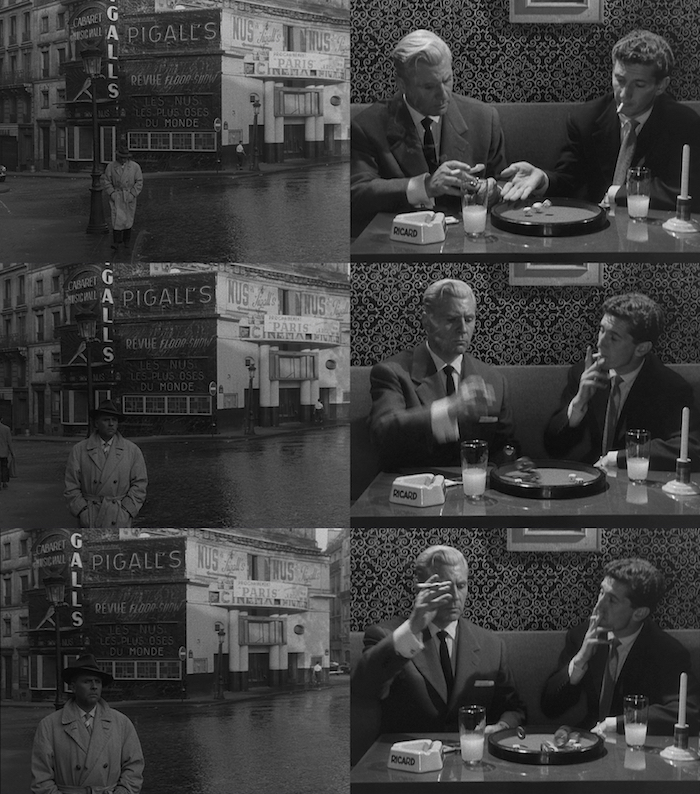
In the moments between night and day, by the dawn's early light, in Montmartre, that hallowed, hilly zone of solemnity and sleaze in Paris, resting somewhere between the Heaven of the Basilica of the Sacré-Cœur at its highest point and below it, the Hell of nightclubs, cheap hotels, cafes, whorehouses and gambling dens, the distinguished trench-coat-adorned silver-haired old fox Bob Montagné (Roger Duchesne) takes one last roll of the dice.

Craps.

It's been a long night and Bob's wiped out. He steps out onto the lonely morning streets, looks into a storefront reflection, straightens his tie and, taking in his weary visage, remarks aloud: "A real hood's face."

And so it is, but he's definitely not your run-of-the-mill garden variety miscreant. Bob Montagné is a class act. He's practically royalty, at least by the standards of magical Montmartre. Sure, he's been in an out of stir for most of his life, but amongst the post-war criminal class of France, he's pulled off some of the most daring heists, and as such, commands respect from thugs and cops alike.

He's a high-roller, you see, and everyone loves Bob: he's worshipped by the sweet young criminal Paulo (Daniel Cauchy), whilst the grizzled police lieutenant Ledru (Guy Decomble) considers him his best friend (and indeed owes his life to him) and, of course, there's a woman - the beautiful young Annie (Isabelle Corey), who adores him for his fatherly influence and generosity. Yes, everyone loves Bob, except for the foul pimp and stool pigeon Marc (Gérard Buhr). Bob has even less use for Marc, a piece of excrement on two legs who beats his women, sells anyone out for the right price and even tries to lure Annie into his stable.

Right from the opening frames of Jean-Pierre Melville's Bob le flambeur we know we're about to enter the world of the criminal class, but for the most part, "class" is the order of the day for men like our title character. Bob's also down for the count, but he's not there for long. He springs up with one last plan to restore himself. As an inveterate gambler, he knows all too well how much dough collects in a casino after a long night and he decides to put together a crack team to pull a heist on the mighty Deauville gaming emporium.

The magical world of Montmartre:
Wet streets, nightclubs, cigarettes and dice.

Best laid plans, however, can go awry, but the manner in which Melville explores this is one of the reasons why Bob le flambeur is a masterpiece. Let's put aside the fact that the picture's sense of atmosphere is so thick you can cut it with a knife, that its touches of Neo-realism make us feel like we're living, breathing and even smelling a world most of us will never know, that its eventual and shocking bursts of violence knock us on our butts and indeed influenced every crime picture that followed in its wake.

Let's put all that aside for a moment. Let's marvel at the sheer, brilliant simplicity of one key stroke of narrative genius:

Bob le flambeur is a heist film in which part of the caper itself involves its mastermind playing the tables of the casino he's going to rob and just as he's about to risk committing a crime that might land him in the hoosegow for a very long time, his rolls of the dice start to yield him a fortune that he's never seen in his life - a fortune that might indeed exceed that of what he could ever hope to rob from the joint.

Damn, this is genius.

THE FILM CORNER RATING: ***** 5-Stars

Bob le flambeur screens at Toronto's TIFF Bell Lightbox in the summer 2017 series "Army of Shadows: The Films of Jean-Pierre Melville" and, via the O.O.P. Criterion Collection DVD which includes an interview with Daniel Cauchy and an archival Gideon Bachman radio interview with Jean-Pierre Melville.

Monday, 3 July 2017

RIFIFI - Review By Greg Klymkiw - The greatest heist film ever made screens at Toronto's TIFF Bell Lightbox in the Summer 2017 series "Panique: French Crime Classics" and is also available on a gorgeous Criterion Collection Blu-Ray/DVD


Rififi (1955)
Dir. Jules Dassin
Scr. Dassin & René Wheeler
Nvl. Auguste Le Breton
Starring: Jean Servais, Carl Möhner,Robert Manuel,
Jules Dassin, Janine Darcey, Magali Noël, Claude Sylvain

Review By Greg Klymkiw

The major set piece of this extraordinary French crime film by blacklisted American director Jules Dassin is a breathless thirty-minute-long heist sequence that is shot with natural sound, no dialogue and no music.

It's pure cinema!

It's also one of the most nail-bitingly suspenseful scenes in movie history. We've come to know the characters, we understand the high stakes for all of them if they don't pull off the big steal and worst of all, we're well aware of what will happen if they're caught - especially the desperate old man, Tony "le Stéphanois" (Jean Servais). He's just served five years of hard time for a heist gone wrong and his only choices in life amount to petty crime, gambling and/or getting caught and being tossed back into the hoosegow until he's dead (or as close to dead as he'll ever get).

These men are criminals, but we want them to succeed. It's post-war France and the opportunities for men who've known only one way to survive are pretty much non-existent. They live by a strict code of honour and they'll steal, but they won't kill (at least until they are pushed to the limit to do so). There's clearly honour amongst these thieves (save for the slimy, greasy, lazy borderline pimps who weasel into the proceedings later on) and we never once feel like there are viable options for our main characters.

And so, we follow them willingly and almost complicitously into the breach - an insanely daring heist that requires split-second timing, impeccable teamwork and one hell of a massive whack of horseshoes worth of luck stuffed up their respective and collective keisters.


If the heist was only thing Rififi had going for it, there's no doubt the picture would be highly regarded, but that its bookends are as solid and compelling as all get out place Dassin's movie on s pedestal that holds some of the greatest crime pictures ever made. The manner in which Dassin shoots the heist is completely in keeping with his approach to the rest of the movie. Shooting almost exclusively on location captures the naturalistic feeling of the film's hard-boiled tale. Much like his groundbreaking American crime pictures (Naked City, Brute Force) which, broke American cinema out of the studio bound mould and took them onto the streets a la the Italian neorealist movement, Rififi is a glorious blend of stylized frissons within the framework of life itself.

Dassin, of course, had a tiny budget and little time to shoot the film, so he personally scouted all the locations in order to get a strong visual sense in advance to allow for impeccable planning. In many ways, Rififi is a model picture for independent, low budget approaches that are still infused with the highest degree of production value. Within Dassin's impeccable eye for visual detail, he's doubly blessed by working with the genius production designer Alexandre Trauner who manages to deliciously goose the look of the film.


Narratively, the tale is tough-minded and even romantic, but the attention to the details of the lives of the criminals and the heist itself (including the meticulous planning) give it the crank it needs to always keep us glued to the screen. As well, there's no overwhelming (and annoying) sense of the proceedings ever diving into moralistic waters. We believe in these men AND their criminal intent. We want them to succeed and if things go wrong and all becomes futile, Dassin sets the picture up in such a way that we're going to feel and care deeply about whatever plight the characters suffer. It helps, also, that the casting is impeccable - especially Servais as the world weary "le Stéphanois", Dassin himself as the funny, sprightly and finally, almost tragic figure of the ladies' man, as well as the other disparate and memorable members of the team.

The importance of Rififi as both dazzling entertainment, but as well, its place in laying the foundations for crime pictures that followed as well as the whole French New Wave that would come a few years later is, frankly, incalculable. All its historical significance aside, it's one hell of a good show! Rififi is brutal, harrowing and darkly funny and it seldom got better than this. The dames are dames, its heroes noble and the villains are pure filth. Sure, the movie trades in on the tropes of the genre, but does so expertly within its overwhelming naturalism that nothing ever feels cliched and is, in fact, far fresher than most films made today.

THE FILM CORNER RATING: ***** 5-Stars

Rififi screens at Toronto's TIFF Bell Lightbox in the Summer 2017 series "Panique: French Crime Classics" and is also available on a gorgeous Criterion Collection Dual Format Blu-Ray/DVD release complete with New 2K digital restoration, my favourite uncompressed monaural soundtrack, a very inspirational interview with director Jules Dassin, set design drawings by art director Alexandre Trauner, still, trailer, an optional English-dubbed soundtrack (especially handily for additional screenings to just study Dassin's visuals and a terrific essay by Jim Hoberman.

Sunday, 2 July 2017

ELEVATOR TO THE GALLOWS (Ascenseur pour l'échafaud) - Review By Greg Klymkiw - Louis Malle's Taut Fiction Feature Debut at Toronto's TIFF Bell Lightbox in the Summer 2017 series "Panique: French Crime Classics" and, of course, on a gorgeous Criterion Collection DVD

Babes. Hunks. Cigarettes. Murder. Paris. UNBEATABLE!!!

Elevator to the Gallows - Ascenseur pour l'échafaud (1958)
Dir. Louis Malle
Scr. Malle & Roger Nimier
Nvl. Noël Calef
Starring: Jeanne Moreau, Maurice Ronet, Georges Poujouly, Yori Bertin,
Jean Wall, Iván Petrovich, Elga Andersen, Félix Marten, Lino Ventura, Charles Denner

Review By Greg Klymkiw

Some movies demand the ingestion of popcorn. Others require mind-altering illicit substances. Louis Malle's stylish crime picture Elevator to the Gallows (Ascenseur pour l'échafaud) makes the insistent and peremptory request that you light up the strongest cigarettes imaginable and chain smoke your way through it from beginning to end. (For anyone planning a big-screen sojourn to see the picture at TIFF Bell Lightbox, you will sadly be shit out of luck on this front due to our city's regressive anti-smoking by-laws.)

Though Louis Malle (Au revoir les enfants, My Dinner with Andre, Atlantic City, Pretty Baby) had already garnered an Academy Award for his 1956 Jacques Cousteau documentary The Silent World, the French New Wave director wisely put together a sure-fire low-budget hit with this first dramatic feature film to solidify his place as a bankable filmmaker and damn, did he dazzle everyone with this très-cool crime thriller based on the pulpy Noël Calef novel. If it's a trifle cold and bereft of some of the hallmarks of Malle's later humanity, we can easily forgive that and just sit back and enjoy this delectable, unbeatable, suspensful indulgence replete with babes, hunks, plenty of cigarettes, zippy cars, cheap motels and murder most foul.

Our movie opens with the impossibly gorgeous couple Florence Carala (Jeanne Moreau) and Julien Tavernier (Maurice Ronet) passionately professing their love for each other over the telephone. A murder is committed, a mistake is made and our lovers are kept apart when our hero is caught in an elevator without power and the heroine is left alone waiting for him and forced to wander the streets of Paris, desperately looking for him. Tavernier's car is stolen by the impossibly handsome young thug Louis (Georges Poujoully) and his impossibly gorgeous girlfriend Véronique (Yori Bertin). The barely-out-of-their-teens couple goes on a joy ride and encounter the gregarious vacationing and champagne-armed German couple Horst (Iván Petrovich) and Frieda (Elga Andersen).

Partying and sex is assured. More murder is just round the corner.

Nail-biting suspense, mistaken identity and dogged detective work from cops Lino Ventura and Charles Denner follow in due course. Henri Decaë's gorgeous black and white cinematographic lensing of Paris and an astonishing music score by Miles Davis carry us along in one of the most delightful noir-tinged crime pictures of the period.

No need to spoil the proceedings with any further details. Just sit back with plenty of throat-shredding ciggies and enjoy!

THE FILM CORNER RATING: **** 4-Stars

Elevator to the Gallows (Ascenseur pour l'échafaud) plays on the big screen at Toronto's TIFF Bell Lightbox in the Summer 2017 series "Panique: French Crime Classics" and, of course, on a gorgeous Criterion Collection special edition double disc DVD that includes a new interview with Jeanne Moreau, archival interviews with Malle, Ronet, Moreau and soundtrack session pianist René Urtreger, footage of Miles Davis and Louis Malle from the soundtrack recording session, a new video program about the score with jazz trumpeter Jon Faddis and critic Gary Giddins, Malle’s student film Crazeologie, featuring the title song by Charlie Parker, Theatrical trailers and a booklet featuring a Terrence Rafferty essay, Malle interview and tribute by producer Vincent Malle.


Wednesday, 28 June 2017

Le Samouraï - Review By Greg Klymkiw - Classic crime picture (on 35mm no less) at Toronto's TIFF Bell Lightbox in summer 2017 series "Army of Shadows: The Films of Jean-Pierre Melville" and, of course available on a gorgeous DVD via the Criterion Collection

Contract killer played by oh-so cool Alain Delon.

Le Samouraï (1967)
Dir. Jean-Pierre Melville
Scr. Melville & Georges Pellegrin
Starring: Alain Delon, François Périer, Nathalie Delon, Cathy Rosier

Review By Greg Klymkiw

Jef Costello is a contract killer. He's clearly good at his job, but he's also inordinately, almost ferociously cool. Oh yeah, he's cool as a cucumber - when you kill for money, you've gotta be, but the "cool" I'm really talking about here is more than his solitary reserve; Jef Costello is cool, as in: he's out of sight, man!

How can he not be?

In Jean-Pierre Melville's awesome 1967 crime thriller Le Samouraï, he's played by the epitome of cool, Alain Delon. When we first meet him, the dude is relaxing in his grungy, spartan Montmartre bachelor suite, smoking a butt on his bed while his tiny pet bird tweets in its cage. Titles appear over this strangely unsettling scene of repose:

"There is no solitude greater than a samurai's,
unless perhaps it is that of a tiger in the jungle."

The quotation is attributed to the "The Book of Bushido". As it turns out, this book is non-existent. It's Melville's invention - no doubt inspired by similar tomes - but that the great auteur chooses to open his film with a manufactured quotation is telling. We're about to enter a world in which the filmmaker is going to steep us in style of the highest order - the film's mise-en-scène proves to be copiously luxuriant in Melville's mastery of technique and appearance. We're going to feel his mitts all over this picture.

Astonishingly though, this will be no mere exercise in style for its own sake. Melville also infuses the work with oddly Neo-realist properties. We know we're watching a movie, but good goddamn, at times it feels like life itself.

And so it is that Jef Costello, attired in a grey trench coat and impossibly sexy fedora, eventually enters a nightclub and guns a man down in cold blood.

Jef's made some mistakes, or so it seems. He's not only been noticed, but at one point he comes face-to-face with a witness, Valérie (Cathy Rosier) the club's gorgeous, exotic piano player. But Costello is too steely and handsome. Valérie refuses to identify him in a police lineup.

This frustrates the Superintendent (François Périer) of the investigating homicide division because his gut is telling him Jef's his killer, in spite of the fact that our icy hitman appears to have crafted a reasonably iron-clad alibi, provided in part by the gorgeous ('natch) Jane Lagrange (Nathalie Delon) his "fiancé", a beautiful hooker with a heart of gold.

The Superintendent is not going to let go. He clamps his vice-like jaws upon Jef like a pit bull. using every available resource at his disposal. To make matters worse, our sleek hero is double-crossed by the men who hired him. They're welching on payment and want to take him out.

What French crime picture doesn't have babes?

What we get is 105 relentless minutes of cat and mouse - double your pleasure, of course, since the Superintendent is stalking his quarry whilst the quarry has his own quarry to stalk.

All of this is stylishly played out upon the grey streets of "Gay Paree". La Ville-Lumière has seldom looked as bleak as it does in Le Samouraï.

In one of the greatest set-pieces in movie history, Jef wends his way through the Knossos-like labyrinth within the bowels of the ancient Paris Metro. We're on the edge of our seat and then some.

Melville dazzles - yes, with sheer cinematic aplomb, but also with a meticulous attention to detail. Every step of the way, he makes us feel like what we're watching is real; whether we wait with Jef through the tedium of having his licence plates swapped in a clandestine garage or when two detectives painstakingly enter Jef's apartment, scour it and eventually plant a bug for audio surveillance.

And for all the cool, the tough-mindedness, the violence, Melville never lets go of his characters' humanity. The film is steeped in romance, star-crossed fate and ultimately, a kind of sad, desperate sense of doom. Damned if he doesn't move us to tears with the same fervour he manages to tantalize our eyes and thrill us to bits.

THE FILM CORNER RATING: ***** 5-Stars

Le Samouraï is playing in 35mm during the TIFF Bell Lightbox series entitled "Army of Shadows: The Films of Jean-Pierre Melville" and is available on the Criterion Collection in a DVD that includes video interviews with Rui Nogueira, author of "Melville on Melville" and Ginette Vincendeau, author of "Jean-Pierre Melville: An American in Paris" plus archival interviews with Melville, Alain Delon, François Périer, Nathalie Delon, and Cathy Rosier.

Sunday, 25 June 2017

THEY LIVE BY NIGHT - Review By Greg Klymkiw - Ray Debut Gets Criterion Deluxe Treatment

Depression-era novel yields perfect post-war Film Noir.

They Live By Night (1948)
Dir. Nicholas Ray
Scr. Charles Schnee, Nicholas Ray
Nvl. Edward Anderson
Starring: Cathy O'Donnell, Farley Granger, Howard Da Silva,
Jay C. Flippen, Helen Craig, Will Wright, Marie Bryant

Review By Greg Klymkiw

You know the kid is doomed. That's usually the way it is in the grand tradition of film noir crime pictures, but there's a lot more to it than mere genre expectation. Nicholas Ray's debut feature film They Live By Night is so immersed in despair that the pain experienced by the viewer is matched only by our hope against hope that the sweet, young escaped convict Bowie (Farley Granger) is somehow, someway going to find a way out of the hole that both he and circumstance are digging - deeper and deeper and ever-deeper, right from the opening frames.

But we know, we just know, it ain't gonna be so. In this world, hope is a stacked deck and the dealer holds all the good cards. The wide-eyed look of both fear and expectation in Bowie's eyes as he waits in the darkness of night with a sweet, stray dog is enough to tell us that no matter what brief glimmers of hope get tossed his way, he's going to be swallowed whole by a hard, cruel world that has it in for the disenfranchized in the post-war ennui that pervades the world of the film (but in its universal prescience, stands in so sadly for a world that continues to assault those who are the most vulnerable).

And so it is, like Edward Anderson's depression-era novel (and Robert Altman's great 1974 film version Thieves Like Us), that Bowie breaks out of a life-sentence in stir with the older, though hardly wiser thugs, the one-eyed Chicamaw (Howard DaSilva) and the grizzled T-Dub (Flippen). The three convicts hide out in the ramshackle rural home of old drunkard Mobely (Will Wright) and his daughter Keechie (Cathy O'Donnell). With the financial and moral support of T-Dub's sister-in-law Mattie (Helen Craig), the trio plan a major bank robbery.

The core of the story is where director Ray excels. (Ray's entire career seems devoted from this film onwards to movies focusing upon disenfranchised outsiders - Rebel Without a Cause, anyone?) Thanks to producer John Houseman and RKO studio chief Dore Schary, this might be the only film that Ray had unfettered freedom. The movie charges with passion and energy, unlike Altman's equally brilliant take which focused upon the sheer monotony of life-on-the-lam.

Ill-fated lovers on the lam: Claustrophobia to Flight.
Nicholas Ray brilliantly tosses in every cinematic tool at his disposal to keep us enthralled. The helicopter "God" shots are especially dazzling and his groundbreaking use of sound places us firmly in a world that pulsates with a terrible beauty - at once real and alternately, hyper-real, borderline expressionism (especially in his use of Christmas Carols during the most heartrending perversion of domestic bliss and a knockout nightclub sequence with Marie Bryant performing "Your Red Wagon").

Of course, the film's narrative nucleus is the doomed love story between Bowie and Keechie and, oh, it's a heartbreaker. Not only is Bowie doomed from the first glimpse of him, so too is the love twixt this sad, broken couple. When we first meet them as a pair, the sparks are clear, but so's their downfall. Whatever shards of joy they're going to share, they're ultimately bound to wind up on a clear path to sheer and utter despair.

In many ways, both characters have been prisoners. Bowie was incarcerated as a teenager, railroaded by a system that had no time to mete genuine justice upon a poor abused kid. Keechie has lived her entire life helping her alcoholic Dad in the middle of nowhere. Neither of these people have done anything resembling "living" and what life they're going to experience together is most definitely not bound for glory.

So much of the movie is "on the road" - getaway cars and buses. Flight certainly offers an alternative to the claustrophobia that infused the lives of the film's young lovers, but one of the most astonishing set pieces offers a strangely moving repast for Bowie and Keechie when the couple takes one day - ONE DAY - to live out their lives as a "normal" couple.

When the heist occurs early on, it yields a whack of dough, but the troubles start there. Every step of the way, from this point forward, is a misstep and the movie can do little more than toss a crumb or two of happiness in our protagonists' way, and then, bury it with shovelfuls of cold, grimy dirt.

They Live By Night is a movie that seems to be digging a grave and maybe, just maybe, the best we can do as observers is experience its sad inevitabilities so that we never close our eyes to the plight of those who need more than mere sympathy, but action, so that we can all live in a world that extends something resembling compassion.

THE FILM CORNER RATING: ***** 5-Stars

They Live By Night is available on the Criterion Collection and comes replete with a new 2K digital restoration, with uncompressed monaural soundtrack on the Blu-ray, an audio commentary featuring film historian Eddie Muller and actor Farley Granger, a great video interview with film critic Imogen Sara Smith, a short piece from 2007 with film critic Molly Haskell, filmmakers Christopher Coppola and Oliver Stone, and film noir specialists Alain Silver and James Ursini, plus a dazzlingly eye-opening (and nicely illustrated) audio interview from 1956 with producer John Houseman in conversation with Gideon Bachmann.

Friday, 14 April 2017

RUMBLE FISH - Review By Greg Klymkiw - Coppola B & W gang pic looks GREAT on Criterion, & Torontonians can see it on a big screen at the "Neon Dreams" series at The Royal Cinema.

"How do you know when someone's crazy?"

Rumble Fish (1983)
Dir. Francis Ford Coppola
Scr. S. E. Hinton and Coppola
Starring: Matt Dillon, Mickey Rourke, Dennis Hopper, Nicholas Cage, Diane Lane,
Diana Scarwid, Vincent Spano, Tom Waits, Chris Penn, Laurence Fishburne,
Tracey Walter, William Smith, Glenn Withrow, Sofia Coppola

Review By Greg Klymkiw

Time passes. Oh, does time pass. Benny (Tom Waits) knows all too well. God knows how long he's been presiding over his Tulsa, Oklahoma billiard parlour and serving (only God knows, how many teenagers); some good, some bad, some from the wrong side of the tracks, some from tony, leafy neighbourhoods of manicured lawns, some who go to public schools, some who go to private schools - but, all of them, young.

They won't be that way for long - young, that is.

Benny knows.

"Time is a funny thing," Benny mutters to nobody in particular, the ancient clock on his wall: framed with neon, ticking, attached to a perpetual flipping/clicking mechanical contraption advertising local businesses. "Time is a very peculiar item," he continues, aimlessly wiping the soda counter with a dirty rag. "You see, when you're young, when you're a kid, you got time. You got nothing but time. Throw away a couple of years here, a couple of years there... it doesn't matter."

Like all glorified soda-jerks long past their prime (if they ever had a prime), Benny is a philosopher. "You know," he observes, "the older you get you say, 'Jesus, how much have I got? Me, I've got thirty-five summers left.' Think about it. Thirty-five summers."

Yeah. Benny knows.

The Motorcycle Boy (Mickey Rourke) knows too. He's been gone a long time. All that's left of him in Tulsa are memories of the old days, memories of when gangs ruled the streets, memories spray-painted on street signs, cement underpasses and brick walls of abandoned, decrepit warehouses - all in corners of the city forgotten by everyone except homeless puking alcoholics and the kids looking for places to rumble, away from the prying eyes of cops - emblazoned with the present-tense words: "The Motorcycle Boy Reigns".

He reigns no more. Like the title of S. E. Hinton's second novel (resting twixt "The Outsiders" and "Rumble Fish") declared: "That was Then. This is Now." And then is when The Motorcycle Boy left Tulsa, like so much dust in the wind. He hightailed it on his hog to California.

They say a young man should "go west". He did. He wanted to see the ocean. He never did. "California got in the way," he muses to his little brother Rusty James (Matt Dillon) upon his surprise return to the city in which he's been immortalized by the youth devoted to aimlessness and violence.

And yes, things do tend to get in the way, but only if you let them.

And time, oh that lover who woos us with infidelity, it rushes by - the sun rises, the sun sets, the glorious cumulonimbus clouds of Oklahoma blitz across the big skies. We, like the film's characters, live in moments so significant, yet so fleeting.

Rumble Fish might be one of Francis Ford Coppola's best films. That's saying something; the dude directed The Godfather, The Godfather: Part II, The Conversation and Apocalypse Now. He also directed The Outsiders, which, like Rumble Fish, was based on the bestselling young adult novel by the aforementioned Hinton.

The Outsiders was a big hit at the box office, especially with kids. Coppola's bold mise-en-scene appropriated, quite liberally, from the technicolor-dappled epics of yore - notably Gone With The Wind, David O. Selznick's astounding film adaptation of the novel which The Outsiders' characters are strangely obsessed with (in spite of being teenage "greasers"). Coppola was really taken with Hinton's books and in the novel "Rumble Fish" he recognized material that could be taken in much darker and decidedly different directions. Warner Brothers (the studio backing The Outsiders) had no interest in Coppola's vision for a film adaptation of "Rumble Fish" and they were especially filled with trepidation over Coppola's desire to have the productions overlap. He did what he usually did - the dude is a maverick - and so he set-up Rumble Fish with another studio, Universal Pictures.

Watching the two pictures together is pretty interesting and a lot of fun, but it's also obvious that the former is vastly inferior to the latter. (That said, where the first film connected with its intended audience, the second film was a big box office flop.)

The first-third of Rumble Fish has a relatively simple narrative exterior. Rusty James is the alpha in a group of pals that includes the smartly-dressed (in a gorgeous "Wild Deuces" club jacket from the 50s) Smokey (Nicholas Cage, in his first major screen role), beefy strong-arm muscle (fibrous between the ears as well as his bulging biceps) B.J. (the late Chris Penn, Sean's younger brother) and bespectacled, white-shirt-attired bookworm Steve (Vincent Spano). The boys are lolly-gagging around Benny's Billiards when the mysterious, snazzily-dressed African-American "Angel of Death" figure Midget (Laurence Fishburne) sashays in to deliver a message that Rusty's hated rival Biff Wilcox (Glenn Withrow) is looking for him. "Says he's gonna kill you, Rusty James," Midget announces with a slight musical cadence in his voice. Rusty James takes aim on the billiards table. "Sayin' ain't doing," he responds.

It's set. Rusty James is going to square-off against Biff Wilcox later that same evening. He and his boys swagger through the streets of Tulsa until Rusty James checks out to visit with his girlfriend, the gorgeous Catholic High School girl Patty (Diana Lane). She's clearly in a whole different league, but she is unable to resist the rough, tough manly charms of this wife-beater-shirt-attired thug with his forehead-wrapped bandana and a smoke perpetually dangling from his lips.

Ah, men in Tulsa, are surely men with a capital "M".

And yes, Rusty James is certainly all-man, especially when he faces the cackling, hopped-up, dirty-fighting Biff Wilcox, so blond and pale, the guy seems to be a veritable albino in sharp contrast to our sweaty, black-haired, olive-complexioned hero. The fight reaches a fever pitch as the lads from the rival camps cheer on their respective leaders.

However, the vicious mano a mano comes to a brief standstill with the mysterious sudden appearance of The Motorcycle Boy, stylishly smoking a cigarette on his hog, shaking his head at the sight of the tussling with an expression of bemusement and disgust. Unfortunately, Rusty James looks at his big brother just long enough for Biff Wilcox to wield a scythe-like shard of glass, slashing our hero's stomach wide open.

No matter.

You see, The Motorcycle Boy is back in town and the chortling albino is handily dispatched in a swift act of violence, so spectacularly shocking that the jaws of the assembled hit the dirt. (This is one of ace stunt-coordinator Buddy Joe Hooker's most astonishing pieces of work that the audience is pretty open-mouthed as well.)

During the middle act of Rumble Fish we're treated to a series of strange episodes involving the relationship between the brothers, their alcoholic father (Dennis Hopper) and a slow, subtle series of power shifts, all culminating in a gloriously dreamy sequence "across the river" in the Black district of Tulsa with plenty of booze-ingestion, pool-playing, wandering the lively streets (in marked contrast to the emptiness of downtown Tulsa) and all to the beat of live zydeco tunes emanating throughout the "wrong" (but clearly more buoyant and ethnically diverse) side of the "tracks".

An act of violence (perpetrated no less by White-Trash, via the wonderful Tracey Walter, the UFO-obsessed janitor in Repo Man) forces Rusty James into an out-of-body near-death experience and from here, we're set up for a third act in which certain very sad truths are revealed.

Some of the saddest truths involve the contrast between the brothers. Rusty James is a dreamer, but his dreams are petty and he's not too smart.

The Motorcycle Boy dreams too. We see him dreaming, but he's not only partially deaf and colour blind (gotta love the B/W lensing in this regard), but in spite of his obvious intelligence, he's squandered his potential and he might, he just might, be insane. Grim faced cop Officer Patterson (William Smith) not only hates The Motorcycle Boy for making the youth on his beat think gang warfare is romantic, but he's convinced the hog-riding, sport-coat-attired dream boat (who looks like he'd be more at home as a Parisian intellectual than a Tulsa greaser) is most definitely mad - batshit crazy.

Dad would disagree. Through the fog imbued in his soul by booze, the grizzled patriarch and former lawyer reduced to collecting welfare and living in a fleapit, looks proudly and yet, with deep sorrow at his eldest son.

Says Dad: "He's merely miscast in a play. He was born in the wrong era, on the wrong side of the river, with the ability to be able to do anything that he wants to do and yet, finding nothing that he wants to do."

Dad puts the capper on this. "I mean nothing." he growls bitterly, dolefully.

The contrast between the brothers doesn't end here. Rusty James keeps imagining he can be just like his brother. "You should pray to God not," warns Dad. Our hero's friend Smokey sums it up best, though. "You might have gotten by for a while on the Motorcycle Boy's rep, but you have to be smart to run things," he states matter-of-factly. "You ain't got your brother's brains. It's nothing personal, Rusty James, but nobody would follow you into a fight because you'd get people killed - and nobody wants to be killed."

Nobody that is, except for The Motorcycle Boy. He's got a massive death wish. Rusty James, however, is all about survival. It might be sheer instinct, but he wants to live so very dearly.

Even in affairs of the heart, the brothers part company. Rusty James dreams of purity. And filth. Patty might wear her Catholic schoolgirl uniforms well, but beneath them is the lithe, supple flesh of sheer beauty. She's the ultimate symbol of the Madonna-Whore. The Motorcycle Boy's love of his life is the appropriately-named Cassandra (Diana Scarwid). Blond, beautiful, tantalizingly sexy and a teacher. Well, ex-teacher. She might love The Motorcycle Boy, but she loves heroin even more. She's a junkie - pure and simple.

Well, maybe Rusty James and The Motorcycle Boy aren't all that different in their taste in women. In their own ways, Patty and Cassandra are both Madonna-Whores. If there's a contrast, The Motorcycle Boy looks upon Cassandra with a blend of sorrow and fleeting joy as he imagines her promise. Rusty James looks upon Patty with pure lust. He even daydreams about her through the boredom of school - he imagines sexy Patty lolling about the classrooms in her bra and panties.

If the brothers share anything wholeheartedly, it's knowing they want something more than what life in Tulsa can ultimately offer. The Motorcycle Boy is obsessed with the Siamese fighting fish (the literal Rumble Fish of the title) that live in separate tanks in the local pet store. The fish can see each other through the glass (they're one of the few things we can see in colour), but it's the glass that keeps them from killing each other.

But maybe, the older brother thinks, just maybe they could live in peace if they were free. But who's going to set them free? Who's going to set The Motorcycle Boy free? And most importantly, who's going to set Rusty James free?

Maybe both of the brothers have to find ways, respectively and on their own, to set themselves free.

The first time I saw Rumble Fish in 1983, I was a huge fan of it. Over the 30+ years since that time, it stayed with me, obsessed me and beckoned me to revisit it. My most recent helping on the Criterion Collection Blu-Ray was not only a dazzling experience, but I fell in love with the picture all over again. The monochrome cinematography by Stephen H. Burum with its lovely fine-grain and brilliant use of short-lenses (skewing all the long shots and making the close-ups resonate with literal in-your-face intimacy), Stewart (drummer from "The Police") Copeland's oddball percussive score with its blend of reggae influences, classical acoustic splendour, rock styling and some truly ear-caressing (alternating with ear-shattering) sound design by mixer Richard Beggs, the expert slicing and dicing of picture and sound (always bold, but still elegant and ALWAYS serving the story and tone) and last, but certainly not least, the morphing of grit, grotesqueries and old-school refinement in the production design of Dean (Little Big Man, Farewell My Lovely, The Brinks Job, all the Godfathers, Apocalypse Now, The Conversation) Tavoularis.

This is a film like no other. Yes, it hits plenty of familiar beats, but it hits them with a multitude of sticks, hammers and two-by-fours. We never quite know where we are, nor do we even fully comprehend when the film is set. It seems so long-and-ago-and-far-away and yet so urgently vital and contemporary. Sometimes it feels like only yesterday and at others like now, in the moment of all our lives, and yet at others, it feels timeless. Rumble Fish can only exist, on film and as a film.

We know it's a film, but even though we're aware of the medium and the craft and the supreme artistry, why does it so often feel like we're looking into a mirror? Probably because it takes chances and revels in the sheer joy of making movies and telling stories with pictures. The style gives us gooseflesh, and yet not a single moment feels self indulgent. It's as if Coppola is using all his love for the medium, every tool at his disposal to rub our noses in terrible truths via fabled delirium.

To watch Rumble Fish is to watch a dream unfold - a mad, no-holds barred expressionistic tale of loyalty, family, madness, coming-of-age and violence - a mythical, phantasmagoric kaleidoscope of sheer aplomb. Yes, we feel, see and hear its director. Thank God! He's a great filmmaker here - never afraid to push aesthetic, cinematic boundaries, but what we experience, really experience, what we feel, oh do we feel, is the rush of time - the inevitability of time ending and the need to make every moment of our time on this earth count, really count.

Rusty James learns the hard way that it's all going to be over before we know it.

And bless Francis Ford Coppola for this picture. He makes us learn it too. And he does so by appropriating (mostly from Murnau, Pabst and Lang) with glorious, unashamed abandon and makes it all his own.

THE FILM CORNER RATING: ***** 5-Stars

Rumble Fish is a Director Approved edition on the Criterion Collection and includes a new, restored 4K digital transfer, supervised by director of photography Stephen H. Burum and approved by director Francis Ford Coppola, with 2.0 surround DTS-HD Master Audio soundtrack on the Blu-ray, an alternate remastered 5.1 surround soundtrack, presented in DTS-HD Master Audio, an audio commentary with Coppola, new interviews with Coppola, S. E. Hinton, Roman Coppola, Matt Dillon and Diane Lane, a new conversation between Burum and production designer Dean Tavoularis, pieces from 2005 about the film’s score and production, interviews from 1983 with Dillon, Lane, Vincent Spano and producer Doug Claybourne, a 1984 French TV interview with Mickey Rourke, "Locations: Looking for Rusty James", a 2013 documentary by Alberto Fuguet about the impact of Rumble Fish, a new piece about the film’s existentialist elements, “Don’t Box Me In” music video, Deleted scenes with a new introduction by Coppola, a trailer, an essay by Glenn Kenny and gorgeous new cover art by Michael Boland.

In Toronto, the film can be seen Friday, May 19, 2017 on a big screen during the wonderful "Neon Dreams" series sponsored by Hollywood Suite and replete with a terrific pre-show presentation beginning one hour prior to the 8:00 p.m. showtime at the best independent theatre in Canada, the Royal Cinema.

Tuesday, 6 December 2016

THE ASPHALT JUNGLE - Review By Greg Klymkiw - Classic Film Noir Heist Picture on Criterion

The palooka has a dream. Let's watch it crumble.

The Asphalt Jungle (1950)
Dir. John Huston
Nvl. W.R. Burnett
Scr. Ben Maddow, Huston
Starring: Sterling Hayden, Jean Hagen, James Whitmore, Sam Jaffe,
Marc Lawrence, Louis Calhern, Anthony Caruso, Marilyn Monroe,
Brad Dexter, John McIntire, Barry Kelley, John Maxwell

Review By Greg Klymkiw

Even a palooka has dreams. If we are to believe the movies - and frankly, why shouldn't we? - post-war America was full of palookas with dreams. Dix Handley (Sterling Hayden) is one of those mugs. He dreams of buying back the beautiful family horse farm in Kentucky that was lost during the Great Depression.

This is the fuel that drives him.

John Huston's film noir heist classic The Asphalt Jungle, adapted from the terrific crime novel by W.R. Burnett, is single-mindedly devoted to seeing a man's dream crumble before our very eyes. And why shouldn't it crumble? This is America - post-war America no less.

This was a place and time all about the dreams of sad men turning to dust.

There is so much to admire in this picture: Huston's tersely muscular direction, the gorgeous black and white palette of Harold (The Docks of New York, The Wizard of Oz, Singing' in the Rain) Robson's cinematography, the brash grind and heartache of Miklós (Double Indemnity, Spellbound, The Killers) Rózsa's score and the to-die-for cast, but if there's anything to acclaim above and beyond all this, it's the sheer portent-infused atmosphere, in both the Ben Maddow/Huston screenplay and the tightly-wound evocative mise-en-scene.

In a sense, there's never a moment we believe anyone's dreams are going to come true and this is what drives and dazzles us. God knows we want it all to work out, but how can it? Life is one big despair-ridden disappointment after another, no matter what occasional highs are tossed our way, and we watch The Asphalt Jungle with the perspective its chief palooka is cursed with.

So from the opening scenes of handsome strong-arm ex-con thug Dix dodging a prowling cop car under overcast skies in the empty, early morning Cincinnati warehouse district, though to his involvement in a jewel heist gone horribly wrong and the vicious double crosses guaranteed to gain nothing for nobody and finally, his desperate dash into the open Kentucky meadow with a bullet in his gut, there isn't anything that's going to save him. Not his loyal buddy Gus (James Whitmore), the hunchback owner of a diner and ace getaway driver, not the love of sweet desperate babe Doll Conovan (Jean Hagen) and most certainly not the shifty master criminal Erwin "Doc" Riedenschneider (Sam Jaffe) who masterminds the whole affair.

All that awaits Dix, and everyone, are lies, desperation, suicide, incarceration and bullets. And those dreams. In post-war America, in the movies and life, those dreams are dangled like carrots in front of old horses. They're so close, but so far.

And we never get the carrot.

THE FILM CORNER RATING: ***** 5-Stars

The Criterion Collection Blu-Ray and (if you must) DVD of The Asphalt Jungle is replete with the following added value of: a new 2K digital restoration, with uncompressed monaural soundtrack on the Blu-ray, a 2004 audio commentary by film historian Drew Casper, featuring archival recordings of actor James Whitmore, Pharos of Chaos, a very strange and fascinating 1983 documentary about actor Sterling Hayden, new interviews with film noir historian Eddie Muller and cinematographer John Bailey, archival footage of writer-director John Huston, a 1979 episode of the TV program "City Lights" featuring Huston, audio excerpts of archival interviews with Huston, a trailer, an essay by critic Geoffrey O’Brien and gorgeous new cover art by F. Ron Miller.

Monday, 5 September 2016

DOG EAT DOG - Review By Greg Klymkiw - TIFF 2016 - Schrader NailsBunker Book Bigtime


Dog Eat Dog (2016)
Dir. Paul Schrader
Scr. Matthew Wilder
Nvl. Edward Bunker
Starring: Nicolas Cage, Willem Dafoe, Christopher Matthew Cook

Review By Greg Klymkiw

The first few minutes of Paul Schrader's sprightly and downright buoyant film adaptation of Edward Bunker's classic crime novel Dog Eat Dog plunges us into a kaleidoscopic, drug-fueled fantasia via Willem Dafoe (as the appropriately monikered "Mad Dog"). This juicily ramps up to one of the most shocking acts of violence imaginable, at least within the oh-so-tender context of Mad Dog promising his porcine "lady love" some good lovin' and a mess o' delectable short ribs. And then the picture forcibly butt-blasts us raw into an even more appalling "OH-FUCK-NO-REALLY?" salvo of horrifyingly hilarious carnage. At this point, it's obvious how terrific this movie is going to be.

This is no surprise, really. As the screenwriter of Taxi Driver and director of Blue Collar, Hardcore, Light Sleeper, Mishima: A Life in Four Chapters, American Gigolo, Auto Focus and the insanely brilliant and unfairly-drubbed The Canyons, the very idea of Schrader directing a Bunker adaptation makes the mouth water. The execution goes well beyond anticipatory salivation - he pins us to the floor and fiercely has his way with us. And we cum and we cum and we cum.


Troy (Nicolas Cage) is the snaky, charming mastermind behind the Holy Trinity of ex-cons which includes the aforementioned Mad Dog and the burly Diesel (Christopher Matthew Cook). After performing a series of small-money scams, which they pull off by the barely competent skins of their wobbly teeth, Troy decides the time is right for the ultimate crime-fueled payday. The Greek (Schrader himself, in a gruffly funny turn) offers them the job of a lifetime; their lifetime, anyway. A scumbag gangster owes The Greek a whack of dough and the job is to kidnap the thug's baby for a princely ransom.

To say things go smoothly might be an understatement, but the major league fumbles guarantee knee-slappers aplenty and blood-soaked shenanigans of the most lovingly repellent kind.


Screenwriter Matthew Wilder deftly updates Bunker's book (a period piece would clearly have cost a small fortune and might well have been un-financeable given the film's darkly hilarious overtones) and shifting the locale from Los Angeles to Cleveland manages to up the ante on the sleaze factor most succulently. 

Schrader's visual palate is gorgeously achieved by the sturdy, no-holds-barred lensing of Alexander Dynan, and ranges from grimy 70s filthiness to fine-grained monochrome to out-and-out blasts of garishly happy 80s colour - splashing across the screen like Jackson Pollock on crystal meth. The cutting of Ben Rodriguez Jr. appropriately jettisons the action along without resorting to unnecessary wham-bam-thank-you-M'am gymnastics and both the music and design elements add oodles of panache to the proceedings.

Dog Eat Dog is one of the best crime pictures of the year, but most of all, it had me soaring out of the cinema feeling like a helium balloon (especially when Cage delivers a moving Bogart riff).

Oh yeah, and it has plenty of nudity. One can never go wrong with that.

THE FILM CORNER RATING: ****

Dog Eat Dog plays Midnight Madness at TIFF 2016


Friday, 17 June 2016

IN A LONELY PLACE + LA CHIENNE - Blu-Ray/DVD Review Double Bill By Greg Klymkiw - Haunting Nicholas Ray Noir on Criterion. Haunting Jean Renoir Melodrama on Criterion. Hangdog Male Leads make perfect bedfellows. Join in, why don't you? Room for all!

Michel Simon and Humphrey Bogart
Brothers in Lost Love and MURDER!
Almost two decades separate two great male performances twixt two of the screen's greatest hangdog faces - Michel Simon in Jean Renoir's La Chienne and Humphrey Bogart in Nicholas Ray's In A Lonely Place. Both involve the least likely candidates to get mixed up in murder, yet it doesn't take long for both to become embroiled in sordid underworlds; by their own choosing, to be sure, but mostly because deep, deep down, their respective psyches demand it.

The former is one of the best French films of the 30s.

The latter is one of the best American films of the 50s.

Both are unforgettable.

Both are Criterion discs.

Make it a double bill o' delectable despair.

Note: In A Lonely Place reviewed first, just below La Chienne is reviewed.


Is Bogie a killer, or is he just lonely?
Gloria Grahame is beginning to wonder.
In A Lonely Place (1950)
Dir. Nicholas Ray
Scr. Edmund H. North, Andrew Solt
Nvl. Dorothy B. Hughes
Starring: Humphrey Bogart, Gloria Grahame, Frank Lovejoy, Carl Benton Reid,
Art Smith, Robert Warwick, Martha Stewart, Jeff Donnell, Hedda Brooks

Review By Greg Klymkiw

"I was born when she kissed me. I died when she left me.
I lived a few weeks while she loved me."

These are but a few lines from a new screenplay by writer Dixon "Dix" Steele (Humphrey Bogart), but they might as well be the story of his life in Nicholas Ray's haunting film noir classic In A Lonely Place. Easily one of the greatest films of the 50s and featuring a Bogie performance that was the pinnacle of his great career, the film is a definite must-see, but after your first viewing you'll be compelled to see it again and again and yet again.

It's a brooding thriller set against the backdrop of the studio dream factories. Dix, a scrappy drinker, brawler and writer is offered the job to adapt a novel. In a Hollywood watering hole, his harried agent Mel Lippman (Art Smith) begs him to take the job since Dix desperately needs a hit and the best-selling potboiler has huge grosses written all over it. This is exemplified by Mildred Atkinson (Martha Stewart), a not-too-bright coat check girl, who can barely get the book out of her face.

Dix needs to read the book overnight and render a decision by morning. A 40-watt bulb blinks on above his noggin and he invites Mildred to his pad to tell him the story so he doesn't have to waste time reading it. Mildred suspects Dix wants only to boink her, so she makes a point of mentioning she has a boyfriend. Dix assures her that he's only interested in hiring her for services rendered - she's read the book and now he doesn't have to.

Through the courtyard leading to his pad, with the still-trepidatious coat-check filly in tow, Dix meets eyes with Laurel Gray (Gloria Grahame), a burgeoning actress and ravishing new neighbour in the apartment complex. Once inside, Dix proves he's good to his word and clearly has no interest in seducing Mildred. She relates the book's story and he's convinced it's a piece of garbage. He shoves some cab money in Mildred's fist and sends her packing so he can get some shuteye.

Then next morning, he gets a visit from his best friend and old army buddy Brub Nicolai (Frank Lovejoy). It's not a social call. Brub is a homicide detective and asks Dix to accompany him "downtown" for an interrogation with Captain Lochner (Carl Benton Reid), a hard-nosed dick.

Mildred, the coat check girl, has been brutally murdered, her body tossed in a very "lonely place". Dix is the prime suspect. Luckily, a band-aid solution to his plight is provided by a partially believable alibi rendered by the sexy doll face Laurel Gray.

This is where In A Lonely Place solidifies its greatness. An impending murder rap places Dix in a love relationship with Laurel which, in turn, inspires him to write a great screenplay, elevating the source material to a film with the potential to be a major prestige picture.

On one hand, the film is one of the most dizzyingly romantic love stories ever made, whilst on the other, it's a genuinely suspense-filled thriller. On both fronts, the film is a compulsive, heavily atmospheric addition to the film noir movement, expertly directed by Nicholas Ray (Rebel Without a Cause, Johnny Guitar, They Live by Night, Bigger Than Life, A Woman's Secret). Ray has always excelled at seeking humanity in the darkest of settings with characters who are cimmerian-to-the-max and In A Lonely Place might well be his greatest work.

He loves her?
He loves her not?
Bogart was a titan. As an actor and star, he was a true original. His performance here, though, blows everything away. Buried beneath the layers of cynicism and just plain meanness, is a man with plenty of romance, love and caring. That it's inspired by Gloria Grahame's Laurel Gray is no surprise. Grahame holds her own against Bogart. Many will remember her as the whore with a heart of gold in Capra's It's a Wonderful Life and Lee Marvin's moll who's disfigured by a pot of scalding coffee tossed in her face in Lang's The Big Heat. Here, she too hits a career pinnacle.

Dix has had a history of violent behaviour. We see several examples of his hair-trigger temper and as the pressures of the homicide case against him mounts, his warm, loving demeanour, which both Laurel and his renewed faith in his writing have allowed to blossom, eventually transform into something truly malevolent.

What finally comes through so poignantly in Ray's astonishing film is just how all of his central characters are in lonely places. Our poor hat-check girl is, at it turns out, in an abusive relationship and seeks solace in cheap melodramatic potboilers. Even that loneliness doesn't save her from the fate of murder in a lonely place. Laurel who once lived a life of aimlessness in search of stardom, finds love, purpose and meaning, only to see it ripped away from her, sending her back to a place even lonelier than before.

And Dix? Struggling his whole life with what seems like a blend of a bi-polar imbalance in addition to memories of his experience in a bloody, senseless world war, have been his constant companions, no matter what brief oases appear. Loneliness is his life. What should have been a magical time, is quashed.

What's worse, I think, is that Dix knows his whole life will be relegated to despair.

All these people, in spite of the dream factories around them, face nothing but heartache. Even more telling is that we get a mirror-view sense of life through the lens of Nicholas Ray. The words Dix writes in his script might well apply to us all:
I was born when she kissed me.

I died when she left me.

I lived a few weeks while she loved me.
We should all live for a few weeks in our otherwise miserable lives.

THE FILM CORNER RATING: ***** 5-Stars

The Criterion Collection edition of In A Lonely Place comes complete with a new 2K digital restoration, with uncompressed monaural soundtrack on the Blu-ray; a new audio commentary featuring film scholar Dana Polan; I’m a Stranger Here Myself, a 1975 documentary about director Nicholas Ray, slightly condensed for this release; a new interview with biographer Vincent Curcio about actor Gloria Grahame; a piece from 2002 featuring filmmaker Curtis Hanson; a radio adaptation from 1948 of the original Dorothy B. Hughes novel, broadcast on the program "Suspense"; the trailer; and an essay by critic Imogen Sara Smith.
Maurice (Michel Simon) loves Lulu (Janie Marèse). Lulu loves his money, but loves her pimp (Georges Flamant)
a whole lot more. Ain't it always the way?
La Chienne (1931)
Dir. Jean Renoir
Scr. Renoir & André Mouézy-Éon
Nvl. Georges de La Fouchardière
Starring: Michel Simon, Janie Marèse, Georges Flamant,
Magdeleine Bérubet, Roger Gaillard

Review By Greg Klymkiw

Michel Simon probably wins hand-down in the hangdog mug sweepstakes. He was also one of the greatest actors who ever lived. To director Jean Renoir, Simon was not only a close friend, but a constant presence in Renoir's work. Simon was to Renoir what DeNiro was to Scorsese or John Wayne to John Ford. Just after working together on the delightfully sordid and pain-wracked melodrama La Chienne, Simon delivered one of his most famous and beloved performances in Boudu Saved From Drowning (remade by Paul Mazursky in 1986 as Down and Out in Beverly Hills with Nick Nolte in the role of the itinerant beggar who takes over the household of a bourgeois family).

Based on the novel "La Chienne" ("The Bitch") by Georges de La Fouchardière and remade in 1945 by Fritz Lang as Scarlet Street with Edward G. Robinson in the role Simon immortalized here, Renoir's film is despair-ridden as all get-out, but features the great French auteur's mordant wit and irony within the social context of the great story. It's not by accident, but by design that Renoir frames his film within the context of a Punch and Judy-like puppet show, its tiny, box-like proscenium opening and closing upon a live-action rendering of what's essentially a morality play.

Michel Simon as the dweeby longtime hosiery cashier Maurice Legrand seems born to be under thumb of women who abuse him. His wife Adèle (Magdeleine Bérubet) constantly berates him, dismisses his only joy as an amateur painter and never fails to compare him unfavourably to her long-lost and presumed-to-be-dead husband, Sgt. Alexis Godard (Roger Gaillard), the Great Man's stern portrait erected prominently in their home. When Maurice meets the beautiful, young hooker Lulu (Janie Marèse) he's smitten, but also sees in her someone who is more abused and downtrodden than he is. He wants nothing more than to offer shelter, protection and love.

Lowly Clerk, Sleazy Pimp: Who to Choose?
When she discovers he's a painter, Dédé (Georges Flamant), her pimp and love of her life sees a great opportunity to make some easy dough. He's able to sell a couple of paintings to a gallery owner and in no time, there's considerable demand for Maurice's work. Lulu convinces Maurice to paint more and begins to take credit for the work since he never signs his paintings and eventually agrees that she should sign them.

When the long lost Sgt. appears as not dead but very much alive, Maurice sees a great opportunity to leave his horrid Adèle and move in permanently with Lulu. Things, of course, are going to go terribly wrong. On the surface, just desserts come to all involved, but there's no sweetness to temper the bitterness.

All humanity in the world of Renoir's great film are reduced to puppets on a tiny stage. Even when the film is in full-on live-action "realism" mode, Renoir so often frames in box-like, proscenium fashion as if everyone is but a player, made of wood rather than flesh and blood, exuding big emotions and meeting with ends which only could be earned in a world of morality and melodramatics.

In so doing, the film is infused with far more humanity and honesty than most pictures of its own time (or any time, for that matter). Maurice's loneliness, the vaguely cretinous "qualities" Simon brings to the role and his desperation to love (and be loved) drive him to desperate actions.

And yet, by the end of the film, our sympathies almost lie with the pimp.

Such is the greatness of Renoir. He confounds all expectations.

THE FILM CORNER RATING: ***** 5-Stars

The Criterion Collection edition of La Chienne includes a new, restored 4K digital transfer, with uncompressed monaural soundtrack on the Blu-ray; an Introduction to the film from 1961 by director Jean Renoir; a new interview with Renoir scholar Christopher Faulkner; a new restoration of On purge bébé (1931), Renoir’s first sound film, also starring Michel Simon; Jean Renoir le patron: “Michel Simon” a ninety-five-minute 1967 French television program featuring a conversation between Renoir and Simon, directed by Jacques Rivette; a new English subtitle translation; an essay by film scholar Ginette Vincendeau and an astoundingly gorgeous new cover designed by Blutch.