Showing posts with label Epic. Show all posts

Wednesday, 11 May 2016

SUNSET SONG - Review By Greg Klymkiw - Oh Dear, Another Terence Davies Masterpiece. What else is new? UK's Greatest Living Director Serves Up Epic of Romance and War.


Sunset Song (2015)
Dir. Terence Davies
Nvl. Lewis Grassic Gibbon
Starring: Agyness Deyn, Peter Mullan, Kevin Guthrie, Jack Greenlees, Daniela Nardini, Douglas Rankine, Ian Pirie, Linda Duncan McLaughlin, Mark Bonnar

Review By Greg Klymkiw

To my mind, Terence Davies is a National Treasure and easily the United Kingdom's greatest living director. Over the course of 30+ years, he's brought us eight feature length diamonds. Some have been exquisitely in the rough like 1983's The Terence Davies Trilogy of short films, the 1993 Southern Gothic of The Neon Bible and the shimmering 2008 Liverpool documentary Of Time and the City.

The carefully hewn diamonds are something else altogether - one picture after another to take their rightful place as cinematic equivalents to the priceless Persian Koh-I-Noor diamond. Blending painterly tableaux, to-die-for lighting, sweetly breathtaking camera moves (often slow and subtle), replete with Davies's virtually trademark recurring themes of time and memory, are, with few peers, amongst the best films of all time.


The masterpieces include 1988's Distant Voices, Still Lives, the gulp-and-tear-inducing exploration of a family seeking solace in "old songs" at the local pub to allay the constant physical, verbal and psychological assaults from a brutal patriarch, 1992's The Long Day Closes, a ravishing ode to movies in post-war Britain, 2000's The House of Mirth, the finest Edith Wharton film adaptation anyone will ever make, and 2011's The Deep Blue Sea, the finest film adaptation of any Terence Rattigan play that (you guessed it) anyone will ever make. (That said, Anthony Asquith's adaptation of The Browning Version with Michael Redgrave is a pubic-hair-close-second in the Rattigan movie sweepstakes.)

And now, a new masterpiece can be added to the pile.


Sunset Song is the ravishing, romantic story of a young woman who gives up her dreams of a higher education to care for farm and family. Her father is a brute who physically abuses his eldest son and demands constant sex from his wife, turning her into a breeding machine long after she is physically able to handle it. Upon the matriarch's death, Daddy Dearest gets a stroke and attempts to demand sexual favours from his only daughter. As she always has, she fights back against the unfairness and evil of patriarchy. Though her dreams of teacher's college were dashed, she discovers that her real dream consists of a deep love for the land, its people and the sweet-faced kindness offered by marrying a handsome, caring young man.

All seems well and then, war.

What's precious about her life is about to flip topsy turvy, but her strength, indomitable courage and intelligence will constantly be set upon the greatest of life's challenges. Davies charges this simple, yet complex tale with an astonishing mise en scène. Never has an on-screen courtship been sweeter and the love experienced by the young man and woman beats its heart constantly through joyous events, strife and hardships of the most devastating order and beyond.

We're faced with a myriad of life's moments with Davies's masterly direction: a deliriously romantic exchange amidst a sea of sheep, a glorious wedding sequence and barn dance, the cruelties of shell shock and the horrors of war.


There's a sequence in Sunset Song which is blessed with one of the most moving series of images and sounds that you're likely to see in any films - period. It's pure Terence Davies, yet also worthy of the very best of John Ford. The sequence is especially reminiscent of those stirring moments from Ford's screen adaptation of novelist Richard Llewellyn's How Green Was My Valley - a cornucopia of knockout moments wherein Welsh miners sing songs of sadness and joy at key points in Ford/Llewellyn's narrative of the land and its people.

Davies, of course, is not in Ford's Wales, but delivers his narrative of the land and people of Scotland in this heartbreaking, but ultimately moving and soaring film adaptation of Lewis Grassic Gibbon's immortal book "Sunset Song", the first in his important trilogy, "A Scots Quair".

As this is a Terence Davies film, music and song carry us to euphoric and elegiac heights. Using what might be the ultimate contemporary recording of Hugh Robertson's arrangement of Katherine Tynan's gut wrenching "All in the April Evening" (performed by The Glasgow Orpheus Choir), Davies and cinematographer Michael (Winter's Bone) McDonough's dazzling camera follow the people of the Estate of Kinraddie in Kincardineshire Mearns of northeastern Scotland as they slowly make their way over the rolling fields of yellow grasses until they converge upon the parish cathedral to prepare for a very solemn Sunday Service.


As beautiful and rich as the images are, along the country road and past the ancient rock buttressing the House of God, the camera, then dollying slowly backwards inside the cathedral as the townsfolk sit whilst sun streams through the majestic windows, waiting for the words of Reverend Gibbon (Mark Bonnar), there is a portent we cannot help but feel to our very core. It doesn't seem lost upon the townspeople either - what begins as a happy parade to worship, soon betrays visages of both melancholy and trepidation and the gait of the assembled, is ultimately not unlike a funeral march.

Tynan's song tells the tale of Christ's Passion, but given that Scotland has been corralled into war by England against The Hun, we cannot help but ascribe the meaning of the lyrics to reflect what really awaits the folk of Kinraddie:

The sheep with their little lambs
Pass'd me by on the road;
All in an April evening
I thought on the Lamb of God.

The lambs were weary, and crying
With a weak human cry;
I thought on the Lamb of God
Going meekly to die.


As the camera passes by the newly, happily married couple, Chris (Agyness Deyn) and Ewan (Kevin Guthrie), the lyrics are timed thusly:

. . . but for the lamb, The Lamb of God
Up on the hill-top green;

Here, Davies and McDonough reverse the angle upon the pulpit as the grim-faced Reverend slowly makes his way to the "holy" perch above the people. And the lyrics lament:

. . .Only a cross, a cross of shame
Two stark crosses between.


The Reverend ascends the stairs to his lectern of doom, lowers his head, then raises it, staring straight out at the congregation as the final lyrics hang in the air like a harbinger of death:

I saw the sheep with their lambs,
And thought on the Lamb of God.

The light then shines upon the suitably creepy Reverend as if it's been cranked-up by God Himself. Taking its place amongst such hellfire and brimstone cinematic sermons like John Gielgud in Joseph Strick's 1977 film of James Joyce's A Portrait of the Artist as a Young Man and Orson Welles in John Huston's film of Herman Melville's Moby Dick, Davies is blessed with the casting of Mark Bonnar to have us (and the congregation), quaking with horror.
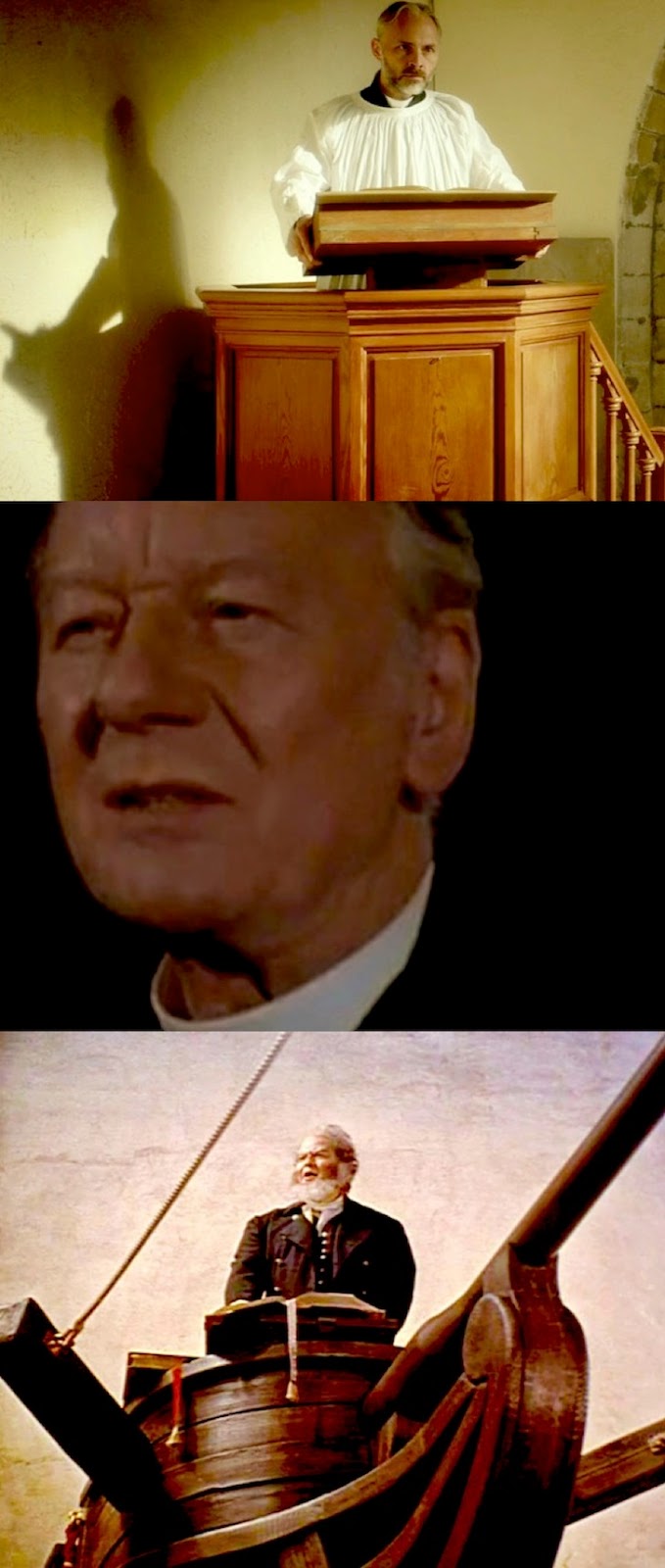

With his brogue pitched to hysteria and meanness, Bonnar's rendering of the sermon seems to be the very core of the film (even though the picture is essentially a grand coming of age story). It goes thusly:

"As you know, we are now at war with Germany. This NEW BABYLON has as many corruption as the old one. How long it will rage is what God in His wisdom will only know. But it's a chastisement by blood and fire that the nations must arise and prevail against this enemy. And Scotland, not the least of these, in its ancient health and humility to tread again the path of peace and courage that will ultimately lead to our victory.

Their King, which they also call Kaiser, is the Antichrist - a foul evil upon this Earth that must be swept away by the righteous.

Those who will not fight to defend their country, must be exposed for that they truly are.

Cowards. And pro-German cowards at that."

History proves that the needs of the state are always bolstered by organized religion. Worse yet, World War I notoriously sacrificed the youngest and largest number of men from Scotland, Ireland and the colonies (including Canada, Australia, etc.) to ensure victory. Whole swaths of generational promise were sacrificed in this dirty war fought between the "ruling classes".

God forbid Davies should ever be politically obvious in a didactic fashion, but in so far as he chooses his material and presents it, he still exposes as many terrible truths about humanity as only the best filmmakers/artists do. Sunset Song is a love story, a coming-of-age story, but most of all, it serves as one of the most heartbreaking and potent antiwar films of the new millennium.

And here's my guarantee, you will shed copious tears.

THE FILM CORNER RATING: ***** 5-Stars

Sunset Song Opens in Canada via Unobstructed View:
May 13: Toronto, Cineplex Cinemas Varsity and VIP (55 Bloor St. W)
Toronto Holdover, Magic Lantern Carlton Cinemas
May 27: Vancouver, Vancity Theatre (1181 Seymour St.)
May 28: Winnipeg, Cinematheque (100 Arthur St.)
June 3: Calgary, Globe Cinema (617 8 Ave SW)
June 3: Waterloo, Princess Twin (46 King St. N)
June 17: Montréal, Cinéma du Parc (3575, av. du Parc)
Cinéma Beaubien (2396, rue Beaubien Est)
June 17: Ottawa, ByTowne Cinema (325 Rideau St.)
June 17: Québec City, Cinéma Le Clap (2360, chemin Sainte-Foy)
June 17: Cobourg, The Loft Cinema (201 Division St.)

Friday, 18 December 2015

ARABIAN NIGHTS - Review By Thomas Zachary Toles - The Captive Storyteller in Gomes Epic


Video Services Corp. (VSC) presents its Canadian theatrical release of 2015's most ambitious and unique cinematic experiences in Montreal, Vancouver and Toronto. A major hit at Cannes and TIFF, Arabian Nights (2015), directed by Portuguese auteur Miguel (Tabu) Gomes is an epic six-hour contemporary masterpiece presented in three parts: Vol. 1, The Restless One / Vol. 2, The Desolate One / Vol. 3, The Enchanted One. This revolutionary trilogy begins in Montreal – Cinema du Parc (3575 Avenue du Parc) on December 18, 2015, then begins in Vancouver – Vancity Theatre (1181 Seymour St) on January 1, 2016, and last, but not least in Toronto – TIFF Bell Lightbox (350 King St W) on January 8, 2016.

The Film Corner is pleased to present its guest critic (and lecturer, actor, director, Rhodes Scholar), Thomas Zachary Toles, to share his thoughts...


The Captive Storyteller: Arabian Nights by Miguel Gomes

Film Corner Guest Review
By Thomas Zachary Toles


When your episodic epic is over six hours long, you have plenty of time for scathing social critique, deadpan comedy, magical realism, documentary-style interviews, and an impressive number of dick jokes.

The sweeping three-part Arabian Nights by Miguel Gomes uses the familiar structure of the classic folktale collection to celebrate and contemplate the need for stories during a crisis (in this case, massive unemployment and fiscal inequality in Portugal). As Scheherazade (Crista Alfaiate) explains, stories “spring from the wishes and fears of man” and, fated as she is herself to hold an audience’s attention she quite literally affirms that stories “help us to survive.”

Whereas Federico Fellini uses Marcello Mastroianni as a fictional surrogate for himself in , Gomes becomes his own Guido Anselmi in Arabian Nights, slipping himself into the prologue--the filmmaker as both fictional character and documentary subject.

Interviews with laid off Portuguese shipyard workers are intercut with footage of an attempted wasp cull, a hazy metaphoric link that the director claims to be too stupid to clarify. Gomes describes himself in these early scenes as pretentious, idealistic, and cowardly. He literally runs from the Arabian Nights project, apparently riddled with doubts about his ambition and competence.

With these self-referential moments, Gomes thematically links his own status as a filmmaker to Scheherazade’s status as the imprisoned storyteller of Arabian Nights. While Scheherazade must always tantalize her audience night after night or be killed, Gomes sees the fate of his country hanging in the balance. The director feels a grave responsibility to respond to the draconian austerity measures across his country, yet is tormented by the thought that his creativity could fail him when he needs it most.

The prologue that introduces Arabian Nights, ostensibly takes a cinéma-vérité approach that suggests a certain faithfulness to “reality” while simultaneously employing a surreal indirectness that bleeds into fantasy. The sequence sets up a crucial collation for Gomes: that of fiction and so-called historical fact.

When the film crew is buried in the sand and Scheherazade takes control of the film’s narration, Gomes imposes his conviction that “imagination and reality have never been able to exist without each other”.


The fantastic elements of the film exist in relation to recognizable human impulse. Moments of magic sometimes serve to highlight contradictions in characters’ thought, as when the expert bird-trapper, Chapas, begrudgingly frees an old, sick genie trapped in a net. In other sequences, magical instances provide an intangible space for characters to connect with each other.

One tale, “The Tears of the Judge,” comically depicts a judge’s frustration as she unravels an increasingly ridiculous and convoluted chain of guilt. The judge becomes so overwhelmed that she rejects everyone in their stupidity, evilness, and despair, lowering her head in surrender. Then, impossibly, the judge is heartened by a sign language pardon that she cannot see. The language of mercy is shown to operate on an extra-sensual level.

The mystical elements of Scheherazade’s tales are knit into the fabric of the world, unsurprising to the characters that encounter them. Strikingly, even the most outlandish tales are filmed with a degree of asceticism. Gomes presents wind spirits, beached mermaids, and talking cows without spectacle, conscious that such inventions are no less comprehensible than the moral bankruptcy of Portugal’s leaders.

Gomes’s lack of visual extravagance in no way limits the aesthetic impact of Arabian Nights. The film’s delicate restraint can be exquisitely devastating: a fugitive patiently eats beans in the dark as officers on horseback gather behind him; Scheherazade and her father discuss her incarceration as they ride a dreamy Ferris wheel on the beach; a mirror is lowered by a dog leash towards the window of an apartment where a couple has committed suicide.

Gomes is fascinated by actors’ bodies, using long takes to capture the way they amble through landscapes or sunbathe nude on a roof. Such attention has an empathic effect. We spend so long watching Simão “Without Bowels” (Chico Chapas) wander, as he staves off the isolation of exile through the offerings of others, that when we are finally told that he has murdered his family, his corporeal vulnerability is entrenched in our minds.

Gomes’s film suggests that stories are as essential to the survival of the Portuguese people as to Scheherazade. Her real world counterparts also face miserable restrictions by tyrannical “kings.”

Heartbreaking testimonies from the unemployed people in “The Swim of the Magnificents” attempt to make sense of life in the aftermath of economic crisis (one man hands out over a thousand CVs until he feels his identity has dissolved). Gomes knows that storytelling done right expands our empathy, helping us to take hold of incomprehensible events that leave us adrift.

The disenfranchised people of Portugal form a chorus of Chaffinches, cruelly trapped, singing beautiful songs for those with the patience to listen.

And, seeing the morning break, the film critic fell silent.

THE FILM CORNER RATING: ***** 5-Stars

Video Services Corp. (VSC) presents

Arabian Nights:
Vol. 1, The Restless One
Vol. 2, The Desolate One
Vol. 3, The Enchanted One


A trilogy by Miguel Gomes

Begins in Montreal – Cinema du Parc (3575 Avenue du Parc)
December 18, 2015

Begins in Vancouver – Vancity Theatre (1181 Seymour St)
January 1, 2016

Begins in Toronto – TIFF Bell Lightbox (350 King St W)
January 8, 2016

Saturday, 1 August 2015

THE LEOPARD - Review By Greg Klymkiw - Magnificent, Heart-Achingly Romantic Visconti Epic @ TIFF Bell Lightbox Summer in Italy series & a gorgeous Criterion Collection BluRay


The Leopard (1963)
Dir. Luchino Visconti
Starring: Burt Lancaster, Alain Delon, Claudia Cardinale

Review By Greg Klymkiw

Christ Almighty, I love Luchino Visconti! Then again, what's not to love? The guy knocked us on our butts with one of the earliest forays into Italian Neo-realism, 1943's still-provocative Ossessione, his debut feature being the very first film adaptation of James. M. Cain's immortal crime melodrama "The Postman Always Rings Twice". With each subsequent picture, he progressively ladled on the most gorgeous, sumptuous compositions in service to increasingly melodramatic narratives.

Still, he almost never forgot his roots in the tradition that became far more synonymous with Roberto Rossellini and Vittorio De Sica. In spite of his penchant for the melodrama driving his epic of politics, war and romance, The Leopard (and so many subsequent films), neo-realism continued to be pervasive within Visconti's unflagging attention to detail, especially during both the battle scenes and lavish rituals of Sicily's ruling class which take breathtaking command of this stunningly great picture.

Based upon the novel by Giuseppe Tomasi di Lampedusa, Visconti and his raft of screenwriters including himself, Pasquale Festa Campanile, Enrico Medioli, Massimo Franciosa and Suso Cecchi d'Amico, craft the compelling tale of Don Fabrizio Corbera (Burt Lancaster), the powerful, respected and beloved Prince of Salina. Whilst many of his family members, neighbours and the estate's personal Catholic priest all fear the recent uprisings to unify Sicily and Italy, led by the savvy military genius General Garibaldi and his 1000 "redshirts", Don Fabrizio harbours a romantic kinship with the rebels. He even finances them and offers his unconditional blessings to his favourite nephew, the dashing, handsome Tancredi (Alain Delon) to join the "redshirts'" cause.

Don Fabrizio is more than happy to share his beliefs with those who will listen: the uprisings will ultimately mean everything and nothing. Yes, they will further unify Italy, but in fact, the "changes" are necessary to maintain the "status quo". Essentially, nothing will really change (at least in the immediate future) for Italy's aristocracy.

His relationship with Tancredi is especially close. The lad takes the place of the son he's always wanted. His love for Tancredi is such that he pooh-poohs the notion of his own daughter marrying the gorgeous swashbuckler since he's well aware of the fact that such a young man (his estate squandered by Fabrizio's brother) will require a wife of considerable wealth. Fabrizio has dowries to offer, of course, but with seven daughters, none of them will come close to adding up collectively to what he feels Tancredi will need for both himself and to solidify the power of the Corbrera Dynasty. Fabrizio is as politically and financially astute as he is a romantic.

In addition to the astonishing battle sequence involving the fall of Palermo to the "redshirts", Visconti continues to soar as a filmmaker with two key set pieces in the 3-hour-long film. One involves the family's journey to their country palace in Donnafugata and the other, a grand ball involving the presentation, or "coming-out" (if you will) of Tancredi's wife-to-be, the drop-dead gorgeous and mega-wealthy Angelica (Claudia Cardinale).


Though the pace of the film is as stately as the lives led by these Italian aristocrats, there is never a dull moment in the proceedings thanks to Visconti's eye for beauty and his knack for detail. (The astounding cinematography of the great Giuseppe Rotunno and the grand orchestral Nino Rota musical score are no slouches, either.)

From a luscious picnic on the way to Donnafugata, through to the traditional processions and celebrations in the town (if anyone wonders where both Scorsese and Coppola received considerable inspiration and cinematic tutelage, they need look no further) and finally the fascinatingly complex negotiations twixt Fabrizio and the somewhat vulgar landowner seeking "legitimacy" by marrying his daughter off to Tancredi, Visconti dazzles our hearts, minds and eyes with drama and images that are simply unforgettable.

One of the magnificent directorial touches is the subtle, almost heart-aching manner in which Visconti captures Fabrizio's passionate, though unrequited love for the stunning Angelica. Handled with looks and glances, along with Burt Lancaster's soulful performance, we feel the ultimate consummation of his desires within the vicarious thrills he enjoys through that of his dashing nephew. As Fabrizio's love flourishes, Tancredi's virtually explodes, and then during one of cinema's greatest ballroom dance sequences, Visconti allows us to bear witness to one of the most wildly romantic scenes in all of cinema history.


Angelica catches one of Fabrizio's glances and in a stunning moment of cinematic glory, we're witness to a sense of her looking into the handsome, distinguished visage of what she herself will grow old with once she marries Tancredi. She asks Fabrizio for a dance. He agrees, but only if the orchestra plays a waltz.

And then, as if the Heavens have parted to grant them their wish, a waltz strikes up and we feel the gooseflesh and tears rise within us as this grand, old Prince takes the stunning princess-to-be for a spin on the glorious dance floor under the majestic chandeliers of the palace and the admiring eyes of all who surround them.

As the film winds down, as the grand ball comes to a fitting end, Visconti allows us to follow the departing Don Fabrizio Corbera, the Prince of Salina as he slowly walks into the night air, disappearing into the darkness as a new generation takes command of the light.

As The Leopard so beautifully proves, things never really change. The cycles of life and love continue, long after we're gone - not forever, but swallowed by our eternal memories and those which supplant our own and create memories anew.

THE FILM CORNER RATING: ***** 5-Stars

The Leopard is part of TIFF's 2015 Summer in Italy series and also available on a gorgeous Criterion Collection Blu-Ray which includes a new high-definition digital transfer, supervised by director of photography Giuseppe Rotunno and presented in the original Super Technirama aspect ratio of 2.21:1, with uncompressed monaural soundtrack on the Blu-ray edition, the 161-minute American release, with English-language dialogue, including Burt Lancaster’s own voice, an audio commentary by film scholar Peter Cowie, A Dying Breed: The Making of The Leopard, a terrific hour-long documentary featuring interviews with Claudia Cardinale, screenwriter Suso Ceccho D’Amico, Rotunno, filmmaker Sydney Pollack, and many others, video interviews with producer Goffredo Lombardo and professor Millicent Marcus on the history behind The Leopard, original theatrical trailers and newsreels, a stills gallery of rare behind-the-scenes production photos and a lovely booklet featuring a new essay by film historian Michael Wood.

Thursday, 23 July 2015

KINGS OF THE SUN - Review By Greg Klymkiw - Chakiris/Brynner: Foes Become Friends


Kings of the Sun (1963)
Dir. J. Lee Thompson
Starring: George Chakiris, Yul Brynner,
Richard Basehart, Shirley Anne Field, Leo Gordon

Review By Greg Klymkiw

How do like your cheese? Ripe, runny and mouldy or a nice solid brick of good, old fashioned Wisconsin Cheddar? Well, though there is much to be said for the rich, flavourful qualities of the former, sometimes the latter is just what the doctor ordered. Kings of the Sun is clearly of the Wisconsin variety, though happily, it's an old white cheddar and as such, a mite more savoury than your garden variety slab of straight-up orange-coloured curd.

This delightfully melodramatic action-adventure epic of manly men and exotic women is set of 1000 years-ago when a nation of wooden-sworded Mayans on the Yucatán are besieged by a much powerful rival tribe who use metal swords. The wooden-sworded nation are led by the brave young King Balam (George Chakiris, the handsome Greek-American dancer who copped the 1961 Supporting Actor Oscar in the role of the Puerto Rican leader of the Sharks in West Side Story). Balam decides to flee from the nasty take-no-prisoners-lest-they're-women-to-be-raped metal-swordsman King Hunac Ceel (Leo Gordon, the stalwart veteran of numerous TV westerns and one of director Don Siegel's favourite bad guys).

Balam, betrothed to the comely Ixchel (Shirley Anne Field), leads his people through a secret tunnel in their majestic Mayan Pyramid, loads them into boats and sets sail for the mysterious lands far north (Tex-Mex country) to bolster their resources and create a new kingdom - maybe to even someday reclaim their ancestral lands.

Once Balam and his people land up in Tex-Mex territory, they put their ingenuity to good use and build a powerful fort, new abodes and begin a whole new Pyramid so they can start sacrificing humans to the Gods as soon as possible.

Ah, but hiding in the woods and observing the Mayans is an indigenous Native American tribe led by Chief Black Eagle (Yul Brynner) and he's royally fuming (like only Brynner can, flaring those sexy nostrils). He plans to battle these oddly costumed intruders, but unfortunately he's wounded and captured by the Mayans, then held hostage to keep the Injuns at bay.


The real power amongst the Mayans is their wacky blood-thirsty, blood-sacrifice-endorsing Witch Doctor Ah Min (played, I kid you not, by the whiter-than-white Richard Basehart, star of TV's Voyage To The Bottom of the Sea). Adorned in a ridiculous wig and flowing robes, Ah-Min looks like he should be an emcee at an octogenarian drag performance club in Slovenija, and as such, he's able to convince Balam and all the others that they must nurse Black Eagle to health so he may be their first official sacrifice when the Pyramid is finished.

A love rivalry twixt Ixchel, Black Eagle and Balam begins to brew and as these lovebirds begin smouldering, little do they know that the crazy Hunac Ceel has loaded up his boats with thousands of warriors to wipe out Balam for good and they're just around the corner.


If the Mayans sacrifice Black Eagle, they'll not be able to count on the necessary allegiance with the Natives to fight Hunac. Hmmmm. Dilemmas-dillemmas. I doubt it's going to come as a surprise to anyone, but get to a rousing final battle sequence, we must submit to a whole water-tower full of roiling melodrama.

I can't actually say that any of this is especially well-acted, but it is exuberantly over-acted and where the picture really succeeds is in its gorgeous cinematography by the legendary Joseph (My Darling Clementine, Viva Zapata, Niagara, Pickup on South Street) McDonald, a rousing orchestral score by Elmer Bernstein, stunning sets and costumes, a cast of thousands and some of the most beautifully directed battle scenes ever committed to film by the stalwart J. Lee Thompson (Taras Bulba, Guns of Navarone, Cape Fear).

So if you're in the mood for some solid cheese, feel free to whack off a few hunks of this Kings of the Sun brand. It'll bind you, bind you real good.

THE FILM CORNER RATING: *** 3-Stars

Kings of the Sun is available on a gorgeous Kino-Lorber Blu-Ray.

Saturday, 13 December 2014

TARAS BULBA (1962) - Blu-Ray Review By Greg Klymkiw - Glory Be to Kino: BULBA on BRD!


On BRD at last! Thanks to
KINO-LORBER
Taras Bulba (1962)
dir. J. Lee Thompson
Starring: Yul Brynner, Tony Curtis
Review By Greg Klymkiw
“Do not put your faith in a Pole.
Put your faith in your sword
and your sword in the Pole!”
Thus spake Taras Bulba – Cossack Chief!(Played by Yul Brynner 1962)
These days, there are so few truly momentous events for lovers of fine cinema and, frankly, even fewer such momentous events for those of the Ukrainian persuasion. However, film lovers and Ukrainians both have something to celebrate. Especially Ukrainians.

Saturday, 29 March 2014

NOAH - Review By Greg Klymkiw - In search of berries in the land of theSmurfs and Vikings

You'll see green alligators and long-necked geese
Some humpty backed camels and some chimpanzees
Some cats and rats and elephants, but sure as you're born
You're never gonna see no unicorns
- The Irish Rovers, The Unicorn Song

"Oh shit, it's black fly season and I've got lockjaw."

"I need BERRIES. Got any?
Noah (2014) *
Dir. Darren Aronofsky
Starring: Russell Crowe, Jennifer Connelly, Anthony Hopkins, Ray Winstone, Nick Nolte

Review By Greg Klymkiw

Four words.

Anthony Hopkins IS Methuselah.

Phew! Who cut the fuckin' cheese? Man, oh man, when great directors fail, it's nice to see them crap-out as spectacularly as Darren (Pi, Requiem For a Dream, Black Swan, The Wrestler) Aronofsky has done with the swirling sea of salt water pickle brine that is Noah. Yes, the movie is dreadful, but it's at least a rip-snorting hoot for most of its running time and if you've a hankering for a multi-million dollar Sun Classic International-styled Ed Wood-directed biblical epic, have I got a picture for you.

"I plan to skewer chipmunks upon my 'stache."
In case you don't already know the plot, we're talking Noah of the Ark fame here, the fairytale Old Testament servant of God. To quote from the angel Gabriel in Green Pastures: "Gangway! Gangway fo' de Lawd." And I've gotta tell ya', de Lawd sho' do be right royally pissed off with Man for all his sinning ways - so much so that he entrusts his loyal earthly servant Noah to build an Ark to house the "innocent" during the Great Flood. The innocents He wishes to save are God's non-human animals - excepting of course, the unicorn. God just wants to bless the beasts with life and start all over again. Can we blame him? (Oh, and Aronofsky, an avowed atheist refuses to use the word "God" in the film. He substitutes it with "Creator", but hey, that's his sick shit, not mine.)

God declares, not unlike Travis Bickle: "Someday a real rain will come and wash all this scum off the streets." Though He doesn't come right out and say it, de Lawd be thinkin', "All the animals come out at night - whores, skunk pussies, buggers, queens, fairies, dopers, junkies, sick, venal."

And I feel for Aronofsky on this. It's not much of a story. God tells Noah to build an ark and fill it with animals while everything and everyone else will die in a flood. Noah builds the Ark, the animals board the Ark, the rains comes, the rains go. End of story.

So one of our great directors decides to add a revisionist twist to the piece and couch it as a tale of man's environmental assaults upon the Earth and how drastic measures must be taken to achieve a new beginning. The same, said director decides there's also an interesting way to tell a tale of religious zealotry through Noah who feels charged with the desire to fulfil God's Word even if it means murdering the children of his eldest son. Aronofsky also dabbles in presenting a rivalry twixt Noah and Tubal-cain (Ray Winstone), the former being someone who blindly accepts a potential misinterpretation of God's Word and the latter who believes God created in His own image to place a species at the top of the food chain and to control his own destiny.

These very interesting elements are there, but the movie is just so Good-Godawful in pretty much every other respect. Noah and his wife are portrayed as some manner of eco-hippies, but they're equally presented as positively insufferable cliches. Anthony Hopkins munches ham to portray the 900-year-old Methuselah as a doddering idiot who's mostly obsessed with being able to find and eat berries before he dies. I kid you not. There's even a scene with Hopkins on all fours whilst maniacally trolling the ground for fucking berries.

And, of course, I shit myself laughing when a little girl asks Noah to sing. I was gobsmacked, actually. Crowe sings!

As if this weren't enough, Aronofsky even goes all Ray Harryhausen on us when we're introduced to humungous stone creatures called "The Watchers" who rise up out of the ground to offer assistance to Noah to both build the Ark AND do battle - yes BATTLE! - with the armies of Tubal-cain. Worse yet, The Watchers are essentially identical to Transformers - yes, rock-hewn Michael-Bay-style Transformers.

This might be one of the biggest follies of all - CG Transformers made of rock aside, the most ludicrous element is just how much of the film is generated via CG. Using real animals would have lent a sense of "humanity" to the proceedings, but no matter which way you slice it, God's non-human animals have about as much warmth as a witch's tit.

The levels of idiocy in this movie know no bounds, frankly. They are all, however, knee-slappingly funny. Yeah, the laughs are unintentional, but they are as pure as those achieved by Edward D. Wood Jr. in his straight-faced Bride of the Monster and Plan 9 From Outer Space. I mean that with absolutely no condescension towards the late Mr. Wood. I genuinely love the guy. Just, as I genuinely love Aronofsky. They're both filmmakers with a voice, and that ain't something to be sneezed at.

Uh, did I just compare Aronofsky to Ed Wood?

Noah is in massive worldwide release via Paramount Pictures

Monday, 24 February 2014

TARAS BULBA (2009) - Review By Greg Klymkiw - Sub-Par Russian Version of classic Ukrainian tale of revolt is little more than a pallid made-for-tv-miniseries-styled slab of propaganda that might stir the loins of Putin-lovers-and-apologists, but it doesn’t come close to mining the stirring potential of Gogol's great story.


Taras Bulba (2009) **
dir. Wolodymyr Bortko
Starring: Bohdan Stupka, Ihor Petrenko, Vladimir Vdovichenkov, Magdalena Mielcarz, Sergei Dryden

Review By By Greg Klymkiw

In light of the recent events in Ukraine, it seems appropriate to turn our attention to one of the more egregious displays of cinematic propaganda I have seen in a long time. The charge of disinformation is, for once, not levelled against Hollywood, but Russia. This is not the Russia of the butcher Joseph Stalin, but that of contemporary Russia, a country rife with the sad, evil remnants of Stalin in the guise of its leader Vladimir Putin who, in his previous career was a nasty little KGB spy who specialized in rooting out those who opposed the supposed glories of Communism and prior to that, when he, as a teacher and academic, disgracefully used his position to carry out surveillance on students.

The film on view is Taras Bulba, a relatively recent and expensive (by Russian standards) screen adaptation of the legendary Ukrainian writer Nikolai Gogol’s great novella of the same name and a film that chooses to use Gogol’s pro-Russian version as its base rather than his original manuscript. Gogol bowed to the will of Czarist Russia and delivered a revised product more in keeping with the country’s own version of Manifest Destiny throughout Eastern Europe.

Propaganda in the cinema is nothing new. In fact, many knee-jerkers will look for any excuse to trash Hollywood for this very thing. Since its very beginnings, a common charge against Uncle Sam’s cinema has been the preponderance of propagandistic elements to extol the virtues of truth, glory and the capitalistic American way in terms of cultural/political superiority and to defend the country’s constant need to engage in warfare. One cannot disagree with this common assertion; however, America ALONE has not propagated the myths of their “superiority” using the most powerful medium of artistic expression – the cinema.

The most common example of this would be the vicious work of Nazi Germany’s Minister of Propaganda Joseph Goebbels, who utilized cinema to spread anti-Semitism with The Eternal Jew, a foul “documentary” that goes so far as to trace and equate the spread of Judaism with that of rats and the spread of the Black Plague. Of course, no mention of Nazi propaganda would be complete without referring to the work of the brilliant Leni Riefenstahl – a truly great artist who delivered one of the most stunning, yet reviled works of the 20th century, her stirring document of the Nuremburg Rallies, The Triumph of the Will.

Strangely, the work of Russian propagandists has not seen the same kind of vitriolic bile heaped upon it and yet, Sergei Eisenstein, (surely as brilliant a filmmaker as Leni Riefenstahl) was happy enough to wear extremely comfortable knee-pads as he knelt before the dictatorial powers of Russia to continually afford him the opportunities to make movies. Eisenstein delivered one film after another that not only propagated the myth of Communism and the notion of Russian superiority, but eventually even extolled the virtues of an even bigger butcher than Hitler, Joseph Stalin. (For more on this, see my review of the Kino DVD release of Battleship Potemkin by visiting HERE.)

This new version of Taras Bulba received a substantial portion of its financing from the Russian Ministry of Culture and while it may bear the trademarks of typical old-Soviet-style propaganda, it is hardly a work that bears the hallmarks of superior filmmaking. At least Eisenstein, Riefenstahl and any number of American directors who generated similar propaganda (Steven Spielberg with Saving Private Ryan is a good example) are great artists who created landmarks of cinema that expanded the boundaries of the medium. The mediocre, though clearly competent television director Wolodymyr Bortko (who prefers the Russian transliteration “Vladimir” in spite of his Ukrainian heritage) serves up some sumptuous production value, elicits some fine performances and seasons his celluloid broth of borscht with all the clichés of epic cinema, but none of the depth one might find in the work of masters of the elephantine genre like David Lean. Bortko’s screenplay adaptation unimaginatively catalogues, almost by rote, the events of Gogol’s Russified version of the novella, but somehow manages to completely miss the spirit of the original writing.

Telling the classical tale of a Cossack Chief, Taras Bulba (majestically portrayed by the great Ukrainian actor Bohdan Stupka) who sends his beloved sons Andriy (Ihor Petrenko) and Ostap (Vladimir Vdovichenkov) to the Polish-ruled university in Ukraine’s capitol city Kyiv to not only get a well rounded education, but to acquaint them with the “enemy”. He eventually takes his sons to the legendary Cossack “Sich” (fortress) of Zaporozhia to train them in the skill of Cossack barbarism.

Bulba’s hatred for Poland flares even more intensely when he learns that his farm has been destroyed and his wife is murdered by the Poles. He manages to get the Cossack nation to march against Poland and soon the Ukrainians are wreaking havoc and decimating their Polish rulers. Things come to a head when Bulba and the Cossacks attack the Ukrainian city of Dubno which is under Polish rule. Unbeknownst to our title character, when Bulba’s most beloved son Andriy was at school in Kyiv, he fell in love with Elzhbeta (the eye-poppingly stunning Magdalena Mielcarz) a member of Polish royalty. As bad luck would have it, her father is now the governor of Dubno and Andriy realizes that he is laying siege to the city of his beloved. Love, it would seem, becomes the ultimate enemy as Andriy betrays his country and father to be with her.

It’s a great story! One of its biggest fans was Ernest Hemingway who proclaimed its genius whenever he could. Too bad, then, that this film version is so by-the-numbers. That said, even a mediocre rendering such as this one is no match for the power of Gogol’s literary prowess and for this we are dealt some tender mercies. Finally though, the movie is a bit of a slog – plodding along its way, but without any of the spark of the original writer. In fact, the tone of the movie is resolutely dour. This is no surprise since screenwriter-director Bortko has chosen to amplify the Russified version of the novella. Without that glorious spark of Gogol’s wonderful sense of boys’ adventure and his delightfully, deliciously and resolutely Ukrainian sense of humour (so beautifully captured in J. Lee Thompson's 1964 Hollywood version), the movie has all the spark of a funeral dirge.

By over-emphasizing the Russification of the original text what we have is a brutal glorification of Russian superiority. This grotesque mockery of a story that, in actuality is a rousing depiction of Ukraine’s never-ending fight for freedom from subjugation leaves us with a very foul taste in our mouths. We are handed one ultra-violent set piece after another – all in the service of boosting Russia’s own notion of might as right. By appropriating this very Ukrainian story by one of its great writers and turning it into grotesque Russian propaganda to try and suggest that the Cossacks and in turn, the Ukrainians, consider themselves little more than barbarians doing the bidding of those who would subjugate, exploit and even perpetrate genocide against them (as Stalin did) is thoroughly reprehensible.

Historically, even the occasional guarded loyalty the Zaporozhian Cossacks paid to the Russian Empire was betrayed by both Czar Peter I and Catherine the Great, the former forcing them to scatter or face death, the latter ordering a full-on genocide of the Zaporozhian Sich. None of this would have been lost on Gogol - especially with his first, but suppressed edition of the novel and even within the Russified version, this healthy distrust of the Empire boils just below the novel's surface.

Bortko’s mediocrity as a director reaches its nadir, however, in his lame handling of the fighting, action and battle scenes which is, in a word, dull. With fabulous locations, thousands of extras and impeccable production and costume design, he cannot direct action. His shooting style is cudgel-like, but it never has the thrilling and freewheeling quality the action needs. Bortko appears to have everything that money can buy – everything that is, except the genuinely distinctive artistic voice that would allow him to rise above his own mediocrity.

I do reiterate, though, that such propagandistic shenanigans would ultimately not be as problematic if this was actually a good movie, but it isn’t. Saddled with a clumsy flashback structure, a lazy use of prose narration from the novel and a dull television-mini-series mise-en-scene, Taras Bulba might stir the loins of Putin-lovers-and-apologists, but it doesn’t come close to mining the stirring potential of the story.

Let’s not forget that Gogol came from Cossack stock and that he was inspired by the very moving Ukrainian nationalist “dumy” (folk ballads) of the Cossacks themselves. Also, one of Hohol/Gogol’s chief literary inspirations was the great Scottish writer Sir Walter Scott and that “Taras Bulba” was conceived as a Ukrainian version of those swashbuckling tales of Scottish Highlanders battling their British oppressors/occupiers (especially notable in "Rob Roy"). A cool historical footnote is that Cossacks themselves might have had some roots in Scotland at a much earlier historical juncture. Another interesting correlation between Scott and Gogol is that both portrayed strong, sympathetic Jewish characters in their respective swashbucklers - Scott created Rebecca in "Ivanhoe" and Gogol gave us Yankel in "Taras Bulba". (The latter character seems to fit the fact that Catherine the Great effected a genocide upon the Ukrainian Cossacks whose administrative power was actually presided over by Ukrainian-Jews - all the record-keeping discovered in archeological digs at the Sich was found to be written in Hebrew.)

Not surprisingly, the best film version of Taras Bulba is the fabulous aforementioned J. Lee Thompson epic from Hollywood in the 1960s. It captures the derring-do, the humour and the stirring, romantic nationalism of the story by adhering the book’s Ukrainian roots as opposed to Bortko’s ill-conceived attempt to please Vladimir Putin. The American treatment of the character of Andriy, the son who betrays father and country is far closer, I think to the spirit of what Gogol intended. Ihor Petrenko’s portrayal of Andriy is so dull and serious. It especially lacks the boyish charm that Tony Curtis with his swarthy Hungarian-Jewish looks and magnificent sense of humour brought to the role.

The other idiotic attempt to Russify this story is how Bortko has commissioned a musical score so lacking in any spirit whatsoever. At least in the Hollywood version, legendary composer Franz Waxman based his entire score on traditional Ukrainian music and delivered a score that was cited by even Bernard Herrman as one of the great scores of all time. (For my full review of the Hollywood version, feel free to visit HERE.)

In fairness to Bortko, however, his screenplay, unlike the Hollywood version restores the odd symbiotic friendship from Gogol’s novella between Bulba and the Jewish money lender Yankel (yielding a stellar performance by Sergei Dryden) and, most importantly, he includes the whole aftermath involving the capture, torture and execution of Ostap at the hands of the Poles and Bulba’s revenge and final noble sacrifice. These are all stirring story beats and while I am grateful for their inclusion, I am less grateful that they are present almost solely to provide Russian propaganda.

This version of Taras Bulba no doubt has poor Gogol spinning in his grave. I’m sure he never would have imagined that so many generations later his work would be bastardized as a piece of propaganda for the country that even now seeks to consume his Motherland whole and tries continually to repress its spirit, culture, language and people.

Worse yet, that it should be a version that reeks of Made-for-TV miniseries mediocrity.

FEEL FREE TO ORDER THE FOLLOWING TARAS BULBA ITEMS DIRECTLY FROM THE LINKS BELOW AND YOU WILL BE CONTRIBUTING TO THE ONGOING MAINTENANCE OF THIS WEBSITE: