Showing posts with label Criterion Collection. Show all posts

Tuesday, 13 February 2018

NIGHT OF THE LIVING DEAD - Review By Greg Klymkiw - Romero Zombies on Criterion!!!


Night of the Living Dead (1968)
Dir. George A. Romero
Starring: Duane Jones, Judith O'Dea

Review By Greg Klymkiw

"Kill the brain, and you kill the ghoul." - Scientist

"If you have a gun, shoot 'em in the head. That's a sure way to kill 'em. If you don't, get yourself a club or a torch. Beat 'em or burn 'em. They go up pretty easy." - Sherriff

Science and law enforcement make for good bedfellows - especially when the unburied dead come to life and seek out the living to snack upon.

The late George A. Romero's 1968 horror classic worked like a charm when I first saw it as a kid and continued to cast its magic spell as I continued to watch it umpteen zillion times over the decades. No matter what format I viewed Night of the Living Dead on - 35mm prints, 16mm prints, tv broadcasts, the myriad of bootleg public domain VHS tapes that floated around forever and a very decent Elite Entertainment DVD release from 2009, this was a movie that never failed to creep me out.

However, seeing it on the brand new Criterion Collection Blu-Ray, it feels like I'd never seen the film ever before - what an amazing experience it was to watch this beautifully restored edition supervised by Romero himself before his tragic, untimely death. Seeing it this way was at least as thrilling, shocking and supremely entertaining as when I was first slammed in the face with the two-by-four that is this genuinely great motion picture.

Of course, zombie and living dead extravaganzas have become so ingrained upon the collective psyches of movie-goers that most of them must view each movie with an air of been-there-done-that, but his original film is so infused with an acute political consciousness and clever satire, that the only movies that come remotely close to its power are Romero's first two sequels Dawn of the Dead and Day of the Dead.

Shot in beautiful black and white, we follow the mousy Barbra (Judith O'Dea) as her obnoxious older brother Johnny (Russell Streiner) drives her out to a graveyard in a remote rural location outside of Pittsburgh. When a pasty-skinned old man lopes onto the scene, Johnny teases his sister that the lumbering dude is "coming to get her". It turns out Johnny's right. He's viciously attacked by the ghoulish septuagenarian and then, Barbra becomes the quarry once her brother's been handily dispatched. She madly races to an old farmhouse and as night falls, the house becomes surrounded by similarly psychotic ghouls.

They have only one thing on their pea-brained minds - to kill the living and eat them.

Yes! Eat them!

Turns out there are other people in the house. They barricade themselves in, attempting to survive this onslaught of ravenous creatures. And what an onslaught it turns out to be.

Of course via television and radio, they discover that a plague of mass murder is occurring right across the state and yes, the unburied dead are rising to feed (literally) upon the living.

The dynamic in the house is fascinating, a microcosm of humanity. From the trembling Barbra to an obnoxiously selfish father, his caring wife, their sick daughter and a perky young couple, Romero's simple, but deft script delivers a group of survivors we are delighted to follow. And no such film would be complete without a hero. The resourceful, brave Ben (Duane Jones), kicks ass with the best movie heroes. And, astonishingly, Romero employed "colour-blind" casting - the film's hero is played by a terrific, handsome young actor and he is African-American. This was a big deal in 1968. That there are colour blind aspects to the character himself, makes it, even now, STILL a big deal.

Throughout the film, Romero paints a vivid portrait of redneck America as hayseed local yokels wander the highways and byways, taking sport in blasting the brains of the "living dead". It's a world gone crazily to Hell. Most tellingly, it's not really all that crazy. This is America in all its danger and "glory".

And that, might be the scariest thing of all.

THE FILM CORNER RATING: ***** 5-Stars

Night of the Living Dead is available on a super-deluxe new edition on the Criterion Collection which includes a new 4K digital restoration, supervised by director George A. Romero, coscreenwriter John A. Russo, sound engineer Gary R. Streiner, and producer Russell W. Streiner, a new restoration of the monaural soundtrack, supervised by Romero and Gary Streiner and presented uncompressed on the Blu-ray, Night of Anubis, a never-before-presented work-print edit of the film, new program featuring filmmakers Frank Darabont, Guillermo del Toro, and Robert Rodriguez, never-before-seen 16 mm dailies reel, new program featuring Russo on the commercial and industrial-film production company where key Night of the Living Dead filmmakers got their start, Two audio commentaries from 1994 featuring Romero, Russo, producer Karl Hardman, actor Judith O’Dea, and others, Archival interviews with Romero and actors Duane Jones and Judith Ridley, New programs about the film’s style and score, New interview program about the direction of ghouls, featuring members of the cast and crew, New interviews with Gary Streiner and Russell Streiner, Newsreels from 1967, Trailer, radio spots, and TV spots, plus an essay by critic Stuart Klaxons.

Monday, 6 November 2017

THE PHILADELPHIA STORY - Review by Greg Klymkiw - Dazzling Cukor Dazzling Criterion


The Philadelphia Story (1940)
Starring: Katherine Hepburn, Cary Grant, James Stewart, John Howard
Ply. Philip Barry
Scr. Donald Ogden Stewart
Dir. George Cukor

Review By Greg Klymkiw

There are three significant men in the romantic life of socialite Tracy Lord (Katherine Hepburn). Born into wealth and privilege, she's dumped the irascible rich boy/playboy C.K. Dexter Haven (Cary Grant) and has rushed into the complacency of marrying George Kittredge (John Howard), the dweeb-ish self-made millionaire.

But, there is a dark horse for her affections charging across the horizon of romance.

Tracy, however, is a force to be reckoned with - perhaps one of the most dazzling, significant female characters in the entire history of Hollywood romantic screwball comedies. Each of these men adore and appreciate her, but for very different reasons. It's these reasons, or rather, declarations, that brilliantly say as much about the individual male characters, as they do about Tracy herself.

Tracy is a walking, talking, living, breathing contradiction. In that sense, she's a full-blooded human being - one we could all do well aspiring to.

Perhaps the most interesting observation comes from Macauley "Mike" Connor (James Stewart), the reporter charged with Tracy's upcoming high society wedding. He's as full of contradiction about Tracy as Tracy is herself when he says (during one of the most romantic/funny scenes in movie history):
"You're wonderful. There's a magnificence in you, Tracy... a magnificence that comes out of your eyes, in your voice, in the way you stand there, in the way you walk. You're lit from within, Tracy. You've got fires banked down in you, hearth-fires and holocausts... No, you're made out of flesh and blood. That's the blank, unholy surprise of it. You're the golden girl, Tracy. Full of life and warmth and delight."
Ah, but the man she is about to marry, sees no real mystery. He declares:

"You're like some marvelous, distant, well, queen, I guess. You're so cool and fine and always so much your own. There's a kind of beautiful purity about you, Tracy, like, like a statue."

A statue? Uh, she's really going to marry this clown? He likens her to an inanimate object - albeit an objet d'art, but an object nonetheless. Worse yet, Kittredge adds that it's these inanimate qualities that "... I first worshipped you for from afar".

Tracy's having none of it:

"I don't want to be worshipped," she declares. "I want to be loved."

It's the philandering scoundrel C.K. Dexter Haven who seems to nail Tracy to the cross of self-discovery when he charges:
"You'll never be a first class human being or a first class woman until you've learned to have some regard for human frailty."
Dexter's quips, as rendered so cuttingly by the epitome of romantic male leads, Cary Grant, cut especially deep. This one in particular gets to the core of Tracy's journey throughout the film, an odyssey in which she learns that class, in all the meanings of the word, should intimately be all about examining and accepting the frailties of all humanity (including one's own).

In so doing, love is indeed the ultimate goal, but that's the genius of this film. We're not just talking about romantic love, but love and acceptance in all its forms. Directed within an inch of its life by the peerless George Cukor and gorgeously adapted by Donald Ogden Stewart from Philip Barry's hit play, The Philadelphia Story has all the nuttiness, romance and machine-gun-fire dialogue one would want from the genre. However, it goes that extra distance. It has heart, soul and the kind of intelligence that makes it universal.

The picture might have been made in 1940, but it speaks to all ages for all time.

I guess that's why they call 'em masterpieces.

THE FILM CORNER RATING: ***** (5-Stars)

The Philadelphia Story is available on a gorgeous Criterion Collection Blu-Ray that includes a new 4K digital restoration, with uncompressed monaural soundtrack on the Blu-ray, an audio commentary from 2005 featuring film scholar Jeanine Basinger, In Search of Tracy Lord, a new documentary about the origin of the character and her social milieu, a new piece about actor Katharine Hepburn’s role in the development of the film, two full episodes of The Dick Cavett Show from 1973, featuring rare interviews with Hepburn, plus an excerpt of a 1978 interview from that show with director George Cukor, the Lux Radio Theatre adaptation of the film from 1943, featuring an introduction by filmmaker Cecil B. DeMille, a restoration demonstration, the trailer and an essay by critic Farran Smith Nehme.

Wednesday, 30 August 2017

REBECCA - Review By Greg Klymkiw - Hitchcock/Selznick Classic on the Criterion Collection


Joan Fontaine, Laurence Olivier, Judith Anderson
in creepy crawly Hitchcock/Selznick romance.

Rebecca (1940)
Dir. Alfred Hitchcock
Prd. David O. Selznick
Nvl. Daphne du Maurier
Scr. Robert E. Sherwood, Joan Harrison
Starring: Laurence Olivier, Joan Fontaine, Judith Anderson,
George Sanders, Gladys Cooper, Nigel Bruce

Review By Greg Klymkiw

"She was incapable of love or tenderness or decency." - Maxim de Winter (Laurence Olivier) in Alfred Hitchcock's Rebecca

Rebecca is a creepy-crawly romance. Make no mistake, though - it is indeed a romance, but damn (!), the picture makes your flesh squirm and the cherry on the sundae is that it's often so suspenseful that you occasionally feel like being one big screaming-sissy-pants-baby.

There aren't many American feature films as great as this one - it's in a class all its own. The finished product is the result of easily the most combustible producer-director partnerships in movie history. Auteur American producer David O. Selznick (Gone With The Wind) teamed up with auteur British director Alfred Hitchcock to adapt the wildly best-selling gothic romance novel by Daphne du Maurier and in so doing, yielded a film that was as modern and sophisticated for its period that has also stood the test of time - so well, that it's still more dazzlingly original than most films made these days, or for that matter - ever!

Hitchcock, however, seemed to downplay the worth of Rebecca, going so far as to say that "it's not really a Hitchcock film", but rather David O. Selznick's picture. Hitch couldn't have been more wrong, though. The movie is pure Hitchcock. He just didn't realize it.

The story that unfurls is one of obsession and on the surface, pure gothic romance. When the ultra-rich widower Max de Winter (Laurence Olivier) meets a plain, nameless (yes, nameless!) travelling companion (Joan Fontaine) at a Mediterranean seaside resort, he falls madly in love with her and whisks the young woman off to be his wife and preside over his mansion Manderley. Of course, the rambling old estate is haunted - mostly by the lingering memories (and perhaps even the ghost) of de Winter's dead first wife Rebecca.

Once ensconced in the stately manse, Max is often busy with business matters and it's up to his fresh new wife to take up her duties as "lady of the house". This is easier said than done. The house is still adorned with all the touches bestowed upon it by the late Rebecca (who died tragically in a boating accident on the raging seas that the mansion overlooks). Even her bedroom, with all its clothing and accoutrements has been preserved as she left it the night she died.

The creepy old housekeeper Mrs. Danvers (the chillingly dour Judith Anderson) does everything she can to remind the young woman what a pale shade she is to the deceased former lady of the house. The new bride assumes Max wants her to replace Rebecca, but in actuality, the title character, as we are reminded constantly, can never really be replaced. If the young bride is to keep both her sanity and her new husband, she needs to create herself in her own image, not that of a dead woman.

As the film progresses, more and more hints are dropped that things, as they so often are in life, are never what they seem. Madness, infidelity and, perhaps, murder most foul lurk in ever dark corner and the picture stealthily makes its way to a climax that is as nail-bitingly suspenseful as it is wildly and gloriously romantic.

This was indeed a great producer-director collaboration. Many of Selznick's instincts about the material were right and he insisted upon fidelity to the original writing of Daphne Du Maurier - something Hitchcock had a clear distaste for, but ultimately acquiesced to. Good thing. What this resulted in was not only a great picture, but whether Hitchcock could ever admit it or not, Rebecca proved to be an important transition picture in his development as a filmmaker and led the way to his rich period during the 50s and eventually gave way to the other great and perfect tale of obsession, Vertigo. I'd go so far as to suggest that without Selznick, Vertigo might have never eventually happened, or at least not as successfully.

Selznick was a filmmaker. A real filmmaker. So too was Hitchcock. The combination was explosive, but yielded a work of lasting value.

Rebecca is available on a new Criterion Collection Blu-Ray/DVD and easily one of the greatest home entertainment triumphs in years. This stunning new 4K digital restoration of the Hitchcock/Selznick classic features an audio commentary from 1990 featuring film scholar Leonard J. Leff, an isolated music and effects track, a new conversation between film critic and author Molly Haskell and scholar Patricia White, a new interview with film historian Craig Barron on Rebecca’s visual effects, Daphne du Maurier: In the Footsteps of “Rebecca,” an extraordinary 2016 French television documentary, a making-of documentary from 2007, footage of screen, hair, makeup, and costume tests for actors Joan Fontaine, Anne Baxter, Vivien Leigh, Margaret Sullavan and Loretta Young, a casting gallery with notes by director Alfred Hitchcock and producer David O. Selznick, Hitchcock interviewed by Tom Snyder on a 1973 episode of NBC’s Tomorrow, a Tomorrow interview with Fontaine from 1980, audio interviews from 1986 with actor Judith Anderson and Fontaine, three radio versions of Rebecca, from 1938, 1941, and 1950, including Orson Welles’s adaptation of the novel for the Mercury Theatre, the theatrical rerelease trailer, an essay by critic and Selznick biographer David Thomson and selected Selznick production correspondence, including with Hitchcock and on the box, a gorgeous cover painting by Robert Hunt.

Tuesday, 22 August 2017

SID AND NANCY - Review By Greg Klymkiw - Classic Punk Biopic on Criterion Collection

Gary Oldman and Chloe Webb as punk lovers
Sid Vicious and Nancy Spungen in Cox classic.

Sid and Nancy (1986)
Dir. Alex Cox
Scr. Cox and Abbe Wool
Starring: Gary Oldman, Chloe Webb, Drew Schofield, David Hayman

Review By Greg Klymkiw

It seems inevitable that the wildly, strangely romantic tragic biopic Sid and Nancy would be Alex Cox's sophomore feature after his astonishing 1984 debut with the punk masterpiece Repo Man. Veering from an almost neo-realist 70s-style nihilism to a whacked-out druggie comedy to a borderline surreal presentation of a world gone completely nuts, Repo Man now feels like the ultimate 80s American film. Cox's picture, with its aimless punk played by Emilio Estevez finding his niche as a repo man with the sage Harry Dean Stanton, virtually spat in the face of the feel-goody-two-shoes of the execrable John Hughes teen dramedies and the sprawling, noisy, state-of-the-art macho action and adventure films that populated that often-wretched decade of cinema.

The hallucinogenic properties Cox brought to bear upon his first feature continued unabated with this grim, grimy love story twixt the legendary Sid Vicious (Gary Oldman), bassist of The Sex Pistols and his girlfriend Nancy Spungen (Chloe Webb). Though the screenplay by Cox and co-writer Abbe Wool hits many tried and true biopic beats, the film ultimately excels during its many flights of fancy and the clearly oddball properties of a loving, domestic partnership against the backdrop of addiction, substance abuse and the sheer anarchy of the late 70s period of punk rock.

The film begins with the early rise to success of the band managed by Malcolm McLaren (David Hayman) and doesn't waste time getting Sid together with Nancy. They're young, they're in love and they're hooked on heroin. They're also inseparable - so much so that their couple-status begins to upset the applecart of the band. Once The Sex Pistols are on tour in America, things go from bad to worse. The group breaks up. Sid and Nancy continue as a couple whilst Sid attempts to launch a solo career.

And then, tragedy strikes in the squalidly legendary Chelsea Hotel in New York City. Love hurts and it most definitely doesn't last forever and death - violent death at that, has a bad habit of ending the joy and most of all, the pain.

As with Repo Man, Cox has a definitely unique eye on America and in Sid and Nancy, he delivers a skewed world through the eyes of these loving drug addicts (thanks to the astonishing work of cinematographer Roger Deakins and especially, Gary Oldman's star-making performance).

One of the most poignantly addled moments in the film comes when Nancy declares: "I hate my fuckin' life." Loving Sid responds: "This is just a rough patch. Things'll be much better when we get to America, I promise." Nancy looks blankly at him and matter-of-factly responds: "We're in America. We've been here a week."

Oh yeah.

Love hurts, alright. Especially when you don't know where you are. Or who you are.

THE FILM CORNER RATING: **** 4-Stars

Sid and Nancy is available as DIRECTOR-APPROVED SPECIAL EDITION on the Criterion Collection in a new 4K digital restoration, with uncompressed stereo soundtrack on the Blu-ray, an alternate 5.1 surround soundtrack, presented in DTS-HD Master Audio on the Blu-ray, Two audio commentaries: one from 1994 featuring cowriter Abbe Wool, actors Gary Oldman and Chloe Webb, cultural historian Greil Marcus, filmmakers Julien Temple and Lech Kowalski, and musician Eliot Kidd; the other from 2001 featuring cowriter-director Alex Cox and actor Andrew Schofield England’s Glory, a 1987 documentary on the making of Sid & Nancy, Infamous 1976 Bill Grundy interview with the Sex Pistols on British television, Rare telephone interview from 1978 with Sid Vicious, Interviews with Vicious and Nancy Spungen from the 1980 documentary D.O.A.: A Right of Passage, Archival interviews and footage, plus an essay by author Jon Savage and a 1986 piece compiled by Cox about Vicious, Spungen, and the making of the film.

Tuesday, 11 July 2017

Le Silence de la mer (The Silence of the Sea) - Review By Greg Klymkiw - Haunting portrait of French Resistance during wartime at TIFF Bell Lightbox Summer 2017 series "Army of Shadows: The Films of Jean-Pierre Melville" and available on the Criterion Collection.

A Nazi soliloquizes to silent listeners in Melville's debut.

Le Silence de la mer - The Silence of the Sea (1949)
Dir. Jean-Pierre Melville
Nvl. Vercors (Jean Bruder)
Starring: Howard Vernon, Nicole Stéphane, Jean-Marie Robain

Review By Greg Klymkiw

There are many forms of resistance during an occupation. As Jean-Pierre Melville's debut feature film proves, the most powerful of all is silence. When an old man (Jean-Marie Robain) and his niece (Nicole Stéphane) are forced to billet Nazi officer Werner von Ebrennac (Howard Vernon) in their own home, they choose to contribute to the French resistance of German occupation by going about their lives as if their unwelcome guest doesn't exist.

Silence proves to be a formidable weapon. Le Silence de la mer is based on the secretly published novel by Jean Bruder under the nom-de-plume "Vercors", published and circulated in France during the Occupation. So horrific is the power of Melville's adaptation that the film succeeds as one of the most chilling anti-war films ever made and this from a picture that seldom leaves the confines of a cozy, bourgeois country living-room. What a gloriously mad first feature film, but one that radiates the sheer abundant cinematic glory that is Jean-Pierre Melville.

The first two-thirds of the movie involves the old man and his niece sitting quietly - the old man reading and/or smoking his pipe whilst his niece intensely embroiders. The Nazi officer pays them nightly visits. He acknowledges and respects their resistance, their cold, borderline cruel silence.

Still, this does not deter him from trying to establish a human connection. He wanders about the living-room, speaking in soliloquy. His words are always gentle, mannered and cultured. It doesn't take long to figure out he isn't the usual garden variety Nazi Officer. It seems that Werner von Ebrennac has the soul of an artist and he holds a deep love and admiration for French culture.

Many of his monologues are heart-achingly beautiful observations on art, language, music and literature. He even reveals tidbits about his life in Germany, some very personal. When he tells the story about his one great love and how he was eventually driven from her when she displayed a deep-seeded cruelty he could have never before imagined, we are allowed to see the pain and disappointment in his eyes. We are allowed to feel for him as a human being. His hosts, however, remain unmoved - at least on the surface. No matter what he says, the old man and his niece remain impassive - and, silent.

Their silence does indeed border on cruelty, though our Nazi doesn't see it that way. He acknowledges their right to silence. Astonishingly he seems to welcome it as the right of any countryman to resist their occupation at the hands of an enemy.

He occasionally veers into political territory - dangerous territory indeed since he betrays considerable naiveté and in so doing he attempts to provide a perverse justification for Germany's occupation of France. This eventually proves to be his biggest mistake because eventually he comes face-to-face with the true reality of his country's motives, their final solution.

Eventually a word will indeed be spoken from the "resistance". When it comes, it's excruciatingly painful. I personally find myself gasping and on the verge of weeping every time I experience this moment.

There's something so perfect, so indelible about this motion picture. Melville, a French Jew who was a resistance fighter during WWII, made this film not long after the war. Given the horror, danger and cruelty he experienced, one might have expected a very different film on his feature debut, but no, he is, after all Jean-Pierre Melville. Le Silence de la mer seems to set the stage perfectly for the compassion and humanity he displayed throughout his career.

He's achieved the impossible. He allows us to see cruelty in resistance and humanity in a Nazi. Just thinking about this makes me want to weep with joy.

And sadness.

THE FILM CORNER RATING: ***** 5-Stars

Le Silence de la mer (The Silence of the Sea) plays at at the TIFF Bell Lightbox Summer 2017 series "Army of Shadows: The Films of Jean-Pierre Melville". It is also available on a gorgeous Criterion Collection Blu-Ray and DVD that comes complete with a new high-definition digital restoration, with uncompressed monaural soundtrack on the Blu-ray, Melville's first film, the short 24 Hours in the Life of a Clown (1946), a new interview with film scholar Ginette Vincendeau, Code Name Melville (2008), a seventy-six-minute documentary on Melville’s time in the French Resistance and his films about it, Melville Steps Out of the Shadows (2010), a forty-two-minute documentary about Le silence de la mer, an interview with Melville from 1959, a new English subtitle translation, plus a booklet featuring an essay by critic Geoffrey O’Brien and a selection from Rui Nogueira’s 1971 book "Melville on Melville".

Monday, 10 July 2017

L'ARGENT - Review By Greg Klymkiw - Bresson's final film gets the Criterion treatment.

Robert Bresson's last film might be his greatest...
and the Dude made one great picture after another.

L'Argent (1983)
dir. Robert Bresson
Starring: Christian Patey, Caroline Lang, Sylvie Van den Elsen, Vincent Risterucci

Review By Greg Klymkiw

Robert Bresson died in 1999. During his forty years as a director, he made only 15 feature films. He was uncompromising.

On one hand, it seems disgraceful it was so difficult for him to secure financing. On the other, when one looks at filmmakers of equal genius (albeit very different filmmakers), the ease with which they were able to grind out film after film left quite a few stinkers in their canons and as their careers progressed into their august years, the work itself adhered strictly to the law of diminishing returns. For me, Ford and Capra (who, in fairness often took gun-for-hire gigs with studios) are those who fall into this category. There were exceptions to the rule like John Huston, who made his fair share of stinkers, but in his last years generated several terrific pictures and in the case of The Dead, his last film, a bonafide masterpiece.

L'Argent was Bresson's last film and made 15 years before his death. I hate to imagine what those final 15 years were like NOT making a film, but one hopes he took some solace in the fact that this was exactly the sort of final work that every artist dreams of leaving behind.

Not only is this picture the ultimate Bresson film - a culmination of his deeply original approach to cinematic storytelling - but is, in fact, a deeply important film; artistically and morally. This is a film that, on its surface seems utterly stripped of redemption for its lead character, for the world and finally, for humanity. This, I believe, IS purely surface. L'Argent may well be one of the great humanist works of the 20th century - up there with the greatest films of Jean Renoir, if not in a stratosphere far above.

While Bresson's work was always secular in its humanism, there was also an adherence to faith - lapsed or otherwise and importantly, never in the sense of religious humanism. L'Argent presents a world where any sense of faith is betrayed and/or quashed and yet, in spite of this (and in spite of the almost cold, calculatingly precise manner in which the tale is rendered), this might well be Bresson's most emotional and affecting film - his most profoundly moving work.

It should probably come as no surprise that L'Argent is based on a literary work by Leo Tolstoy - a writer who practically defined the modern art of narrative (as I'd argue Bresson did with cinema), a great thinker/philosopher (again, not unlike Bresson) and a believer in both faith and a higher power, but ultimately eschewing the corruption and hypocrisy of organized religion (and again, Bresson being cinema's Tolstoy in this regard). Where Bresson and Tolstoy appear to part, at least literally, is that Bresson chose to base his film upon only Part I of Tolstoy's novella "The Forged Coupon" and not touch Part II of the work - the part wherein redemption was sought and found.

For Bresson's great film, this was a brave, brilliant and strangely apt choice.

There is, finally, something mysteriously affecting in Bresson's almost under-a-microscope study of how one immoral action sets off a chain of events, domino-like, of one unethical act after the other until we are faced with the ultimate evil, actions of the most viciously immoral kind - conducted with no remorse, no feeling (not even hate, it seems) and certainly - no redemption.

The tale Bresson spins is relatively faithful to Tolstoy's (though updated to contemporary France). A forged bill is passed on to a hapless soul who is powerless to fight the punishment he receives after unwittingly passing on the fake money. Losing his job and any reasonable prospect of employment to support his wife and child, he takes on the job of a getaway driver during a heist. He is caught, sentenced to prison and loses his child to a fatal illness and his wife who decides to move on and begin a new life. Upon his eventual release from prison, he has nothing. His soul seems drained and his actions become increasingly violent.

Upon committing an utterly heinous and unpardonable sin/crime, he calmly turns himself in - not out of redemption or guilt or compassion, but to further an opportunity to be incarcerated with the person who passed him the bill in the first place - to exact cold, calculated revenge (and by this point, without even the extreme emotion of hatred - revenge becomes almost a base need).

It is here where Bresson offers one of the most astonishing final images and cleaves it off literally with a picture cut to black that is so exquisite, so precise, so emotionally and viscerally powerful, that experiencing it invokes a physical response that is literally breathtaking.

Tolstoy offered us redemption. Bresson denies it to us. Two different approaches to the same material, however, yield similar results. We so desperately cling to the hope that redemption will come to Bresson's central character, that it's our hope, that is, finally, the redemption. Bresson allows us to seek humanity in ourselves through the inhuman actions of another.

This is a masterpiece.

To not see it, to not acknowledge this, to not revisit this great work again and again and again is to deny cinema and the power of cinema - one that even Tolstoy himself in his final years lamented not having an opportunity to tackle.

Cinema is a great gift.

Bresson, however, was the greatest gift to cinema and L'Argent is his greatest film.

THE FILM CORNER RATING: ***** 5-Stars

L'Argent is now available via the Criterion Collection with a new restored 4K digital transfer, with uncompressed monaural soundtrack on the Blu-ray, the press conference from the 1983 Cannes Film Festival, a new video essay by film scholar James Quandt, the trailer, a new English subtitle translation, an essay by critic Adrian Martin and a newly expanded 1983 interview with director Robert Bresson.

Tuesday, 4 July 2017

Bob le flambeur - Review By Greg Klymkiw - Classic Melville Heist Picture at Toronto's TIFF Bell Lightbox in summer 2017 series "Army of Shadows: The Films of Jean-Pierre Melville" and via the O.O.P. Criterion Collection DVD.

Aging high-roller takes the biggest gamble of them all.

Bob le flambeur (1956)
Dir. Jean-Pierre Melville
Scr. Melville & Auguste Le Breton
Starring: Roger Duchesne, Daniel Cauchy, Isabelle Corey, Guy Decomble, Gérard Buhr

Review By Greg Klymkiw

"I was 14 when I left my mother... I returned 10 years later, early one morning. I saw an old woman on her knees, scrubbing away, as she always had. That's how I recognised her. I left without a word. Then I sent her a postal order each month. One month it was sent back. She had stopped scrubbing." - Bob Montagné in Jean-Pierre Melville's Bob le flambeur

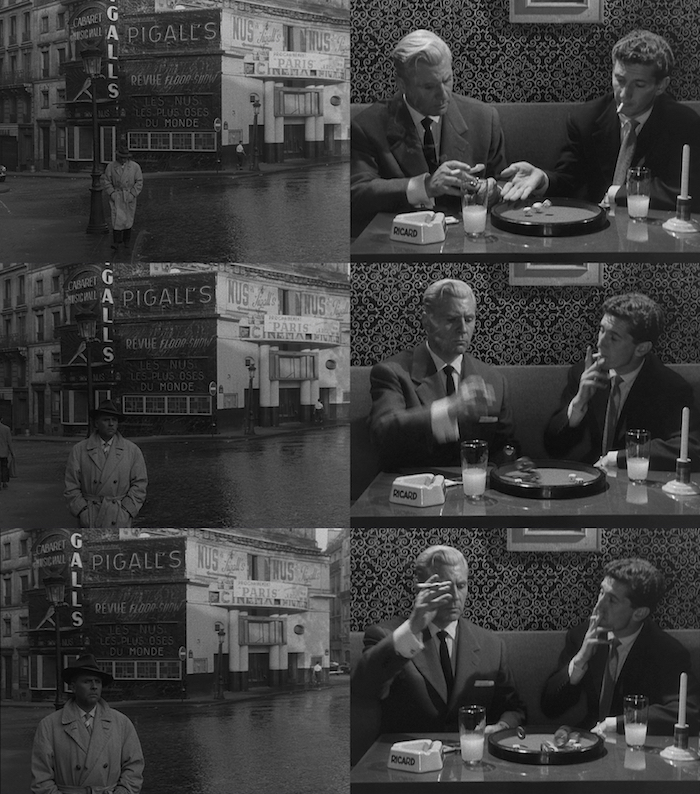
In the moments between night and day, by the dawn's early light, in Montmartre, that hallowed, hilly zone of solemnity and sleaze in Paris, resting somewhere between the Heaven of the Basilica of the Sacré-Cœur at its highest point and below it, the Hell of nightclubs, cheap hotels, cafes, whorehouses and gambling dens, the distinguished trench-coat-adorned silver-haired old fox Bob Montagné (Roger Duchesne) takes one last roll of the dice.

Craps.

It's been a long night and Bob's wiped out. He steps out onto the lonely morning streets, looks into a storefront reflection, straightens his tie and, taking in his weary visage, remarks aloud: "A real hood's face."

And so it is, but he's definitely not your run-of-the-mill garden variety miscreant. Bob Montagné is a class act. He's practically royalty, at least by the standards of magical Montmartre. Sure, he's been in an out of stir for most of his life, but amongst the post-war criminal class of France, he's pulled off some of the most daring heists, and as such, commands respect from thugs and cops alike.

He's a high-roller, you see, and everyone loves Bob: he's worshipped by the sweet young criminal Paulo (Daniel Cauchy), whilst the grizzled police lieutenant Ledru (Guy Decomble) considers him his best friend (and indeed owes his life to him) and, of course, there's a woman - the beautiful young Annie (Isabelle Corey), who adores him for his fatherly influence and generosity. Yes, everyone loves Bob, except for the foul pimp and stool pigeon Marc (Gérard Buhr). Bob has even less use for Marc, a piece of excrement on two legs who beats his women, sells anyone out for the right price and even tries to lure Annie into his stable.

Right from the opening frames of Jean-Pierre Melville's Bob le flambeur we know we're about to enter the world of the criminal class, but for the most part, "class" is the order of the day for men like our title character. Bob's also down for the count, but he's not there for long. He springs up with one last plan to restore himself. As an inveterate gambler, he knows all too well how much dough collects in a casino after a long night and he decides to put together a crack team to pull a heist on the mighty Deauville gaming emporium.

The magical world of Montmartre:
Wet streets, nightclubs, cigarettes and dice.

Best laid plans, however, can go awry, but the manner in which Melville explores this is one of the reasons why Bob le flambeur is a masterpiece. Let's put aside the fact that the picture's sense of atmosphere is so thick you can cut it with a knife, that its touches of Neo-realism make us feel like we're living, breathing and even smelling a world most of us will never know, that its eventual and shocking bursts of violence knock us on our butts and indeed influenced every crime picture that followed in its wake.

Let's put all that aside for a moment. Let's marvel at the sheer, brilliant simplicity of one key stroke of narrative genius:

Bob le flambeur is a heist film in which part of the caper itself involves its mastermind playing the tables of the casino he's going to rob and just as he's about to risk committing a crime that might land him in the hoosegow for a very long time, his rolls of the dice start to yield him a fortune that he's never seen in his life - a fortune that might indeed exceed that of what he could ever hope to rob from the joint.

Damn, this is genius.

THE FILM CORNER RATING: ***** 5-Stars

Bob le flambeur screens at Toronto's TIFF Bell Lightbox in the summer 2017 series "Army of Shadows: The Films of Jean-Pierre Melville" and, via the O.O.P. Criterion Collection DVD which includes an interview with Daniel Cauchy and an archival Gideon Bachman radio interview with Jean-Pierre Melville.

Monday, 3 July 2017

RIFIFI - Review By Greg Klymkiw - The greatest heist film ever made screens at Toronto's TIFF Bell Lightbox in the Summer 2017 series "Panique: French Crime Classics" and is also available on a gorgeous Criterion Collection Blu-Ray/DVD


Rififi (1955)
Dir. Jules Dassin
Scr. Dassin & René Wheeler
Nvl. Auguste Le Breton
Starring: Jean Servais, Carl Möhner,Robert Manuel,
Jules Dassin, Janine Darcey, Magali Noël, Claude Sylvain

Review By Greg Klymkiw

The major set piece of this extraordinary French crime film by blacklisted American director Jules Dassin is a breathless thirty-minute-long heist sequence that is shot with natural sound, no dialogue and no music.

It's pure cinema!

It's also one of the most nail-bitingly suspenseful scenes in movie history. We've come to know the characters, we understand the high stakes for all of them if they don't pull off the big steal and worst of all, we're well aware of what will happen if they're caught - especially the desperate old man, Tony "le Stéphanois" (Jean Servais). He's just served five years of hard time for a heist gone wrong and his only choices in life amount to petty crime, gambling and/or getting caught and being tossed back into the hoosegow until he's dead (or as close to dead as he'll ever get).

These men are criminals, but we want them to succeed. It's post-war France and the opportunities for men who've known only one way to survive are pretty much non-existent. They live by a strict code of honour and they'll steal, but they won't kill (at least until they are pushed to the limit to do so). There's clearly honour amongst these thieves (save for the slimy, greasy, lazy borderline pimps who weasel into the proceedings later on) and we never once feel like there are viable options for our main characters.

And so, we follow them willingly and almost complicitously into the breach - an insanely daring heist that requires split-second timing, impeccable teamwork and one hell of a massive whack of horseshoes worth of luck stuffed up their respective and collective keisters.


If the heist was only thing Rififi had going for it, there's no doubt the picture would be highly regarded, but that its bookends are as solid and compelling as all get out place Dassin's movie on s pedestal that holds some of the greatest crime pictures ever made. The manner in which Dassin shoots the heist is completely in keeping with his approach to the rest of the movie. Shooting almost exclusively on location captures the naturalistic feeling of the film's hard-boiled tale. Much like his groundbreaking American crime pictures (Naked City, Brute Force) which, broke American cinema out of the studio bound mould and took them onto the streets a la the Italian neorealist movement, Rififi is a glorious blend of stylized frissons within the framework of life itself.

Dassin, of course, had a tiny budget and little time to shoot the film, so he personally scouted all the locations in order to get a strong visual sense in advance to allow for impeccable planning. In many ways, Rififi is a model picture for independent, low budget approaches that are still infused with the highest degree of production value. Within Dassin's impeccable eye for visual detail, he's doubly blessed by working with the genius production designer Alexandre Trauner who manages to deliciously goose the look of the film.


Narratively, the tale is tough-minded and even romantic, but the attention to the details of the lives of the criminals and the heist itself (including the meticulous planning) give it the crank it needs to always keep us glued to the screen. As well, there's no overwhelming (and annoying) sense of the proceedings ever diving into moralistic waters. We believe in these men AND their criminal intent. We want them to succeed and if things go wrong and all becomes futile, Dassin sets the picture up in such a way that we're going to feel and care deeply about whatever plight the characters suffer. It helps, also, that the casting is impeccable - especially Servais as the world weary "le Stéphanois", Dassin himself as the funny, sprightly and finally, almost tragic figure of the ladies' man, as well as the other disparate and memorable members of the team.

The importance of Rififi as both dazzling entertainment, but as well, its place in laying the foundations for crime pictures that followed as well as the whole French New Wave that would come a few years later is, frankly, incalculable. All its historical significance aside, it's one hell of a good show! Rififi is brutal, harrowing and darkly funny and it seldom got better than this. The dames are dames, its heroes noble and the villains are pure filth. Sure, the movie trades in on the tropes of the genre, but does so expertly within its overwhelming naturalism that nothing ever feels cliched and is, in fact, far fresher than most films made today.

THE FILM CORNER RATING: ***** 5-Stars

Rififi screens at Toronto's TIFF Bell Lightbox in the Summer 2017 series "Panique: French Crime Classics" and is also available on a gorgeous Criterion Collection Dual Format Blu-Ray/DVD release complete with New 2K digital restoration, my favourite uncompressed monaural soundtrack, a very inspirational interview with director Jules Dassin, set design drawings by art director Alexandre Trauner, still, trailer, an optional English-dubbed soundtrack (especially handily for additional screenings to just study Dassin's visuals and a terrific essay by Jim Hoberman.

Sunday, 2 July 2017

ELEVATOR TO THE GALLOWS (Ascenseur pour l'échafaud) - Review By Greg Klymkiw - Louis Malle's Taut Fiction Feature Debut at Toronto's TIFF Bell Lightbox in the Summer 2017 series "Panique: French Crime Classics" and, of course, on a gorgeous Criterion Collection DVD

Babes. Hunks. Cigarettes. Murder. Paris. UNBEATABLE!!!

Elevator to the Gallows - Ascenseur pour l'échafaud (1958)
Dir. Louis Malle
Scr. Malle & Roger Nimier
Nvl. Noël Calef
Starring: Jeanne Moreau, Maurice Ronet, Georges Poujouly, Yori Bertin,
Jean Wall, Iván Petrovich, Elga Andersen, Félix Marten, Lino Ventura, Charles Denner

Review By Greg Klymkiw

Some movies demand the ingestion of popcorn. Others require mind-altering illicit substances. Louis Malle's stylish crime picture Elevator to the Gallows (Ascenseur pour l'échafaud) makes the insistent and peremptory request that you light up the strongest cigarettes imaginable and chain smoke your way through it from beginning to end. (For anyone planning a big-screen sojourn to see the picture at TIFF Bell Lightbox, you will sadly be shit out of luck on this front due to our city's regressive anti-smoking by-laws.)

Though Louis Malle (Au revoir les enfants, My Dinner with Andre, Atlantic City, Pretty Baby) had already garnered an Academy Award for his 1956 Jacques Cousteau documentary The Silent World, the French New Wave director wisely put together a sure-fire low-budget hit with this first dramatic feature film to solidify his place as a bankable filmmaker and damn, did he dazzle everyone with this très-cool crime thriller based on the pulpy Noël Calef novel. If it's a trifle cold and bereft of some of the hallmarks of Malle's later humanity, we can easily forgive that and just sit back and enjoy this delectable, unbeatable, suspensful indulgence replete with babes, hunks, plenty of cigarettes, zippy cars, cheap motels and murder most foul.

Our movie opens with the impossibly gorgeous couple Florence Carala (Jeanne Moreau) and Julien Tavernier (Maurice Ronet) passionately professing their love for each other over the telephone. A murder is committed, a mistake is made and our lovers are kept apart when our hero is caught in an elevator without power and the heroine is left alone waiting for him and forced to wander the streets of Paris, desperately looking for him. Tavernier's car is stolen by the impossibly handsome young thug Louis (Georges Poujoully) and his impossibly gorgeous girlfriend Véronique (Yori Bertin). The barely-out-of-their-teens couple goes on a joy ride and encounter the gregarious vacationing and champagne-armed German couple Horst (Iván Petrovich) and Frieda (Elga Andersen).

Partying and sex is assured. More murder is just round the corner.

Nail-biting suspense, mistaken identity and dogged detective work from cops Lino Ventura and Charles Denner follow in due course. Henri Decaë's gorgeous black and white cinematographic lensing of Paris and an astonishing music score by Miles Davis carry us along in one of the most delightful noir-tinged crime pictures of the period.

No need to spoil the proceedings with any further details. Just sit back with plenty of throat-shredding ciggies and enjoy!

THE FILM CORNER RATING: **** 4-Stars

Elevator to the Gallows (Ascenseur pour l'échafaud) plays on the big screen at Toronto's TIFF Bell Lightbox in the Summer 2017 series "Panique: French Crime Classics" and, of course, on a gorgeous Criterion Collection special edition double disc DVD that includes a new interview with Jeanne Moreau, archival interviews with Malle, Ronet, Moreau and soundtrack session pianist René Urtreger, footage of Miles Davis and Louis Malle from the soundtrack recording session, a new video program about the score with jazz trumpeter Jon Faddis and critic Gary Giddins, Malle’s student film Crazeologie, featuring the title song by Charlie Parker, Theatrical trailers and a booklet featuring a Terrence Rafferty essay, Malle interview and tribute by producer Vincent Malle.


Saturday, 1 July 2017

Les enfants terribles - Review By Greg Klymkiw - Melville and Cocteau make for strange bedfellows in this oddball 1950 effort at Toronto's TIFF Bell Lightbox in summer 2017 series "Army of Shadows: The Films of Jean-Pierre Melville" and, via the Criterion Collection DVD.

Can too much Cocteau be too much? Perhaps.

Les enfants terribles (1950)
Dir. Jean-Pierre Melville
Scr. Jean Cocteau & Melville
Starring: Nicole Stéphane, Édouard Dermit, Jacques Bernard, Renée Cosima

Review By Greg Klymkiw

God knows I love Jean-Pierre Melville, but sitting through his gun-for-hire directorial effort Les infants terribles is a bit like what a colonoscopy used to feel like before they knocked you out with happy drugs. In fact, it's not dissimilar to suffering through any movie directed by the lumberingly precious Jean Cocteau (Le Sang d'un poète, La Belle et la Bête, Orphée). Well, surprise-surprise, Les infants terribles is based upon the novel of the same title (and co-screenwritten) by Jean Cocteau. Even more appalling is that Cocteau himself, with a nasal, mannered delivery, narrates the movie with his sarcastic, obvious, on-point jackhammered prose.

At times, the movie feels like a Gallic-tinged Howard Hawks comedy with rapid-fire delivery and a score comprised mainly of Vivaldi, which, I'll admit, makes it sound more engaging than it actually is.

But no, it's often painful.

That, however, might be the point and in spite of often detesting the movie, I found it compulsively watchable - mostly because of Melville's direction and in spite of Cocteau's writing (not so much the narrative and dialogue, but the aforementioned narration, which often serves to rip us out of the picture's forward thrust).

Things begin well enough in the opening scenes at an all-male Catholic school where a bunch of boisterous lads roughhouse after a fresh snowfall. The dashing pretty-boy Dargelos (Renée Cosima) is leading the charge and at one point, he hurls a snowball tightly packed round a stone at the fey, aquiline-featured Paul (Édouard Dermit). Smacking him in the chest, it winds him to such an extent that he crashes to the ground, rendered unconscious and suffering from bruised ribs.

Melville's direction during this sequence is dazzling. We feel like we're in the midst of a war-like skirmish on the fields of Flanders and it's as sprightly and engaging an opening as one could hope for in any movie.

Eventually we're ensconced in the cramped middle-class quarters where Paul lives with his sister Élisabeth (Nicole Stéphane) and their infirm Mother (Maria Cyliakus). It's here where the film's annoyance-meter ramped up for me.

The picture plunges us into the obsessive, seemingly incestuous sibling rivalry/love and the pair engage in a series of tête-à-têtes that eventually reveal themselves to be an ongoing, deep-seededly perverse game. Paul is ordered by the doctor to stay home and in bed and Élisabeth becomes caregiver to both him and his Mother. Needless to say, the claustrophobia of the situation allows for plenty of nasty game-playing. Obsession rules the day - Paul is obsessed with pretty-boy Dargelos and misses him desperately and one of his school chums, Gérard (Jacques Bernard) visits regularly. He's obsessed with both the brother and sister and their games, but he also provides solace to Paul with news about the naughty Dargelos.

Things perk up when Mom dies (a magnificent cut and shot, pure Melville, reveals her to us and the characters). Enter the beautiful Agathe (also played by Renée Cosima) who Paul falls madly in love with since she's a dead ringer for his beloved naughty pal Dargelos. And yes, it's here where the movie hits its stride and ploughs us into the kind of madly delirious melodrama that Melville did so beautifully in the much-better and genuinely great melodrama Le silence de la mer (1949).

It's here wherein Élisabeth becomes so terrified that her brother will eventually marry Agathe and leave her alone (and hence, without the madly incessant game-playing) that what the nutty sister does next is sheer, delicious nastiness.

And you know what? As much as I profess(ed) to hate this movie, I must humbly, shamefully admit (in spite of Cocteau's influence) that I've now seen the picture three times. Well, like the old adage goes, "third time's the charm" and I find myself wanting to see the movie again. What a journey!

Vive Melville!

THE FILM CORNER RATING: **** Four Stars

Les enfants terribles screens at Toronto's TIFF Bell Lightbox in the summer 2017 series "Army of Shadows: The Films of Jean-Pierre Melville" and is available for home consumption via the Criterion Collection DVD which includes a new, restored high-definition digital transfer, an audio commentary by Gilbert Adair, interviews with producer Carole Weisweiller, actors Nicole Stéphane and Jacques Bernard and assistant director Claude Pinoteau, "Around Jean Cocteau", a 2003 short video by filmmaker Noel Simsolo discussing Cocteau and Melville’s creative relationship, the theatrical trailer, a gallery of behind-the-scenes stills and a booklet featuring a Gary Indiana essay, a tribute by Stéphane, an excerpt from Rui Nogueira’s "Melville on Melville" and drawings by Cocteau.

Thursday, 29 June 2017

Army of Shadows (L'armée des ombres) - Review By Greg Klymkiw - Grim, Haunting Portrait of Collaboration and Resistance at Toronto's TIFF Bell Lightbox in summer 2017 series "Army of Shadows: The Films of Jean-Pierre Melville" and, via a gorgeous (O.O.P. limited availability) Blu_Ray/DVD via the Criterion Collection

Collaboration is a dirty business. So is Resistance.

Army of Shadows AKA L'armée des ombres (1969)
Dir. Jean-Pierre Melville
Nvl. Joseph Kessel
Starring: Lino Ventura, Simone Signoret, Jean-Pierre Cassel,
Christian Barbier, Paul Crauchet, Claude Mann, Paul Meurisse, Serge Reggiani

Review By Greg Klymkiw

Collaboration is a dirty business. So is resistance. In an occupied country, both will thrive, yet seldom have either been more grim, mean and downright foul than in France during World War II.

Jean-Pierre Melville's film adaptation of Joseph Kessel's fictionalized version of his own real-life experience during this shameful period of 20th Century French History is not only a masterpiece, but it might be one of the most heroic depictions of the French Resistance ever made. That said, Melville's brand of heroism is replete with relentless outrage and deep, deep anguish.

Army of Shadows (L'armée des ombres) will be a bitter pill for any audience to swallow, but its necessity might be more urgent now than ever. "Occupation" of one country by another has become especially endemic to the ongoing and mounting political strife plaguing our world in this century and has resulted in the kind of "collaboration" and "resistance" that ripped the guts out of France and so many other European countries during the Second World War. One of the most fascinating features/attributes of Melville's picture is the fact that it stands before us as a film made almost half a century ago, about events that occurred almost one quarter of a century before the film itself was made, and yet here we sit, now, looking at it, our jaws agape over the cruelties and complexities the movie depicts, and realizing, ever-sadly, how so little, how so goddamn little in our world has actually changed.

It's a movie of universal qualities. The picture comes by them due to the strange narrative and stylistic structures Melville has chosen to infuse it with, all of which place us in a world that, from beginning to end, knock us off-kilter, keep us on edge and finally instil in us a dread that its events, which once happened, are indeed happening now and will happen again and again if we do not, by both acknowledgment and action, recognize and work towards ensuring that it stops.

Melville creates a film here that rubs our noses in the fact that our very nature as human beings is highly susceptible to the damage caused by occupation and how the inevitable resulting collaboration with occupying forces yields the kind of self-serving selfishness (the selfishness of survival, if you will) which gives way to the kind of inhumanity that even resistance can engender.

So how then, does he do this?

The first thing Melville chooses to greet us with are words.

Popping up from deep black, brilliant white typeface announces:

"Unhappy memories! Yet I welcome you...You are my long lost youth..."

My God, was there ever an epigram infused with more truth?

There is no elegant fade to black from these words, no gentle dissolve. Melville jolts us with a cut and the beautifully composed long shot he bestows upon us is that of the Arc de Triomphe de l'Étoile, that glorious symbol of France's victories over those who would dare profane French soil - a testament to the fallen warriors of the Revolutionary and Napoleonic Wars and, indeed, the resting place of the Tomb of the Unknown Soldier from World War I.

The Eiffel Tower might well be the ultimate symbol of Paris, but situated at one end of the Champs-Élysées, smack in the middle of the now-named Place Charles de Gaulle, but the more evocatively once-named Place de l'Étoile, the imposing Arch of Triumph remains, for most of us, the definitive apogee of France itself.

And we sense, immediately, that something is amiss. It's not the shot itself, nor is it the the drumbeats and marching feet from a line of soldiers on parade that slowly creep onto the soundtrack and intensify, but rather, it's the sky towering above the grand arch, so grey, so weirdly forbidding in the drabness of the clouds that makes us uneasy.

The camera never moves - or so it seems. Initially, the soldiers are so far away from us they're dwarfed by the Arch itself. As the parade gets closer and the music and marching become ever-cacophonous: beats, bleats, blasts and finally a blare - we're jolted into reality and the camera does indeed shift, ever-so subtly for us to realize that the soldiers are Nazis. As they get closer, filling the frame, defaming the composition of the Arch itself, our nerves are jangled.

And we are sickened.

Things don't get brighter. Melville bestows the rest of the opening of the film in swathes of dull blues, greens and greys as we're introduced to the well-groomed civil engineer Philippe Gerbier (Lino Ventura) who is being driven to a prison camp filled with "enemies" of the collaborationist Vichy government of France, the ruling bureaucracy which has prostrated itself before the Germans who have swallowed the country whole as an occupying force.

Dirty Nazis.

Dirtier still are the French - or rather, those Frenchmen who betray their soil, their nation and their people to serve the foul occupiers.

Phillipe is treated by his captors in a relatively gentlemanly fashion. Housed in a barracks that was ironically designed by the French to house German officers, but is instead now populated by Frenchmen, the pensive, almost bookish prisoner has little regard for his fellow captives, until he takes a shine to a bright young man who proposes a brilliant plan of escape.

This will be our (and Phillipe's) first taste of betrayal in the film. The vibrant youthful co-conspirator sells out our hero to the Vichy pigs and he soon finds himself transported to a Nazi facility. Phillipe escapes (quickly, efficiently and shockingly engineered) and we eventually find him ensconced on the Riviera where he leads the French Resistance movement.

From here, the film charts a series of resistance movements - some successful, and others scuttled by either circumstance or worse (and most often), betrayal. Occupying forces count on the Judas Kiss and Melville's film doesn't spare its characters from being forced to sell out. Then again, and most tragically, the film doesn't save several other characters from refusing to turncoat, and what awaits them is torture and inevitably, agonizing death. And though we see numerous instances of characters succumbing to the equivalents of the "death-by-a-thousand-cuts", Melville conversely doesn't spare an equal number of them from being snuffed out brutally and swiftly.

Throughout his career, Melville 's approach to on-screen violence was unique in its savage efficiency and in Army of Shadows, we are "treated" to several instances of this, so ferocious in the barbarity of the acts, that we're forced to cringe and gasp through several agonizing stranglings, stabbings, beatings and shootings. From a tea towel garrotte wrenching a traitor's last gasps of air to a cold, hard pistol appearing out of nowhere, pausing to give its intended victim a few moments of recognition and then, the inevitable, the blast of a gunshot, the piercing of flesh and death that is as merciful as it is cruel.

There are, of course, moments of tenderness, love, loyalty and yes, even hope. However, the film's overall tone is one of despair. The picture begins as it ends, beginning with one thing and allowing it to transform into something quite different - jolting us out of anything resembling comfort or complacency.

Yes, amongst the army of shadows in this horrific topsy-turvy world of collaboration and resistance, there is heroism, but nobody - nobody is a winner.

THE FILM CORNER RATING: ***** 5-Stars

Army of Shadows AKA L'armée des ombres is being screened during the TIFF Bell Lightbox series entitled "Army of Shadows: The Films of Jean-Pierre Melville" and is available on the Criterion Collection in a (limited availability O.O.P.) BLU-RAY and DVD that includes an audio commentary with film historian Ginette Vincendeau, an interview with editor Françoise Bonnot, On-set footage and excerpts from archival interviews with director Jean-Pierre Melville, cast members, writer Joseph Kessel, and real-life Resistance fighters, "Jean-Pierre Melville et L’armée des ombres” (2002) and "Le journal de la Résistance" (1944), a rare short documentary shot on the front lines during the final days of German-occupied France.

Wednesday, 28 June 2017

Le Samouraï - Review By Greg Klymkiw - Classic crime picture (on 35mm no less) at Toronto's TIFF Bell Lightbox in summer 2017 series "Army of Shadows: The Films of Jean-Pierre Melville" and, of course available on a gorgeous DVD via the Criterion Collection

Contract killer played by oh-so cool Alain Delon.

Le Samouraï (1967)
Dir. Jean-Pierre Melville
Scr. Melville & Georges Pellegrin
Starring: Alain Delon, François Périer, Nathalie Delon, Cathy Rosier

Review By Greg Klymkiw

Jef Costello is a contract killer. He's clearly good at his job, but he's also inordinately, almost ferociously cool. Oh yeah, he's cool as a cucumber - when you kill for money, you've gotta be, but the "cool" I'm really talking about here is more than his solitary reserve; Jef Costello is cool, as in: he's out of sight, man!

How can he not be?

In Jean-Pierre Melville's awesome 1967 crime thriller Le Samouraï, he's played by the epitome of cool, Alain Delon. When we first meet him, the dude is relaxing in his grungy, spartan Montmartre bachelor suite, smoking a butt on his bed while his tiny pet bird tweets in its cage. Titles appear over this strangely unsettling scene of repose:

"There is no solitude greater than a samurai's,
unless perhaps it is that of a tiger in the jungle."

The quotation is attributed to the "The Book of Bushido". As it turns out, this book is non-existent. It's Melville's invention - no doubt inspired by similar tomes - but that the great auteur chooses to open his film with a manufactured quotation is telling. We're about to enter a world in which the filmmaker is going to steep us in style of the highest order - the film's mise-en-scène proves to be copiously luxuriant in Melville's mastery of technique and appearance. We're going to feel his mitts all over this picture.

Astonishingly though, this will be no mere exercise in style for its own sake. Melville also infuses the work with oddly Neo-realist properties. We know we're watching a movie, but good goddamn, at times it feels like life itself.

And so it is that Jef Costello, attired in a grey trench coat and impossibly sexy fedora, eventually enters a nightclub and guns a man down in cold blood.

Jef's made some mistakes, or so it seems. He's not only been noticed, but at one point he comes face-to-face with a witness, Valérie (Cathy Rosier) the club's gorgeous, exotic piano player. But Costello is too steely and handsome. Valérie refuses to identify him in a police lineup.

This frustrates the Superintendent (François Périer) of the investigating homicide division because his gut is telling him Jef's his killer, in spite of the fact that our icy hitman appears to have crafted a reasonably iron-clad alibi, provided in part by the gorgeous ('natch) Jane Lagrange (Nathalie Delon) his "fiancé", a beautiful hooker with a heart of gold.

The Superintendent is not going to let go. He clamps his vice-like jaws upon Jef like a pit bull. using every available resource at his disposal. To make matters worse, our sleek hero is double-crossed by the men who hired him. They're welching on payment and want to take him out.

What French crime picture doesn't have babes?

What we get is 105 relentless minutes of cat and mouse - double your pleasure, of course, since the Superintendent is stalking his quarry whilst the quarry has his own quarry to stalk.

All of this is stylishly played out upon the grey streets of "Gay Paree". La Ville-Lumière has seldom looked as bleak as it does in Le Samouraï.

In one of the greatest set-pieces in movie history, Jef wends his way through the Knossos-like labyrinth within the bowels of the ancient Paris Metro. We're on the edge of our seat and then some.

Melville dazzles - yes, with sheer cinematic aplomb, but also with a meticulous attention to detail. Every step of the way, he makes us feel like what we're watching is real; whether we wait with Jef through the tedium of having his licence plates swapped in a clandestine garage or when two detectives painstakingly enter Jef's apartment, scour it and eventually plant a bug for audio surveillance.

And for all the cool, the tough-mindedness, the violence, Melville never lets go of his characters' humanity. The film is steeped in romance, star-crossed fate and ultimately, a kind of sad, desperate sense of doom. Damned if he doesn't move us to tears with the same fervour he manages to tantalize our eyes and thrill us to bits.

THE FILM CORNER RATING: ***** 5-Stars

Le Samouraï is playing in 35mm during the TIFF Bell Lightbox series entitled "Army of Shadows: The Films of Jean-Pierre Melville" and is available on the Criterion Collection in a DVD that includes video interviews with Rui Nogueira, author of "Melville on Melville" and Ginette Vincendeau, author of "Jean-Pierre Melville: An American in Paris" plus archival interviews with Melville, Alain Delon, François Périer, Nathalie Delon, and Cathy Rosier.

Sunday, 25 June 2017

THEY LIVE BY NIGHT - Review By Greg Klymkiw - Ray Debut Gets Criterion Deluxe Treatment

Depression-era novel yields perfect post-war Film Noir.

They Live By Night (1948)
Dir. Nicholas Ray
Scr. Charles Schnee, Nicholas Ray
Nvl. Edward Anderson
Starring: Cathy O'Donnell, Farley Granger, Howard Da Silva,
Jay C. Flippen, Helen Craig, Will Wright, Marie Bryant

Review By Greg Klymkiw

You know the kid is doomed. That's usually the way it is in the grand tradition of film noir crime pictures, but there's a lot more to it than mere genre expectation. Nicholas Ray's debut feature film They Live By Night is so immersed in despair that the pain experienced by the viewer is matched only by our hope against hope that the sweet, young escaped convict Bowie (Farley Granger) is somehow, someway going to find a way out of the hole that both he and circumstance are digging - deeper and deeper and ever-deeper, right from the opening frames.

But we know, we just know, it ain't gonna be so. In this world, hope is a stacked deck and the dealer holds all the good cards. The wide-eyed look of both fear and expectation in Bowie's eyes as he waits in the darkness of night with a sweet, stray dog is enough to tell us that no matter what brief glimmers of hope get tossed his way, he's going to be swallowed whole by a hard, cruel world that has it in for the disenfranchized in the post-war ennui that pervades the world of the film (but in its universal prescience, stands in so sadly for a world that continues to assault those who are the most vulnerable).

And so it is, like Edward Anderson's depression-era novel (and Robert Altman's great 1974 film version Thieves Like Us), that Bowie breaks out of a life-sentence in stir with the older, though hardly wiser thugs, the one-eyed Chicamaw (Howard DaSilva) and the grizzled T-Dub (Flippen). The three convicts hide out in the ramshackle rural home of old drunkard Mobely (Will Wright) and his daughter Keechie (Cathy O'Donnell). With the financial and moral support of T-Dub's sister-in-law Mattie (Helen Craig), the trio plan a major bank robbery.

The core of the story is where director Ray excels. (Ray's entire career seems devoted from this film onwards to movies focusing upon disenfranchised outsiders - Rebel Without a Cause, anyone?) Thanks to producer John Houseman and RKO studio chief Dore Schary, this might be the only film that Ray had unfettered freedom. The movie charges with passion and energy, unlike Altman's equally brilliant take which focused upon the sheer monotony of life-on-the-lam.

Ill-fated lovers on the lam: Claustrophobia to Flight.
Nicholas Ray brilliantly tosses in every cinematic tool at his disposal to keep us enthralled. The helicopter "God" shots are especially dazzling and his groundbreaking use of sound places us firmly in a world that pulsates with a terrible beauty - at once real and alternately, hyper-real, borderline expressionism (especially in his use of Christmas Carols during the most heartrending perversion of domestic bliss and a knockout nightclub sequence with Marie Bryant performing "Your Red Wagon").

Of course, the film's narrative nucleus is the doomed love story between Bowie and Keechie and, oh, it's a heartbreaker. Not only is Bowie doomed from the first glimpse of him, so too is the love twixt this sad, broken couple. When we first meet them as a pair, the sparks are clear, but so's their downfall. Whatever shards of joy they're going to share, they're ultimately bound to wind up on a clear path to sheer and utter despair.

In many ways, both characters have been prisoners. Bowie was incarcerated as a teenager, railroaded by a system that had no time to mete genuine justice upon a poor abused kid. Keechie has lived her entire life helping her alcoholic Dad in the middle of nowhere. Neither of these people have done anything resembling "living" and what life they're going to experience together is most definitely not bound for glory.

So much of the movie is "on the road" - getaway cars and buses. Flight certainly offers an alternative to the claustrophobia that infused the lives of the film's young lovers, but one of the most astonishing set pieces offers a strangely moving repast for Bowie and Keechie when the couple takes one day - ONE DAY - to live out their lives as a "normal" couple.

When the heist occurs early on, it yields a whack of dough, but the troubles start there. Every step of the way, from this point forward, is a misstep and the movie can do little more than toss a crumb or two of happiness in our protagonists' way, and then, bury it with shovelfuls of cold, grimy dirt.

They Live By Night is a movie that seems to be digging a grave and maybe, just maybe, the best we can do as observers is experience its sad inevitabilities so that we never close our eyes to the plight of those who need more than mere sympathy, but action, so that we can all live in a world that extends something resembling compassion.

THE FILM CORNER RATING: ***** 5-Stars

They Live By Night is available on the Criterion Collection and comes replete with a new 2K digital restoration, with uncompressed monaural soundtrack on the Blu-ray, an audio commentary featuring film historian Eddie Muller and actor Farley Granger, a great video interview with film critic Imogen Sara Smith, a short piece from 2007 with film critic Molly Haskell, filmmakers Christopher Coppola and Oliver Stone, and film noir specialists Alain Silver and James Ursini, plus a dazzlingly eye-opening (and nicely illustrated) audio interview from 1956 with producer John Houseman in conversation with Gideon Bachmann.

Monday, 19 June 2017

GHOST WORLD - Review By Greg Klymkiw - 2001 Zwigoff & Clowes masterpiece on Criterion

Shirtless Nunchuck Master fortifies with beef jerky.
A sad old man waits for a bus that never comes.
Teenage girls in this GHOST WORLD see it all.

Ghost World (2001)
Dir. Terry Zwigoff
Scr. Daniel Clowes and Zwigoff
Starring: Thora Birch, Scarlett Johansson, Steve Buscemi, Illeana Douglas, Pat Healy, Brad Renfro, Bob Balaban, Teri Garr, Dave Sheridan and Charles C. Stevenson Jr.

Review By Greg Klymkiw

"I used to think about one day, just not telling anyone, and going off to some random place. And I'd just, disappear. And they'd never see me again." - Enid (Thora Birch) in Ghost World

The sad old man in a dark suit and gray tie stares at nothing in particular as he sits on a bench at a long-discontinued transit line, waiting for a bus that will never come. His name is Norman (Charles C. Stevenson Jr.). Though a touch distracted, he seems friendly enough when recent high school grads Enid (Thora Birch) and Rebecca (Scarlett Johansson) stop to talk with him, but when they assert that the bus route was cancelled two years ago, he expresses mild annoyance, even outright dismissal when he growls, "You don't know what you're talking about."

On the surface, Ghost World, director Terry (Crumb) Zwigoff's film adaptation of the Daniel Clowes graphic novel seems to be about the gradual drift that occurs between these two longtime girlfriends during their first summer of true freedom after twelve-long-years of school, and yes, so it is - on the surface. In reality, though, the picture seems rooted firmly in the character of Norman, someone who appears only briefly in three scenes.

Norman, you see, has a dream and so does young Enid. It is a dream of longing, a dream of escape - leaving behind the ghosts of a town that's become too small to hold anyone there with the desire for flight, the gnawing need to migrate towards a fresh life and new adventures.

One night, Enid visits Norman at the bus stop with the following confession: "You're the only person in this world I can count on, because no matter what, I know you will always be here."

This is Enid's problem. She can't count on anyone or anything to remain in her life. Oh sure, she's surrounded by a handful of constants. Her bestie Rebecca has long been an appendage. The two have remained super-glued together through a life of quips and wry, cynical observations on everyone and everything that seems so ordinarily below their lofty station - "normal" is a dirty word in their vocabularies. They've shared a dream of getting jobs and rooming together in their very own apartment, but when the reality of settling down creeps into their friendship, Enid turns to the geeky middle-aged 78 collector Seymour (Steve Buscemi) for solace and inspiration.

Enid meets Seymour when she's concocted a nasty little ruse after reading his plea in a "personals" column and she responds to it, pretending to be a potential paramour. Instead, she and Rebecca show up to the prescribed meeting place, a faux-50s-style diner in a strip mall and cruelly sit back and watch him arrive and wait in vain for the date that never shows up. They follow the dejected schlub to his nondescript low-rise apartment dwelling and even patronize his garage sale one Saturday morning.

The first signs of a shift in the girls' friendship is apparent. Rebecca thinks Seymour is a creepy nerd (especially after the girls attend a party in his apartment populated by middle-aged 78/vinyl geeks). Enid however, becomes a woman obsessed. She finally admits that Seymour represents "the exact opposite of everything I hate".

But even Seymour won't remain long in Enid's life - it's partially her own doing. She plays teenage matchmaker and when he finally lands a girlfriend, she jealously attempts to break it up by coming on to the poor schlub and eventually dumps him once she realizes that life with him isn't what she's cut out for.

When Enid talks to old Norman at the bus stop, he declares: "I'm leaving town." When a bus mysteriously appears, he boards it and disappears from her life, probably forever. Every anchor in Enid's life continues to dissipate. Even her single dad (Bob Balaban) is planning to get married. They're all dropping like flies. This is a coming-of-age via abandonment, but maybe, just maybe, a bit of self-abandonment is necessary.

New Criterion cover-art by Daniel Clowes.

Zwigoff and Clowes have created one of the most compelling female characters in all of cinema. Enid comes to life in ways that so many characters (no matter what their sex) have ever done. From the opening scene in which the camera tracks along the open windows of an apartment complex, we hear the sounds of a rousing Bollywood tune whilst each window gives us a glimpse into a series of seemingly empty lives: a lone Asian woman staring forlornly into the night, a shirtless dude with a mullet sitting alone in his kitchen, a dinner table bereft of anyone in sight to enjoy the booze, uneaten food and exercise bicycle next to it, a dopey bovine couple watching their stupid kid whack his toys with a plastic baseball bat, and then...

Enid! A raven-haired young beauty in a red kimono-like bathrobe, dancing madly and identically to a woman in a Bollywood video that plays on her television, is revealed to us as someone who is clearly cut of her own unique cloth. (When Enid dyes her hair green and begins sporting period punk-wear, she's even more ravishing and definitely, cooler-than-cool.) Thora Birch attacks the role with a vengeance - as if it were the role of a lifetime, which, it probably will end up being.

The film captures the ennui, the downright melancholy of adolescence with deadpan fervour. The muted colour-pallette created by cinematographer Affonso Beato, the perfection of the movie's cast and an astonishing score comprised of the heartbreaking strains of David Kitay's music and a terrific whack of songs (including the legendary "Devil Got My Woman" by Skip James), all combine to deliver a work that's as riotously funny as it is deeply and profoundly moving.

The film has not dated in the sixteen years since its first release. Though the period details of its late 20th Century never-never-land are omnipresent, the picture's perspective feels downright universal. I was delighted that during my most recent helping of the film, my own 16-year-old daughter was completely blown away by the movie and can't stop watching it - over and over again. We've talked at length about it, but she actually observed something I couldn't have put better myself.

Referring to the haunting final moments of the film, my daughter remarked, "You know, Dad, sometimes we all just need to get on that bus and disappear."

I won't argue with that.

THE FILM CORNER RATING: ***** 5-Stars

Ghost World is available in a sumptuous Criterion Collection DIRECTOR-APPROVED SPECIAL EDITION on Blu-Ray/DVD and includes a new, restored 4K digital transfer, supervised by Zwigoff, a 5.1 surround DTS-HD Master Audio soundtrack on the Blu-ray, a great commentary featuring Zwigoff, Clowes and producer Lianne Halfon, new interviews with actors Thora Birch, Scarlett Johansson, and Illeana Douglas, an extended excerpt from Gumnaam (1965) featuring the Bollywood number that appears in the movie’s opening title sequence (and with a wonderful commentary about the film itself), some terrific deleted scenes (including alternate takes of the nunchuck wielding madman played by Dave Sheridan), the trailer, an essay by critic Howard Hampton, a 2001 piece by Zwigoff on the film’s soundtrack and reprinted excerpts from Clowes’s comic "Ghost World". The Blu-Ray/DVD includes gorgeous new cover art by Daniel Clowes himself.