Showing posts with label A71. Show all posts

Friday, 26 May 2017

POPULATION ZERO - Review By Greg Klymkiw - How To Get Away With Murder in the U.S.A.

In Yellowstone National Park:
You can legally get away with murder,
a bear once chased a burning bison and
a documentary filmmaker buys a really stupid hat.

Population Zero (2017)
Dir. Adam Levins, Julian T. Pinder
Scr. Jeff Staranchuk
Prd. Tyler Levine

Review By Greg Klymkiw

Three young men go camping in the majestic Yellowstone National Park. They are shot at point blank range. Their killer calmly turns himself in and confesses to his crimes. He cannot be charged with murder. After serving 60 days for illegal possession of a firearm in a national park, he goes free.

Documentary filmmakers Julian T. Pinder and Adam Levins want answers. Why does an American constitutional loophole exist so that anyone - I repeat, anyone, can commit an act of first-degree homicide (or any crime of their choosing) in a tiny stretch of the Yellowstone National Park?

That is the question.

This mere 50-square-miles of parkland spills over into Idaho and Montana, but since it is federal land, the powers-that-be have morphed the entire shooting match (as it were) into Wyoming's federal district.

Sure, American Presidents commit murder all the time whenever the country engages in spurious wars, but if, say, President Trump was a guest on The Late Show and he blew Stephen Colbert's head to smithereens with a handgun, even he would face murder charges. If, however, he went camping and ran into Stephen Colbert on this isolated stretch of Yellowstone in Idaho or Montana, he'd be able to rearrange Colbert's face with a shotgun blast and not be charged with murder. That is because President Trump would not be able to face a jury since the population of this region is zero and every American has the God-given right to face twelve peers.

With Levins operating the camera and Pinder on camera, Population Zero is a quest for truth. Who were these young men? Why were they murdered? Who was their killer? And why, oh why, did he get away with murder - legally and constitutionally?

As documentaries go, Population Zero is a strange duck. Sometimes it feels like a cheesy piece of true-crime reality TV blended with a kind of Michael Moore-like filmmaker-as-obsessive hunter/detective. It's ultimately better than the former, but its dalliances with the latter are mildly flawed since the filmmakers' personalities, agendas and back stories don't quite connect with their quarry, nor are they adequately presented in contrast.

All that said, Population Zero is compulsive viewing. As things ramp up, especially when the filmmakers uncover increasingly shocking clues and get closer to the killer, the film is flat-out chilling and during its last third, genuinely scary. It's one thing for this geeky pair to interview family and friends of both the victims and the killer, it's quite another when it seems like the whack-job, who has all but disappeared upon release from jail, begins leaving a trail of clues for the filmmakers - intentionally. Along the way, the filmmakers also uncover an environmental tragedy in Williston, North Dakota which, actually might tie-in to the horrible crimes.

I had certainly heard about the oddball American constitutional loophole (God knows, I listen to enough George Noory, Art Bell, Linda Moulton-Howe and other alt-news personages to be acquainted with it), but what forced me to keep watching (in spite of suffering as co-director Pinder insists upon wearing one of the ugliest hats I have ever seen anyone choose to wear) is that the story of these three sweet young men being murdered and their killer getting away scot-free was completely new to me. I try not to pay too much attention to world events, but when the film ended, this fella was scratching his noggin furiously over the fact that this was one item, the mass killing in the park (and subsequent constitutional controversy), that had inexplicably slipped well below his radar.

It turns out that there's a very good reason for this. If you want to know why, stop reading, watch the movie, then come back and read the rest of this review.

Exhibit A: a press release
Exhibit B: a producer

As any of my regular readers (and friends and colleagues) know, I do everything in my power to know as little about any movie I see before I see it: No trailers, no puff pieces, no reviews and even averting my eyes to posters, ads and social media babbling. When I get press releases for new movies, I never read them - or rather, I can't help but read the first few lines when I open email missives from the publicists.

In the case of Population Zero, all my eyes bothered to register was the title (a pretty good one), the logo from A-71 (a very cool Canadian boutique distribution company) and, conveniently positioned on the right-hand bottom of the credit block, the name of the film's producer Tyler Levine (a former student from when I taught at the Canadian Film Centre).

OK. Three good reasons to request a screener link (yeah, critics almost seldom pre-screen indie films in theatres). Password-protected Vimeos are the cinema of choice. Besides, I have the luxury of not bothering to review movies I don't like, so if the movie stinks, I can turn it off and not write about it. (Oh, don't worry, I STILL enjoy crapping on any bad movie I am forced to sit all the way through.)

So I watched this movie. All the way through. Then it ended.

So why the hell had I never heard about this crime (and lack-of-punishment) before?

I went back to the press release. Ah, this is NOT a documentary. It is a narrative constructed AS a documentary. Pretty decent job, dudes. You fooled the shit out of me. I also should have wondered why some of the documentary subjects looked familiar. Uh, a few of them are character actors on TV and in the movies.

I do wonder how I'd have responded to the movie if I knew, from the get-go, that it was a fake doc. Well, I'll never know now. What I DO know is that it's a damn enjoyable movie as it stands and I highly recommend that everyone stop going to see movies knowing what they're going to see. It's so much more edifying.

THE FILM CORNER RATING: *** 3-Stars

Population Zero is being released in Canada via A-71 Entertainment.

Thursday, 4 May 2017

JACKIE BOY - Review By Greg Klymkiw - Angry Young Men in Grotesque Canuck Kitchen Sink

Jackie Boy (2015)
Dir. Cody Campanale
Starring: Alino Giraldi, Shannon Coulter, Edward Charette,
Andrew Di Rosa, Chloe Van Landschoot, Christina Bryson

Review by Greg Klymkiw

This grim, powerful slice-of-life exploration of male bonding and misogyny is the best feature film of its kind since 1997's In the Company of Men and is, in fact, far more aesthetically whole and bereft of the quick, easy moralistic turns taken in Neil LaBute's foray into manly meanness. Though it lacks LaBute's satirically-edged humour, this is not a problem at all since writer-director Cody Campanale is clearly burrowed into the kitchen sink realism of mannish hatreds (not unlike films from the 60's British New Wave such as This Sporting Life, Room at the Top and Look Back in Anger).

Here we find three layabout buddies in their late 20s, living aimlessly in the dreary post-war suburbs of Hamilton. The group's Alpha-Male is Jack (Alino Giraldi), the strikingly handsome and sexy cocksman who lives in a morass of drugs, booze and one night stands in the clubs. After finding out that one of his female conquests has a boyfriend, he snaps a bunch of nude provocative photos of her and uploads them to social media, just to humiliate her and brag to his buddies about how badass he was. Kal (Edward Charette) might even harbour deeper feelings of hatred towards women and we get considerable clues that he is, in fact, repressing his homosexuality. Tony (Andrew Di Rosa) is a major loser with a hot life partner who puts up with his general untidiness, unemployment and increasing weight gain, but she's near the end of her charitable rope.

These men are pigs. They have no redeeming qualities whatsoever. This is a good thing. Campanale seeks not to explain away their behaviour, nor does he attempt to falsely attribute positive aspects to their foul personae. Watching the film is uncanny - sickeningly so. I know these men and even recognize (to my shame) bits and pieces of myself. Campanale's sense of observation is masterly and he's offered considerable support to this end from his cast, cinematographer and an outstanding score.

However, watching these guys be pigs for a whole film would be too much and Campanale's deft screenplay realistically provides a spanner in the works. Jack meets Jasmine (Sharon Coulter), a smart, funny and unbelievably sexy young woman who refuses to succumb to his bullshit. This makes him want her even more - so much so, that the unthinkable happens and he begins to fall in love with her. Having normal feelings for a woman pisses off his buds mightily and the film creepily edges to a shocking climax.

Unfortunately, I wish Campanale had trusted in the inevitability of the story's actions and had not succumbed to working a "surprise" sub-plot in to deflect attention away from the said (and sad) inevitability. It's the one false note in a movie that is refreshingly without them (and keeps the picture from attaining masterpiece potential). Still, it's a terrific film and to its undying credit that this one glaring flaw doesn't keep the movie from sinking too deeply into a quagmire of disappointment.

Ultimately, Jackie Boy is the real thing. So is its director.

THE FILM CORNER RATING: **** 4-Stars

Sidenote: Campanale's film weirdly reminded me of a short film I wrote and directed for the now-defunct OMDC Calling Card Programme in 2000 called Zabava. The short swam about in the bucket of piss known as Ukrainian-Canadian man-boys treating women like shit. Though not derivative of my film in any way, there are narrative elements in Campanale's feature that are strikingly similar to my short, proving only that misogyny carries over in similar ways from generation to generation.

Jackie Boy opens May 5 at The Royal Cinema via A71.

Tuesday, 31 May 2016

THE WAITING ROOM - Review By Greg Klymkiw - The Living Death of War *****


The Waiting Room (2015)
Dir. Igor Drljača
Starring: Jasmin Geljo, Zeljko Kecojevic, Cynthia Ashperger

Review By Greg Klymkiw

Even when a war is 20-years-ago and thousands of miles away, it sears its ugly imprint upon your soul forever. It's even worse if you've been forced to abandon all you know and love for a new country with few prospects for immigrants and refugees.

Jasmin (Jasmin Geljo, a tough, pug-faced Buster Keaton) knows this all too well. The popular actor and playwright fled the violent dismantlement of the former Yugoslavia and settled in Toronto. Estranged from his first wife, he still finds time to visit her in the terminal cancer ward, alternating the death-watch with his youthful adult daughter. Married to a much younger woman, with whom he's sired two children, Jasmin grows increasingly distant from her.

Eking out a living as a construction labourer whilst endlessly auditioning for stereotypical television roles requiring Eastern European gangster "types", he dreams of recapturing former glories (of the thespian kind) by returning to Sarajevo to mount the hilariously bawdy theatrical comedy he's been performing for Toronto's Yugoslavian community.


War, however, forces dreams to either die hard or at best, reside in a kind of purgatory. His attempts to move forward seem to create an ever-increasing stasis. Taking part in the filmed portion of a political avant-garde art installation about the turbulent events two decades earlier is what finally ignites memories of the war he's tried so hard to closet. One repression usually leads to another and Jasmin's purgatory intensifies.


Writer-director Igor Drljača has taken several astonishing leaps forward from his dazzling 2012 debut feature Krivina.

This sophomore effort is even more richly layered, but on this occasion, he's splashed the movie with healthy sprinklings of (mostly sardonic) humour amidst the angst. What consumes us, though, is Drljača's rich mise-en-scène - gorgeously composed still-life shots, the drab, grey Toronto juxtaposed with a fake backdrop of the gorgeous Yugoslavian countryside. The pace is miraculously measured and calculated; so much so that the picture's guaranteed to mesmerize.

Like his first feature, Drljača has crafted a devastating film about war with nary a single shot fired from a gun, nor a single bomb exploded. The echoes, explosions and shots heard round the world are burrowed in the film's devastating silence and the pain etched into the faces of those suffering strangers in a strange land are like silent screams ever-reminding us of the true casualties of war - those who live a living death.

THE FILM CORNER RATING: ***** Five Stars

The Waiting Room opens June 3 in Canada via A-71 Entertainment with its inaugural theatrical play date at the TIFF Bell Lightbox and additional dates to follow.

Monday, 2 May 2016

THE RAINBOW KID - Review By Greg Klymkiw -


The Rainbow Kid (2015)
Dir. Kire Paputts
Starring: Dylan Harman, Julian Richings, Tony Nappo, Nicholas Campbell

Review By Greg Klymkiw

Is it possible for a picture to hover in the strange never-never land of neorealism and magic realism? Well, it's improbable, but not impossible and if there's a picture that manages to do so whilst creating its own unique voice, then said honour belongs to the new film by Kire Paputts. Original, moving and transcendent, The Rainbow Kid leads us to the very heart of humanity.

Impossible journeys to achieve even more impossible goals are the stuff dreams and good films are made of. Happily, Paputts gets to have his cake and eat it too with this lovely picture. The film has a surface sweetness and gentle demeanour which masques the darkness which can befall and/or threaten the innocent in a world rife with meanness.


Eugene (Dylan Harman) has Downs Syndrome. His healthy obsession with rainbows leads him to embark upon an odyssey to discover the pot of gold which, it has been said, rests ever-so gently at the end of those splendorous bands of colour arching across the sky after a good rain. Like any great quest tale, Eugene experiences a series of episodic adventures along the way. Many of them take the form of meeting and relating to a variety of people including an old punk rock star played one of Canada's greatest character actors, Julian Richings.


The film has an incorruptibility that borders on the whimsical, but happily never careens into the sickening tweeness of films, mostly of the French and Spanish persuasion, which annoyingly force us to bathe and/or drown in a septic tank full of treacle and bile. The tough-minded core always remains just below the surface, always threatening to impinge up Eugene.

If anything, The Rainbow Kid is imbued with the tone so overwhelming in David Lynch's immortal The Straight Story in which old contemporary cowpoke Richard Farnsworth (The Grey Fox) traverses the highways of America on a lawn mower to reunite with his long-estranged brother. In both cases, humanity reigns supreme as the respective central characters transcend their challenges by an immersion in the challenges, tears, joy and, yes, meanness of others.

THE FILM CORNER RATING: **** Four Stars

The Rainbow Kid opens the Canadian Indie Film Series May 4 and theatrically May 6 in Canada via A-71. Canadian Indie Film Series screenings on May 4 include: Kingston, Waterloo, Calgary, Kamloops, Penticton, Cranbrook, Campbell River, Courtenay, Edmonton, Winnipeg, Kanata, Whitby, New Westminster, Kelowna, Nanaimo with special events at Staircase Theatre in Hamilton (date TBD) and Market Hall Theatre in Peterborough (June 8).

Thursday, 14 April 2016

ACROSS THE LINE - Review By Greg Klymkiw - Hockey, Crime and Racial Divides in Halifax

Two brothers. One's a pimp. The other's a new NHL star.

Across the Line (2015)
Dir. Director X
Scr. Floyd Kane
Starring: Stephan James, Sarah Jeffery, Shamier Anderson,
Lanette Ware, Steven Love, Denis Theriault, Cara Ricketts

Review By Greg Klymkiw

In the movies, racial violence and hatred has almost always seemed like the domain of urban concrete jungles in cities like New York, Boston, Chicago, Los Angeles and, among others, Detroit.

But in Halifax, Nova Scotia?

We're talking a big, old small town in Eastern Canada with fiddle players on every corner. The bustling metropolis of Metro Toronto has seen several Canadian films (like the classic Rude) dealing with the African diaspora in the land of Mounties and Beavers, but it's never seemed as mean-spiritedly infused with the kind of roiling racism just looking to explode in violence as the burgh detailed in Across the Line.

The picture focuses on Mattie Slaughter (Stephan James), a hot young hockey forward on the verge of a major N.H.L. deal whose rise to the top is affected by said racism in the seemingly quaint seaside Halifax Harbour and surrounding environs. Add to this a pressure cooker of challenges, many of which are placed in the path of any young man on the verge of sports superstardom, but for a Black kid in a tough school in a backwards backwater, they're exponentially multiplied.

Floyd Kane's script nicely balances a group of engaging characters in a setting that's not only wholly, indigenously Canadian, but is one we're not familiar with (yet feels altogether real). Mattie's brother Carter (Shamier Anderson) brings shame to the family as he pimps out teenage girls from the high school. The relationship between the Slaughter brothers, though not without precedents in the sports movie world, has enough touches of darkness to deliver the sibling strife not unlike Foxcatcher (though nowhere near the twisted Bros in Scorsese's Raging Bull).

Our hockey hero's peer group, Black and White include his friend John (Steven Love), who is dating the mixed-race beauty Jayme (Sarah Jeffrey). In spite of the friendship twixt the two lads, John always feels like Mattie's eye is roving towards the woman he loves.

He wouldn't be wrong about this either.

So suspects the venal, rich boy Todd (Denis Theriault) who is always quick to hurl racial epithets and instigate fisticuffs and/or bullying against Black students in the school. In a nutshell, tensions are running high and a race riot twixt Black and White seems inevitable.

One of the nice things about the movie is how we're pulled into a setting so antithetical to the cliches of other gangland warfare pictures about African-Americans/Canadians pitted against Whitey. No high-rise projects on view in this setting - the families live in Haligonian bungalows in the burbs and the parents are hardworking working stiffs (Mattie's Dad is a self employed cement finisher, Jayme's pops is a uniformed beat cop and John's Mom is a weary nurse).

At times Across the Line reminded me of Charles Burnett's classic of African-American "normal" life To Sleep With Anger, but also, it manages to seethe even a bit closer to Burnett's Killer of Sheep where a working stiff eventually questions the future quality of life for his family due to the overwhelming pressures of daily life amongst his fellow African-American friends and neighbours.

If Charles Burnett made a movie in Halifax, it might feel a lot like this one. Alas, there are moments where Across the Line doesn't quite work as well as it should. The film flip-flops between gorgeously observed, almost Neo-realistic touches to some semi-klunky, seemingly shoehorned-in TV-issue-of-the-week shenanigans. In a sense, the screenplay, which is full of terrific writing, also betrays itself by feeling a bit too worked and polished. There is, for example, a clumsy subplot involving one of the teachers, played by Cara Ricketts, whose experience with racial tensions in her past informs her teaching ethos in the present. This makes sense, but a very strange, near-breakdown sequence she has during a White vs Black school riot just doesn't ring true, except maybe on a CBC Sunday Night made for TV movie.

What does ring true, though, are the elements of the story involving Mattie needing to "keep his nose clean" to ensure himself an NHL spot. Each moment that threatens to upset this apple cart adds considerable conflict to the story which increasingly feels so unfair that we're open-mouthed at how racist the world of pro sports is - especially one so "white" and "Canadian" like hockey. It is implied constantly and even stated very clearly that because Mattie is Black, he's got to tip-toe around every eggshell.

Luckily music video director, Director X, has a decent eye and good sense of rhythm. Working in tandem with cinematographer Samy Inayeh, editor Dev Singh and a first-rate cast (Stephan James, Shamier Anderson and Sarah Jeffrey all deliver sprightly, star-making and camera-loves-them performances), much of the picture pulsates and sparkles with the stuff of real life and bigger conflicts which pull the picture out of its occasional TV-movie-like toe-dipping.

And hell, the picture's main backdrop involves hockey.

It doesn't get more engaging and Canadian than that.

THE FILM CORNER RATING: ***½ Three-and-a-half Stars

Across the Line opens theatrically in Canada April 15, 2016 via A71 Entertainment.

Friday, 1 April 2016

DEAD RUSH, JACKIE BOY, HOW TO PLAN AN ORGY IN A SMALL TOWN: 3more2C@CFF2016 Reviews By Greg Klymkiw:

The ALL-CANUCK hits keep-a-comin' during the 2016 Canadian Film Fest (CFF) at Toronto's Royal Theatre. Cleanse thine palates of the disgraceful wins for fake, non-Canadian co-productions at the 2016 Canadian Film Awards and the fact that Telefilm Canada and a whole lot of government agencies made the taxpayer-financed investments in the non-Canadian co-pros in the first place. Here's a brief look at three more fine ALL-CANADIAN feature films during the 10th anniversary of the CFF: an adult-diaper-required original horror film, an early-Neil-LaBute-like macho masticator and a sniggering Canuckian sex-rom-com in the grand tradition of 70s Brit-sex-coms. All three reviewed below.
Ads/Posters for first-person POV zombie picture
need to take a cue from MGM in 1947.
Dead Rush (2016)
Dir. Zachary Ramelan
Scr. Gavin Michael Booth, Raven Cousens, Zachary Ramelan
Starring: David Michael Moote, Raven Cousens, Timothy Paul McCarthy,
Charlie Hamilton, Caleigh Le Grand, Rich Piatkowski, Austin Duffy

Review By Greg Klymkiw

If your conspiracy theorist Dad constantly calls you to check outlandish stuff online, sometimes it might actually be a good idea not to blow the old bugger off. Such is the mistake made by David (David Michael Moote) whilst boinking his mouthwateringly scrumptious and gorgeously BBW-preggers wifey Megan (Raven Cousens).

As David continues to dip the wick fantastic into the soft, warm beeswax colander of quim, Pater Dearest (Timothy Paul McCarthy) is begging his sonny boy to watch a conspiracy video that's just breaking on the worldwide web. Our couple, however, have more important things to do in their cozy boudoir. One can't really blame them since they are in mid-hump and have not been privy to the shocking (and clever wraparound) preamble to Dead Rush which tips us off to the horrors about to follow.

And damn, horror almost immediately follows the coital gymnastics with a vengeance.

There is, you see, an infection. Horror movie fans understand this word all too well. Infection means one thing and one thing only: there will be zombies knocking their pus-cushioned knuckles upon your door to gain entry and eat your ass good (and I don't mean a pleasurable rim job, here).

Sheer terror explodes and we follow our protagonists, including David's loyal bro-mantic partner Wayne (Charlie Hamilton) on a journey into survival hell, eventually hooking up with a motley crew of well-armed evangelists led by crazed TV preacher, the most Reverend Patrick Rock (Rich Piatkowski) and a stunningly hot kick-ass babe (Caleigh Le Grand). The scares are relentless and the violence mounts exponentially, all resulting in an eventual shocker of a climax.

We've all seen horror movies like this before, but what separates Dead Rush from the pack is the solid writing (tersely appropriate dialogue, decent swathes of character detail), first-rate performances across the board, astonishingly effective cinematography by ace Canuck camera maestro Karl (The Hexecutioners) Janisse, who utilizes a variety of imaginative neo-realist lighting touches and smartly composed herky-jerky shots, all of which go a long way to dishing out first-rate footage for director-editor Ramelan to edit with appropriate ramrod aplomb.

All this and then some is, of course, to the good, but I've yet to mention the most wonderful slice of originality to infuse the picture.

The first fully first-person POV picture in movie history
and still the most utterly insane
(though DEAD RUSH is a pretty close second).

In 1947, two legendary film noir pictures made motion picture history.

In Delmer Daves's Dark Passage, we never see Humphrey Bogart's face until his character has successfully undergone plastic surgery. Until the point where the bandages come off, we see the action of the gritty noir crime drama via first-person point-of-view. For me this is the most successful partial use of the technique amongst the films which subsequently employed it.

However, the most completely, utterly and clearly insane use of first-person POV is Robert Montgomery's film adaptation of Raymond Chandler's novel Lady in the Lake. MGM's brilliant ad campaign stressed star-director Montgomery's desire for audiences to experience the story completely immersed in it through the eyes of private dick Philip Marlowe.

Only occasional glimpses of Montgomery occur via mirrors - the rest of the time we see the endless shot-glasses of rotgut headed towards the camera lens to be ingested via Marlowe's thirsty maw and, just as often, Marlowe's hands opening doors, holding guns and his tight closed-fist cold-cocking of bad guys. And, of course, as the ads proclaimed: YOU and Robert Montgomery solve a mystery together. Best of all, there's no real reason to do this other than the fact that it's cool (something shared by Ramelan's zombie extravaganza).

Well, fast-forward six decades later. Dead Rush presents a slight variation upon MGM's come-hither ad copy, inviting YOU to split a zombie's skull open with an axe. Indeed, welcome to the 21st Century and feel free to thoroughly enjoy this deliciously fresh take on the zombie genre that puts YOU in the post-apocalyptic persona of a leading man attempting to avoid the non-pearly-white teeth of a zombie, a few centimetres away from tearing off his face.

Needless to say (but I will anyway), Ramelan's picture is a compulsive, propulsive, sickeningly scary and darkly hilarious roller coaster ride infused with genuine filmmaking bravado and originality. You don't actually see that everyday - most certainly not in expensive studio genre efforts. Thank God for indie no-budget Canucks!

THE FILM CORNER RATING: **** 4-Stars

Dead Rush enjoyed its World Premiere at the 2016 Canadian Film Fest (CFF).

Men will be Men, some men will always be boys.

Jackie Boy (2015)
Dir. Cody Campanale
Starring: Alino Giraldi, Shannon Coulter, Edward Charette,
Andrew Di Rosa, Chloe Van Landschoot, Christina Bryson

Review by Greg Klymkiw

This grim, powerful slice-of-life exploration of male bonding and misogyny is the best feature film of its kind since 1997's In the Company of Men and is, in fact, far more aesthetically whole and bereft of the quick, easy moralistic turns taken in Neil LaBute's foray into manly meanness. Though it lacks LaBute's satirically-edged humour, this is not a problem at all since writer-director Cody Campanale is clearly burrowed into the kitchen sink realism of mannish hatreds (not unlike films from the 60's British New Wave such as This Sporting Life, Room at the Top and Look Back in Anger).

Here we find three layabout buddies in their late 20s, living aimlessly in the dreary post-war suburbs of Hamilton. The group's Alpha-Male is Jack (Alino Giraldi), the strikingly handsome and sexy cocksman who lives in a morass of drugs, booze and one night stands in the clubs. After finding out that one of his female conquests has a boyfriend, he snaps a bunch of nude provocative photos of her and uploads them to social media, just to humiliate her and brag to his buddies about how badass he was. Kal (Edward Charette) might even harbour deeper feelings of hatred towards women and we get considerable clues that he is, in fact, repressing his homosexuality. Tony (Andrew Di Rosa) is a major loser with a hot life partner who puts up with his general untidiness, unemployment and increasing weight gain, but she's near the end of her charitable rope.

These men are pigs. They have no redeeming qualities whatsoever. This is a good thing. Campanale seeks not to explain away their behaviour, nor does he attempt to falsely attribute positive aspects to their foul personae. Watching the film is uncanny - sickeningly so. I know these men and even recognize (to my shame) bits and pieces of myself. Campanale's sense of observation is masterly and he's offered considerable support to this end from his cast, cinematographer and an outstanding score.

However, watching these guys be pigs for a whole film would be too much and Campanale's deft screenplay realistically provides a spanner in the works. Jack meets Jasmine (Sharon Coulter), a smart, funny and unbelievably sexy young woman who refuses to succumb to his bullshit. This makes him want her even more - so much so, that the unthinkable happens and he begins to fall in love with her. Having normal feelings for a woman pisses off his buds mightily and the film creepily edges to a shocking climax.

Unfortunately, I wish Campanale had trusted in the inevitability of the story's actions and had not succumbed to working a "surprise" sub-plot in to deflect attention away from the said (and sad) inevitability. It's the one false note in a movie that is refreshingly without them (and keeps the picture from attaining masterpiece potential). Still, it's a terrific film and to its undying credit that this one glaring flaw doesn't keep the movie from sinking too deeply into a quagmire of disappointment.

Ultimately, Jackie Boy is the real thing. So is its director.

THE FILM CORNER RATING: **** 4-Stars

Sidenote: Campanale's film weirdly reminded me of a short film I made for the now-defunct OMDC Calling Card short film programme in 2000 called Zabava. The short swam about in the bucket of piss known as Ukrainian-Canadian man-boys treating women like shit. Though not derivative of my film in any way, there are narrative elements in Campanale's feature that are strikingly similar to my short, proving only that misogyny carries over in similar ways from generation to generation.

Jackie Boy plays the 2016 Canadian Film Fest (CFF) and opens theatrically via A71.

Katharine Isabelle & James McGowan steal the orgy.

How to Plan an Orgy in a Small Town
Dir. Jeremy LaLonde
Starring: Jewel Staite, Ennis Esmer, Lauren Lee Smith, Katharine Isabelle,
Mark O’Brien, Jonas Chernick, Tommie-Amber Pirie, James McGowan,
Kristian Bruun, Gugun Deep Singh, Natalie Brown, Lauren Holly, Zoe Cleland

Review by Greg Klymkiw

There are plenty of mild laughs to be enjoyed in this Canadian throwback to the sniggering British sex comedies of the 70s. While far more risqué than the Carry On pictures, it doesn't begin to hold a candle to the immortal Confessions series and ultimately feels a touch too moralistic than either of the aforementioned would ever dare to be. That the film goes so far as to allow all the characters nice happy endings which might lead to the sort of self-satisfied monogamy the picture purports to skewer (or at least dangles as a carrot for those seeking some saucy impudence), is both what drives it and ends up being its biggest disappointment.

There are considerable pleasures to be had, however, in the milking of small-town stereotypes (all of which have some deep roots in reality) and on the surface, there's a high concept which will attract audiences to the picture. Basically, it's the story of a young woman who was unconscionably tarred and feathered as a slut and has become a successful big city writer. Upon returning to the town of her greatest humiliation for her Mother's funeral, she's forced by a horrendous twist of fate (related to the slut shaming of her youth) into providing orgy counsel to the repressed, but game townsfolk and hopefully deliver solid material for a new book. Along the way, she (ugh!) finds herself, finds romance and manages to be the moral leader/compass for the whole town.

The cast is sprightly (the lovely Katharine Isabelle in particular), the script dishes out quite a few decent lines of sit-com-like ribaldry and I'll admit to having far more dreary experiences at the movies than this one. Most of all, though, the real treat here is a magnificent performance by James McGowan as a hot middle-aged gent with a hilariously relaxed sense of sexuality. The movie comes to life whenever he's onscreen and both his performance and the material he's given to work with suggest how terrific the film might have been if it had been imbued with the far more joyous qualities of the libidinous abandon that he brings to the picture.

All this said, I suspect the film will prove to be a huge on-demand hit based solely on its title. I also suspect most of on-demand's undiscriminating audiences will also feel like they got their money's worth.

THE FILM CORNER RATING: **½ Two-and-a-half Stars

How to Plan an Orgy in a Small Town plays the 2016 Canadian Film Fest (CFF) and opens theatrically via Northern Banner Releasing/Raven Banner.

Saturday, 12 September 2015

THE RAINBOW KID - Review By Greg Klymkiw - #TIFF15 - Incorruptibility on the road


The Rainbow Kid (2015)
Dir. Kire Paputts
Starring: Dylan Harman, Julian Richings, Tony Nappo, Nicholas Campbell

Review By Greg Klymkiw

Is it possible for a picture to hover in the strange never-never land of neorealism and magic realism? Well, it's improbable, but not impossible and if there's a picture that manages to do so whilst creating its own unique voice, then said honour belongs to the new film by Kire Paputts. Original, moving and transcendent, The Rainbow Kid leads us to the very heart of humanity.

Impossible journeys to achieve even more impossible goals are the stuff dreams and good films are made of. Happily, Paputts gets to have his cake and eat it too with this lovely picture. The film has a surface sweetness and gentle demeanour which masques the darkness which can befall and/or threaten the innocent in a world rife with meanness.


Eugene (Dylan Harman) has Downs Syndrome. His healthy obsession with rainbows leads him to embark upon an odyssey to discover the pot of gold which, it has been said, rests ever-so gently at the end of those splendorous bands of colour arching across the sky after a good rain. Like any great quest tale, Eugene experiences a series of episodic adventures along the way. Many of them take the form of meeting and relating to a variety of people including an old punk rock star played one of Canada's greatest character actors, Julian Richings.


The film has an incorruptibility that borders on the whimsical, but happily never careens into the sickening tweeness of films, mostly of the French and Spanish persuasion, which annoyingly force us to bathe and/or drown in a septic tank full of treacle and bile. The tough-minded core always remains just below the surface, always threatening to impinge up Eugene.

If anything, The Rainbow Kid is imbued with the tone so overwhelming in David Lynch's immortal The Straight Story in which old contemporary cowpoke Richard Farnsworth (The Grey Fox) traverses the highways of America on a lawn mower to reunite with his long-estranged brother. In both cases, humanity reigns supreme as the respective central characters transcend their challenges by an immersion in the challenges, tears, joy and, yes, meanness of others.

THE FILM CORNER RATING: **** Four Stars
The Rainbow Kid enjoys a World Premiere in the TIFF Discovery section of TIFF 2015. For fix, dates, times and venues, visit the TIFF website HERE. The film will be released theatrically in Canada via A71.

Thursday, 4 June 2015

Canuck Horror and Canuck Comedy offer up distinctive shrieks- Reviews By Greg Klymkiw - BERKSHIRE COUNTY ****, MANGIACAKE ***

In the middle of nowhere, on All Hallows Eve:
THERE WILL BE PIGS!!!
Berkshire County (2014)
Dir. Audrey Cummings
Starring: Alysa King, Madison Ferguson, Cristophe Gallander,
Samora Smallwood, Bart Rochon, Aaron Chartrand, Leo Pady, Robert Nolan

Review By Greg Klymkiw

Pigs get a bad rap. They're gentle, friendly and intelligent creatures. Alas, in the parlance of western culture, since time immemorial, really, the pig has been synonymous with a variety of grotesqueries such as filth, greed, gluttony, violence, corruption and most decidedly, just plain uncouth behaviour. With that rather unfair but common understanding of piggishness, it seems only appropriate that the damnable porkers abound malevolently in Berkshire County, the dazzling first feature by Canadian filmmaker Audrey Cummings. On the surface and at its most basic level, it could be seen as a simple, straight-up babysitter-in-peril-during-a-home-invasion thriller.

Sure, it most certainly is that, especially if that's all you're looking for. However, it's not quite as straight up as one might suspect. The reason it works so superbly is that the simple premise is successfully mined to yield several levels of complexity which add to the picture's richness. Most notably, there's the matter of the movie's virtuosity. Cummings directs the picture with the kind of within-an-inch-of-her-life urgency and stratospheric level of craft that, with the whiz-bang cutting of editor Michael P. Mason and Michael Jari Davidson's evocative lensing, yield a horror suspense thriller that infuses you with creepy-crawly dread and one astounding scare set-piece after another.

That, frankly, would be enough to spew laudatory ejaculate right in the face of the whole affair, but on a deeper thematic level, Cummings and screenwriter Chris Gamble offer up a delectably sumptuous and varied buffet for an audience to gobble up with the ferocity of snuffling hogs at the trough. Berkshire County is an intense, topical, nasty, darkly funny and even politically-charged feminist horror picture in the tradition of other leading Canadian female genre directors like the Soska Sisters, Karen Lam and Jovanka Vuckovic.

It's proof positive, once again, that Canadian WOMEN are leading the charge of terrifying, edge-of-your-seat horror-fests that are as effectively drawer-filling as they are provocative and politically astute. It's unabashed exploitation injected with discerning observational power.

The film begins during a Halloween party in the rural enclave of the film's title. The gorgeous teenage girl-next-door Kylie Winters (Alysa King) arrives adorned in the sexiest Little Red Riding Hood costume imaginable. Heads swivel in her general direction, but none more so than that of the handsome Marcus (Aaron Chartrand), a hunky stud-horse-man-boy from the local high school. He, like the other small town, small-minded fellas is swine (of the male chauvinist variety) incarnate.

In what's possibly one of the more disturbing acts committed in any genre picture of recent memory, Kylie is plied with booze, coerced - essentially date-raped - into blowing Marcus. Unbeknownst to her, she's captured on his smart phone movie camera which he promptly uploads to cyber space for all to see.

Though the film has previously opened with a creepy Kubrickian traveling overhead shot of the county's forested, isolated topography (a la The Shining), Cummings and Gamble plunge us into very unexpected territory. Initially, the horror is neither supernatural nor of the psychopathic variety, but a monstrous act of sexual abuse, followed by the insidious cyber-dissemination of pornographic images of said abuse and then the teasing, bullying and shame experienced by Kylie who was the target of the abuse and subsequent derision levelled at her by peers.

Ripped from the headlines of a veritable myriad of similar cases involving tragic sexual abuse, we are privy to one of the more abominable aspects of contemporary teen culture. In Canada, the most horrific example is that of Nova Scotia teen Rehtaeh Parsons who, plied with booze and gang raped on camera, committed suicide when the images went viral. What faces Kylie is so debilitatingly nasty that she's the one made to feel like a pariah - as if she were to blame. Even Kylie's repressed dough-headed mother blames Kylie for bringing scandal upon the family.

To add insult to injury, Kylie is further estranged from those who should be offering support when she is practically forced by her mother to take a Halloween night babysitting gig at an isolated mansion on the outskirts of the community. That said, Kylie seems to welcome the peace and isolation the job might afford, far away from the piggish behaviour of her abuser, his stupid friends, her idiot mother and everyone else who teases and/or affixes blame upon her. A gorgeous mansion with all the amenities and two sweet kids has Heaven on Earth written all over it. Or so she (and we) think. She (and we) are wrong about that.

Pigs, you see, are lurking in the woods. Not just any pigs, mind you, but a family of travelling serial killers adorned in horrifying pig masks. And these sick fuckers mean business. Happily, Cummings and Gamble have fashioned a terrific female empowerment tale within the context of the horror genre. By focusing, in the first third, upon the teen culture of abuse and bullying and then tossing their lead character into a nail-bitingly terrifying maze of sheer horror, they, as filmmakers and we, as an audience, get to have the whole cake and eat it too. The final two-thirds cleverly and relentlessly presents one seemingly impossible challenge after another and we're front-row passengers on a roller coaster ride of mostly unpredictable chills and thrills until we're eyeballs-glued-to-the-screen during some deliciously repellent violence and, of course, a bit of the old feminist-infused empowerment.

Joining a fine tradition of home invasion movies like The Strangers and You're Next, it's a film that, in its own special way exceeds the aims of those seminal works because it places the horror in a context of the kind of horror which has become all too real in contemporary society. In a sense, the film's target audience, teens and young 20-somethings (and middle-aged horror geeks who've never grown up) will get everything they want out of the picture - and then some.

And just so we're not feeling too warm and fuzzy after the film's harrowing climax, Cummings spews a blood-spattered shocker upon us - one that horror fans have seen a million times before, but when it's served up right, we're always happy to see it again. So take a trip to Berkshire County. It's a fork in the road (and blade in the gut) worth choosing.

THE FILM CORNER RATING: **** 4-Stars

Berkshire County, winner of the Grand Jury Prize at the esteemed Shriekfest Film Festival in Los Angeles will be released in Canada via A-71 and is being sold to the rest of the world by the visionary Canadian sales agency Raven Banner. Playdates so far are as follows:

OPENS Theatrically – JUNE 5, 2015
TORONTO – Carlton Cinema, 20 Carlton St.
OTTAWA – Landmark Kanata, 801 Kanata Ave
WHITBY – Landmark Cinemas 24 Whitby, 75 Consumers Drive


More cities to follow


Mangiacake (2015)
Dir. Nate Estabrooks
Scr. Christina Cuffari & Estabrooks
Starring: Melanie Scrofano, Christina Cuffari, Jocelyne Zucco, Paula McPherson

Review By Greg Klymkiw

Mangiacake takes the cake for being one of the most perversely entertaining ethnic family comedies I've seen in quite some time. It's not perfect; the film's ultra-low budget sometimes betrays it in the production-value department with spotty sound, flat lighting and spartan production design, BUT, if you can overlook those elements, then you'll probably have a good time.

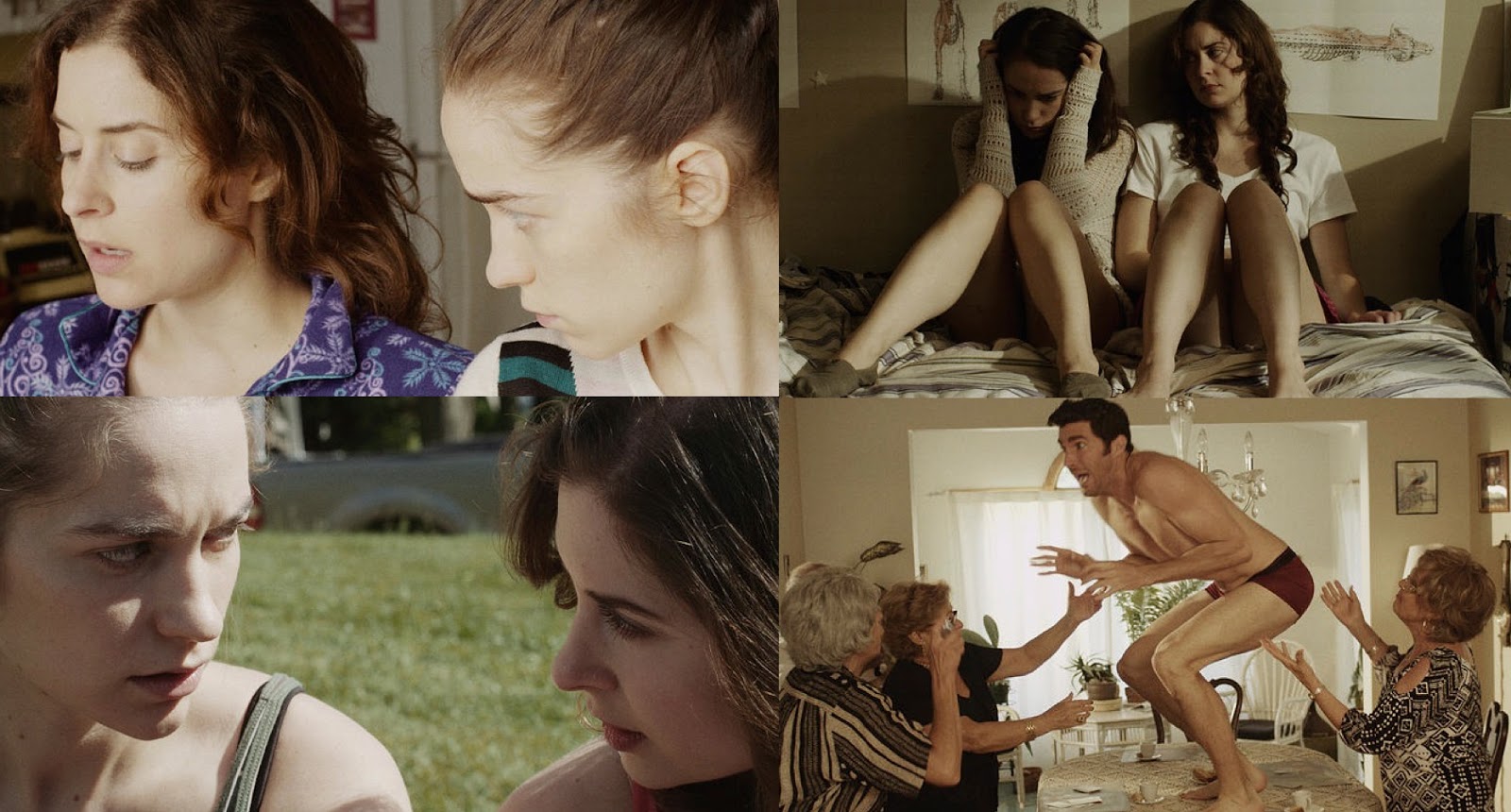
Two early-20-something Italian sisters (Melanie Scrofano, Christina Cuffari) move back home with their mother and grandmother. They're major-league squabblers and sparks fly right from the beginning.

One sister has suffered a massive concussion and suffers from memory loss, an especially inconvenient state of affairs since she's studying for finals in traditional Chinese medicine. (There are a couple of knee-slappers involving acupuncture needles and fresh produce.) The other sister, a not-too-successful actress is fleeing responsibility, auditioning for roles she'll probably never get and embroiled in a very odd text-only romantic relationship.

Mom (Paula McPherson), unprepared for being assailed by the squabbling sisters is hitting the sauce a bit too heavily and Grandma (Jocelyne Zucco), devoted to Jesus and the Virgin Mary, attempts to broker peace with her endless looks of displeasure and nonsensical old world sayings.


A good chunk of the movie is devoted to the bickering twixt the sisters. This is pretty easy to take since both actresses are easy on the eyes and acquit themselves especially well -- they've got to spit out lines at each other faster than a gatling gun and often, at the top of their considerable Italian lungs. In fact, this is what I found especially insane -- the movie is an almost non-stop screamfest with plenty of good insults hurled back and forth and eventually building to a chaotic everything but the kitchen sink climax of madness and not without hilarity.

Watching two young, hot Italian babes screaming at each other and engaging occasionally in cat fights is probably what I responded to most of all. At times I couldn't believe how intense their jousting got, but the bigger it got, the more I thoroughly appreciated it.

At times, the pace of the dialogue (courtesy of the oddball screenplay) is a kind of Speedy Gonzalez version of Howard-Hawksian back and forth (courtesy of direction, cutting and performances) and that, almost in and of itself offers considerable pleasure. The writing feels like it comes from a real place, even though much of it is overwrought -- it's overwrought in ways I've witnessed in many ethnic family dynamics.

Estabrooks' coverage as a director, is usually spot on. He shoots simply for the laughs, and production value aside, it's nicely directed. A dinner table scene is especially well done and, believe it or not, scenes around tables can often be the most difficult things to properly do. Hell, they can sometimes be more challenging than a bloody car chase. Happily, it and a number of other comedy set-pices are nicely covered and cut. Oh, and yeah, the dinner table scene is especially grotesquely funny (as is much of the movie).

I'll admit to spitting up my Chinotto on more than one occasion.

THE FILM CORNER RATING: *** Three Stars

Mangiacake is in limited theatrical release across Canada and also available via VOD. It opens July 19 at the Magic Lantern Rainbow Carlton Cinemas in Toronto.

Friday, 13 February 2015

IN HER PLACE - Review By Greg Klymkiw - One of the year's 10 Best Films as selected by The Film Corner begins its Canadian Theatrical Premiere at the Magic Lantern Carlton Cinemas in Toronto. A GREAT FILM that quietly rips our hearts to shreds. AN ABSOLUTE MUST-SEE!!! ***** 5-Stars Highest Film Corner Rating

WINNER of numerous Accolades from Critic Greg Klymkiw
in The Film Corner Awards (TFCA 2014)
One of the 10 BEST FILMS of 2014
Best Canadian Feature Film: Time Lapse Pictures
Best Supporting Actress: Ahn Ji-Hye
Best Musical Score: Alexander Klinke
WINNER of numerous Accolades from Critic Greg Klymkiw
in the Film Corner Canadian Film Awards 2014
Director Albert Shin
Screenwriters Pearl-Ball Harding, Albert Shin
Actresses Yoon Da-kyung, Kil Hae-yeon, Ahn Ji-Hye

David Miller, A71 Entertainment,
Top 10 Heroes of Canadian Cinema
A daughter,
whose child
can never be hers.
A mother,
whose daughter
is everything.
A woman,
who comes
between them.
A baby,
that binds
all three
for eternity.
In Her Place (2014)
Dir. Albert Shin
Script: Shin
& Pearl Ball-Harding
Prods. Igor Drljaca, Yoon Hyun Chan & Shin
Starring: Yoon Da Kyung, Ahn Ji Hye, Kil Hae Yeon, Kim Sung Cheol, Kim Chang Hwan

Review By Greg Klymkiw

Now and again, I find myself seeing a movie that feels so perfect, so lacking in anything resembling a single false note and so affecting on every level that I'm compelled to constantly pinch myself to make sure I'm not dreaming. In Her Place, enjoying its Canadian Theatrical Premiere at Toronto's Magic Lantern Carlton Cinemas is a dream, but most decidedly of the dream-come-true variety. This is exactly the sort of film that restores my faith in the poetic properties of cinema and how the simplest of tales, at their surface, allow its artists to dig deep and yield the treasures inherent in the picture's soul. When a film is imbued with an inner spirit as this one is, you know you're watching something that hasn't been machine-tooled strictly for ephemeral needs. In Her Place is a film about yearning, love and the extraordinary tears and magic that are borne out of the company and shared experience of women. And, it is exquisite.

A childless couple nearing the early stages of middle-age, cut a private deal to adopt outside the purview of an official agency, which, they're convinced, will be the ideal no-muss-no-fuss arrangement. The Wife (Yoon Da-kyung), having been previously afflicted with serious health issues, especially wants the world to think she's the biological birth-mother of the adopted newborn.

She and her Husband (Kim Kyung Ik) concoct a cover for friends and family that she's waiting out her pregnancy in America instead of Seoul. In reality, she's not left South Korea at all and is staying on an isolated farm. Her hosts are The Mother (Kil Hae-yeon), widowed and forced to run the sprawling acreage on her own and her daughter, a shy, pregnant teenage Girl (Ahn Ji-hye). For a substantial sum, this financially needy rural family agrees to give up the baby to the well-to-do couple from the big city. The Wife stays in modest digs originally meant for onsite farmhands while her Husband returns to Seoul to work. From here, she can maintain the optics of being away from home during pregnancy but also take an active role in nurturing the young lady carrying "her" child. The arrangement seems too good to be true and sure enough, complications slowly surface and threaten to scuttle an otherwise perfect plan.

In Her Place is director Albert Shin's stunning sophomore feature-length outing. Working with co-writer Pearl Ball-Harding and co-producer Igor Drljaca (director of 2012's dazzling Krivina and Shin's old York University film school pal and partner in their company TimeLapse Pictures), Shin and Drljaca seem to have pulled off another miracle in the relatively short life of their seemingly perfect partnership. Evocatively photographed by Moon Myoung Hwan, wrenchingly and beautifully scored by Alexandre Klinke, featuring a cast as perfect as any director (or audience) would want and edited by Shin himself with the pace and deep sensitivity that's reminiscent of a Robert Bresson film, you'll experience as haunting and touching a film as any of the very best that have been wrought. This is great filmmaking, pure and simple.

What I love about this movie, aside from its emotional content, is just how Shin trusts in the beautiful writing and employs a mise-en-scène that allows his actors to inhabit the frame (always perfectly composed) for the kind of maximum impact that can come from holding steady on narrative action and only cutting when absolutely necessary to spin things forward in subtle ways - parcelling out information so that we are allowed to take in both information and the affecting layers of very palpable impression and subtext.

A perfect example of Shin's assured direction occurs right off the top. The film opens with a fade up from black into a perfectly composed fixed shot of a well-worn gravel road. Flanked by lush, green trees, an unassuming, slightly worn farmhouse sits deep in the centre background, while a car makes its way into the frame and moves with purpose onto the property. All is swathed in a strange grey light from the overcast sky and as the car reaches a halfway point on the road, Shin cuts to place us in a reverse as the vehicle comes even closer to the house. It's as if the point of view was not so much from that of a character, or even from the inanimate house as if it were personified, but rather taking the perspective of an omnipresent observer. This won't be the first time Shin delivers such a POV. From this point and onwards, he allows us, the audience to participate with a kind of fly-on-the-wall scrutiny.

This second shot of the film is masterful on several important fronts.

In both the writing and staging, the camera lets action play out in the time it takes and in so doing, always keeps us guessing (in all the right ways) as to who is in the car, who the people are once we meet them as they exit the vehicle, get an immediate sense of character from how the two people are positioned in the frame and also by their actions and finally, a very subtle dolly back as the two characters move forward and encounter a sweet, friendly, but sad-eyed dog, chained next to an empty food bowl as it observes the visitors.

This image of a chained dog resonates incalculably as the film progresses.

Another important element here is that these two people become identifiable as a married couple because the shot takes its time and is so perfectly blocked. Even more extraordinarily, the shot allows enough time for one of the people to notice something in the distance and move towards it before the next cut.

This entire shot is a brave and bold stroke so early in the proceedings. The shot lasts for two minutes of screen time, setting the mood, tone and pace of how the tale will unfold, but also establishing how we, as viewers, are observers. And we are not passive viewers. It's as if we were actually in the frame, unseen by the characters, but participants in the narrative nevertheless, almost complicit in the actions of the story. Complicity is indeed a key thematic element at play in the film and Shin does not let us off the hook.

Finally, though, the shot also gives us the sense that this will be the story of The Husband. He is, after all, the most active half of the couple. This is essential at this point, especially since we soon find ourselves within an interior shot set back from a table where the Husband, his back to us, continues to be the most active character in terms of his domination of the conversation and by his declarative statements regarding the heat and stuffiness of the interior.

The notion of being able to breathe, to feel the sort of freedom this natural, rural environment should inspire, to not be hemmed in by circumstance, a lack of communication and/or connection to the outside world is also an element that is established and will reverberate throughout the film with great force.

The other vital component here is that the position of the camera allows us to see all three women very clearly. Though their interaction seems tentative compared to that of the husband, the very length of the shot allows Shin to establish trinity between these women and we're soon plunged into their story - which ultimately, the film is. The Husband seems a mere appendage or, if you will, the chauffeur. He gets his wife there, he even gets us there, but when his job is done, he's dispensed with save for a few key moments later on wherein he still, strangely, feels more like an instrument of mere conveyance.

The dynamic between these three women is so powerful, so telling and finally, so devastating, that Shin's subtle control of his film is at once invisible and yet always present because we are where we have to be for every single emotional and narrative beat.

In Her Place so quietly rips our hearts to shreds. We are included in the emotional journeys of a daughter whose child can never be hers, a mother whose daughter is everything to her but comes to this realization when it's too late and a woman who has come between them because her own desire to love and nurture is so strong and true.

Finally, it's all about a baby - a new life that binds all three women for what will be an eternity.

This is a great picture. See it.

THE FILM CORNER RATING: ***** 5-Stars

In Her Place enjoys its Canadian Theatrical Premiere at the Magic Lantern Carlton Cinemas in Toronto via A71 Entertainment.


Friday, 28 November 2014

BERKSHIRE COUNTY - Review By Greg Klymkiw - Hot babysitter-in-peril thriller superbly directed, intelligently written and laced with female-empowerment undertones.

In the middle of nowhere, on All Hallows Eve:
THERE WILL BE PIGS!!!
BABE IN PERIL: FROM DATE RAPE
TO HALLOWEEN HOME INVASION!
Berkshire County (2014)
Dir. Audrey Cummings
Starring: Alysa King, Madison Ferguson, Cristophe Gallander,
Samora Smallwood, Bart Rochon, Aaron Chartrand, Leo Pady, Robert Nolan

Review By Greg Klymkiw

Pigs get a bad rap. They're gentle, friendly and intelligent creatures. Alas, in the parlance of western culture, since time immemorial, really, the pig has been synonymous with a variety of grotesqueries such as filth, greed, gluttony, violence, corruption and most decidedly, just plain uncouth behaviour. With that rather unfair but common understanding of piggishness, it seems only appropriate that the damnable porkers abound malevolently in Berkshire County, the dazzling first feature by Canadian filmmaker Audrey Cummings. On the surface and at its most basic level, it could be seen as a simple, straight-up babysitter-in-peril-during-a-home-invasion thriller.

Sure, it most certainly is that, especially if that's all you're looking for. However, it's not quite as straight up as one might suspect. The reason it works so superbly is that the simple premise is successfully mined to yield several levels of complexity which add to the picture's richness. Most notably, there's the matter of the movie's virtuosity. Cummings directs the picture with the kind of within-an-inch-of-her-life urgency and stratospheric level of craft that, with the whiz-bang cutting of editor Michael P. Mason and Michael Jari Davidson's evocative lensing, yield a horror suspense thriller that infuses you with creepy-crawly dread and one astounding scare set-piece after another.

That, frankly, would be enough to spew laudatory ejaculate right in the face of the whole affair, but on a deeper thematic level, Cummings and screenwriter Chris Gamble offer up a delectably sumptuous and varied buffet for an audience to gobble up with the ferocity of snuffling hogs at the trough. Berkshire County is an intense, topical, nasty, darkly funny and even politically-charged feminist horror picture in the tradition of other leading Canadian female genre directors like the Soska Sisters, Karen Lam and Jovanka Vuckovic.

It's proof positive, once again, that Canadian WOMEN are leading the charge of terrifying, edge-of-your-seat horror-fests that are as effectively drawer-filling as they are provocative and politically astute. It's unabashed exploitation injected with discerning observational power.

HALLOWEEN BABYSITTER
VS
PIGGLY 
WIGGLIES GALORE!
The film begins during a Halloween party in the rural enclave of the film's title. The gorgeous teenage girl-next-door Kylie Winters (Alysa King) arrives adorned in the sexiest Little Red Riding Hood costume imaginable. Heads swivel in her general direction, but none more so than that of the handsome Marcus (Aaron Chartrand), a hunky stud-horse-man-boy from the local high school. He, like the other small town, small-minded fellas is swine (of the male chauvinist variety) incarnate.

In what's possibly one of the more disturbing acts committed in any genre picture of recent memory, Kylie is plied with booze, coerced - essentially date-raped - into blowing Marcus. Unbeknownst to her, she's captured on his smart phone movie camera which he promptly uploads to cyber space for all to see.

Though the film has previously opened with a creepy Kubrickian traveling overhead shot of the county's forested, isolated topography (a la The Shining), Cummings and Gamble plunge us into very unexpected territory. Initially, the horror is neither supernatural nor of the psychopathic variety, but a monstrous act of sexual abuse, followed by the insidious cyber-dissemination of pornographic images of said abuse and then the teasing, bullying and shame experienced by Kylie who was the target of the abuse and subsequent derision levelled at her by peers.

Ripped from the headlines of a veritable myriad of similar cases involving tragic sexual abuse, we are privy to one of the more abominable aspects of contemporary teen culture. In Canada, the most horrific example is that of Nova Scotia teen Rehtaeh Parsons who, plied with booze and gang raped on camera, committed suicide when the images went viral. What faces Kylie is so debilitatingly nasty that she's the one made to feel like a pariah - as if she were to blame. Even Kylie's repressed dough-headed mother blames Kylie for bringing scandal upon the family.

To add insult to injury, Kylie is further estranged from those who should be offering support when she is practically forced by her mother to take a Halloween night babysitting gig at an isolated mansion on the outskirts of the community. That said, Kylie seems to welcome the peace and isolation the job might afford, far away from the piggish behaviour of her abuser, his stupid friends, her idiot mother and everyone else who teases and/or affixes blame upon her. A gorgeous mansion with all the amenities and two sweet kids has Heaven on Earth written all over it. Or so she (and we) think. She (and we) are wrong about that.

THIS LITTLE PIGGY
CAME HOME!!!
He has a butcher knife
. . . and friends!
Pigs, you see, are lurking in the woods. Not just any pigs, mind you, but a family of travelling serial killers adorned in horrifying pig masks. And these sick fuckers mean business. Happily, Cummings and Gamble have fashioned a terrific female empowerment tale within the context of the horror genre. By focusing, in the first third, upon the teen culture of abuse and bullying and then tossing their lead character into a nail-bitingly terrifying maze of sheer horror, they, as filmmakers and we, as an audience, get to have the whole cake and eat it too. The final two-thirds cleverly and relentlessly presents one seemingly impossible challenge after another and we're front-row passengers on a roller coaster ride of mostly unpredictable chills and thrills until we're eyeballs-glued-to-the-screen during some deliciously repellent violence and, of course, a bit of the old feminist-infused empowerment.

Joining a fine tradition of home invasion movies like The Strangers and You're Next, it's a film that, in its own special way exceeds the aims of those seminal works because it places the horror in a context of the kind of horror which has become all too real in contemporary society. In a sense, the film's target audience, teens and young 20-somethings (and middle-aged horror geeks who've never grown up) will get everything they want out of the picture - and then some.

And just so we're not feeling too warm and fuzzy after the film's harrowing climax, Cummings spews a blood-spattered shocker upon us - one that horror fans have seen a million times before, but when it's served up right, we're always happy to see it again. So take a trip to Berkshire County. It's a fork in the road (and blade in the gut) worth choosing.

THE FILM CORNER RATING: **** 4-Stars

Berkshire County, winner of the Grand Jury Prize at the esteemed Shriekfest Film Festival in Los Angeles, enjoys it's Canadian premiere during the 2014 Blood in the Snow Film Festival at the Magic Lantern Carlton Theatres in Toronto. It will be released in Canada via A-71 and is being sold to the rest of the world by the visionary Canadian sales agency Raven Banner.