Showing posts with label Adventure. Show all posts

Saturday, 17 June 2017

Wonder Woman - Review By Greg Klymkiw - Lame, voiceless direction sinks WW solo effort

I am Wonder Woman! I kill to bring peace to mankind.

Wonder Woman (2017)
Dir. Patty Jenkins
Scr. Allan Heinberg
Starring: Gal Godot, Chris Pine, Danny Huston, David Thewlis, Robin Wright,
Ewan Bremner, Saïd Taghmaoui, Eugene Brave Rock
Connie Nielsen, Elena Anaya, Lucy Davis

Review By Greg Klymkiw

Though I refused to read any reviews of Wonder Woman before seeing it, I was unable to avoid knowing that "critics" (I use the word loosely these days) have enthusiastically raved about the film. That the picture is such a huge hit, another fact I was unable to avoid knowing, adds insult to injury. Granted, the injury afflicted is to me (and seemingly me and me alone), but it is an injury nonetheless.

Watching the loathsome Wonder Woman was one of the more painful acts of self-flagellation I've recently engaged in. Let me assure you, my flesh is now mighty raw from that scourging. My soul is empty and again I felt bereft of hope for the future of movies. (Luckily, hope was restored one day after suffering through the dross by watching Jean-Pierre Melville's Two Men in Manhattan and David Miller's Sudden Fear - both made when people made real movies.)

I made a point of seeing Wonder Woman in 70mm. Though preferable to unwatchable 3-D, the glorious widescreen film-format ultimately added nothing to the experience. I found myself limping out of the movie theatre after having to yank the nails from my feet, which I was forced to use in order to affix myself in place for the entirety of the loathsome 141 minutes of Patty Jenkins's interminable miserably directed sewage tank of wasted celluloid.

If you must know, Wonder Woman retches up the origin of Diana Prince (Gal Godot), D.C. Comics' lithe raven-haired superhero. We're forced to endure her childhood, adolescence and early adulthood on the all-female-populated island of Themyscira, a kind of Isle of Lesbos without the lesbo action (not even submerged). Here a race of powerful Amazons created by the Gods of Mt. Olympus, endlessly train in the art of killing in order to eventually bring peace to the world.

When an insufferably handsome American pilot, Captain Steve Trevor (the sickeningly smirking Chris Pine), crashes his plane, he's rescued by our heroine. She learns that World War I is raging and as it's her birthright to restore peace to humankind, she joins him on a pilgrimage to Dear Old Blighty. She's convinced the war is not the fault of Kaiser Wilhelm and the Germans, but rather, by Ares, the nasty nemesis of Zeus who has supplanted himself in the body of British politician Sir Patrick Morgan (David Thewlis). (Some might consider this a "spoiler", but if you can't figure it out from the moment you first lay eyes on him, then I suspect you might require a brain transplant.)

Morgan is in cahoots with General Erich Ludendorff (the vaguely amusing, scenery-chewing Danny Huston) and his facially-deformed chief mad-scientist Doctor Poison (Elena Anaya) who are concocting a super-deadly cocktail of mustard gas in the hopes that Germany will bring the world to its knees.

Wonder Woman and the annoying American join forces with a dog's breakfast of wily rascals to kill a whole mess of Germans to bring peace to the world.

Ugh!

I first read the D.C. comic "Wonder Woman" when I was a kid in the 60s and 70s. Unlike the critically-maligned (and boneheadedly so) Zack Snyder-directed Man of Steel and Batman v Superman movies, Patty Jenkins has no feel for the essence of these grand comic books of yore, but even worse, she clearly has no idea where the camera needs to be placed during action scenes. They are the typical contemporary hodgepodge of poorly composed multiple camera setups that the editors are forced to breathe life into (and mostly in vain) by creating sound-based cut-points instead of dramatic "action" cut-points.

The jury is out on whether Jenkins has any genuine talent. Her first film was the competent, decently acted Monster which dramatized the tale of real-life serial killer Aileen Wuornos (who was the focus of two great documentaries by a real filmmaker, Nick Broomfield). On the basis of Monster and now Wonder Woman, I see no evidence of a genuine directorial vision. It's little more than a (mostly) badly acted catalogue of dull action scenes. I simply don't understand why the studios keep hiring directors with no feel for action (I'm looking at YOU: Christopher "One Idea" Nolan and Sam "I'm from the thay-uh-tuh" Mendes). When you think of the Zack Snyder DC films, one can at least marvel at the painterly compositions of every shot and even though the cutting is rapid fire, he has actually put thought into creating action set pieces as units of dramatic action, not merely "action".

Just because they gave a woman a shot at directing means nothing. They should have thought of hiring a woman who knows how to direct with some panache. Much as I hate all of the Twilight movies, the very first film in the franchise was at least directed by a woman who has obvious directorial talent/vision. Catherine Hardwicke's distinctive voice as a filmmaker is what raised the level of the 2008 vampire soap opera from a simple "event" movie to that of a genuine work of first-rate pop-art.

Audiences don't care about "voice" or "skill" anymore. They've been systematically indoctrinated into not caring about much of anything other than ADHD-infused pyrotechnics, which Wonder Woman is over-stuffed with.

Also, that the movie threw away an opportunity in the first section with the Amazons by avoiding a healthy infusion of lesbian subtext is beyond the pale.

THE FILM CORNER RATING: * One-Star

Wonder Woman is in wide release via Warner Brothers.

Friday, 10 March 2017

KONG: SKULL ISLAND - Review By Greg Klymkiw - Saved By Great Monsters, John C. Reilly

John C. Reilly: The only thing resembling a human being.

Kong: Skull Island (2017)
Dir. Jordan Vogt-Roberts
Scr. Dan Gilroy, Max Borenstein, Derek Connolly
Sty: John Gatins
Starring: Tom Hiddleston, Samuel L. Jackson,
John Goodman, Brie Larson, John C. Reilly

Review By Greg Klymkiw

Why it took four writers to come up with the lame, dull Kong: Skull Island screenplay is beyond me. Then again, given the sheer emptiness of most studio pictures these days, it shouldn't surprise anyone since it takes a whole lotta boneheads to generate a whole lotta stupid. An American President called Donald Trump is proof of that.

If truth be told, I can almost even forgive inept imbecility. What I can't forgive is tedium and this mostly horrendous reboot of the Kong franchise is nothing if not mind-numbingly boring for most of its interminable 118-minute length. Much of what makes the movie dull are the missed opportunities it took four writers to conjure up.

Things begin promisingly enough with the pre-credit sequence. It's WWII and two soldiers - one American, the other Japanese - crash on the remote Skull Island. Ah, tantalizing! Perhaps we will be afforded a lovely action-packed nod to John Boorman's Hell in the Pacific? But, no. We're handed two dull anonymous actors - no Lee Marvin or Toshiro Mifune here. Jesus, I'd have even settled for something resembling Peter Sellers/Burt Kwouk Pink Panther martial arts slap-schtick shenanigans. That, however, would be too politically incorrect by contemporary standards (and sadly, the movie's endlessly shoe-horned P.C. sensibilities are another big problem with the picture). So instead, we get a dull sprint up a mountain and our warring soldiers meet with a far more formidable enemy - Yup, you guessed it, King Kong, the big hairy ape. (But don't worry, ain't nothing too Eugene O'Neill about this hirsute monkey.)

Our movie launches into an annoyingly wham-bam credit sequence detailing American history from the last Great War and eventually leading up to the turbulence of the 1970s. Thank God it stops here - a real decade. Alas, the period detail, in virtually every respect, is woefully inadequate - most annoyingly with the contemporary-speak of the dialogue and the decidedly 2017 timbre of the delivery of said dialogue.

Of course, this being 2017, in spite of the movie being set in the 1970s, we don't get to meet a cool adventurer seeking passage to Skull Island, say along the lines of showman Carl Denham (Robert Armstrong in the 1933 version, Jack Black in Peter Jackson's 2005 entry) or even a delectably sleazy oilman like Fred Wilson (Charles Grodin in 1976). What we get is the supremely unimaginative, ineffectual government hack Bill Randa (John Goodman) and his earnestly plucky African-American geologist Houston Brooks (Corey Hawkins). Randa is such a useless schmo that it takes his right-hand Houston to convince a Senator to bankroll the expedition.

Welcome to 2017. And not that I have a problem with this smooth young Black male weaselling dough out of the Senator instead of boss man Whitey, but it might have been far more interesting to have a character like Randa, written-for and played by someone with some balls, like Laurence Fishburne for example. The role of this character, or character-type, requires - Nay, demands someone in his august years (or at least in the case of 1976's Grodin, one of those 30-something guys who feels like he's in his 50s or 60s) and more importantly, someone who has the smarts to squeeze oil out of an empty drum.

But, I remind you - it took four writers to generate this screenplay.

Can't go too wrong with a cute prehistoric muskox.

So, off to Skull Island we go. Randa assembles a stock, boring team that includes former British Special-Ops mercenary James Conrad (Tom Hiddleston, a great actor in a nothing role), gung-ho army dude Colonel Preston Packard (Samuel L. Jackson, a great actor, but more boring than usual in this stock role), looking for more carnage now that the Vietnam War is over and perhaps most sickeningly, Mason Weaver (Brie Larson, a great actress with a completely idiotic role), a self-proclaimed "Anti-war photographer" (whatever that's supposed to mean). Of course the team is replete with other soldiers, scientists and bureaucrats in order to provide ample food for the monsters.

The movie plods through all of its uninspired machinations as our team essentially needs to get off the island as soon as they land on it - there are monsters, after all. Our leading lady is, of course, not the "beauty who killed the beast", but rather, the beauty that the beast thinks is kind of okay and not a danger to him. Our leading man is boring and does little more than argue with the gung-ho army guy and acquiesce to the madman's needs to kill monsters to avenge the deaths of his soldiers. Of course, the ineffectual adventurer Randa is so useless that we almost forget he's in the movie until he gets eaten. Then, we get to forget about him all over again.

Happily, the movie introduces us to Lieutenant Hank Marlow (John C. Reilly, playing the older version of the American soldier introduced at the beginning of the movie). Marlow has been living on the island since WWII in the protective custody of the island's indigenous Native population. Thank God! A real character with an irascible sense of humour. Reilly not only makes us laugh, but he's really the only person we care about. Stupidly, the writers have relegated Marlow's Japanese counterpart to that of a corpse - someone who is talked about fondly, but whom we don't get a chance to know. It would have been amazing to have a great veteran Asian actor quipping with Reilly and doing battle with the monsters, but you know, there were only four writers, so you can't expect creative miracles.

Even more boring than most of the film's non-characters are the island's tribesmen. What a ho-hum lot. They appear to be pseudo-Buddhist types who do little more than cast inscrutable glances every which way. This is strangely even more ethnocentric (and perhaps even downright racist) than the previous incarnations of "ignorant", "bloodthirsty" "savages" in the 1933 and 2005 versions. At least those people had something resembling "life" infused in their ooga-booga personae.

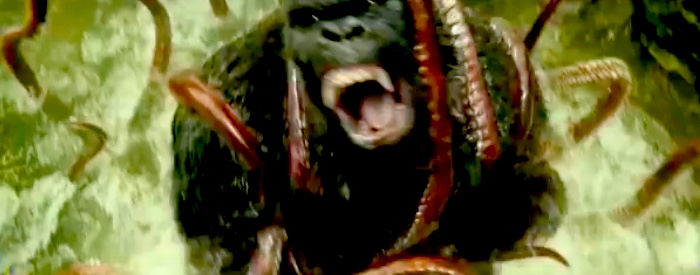
Kong looks forward to some yummy octopus tentacles.

Other than Reilly's delightful performance, the only thing else left are the monsters. I won't bother attributing any of the picture's "success" in this regard to the by-rote direction of Jordan Vogt-Roberts (his boring nods to Apocalypse Now notwithstanding), but rather, all the magnificent SFX geniuses who designed the myriad of creatures. Kong's battles with the other behemoths are pretty damn spectacular and perk things up ever-so thrillingly. There's a phenomenal aquatic cage match twixt Kong and a humungous octopus which culminates in a wonderful moment in which Kong slurps up a few tentacles. One can, I suppose, attribute this to one of the four writers. Kudos, dudes!

That said, all previous incarnations of the Kong story were a whole lot more than just the monsters. They had, uh, characters, a solid story arc and were chockfull of wonder. They were sheer magic. There's nothing like that here - just a whole lotta tedious expository (and stupid, 'natch) nonsense to setup the inevitable sequels and franchise "universe". I'm coming to hate that word. "Universe" should conjure up feelings of expanse and possibility - not more of the same.

THE FILM CORNER RATING: *½ One-and-a-Half Stars

Kong: Skull Island is in wide release via Warner Brothers

Tuesday, 13 September 2016

MALIGLUTIT/SEARCHERS - Review By Greg Klymkiw - TIFF 2016 - Inuk John Ford Obsessions

MALIGLUTIT: a figure on the landscape of the universe.

Maliglutit/Searchers (2016)
Dir. Zacharias Kunuk, Natar Ungalaaq
Scr. Norman Cohn, Kunuk
Starring: Benjamin Kunuk, Jocelyne Immaroitok,
Johan Qunaq, Karen Ivalu, Lucy Tulugarjuk

Review By Greg Klymkiw


Inspired by John Ford's The Searchers, Zacharias (Atanarjuat: The Fast Runner) Kunuk and co-director Natar Ungalaaq serve up one of the most compelling and exciting action-adventure pictures of the year. Set against the backdrop of the Canadian north, a father and son obsessively chase after a group of men who slaughter much of their family and kidnap their women.

That's it - on the surface.

Below the simple veneer, a tale of family, love and a culture rooted in a land of harsh beauty roils with uncompromising resonance. Kunuk captures the rich tradition of the Inuk people and his visual storytelling acumen reaches a dazzling pinnacle. He paints a portrait of good guys and bad guys, but does so with the kind of deep strokes which reveal humanity on both ends of the spectrum.

Though Ford's great film is clearly about racism and was made to "right" the "wrongs" of previous westerns and their portrayal of indigenous culture, there is one major difference that stands out amongst others - the portrayal of the "kidnappers".

MALIGLUTIT: The humanity of good and evil.


In the Ford, the "villain" (or rather, the traditional "antagonist") is the Commanche Chief Scar. What we're allowed to know about him is what's told to us about him. When we finally see him, Ford reveals one of the most indelible, still chilling, still uber-creepy images of sheer evil.

Scar is less a character than an image, a symbol. Kunuk and co-writer Cohn takes this several steps further. Their antagonists are characters. We get to know them, just as we get to know the protagonists.

The bottom line though, is that both films share a narrative coat hanger and are ultimately two very different films. What's very similar between them is Kunuk and Ford's love of the land as a backdrop to the human drama - that the universe is always watching. The other similarity is how both filmmakers adhere to classical styles of filmmaking. The images in Kunuk's work go head to head with Ford's - one is the Canadian Arctic, the other is Monument Valley - both are beautiful, and so very, very dangerous.


MALIGLUTIT: Monument Valley vs the Canadian Arctic.

Both filmmakers also employ a classical approach to the action scenes, but Kunuk might actually win those sweepstakes with a breathtaking extreme wide shot in which we watch our hero and villain duke it out in a gorgeously choreographed fight as mere figures on the landscape. We've come to know both as human beings and as such, the stakes are so very high as we sit back as spectators, high up in the stands, the ice, snow and mountain ranges, the arena.

Of course in Ford's film, nobody ever forgets the iconic shot from within the cabin at the end of the film. Kunuk beautifully riffs on this with a similar shot from within an igloo. They're both iconic, but what they represent are so very similar, in terms of loss, but so very contradistinctive in terms of hope. They're both great on their own, but Jesus, what a double bill they make.

THE FILM CORNER RATING: ***** 5-stars

Maliglutit/Searchers is in the TIFF 2016 Platform series.

Friday, 23 October 2015

THE LAST WITCH HUNTER - Review By Greg Klymkiw - Hopefully the first and LAST!!!

"I'm hoping this franchise can transform me into a Steve Reeves for the New Millennium."

The Last Witch Hunter (2015)
Dir. Breck Eisner
Starring: Vin Diesel (dubbed "Not His Real Name" by the late, great film critic John Harkness), Michael Caine, Rose Leslie, Elijah Wood, Ólafur Darri Ólafsson

Review By Greg Klymkiw

One doesn't go to a movie entitled The Last Witch Hunter expecting a masterpiece, especially when its lead is played by Vin ("Not His Real Name") Diesel, the bald, vaguely simian wiseacre star of the Fast and Furious and XXX franchises who, it seems, is seeking a whole new persona to exploit in yet another potential franchise. In fact, one expects something considerably lower on the rung when its revealed that the director will be Breck (Sahara, The Crazies) Eisner, a man who has yet to direct anything resembling a good movie.

In spite of these strikes against it, one grits ones teeth and hopes the movie will at least be fun on the level of 50s/60s Italian sword and sandal epics starring the likes of Steve Reeves. For the first few minutes, with Diesel traipsing about some Middle Ages fantasy setting with a ludicrous bushy beard and wielding a humungous sword, one believes that the modest hopes one had going in might blossom into something a bit more enjoyable.

Unfortunately, Diesel's character is defeated by the head honcho of all witches and cursed with eternal life and banished to an eternity of always remembering he didn't avenge the murder of his wife and child. That said, he becomes a witch hunter and, for a few hundred years he's been decimating "bad" witches all over the place.

"Look, this babe behind me has such a bad speech impediment I can't understand a word she says. Can we use some witchcraft to fix this up?"

For the rest of this movie, Diesel (sans beard) lives high atop the city in a swanky Manhattan pad and continues his vendetta against witches who refuse to live peacefully with humans. He even has a sidekick in the form of a Catholic priest played by Michael Caine (who no doubt earned a sizeable cheque to pay for a few more mansions in the sky). When Sir Michael is savagely tortured and left for dead, Diesel not only gets mad, he's going to get even. Related to this injustice is the fact that some bad witches are about to release a plague upon New York, so the Diesel-meister is going to have his hands full. The Catholics, always on top of such matters, give him a new Holy mortal sidekick in the form of a young priest (Elijah Wood) who means well, but is lacking the know-how of his predecessor.

Even all this might have been palatable if it wasn't for the fact that the movie gets increasingly convoluted and stupid. Stupid is fine, but once its commingled with convolutions, it becomes deadly. Add to this an uninspired villain (Ólafur Darri Ólafsson) and a horrendous leading lady (Rose Leslie, she of the speech impediment which renders all her lines to mush and a grating high-pitched voice which is probably enough to send canines the world over into a tizzy rivalling the silent dog whistles one can buy from ads at the back of comic books) and worst of all, a character working both sides of the good/evil coin that we can see from the first minute he appears on screen, we know - beyond a shadow of any doubt - that this picture is going to be a boring stinker.

One of the most repulsive screen kisses in recent memory.

Eisner's non-direction proves he's not even grasped basic skill sets to put him in hack territory. He simply has no idea of where to place his camera and the action scenes are all a miss-mashed mess.

Diesel has apparently announced a sequel is in the works. Let's hope it quietly goes the way of the Dodo. That said, I'd be up for a Fast and Furious sequel which offers Diesel in full-on sword-and-sandal beard. Now that, could be a howler worth enjoying.

THE FILM CORNER RATING: * One-Star

The Last Witch Hunter is a Lions Gate production in release world wide via eOne.

Thursday, 23 July 2015

KINGS OF THE SUN - Review By Greg Klymkiw - Chakiris/Brynner: Foes Become Friends


Kings of the Sun (1963)
Dir. J. Lee Thompson
Starring: George Chakiris, Yul Brynner,
Richard Basehart, Shirley Anne Field, Leo Gordon

Review By Greg Klymkiw

How do like your cheese? Ripe, runny and mouldy or a nice solid brick of good, old fashioned Wisconsin Cheddar? Well, though there is much to be said for the rich, flavourful qualities of the former, sometimes the latter is just what the doctor ordered. Kings of the Sun is clearly of the Wisconsin variety, though happily, it's an old white cheddar and as such, a mite more savoury than your garden variety slab of straight-up orange-coloured curd.

This delightfully melodramatic action-adventure epic of manly men and exotic women is set of 1000 years-ago when a nation of wooden-sworded Mayans on the Yucatán are besieged by a much powerful rival tribe who use metal swords. The wooden-sworded nation are led by the brave young King Balam (George Chakiris, the handsome Greek-American dancer who copped the 1961 Supporting Actor Oscar in the role of the Puerto Rican leader of the Sharks in West Side Story). Balam decides to flee from the nasty take-no-prisoners-lest-they're-women-to-be-raped metal-swordsman King Hunac Ceel (Leo Gordon, the stalwart veteran of numerous TV westerns and one of director Don Siegel's favourite bad guys).

Balam, betrothed to the comely Ixchel (Shirley Anne Field), leads his people through a secret tunnel in their majestic Mayan Pyramid, loads them into boats and sets sail for the mysterious lands far north (Tex-Mex country) to bolster their resources and create a new kingdom - maybe to even someday reclaim their ancestral lands.

Once Balam and his people land up in Tex-Mex territory, they put their ingenuity to good use and build a powerful fort, new abodes and begin a whole new Pyramid so they can start sacrificing humans to the Gods as soon as possible.

Ah, but hiding in the woods and observing the Mayans is an indigenous Native American tribe led by Chief Black Eagle (Yul Brynner) and he's royally fuming (like only Brynner can, flaring those sexy nostrils). He plans to battle these oddly costumed intruders, but unfortunately he's wounded and captured by the Mayans, then held hostage to keep the Injuns at bay.


The real power amongst the Mayans is their wacky blood-thirsty, blood-sacrifice-endorsing Witch Doctor Ah Min (played, I kid you not, by the whiter-than-white Richard Basehart, star of TV's Voyage To The Bottom of the Sea). Adorned in a ridiculous wig and flowing robes, Ah-Min looks like he should be an emcee at an octogenarian drag performance club in Slovenija, and as such, he's able to convince Balam and all the others that they must nurse Black Eagle to health so he may be their first official sacrifice when the Pyramid is finished.

A love rivalry twixt Ixchel, Black Eagle and Balam begins to brew and as these lovebirds begin smouldering, little do they know that the crazy Hunac Ceel has loaded up his boats with thousands of warriors to wipe out Balam for good and they're just around the corner.


If the Mayans sacrifice Black Eagle, they'll not be able to count on the necessary allegiance with the Natives to fight Hunac. Hmmmm. Dilemmas-dillemmas. I doubt it's going to come as a surprise to anyone, but get to a rousing final battle sequence, we must submit to a whole water-tower full of roiling melodrama.

I can't actually say that any of this is especially well-acted, but it is exuberantly over-acted and where the picture really succeeds is in its gorgeous cinematography by the legendary Joseph (My Darling Clementine, Viva Zapata, Niagara, Pickup on South Street) McDonald, a rousing orchestral score by Elmer Bernstein, stunning sets and costumes, a cast of thousands and some of the most beautifully directed battle scenes ever committed to film by the stalwart J. Lee Thompson (Taras Bulba, Guns of Navarone, Cape Fear).

So if you're in the mood for some solid cheese, feel free to whack off a few hunks of this Kings of the Sun brand. It'll bind you, bind you real good.

THE FILM CORNER RATING: *** 3-Stars

Kings of the Sun is available on a gorgeous Kino-Lorber Blu-Ray.

Tuesday, 5 May 2015

ROAR - Review By Greg Klymkiw - Wildlife Nature Adventure Snuff Film 4 Whole Family

REAL LIONS. REAL PEOPLE. REAL MAULING. REAL CRAZY.
Roar (1981)
Dir. Noel Marshall
Starring: Noel Marshall, Tippi Hedren, Melanie Griffith, Kyalo Mativo

Review By Greg Klymkiw

Roar is clearly one of the most insane movies ever made. Oh hell, let's shoot the works and just declare that it is the most insane movie ever made. It stars 150 lions, tigers and other big cats. No animals were harmed during the making of the movie, but 70 people were.

It all began when actress Tippi Hedren (The Birds, Marnie) was in Africa shooting a movie in the mid-60s when she discovered on safari that an entire abandoned mission had been taken over completely by lions.

Ding! Light bulb flashes over Tippi's head! There's a movie in this, she thinks.

Her hubby, producer Noel Marshall agrees. In fact, for a few years, the two of them become wildlife preservation activists and eventually started to rescue lions, tigers and all other manner of big cats and raised them on the grounds of their Beverly Hills mansion. When the menagerie started to get a trifle large, they moved out to Acton, California where they bought up huge tracts of land and set up a wildlife reserve. They kept buying more and more big cats and even elephants - giving them all a safe harbour to live out the rest of their lives peacefully. This is, to my mind, a damn wonderful thing for them to have done, especially given how unscrupulous the wildlife trade has always been (as well as poor animals being exploited in circuses and private zoos).

Maybe not so wonderful is the film they eventually made; not that it's awful - well, actually, it kind of is - but as you're watching the movie, you just keep wondering, "What in the hell am I watching here?" And you know what? That's probably a good thing. So many movies during the past 40-or-so years are such dull, by-the-numbers bore-fests, machine-tooled within an inch of their lives, that anything that forces you to scratch your noggin so hard it starts to bleed has got to have something going for it.

The movie tells the rather insane tale of a guy who runs a huge wild animal preserve. Most of the recipients of his largesse are lions - a ridiculous number of lions (plus tigers, panthers, leopards, cheetahs and the aforementioned elephants). Played by director, co-writer and co-producer Marshall, our hero spends a good deal of screen time wrasslin' his beasts. They are such ornery critters and. BONUS, super cute and loveable. The only problem is, they're lions and tigers for Christ's sake! Marshall's Man Friday and sidekick Mativo, while no Stepin Fetchit, is definitely in Mantan Moreland territory as he goes mega-bug-eyed when the lions and tigers act up - which, during the first half hour of the film is pretty much all the time. (There's even a ludicrous running gag involving Mativo fending off tigers with an umbrella.)

MELANIE GRIFFITH AND LION CAVORT
It turns out that Marshall's family has been away from the compound for some time. Wife Tippi has needed a trial separation from her big-cat-crazy hubby. Now, however, she, their two sons and their mega-hot teenage daughter (Tippi's real-life daughter Melanie Griffith) are due to fly in. Given that the animals are acting up (they even attack and maul some visiting wildlife committee members for the area), Marshall's a tad worried he might be late picking them up at the airport. He and Mativo jump into a boat and go down river. Unfortunately, a couple of tigers jump into the boat and it doesn't take long for it to capsize. This results in a seemingly endless farce involving bicycles and a jeep, all of which break down.

In the meantime, the family has indeed landed and with nobody to greet them, they hope a bus for the wildlife compound. When they arrive, we are treated to one of the most insane, surreal extended sequences ever put on film. The lions and tigers get mighty ornery in Marshall's absence and chase the entire family around the compound, destroying much of the interior of the big house. This feels like it's going to go on forever. Not that it's boring, though. These are real lions and real people.

TIPPI HEDREN IS MAULED BY A CHEETAH,
JAN DE BONT IS MISSING HALF OF HIS SCALP,
A HAPPY-GO-LUCKY WILDERNESS FAMILY REJOICES!!!
Now, seriously, I need to stop for a moment and try to explain how insane this all is? We're basically cross cutting twixt the bumbling Marshall and his bug-eyed Mantan Moreland-wannabe getting into a whole whack o' "fine messes" and a lithe, middle-aged Momma and her brood being chased by lions. At one point, they're even attacked by - I KID YOU NOT - elephants!!! As if these events weren't insane enough, I think it's important to point out that many of the bites, scratches and outright mauling-actions are REAL. The looks of terror on the faces of the actors are not acting, they're real, too.

This is like The Adventures of Wilderness Family as snuff film. During the course of shooting, Marshall got so repeatedly mauled that he almost died from gangrene. Tippi was bitten in the head. The boys were both bitten and Melanie Griffith was so horrifically mauled, that she required major reconstructive surgery.

Cinematographer Jan De Bont (he'd shot many of Paul Verhoeven's Dutch films and directed Speed, Speed 2 and Twister) had pretty much half of his scalp torn right off.

The plot, such as it is, eventually allows the family to get back together in an utterly harrowing climactic sequence. There's also a subplot involving some wildlife committee members who decide they're going to shoot all of Marshall's lions in retaliation for the mauling they received earlier. After shooting a few helpless beasts, the alpha lion attacks them and tears their throats out. Marshall tells Mantan Mativo not to say anything to the wife and kids so as not to ruin their reunification. We're then treated to a ten-or-so-minute-long montage sequence of the happy family and lions with a gentle folk song on the soundtrack.

Roar, from conception to finished product took 11 years. The principal photography alone took 4 years. The budget soared to a reported $17 million, the vast chunk of the money coming from Hedren and Marshall's combined savings, earnings and real estate. (Marshall actually made a small fortune from his royalties on such hit films that he executive-produced like The Exorcist and The Harrad Experiment.) But, really, $17 million??? Look, 17-mill is nothing to sneeze at, even though in today's bucks, it's considered a pittance for most pictures, but by 1981, when Roar was finally completed and released (to zippo boxoffice) this was a HUMUNGOUS amount of money.

Frankly, I don't even know where the film is supposed to take place. There's some odd thank you to the Massai nation at the beginning of the movie and many African actors populate supporting roles. Sometimes it looks like we're in Africa, but most of the time, it looks like we're in Acton, California surrounded by wild beasts from Africa. And guess what? It really doesn't matter. This movie could only be set in the never-never land it appears to take place in.

The film has barely been seen since 1981, but now, thanks to Drafthouse Films, Roar has been restored to its former glory for a theatrical release followed by a huge Blu-Ray/DVD run.

And here's the rub, I can't actually say the picture is awful, nor can I say it's good. I really have no idea what to say other than the fact that it's unlike anything you'll ever see. It's gorgeously shot, some of the suspense and action scenes are definitely hair-raising and most of the acting (when it is acting and not real terror) is pretty good. Tippi Hedren, in particular, makes quite a terrific Perils of Pauline figure as she seems to get into the most ludicrously dangerous animal-dodging gymnastics and little Melanie is just plain mouth-wateringly gorgeous. Director Marshall, however, is a dreadful actor. He's so overwrought you just want to punch him in the face. It won't be necessary, though. He got gangrene for his troubles and egregious ham-boning.

A year after the film flopped, Marshall and Hedren divorced. Wilderness Families only live happily ever after in the movies.

THE FILM CORNER RATING: *** 3 Stars (though it's really impossible to rate this at all)

Roar is playing in a variety of special engagements. In Toronto, it can be seen in repertory all through the month of May at the Royal Cinema. You really want to see this on a big screen. The bigger the better.

Tuesday, 9 September 2014

THE REACH - TIFF 2014 - Review By Greg Klymkiw

The Reach (2014)
Dir. Jean-Baptiste Léonetti
Starring: Michael Douglas, Jeremy Irvine, Ronny Cox

Review By Greg Klymkiw

The Reach offers up happy corroboration that filmmaker Jean-Baptiste Léonetti’s astonishing dystopian science fiction masterpiece Carré Blanc was no first feature fluke. Léonetti is the real thing and he can direct rings round most contemporary genre helmers. Instead of all the tin-eyed boneheads who keep directing any number of visually challenged studio abominations, Léonetti has ‘go-to guy’ written all over him.

Based on Deathwatch, a hugely popular boys’ adventure novel written by the prolific author Robb White (who also toiled as William Castle’s screenwriter on such exploitation delights as The House on Haunted Hill, 13 Ghosts, The Tingler, Macabre and Homicidal), it was competently adapted by Stephen Susco. Updating the late 60s setting of the book, the script invests it with the right amount of macho existentialism, ultra-violence, hilariously nasty black humour and up-to-the-minute social commentary involving the haves and have-nots of the world.

I have to admit, however, that I originally went into the picture knowing only that it was Léonetti’s sophomore feature starring Michael Douglas, and it was only while watching the movie that I realized its literary pedigree. That it was based on one of many White books I read as a kid (and still proudly own some 40-plus years later) turned out to be extra layers of icing on this very rich cake. (Pathetically, I even remembered seeing the fine ABC Movie of the Week entitled Savages, which starred Andy Griffith and Sam Bottoms in the lead roles.)

This stirring mano a mano variant on The Most Dangerous Game faithfully sticks to the original main characters of White’s book, and for good reason – you can’t beat a winning formula. Madec (Douglas) is a disgustingly rich cell-phone-tied dealmaker who hires the impoverished Ben (hunky Jeremy Irvine of War Horse fame) to be his guide in the deadly Mojave Desert so he can bag a new hunting trophy (he boasts having many), the rare bighorn sheep. The two men are clearly oil and water, but their time together eventually yields a father-son-like bond. Alas, Madec accidentally shoots something he shouldn’t. When it’s clear Ben won’t go for a whopping bribe, the sportsman in Madec sends Ben into the desert so he can hunt him down, but also gives the lad a fighting chance. Ben proves to be a formidable adversary. This fuels Madec even further.

Léonetti keeps the suspense taut, the action blistering and his exquisite eye for placing man against imposing backdrops has not at all wavered since Carré Blanc. His delightfully grim sense of humour is also set to overdrive, especially since Michael Douglas is remarkably game to chew the scenery and spit out one nasty line after the other. The only place Léonetti is let down by Susco’s otherwise fine script is during the climactic moments, which feel like a perverse bargain basement Fatal Attraction.

Given Michael Douglas’s involvement in that film, this could have been a cool borderline post-modernist touch, but the action is rendered far too straight up and oddly, and one can feel Léonetti not quite at ease. You can’t blame him. He’s handed gold, then when it counts the most, his producer (Douglas) and screenwriter toss him a smelly bighorn sheep turd. Luckily for us, we don’t have to smell it for too long and its aroma doesn’t overpower the rest of the film’s smells of victory.

THE FILM CORNER RATING: ***½ Three-and-a-half Stars

The Reach is an official selection of the Toronto International Film Festival 2014 (TIFF 2014). For further information please visit the TIFF website HERE.

PLEASE FEEL FREE TO ORDER ANYTHING FROM AMAZON BY USING THE LINKS BELOW. CLICKING ON THEM AND THEN CLICKING THROUGH TO ANYTHING WILL ALLOW YOU TO ORDER AND IN SO DOING, SUPPORT THE ONGING MAINTENANCE OF THE FILM CORNER.

AMAZON.CA


AMAZON.COM


AMAZON.UK


Monday, 2 June 2014

TRACKS - Review By Greg Klymkiw - Cuteness Galore available theatrically via Mongrel Media in Toronto, Montreal & Vancouver on June 6, 2014. Cuteness Abounds Down Under: Cute Babe, Cute Camel, Cute Movie.


Tracks (2013) **1/2
Dir. John Curran
Starring: Mia Wasikowska, Adam Driver

Review By Greg Klymkiw

Robyn Davidson (Mia Wasikowska) was an Aussie hippie chick who abandoned a formal post-secondary education and instead lived with a bunch of radical animal science types n Adelaide (where she learned a whole ton about God's creatures). She subsequently joined a left-wing organization of wanker egghead fruitcakes in Sydney (that included the likes of Germaine Greer) where she grooved the Bohemia electric. In the 70s she settled in the middle of nowhere and learned everything she always wanted to know about camels (and was, decidedly, not afraid to ask). Her first experience was with a brutal camel farmer who exploited her until finally, she met and worked for a kindly camel expert who taught her a great deal and partially bankrolled what was to become her biggest challenge.

Davidson's ultimate goal was to trek 1700 miles alone across the deserts of Western Oz from Alice Springs to the Indian Ocean. Well, she wasn't completely alone - she had her faithful mutt and a handful of ornery, but loyal camels. Since her trip was financed by the National Geographic Society, she was occasionally in the company of Rick Smolan (Adam Driver), a photographer who would add the pictorial materials to Robyn's eventual story in the famous wildlife magazine. The two enjoyed an on-again-off-again love affair and eventually Robyn wrote the full length memoir that this film is based upon.

This is by no means a dreadful film. Wasikowska is a pleasing screen presence and very easy on the eyes. When the film focuses upon Robyn and the camels, it's pretty engaging - especially in the first third of the movie. Unfortunately, something is off about the period detail in terms of the performance of the genuinely annoying Adam Driver who seems completely miscast and throws the picture off balance anytime he's on-screen.

Even the picture's sense of place seems off. The movie feels like a Walt Disney True Life Nature Adventure set in the wilds of Australia (with occasionally chaste boinking). Tracks certainly doesn't have the richness in both period and ethnographic detail that is so infused in works like Nicolas Roeg's Walkabout and Ted Kotcheff's Wake in Fright. We never really feel any danger or mystery in the proceedings and other than the early going, the central conflict has no real punch.

This is more than a bit surpising since John Curran's direction of the exquisite film adaptation of Somerset Maugham's novel The Painted Veil was so rich in period detail and observational attention to character nuance. Here, howeve, the leading actors wear everything on their respective sleeves and we're left with little more than a girl and her camels, doggie and an occasonal poke under the desert sky from an enormously unappealing actor.

The movie clips along amiably enough and the scenery is almost always a saving grace, but somehow the whole thing feels a touch inconsequential. While it might provide momentary and relatively inoffensive entertainment as a girls' adventure tale, Tracks doesn't stick to your cerebellum, but rather, sticks to your craw.

Tracks opens theatrically in Canada via Mongrel Media on June 6, 2014 in Toronto, Vancouver and Montreal. It premiered in the TIFF Special Presentation series at the Toronto International Film Festival 2013.

Tuesday, 3 September 2013

TRACKS - Review By Greg Klymkiw - #TIFF 2013: Babe + Camels +Dog + Hunk = Cute Movie


Tracks (2013) **1/2
Dir. John Curran
Starring: Mia Wasikowska, Adam Driver

Review By Greg Klymkiw

Robyn Davidson (Mia Wasikowska) was an Aussie hippie chick who abandoned a formal post-secondary education and instead lived with a bunch of radical animal science types n Adelaide (where she learned a whole ton about God's creatures). She subsequently joined a left-wing organization of wanker egghead fruitcakes in Sydney (that included the likes of Germaine Greer) where she grooved the Bohemia electric. In the 70s she settled in the middle of nowhere and learned everything she always wanted to know about camels (and was, decidedly, not afraid to ask). Her first experience was with a brutal camel farmer who exploited her until finally, she met and worked for a kindly camel expert who taught her a great deal and partially bankrolled what was to become her biggest challenge.

Davidson's ultimate goal was to trek 1700 miles alone across the deserts of Western Oz from Alice Springs to the Indian Ocean. Well, she wasn't completely alone - she had her faithful mutt and a handful of ornery, but loyal camels. Since her trip was financed by the National Geographic Society, she was occasionally in the company of Rick Smolan (Adam Driver), a photographer who would add the pictorial materials to Robyn's eventual story in the famous wildlife magazine. The two enjoyed an on-again-off-again love affair and eventually Robyn wrote the full length memoir that this film is based upon.

This is by no means a dreadful film. Wasikowska is a pleasing screen presence and very easy on the eyes. When the film focuses upon Robyn and the camels, it's pretty engaging - especially in the first third of the movie. Unfortunately, something is off about the period detail in terms of the performance of the genuinely annoying Adam Driver who seems completely miscast and throws the picture off balance anytime he's on-screen.

Even the picture's sense of place seems off. The movie feels like a Walt Disney True Life Nature Adventure set in the wilds of Australia (with occasionally chaste boinking). Tracks certainly doesn't have the richness in both period and ethnographic detail that is so infused in works like Nicolas Roeg's Walkabout and Ted Kotcheff's Wake in Fright. We never really feel any danger or mystery in the proceedings and other than the early going, the central conflict has no real punch.

This is more than a bit surpising since John Curran's direction of the exquisite film adaptation of Somerset Maugham's novel The Painted Veil was so rich in period detail and observational attention to character nuance. Here, howeve, the leading actors wear everything on their respective sleeves and we're left with little more than a girl and her camels, doggie and an occasonal poke under the desert sky from an enormously unappealing actor.

The movie clips along amiably enough and the scenery is almost always a saving grace, but somehow the whole thing feels a touch inconsequential. While it might provide momentary and relatively inoffensive entertainment as a girls' adventure tale, Tracks doesn't stick to your cerebellum, but rather, sticks to your craw.

"Tracks" is part of the TIFF Special Presentation series at the Toronto International Film Festival 2013. Visit the TIFF website HERE. The film is distributed by Mongrel Media.

Monday, 12 August 2013

SWORD OF SHERWOOD FOREST - Review By Greg Klymkiw - The Parallax View in Green Tights via Hammer Studios

Sword of Sherwood Forest (1960) dir. Terence Fisher **1/2
Starring: Richard Greene, Peter Cushing, Sarah Branch, Nigel Green, Niall MacGinnis, Oliver Reed, Desmond Llewelyn

Review By Greg Klymkiw

With the theatrical release of Ridley Scott's abominable revisionist prequel "Robin Hood", movie fans have been blessed with the DVD releases of virtually every piece of Robin Hood cinema produced in the western world. Of course, the best film of this great character will always be Warner Brothers' Errol Flynn technicolor epic, but I'm extremely pleased to see a decent transfer of a movie I loved as a kid - "Sword of Sherwood Forest".

Starring Richard Greene, who portrayed Robin for five years on the great British television series "The Adventures of Robin Hood", this big screen rendering was a staple for me during Saturday kiddies matinees and later on Sunday afternoon television movie broadcasts. Even as a young lad, I knew this movie was nowhere near as good as the television series, but that never stopped me from seeing it over and over again. Seeing it now, for the first time in over forty years, I had a rollicking good time and see why I enjoyed watching it so many times. It's extremely entertaining - pure and simple. It also features some robust merry-man comedy and a terrific final twenty minutes of swashbuckling action.

The relatively simple plot involves Robin and his band of merry men thwarting an assassination attempt upon the Archbishop of Canterbury. The wicked Sheriff of Nottingham (played to utter perfection by Peter Cushing) is teamed up with a group of greedy landowners to gain control of some strategically important land to fortify with a new castle - one which would place them in a position of considerable power over the Crown. This, of course, will never do - not with King Richard away at the Crusades - but with Robin Hood on the case, it's never in question that good will triumph over evil.

Seeing the movie now, there's a fair bit about it that's pretty interesting and engaging. First and foremost is how the entire story hinges on assassination. While this flew over my head as a kid, many people would have, at the time, first seen the picture second-run and/or on television soon after JFK's assassination. Because the political intrigue of the film involves cold-blooded murder and conspiracy it probably had some impact on people - though that impact seems even more profound decades later.

In the context of what we know now, there's one sequence that's genuinely well written, expertly directed and very chilling. Robin is recruited by one of the evil landowners who takes considerable interest in Robin's prowess as an archer. Robin takes up this post to gain as much information as he can, but his character soon becomes as appalled as we are as well. Robin is given a series of archery challenges and as they progress, it slowly and creepily becomes apparent that he's being tested for his ability to perform a public political assassination. It's not quite Pakula's "The Parallax View" (albeit one with green tights), but director Terence Fisher - no slouch in the suspense department - handles this sequence with the kind of efficiency he was known for.

Fisher, of course, is one of the other interesting aspects of the film. Produced by Hammer Studios, renowned both then and now for their superb science fiction and horror films chose very wisely in assigning their star director to this project. Fisher was not only a director of numerous episodes of the Robin Hood series, but was a highly skilled and stylish filmmaker who delivered such classics as "Curse of Frankenstein", "Horror of Dracula", "Brides of Dracula" and "The Mummy" (in addition to numerous other pictures which, ranged from solid to excellent, if not always in the classic vein).

In addition to the aforementioned assassination test sequence, Fisher handles a number of scenes very well - one in which the Sheriff offers one of Robin's men a pardon in exchange for information and chillingly kills the man in cold blood once he gets what he needs, and another involving the storming of the priory to commit cold-blooded murder which is thwarted by a truly thrilling action sequence. There's also a surprise murder sequence which I won't ruin for you, but Fisher handles it with such vicious relish that on this recent viewing, even I was kind of shocked in spite of all the times I saw the movie as a kid.

The surprise murder is committed by the completely psychotic Lord Melton who is played by none other than the magnificent Oliver Reed. Reed's given so many great performances, but this has to be one of the weirdest he's ever delivered. He plays his character with a truly bizarre, non-descript, but definitely "foreign" accent and he minces about so foppishly, nastily and Nancy-boy-like, that he seems to be auditioning well in advance for a role in "Cruising". One of the more delightful moments involves Reed prissily riding his horse with a beloved falcon on his shoulder that he strokes with the same kind of finger-gesticulating relish as Charles Gray or Donald Pleasance as Ernst Stavro Blofeld in the Bond pictures. When something completely shocking happens to the falcon, Reed's stuttering, twittering response is priceless.

The picture has other small pleasures. For movie geeks, Desmond Llewelyn who played "Q" in all the pre-2000 Bond pictures, plays a small role and for Hammer aficionados, the unfortunate non-actress playing Maid Marian (the lamentably wooden and rather unfortunately sur-named Sarah Branch) is more than suitably endowed in the mammary department - one of Hammer's more delightful trademarks for all its leading ladies.

I can't actually defend the picture as anything resembling exceptional cinema, but "Sword of Sherwood Forest" is a perfect picture to curl up with on a rainy afternoon.

And like I said earlier, it shames Ridley Scott's "Robin Hood" and was, no doubt, made on a budget SLIGHTLY less than would have been paid to Cate Blanchett's manicurist. And while Richard Greene as Robin is starting to be a tad long-in-tooth for the role, he's at least not as Friar-Tuck-like as Russell Crowe.

"Sword of Sherwood Forest" is available on DVD from Sony Pictures Home Entertainment along with three other Robin Hood pictures in the "Robin Hood Collection" - "Prince of Thieves" with the inimitable Jon Hall, "Rogues of Sherwood Forest" with the astounding John (former husband of Bo) Derek and "The Bandit of Sherwood Forest" starring the always-versatile Cornel Wilde.

Tuesday, 23 July 2013

LORD OF THE FLIES - Review By Greg Klymkiw - Golding on film Shines on Criterion BLU-RAY


Lord of the Flies (1963) *****
Dir. Peter Brook
Starring: James Aubrey, Tom Chapin, Hugh Edwards

Review By Greg Klymkiw

Some movies just stay with you forever. You can't shake them out of your memory banks and when you see them again, they feel as fresh and vital as they once were - in some cases, even more so - especially if your first helping was in childhood and subsequent screenings were spread out over different periods of your life. Peter Brook's extraordinary 1963 film adaptation of William Golding's immortal novel Lord of the Flies is just such a film.


My first viewing was as a child on television at some point in the late 60s - at nine or ten years of age. The movie had such a profound effect upon me. This, of course was during a time when kids were allowed all manner of toys that replicated guns of many kinds and "war", "cops and robbers", "cowboys and indians" were frequent play amongst young boys. Here, though, was a film, that at the time, featured kids my own age - some a bit younger, others a bit older. Even with British accents (not uncommon on Canadian TV back then anyway as British programming was considered equal to indigenous Canadian programming), the movie spoke directly to myself and so many friends. The difference is that the on-screen play-acting was in the context of a boys' adventure set on an island. Even more telling for us was the fact that the games got deadly and when they did, the kids in the movie couldn't pick themselves up and continue playing - they were dead and gone.


The movie was so profound I ended up getting a paperback copy at my local Coles bookstore - a yellow cover with a photograph of the chubby young "Piggy"(Hugh Edwards), holding a conch and staring up, squinting into the blazing sun - and I read it voraciously and many times after. There was, after all, no other way to see the movie again in those pre-homevideo/cable TV days and the William Golding book proved very readable for most kids at the time and delivered any number of indelible moments to remind one of the movie, but also flesh out what was already a compelling story. I didn't see the movie again until I was 14 years old when the book was taught in Grade 9. After all the lectures and class discussions and assignments were done, our Language Arts teacher screened the film in the classroom - on actual 16mm via the trusty Bell and Howell movie projector which had to be stopped and rethreaded for each of the film's three reels. At that point, the study of the book and movie took on added resonance since by that point, Social Studies for kids included history lessons involving the World Wars as well as various battles involving the colonial periods of Canada. Though the Vietnam War was now in our collective as-it-happened consciousness, it seems odd, in retrospect, that the nightly news footage of carnage in the jungles of Vietnam played no role in the teaching of the book or movie, but I vaguely recall making note of this to myself at the time anyway.

Luckily, the film became quite an accessible work over the years and it was a movie that I saw many times at various stages throughout the 70s and 80s when I eventually acquired my own 16mm projectors and gained access to free movies from the local film exchanges (due to my youthful employment in the exhibition business) and throughout various phases of home entertainment formats including Beta, VHS, Laserdisc and eventually a great Criterion Collection DVD.

Now, however, the film appears in all its original glory in the sumptuous new Criterion Collection Blu-Ray. The story of a group of British boys marooned on an uninhabited island and their eventual regression to various stages of savagery for survival and control of power and resources seems as engaging, thrilling and powerful as it did when I first saw it. The performances of the children, the stunningly realistic black and white photography, the overall mise-en-scene which veers from neo-realist to classical to expressionistic and back again to neo-realism are all powerful attributes that contribute to a work that has not dated in the least and politically, feels as vital today as it did then - even more so.

The film's value as entertainment is unquestionable, but as a tool for teaching and discussion - especially if used in conjunction with the study of Golding's novel - has considerable virtues in a world continually torn by war, strife, unrest, terrorism and even gang warfare amongst inner city youth.

The new Criterion Collection Blu-Ray is a masterwork of the medium and offers several elements that will enhance the film. The exquisite new restoration and transfer of the picture and sound yield a movie that looks, frankly, like it could have been made yesterday. Its power in terms of story also feels incredibly modern. The first-rate extra features provide a great deal of background on the making of the film that the new Blu-Ray is valuable for both fans and scholars. It's also a must-own item for all burgeoning filmmakers as it details the remarkable manner in which the film was made. Its financial resources were, even when adjusted for inflation, far below what first-time filmmakers can acquire even now and Brooks' approach is so phenomenally sound that there's much to lean about the process of movie-making.

Universality is ultimately what defines classic work. This is doubly true for the Criterion Collection Blu-Ray which not only presents a genuinely great picture, but a bevy of materials to flesh out the entire experience so that it stands as a classic of the home entertainment medium itself.

"The Lord of the Flies" is available on Blu-Ray via the visionary Criterion Collection. It's a must-own title. Whatever you do, avoid the dreadful Harry Hook film adaptation. The Criterion version includes the following items: New, restored digital transfer (box set edition); new, restored 4K digital film transfer, supervised by editor and cameraman Gerald Feil, ASC (two-DVD and Blu-ray editions), with uncompressed monaural soundtrack on the Blu-ray edition, Audio commentary featuring director Peter Brook, producer Lewis Allen, director of photography Tom Hollyman, and Feil, Audio recordings of William Golding reading from his novel Lord of the Flies, accompanied by the corresponding scenes from the film, Deleted scene, with optional commentary and Golding reading, Interview with Brook from 2008 (two-DVD and Blu-ray only), Collection of behind-the-scenes material, including home movies, screen tests, outtakes, and stills, Excerpt from a 1980 episode of The South Bank Show featuring Golding (two-DVD and Blu-ray only), New interview with Feil (two-DVD and Blu-ray only), Excerpt from Feil’s 1973 documentary The Empty Space, showcasing Brook’s theater method, Living “Lord of the Flies,” a piece composed of never-before-seen footage shot by the boy actors during production, with new voice-over by actor Tom Gaman, Trailer, PLUS: An essay by film critic Geoffrey Macnab (two-DVD and Blu-ray only) and an excerpt from Brook’s autobiography The Shifting Point, New cover by Kent Williams (two-DVD and Blu-ray editions); new cover by Olga Krigman (box set edition)

Thursday, 7 February 2013

THE FOUR FEATHERS - Review By Greg Klymkiw - Classic Colonial Epic on Criterion BD


The Four Feathers (1939) ***
dir. Zoltan Korda
Starring: John Clements, Ralph Richardson, June Duprez, C. Aubrey Smith

Review By Greg Klymkiw

I wonder if it's better, at least with some movies, to hold childhood memories dear and assume those same feelings of joy will NEVER be rekindled in adulthood. The Four Feathers, Zoltan Korda's celebrated 1939 film adaptation of A.E.W. Mason's turn-of-the-century Boys Own-styled novel of war and redemption during Britain's colonial struggles during the late 19th century in Egypt and Sudan, was a movie near and dear to my heart. Seeing it now, I can SEE why I loved it. I just don't FEEL it anymore.

Mason's book spawned numerous adaptations for the silver screen, and of those I've seen, I still believe it's the best. Don Sharp directed a low-budget version in the 70s with a great cast, but sub-par production value and Shekhar (Bandit Queen, Elizabeth) Kapur generated a dull, annoyingly revisionist version with the late Heath Ledger in 2002. What these subsequent versions lack, frankly, are the stunningly directed battle scenes of Korda's film (Sharp's were proficient, Kapur's a mess) and, surprisingly, the Kapur offers less food for thought in terms of the notions of imperialism and war.

It's a simple tale. Harry Faversham (John Clements) is descended from an upper-crust British family of war-mongers and against his better judgement, he follows in their footsteps. On the eve of Britain going to war with the Dervishes in Egypt and Sudan, he resigns his post. His three best friends, military men all, send him three feathers - signifying that they believe him to be a coward.

His fiance, Ethne (June Duprez) and her father General Burroughs (C. Aubrey Smith) are disgusted with his decision. Ethne always loved Harry's best friend, Captain John Durrance (Ralph Richardson) anyway, so she also bestows Harry with a feather symbolizing his cowardice and breaks off her betrothal (a marriage of convenience to please her father who now has nothing but contempt for his son-in-law-to-be). Harry, is not a coward, however. Once the war begins in earnest, he secretly journeys to the middle east in disguise and sacrifices everything to rescue his three friends from the hands of the Dervishes.

This is, purely and simply, a great story! Great! As a movie, it would take a total bonehead to mess it up and Zoltan Korda (along with legendary producer Alexander Korda) render it with skill, production value and impeccable taste. So why, you might ask, does the movie not send me soaring to the same heights I ascended as a young boy? It's a reasonable question and one I find difficult to answer. Allow me to try.

The movie opens with an astounding battle montage that lays the historical groundwork for what follows. So far, so good. We're then introduced to Harry as a young man and get a sense of of his intelligent, sensitive, introspective nature - at odds with his family and those around him.

Leaping ten years later, we find him on the cusp of marriage and war. When he resigns his commission, he makes it clear to both his superiors and fiance that his dream is to use his wealth to HELP people, not to engage in senseless war (especially this one which, is rooted in both vengeance and the maintenance of colonial exploitation). When the movie settles into Harry coming to the decision to assist his comrades and begin the long, dangerous journey into the Middle East, the movie begins to slow down - not so much due to pace, but because a number of interesting elements that have been introduced take a back seat to the proceedings.

Korda seems to settle into a weird auto-pilot here. We get all the basic plot details by rote, but with little passion. Oh, there's plenty of spirit infused in the surface action, but by abandoning the very interesting thematic and character-rooted ideas of a man struggling with the "values" of colonialism is precisely what drags the movie down. This theme is not one rooted in the same kind of revisionism applied to contemporary adaptations of period work, but is, in fact, anchored in both the source material and the first third of the screenplay. Even more odd, is that we don't adequately get a sense of how Harry's friendship with the three men is what pushes him forward. He pushes forward because the plot would have it so.

As a kid, this WAS good enough. Alas, as an adult, it's not - especially since the groundwork of some very interesting and ahead of its time notions of anti-colonialism are introduced, but dropped and/or just glanced upon. Plot takes over, but there are layers - already and consciously set-up - that are begging to be plumbed.

When the film shifts its focus to his old pal John and we're treated to an astounding night attack sequence upon the British by the Dervishes, the movie springs miraculously back to life. When Harry catches up to John and the arduous rescue sequence across the desert begins, the movie slows down again. This time, it's a similar problem. Korda hits all the plot points, but seldom rests long enough to explore the true resonance of the tale.

There are several more rescue and action scenes - including a battle sequence that is clearly one of the best ever committed to film, so this is not to say I was disappointed in seeing the movie again. On the contrary, it's still a fine story and there's enough by way of spectacular derring-do with a huge cast, great costumes and stunning technicolor photography. The problem, perhaps, is all mine - assuming it's possible to recreate childhood wonder with EVERY movie I loved as a kid.

It's not the movie's fault. Korda ultimately delivered what audiences at the time wanted. After all, the world was on the cusp of war with Hitler. Propaganda in all things war-related was starting to heat up.

Historically, in terms of the British film industry, this movie and subsequent British films thrived because of the Act of Parliament passed in 1927 which instituted a stringent exhibition quota that lasted for ten years and was responsible for developing a vibrant indigenous film industry in Britain. Sure, there were box office and critical bombs as it gave way to the "quota quickie" (low budget B-movies), but it helped the Korda family establish a great British studio and generate product that, while expensive and unable to recoup costs entirely in Britain, did so spectacularly in the international marketplace. It also gave rise to consistent output from the likes of Alfred Hitchcock and The Powell-Pressburger Archers' team. As a Canadian, I've always longed for a similar system here to make movies.

The Four Feathers, as it turned out, was beloved the world over - for decades and still is in many quarters. Certainly, as a child, it did what it was supposed to do and as an adult, it has plenty of great things going for it. It's a good movie. Don't mind me.

The Four Feathers is now available on a Criterion Blu-ray version. The source material seems to have needed quite a brush-up and, at the very least, the colour is spectacular. The uncompressed mono sound is a joy - proving once again that a great mono mix is as spectacular as anything. There's a bevy of decent extras in this package including an audio commentary by film historian Charles Drazin, a new video interview with David Korda, son of director Zoltán Korda, A Day at Denham, a short film from 1939 featuring footage of Zoltán Korda on the set of The Four Feathers, a trailer and an essay by Michael Sragow.