Showing posts with label TIFF Contemporary World Cinema. Show all posts

Thursday, 17 September 2015

MEKKO - Review By Greg Klymkiw - TIFF 2015 - Urban Rez on the mean streets of Tulsa


Mekko (2015)
Dir. Sterlin Harjo
Starring: Rod Rondeaux, Zahn McClarnon, Wotko Long, Sarah Podemski, Scott Mason

Review By Greg Klymkiw

They're living ghosts on the dirty, mean streets of Tulsa, Oklahoma, looking for a patch of turf to rest their weary bones, quaff cheap booze and await death whilst clinging desperately to life so they can numb the pain.

Far from home, family and dignity, they're Native Americans reduced to poverty at its lowest rung on this makeshift Indian Reservation in the heart of a flat, grey city on the open plains of the dust bowl state. Life is hard, but death without redemption will be harder. One pain will be replaced with yet another, only this time, it will last an eternity if the loose ends aren't tied up.

Not every man will be up to the task, but in the hands of one man, there exists the power of salvation for his community of homeless indigenous people.
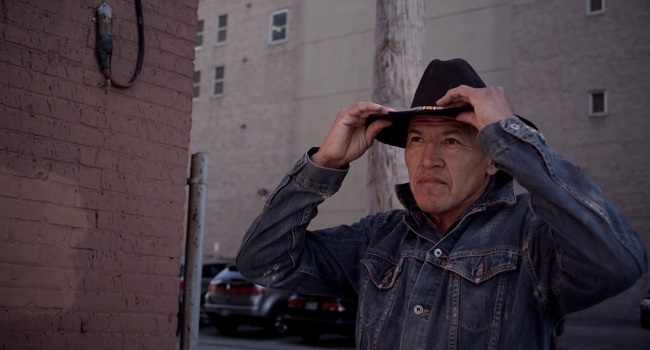

For many of us and certainly within the context of both this film and life itself, the blood and violence that eventually explode in answer to a brutal, cowardly assault and murder, will seem like cold, calculating vengeance, but the writer-director Sterlin Harjo knows better. In his third extraordinary feature film, Harjo takes us deep into the life and spirit of one man to expose a truth we must all face and come to know.

His film Mekko bears the name of its protagonist, a quiet lean, gentle giant played by longtime stuntman Rod Rondeaux (a la such immortals as Ben Johnson and Richard Farnsworth); a man who still has enough of a spark left in him to conjure the memories emblazoned upon his soul in childhood by the words of his long-dead grandmother.

In the tradition of Lionel Rogosin's searing docudramas on America's post-war homeless and the early years of South African apartheid in On the Bowery and Come Back, Africa respectively, in addition to the neo-realist visions of Vittorio De Sica (Bicycle Thieves, Shoeshine, Umberto D), Harjo has created a contemporary masterpiece in Mekko, one which indelibly presents a portrait of Native Americans that's as much a harrowing slice-of-life drama as it is a piece rooted in the folklore of our indigenous peoples.


Harjo hangs his raw cinematic engraving upon the simple tale of a man recently released from a 19-year prison stint for murder who winds up homeless on the streets of Tulsa. He reconnects with an old friend from his youth who's also on the streets, is then befriended by a kind-hearted Native American waitress in a local greasy spoon and eventually confronts his nemesis, an odious street goon who keeps his own people hooked on booze and drugs to extort, bully and eke what cash he can out of them.

As in his grandmother's legends, Mekko and his people are always followed by a malevolent witch-spirit who will haunt them to their graves and beyond unless someone bravely takes action to rip the evil heart and soul out of this scourge, this blight upon humanity. It's ultimately all about looking inward to expose one's own demons and eradicate them with extreme prejudice in order to make the world pure again.

Mekko is an extraordinary work, gorgeously crafted, beautifully acted and even utilizing real indigenous street people in the cast. It's sad, shocking, profoundly moving and ultimately uplifting. The journey to elation is, however, fraught with danger and suffering. It's not cheaply and easily earned, but it's a journey you'll never forget, one with the power to fill you with the kind of truth that not only exposes the lives of real people, but the potential to inspire change within yourself.

Yes, this is what they indeed do. Masterpieces, that is.

THE FILM CORNER RATING: ***** 5-Stars

Mekko enjoys its international premiere in the Contemporary World Cinema section of TIFF 2015. For further info, visit the TIFF website HERE.

Wednesday, 16 September 2015

HOW HEAVY THIS HAMMER - Review By Greg Klymkiw - TIFF 2015 - Self-loathing 4 U


How Heavy This Hammer (2015)
Dir. Kazik Radwanski
Starring: Erwin Van Cotthem, Kate Ashley, Seth Kirsh, Andrew Latter

Review By Greg Klymkiw
"I know at last what I want to be when I grow up.
When I grow up I want to be a little boy."

- Robert Slocum in Joseph Heller's "Something Happened"

"You can spend the entire second half of your life
recovering from the mistakes of the first half."

- Tommy Wilhelm in Saul Bellow's Seize the Day

“...for your life to be worth anything you must sooner or later
face the possibility of terrible, searing regret."

- Frank Bascombe in Richard Ford's The Sportswriter
Erwin (Erwin Van Cotthem) has never grown up. He spends most of his leisure time alone in front of a computer playing a video game which takes him into the adventure world of viking warriors he desperately longs to have been a part of.

He barely acknowledges his wife and two boys. On rare occasions he lumbers out of his man-cave to eat dinner. With his late-period-Orson-Welles-like frame, the sounds he emits over the family dinner table are seldom conversation, but mastication is joyously present.

He's been a lucky man during this horrendous period of despair. His wife has been surprisingly supportive of his ennui, but she's quickly losing patience as his increasing misanthropy is affecting their two sweet boys.

His jowly countenance has stroke/heart-attack written all over it - he's in pure self-destruction mode. The only exercise he gets is playing rugby. In spite of his girth, the sport seems to fit him like a glove. Here his weight allows him to smash his opponents to a pulp and for a few hours per week, Erwin gets to be a Viking warrior on the pitch. After each game, he also has an excuse to quaff several barrel-fulls of beer, his inebriation hardly the sort of thing which engenders him to his wife and kids when he eventually stumbles home.

Erwin might even have it in him to be a good husband and father if it wasn't for the fact that he's only around in body. His spirit is lost under the layers of flesh and self-loathing.

Changes are indeed looming.


Though there are a myriad of films which dramatically render the mid-life crises of white, middle-class men, I can think of very few in recent years (and no, in case you were wondering, NOT the overrated Sam Mendes nonsense American Beauty) which achieve the kind of stark truth and resonance nailed by Kazik Radwanski in his intensely gripping kitchen sink exploration of male ennui in his sophomore feature film How Heavy This Hammer.

Certainly the 50s, 60s and 70s in both British and American cinema are periods which exemplify some of the best work in this tradition and Radwanski's picture can easily share a place with films like: Tony Richardson's Look Back in Anger, Elaine May's Mikey and Nicky, John Cassavetes' Husbands, Gilbert Cates' I Never Sang For My Father, Douglas Schwartz's Your Three Minutes Are Up and among many others, Bob Rafelson's Five Easy Pieces. (There was also many great Canadian pictures in this tradition, most notably Paul Lynch's The Hard Part Begins, Peter Pearson's Paperback Hero, Peter Carter's The Rowdyman and the grandaddy of all Canadian beautiful loser pictures, Donald Shebib's Goin' Down The Road.)

Rather than movies, though, Radwanski's picture seems much closer to a literary tradition, that of Saul Bellow, Joseph Heller, Phillip Roth, John Updike, Richard Ford, Frederick Exley, et al - the grand purveyors of the deepest depths of male angst. Radwanski does not disappoint in this respect. His film is as harrowing a dive into self hatred as one might imagine.

Using the British New Wave kitchen sink tradition of handheld cinematography, Radwanski takes a few steps further into despair as his brilliantly photographed film seems to live in perpetual closeups - most of the time focused upon the great performance of Erwin Van Cotthem as the hapless wannabe father/husband. Keeping us so glued to the faces of the characters forces us to examine virtually every blemish, wrinkle and pore.

What we see on the surface, of course, is skin deep, but we can't help but look deeper.


In spite of everything, in spite of Erwin's selfishness and repellence, Radwanski, his creative team and actors manage to maintain a level of humanity so that we're always in Erwin's corner - hoping and praying he doesn't keep fucking up.

The aforementioned closeups are a big part of this. When Erwin isn't completely blank, his eyes seem to mist over and moisten as if deep down in those ocular pools is the spirit of a man once imbued with great warmth and sensitivity, a man who has lost his way, possibly even irretrievably.

Still, he tries to change, but it gets even more calamitous as he continues to blow his attempts to turn things around. The will always seems to be there, but such is his lot in life to keep fucking it up. It's as if his attempts to change things are akin to merely paying lip service.

What Radwanski's film so tragically details is a man whose only forward movement is always accompanied by two steps backward. We're left with the portrait of a man whose lot in life is to ruin everything that could bring joy to his life.

The picture is a heartbreaker

The Film Corner Rating: ***** 5-Stars

How Heavy This Hammer enjoys its world premier in the Contemporary World Cinema program at the Toronto International Film Festival (TIFF 2015).

Saturday, 12 September 2015

LAMB - Review By Greg Klymkiw - TIFF 2015: Extending humanity to all of God's creatures


Lamb (2015)
Dir. Yared Zeleke
Starring: Rediat Amare, Kidist Siyum, Welela Assefa, Surafel Teka, Indris Mohamed

Review By Greg Klymkiw
"For as a lamb is brought to slaughter, so
She stands, this innocent, before the king."


- Geoffery Chaucer, Man of Law's Tale, 1386
Though the main character of Yared Zeleke's extraordinary first feature Lamb is hardly a direct derivation of the popular "persecuted princess" genre of the 13th and 14th centuries, he bears a number of unique similarities to "Custance" the central figure of the aforementioned Chaucer piece from the immortal "Canterbury Tales".

Ephraïm (Rediat Amare) is nine-years-old and his former charmed life of early childhood has been sadly decimated by the droughts and poverty of contemporary Ethiopia. His beloved mother dies of illness related to malnutrition and his father must take his boy to a more stable home environment many miles away whilst Dad then travels to the city of Addis Ababa to seek employment.

Ephraïm's only balm for his sadness is the deep love and friendship he maintains for Chuni, a sweet lamb that his beloved late Mother also cherished. Things don't look too positive here, though, since Dad drops the huge bomb that Ephraïm will soon need to cross over into manhood by slaughtering the lamb with his own hands.

This sentiment of manly tradition is reinforced by the patriarch of the foster family he's been left with. Uncle Solomon (Surafel Teka) makes it very clear that the lamb must die for an upcoming feast, but more importantly, to assist with the malnutrition of the family's sickly infant daughter.


Though Lamb hardly apes the Chaucer story in terms of its main character maintaining her constant faith to Christianity in spite of being assailed by "heathen" influence, Zaleke's film still oddly parallels the "Canterbury Tale" as Ephraïm maintains a constant faith in his wealth of spirit, his love for Chuni and most importantly, his natural gifts which fly in the face of the patriarchal traditions of rural Ethiopia. Happily, he finds an ally in his cousin Tsion (Kidist Siyum), the eldest daughter of his foster family who flouts convention with her intelligence, literacy and refusal to be married off.

Tears, however, will be shed.

Life moves in mysterious ways and a big part of Ephraïm's coming age will, in spite of all his best efforts to maintain the status quo of childhood, lead to a point wherein he must accept that love means learning to move on, to let go, to maintain his own spirit of compassion, but to allow himself to be unencumbered by things which will hold back his natural abilities to excel beyond the meagre demands of rural society.


Curiously, in addition to the film's parallels to classic literature, it also shares a place with many of cinema's greatest works involving animals and how they relate to a child's coming of age. Lamb conjures fond memories of Clarence Brown's The Yearling (from the book by Marjorie Kinnan Rawlings), Lewis Milestone's The Red Pony (from John Steinbeck's glorious novella) and yes, even the genuinely beautiful Walt Disney heartbreaker Old Yeller directed by Robert (the Orson Welles/Joan Fontaine "Jane Eyre" and "Mary Poppins") Stevenson (from Fred Gipson's Newberry-Award-winning book).

Sensitively directed, intelligently written, beautifully acted and stunningly photographed, Lamb is an extraordinary, moving and beautiful experience for young and old alike.

THE FILM CORNER RATING: **** 4-Stars

Lamb enjoys its North American premiere in the TIFF 2015 Contemporary World Cinema Program. For further information visit the TIFF website HERE.

Thursday, 3 September 2015

JACK - Review By Greg Klymkiw - Portrait of the artist as a Serial Killer ***TIFF TOP PICK***

Jack (2015)
Dir. Elisabeth Scharang
Starring: Johannes Krisch, Corinna Harfouch,
Birgit Minichmayr, Sarah Viktoria Frick, Paulus Manker

Review By Greg Klymkiw

Jack is a pimp and poet.

He's also a ladykiller in both the amorous and literal meanings of the word.

As such, the opening ten minutes of Jack are so shocking, scary, creepy and exhilarating - Yes! EXHILARATING! - you feel like director Elisabeth Scharang's mise-en-scène has been designed to take a two-by-four to your face, guts and privates with equal force (and a bit of sadistic glee for added sprinklings of seasoning).

In short order we see the automatically malevolent title character (the perversely sexy and almost cadaverous Johannes Krisch) and his frizzy-haired, pudgy-cheeked girlfriend (Sarah Viktoria Frick) running out of an isolated country liquor mart, which they've clearly just jacked. Slipping and sliding along snow-packed, icy ruts on the ground, then piling into their big old car, they blast down the empty, rural highway as the somewhat Missy Piggy-like lassie greedily, happily guzzles from a bottle of hootch whilst Jack looks straight ahead, puffing maniacally and oh-so stylishly on cigarette after cigarette as the propulsive drone of music blasts from the car radio.

Yes, Ms. Scharang, Madame Director Extraordinaire, we're ready for action and then some. And she does not disappoint. We get a bout of rough sex twixt Jack and Miss Piggy, followed by a sequence in which his lady love procures a beautiful, innocent and young acquaintance for Jack to abuse, terrify and eventually, murder - just for fun, mind you.

And that, I reiterate, is the first ten minutes! The film doesn't let up from there. It keeps us riveted with its strange goings-on and bizarrely achieves this with an almost cryptically choppy, but evocative structure. All the while it never gives us a moment to guess where this demented, roughly-hewn, hard-boiled virtually Jim Thompson-like tale of crime, punishment and more crime, will take us.

All you know for sure is that it's impossible to avert your eyes, no matter how strange and icky things get.


There is a bit of a flip side to the creep-fest.

We're treated to some genuinely soulful voiceover poetry with images of a deer bounding through snow and Jack being ass-fucked forcibly in a prison shower (amongst other salient and prurient snippets of his life) as we learn he's been convicted and sentenced for his crime. Spending many long years in prison he churns out oodles of great poetry, stories and his prison memoirs, corresponds with hundreds of women (all of whom send him their photos, many of then nude) and finally, after charming a beautiful literary editor (Birgit Minichmayr), he's pardoned and sprung from the hoosegow.

Here the movie turns into a strange "star is born" rise-to-the-top as Jack adorns himself like an ever-so stylish pimp daddy, becoming a successful author, crime reporter and public speaker. He's the toast of Viennese society - a dashing literary figure, feted by the intelligentsia, appearing on television in heartfelt roundtable discussions on crime, punishment and redemption and engaged in a torrid affair with a sexy, married society gal (Corinna Harfouch) whom he corresponded with on a very deep level while in prison.


A great deal of the film's success is due to the great actor Johannes Krisch whom most will remember from Götz Spielmann's harrowing crime picture Revanche. Here, though, he's dazzling - working his charm and malevolence at the drop of a hat. He's a kind of perverse cross between a sinewy Robert Mitchum as Max Cady in Cape Fear, a kind of elegant Christopher Plummer Baron Von Trapp from The Sound of Music with healthy dollops of Dan Duryea tossed in for good measure.

Krisch is the lynch-pin for the sequences in which we revel in his success and even feel empathy for a man who eventually faces the mother (Inge Maux) who took a powder on him as a child and now suckers him into a position where she absconds with a whack of his dough. While director Scharang spends an inordinate amount of energy lavishing her camera upon Krisch's sexy, manly, tattooed body and reptilian facial features and a smile like a gleaming, white-toothed vampire, she also drops hints along the way that all might NOT be right with Jack. As prostitutes are grimly dropping like flies in whatever city Jack finds himself in, the police begin to surveil him and his paranoia ramps up. So does ours. At times we're in his corner, at others, we're thinking he might be getting away with serial killings.

Things are, as per the rest of this bold, brilliant feature film, never quite what they seem, which is, as it should be. And man, the picture just plain scares the fuck out of you.

THE FILM CORNER RATING: ***** 5 Stars

***NOTE*** SPOILER ALERT IN WHICH I WILL NOT SPOIL ANYTHING FOR YOU! There is an element to this film which I believe Scharang has expertly avoided addressing. Subsequent to seeing the film and writing this review, I've finally read a few reviews which exposed this element. Because I normally try to watch films as fresh and virginal as possible, I was delighted with this suppressed element which is perhaps one of the most honest and pure ways of approaching the subject matter. HOWEVER, if you're NOT AWARE of this element in any way, shape or form, TRY NOT READING ANY REVIEWS BEFORE SEEING THIS FILM. So far, every single review I've read has oh-so cleverly revealed this element. Yes, once I read about it, it all came flooding back to me, BUT, I'm glad I did not have to experience the film with these ULTIMATE SPOILERS. It wouldn't have ruined the film, but it sure made it one hell of a great ride NOT KNOWING in advance.

Jack receives its North American Premiere in the TIFF Contemporary World Cinema series during TIFF 2015. For dates, times and tix, visit the TIFF website HERE.

Wednesday, 2 September 2015

A HEAVY HEART - Review By Greg Klymkiw - Old Boxer's Last Bout ****TIFF TOP-PICK****


A Heavy Heart (2015)
Dir. Thomas Stuber
Scr. Stuber, Clemens Meyer, Paul Salisbury
Starring: Peter Kurth, Lina Wendel, Lena Lauzemis, Edin Hasanovic

Review By Greg Klymkiw

WARNING: Do not attend this film without a box of Kleenex.

What is it about old boxers that gets the tear ducts flowing like Kakabeka Falls? Perhaps because it's a thankless sport which renders most of its practitioners to mincemeat and eventually forces them into poverty in their waning years. Perhaps it's their youthful devotion to a sport which estranged them from all those they loved. Perhaps it's the fear of being forgotten, or worse yet, being remembered as a great boxer who could have been a contender, but never quite assailed the heights that seemed so assured. Perhaps it's because old boxers are almost never really all that old, but their middle age resembles those years more suited to senior citizens. Perhaps it's all of the aforementioned and then some.

A Heavy Heart (I much prefer its German title Herbert) is a knockout in more ways than one. It is director Thomas Stuber's first professional feature film from a fine screenplay he wrote with Clemens Meyer and based on a Paul Salisbury story, and after several short films and an award winning student feature, he's delivered a most assured debut. He handles the tough, gritty elements of the story and its heartbreaking sentiment with equal force. Even more telling in terms of his natural filmmaking gifts is how he tempers the sentiment with a warts-and-all realism which gives it even greater power.


Herbert (Peter Kurth) is a mountainous figure, shuffling and breathing heavily through his sordid life as a bouncer and strong-arm collection agent for a gangster - still busting heads for a living, but with none of the accolades of his former life. His one and only true joy is training Eddy (Edin Hasanovic), a talented young boxer who has a very real chance to attain a title shot (something which eluded poor Herbert during his years as a pugilist in the former East Germany). Try as he might, though, Herbert's fatal flaw is pushing those people away who, for whatever reason have not given up on him and still love him. His long-suffering girlfriend (Lina Wendel) is a case in point. Even when she plans a lovely birthday celebration for him, he arrives late, drunk and in no mood to even pay attention to her.

Something is more seriously wrong with Herbert. Painful muscle spasms, fatigue and an increasing inability to perform simple tasks, all get worse by the day. Though he ignores the symptoms with even more contempt than those who love him, he's eventually forced to succumb to a battery of tests which confirm the worst possible diagnosis.


He is afflicted with ALS (Lou Gehrig's Disease) and it will kill him - quickly. All his hopes of living vicariously through his talented protégé are dashed. He reaches out to his beleaguered girlfriend who selflessly becomes his caregiver, but most importantly, he has a huge hole in his heart that he's created for himself: Sandra (Lena Lauzemis), the daughter he estranged himself from so long ago. Worse yet, he discovers he's a grandfather. Time, however is running out.

The final hour of the film is perhaps one of the more harrowing cinematic renderings of the ravages of a disease I've seen. Stuber doesn't shield us from Herbert's rapid deterioration and it's as painful an experience as anything you're likely to have in any film. Stuber is, of course blessed with the stunning performance of Peter Kurth. Anyone who has had to helplessly watch a loved one die from ALS (I have) will be faced with an on-screen realism that's seldom been matched. Kurth's often Buster-Keaton-like stone face is betrayed by his evocative eyes, all displaying a gamut of emotion - pain, sorrow, regret and yes, even happiness and love. (And just so Herbert is never too saintly, the film and Kurth don't shy away from those moments of frustration the sick and dying are wont to have which, to put a fine point on it, reveals just how much they can be all-out pricks.)


This is one great boxing picture. Stuber's work here renders a film that's as powerful and moving as some of the best like Anatole Litvak's City For Conquest, Robert Wise's The Set-Up, John Huston's Fat City and even evoking the pain and emotion of William Saroyan's great short story "Dear Baby".

But I warn you again. Do not see this film unprepared. I suggest the heavy duty triple-ply Kleenex tissue. It will serve you well whilst watching A Heavy Heart.

THE FILM CORNER RATING: ***** 5-Stars

A Heavy Heart (Herbert) receives its World Premiere in the TIFF Contemporary World Cinema program at TIFF 2015. For dates, times and tix, visit the TIFF website HERE.

Tuesday, 1 September 2015

STRANGER (Zhat) - Review By Greg Klymkiw - Oscar Hopeful ***TIFF 2015 TOP PICK***


Stranger aka Zhat (2015)
Dir. Yermek Tursunov
Starring: Yerzhan Nurymbet

Review By Greg Klymkiw

When you're watching a picture and it occasionally reminds you of Sydney Pollack's Jeremiah Johnson, Akira Kurosawa's Dersu Uzala, Serhiy Paradjanov's Shadows of Forgotten Ancestors AND does so with its own unique stylistic and narrative approach, then you know you're watching something very special indeed. Yermek Tursunov's Stranger (Zhat) has the kind of "thinking man's" epic sweep one expects, but never really gets from many overblown extravaganzas touted as such. Tursunov, however, delivers the goods in spades by focusing upon the solitary life of Ilyas (Yerzhan Nurymbet, in an astonishingly hypnotic performance) from childhood through to his solitary death.


Probably the most fascinating aspect of Tursunov's terrific film is that Ilyas's life is charted against the backdrop of Totalitarian rule under the Soviet Union's very own version of Hitler, the evil butcher Joseph Stalin. Beginning with the early days of farm collectivization (a polite way of saying slavery), through the various periods of forced-starvation genocides and purges, World War II, post-war "prosperity" and finally, Stalin's death in 1953, Tursanov presents a sad portrait of a young man forced into a life of solitude by a reign of political terror which sees him orphaned as a boy when his father is secreted away by Stalinist goons for "collaboration".

Luckily for Ilyas, when a local yokel steals his father's horse to butcher and feed to the nearby village, the yearling is left behind and our young hero, having been taught wilderness survival tactics by his father, takes off with the young horse into the forests and mountains amidst the mighty Kazakh steppe. Adopting and raising a pack of orphaned wolves, he lives amongst them in a cave dwelling for most of his adult life, missing out on all the changes and strife in the greater world of his fellow countrymen.

Still, the pull of society is strong and amongst such genuine desires as making his unrequited love for a childhood sweetheart a reality and the very basic need for companionship, Ilyas is a man without a country, especially since he eschews the notions of Soviet politics and nationhood. The few locals who might want to be his friend, ultimately spurn him on the shaky moral ground of Ilyas's disregard for the trappings as dictated by the evil Communist Party. For his part, Ilyas is completely left behind as the world becomes ever-modern.


Though Tursonov might feel the urgings of sentiment, he merely flirts with them. Even so, his film is replete with sequences so moving and powerful, that melodrama is not a requirement here. The number of memorable moments are incalculable, but so many of them are linked to the mighty work of actor Yerzhan Nurymbet and Tursonov's natural desire to capture the deep pain in the eyes of his central character. Whether, Nurymbet looks longingly at the woman he loves but will never have as his wife or into the eyes of his beloved old horse with the tell-tale signs of cancer-imposed malnutrition forcing him to let the beast go off into the woods to meet his maker, Tursonov gives us a film that inspires deep emotion within us.

The film has been chosen by Kazakhstan as its official entry into the Foreign-Language Oscar sweepstakes. TIFF has long been a bell-weather for Oscar hopefuls, but with Stranger, this is one time I find myself in a film's corner for such an accolade. This picture deserves to be seen and acclaimed by as wide an audience as possible.

THE FILM CORNER RATING: ***** 5-Stars

Stranger (Zhat( receives its World Premiere in the TIFF Contemporary World Cinema program at TIFF 2015. For dates, times and tix, visit the TIFF website HERE.

Thursday, 27 August 2015

OUR LITTLE SISTER + MUSTANG - Reviews By Greg Klymkiw - Mongrel Media's Must-See Sister Act - The Film Corner's Handy-Dandy *****TIFF 2015 TOP PICKS***** continue.

MONGREL MEDIA'S MUST-SEE SISTER ACT AT TIFF 2015
Our Little Sister (above)
Mustang (below)

Our Little Sister (2015)
Dir. Hirokazu Kore-eda
Starring: Haruka Ayase, Masami Nagasawa, Kaho, Suzu Hirose

Review By Greg Klymkiw

When three sisters attend the funeral of their long-estranged father, they meet his daughter from a second marriage, the little sister they never met. They welcome her with open arms and she decides to live with them. For the first time in her life, she feels what it means to have family you can love and count on.


As far as I'm concerned, director Hirokazu Kore-eda (After Life, Nobody Knows, Still Walking, Like Father Like Son) has no equals in contemporary Japanese Cinema. He seems to be the one true and genuine successor to the legacy of Yasujiro (Tokyo Story) Ozu, the master of the groundbreaking tatami shots, long takes, figures moving in and out of frame, a stately pace allowing for deep contemplation of the dramas unfolding, a deep sense of humanity, a love for the properties of melodrama and an unflagging commitment to examining the intricacies of family. To a certain extent, the aforementioned Ozu grocery list of unbeatable properties seems not dissimilar to the work of Kore-eda.

Kore-eda, however, differs on two fronts. He downplays sentiment almost to the extent of eschewing it completely, but then, when you least expect it, he's not afraid of using melodrama sparingly as a legitimate storytelling tool (usually with a wallop to the solar plexus). Secondly, though Kore-eda is also primarily interested in the dynamics of family, he adds his own special thematic element, dealing heartbreakingly with the theme and dramatic action of abandonment.

Our Little Sister has got "abandonment" almost literally spilling out of its ears and he allows us to be privy to three, then four sisters filling various voids in their hearts with the love they have for each other. At times it feels like nothing much is really happening, but "it" most certainly is - in tiny, delicate and subtle ways. Kore-eda allows us time to luxuriate in each sister's unique qualities and how they play off each other.

He slowly builds to a handful of scenes during the final stretch of the picture that inspire overwhelming emotions in the hearts of its audiences. I bawled like a baby and still can't shake or forget its uplifts which are never machine-tooled, but burst forth naturally from within his film's very big heart.

THE FILM CORNER RATING: **** 4-Stars

Our Little Sister plays in the TIFF Masters program during TIFF 2015. For dates, times and tix, visit the TIFF website HERE.


Mustang (2014)
Dir. Deniz Gamze Ergüven
Starring: Gunes Sensoy, Dogba Doguslu, Tugba Sunguroglu,
Elit Iscan, Ilayda Akdogan, Ayberk Pekcan, Nihal Koldas

Review By Greg Klymkiw

The events depicted in Mustang are so horrific and harrowing, it's sometimes more unbearable to experience an equal number of story beats infused with fun, love, kindness, pleasurable abandon and humour since they're such powerful juxtapositions to the tragedy of the situation presented.

In a small Turkish coastal town on the Black Sea, a repressed, deeply traditional busybody neighbour spies five orphan sisters having fun on the last day of school. The innocent actions are deemed obscene. Their grandmother and stern uncle hit the roof and what should have been a glorious summer vacation turns into a living nightmare. They're immediately locked in the house, stripped of all items which could be considered immoral, informed that their education has come to an end and thrown into a rigorous indoctrination to be loyal, subservient wives. Parades of potential suitors are brought in to inspect their "wares" and the goal is to have all the girls, ranging from 12 to 16, married off by the end of summer.

The youngest sister proves to be the craftiest and most rebellious. She masterminds a brief escape for the girls to watch a soccer match, but the happiness is short lived when they're eventually caught in the act by their guardians. At this point, all bets are off. The home is then transformed into a literal prison replete with iron bars on all the windows, extra locks, barbed wire atop the walls surrounding the house and an intensified chaperoned courting/match-making process. In addition to the threat of physical and even sexual abuse, the girls are treated like so much chattel instead of individuals with minds of their own.

The first two-thirds of Mustang is so superbly directed and acted, it's a shame the screenplay takes a fairly conventional turn in its final act. What transpires comes close to negating the power of the rest of the film. Though some will find the denouement inspiring in all the right ways, it ultimately contradicts the reality of the girls' lives and offers up hope where none, in reality, would ever exist.

During one of the final set-pieces, first-time feature filmmaker Ergüven directs the proceedings with the urgent, nerve-jangling skill of a master. The suspense is virtually unbearable, but it's almost rendered moot when the yellow-brick-road to happiness rears its ugly head. Of course we want the girls to escape, but deep down we know a happy end to their short lives of freedom must surely be an impossibility. When these tables turn, it's not so much a cause for celebration, but a lament for honesty.

THE FILM CORNER RATING: *** 3-Stars

Mustang is a TIFF 2015 Special Presentation. For dates, times and tix, visit the TIFF website HERE.

Wednesday, 26 August 2015

THE WAITING ROOM - Review by Greg Klymkiw - Yugo Noir: *****TIFF 2015 TOP PICK*****


The Waiting Room (2015)
Dir. Igor Drljača
Starring: Jasmin Geljo, Zeljko Kecojevic

Review By Greg Klymkiw

Even when a war is 20-years-ago and thousands of miles away, it sears its ugly imprint upon your soul forever. It's even worse if you've been forced to abandon all you know and love for a new country with few prospects for immigrants and refugees.

Jasmin (Jasmin Geljo, a tough, pug-faced Buster Keaton) knows this all too well. The popular actor and playwright fled the violent dismantlement of the former Yugoslavia and settled in Toronto. Estranged from his first wife, he still finds time to visit her in the terminal cancer ward, alternating the death-watch with his youthful adult daughter. Married to a much younger woman, with whom he's sired two children, Jasmin grows increasingly distant from her.

Eking out a living as a construction labourer whilst endlessly auditioning for stereotypical television roles requiring Eastern European gangster "types", he dreams of recapturing former glories (of the thespian kind) by returning to Sarajevo to mount the hilariously bawdy theatrical comedy he's been performing for Toronto's Yugoslavian community.


War, however, forces dreams to either die hard or at best, reside in a kind of purgatory. His attempts to move forward seem to create an ever-increasing stasis. Taking part in the filmed portion of a political avant-garde art installation about the turbulent events two decades earlier is what finally ignites memories of the war he's tried so hard to closet. One repression usually leads to another and Jasmin's purgatory intensifies.


Writer-director Igor Drljača has taken several astonishing leaps forward from his dazzling 2012 debut feature Krivina.

This sophomore effort is even more richly layered, but on this occasion, he's splashed the movie with healthy sprinklings of (mostly sardonic) humour amidst the angst. What consumes us, though, is Drljača's rich mise-en-scène - gorgeously composed still-life shots, the drab, grey Toronto juxtaposed with a fake backdrop of the gorgeous Yugoslavian countryside. The pace is miraculously measured and calculated; so much so that the picture's guaranteed to mesmerize.

Like his first feature, Drljača has crafted a devastating film about war with nary a single shot fired from a gun, nor a single bomb exploded. The echoes, explosions and shots heard round the world are burrowed in the film's devastating silence and the pain etched into the faces of those suffering strangers in a strange land are like silent screams ever-reminding us of the true casualties of war - those who live a living death.

THE FILM CORNER RATING: ***** Five Stars

The Waiting Room plays at TIFF 2015 in the Contemporary World Cinema program. For dates, times and tix, visit the festival's website HERE.

Sunday, 31 August 2014

L'IL QUINQUIN - TIFF 2014 - (Contemporary World Cinema) - Review By Greg Klymkiw

Ah, the bucolic lives of rural inbreds.
L'il Quinquin (aka P'tit Quinquin) (2014)
Dir. Bruno Dumont
Starring: Alane Delhaye, Lucy Caron, Bernard Pruvost, Philippe Jore

Review By Greg Klymkiw

I pretty much can't stand Bruno Dumont. His oh-so ironic plunges into northern French rural culture have always been rendered with a heavy enough hand that I've found it almost impossible to respond on any level but contempt. I especially hated his inexplicably acclaimed L'Humanite which involved an investigation of an especially brutal act of violence punctuated by scenes of cops actually taking weekends off to go to the seaside, eat cheese and sip wine. The non-thriller exploration of character and culture grew tiresome and just made me long for some of the more straight-up Gallic policiers I'd come to love over the years.

Though L'il Quinquin also involves an investigation into a series of serial killings similar in setting to the aforementioned, I was shocked to find myself sufficiently intrigued to sit all the way through this film's mammoth length of 200 minutes. Focusing upon a group of kids living in a seaside resort, the film is an all-out comedy and as such, works moderately well.

Focusing upon the pug-ugly title character and his friendship with a pretty little girl, one gets a sense of how mundane their lives are in the tiny one-horse village they live in and their antics are not without amusement value. Dumont's social observations seem less heavy-handed than usual and within the commitment to laughs, I daresay he's crafted a pretty darn successful outing this time round.

The boy and girl, in addition to a few local kids, happen upon the strange sight of a murder scene being investigated by the local police chief (who makes Inspector Clouseau look like a Rhodes Scholar) and his even stupider partner. The murders are curious. The victims have been hacked up and their body parts appear to be shoved deep into the assholes of cows lying dead in a variety of unlikely locales. (I have to admit I appreciated blood, viscera and fingers spilling out of a cow's ass.) Quinquin, strictly through his boredom and powers of observation proves to be an unwitting partner in the investigation (though the chief inspector has taken an intense dislike to the little rascal).

The movie is often knee-slappingly hilarious and its stately pace takes on a kind of clever deadpan that allows for it to never inspire looking at your watch to see when you can safely vacate the cinema. The performances of the kids are delightfully natural and the adults are all suitably bumbling or ignorant. Though this all could have proven intolerable, it's imbued with something resembling heart. This was probably a stretch for Dumont, but he pulls it off. The movie is sufficiently engaging that I'm actually looking forward to his next film. When it comes to directors I have no use for, that's quite an accomplishment.

L'il Quinquin is distributed by Kino Lorber and is playing in the Contemporary World Cinema series at TIFF 2014. For tix, times, dates and venues, visit the TIFF website by clicking HERE.

PLEASE FEEL FREE TO ORDER ANYTHING FROM AMAZON BY USING THE LINKS BELOW. CLICKING ON THEM AND THEN CLICKING THROUGH TO ANYTHING WILL ALLOW YOU TO ORDER AND IN SO DOING, SUPPORT THE ONGING MAINTENANCE OF THE FILM CORNER.

AMAZON.CA


AMAZON.COM


AMAZON.UK


Thursday, 12 September 2013

THE MAJOR - Review By Greg Klymkiw - #TIFF 2013 - Did you know corruption exists in Russia? Now you do!

The Major (2013) ***
Dir. Yuri Bykov
Starring: Denis Shvedov, Yuri Bykov, Irina Nizin

Review By Greg Klymkiw

Did you know corruption runs rampant in Russia? Gotta tell ya', it sure came as a surprise to me. I always assumed a country run by a Totalitarian ex-KGB agent like, say, Vladimir Putin, would be clean - fresh as a handi-napped baby's anus. Alas, the truth of the matter has left me crestfallen - especially with the newly-gleaned tidbit that Russia's corruption extends even to the police force. Corruption in the police force? Yes, even in Mother Russia. Thanks, of course, to the art of cinema, we all get to learn something new everyday and what I really learned from the new movie The Major is the extent to which Russian cops will go to protect each other. Policemen protecting each other? In Russia? Sure. Let's take police major Sergey Sobolev (Denis Shvedov). Learning his wife's in labour, he hightails it to the hospital, blasting down an icy highway like it's his personal Indy 500. If truth be told, his aggressive behind-the-wheel shenanigans are typical of Russian drivers, but because he's a cop, he's not blind drunk like the civilians most certainly are.

As (bad) luck would have it, he sees a kid crossing the road. Instead of slowing down, he honks his horn, pedal to the metal. The child stops in his tracks - confused, disoriented and scared. In a matter of seconds, Sergey ploughs into the kid and turns the burgeoning proletarian into a huge wad of hamburger meat in front of his babe-o-licious Mom (Irina Nizin). Sergey does what any good police officer in Russia would do - he locks the sobbing, screaming mother into his car (keeping her from being with the child during his last burbles of life), then calls his loyal partner Kroshunov (writer-director Bykov) and waits for the true magic of Mother Russia to work its miracles.

And what magnificent Russkie magic Kroshunov orchestrates! Mom is plied with booze before a blood test is taken, the length of the skid marks are falsified, Mom's threatened with being a negligent parent (she was "drunk" after all) and then she watches her husband beaten to a pulp and facing arrest for assaulting a police officer. With her child's shredded slab o' pulp in the morgue, the distraught Mom signs a statement relieving Sergey of all responsibility and agrees her child moronically darted out in front of the vehicle.

Just when things look bright, Sergey shocks strings of undigested cabbage out of his colleagues butt holes when he announces he wants to face the music. Redemption is the salvation he now seeks. If his overwhelming guilt is allowed to be indulged, a lot of cops, including his superiors, are going down. As if this wasn't enough, the dead kid's Dad storms the police station bearing arms and proceeds to take hostages.

The real shit storm is only just beginning.

Director Bykov has pulled out all the stops and The Major is a tautly directed cop thriller that generates anxiety and cuticle-gnawing suspense. Even when Bykov's screenplay injects a potentially unearned redemption and slightly hard-to-swallow change of heart in Sergey's character, the action is as sharp as a Cossack's sabre and things clip along with such grim force that you almost don't notice a few of the gaping holes in the story's logic. Shvedov's intense performance is the one thing that makes the speed at which his character arrives to his unpopular decision a bit less bitter a pill to swallow. In fact, the overall mise en scène powerfully captures the genuine underbelly and reality of today's Russia - drab, lifeless backdrops with alternating harsh and murky lighting.

This is one grim thriller. Though the script falters a touch, the direction and performances always deliver a nasty, break-neck ride with plenty of 70s-style American genre tropes applied to the jaw-droppingly horrendous reality of contemporary Russia - a country run by gangsters with badges - the descendants of both Czarist extremes and Stalinist brutality. The players might change, but the song always remains the same.

"The Major" is part of the TIFF Contemporary World Cinema series at the Toronto International Film Festival 2013. Visit the TIFF website HERE.
Saturday, 7 September 2013

Le démantèlement - Review By Greg Klymkiw - #TIFF 2013 - King Lear visits the farm (Quebec style)


Le démantèlement (2013) *****
Dir. Sébastien Pilote
Starring: Gabriel Arcand, Sophie Desmarais, Lucie Laurier, Gilles Renaud, Pierre-Luc Brillant, Dominique Leduc

Review By Greg Klymkiw


Who is Sébastien Pilote?

Seriously. Who the hell is this guy, anyway?

These were questions I first asked myself upon seeing his extraordinary first feature film Le Vendeur. This stunning Quebecois kitchen-sink drama was so raw, real and infused with a seldom-paralleled acute pain that the film's quiet power betrayed its creator's cinematic genius. Starring the great Gilberte Sicotte as an ace car salesman in a small factory town in Quebec on the brink of total financial collapse, this staggeringly powerful, exquisitely-acted and beautifully written motion picture was, for me, the first genuine Quebecois heir apparent to the beautiful-yet-not-so-beautiful-loser genre of English-Canadian cinema of the 60s and 70s (best exemplified by films like Don Shebib's Goin' Down the Road, Peter Pearson's Paperback Hero and Zale Dalen's Skip Tracer). As if making a modern masterpiece of Quebec cinema as a first feature wasn't enough, I eventually caught up with Pilote's earlier short film DUST BOWL HA! HA! which featured Andre Bouchard as a hard-working family man in small-town Quebec who stoically maintains his dignity in a world where nothing and nobody escapes the crushing weight of the financial crisis. This turned out to be one of the best short films I had ever seen - period - a phenomenal portrait of humanity, so graceful and so simple, that upon first seeing it I felt about as winded as I did after I first saw Le Vendeur.

So now I have even more reason to ask: Who the fuck is Sébastien Pilote? His second feature film Le démantèlemen completely and utterly knocked me on my ass. Starring the legendary Gabriel Arcand as a Quebec sheep farmer extraordinarily blends a neo-realist sensibility with the sort of pace one takes while appreciating a great work of visual art and as such, is not only great, thought-provoking drama but visually astonishing - gorgeously lit and composed by cinematographer Michel La Veaux in a classical tradition not unlike that of Haskell Wexler's heartbreakingly beautiful work in Bound For Glory.

Gaby Gagnon (Arcand) has worked the family farm his whole life - long after his brothers abandoned rural life, long after his wife left him to say farewell to a suffocating existence and now he continues to painstakingly toil away, often missing, but seldom seeing the daughters he loves so dearly and who live far away in Montreal. He has friends - his loyal pal and accountant (Gilles Renaud) who brings good humour, fellowship and counsel into his life (along with an unwanted clunker of a computer), a neighbouring widow (Dominique Leduc) who endows him with warmth and commiseration and, he has a sweet-eyed ten-year-old dog who sticks to his side faithfully. They all offer some solace to Gaby's isolation, but when his accountant pal speaks disapprovingly about how the family seems to have all but abandoned him, Gaby shrugs it all off as being an inevitability. Thanks to Arcand's extraordinary performance we don't really buy his expectations of abandonment and disappointment.

If anything provides Gaby with genuine solace it is the work itself. During the first third of the film, Pilote painstakingly details the drudgery of Gaby's daily chores - almost to the point where one feels like the movie could be a sumptuously photographed documentary about sheep farming in rural Quebec (instilling avid interest in the rearing of mutton to the unlikeliest candidates for such tutelage). I might be insane, but I could have watched Gabriel Arcand tending to this farm in Frederick Wiseman-like breadth and girth for hours. (I reiterate, however, my mental state on such matters.)

It is in this section of the film we get such an acute sense that Gaby's heart and soul is farming - so much so that when we eventually get to the action of the film's title we're devastated in extremis. This is where another aspect of Pilote's brilliant storytelling approach sneaks stealthily upon us - we not only understand why Gaby would never imagine another life, but it seems like there isn't a single shot or story beat employed in which we don't fall in love with the world of the farm either. There's nothing overtly sentimental about this approach - Pilote never tempers his gaze upon the hardships and/or challenges of farm life, but in fact creates a sense of life's infinite give and take. To put too fine of a point on it: climbing Mt. Everest is full of pain, hardship and requires a meticulous attention to every detail, but Good Goddamn (!) it's worth it!

When Gaby gets a visit from his oldest daughter Marie (Lucie Laurier), he gets the bad news that her marriage is over and she needs a $200,000 loan to buy out her debt-ridden husband's share of her home. For both her sake and her kids, he agrees to look into finding the money for her by using his farm as collateral. His youngest daughter Frédérique (an exquisitely radiant Sophie Desmarais), who enjoys a carefree career as a stage actress, actually seems to have more sense than her older sister and points out to Gaby that he's being taken advantage of if he risks the farm.

And like all good fathers, he shrugs and admits he knows this.

Almost as painstaking in its detail as the recreation of farm life is the "dismantlement" and it is here where the elements of tragedy kick into high gear - there are, after all, several allusions in the film to Shakespeare's "King Lear" - and I defy any audience member to not be moved to tears on several occasions throughout this emotionally devastating series of events. There are sequences of almost unbearable pain. A visit to an animal shelter to "take care" of the dog nobody wants, rivals the old man's visit to the dog pound gas chambers in DeSica's Umberto D and a scene where Gaby tours a decrepit low income housing unit is equally fraught with the same grim, stark power generated by the Italian neorealists. The final half of the film is thoroughly heart-wrenching - but most astoundingly, it is here where Pilote demonstrates such world-wise maturity that we come to recognize and accept with both sadness and joy that death yields regeneration.

And what soaring, truthful and deeply moving regeneration the film offers.

Who is Sebastien Pilote?

One of the greatest filmmakers of Quebec and that means something - a lot, actually.

"Le démantèlement" is part of the Toronto International Film Festival's (TIFF 2013) Contemporary World Cinema series. GET A TICKET HERE.

Monday, 29 July 2013

PARADISE: LOVE - DVD review - Review By Greg Klymkiw - First in Seidl's Paradise Trilogy


Paradise: Love (2012) *****t
dir. Ulrich Seidl
Starring:Margarethe Tiesel, Peter Kazungu

Review By Greg Klymkiw
"Never have I looked so directly into hell."
-Werner Herzog on Animal Love, by Ulrich Seidl

One almost imagines an off-screen Julie Andrews singing "These are a Few of My Favourite Things" as the lens of filmmaker Ulrich Seidl greedily drinks in globs of fleshy pink corpulence jiggling like mounds of jello, streaked with road maps of stretch marks boring through virtual mountain ranges of cellulite and grotesque cauliflower-like skin tags gripping desperately to spongy thighs like bats in a cave. But no, as the blonde blob adorned in a sun hat flip-flops onto the sunny airport tarmac of a Kenyan resort, surrounded by her equally porcine 40-50-something Austrian maidens, she is greeted with the happy voices of a welcoming party as they joyfully croon "Hakuna Matata." Once happily ensconced in the paradise of the resort, our jolly Teresa (Margarethe Tiesel) ogles the rich, lithe, cocoa bodies of her male hosts, salivating with the same delightful desire she might express when gazing upon a platter of rich Viennese pastries, imagining the joy of stuffing them all down her expansive, greedy gullet.

That said, Teresa looks like someone's mother.

And indeed she is. She's left her nasty, blubbery smart-phone-obsessed daughter in the capable care of an aunt. Also behind her is the daily toil of caring for extremely mentally challenged adults. However, the loneliness permeating her single parent existence will soon be filled to overflowing. "Filled" is indeed the operative word here.

She will soon enter the pleasurable heart of darkness known as sex tourism and we know, within seconds, that we have plunged ourselves yet again into the wonderful world of Ulrich Seidl. As noted by director Werner Herzog upon seeing Seidl's early documentary Animal Love, we too are looking "directly into hell".

Seidl is no ordinary obsessive. He's an artist with one of the most unique voices in contemporary cinema. His early documentaries exposed things about humanity (and by extension, ourselves) that we all try to deny as being within us and the rest of the whole wide world. Where Seidl differs from traditional documentarians is his insistence upon shooting in long takes - expertly composed shots with exquisite lighting (or in some cases, starkly appropriate such as when his camera trained itself upon the aforementioned individuals who truly loved their animals - a lot!)

All this went several steps further, however, once Seidl switched gears in 2001 and began to apply his unique mise-en-scene and obsessions in the world of drama with what is inarguably still his greatest picture Dog Days.

Paradise: Love isn't too far behind in terms of its brilliance and impact. The tale of the aforementioned Teresa might prove far to unsettling for some, but like all Seidl, patience and perseverance with pay off.

Some accuse him of being little more than a cinematic equivalent to a freakshow impresario, but this is to remain myopic to what he's really up to. Seidl is indeed a humanist who seeks his quarry amongst the extremities of mankind (and most notably in the backyards of Austria).

With Paradise: Love, Seidl unflinchingly charts a woman's descent into satisfying her most basic sexual needs by exploiting those who are so poor they will do whatever they have to do in order to survive.


Teresa parades along the Kenyan beaches in outfits that accentuate her strudel and schnitzel induced corpulence. It's her fat face emblazoned with lustful wonder that ultimately betrays her slatternly desires. Surrounded by eager, young and almost criminally gorgeous Kenyan men who vie for her attention in the hope she'll buy a lot more than the trinkets they have on offer, Teresa eventually sets her sights on one young lad who, on every level, offers just what she wants.

And as Seidl's camera unflinchingly reveals, what some of these young lads have to offer is jaw-droppingly succulent. I dare even strictly heterosexual male viewers to not fantasize about dropping their own jaws to take in the stunning magnificence that dangles between the thighs of these heartbreakingly beautiful young men. With their smooth gentle voices, glisteningly ripped bodies and irrepressibly insistent promises of the love they will provide, it's not hard to believe that Teresa and her ilk might actually believe it is LOVE they are paying for, not sex.

As per usual in Seidl's dramas, the script is a springboard for the drama created in lengthy, intensive improvisations between professional actors and real people. This results in a number of especially harrowing moments. For all the genuine dark humour the movie generates, there are just as many sequences when Seidl's camera catches the eyes of the beautiful young men (who are indeed - in real life - dirt poor and who have provided their services to women like Teresa many times in their lives).

Their eyes betray desperation and terror. The performances of non-actors and actors alike are imbued with reality and poignancy - so much so that it eventually becomes impossible to laugh and you are, in turn, indelibly overwhelmed and saddened with the naked truth of the world we live in. Humanity is indeed at the top of the food chain, but as it devours its own with through-the-roof relish and frequency, one can only despair at where it will all lead us.

Seidl leaves us with a Kenyan folk music group performing "Hakuna Matata" which, in Swahili is literally translated into English as "There are no worries."

No worries, indeed.

"Paradise: Love" premiered at the Toronto International Film Festival 2012 (TIFF 2012) and is currently available on DVD via Strand Releasing.

Wednesday, 12 September 2012

BABY BLUES - TIFF 2012 - Review By Greg Klymkiw - Nobody makes movies quite like Kasia Roslaniec. With her first feature Mall Girls and now her new picture, the extraordinary Baby Blues, she tackles very serious and important issues with respect to the challenges young teenage girls face in the modern world. Her movies rock! Big time!


Baby Blues (2012) ****
dir.
Kasia
Roslaniec

Starring:
Magdalena Berus,
Nikodem Rozbicki


TIFF 2012 - Contemporary World Cinema
Review By Greg Klymkiw

Nobody makes movies quite like Kasia Roslaniec. With her first feature Mall Girls and now her new picture, the extraordinary Baby Blues, she tackles very serious and important issues with respect to the challenges young teenage girls face in the modern world and yet, her touch is never didactic, humourless, rife with a bludgeon of dour political correctness, nor hampered with the ultra-conservative by-the-numbers after-school-special-styled dreariness so prevalent in similarly-themed works from North America (and especially, God Help Our Nation's Cinema, Canada).

Her movies rock! Big time!

Baby Blues tackles the subject of teen pregnancy. Sounds dull, right? Sounds like you've seen it all before and then some, right? Sounds like something you'd not go out of your way to see, right? Well, it's none of those things and to skip it, you'd be skipping one of the most original, heartfelt, humanist and rooted-in-realism pictures to ever deal with this subject matter.

The movie crackles with life, but it's also deliriously romantic, moving and exactly the sort of picture that needs to be seen by tween, teen and adult women. Maybe more importantly, guys need to see it, too. Guys of all ages. We're so inundated with false portraits of female sexuality generated by most male filmmakers, but sadly, by women also, that Baby Blues is pure magic - a movie with no false notes and yet imbued with the highest degree of entertainment value.

One of the things that makes the movie work so well is its director's exquisite, devil-may-care mise-en-scène. Roslaniec breaks every rule in the book, but does so as someone who clearly understands what the rules are or at least has that filmmaking DNA so hardwired into her very being that her instincts are spot-on. She also has a gift for how rules need to be broken in order to deliver a movie that will pulsate with life and resonate far beyond other movies that will be long forgotten.

On one hand, she injects a delightfully wonky verité nuttiness into so much of the picture and yet, none of the whirling, hand-held images have that annoyingly sloppy shaky-cam that bad filmmakers use to try and coverup the fact that they really have no talent (and that, on occasion, audiences and critics make the mistake of thinking positively towards).

Roslaniec uses this technique ONLY when it is emotionally and dramatically necessary to do so. As well, not unlike Paul Greengrass, the technique - while natural in the sense that we do not see her consciously using it - has the strong feeling that it's been planned down the last detail.

On the other hand, when Roslaniec needs (or wants) to deliver more classical approaches to her mise-en-scène it's there in spades, but never do we feel that her varied directorial techniques are a mish-mash. They are so seamless, that one almost doesn't notice them. If anything, this approach is what makes her films, and Baby Blues in particular, so dramatically compelling.

There's even a fabulous cutting style employed throughout the film where cuts to black are inserted, held on, then cut out of to picture - often within the same dramatic sequence.

She's also not afraid to let scenes play out in one shot without cuts - a technique many master filmmakers employ, but one that is seldom utilized in young filmmakers who feel the need to cut constantly - as if this annoying Attention Deficit Disorder approach will pick up the pace. Heavy cutting actually has the effect of slowing the pace down because it interferes with the natural dramatic rhythms of the scenes. Roslaniec never makes this mistake - scenes play out in ways they NEED to play out.

Given that the film is about a teenage girl who has a baby sired by her unwitting boyfriend and that she is bound and determined to keep it, there's one incredible moment of cinema that I feel is as sublime as the smile on Chaplin's face at the end of City Lights or the noble owl presiding over the animal graveyard in Rene Clement's Forbidden Games or John Merrick's responses to the pantomime performance in David Lynch's The Elephant Man.

The scene occurs between the teenage girl Natalia (Magdalena Berus) after a frantic visit to the hospital with her baby boy Antek. Natalia is huddled with her baby on a metro train as it hurtles along. Roslaniec holds on a shot of such dramatic power and beauty you can hardly believe your eyes that it's happening. She holds and holds and holds the shot and then, when you suspect she's going to cut out of it, she holds it even longer.

All I can say is this: If this scene fails to move you to tears (and perhaps sobs), I suspect you might not be human.

The movie is full of moments like this. They're not all imbued with the same emotional wallops. Some of them are very small and delicate. Often, they are found in scenes where Natalia and her well-meaning, amiably clueless dope-smoking boyfriend Kuba (Nikodem Rozbicki) are navigating the unfamiliar waters of domestic life and parenthood.

What's especially phenomenal is that Roslaniec so beautifully and truthfully captures how quickly these two people try to adapt to the responsibilities that come from being parents. What she captures is truthful - not only to young people - but frankly, just as truthful to those who are supposedly far more mature than this couple. For those who have experienced being parents and those who have not, you never feel like Roslaniec's manipulations are cloyingly by-the-book, but are, rather, infused with life itself.

Baby Blues is a movie that will resonate on so many levels for so many people. It will bring them face to face with realities they might have experienced themselves or, at the very least, realities they feel they could someday face. The movie achieves this in ways that are wholly original and a touch that veers from bold to sweetly gossamer.

I'm also thankful that Roslaniec is making the films that she is making. My own little girl has seen them and they're exactly the sort of films I know she will come back to as the years progress. They are films that will both delight and empower her as both a woman and a human being.

This is a great film. It might be unfair to greedily expect this, but filmmaker Kasia Roslaniec has plenty of greatness left in her and I, for one, will be keeping my eyes and heart open for more films from this filmmaker. I will demand and expect continued bravery and artistry of even higher levels.

In the meantime, there is Baby Blues to contend with. Missing it should be a capital offence of artistic neglect.

"Baby Blues" is playing at the Toronto International Film Festival (TIFF 2012) Wednesday September 12 Cineplex Yonge & Dundas 4 9:00 PM and Saturday September 15 Cineplex Yonge & Dundas 2 12:15 PM. For ticket information visit the TIFF website HERE.


Saturday, 8 September 2012

PARADISE: LOVE - TIFF 2012 Reviewed By Greg Klymkiw Ulrich Seidl, the "bad-boy" of Austrian cinema is back with this searingly funny, powerful and harrowing drama against the backdrop of Kenya's sex tourism industry. He deftly plumbs the extremities of human behaviour in order to reveal humanity in all its disparate forms and with the weight and resonance of its tragic beauty.


Paradise: Love (2012) *****
TIFF 2012 - Contemporary World Cinema
dir. Ulrich Seidl
Starring:Margarethe Tiesel, Peter Kazungu

Review By Greg Klymkiw
"Never have I looked so directly into hell."
-Werner Herzog on Animal Love, by Ulrich Seidl

One almost imagines an off-screen Julie Andrews singing "These are a Few of My Favourite Things" as the lens of filmmaker Ulrich Seidl greedily drinks in globs of fleshy pink corpulence jiggling like mounds of jello, streaked with road maps of stretch marks boring through virtual mountain ranges of cellulite and grotesque cauliflower-like skin tags gripping desperately to spongy thighs like bats in a cave. But no, as the blonde blob adorned in a sun hat flip-flops onto the sunny airport tarmac of a Kenyan resort, surrounded by her equally porcine 40-50-something Austrian maidens, she is greeted with the happy voices of a welcoming party as they joyfully croon "Hakuna Matata." Once happily ensconced in the paradise of the resort, our jolly Teresa (Margarethe Tiesel) ogles the rich, lithe, cocoa bodies of her male hosts, salivating with the same delightful desire she might express when gazing upon a platter of rich Viennese pastries, imagining the joy of stuffing them all down her expansive, greedy gullet.

That said, Teresa looks like someone's mother.

And indeed she is. She's left her nasty, blubbery smart-phone-obsessed daughter in the capable care of an aunt. Also behind her is the daily toil of caring for extremely mentally challenged adults. However, the loneliness permeating her single parent existence will soon be filled to overflowing. "Filled" is indeed the operative word here.

She will soon enter the pleasurable heart of darkness known as sex tourism and we know, within seconds, that we have plunged ourselves yet again into the wonderful world of Ulrich Seidl. As noted by director Werner Herzog upon seeing Seidl's early documentary Animal Love, we too are looking "directly into hell".

Seidl is no ordinary obsessive. He's an artist with one of the most unique voices in contemporary cinema. His early documentaries exposed things about humanity (and by extension, ourselves) that we all try to deny as being within us and the rest of the whole wide world. Where Seidl differs from traditional documentarians is his insistence upon shooting in long takes - expertly composed shots with exquisite lighting (or in some cases, starkly appropriate such as when his camera trained itself upon the aforementioned individuals who truly loved their animals - a lot!)

All this went several steps further, however, once Seidl switched gears in 2001 and began to apply his unique mise-en-scene and obsessions in the world of drama with what is inarguably still his greatest picture Dog Days.

Paradise: Love isn't too far behind in terms of its brilliance and impact. The tale of the aforementioned Teresa might prove far to unsettling for some, but like all Seidl, patience and perseverance with pay off.

Some accuse him of being little more than a cinematic equivalent to a freakshow impresario, but this is to remain myopic to what he's really up to. Seidl is indeed a humanist who seeks his quarry amongst the extremities of mankind (and most notably in the backyards of Austria).

With Paradise: Love, Seidl unflinchingly charts a woman's descent into satisfying her most basic sexual needs by exploiting those who are so poor they will do whatever they have to do in order to survive.

Teresa parades along the Kenyan beaches in outfits that accentuate her strudel and schnitzel induced corpulence.

It's her fat face emblazoned with lustful wonder that ultimately betrays her slatternly desires. Surrounded by eager, young and almost criminally gorgeous Kenyan men who vie for her attention in the hope she'll buy a lot more than the trinkets they have on offer, Teresa eventually sets her sights on one young lad who, on every level, offers just what she wants.

And as Seidl's camera unflinchingly reveals, what some of these young lads have to offer is jaw-droppingly succulent. I dare even strictly heterosexual male viewers to not fantasize about dropping their own jaws to take in the stunning magnificence that dangles between the thighs of these heartbreakingly beautiful young men. With their smooth gentle voices, glisteningly ripped bodies and irrepressibly insistent promises of the love they will provide, it's not hard to believe that Teresa and her ilk might actually believe it is LOVE they are paying for, not sex.

As per usual in Seidl's dramas, the script is a springboard for the drama created in lengthy, intensive improvisations between professional actors and real people. This results in a number of especially harrowing moments. For all the genuine dark humour the movie generates, there are just as many sequences when Seidl's camera catches the eyes of the beautiful young men (who are indeed - in real life - dirt poor and who have provided their services to women like Teresa many times in their lives).

Their eyes betray desperation and terror. The performances of non-actors and actors alike are imbued with reality and poignancy - so much so that it eventually becomes impossible to laugh and you are, in turn, indelibly overwhelmed and saddened with the naked truth of the world we live in. Humanity is indeed at the top of the food chain, but as it devours its own with through-the-roof relish and frequency, one can only despair at where it will all lead us.

Seidl leaves us with a Kenyan folk music group performing "Hakuna Matata" which, in Swahili is literally translated into English as "There are no worries."

No worries, indeed.

"Paradise: Love" is playing at the Toronto International Film Festival 2012 (TIFF 2012) Saturday September 8 Isabel Bader Theatre 9:15 AM and Sunday September 16 Cineplex Yonge & Dundas 7 9:30 AM. For tickets visit the TIFF website HERE.