Showing posts with label Heist. Show all posts

Wednesday, 12 July 2017

BABY DRIVER - Review By Greg Klymkiw - Lead Character Needs to be Punched in the Face.

Baby needs to be punched in the face - and often.

Baby Driver (2017)
Dir. Edgar Wright
Starring: Ansel Elgort, Kevin Spacey, Lily James, Jamie Foxx,
Eiza González, Jon Hamm, Jon Bernthal, Paul Williams, Sky Ferreira

Review By Greg Klymkiw

Baby (Ansel Elgort) is an ace getaway driver for Doc (Kevin Spacey), an Atlanta crime kingpin who never uses the same crew for the bank heists he masterminds, but happily breaks from protocol by using Baby each and every time. The kid is the best. He also owes Doc a whack of "tribute" dough and is paying down the debt. The kid suffers from the tinnitus he acquired in a car accident that spared him, but munched his Mommy and Daddy. He's perpetually plugged into classic R&B to drown out "the hum in his drum" and provide the necessary inspiration to put the pedal to the metal. When Baby isn't driving, he pretty much comports himself the same way. With tunes blasting through earphones, Baby bobs his head with the same metronomic rhythm that a cow chews its cud.

Baby might be the most annoyingly insufferable big-screen figure since Jar-Jar Binks (or, perhaps, Patch Adams or Sam Witwicky) and there isn't a moment this cutesy bonehead doesn't inspire me to want to punch him in the face - repeatedly, I might add. Almost as sickening is Baby's love interest Debora (Lily James), a vapid, toothy waitress who's clearly as empty as he is since she falls in love with him at first sight. Yes, she too needs to be punched in the face.

Look, I love Edgar Wright's Shaun of the Dead as much as the next fella, but his output ever since has adhered to the law of diminishing returns and Baby Driver is the nadir. Jam-packed with by-rote crime movie cliches in the guise of "homage", the picture seems machine-tooled to appeal to audiences as bovinely-brained as its lead character.

None of the endless car chases have any narrative urgency, nor are they ever rooted in anything resembling genuine desperation. I could almost accept this if Wright handled the heists and chases with some kind of genuine panache, but they're all a compendium of the usual contemporary ADHD editing with cameras all over the place and cuts driven by sound rather than picture. It's deathly dull. The stunt work is fine, but it seems to be captured by sight-bereft filmmakers.

A few nights after seeing this piece of shit I re-watched William Friedkin's To Live and Die in L.A. and had the hairs standing up on the back of my neck during some of the most hair-raising, dramatically urgent car chase footage ever committed to film. No such hairs stood up for me during Baby Driver. In fact, I was often so bored that my mind wandered to the notion of shaving my flaccid pubic hairs to give me something to do whilst watching the tedious proceedings.

Even more egregious is that the whole thing is so moronically sun-dappled that Wright can't even muster up enough balls to generate the kind of gloriously downer ending a great crime picture demands. Baby is involved in several high-profile robberies and is an accessory to a whack of murders, but so many of the film's supporting characters attest to his goodness as a human being that he barely serves any prison time and by the end of the picture hops into some hot wheels with his moron girlfriend to trip the highways fantastic.

Leaving the cinema as Baby Driver ended, I not only wanted to punch Baby in the face, I just wanted to punch everyone happily leaving the cinema. The stupid grins plastered upon their satisfied visages all seemed worthy of rearrangement via my fists.

THE FILM CORNER RATING: * One-Star

Baby Driver is in wide release via Tri-Star and Sony Pictures.

Tuesday, 4 July 2017

Bob le flambeur - Review By Greg Klymkiw - Classic Melville Heist Picture at Toronto's TIFF Bell Lightbox in summer 2017 series "Army of Shadows: The Films of Jean-Pierre Melville" and via the O.O.P. Criterion Collection DVD.

Aging high-roller takes the biggest gamble of them all.

Bob le flambeur (1956)
Dir. Jean-Pierre Melville
Scr. Melville & Auguste Le Breton
Starring: Roger Duchesne, Daniel Cauchy, Isabelle Corey, Guy Decomble, Gérard Buhr

Review By Greg Klymkiw

"I was 14 when I left my mother... I returned 10 years later, early one morning. I saw an old woman on her knees, scrubbing away, as she always had. That's how I recognised her. I left without a word. Then I sent her a postal order each month. One month it was sent back. She had stopped scrubbing." - Bob Montagné in Jean-Pierre Melville's Bob le flambeur

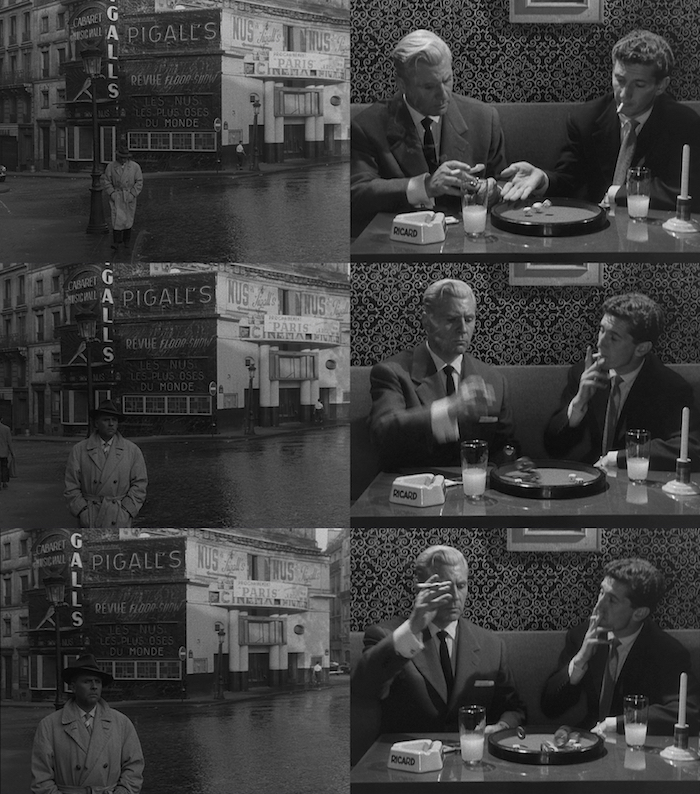
In the moments between night and day, by the dawn's early light, in Montmartre, that hallowed, hilly zone of solemnity and sleaze in Paris, resting somewhere between the Heaven of the Basilica of the Sacré-Cœur at its highest point and below it, the Hell of nightclubs, cheap hotels, cafes, whorehouses and gambling dens, the distinguished trench-coat-adorned silver-haired old fox Bob Montagné (Roger Duchesne) takes one last roll of the dice.

Craps.

It's been a long night and Bob's wiped out. He steps out onto the lonely morning streets, looks into a storefront reflection, straightens his tie and, taking in his weary visage, remarks aloud: "A real hood's face."

And so it is, but he's definitely not your run-of-the-mill garden variety miscreant. Bob Montagné is a class act. He's practically royalty, at least by the standards of magical Montmartre. Sure, he's been in an out of stir for most of his life, but amongst the post-war criminal class of France, he's pulled off some of the most daring heists, and as such, commands respect from thugs and cops alike.

He's a high-roller, you see, and everyone loves Bob: he's worshipped by the sweet young criminal Paulo (Daniel Cauchy), whilst the grizzled police lieutenant Ledru (Guy Decomble) considers him his best friend (and indeed owes his life to him) and, of course, there's a woman - the beautiful young Annie (Isabelle Corey), who adores him for his fatherly influence and generosity. Yes, everyone loves Bob, except for the foul pimp and stool pigeon Marc (Gérard Buhr). Bob has even less use for Marc, a piece of excrement on two legs who beats his women, sells anyone out for the right price and even tries to lure Annie into his stable.

Right from the opening frames of Jean-Pierre Melville's Bob le flambeur we know we're about to enter the world of the criminal class, but for the most part, "class" is the order of the day for men like our title character. Bob's also down for the count, but he's not there for long. He springs up with one last plan to restore himself. As an inveterate gambler, he knows all too well how much dough collects in a casino after a long night and he decides to put together a crack team to pull a heist on the mighty Deauville gaming emporium.

The magical world of Montmartre:
Wet streets, nightclubs, cigarettes and dice.

Best laid plans, however, can go awry, but the manner in which Melville explores this is one of the reasons why Bob le flambeur is a masterpiece. Let's put aside the fact that the picture's sense of atmosphere is so thick you can cut it with a knife, that its touches of Neo-realism make us feel like we're living, breathing and even smelling a world most of us will never know, that its eventual and shocking bursts of violence knock us on our butts and indeed influenced every crime picture that followed in its wake.

Let's put all that aside for a moment. Let's marvel at the sheer, brilliant simplicity of one key stroke of narrative genius:

Bob le flambeur is a heist film in which part of the caper itself involves its mastermind playing the tables of the casino he's going to rob and just as he's about to risk committing a crime that might land him in the hoosegow for a very long time, his rolls of the dice start to yield him a fortune that he's never seen in his life - a fortune that might indeed exceed that of what he could ever hope to rob from the joint.

Damn, this is genius.

THE FILM CORNER RATING: ***** 5-Stars

Bob le flambeur screens at Toronto's TIFF Bell Lightbox in the summer 2017 series "Army of Shadows: The Films of Jean-Pierre Melville" and, via the O.O.P. Criterion Collection DVD which includes an interview with Daniel Cauchy and an archival Gideon Bachman radio interview with Jean-Pierre Melville.

Monday, 3 July 2017

RIFIFI - Review By Greg Klymkiw - The greatest heist film ever made screens at Toronto's TIFF Bell Lightbox in the Summer 2017 series "Panique: French Crime Classics" and is also available on a gorgeous Criterion Collection Blu-Ray/DVD


Rififi (1955)
Dir. Jules Dassin
Scr. Dassin & René Wheeler
Nvl. Auguste Le Breton
Starring: Jean Servais, Carl Möhner,Robert Manuel,
Jules Dassin, Janine Darcey, Magali Noël, Claude Sylvain

Review By Greg Klymkiw

The major set piece of this extraordinary French crime film by blacklisted American director Jules Dassin is a breathless thirty-minute-long heist sequence that is shot with natural sound, no dialogue and no music.

It's pure cinema!

It's also one of the most nail-bitingly suspenseful scenes in movie history. We've come to know the characters, we understand the high stakes for all of them if they don't pull off the big steal and worst of all, we're well aware of what will happen if they're caught - especially the desperate old man, Tony "le Stéphanois" (Jean Servais). He's just served five years of hard time for a heist gone wrong and his only choices in life amount to petty crime, gambling and/or getting caught and being tossed back into the hoosegow until he's dead (or as close to dead as he'll ever get).

These men are criminals, but we want them to succeed. It's post-war France and the opportunities for men who've known only one way to survive are pretty much non-existent. They live by a strict code of honour and they'll steal, but they won't kill (at least until they are pushed to the limit to do so). There's clearly honour amongst these thieves (save for the slimy, greasy, lazy borderline pimps who weasel into the proceedings later on) and we never once feel like there are viable options for our main characters.

And so, we follow them willingly and almost complicitously into the breach - an insanely daring heist that requires split-second timing, impeccable teamwork and one hell of a massive whack of horseshoes worth of luck stuffed up their respective and collective keisters.


If the heist was only thing Rififi had going for it, there's no doubt the picture would be highly regarded, but that its bookends are as solid and compelling as all get out place Dassin's movie on s pedestal that holds some of the greatest crime pictures ever made. The manner in which Dassin shoots the heist is completely in keeping with his approach to the rest of the movie. Shooting almost exclusively on location captures the naturalistic feeling of the film's hard-boiled tale. Much like his groundbreaking American crime pictures (Naked City, Brute Force) which, broke American cinema out of the studio bound mould and took them onto the streets a la the Italian neorealist movement, Rififi is a glorious blend of stylized frissons within the framework of life itself.

Dassin, of course, had a tiny budget and little time to shoot the film, so he personally scouted all the locations in order to get a strong visual sense in advance to allow for impeccable planning. In many ways, Rififi is a model picture for independent, low budget approaches that are still infused with the highest degree of production value. Within Dassin's impeccable eye for visual detail, he's doubly blessed by working with the genius production designer Alexandre Trauner who manages to deliciously goose the look of the film.


Narratively, the tale is tough-minded and even romantic, but the attention to the details of the lives of the criminals and the heist itself (including the meticulous planning) give it the crank it needs to always keep us glued to the screen. As well, there's no overwhelming (and annoying) sense of the proceedings ever diving into moralistic waters. We believe in these men AND their criminal intent. We want them to succeed and if things go wrong and all becomes futile, Dassin sets the picture up in such a way that we're going to feel and care deeply about whatever plight the characters suffer. It helps, also, that the casting is impeccable - especially Servais as the world weary "le Stéphanois", Dassin himself as the funny, sprightly and finally, almost tragic figure of the ladies' man, as well as the other disparate and memorable members of the team.

The importance of Rififi as both dazzling entertainment, but as well, its place in laying the foundations for crime pictures that followed as well as the whole French New Wave that would come a few years later is, frankly, incalculable. All its historical significance aside, it's one hell of a good show! Rififi is brutal, harrowing and darkly funny and it seldom got better than this. The dames are dames, its heroes noble and the villains are pure filth. Sure, the movie trades in on the tropes of the genre, but does so expertly within its overwhelming naturalism that nothing ever feels cliched and is, in fact, far fresher than most films made today.

THE FILM CORNER RATING: ***** 5-Stars

Rififi screens at Toronto's TIFF Bell Lightbox in the Summer 2017 series "Panique: French Crime Classics" and is also available on a gorgeous Criterion Collection Dual Format Blu-Ray/DVD release complete with New 2K digital restoration, my favourite uncompressed monaural soundtrack, a very inspirational interview with director Jules Dassin, set design drawings by art director Alexandre Trauner, still, trailer, an optional English-dubbed soundtrack (especially handily for additional screenings to just study Dassin's visuals and a terrific essay by Jim Hoberman.

Monday, 20 July 2015

THUNDERBOLT AND LIGHTFOOT - Review By Greg Klymkiw - Classic 70s Heist/Buddy Picture


Thunderbolt and Lightfoot (1974)
Dir. Michael Cimino
Starring: Clint Eastwood, Jeff Bridges, George Kennedy,
Geoffrey Lewis, Catherine Bach, Gary Busey, Bill McKinney, Dub Taylor

Review By Greg Klymkiw
"I don't think of us as criminals, you know? I feel we accomplished something. A good job. I feel proud of myself, man. I feel like a hero."
- Jeff Bridges as "Lightfoot" in Thunderbolt and Lightfoot
The big sky of Montana has never looked quite as beautiful as it does in Michael (The Deer Hunter) Cimino's directorial debut, Thunderbolt and Lightfoot, but every so often an object, seemingly innocent on the surface, enters the frame and its mere presence takes on a strange kind of malevolence - as if that big sky is bearing witness to potential chaos amidst the natural, peaceful order of the dazzling sun beaming down upon the flat, limitless ocean of prairies.


The opening wide shots of a church should feel at home here, but the structure just doesn't feel right, its spire jutting up aberrantly from the Earth. Hymns of worship waft gently in the wind across the fields; innocent enough until a lone vehicle enters the frame and moves slowly amidst the empty, parked cars of the parishioners within. Whatever natural order exists, we're sure something's seriously amiss.

That big old American sky, the brilliant white church and the rolling fields are little more than a piping hot apple pie cooling in the summer breeze, but its insides are harbouring a pulpy sweet mash laced with arsenic. It's America, don't you know. The preacher seems amiable enough, his parishioners all eyes and ears, but when the front doors burst open and two gents adorned in shades and tacky dark sport coats brandish firearms, America the Beautiful gets just a little less so.


It's a big, old American film, too, so in short order we realize the Preacher is Clint Eastwood, no genuine Man of the Cloth, but a Man in Hiding and the mysterious gents, the bulky, malevolent carrot-topped George Kennedy and his sidekick, none other than Geoffrey Lewis, the short, wiry little man with the bug-eyes are hell-bent on blasting the fake preacher to Kingdom Come.

It's one hell of an opening and it doesn't get less intense as guns blaze and Eastwood hightails across an open prairie with the slavering madmen in pursuit until, as Good Old Fashioned American Luck will have it, a genial car thief, played no less than by the blondy-locked pretty boy Jeff Bridges, barrels along a country road and provides rescue and flight for our preacher, who by now we know, is no preacher.

Bridges assumes as much also as he quips, "You ain't no country preacher, Preacher."

If this were a classic romantic comedy, which it kind of is, since Thunderbolt and Lightfoot is very much in the tradition of 70s American bro-mances like Scarecrow, Midnight Cowboy, California Split and Your Three Minutes Are Up, one might refer to this mad, action-packed first meeting twixt eventual best buddies Eastwood and Bridges as a "meet-cute" (albeit with guns blazing and big American cars roaring across open roads).

And though on the surface, Thunderbolt and Lightfoot is a crime picture with a major bank heist as its central set piece, make no mistake - this is a road movie romantic comedy, a kind of It Happened One Night with lots of snappy one-liners and big, really big, guns.

And lest we forget, all those big, glorious American cars our heroes keep stealing as they make their way across Montana State, are the vehicles of choice as opposed to the Dirty 30s buses and trains of Capra's great classic.


Though Cimino handles the action with the skill he honed and brought to bear years later with The Deer Hunter and Year of the Dragon (as well as the sheer visual majesty of Heaven's Gate), this is first and foremost an ambling, episodic buddy road movie; character-driven and full of all manner of oddball narrative touches.

At the heart of the film are our two title characters - mismatched from the start, but gradually finding the common ground that makes for deep love and friendship. Eastwood's "Thunderbolt" is older, wiser and more cynically realistic than his nutty wisecracking little buddy Lightfoot. He's clearly from the post-Korea-post-Vietnam generation who served loyally and got bupkis for it in the real world. Lightfoot is the "hippie" - all youthful ideals and a sense of humour that keeps cracking the shell of his "old man" best buddy.

Like lovers, they're made for each other, the same way opposites attract. Perhaps overriding it all, though is a combination of big-brother-little-brother and perhaps even father and son. One of the more moving and sadly prophetic moments in the film is when the eager Lightfoot happily and boastfully feels like the two men could be legendary.

"Thunderbolt and Lightfoot," Bridges beams. "You know, that really sounds like something." Then he adds, with jokey pride in Thunderbolt's direction, "Hey, you stick with me kid. You do and you're gonna live forever."

It's a moment that strangely parallels a later scene when Eastwood looks at Bridges and says "You don't look so good, kid." Bridges replies, probably with the line that nabbed him his first Oscar nomination, "I believe you're right."


Eastwood's Thunderbolt has been around Hell's block a few times and back again. He's been to war and he knows enough to realize that "back home" is just another battleground - nobody, lives forever, anywhere, anytime. This is especially true given that are buddies eventually hook up with the crazy-ass criminal cranks from the film's opening. George Kennedy's Red Leary has meanness hard-wired into his DNA and he takes an immediate dislike to Lightfoot - so much so that he reminds the lad that Thunderbolt and he "go back a long way. But you don't mean nothin' to me, understand? Nothin'!" Lightfoot asks him why he tried to kill Thunderbolt if they were so close.

"Because," Red Leary snarls (in George Kennedy's trademark rancourous tone), "Because we were friends."

Nothing in Thunderbolt and Lightfoot ever feels quite right and it's what makes the film so special. Like the natural beauty dappled with occasional intrusions of malevolence, Cimino's screenplay takes numerous strange turns as it moves towards the inevitable big heist and eventual series of bad-guy fallouts. Even then, Cimino's story shocks and surprises and we're eventually left with a big old American movie - as grand and elegiac as the big old skies of Montana.

It's kind of like when Eastwood furrows his brow upon first hearing Bridges' name "Lightfoot" and asks him if it's an "Indian" name.

"Nope," Bridges replies. "Just American."

THE FILM CORNER RATING: **** 4-Stars

Thunderbolt and Lightfoot is available on Kino-Lorber DVD.
In Canada ORDER HERE
In USA ORDER HERE

Thursday, 30 January 2014

RIFIFI - Review By Greg Klymkiw - The Greatest Heist Film Ever Made - Bar None!!! Available on Criterion Collection Blu-Ray


Rififi (1955) *****
Dir. Jules Dassin
Starring: Jean Servais, Carl Möhner,
Robert Manuel, Jules Dassin, Janine Darcey, Magali Noël

Review By Greg Klymkiw

The major set piece of this extraordinary French crime film by blacklisted American director Jules Dassin is a breathless thirty-minute-long heist sequence that is shot with natural sound, no dialogue and no music.

It's pure cinema!

It's also one of the most nail-bitingly suspenseful scenes in movie history. We've come to know the characters, we understand the high stakes for all of them if they don't pull off the big steal and worst of all, we're well aware of what will happen if they're caught - especially the desperate old man, Tony "le Stéphanois" (Jean Servais). He's just served five years of hard time for a heist gone wrong and his only choices in life amount to petty crime, gambling and/or getting caught and being tossed back into the hoosegow until he's dead (or as close to dead as he'll ever get).

These men are criminals, but we want them to succeed. It's post-war France and the opportunities for men who've known only one way to survive are pretty much non-existent. They live by a strict code of honour and they'll steal, but they won't kill (at least until they are pushed to the limit to do so). There's clearly honour amongst these thieves (save for the slimy, greasy, lazy borderline pimps who weasel into the proceedings later on) and we never once feel like there are viable options for our main characters.

And so, we follow them willingly and almost complicitously into the breach - an insanely daring heist that requires split-second timing, impeccable teamwork and one hell of a massive whack of horseshoes worth of luck stuffed up their respective and collective keisters.


If the heist was only thing Rififi had going for it, there's no doubt the picture would be highly regarded, but that its bookends are as solid and compelling as all get out place Dassin's movie on s pedestal that holds some of the greatest crime pictures ever made. The manner in which Dassin shoots the heist is completely in keeping with his approach to the rest of the movie. Shooting almost exclusively on location captures the naturalistic feeling of the film's hard-boiled tale. Much like his groundbreaking American crime pictures (Naked City, Brute Force) which, broke American cinema out of the studio bound mould and took them onto the streets a la the Italian neorealist movement, Rififi is a glorious blend of stylized frissons within the framework of life itself.

Dassin, of course, had a tiny budget and little time to shoot the film, so he personally scouted all the locations in order to get a strong visual sense in advance to allow for impeccable planning. In many ways, Rififi is a model picture for independent, low budget approaches that are still infused with the highest degree of production value. Within Dassin's impeccable eye for visual detail, he's doubly blessed by working with the genius production designer Alexandre Trauner who manages to deliciously goose the look of the film.


Narratively, the tale is tough-minded and even romantic, but the attention to the details of the lives of the criminals and the heist itself (including the meticulous planning) give it the crank it needs to always keep us glued to the screen. As well, there's no overwhelming (and annoying) sense of the proceedings ever diving into moralistic waters. We believe in these men AND their criminal intent. We want them to succeed and if things go wrong and all becomes futile, Dassin sets the picture up in such a way that we're going to feel and care deeply about whatever plight the characters suffer. It helps, also, that the casting is impeccable - especially Servais as the world weary "le Stéphanois", Dassin himself as the funny, sprightly and finally, almost tragic figure of the ladies' man, as well as the other disparate and memorable members of the team.

The importance of Rififi as both dazzling entertainment, but as well, its place in laying the foundations for crime pictures that followed as well as the whole French New Wave that would come a few years later is, frankly, incalculable. All its historical significance aside, it's one hell of a good show! Rififi is brutal, harrowing and darkly funny and it seldom got better than this. The dames are dames, its heroes noble and the villains are pure filth. Sure, the movie trades in on the tropes of the genre, but does so expertly within its overwhelming naturalism that nothing ever feels cliched and is, in fact, far fresher than most films made today.

"Rififi" is available on a gorgeous Criterion Collection Dual Format Blu-Ray/DVD release complete with New 2K digital restoration, my favourite uncompressed monaural soundtrack, a very inspirational interview with director Jules Dassin, set design drawings by art director Alexandre Trauner, still, trailer, an optional English-dubbed soundtrack (especially handily for additional screenings to just study Dassin's visuals and a terrific essay by Jim Hoberman.

Friday, 2 November 2012

Ocean's Eleven - Blu-Ray Review By Greg Klymkiw - Oozing with Post-War Ennui, Lewis Milestone's Ultra-Cool 1960 Rat Pack Original Blows Slick Soderbergh Remake to Smithereens!!!

Does Soderbergh's Remake Have Dean Martin and the Red Norvo Orchestra performing "Ain't That a Kick in the Head" or feature manly advice like "Tell her you love her. That'll hold her for a couple of weeks" or fine romantic come-ons like, "Hey honeyface, I'd like to take you home and spread you all over my waffle" or the Über-delectable-in-her-prime Angie Dickinson cracking to Frank Sinatra with wiseacre melancholy: "We had no home, we had a floating crap game." 'Nuff Said, Daddio!!!
Ocean’s Eleven (1960) dir. Lewis Milestone ****
Starring: Frank Sinatra, Dean Martin, Sammy Davis Jr., Peter Lawford, Cesar Romero, Richard Conte, Henry Silva, Akim Tamiroff, Joey Bishop, Angie Dickinson, Shirley MacLaine, Red Skelton, George Raft, Hoot Gibson, Buddy Lester, Red Norvo

Review By Greg Klymkiw

Right from the beginning of Ocean’s Eleven you know you’re in for a treat! The stunning opening credit sequence designed by master stylist Saul Bass (Psycho), the supremely cool Nelson Riddle score and one legendary star’s name after another all signal a picture that just can’t fail.

And it doesn’t!

This legendary heist caper featuring the immortal Las Vegas “Rat Pack” (Frank Sinatra, Dean Martin, Peter Lawford, Sammy Davis Jr. and Joey Bishop) is probably my favourite caper picture ever. It’s not the best heist picture ever made – that honour would go to Jules Dassin’s Rififi – but Ocean’s Eleven is the coolest.

It’s cooler than cool.

Remade in 2001 by Steven Soderbergh (and followed by two unnecessary sequels), one could even argue that the more recent picture is technically better made. I’d not argue that at all, but in spite of this, Soderbergh’s George Clooney-Brad Pitt et al extravaganza of contemporary star power has nothing memorable about it – nothing at all. You watch it and once it’s over, it passes through your system like so much junk food waste matter.

Lewis Milestone’s original rendering, as wonky, occasionally clunky and definitely dated as it is sticks to your memory banks, not unlike a good wad of honey mixed with walnuts, buckwheat and poppy seeds flung to the ceiling by mad Ukrainians during their Eastern Rite Christmas celebrations. Bits of the glop may drop off from time to time, but unless you chisel away at it like some obsessive unskilled labourer at a construction site, those delectable globs are there forever.

And that’s pretty much what the 1960 Ocean’s Eleven is – a delectable glop of honey mixed with walnuts, buckwheat and poppy seeds! It's sweet, tasty and sticks to your insides.

Detailing the adventures of some aimless old army buddies in post-war America, the picture takes us right into their seemingly insane plan to pull off the biggest heist imaginable – hitting five Las Vegas casinos (The Flamingo, The Sands, The Desert Inn, The Riviera, The Sahara) all at once on New Year’s Eve. Not only does it take a first rate crew, but a good stake and tons of planning. Most of all, the operations require the same precision used in battleground manoeuvres.

This, of course, is where high-roller Danny Ocean (Sinatra) comes in. During wartime, Danny was a crack squad leader of an Airborne Division. He fearlessly led his boys into the fray many times and always got them through unharmed. He’s a genius at military manoeuvres and always on the lookout for the welfare of his buddies. And now Danny wants them to make up for lost time. Post-war America has ignored them and it's time for some payback. As Danny declares, “Why waste all those cute little tricks the army taught us just because it’s a little peaceful now?” Given that his plan is to rip the casinos off as if they were in battle with the Germans and that he’ll be fearlessly leading the way is enough for lowlife moneyman Spyros Acebos (Akim Tamiroff munching scenery with the voracity of several off-the-wagon members of Weight Watchers let loose in a buffet) to stake them.

The fun of the movie is, of course, the WORLD of the movie and not necessarily the heist itself. This is the mistake Soderbergh made with his remake. He trotted out all his stars and proficiently laid out the groundwork and execution of a suspenseful heist. Not that this was necessarily a bad thing to do. The picture worked very well on that level and certainly grossed oodles of money (including the two lousy through-the-roof sequels). What the remake didn’t do (and perhaps couldn’t achieve, due to the fact that Vegas NOW is NOT the Vegas it once was) is create compelling enough backdrops for the movie to be more than an ephemeral hit. When Soderbergh’s picture is long forgotten, I do believe Milestone’s will survive.

For example, the first time we see George Clooney’s Danny in the Soderbergh film, he’s in the hoosegow and frankly it’s just not as much fun to see your hero in prison garb as the first time we see our hero in Milestone’s picture. Our first taste of Sinatra as Danny is utterly, irrepressibly, unbelievably, jaw-droppingly cool – or, like I noted before, cooler than cool. In a swank pad, we’re introduced to Danny and his pal Jimmy Foster (Peter Lawford) getting massages from a couple of bodacious beauties.

I’m taking Sinatra, Lawford and two blondes over George Clooney in prison duds anytime – hands down!

To quote Cagney in Strawberry Blonde, “That’s just the kind of hairpin I am.” Great line, by the way. That’s the other thing Soderbergh’s remake doesn’t have. Can anyone remember a single line of memorable dialogue from the 2001 Ocean’s Eleven? If you can, you’re lying. Or worse, you don't know what a great line is.

Milestone’s 1960 version of this heist tale is bursting at the seams with first-rate dialogue. Some of it is scripted, much of it was ad-libbed by the Rat Pack. When I first saw the movie as a kid, most of my friends and I peppered our speech in the schoolyard with nuggets from the movie. (And in case you lob the old “that was then” argument at me, my own 10-year-old daughter who recently saw the movie is spouting these same lines. Everything old CAN become new again.) One of the more deliciously “offensive” (yet utterly memorable and eminently quotable) lines in the 60s version is when Peter Lawford offers the following to someone who doubts how airtight the heist plan is. Using the ultimate, swinging, cool cat reasoning, Lawford casually remarks: “You can take my word for it. You know I only lie to girls.” Oh, and ladies reading this review are advised that substitution of the word “boys” for “girls” is a sure-fire winner for all occasions. Sammy Davis Jr. also gets a zinger that could be used by ladies in a contemporary context – it’s a hilarious moment when one of the guys doesn’t know how to explain his absence during the heist to his wife and Sammy responds: “Tell her you love her. That’ll hold her for a couple of weeks.”

The other thing Soderbergh’s film doesn’t have is the resonance of the historical cusp Milestone’s version is set on. Situated at the tail end of the post-war ennui AND baby boom and just before the turbulence of the post-JFK assassination, Ocean’s Eleven resonates with the times in ways filmmakers could only dream about in the pre-9/11 world. Even post-9/11, the Soderbergh sequels don't bother with any political contexts.

The biggest differences, though, are storytelling elements of an earlier age seldom being exploited in contemporary cinema – especially sentiment.

When Henry Silva as one of the team-assemblers comes to visit the sad-sack Richard Conte, he’s faced with a divorced dad, just out of stir, who needs to come up with a whack of dough to keep his son in a swanky private military school. It’s about the only “face” he’s got left with his kid. While Conte's character would prefer to walk the straight and narrow, he asks Silva if his cut of the heist will be enough to keep his kid in school. Silva replies that the cut will be enough for Conte to BUY his son a school.

With this particular subplot, there are two sequences so sentimental, yet deeply and almost profoundly moving that Soderbergh, for all HIS contemporary cooler-than-cool styling, would never be able to achieve. Milestone very sensitively directs a visit between father and son at school that continues to move me to tears every time I see it. Sometimes I start bawling like some old grandmother when I simply THINK about the scene. The major tear-squirter occurs when Conte visits his doctor and senses the worst. He asks, “Tell it to me straight, Doc – is it the Big Casino?” And indeed, it is. Conte has very little time to live, as he’s afflicted with lung cancer. He knows well what he needs to do.

This is, frankly, why the movie has all the earmarks of a classic. The characters all have so much to lose and this is what resonates so overwhelmingly. These are things I’ve never forgotten over the years and it’s narrative details like these that contribute to a picture’s staying power. One of the Eleven, for example, works as an emcee in a cheap nightclub where his wife also works as a stripper. Day in and day out, he has to lasciviously introduce her to all the slavering men in the club and even witness slime-bags making passes at her like, “Hey honeyface, I’d like to take you home and spread you all over my waffle.”

The fates of all these war veterans have far more resonance than any of the characters in Soderbergh’s remake.

The great Sammy Davis Jr. plays a former minor league baseball player who has lost an eye and is now working as a garbage collector. When he’s told how brave he must have been in wartime, he responds with melancholy: “The real brave ones don’t come home.” This is followed by an amazing sequence where Sammy sings the title track of the movie – jamming and jiving to pick up the spirits of his fellow African-American colleagues sitting amidst the garbage trucks in a loading dock. It’s not only an opportunity to get one of the great entertainers of the 20th century to do his stuff on film, but render it in a manner that is credible and rooted in the narrative.

The movie addresses the issue of race during this time head-on, and it’s Sammy who gets a crack that must have had audiences of all colours reacting with knee-slapping laughter, but with even more resonance amongst African-Americans. At one point, the Rat Pack is smearing their faces with black shoe polish and Sammy refers to his natural ability to blend in when the power in the casino goes out. He has this great quip: “I knew this colour would come in handy someday.” An interesting side note to this is how Sammy was forced to stay in "Coloured-Only" hotels even though he was playing at swanky joints in Vegas at the time. During the shooting of the film, Sinatra himself put an end to this racism during the film's shooting. Segregation in Vegas came to an end because of this.

Sinatra wasn't called "The Chairman of the Board" for nothing.

One of my favourite moments with Sammy Davis Jr. is the scene where the whole teams is assembled and ready to knock off the Vegas casinos and he announces with equal parts melancholy and pride: “Us eleven cats up against this old city – we’re in overlay.”

Who can write great dialogue like this these days? I can count them on one hand. What actors can even render this dialogue today or, for that matter, even ad-lib it?

And just in case you think the entire movie and every piece of dialogue uttered by Frank, Dean and the rest of the Rat Pack is wildly out of whack and male-centric, the movie delivers some terrific performances from women who get their fair share of truly memorable moments and zingers. Female rat-packer Shirley MacLaine appears in a delicious cameo as a hooker. She rattles off a great line: "I'm so drunk I don't think I could lie down without holding on." Angie Dickinson – in her prime, no less – appears as Sinatra’s ex-wife. When Dean Martin gets a gander at her ravishing beauty, he quips, “You better stop getting prettier every day or you’ll turn into a monopoly.” Truer words were never spoken. Dickinson oozes screen presence in ways most contemporary female stars can only dream of. As for Dean's line, I sure wish contemporary characters could occasionally refer to gorgeous leading ladies that way. Angie Dickinson herself has quite a few zingers. When Frank laments their divorce and claims that all he wanted for them was a place to call home, Angie fires off the following: “We never had a home, we had a floating crap game.”

Ouch!

Of all the Rat Pack movies, Ocean’s Eleven is clearly the best. Sergeants 3, directed by John Sturges, was an okay semi-remake of Gunga Din, 4 for Texas was a moderately enjoyable western comedy directed by Robert Aldrich and Robin and the Seven Hoods was a relatively cool musical comedy in which Vegas stood in for Sherwood Forest and was directed by prime-cut old studio camera jockey Gordon Douglas.

I think Ocean’s Eleven works the best not only because it was the first, but the manner in which it was made was infused with the pure adrenalin of Vegas. All of the Rat-Packers were booked at the same time and playing shows at night, then partying all night and finally, shooting the movie all morning and early afternoon. These guys were primed and they were lucky to have a great old hand like Lewis (All Quiet On The Western Front) Milestone helming the proceedings. Seeing the movie in the real Las Vegas in 1960 with marquees touting the names of Harry James, Red Skelton, Danny Thomas, Louis Prima, Buddy Hackett and others must surely have been a charge while making the movie. Amazingly, it all spews out on celluloid.

I mean, My God! We even get a phenomenal scene with Dean Martin singing the great tune “Ain’t That a Kick in the Head” with Red Norvo on vibes.

Even cooler is the ending. It’s not only a great surprise ending but is frankly, a shocker. As much as the film is entertainment, it’s so rooted in a reality beyond time and place, it’s rooted firmly in the world of Las Vegas – a world where the house ALWAYS wins!

Ocean’s Eleven is a movie that’s as much a part of “old” Hollywood while signalling the eventual “new” Hollywood of the next decade. The movie was clearly more than an ephemeral box office hit. It had influence and staying power. People often forget that this is what can make good movies great.

I’m more than happy to extol the greatness of Ocean's Eleven!

Ocean’s Eleven is available in a terrific Blu-ray transfer through Warner Home Entertainment that preserves the grain while reflecting the picture’s outstanding colour palette. The extra features include a great commentary from Frank Sinatra Jr. (and occasional patter from Angie Dickinson) and the added treats of a Tonight Show clip with Frank (guest hosting no less) and Angie (as his guest) and some decent little featurettes on the great Vegas hotels.