Showing posts with label Ireland. Show all posts

Saturday, 17 October 2015

THE HALLOW - Review By Greg Klymkiw - In Ireland, there are animals in the woods. Terrifying, visceral first feature at Toronto After Dark Film Festival (TADFF 2015): ***½


The Hallow (2015)
Dir. Corin Hardy
Scr. Hardy and Felipe Marino
Starring: Joseph Mawle, Bojana Novakovic, Michael McElhatton, Michael Smiley

Review By Greg Klymkiw

So you move into an old stone cottage in the middle of Inbredville, Ireland because your hubby (Joseph Mawle) has been hired by rich scumbag developers to survey a deep, gorgeous old forest for nefariously commercial purposes.

It should be plenty quaint. Hubby gets to tromp about the woods with his trusty dog and your cute baby stuffed into one of those handy Mountain Co-Op hiking carriers. You, the loyal wifey (Bojana Novakovic) will have plenty of time to putter about the sweetly idiosyncratic old house and gardens. One of the first orders of business is to remove all the unsightly steel bars which are mounted on every single window. This bit of home improvement is all well and good, but did you not think - if only for a second - why these bars have been affixed there in the first place?

Honey, there's always a good reason for steel bars on the windows.

To keep someone or something in? Or, maybe, just maybe, the bars are meant to keep something out - something lurking in the deep woods. In fact, a gun-toting local inbred (Michael McElhatton) repeatedly demands that hubby stop trespassing in the ancient heritage forest and furthermore suggests that you all should just plain LEAVE. GO. BUGGER OFF! NOW! RIGHT FUCKING NOW!


This then is The Hallow, a film of mounting, creepy chills until it blasts into the stratosphere of utter, relentless terror. Frankly, there's absolutely no need to describe what is in those woods, but suffice to say it's shit-your-drawers ghastly and as an added bonus, rooted in not the most pleasant Irish folklore - no Darby O'Gill and the Little People here, folks. No fucking Gnome Mobile in sight. Just icky, sticky, oozing... uh, let's just say, things.


Though much of the screenplay is by the book structurally, it's rife with realistic dialogue (uttered with conviction by a first-rate cast) and plenty of local colour to keep one tantalized. The special effects are mostly of the non-digital variety and as such are a whopping jarful of maraschino cherries floating in viscous fluids and deposited in healthy dollops upon this most foul ice cream sundae of a movie.

Director Hardy demonstrates considerable skill and aplomb with this, his first feature film as a director. Though the picture's elements are familiar enough, his mise-en-scene is always several country miles ahead of most genre directors with its solid compositions, plenty of variation in performance and skillful coverage to allow for elegant cutting. The man has skill, but he also has a lot of style and he displays the strong early beginnings of a distinctive filmmaking voice.

The Hallow is that lovely pot at the end of the Irish rainbow, a pot overflowing with blood and plenty of gelatinous chunks of viscera.

One cannot argue with this.

The Film Corner Rating: ***½ 3-and-a Stars

The Hallow plays at the Toronto After Dark Film Festival (TADFF 2015)

Saturday, 22 August 2015

ROOM - Review By Greg Klymkiw - FRANK director delivers another winner - TIFF 2016


Room (2016)
Dir. Lenny Abrahamson
Scr. Emma Donoghue
Starring: Brie Larson, Jacob Tremblay, Joan Allen, Tom McCamus, William H. Macy, Sean Bridgers, Wendy Crewson

Review By Greg Klymkiw

Lenny Abrahamson turned out to be the best director imaginable for this screen rendering of Emma Donoghue's novel of the same name. His last film Frank, created a wondrous, expansive world within the isolated confines of the country cottage wherein the title character's band creates music for a new album. Abrahamson then shifted us, ever-so deftly to a constrained, insular and painful emotional domain once Frank and company attend the SXSW music festival in Austin, Texas. Finally, we were plopped, alongside the film's characters onto the flat, open, limitless landscape under a big American sky, dwarfing, as it always does, everything and everyone.

Room shares a similar story structure to the aforementioned gem of a film. Like Donoghue's book, the first half of Abrahamson's new picture confines us to the tiny space that Ma (Brie Larson) and her 5-year-old son Jack (Jacob Tremblay) live in. Having been kidnapped and held hostage by Old Nick (Sean Bridgers), a sexual predator who has repeatedly raped Ma until she became pregnant with Jack, the isolated room of the title has been turned into a wide open world by Ma to keep her sanity, as well as that of her child.

Ma has used what meagre means she has at her disposal to educate her child. For example, every item in the room is ascribed qualities akin to humanity which not only describe said items, but allows Jack to offer salutations upon first laying eyes upon them every morning. Personification in fiction is one thing, but in real life, it's clearly quite another.

At the midway point of the picture, a harrowing escape delivers us into the world outside the room and in spite of the new expanse, Ma especially suffers as a free woman - her incarceration and the repeated sexual abuse (not to mention relentless media attention) has somehow dwarfed everything that could be seen as healthy and positive to her.

The two halves of the film are rendered with an astonishingly brilliant mise en scène, which indeed creates expanse in isolation and isolation in expanse. The first half, in spite of the one "room" setting, never really seems claustrophobic as the film roots the mother and son's relationship in a limitless love and deep imagination. Conversely (and not unlike Frank), freedom takes us to drearily grey exteriors and "normal" interiors that bear so much in common with everything that is so unbearably "normal" to anyone with huge imaginations (like Ma and Jacob).


Luckily, Abrahamson has the source material of Donoghue's novel to draw upon, as well as her screenplay adaptation. Oddly, Donoghue's screenwriting mostly eschews the novel's great "voice" (the story in the book is told by the five-year-old Jack) and Abrahamson must render it visually, without relying upon Jack's "voice" (except in tiny dollops). The lighting utilized in the room is especially evocative during daytime wherein the lone glimpse Ma and Jack have at the outside world is a small, dirty and unreachable skylight, casting a variety of eerie glows upon the proceedings. This genuinely great filmmaker pulls off the first half of the picture with flying colours, especially in the manner he blocks the movement within the interior of the "room", then eventually, outside of it - maintaining superb compositions to tell the story by cinematically capturing the evocative "voice" of the novel.

One other aspect which plays beautifully in the film is how it actually downplays the book's rather obvious allusions to the legend of Perseus. Donoghue makes use of an evocative epigraph of Simonides's (c. 556-468 BCE) poem "Lamentation of Danaë" which does help set the overall tone:
My child
Such trouble I have
And you sleep, your heart is placid;
you dream in the joyless wood;
in the night nailed in bronze,
in the blue dark you lie still and shine.
Alas, perhaps it sets the tone too well.

It's difficult to read Donoghue's book without thinking heavily about the woman in the Simonides poem being both confined to a tiny space and unmoored upon unfamiliar waters, and, of course, Jack's brave actions during a harrowing escape sequence wherein, like Perseus, he essentially slays the gorgon Medusa - or rather, is responsible for the undoing of Old Nick. (In spite of the character's inherent evil, Abrahamson manages to do a great job of extracting a great performance from Bridgers which, in turn, adds a layer of humanity that far exceeds that of the book.)

Luckily for most audiences, the film subtly mutes Simonides. It's there if we want it, but I trust most eggheads will repress its use in the book once seeing the movie. And speaking of repression, one of the most moving aspects of the film is how Ma represses her pain rather than facing it. This is in direct contrast to her son Jack, whom she's sheltered from as much pain as possible so that he can hoover up every aspect of the great wide world. Ma's sacrifices and both Jack's support for his mother and his unyielding quest for knowledge are guaranteed to extract copious tears from even the most blinkered eyes.

Room is deeply moving, thanks to its evocative source material, an odd, but effective screenplay adaption by the novel's original author, to-die-for performances (especially Brie Larson as Ma) and Lenny Abrahamson's delicate direction. He's the real thing and then some. I suspect we're going to see many genuine masterpieces from Lenny Abrahamson over the next decade (or two, or three, or four, etc.).

Well, here's hoping, anyway.

Room is a Special Presentation at TIFF 2014 and is the lucky recipient of thr Grolsch People's Choice Award, and as such, will screen for free.

Wednesday, 3 June 2015

LET US PREY - BLU-RAY/DVD Review By Greg Klymkiw - Hot Babe Cop KicksDemonic Ass


Let Us Prey (2014)
Dir. Brian O'Malley
Scr. David Cairns, Fiona Watson
Starring: Pollyanna McIntosh, Liam Cunningham,
Douglas Russell, Bryan Larkin, Hanna Stanbridge, Niall Greig Fulton

Review By Greg Klymkiw

Brian O'Malley's Let Us Prey, is a rip-snortingly scary, utterly demented supernatural take on John Carpenter's Assault on Precinct 13, which, for added kick, is liberally sprinkled with plenty of Irish Whiskey and smothered with globs of bloody haggis (as its Irish-Scottish co-pro roots demand).

If you've seen Lucky McKee's delectably vile The Woman, you already know what a great actress (and babe) Pollyanna McIntosh is. Well, praise be to Jesus and Lucifer, Let Us Prey serves up McIntosh's va-va-va-voom frame of womanhood stuffed into the tasty sausage sack of a form-fitting cop's uniform. Unlike McKee's picture, though, this plucky lassie is not about to be hung up nude in a barn and used for sexual gratification, but like The Woman, she more than admirably gets to exact major-league ultra-violent payback upon a fine selection of despicable scumbags.

Using the taut, imaginative screenplay by David Cairns and Fiona Watson as his blueprint for madness, helmer O'Malley skillfully leads us into the fiery pits of the first official night on the job for a newbie female cop in a Bonny Scottish police station located in the most remote locale imaginable (which, is pretty much all of Scotland, so there's always going to be weird stuff going on in that blessed country).

As you already know it's a variation on the great John Carpenter station-house-under-siege picture, it's best not to spoil things with too many details. All you need to understand before going in is that an event occurs which spirals out of control as the cop shop is besieged by evil filth of the highest order and, of course, MUST be dispatched -- with, of course, extreme prejudice.

We get an alcoholic thug, a mass murderer, a self-flagellating killer of buff, young fellas and amongst some garden variety corrupt, murderous cops, there's a child-raping kidnapper who may or may not be a demon from the utter depths of Hell itself. Of all nights, this is one in which our plucky heroine might have wished she'd been home washing her hair and eating bonbons in front of the telly.

But such is not to be the case.

Violence must be done by a hot babe and we, the audience, are all the better for it.

THE FILM CORNER RATING: ***½ 3-and-a-half-stars

Let Us Prey is now available on a gorgeously transferred BluRay and DVD combo pack via Raven Banner Entertainment and Anchor Bay Canada.

Sunday, 7 December 2014

FRANK - Blu-Ray Review By Greg Klymkiw - Poignant indie gets terrific Magnolia/VSC BRD


THE
MANY
FACES
OF
FRANK
Frank (2014)
Dir. Lenny Abrahamson
Scr. Jon Ronson, Peter Straughan
Starring: Michael Fassbender, Domhnall Gleeson, Scoot McNairy, Maggie Gyllenhaal, Francois Civil, Tess Harper
Review By Greg Klymkiw

Give an actor something to obscure their best feature and then see what they can deliver. I had occasion recently to recall Jack Nicholson in Tony Richardson's 1982 The Border where he was forced to wear sunglasses in virtually every exterior shot. Given that Nicholson was playing a Texas border guard, this not only made sense in terms of his character, but it shielded us from one of Nicholson's most expressive facial features. This resulted in one of his all-time best performances.

Given that by 1982 Jack's eyes and what he could do with them had already began to border on the cliched, we the audience were afforded the opportunity to see him render work that felt as fresh and vital as it had always been. It's as if the shades rendered the character even more internal - we had to work hard reading him, which made the proceedings rooted in a kind of reality it might not have otherwise had. Nicholson's movements became stiffer, slower and as he was playing someone who was on a slow burn, especially as he began to respond to the horrendous corruption and unfairness with respect to Mexicans sneaking across the border for a slice of America's pie of opportunity, we were able to almost put ourselves inside the character.

Most importantly, we had to respond to what he saw without necessarily having a full picture of how to read him.

Monday, 27 October 2014

LET US PREY - Review By Greg Klymkiw - 2nd Closer 2014 Toronto After Dark Film Fest


Let Us Prey (2014)
Dir. Brian O'Malley
Scr. David Cairns, Fiona Watson
Starring: Pollyanna McIntosh, Liam Cunningham, Douglas Russell, Bryan Larkin, Hanna Stanbridge, Niall Greig Fulton

Review By Greg Klymkiw

If you've seen Lucky McKee's delectably vile The Woman, you already know what a great actress (and babe) Pollyanna McIntosh is. Brian O'Malley's Let Us Prey, is a rip-snortingly scary, utterly demented supernatural take on John Carpenter's Assault on Precinct 13, which, for added kick, is liberally sprinkled with plenty of Irish Whiskey and smothered with globs of haggis (as its Irish-Scottish co-pro roots demand).

Featuring McIntosh's va-va-va-voom frame of womanhood stuffed into the tasty sausage sack of a form-fitting cop's uniform, she's clearly not here (as in McKee's picture) to be hung up nude in a barn and used for sexual gratification, but like The Woman, she more than admirably delivers the goods in terms of ass-kicking and major-league ultra-violent payback upon a fine selection of despicable scumbags.

Using the taut, imaginative screenplay by David Cairns and Fiona Watson as his blueprint for madness, helmer O'Malley skillfully leads us into the fiery pits of the first official night on the job for a newbie female cop in a Bonny Scottish station house located in the most remote locale imaginable. All you need know is that an event occurs which spirals the whole joint out of control as it's besieged by filth of the highest order - all demanding to be dispatched.

We get an alcoholic thug, a mass murderer, a self-flagellating killer of buff, young fellas and amongst corrupt, murderous cops, a child-raping kidnapper who may or may not be a demon from the utter depths of Hell itself. Of all nights, this is one in which our plucky heroine might have wished she'd been home washing her hair, then eating bonbons in front of the telly. But such is not to be the case. Violence must be done and we, the audience, are all the better for it.

THE FILM CORNER RATING: ***½ 3-and-a-half-stars
Let Us Prey was one of the closing night films at the 2014 edition of the Toronto After Dark Film Festival. It'll be coming to cinema and home entertainment venues near you via Raven Banner Entertainment and Anchor Bay Canada.

Monday, 29 September 2014

FRANK - Review By Greg Klymkiw - FrankSidebottom/ChrisSievey-inspired Cult film runs @TheRoyal via @VSC

THE MANY FACES OF FRANK
Frank (2014)
Dir. Lenny Abrahamson
Scr. Jon Ronson, Peter Straughan
Starring: Michael Fassbender, Domhnall Gleeson, Scoot McNairy, Maggie Gyllenhaal, Francois Civil, Carla Azar, Tess Harper

Review By Greg Klymkiw

Give an actor something to obscure their best feature and then see what they can deliver. I had occasion recently to recall Jack Nicholson in Tony Richardson's 1982 The Border where he was forced to wear sunglasses in virtually every exterior shot. Given that Nicholson was playing a Texas border guard, this not only made sense in terms of his character, but it shielded us from one of Nicholson's most expressive facial features. This resulted in one of his all-time best performances. Given that by 1982 Jack's eyes and what he could do with them had already began to border on the cliched, we the audience were afforded the opportunity to see him render work that felt as fresh and vital as it had always been. It's as if the shades rendered the character even more internal - we had to work hard reading him, which made the proceedings rooted in a kind of reality it might not have otherwise had. Nicholson's movements became stiffer, slower and as he was playing someone who was on a slow burn, especially as he began to respond to the horrendous corruption and unfairness with respect to Mexicans sneaking across the border for a slice of America's pie of opportunity, we were able to almost put ourselves inside the character. Most importantly, we had to respond to what he saw without necessarily having a full picture of how to read him.

Michael Fassbender is easily as great an actor as Nicholson, yet he's not quite crossed over into rendering performances rooted in cliches, so it's all the more astonishing to witness his work in Frank.

Co-writer Jon Ronson had been in Chris Sievey's Oh Blimey Big Band once the eccentric musician-comedian frontman of The Freshies had established his "Frank Sidebottom" persona for stage and television. "Frank" was a kind of Pee Wee Herman-like persona who wore a humungous fake head that resembled characters in the early cartoons of the legendary Fleischer Brothers (Betty Boop, Popeye). Though the screenplay for Frank is ultimately fictional, it's based in part on Ronson's journal entries during this period.

The first hour of Frank is especially lovely. It focuses on Jon (Domhnall Gleeson) a young keyboardist/songwriter who is miraculously swept out of his suburban ennui by Don (Scoot McNairy), a taciturnly amusing road manager and plunged headlong into a band led by the title frontman played by Fassbender. At first, Jon's ignored and/or reviled by Frank's eccentric band members (Maggie Gyllenhaal, Francois Civil, Carla Azar), but when he invests his "nest-egg" inheritance into the recording of a new album, their disdain transforms into guarded acceptance. Gyllenhaal even grudgingly prongs herself upon Jon's root, claiming disgust, but partaking of it with relish nonetheless. Jon, unbeknownst to the others, has been tweeting his adventures and even uploading clips to YouTube. Eventually, the band develops a sizeable cult following and is invited to launch themselves at the famed SXSW music festival in Austin, Texas.

Both the screenplay and Abrahamson's solid direction keep us delighted and enthralled in the odd creative process, and once the band heads to America, we're equally tantalized by the juxtaposition twixt the bucolic Irish cottage they're initially holed up in and the Big Sky of Texas. Though success looms, the film successfully shifts gears and we're plunged into the reality of the title character which, up until this point, has been mysterious to say the least. What's been funny and borderline (thank Christ for "borders") whimsical, becomes deeply and painfully moving.

Fassbender is the engine which ultimate drives the film. Saddled with his fake head, which he never removes, is what forces the great actor to utilize his innate gifts. With both his oft-muffled voice and body (as well as eventual sign language and verbal descriptions to convey his facial expressions under the mask), Fassbender extraordinarily delivers a myriad of emotions.

For anyone who discovered the world of true musical iconoclasts like Captain Beefheart, David Thomas of Pere Ubu fame and the multitude of genuinely alternative musicians during the punk and new wave phases in the late 70s and early 80s will especially be filled with a nostalgic glow that occasionally borders on epiphanies of the most hallowed kind. Frank is a film that seems featherweight, but its depiction of both the creative process and mental illness creeps up slowly and grabs you. Most of all, it doesn't ever really let go, long after the movie is over.

THE FILM CORNER RATING: **** Four Stars

Frank is a VSC release which continues its successful run with an engagement at The Royal in Toronto.

PLEASE FEEL FREE TO ORDER ANYTHING FROM AMAZON BY USING THE LINKS BELOW. CLICKING ON THEM AND THEN CLICKING THROUGH TO ANYTHING WILL ALLOW YOU TO ORDER AND IN SO DOING, SUPPORT THE ONGING MAINTENANCE OF THE FILM CORNER.

AMAZON.CA


AMAZON.COM


AMAZON.UK


Wednesday, 10 September 2014

'71 - Review By Greg Klymkiw - TIFF 2014 (TIFF DISCOVERY SERIES)

Belfast. 1971.
Not the safest

place for a
Brit soldier
to get lost in.
'71 (2014)
Dir. Yann Demange
Scr. Gregory Burke
Starring: Jack O'Connell

Review By Greg Klymkiw

Barely out of their teens and thrust immediately from basic training into the hellfire of war must surely have been traumatic enough, but for the lads in the British Army during the early 70s, the sense of horror and disorientation must have multiplied exponentially when they found themselves fighting on what they would have perceived as their home turf. Not that the "troubles" in Northern Ireland were ever really as familiar to the rest of the United Kingdom as their own backyards, but still, they'd have been amongst English-speaking citizens, living in homes not far removed from the architecture of their own and round every corner, neighbourhood pubs would've had the brew of mother's milk amply flowing out of the taps. Alas, the incongruities of burning wrecks of British Army vehicles everywhere, bombs going off at random, children pelting them with plastic bags full of urine and at times, those same children bearing firearms, all would have seemed like a living nightmare.

From a tersely efficient screenplay by Gregory Burke, director Yann Demange flings us into Paul Greengrass herky-jerky realist territory as we follow the fresh young British private Gary (Jack O'Connell) as he's separated from his platoon during a massive street riot and finds himself smack in the middle of the most violent section of Belfast, the border separating the Loyal Protestants and the anti-Brit, anti-Protestant Catholics. There's not much more to the movie than the sheer tale of survival over the course of one night, but for much of the picture's running time, it's genuinely suspenseful - at times, unbearably so.

The period detail is especially impressive and contributes immeasurably to painting a portrait of a city under siege by its own inhabitants. Burke and Demange do, however, let us down during the final third as they set up and follow through with a cliche-ridden and predictable cavalry-to-the-rescue climax. The whole thing at this point feels so false, unearned and not in keeping with the rest of the picture, that even the potentially powerful aspects of its denouement lack the sort of clout the filmmakers appear to be yearning for. The 70s grittiness the picture adheres to, but then abandons, is such a crashing disappointment that it comes close to negating everything about the picture that works quite splendidly.

THE FILM CORNER RATING:
**½ Two-and-a-half-Stars


'71 plays at TIFF 2014 in the TIFF Discovery Series.


PLEASE FEEL FREE TO ORDER ANYTHING FROM AMAZON BY USING THE LINKS BELOW. CLICKING ON THEM AND THEN CLICKING THROUGH TO ANYTHING WILL ALLOW YOU TO ORDER AND IN SO DOING, SUPPORT THE ONGING MAINTENANCE OF THE FILM CORNER.

AMAZON.CA


AMAZON.COM


AMAZON.UK


Thursday, 8 May 2014

NATAN - Review By Greg Klymkiw - Toronto Jewish Film Festival 2014 (TJFF 2014) - French Cinema's Pioneer

I AM NOT BERNARD NATAN, I AM A FILM OF BERNARD NATAN

NATAN'S LEGACY
FRENCH CINEMA
Natan (2013) ****
Dir. David Cairns and Paul Duane
Writ. David Cairns, Prod. Paul Duane

Review By Greg Klymkiw

Antisemitism is responsible for erasing the memory of Bernard Natan. He was, in many ways, the Father of French Cinema as we now know and love it. This visionary Romanian-Jew who made Paris his home from childhood onwards was eventually the victim of Nazi genocide in Auschwitz, but if there can be anything more horrific than that, the legacy of Bernard Natan was first tarnished by a series of Vichy-and-Nazi-orchestrated smear campaigns, prosecutions and persecutions, but has further been obliterated from the history books by the sullying at the hands of American academic Joseph W. Slade at Ohio University who proclaimed and furthered the myth that Natan was not only a pornographer, but in fact, acted in the hard-core films he purportedly produced, engaging in on-screen sexual acts including bestiality.

To say this is appalling is an understatement of enormous proportions and we must bless and kiss the ground walked on by filmmakers David Cairns and Paul Duane for making the film Natan and righting the wrongs that so many have never bothered to even think about doing.

The film details a bevy of important facts about Natan, beginning with his arrival in Paris as Natan Tannenzaft and his early years working as a lab technician and projectionist in the burgeoning motion picture industry. Changing his name to Bernard Natan, we're given what few facts remain about Natan's involvement in pornography and frankly, other than being charged and convicted with several other individuals for the distribution of obscene materials, it's clear the young man was in the wrong place at the wrong time.

Besides, even if he had been peripherally or directly involved in the manufacture of pornographic films, one could surely condemn a long list of important filmmakers for such scabrous activities including everyone from Francis Ford Coppola's early foray into film via a nudie feature The Bellboy and the Playgirl, to a highly esteemed Canadian mogul who once demanded that a young art-film director in his charge add more "woman on woman" action to his film because "the man [who goes to the movies] likes the woman with the woman, but more importantly, the woman [who goes to the movies] loves the woman with the woman, too." (And full disclosure, lest some readers charge me with being the pot calling the kettle black, I co-wrote and produced the controversial Bubbles Galore, a feature length satire of pornography starring Nina Hartley, Annie Sprinkle, Penthouse Pet Shauny Sexton, a whole whack o' strippers as well as some of Canada's finest legit actors Daniel MacIvor, Tracy Wright, Thea Gill and many others.)

Natan's real achievements quickly eclipsed all the aforementioned pornography nonsense. Not only did Natan build a huge sound studio BEFORE sound, he pioneered several aspects of film technology, art and the business of making, distributing and exhibiting film. In 1929, his company Pathé-Natan was born when he purchased the reigning French studio and in spite of the Stock Market Crash and subsequent Great Depression, Natan took Pathé to unbelievable heights.

Profits were huge, Natan began to back several filmmakers to produce some of the greatest epics in French cinema's history (Joan of Arc, Les Miserables) and he invested huge amounts of capital into the research and development of such groundbreaking cinematic technical developments as anamorphic lenses and cinemascope. Natan was, without question a visionary who contributed to the explosion of French Cinema as a major artistic force that created indigenous product for a French-speaking market, thus putting a major damper on Hollywood's desire to dominate the world marketplace (to an extent that the studios predicted "English" would become the leading world language).

Astonishingly, when Natan heard that pioneering French filmmaker Georges Méliès had been reduced to bankruptcy, he sent regular cheques to the filmmaker at the little toyshop he worked in.

BERNARD NATAN
A MAN ERASED by
ANTI-SEMITISM
The film argues quite successfully that Natan's devotion to FRENCH cinema was unparalleled and that the true groundwork was laid by his vision and genius. Alas, vision and genius invite enemies and when several members of the Pathé board (one of whom was tied to the Nazis in Germany and others who become dirty Vichy pigs when the Nazis invaded), decided Natan had to be taken apart - piece by piece. Not only was Natan charged with fraud, but a disgraceful campaign attacking his Jewish roots and questioning his French citizenship was instituted without mercy. Natan was eventually imprisoned and it was during this time that the Nazis and Vichy took control. Natan was singled out in Nazi Documents as a Jew, a pornographer and directly responsible for sullying the French people and he was released, only to be sent to the concentration camp of Auschwitz.

We learn that after he'd been murdered by the Nazis, the French Government tried and convicted him even further and in absentia (death). We learn that in France, there are no monuments to Natan. Even more egregious is that the famed French film school La femis exists on the first sound studio built in France, Natan's studio, yet there is nothing to honour him and none of the students have any idea that their school is on sacred ground, nor do they even know who Bernard Natan was.

Natan is a deeply and profoundly moving film that expertly seeks to place the great man of French Cinema where he truly belongs. Cairns and Duane create a brilliant and downright imaginative artistic vessel to tell Natan's story. The film is narrated, NOT by Natan, but by the film itself. The documentary is personified as "a FILM about Bernard Natan" and we are led through his life story by a mysterious figure who appears first as Natan, but is transformed, through the magic of cinema into a figure wearing what appears to be a paper bag over his head, one which has been configured in an odd Papier Mâché mask resembling Natan. The "film" narrates and is skillfully interspersed with a series of superb interviews with a variety of cinema experts, Natan's surviving family, a wealth of archival footage, photos and clips as well as from Natan's output as a production chief.

Yes, we also see the offending pornographic material and though some of the shots bear a slight resemblance to Natan, it's also pointed out how the dates of production are incongruous with Natan's genuine rise to power. No studio head would need or want to be making hard-core pornography.

The footage detailing the anti-Semitic slags against Natan during his fall from grace are heartbreaking beyond belief - so much so, that one is not only shocked by what occurred in the past, but that there's been so little done until this film to restore Natan's place in cinema history.

Having a "film about Natan" telling the tale isn't the only interesting approach, but it's a stroke of mad genius that Natan's image be cloaked with a receptacle to hide his identity. It somehow parallels the idiotic assertions of the aforementioned academic Joseph Slade who appears on camera reading from his seemingly spurious paper which declares that Natan "unquestionably" generated hardcore pornography, appeared in it and "bled [Pathé] to ruin". The film presents this as the utter nonsense it is and Slade comes off like some stuffed shirt bonehead who defends his paper by declaring that the films that came in his possession once belonged to actor Michel (Boudu Saved From Drowning) Simon who not only owned the largest collection of pornography in France, but "said" the films were made by Natan. Someone "said" this. What a pathetic tidbit to base this academic assassination on.


"Scholarship" by the - ahem - esteemed
Professor Joseph Slade
Finally, Natan is an absolute must-see film for anyone who cares about French Cinema, but furthermore, anyone who cares about cinema period. Without him, this God-given art might not even exist as it does now. This is a film that changes all that. It is as important a work as it is a lovingly crafted little work of art unto itself.

My only quibble is that I'd have enjoyed seeing Professor Slade adorned with a huge dunce cap over his entire head - a huge white cone with eyeholes cut out and resembling a Ku Klux Klan hood.

Well, I can at least dream about it.

Natan makes its Canadian Premiere at the Toronto Jewish Film Festival 2014 (TJFF) For tickets and info, visit the festival's website HERE.

Sunday, 16 March 2014

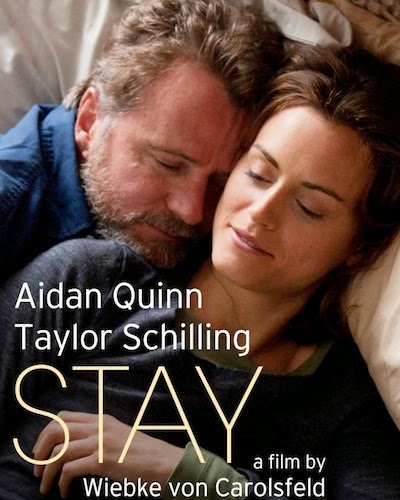
STAY - Review By Greg Klymkiw - No matter how much one tries to gussy it up, twee is as twee is and always will be. Twee, that is.


Stay (2014) Dir. Wiebke von Carolsfeld
Starring: Aidan Quinn, Taylor Schilling, Michael Ironside

Review By Greg Klymkiw

I always liked Aidan Quinn, but he really hasn't had a decent role since Barry Levinson's Avalon almost one quarter of a century ago. As such, I was kind of looking forward to seeing him in this movie - one I knew little about, save for the fact that he was in it and had a starring role opposite Taylor Schilling (an actress of dubious gifts, but not without some screen presence displayed in a clutch of bad movies like The Lucky One, Argo and (Ugh!) Atlas Shrugged). Alas, my heart sank a tiny bit when a head credit popped up which read: "With the financial participation of Telefilm Canada". I thought, oh, perhaps this won't be a real movie after all, but a Canadian movie pretending to be a foreign film with pig-in-a-poke "names" as window dressing to sucker audiences in to see it. Still, I was willing to give this a shot. Unfortunately, the movie's staggeringly stereotypical Canadian preciousness announced itself right at the outset as Quinn kicks a tin can along the ground as he walks along a lovely big-sky aquatic vista.

Great way to open a movie - kicking a can, looking forlorn against a topographical backdrop that might as well have been some Maritime Canadian locale. Luckily, it's not Canada, but Ireland. I recall thinking, "Well, at least I won't have to listen to Maritime fiddle music or Newfie rugby songs."

Well, maybe luck isn't with me. The soundtrack began to swell with some sickeningly twee folk song with the twittering voice of an Irish lass as Quinn enters his home, prepares a lovely tray of breakfast-in-bed and saunters gently into the boudoir where a gorgeous, young Taylor Schilling sleeps ever-so soundly.

Ack!

The movie then veered into territory I fully expected it to (based upon the initial letdown of the Telefilm Canada credit) and it does so with all the typical, uh, flair of a Canadian movie that values studied, ambrosial flatness.

Based upon a novel I haven't read by Aislin Hunter, I think perhaps I can't heap all my disdain for this flaccid movie and its ho-hum narrative upon screenwriter-director Wiebke von Carolsfeld since she did a perfectly decent job with Daniel MacIvor's Marion Bridge. But damn! This is one rink-dink sojourn into Dullsville that not even the presence of Aidan Quinn can quite save.

Quinn plays a semi-retired Archeology professor who lives in this relatively obscure small Irish community with his best gal, the supple late-20-something Schilling whose cradle he robbed during a trip to nearby Galway. It turns out the lassie is preggers with Aidan's seed and due to a deep, dark secret (revealed later on), he's not too keen on having kids. Schilling, conveniently from Montreal (allowing for a co-production twixt Canada and Ireland for this movie), decides to travel back to La Belle Province to engage in some soul searching with her Dad (Michael Ironside, looking very uncomfortable without automatic weaponry in his arms). Quinn does his fair share of soul searching too. We basically bounce back and forth between the Emerald Isle and French Canada's very own City of Lights as both characters spend a lot of time thinking about their relationship as well as the notion of having a child.

The lion's share of this whole-lotta-ruminating-going-on takes place in the Land o' Leprechauns where we get treated to subplots involving a young lad who is fatherless, a young preggers Momma who is motherless and Quinn learning a few lessons from both of them. Schilling learns a few lessons from friends and relatives in Montreal and even more sickeningly, we discover that her own Momma buggered off long ago because she didn't want a child. Wow! So many people abandoned by their Mamas and Papas. It's no wonder all these conveniently converging plot lines require a fair bit of mulling over.

If any of this had been treated with some good old fashioned passion and panache, it might have been palatable - maybe even, uh, good - but of course, since the movie is ultimately Canadian and not directed with any of the oomph Canadians can deliver (Cronenberg, Maddin, Veninger, the Soska Sisters, etc.), we're treated to little more than a limp, precious meander that doesn't even have the sort of TV-movie watchability that many Canadian dramas are infused with. In spite of some potential for roiling melodrama, all we get is a movie that's not edgy enough to be art, nor narratively competent enough to be entertaining.

Like many Canadian films (and, in fact, resembling much of the country's ethos), Stay sits rigidly on a fence post - the tip of it, and beyond, lodged firmly in that place where the sun don't shine.

"Stay" is distributed by Alliance VivaFilm in Montreal and is enjoying a limited run in that otherwise magical city and the not-so-magical city of Toronto at the TIFF Bell Lightbox.

Friday, 16 November 2012

CITADEL - Review By Greg Klymkiw - Brilliant, Terrifying First Feature Opens Theatrically in Canada via Mongrel Media

CITADEL: The fears of the disenfranchised (which indeed could be all our fears) drive this creepy and terrifying dystopian shocker .


Citadel (2012) ****
dir. Ciaran Foy
Starring: Aneurin Barnard, Wunmi Mosaku, James Cosmo, Jake Wilson

Review By Greg Klymkiw

I always wondered if I would be able to offer safety and protection to those I love if confronted with the need to choose physical violence. Being an ex-cop/ex-athlete's son, I received plenty of dirty pugilistic tactics in those halcyon days when folks didn't bat an eye over playground scuffles. I eventually put Dad's counsel to use on a particularly vile bully. It worked so well that my opponent's face was exquisitely rearranged and from that point on, nobody, I mean NOBODY, ever bothered me again. I knew I was able to employ similar techniques if it ever happened again and went through life with no worries. But that's ME. What could/would happen if I needed to protect someone else? Could/would I be able to do it again? Would it be different? Worse yet, what if I was not able to deliver the goods? That's very scary. That, I can assure you.

This is a key element permeating Ciaran Foy's stunning feature film Citadel.

READ MY FULL REVIEW PUBLISHED DURING THE TORONTO AFTER DARK FILM FESTIVAL 2012 HERE

Wednesday, 24 October 2012

CITADEL - Review By Greg Klymkiw - Toronto After Dark Film Festival (TADFF 2012)

CITADEL: The fears of the disenfranchised (which indeed could be all our fears) drive this creepy and terrifying dystopian shocker .


Citadel (2012) ****
dir. Ciaran Foy
Starring: Aneurin Barnard, Wunmi Mosaku, James Cosmo, Jake Wilson

Review By Greg Klymkiw

I always wondered if I would be able to offer safety and protection to those I love if confronted with the need to choose physical violence. Being an ex-cop/ex-athlete's son, I received plenty of dirty pugilistic tactics in those halcyon days when folks didn't bat an eye over playground scuffles. I eventually put Dad's counsel to use on a particularly vile bully. It worked so well that my opponent's face was exquisitely rearranged and from that point on, nobody, I mean NOBODY, ever bothered me again. I knew I was able to employ similar techniques if it ever happened again and went through life with no worries. But that's ME. What could/would happen if I needed to protect someone else? Could/would I be able to do it again? Would it be different? Worse yet, what if I was not able to deliver the goods? That's very scary. That, I can assure you.

This is a key element permeating Ciaran Foy's stunning feature film Citadel.

As an adult, I encountered an especially dangerous situation. Some time ago, after an extended sojourn across the Atlantic, I returned to discover my apartment had been burgled. It was an easy place to burgle, but unexpected since my beloved and I lived in a "protected" building. Bikers and dealers lived there and as such, was one of the safest places for anyone to live (save for the potential of being caught in crossfire which, thankfully, never happened).

But, burgled we most certainly were. The immediate concern was twofold. Whoever did it wasn't especially concerned about the "protected" aspect of the building and might well have been completely insane (we lived round the corner from an outpatient clinic specializing in emotionally-challenged mental defectives) or worse, the perp was a junkie (most of whom wouldn't be desperate enough to hit a "protected" domicile). This was someone who simply didn't give a rat's ass. They must be feared at all costs. One must be prepared to do whatever it takes to stop them in their tracks.

Secondly, I was sure the psycho would return.

Each night I'd rest easy with a baseball bat beside me and sure enough, soon after the burglary and in the pitch of black, I heard a huge crashing sound. Lo and behold, a dark figure stood at the foot of the bed. Springing into action, I grabbed the bat and threatened to crush the whacko's noggin like a watermelon. As quickly as he appeared, he disappeared.

A funny thing happened after this incident. My initial exhilaration immediately transformed into complete and total terror when thoughts of what could have happened had I remained asleep or if, God forbid I tussled with the fucker and screwed up. And here's the rub - my fear had nothing to do with what could have happened to me. It had everything to do with what might have happened to my wife. Scenarios danced through my brain and I became so paralyzed with fear that I insisted we move in with friends until we could pack up and move as pronto as possible.

The worry and fear I experienced over this has only multiplied exponentially now that I'm a father. Could I? Would I? Damn straight! I'd be a take-no-prisoners pit bull if either my wife or daughter needed my protection. No fear in that at all. It's the other fear, the one that cuts deep. That's the fear none of us want to feel.

The greatest fear, they say, is fear itself and now, my fear boils down to this: What if I failed to protect? What would the consequences be? Not to me, per se - I don't give a shit about ME, I care only about protecting those I love.

How would this fear transform itself in the aftermath of FAILURE to deliver protection?

These are very real things we all, to varying degrees, must deal with.

They also happen to be the very things that drive Citadel, one of the best films of the year.

Cinema, and in particular those films which are rooted in genre can actually work as first-rate entertainment or top-drawer roller coaster rides, but are magnified a thousandfold when they're rooted in themes and actions that come from very real places. This is something that Val Lewton knew very well. He was the first person within Hollywood's mainstream studio system to tell real stories, about real people with real fears - all against the backdrop of genre pictures designed to bring much-needed returns into a near-bankrupt studio.

This bold move on Lewton's part changed genre films forever. He was the great 40s producer who ran RKO's horror division in the wake of two debilitating financial disasters (surprisingly, Citizen Kane and The Magnificent Andersons), but he did it in ways that his bosses and the rest of the industry would have been appalled by - if they actually realized what he was doing and if his gamble did NOT pay off as handsomely as it did with films like The Cat People (marital strife), The Curse of the Cat People (loneliness and introversion amongst children), The 7th Victim (the danger of cults and those most susceptible to them) and, among others, I Walked With a Zombie (mental illness).

Lewton believed that what really scared people were those things they had to deal with everyday. He believed in doing this above all - setting wheels of reality in motion against a fantastical backdrop which yielded a much better chance of scoring at the box office. Without Lewton, one wonders if we'd have ever seen similar approaches to storytelling on the screen that have all become classics of both genre and cinema as a whole.

In The Exorcist, Demon Pazuzu's shenanigans (which included grotesque head-spinning, crucifix-as-dildo-masturbatory-action and green pea vomit expulsion), were preceded by an hour of screen time devoted to the creepy and increasingly painful poking and prodding of a 12-year-old girl by members of the medical profession. As realized by director William Friedkin, the cold and clinical approach to healing by inflicting the extremes of scientific exploration turn out to be equally harrowing as the grotesqueries of the Devil.

Robert Wise's The Haunting and Jack Clayton's The Innocents followed in Lewton's footsteps to explore mental illness within the context of seemingly straight-up ghost stories and, lest we forget, Nicholas Roeg's extraordinary Don't Look Now which begins with a child's accidental death, moves through to parental grief and eventually into territory of the most horrific kind.

With the ever-widening gap between rich and poor, the increased likelihood of apocalypse as America ramps up its greedy desire to control oil in the name of fighting terrorism and the obvious New World Order desire to cull the world's population, we are living in dangerous times. So much so that writer/director Ciaran Foy wisely places Citadel, his dystopian tale of horror in the same footsteps forged by Lewton.

Foy's picture is, first and foremost, a film about crashing, numbing, unrelenting fear. It is a palpable fear that's brought on when the film's young protagonist watches - not once, but twice - as those he loves are brutalized and/or snatched away from him. His fear intensifies so unremittingly, with such grim realism, that we're placed directly in the eye of the storm that is his constant state of terror.

Contributing greatly here is lead actor Aneurin Barnard as the young father Tommy. He delivers a performance so haunting, it's unlikely audiences will ever shake the full impact of what he achieves. Off the top of my head, I can think of very few (if any) scenes he is not in. We follow his story solely from his sphere and given that the character is almost always in a state of intense apprehension, the whole affair could have been utterly unbearable. Thankfully, he breathes such humanity into the role that we not only side with him, but I frankly defy anyone to NOT see themselves (or at least aspects of who they are and what they feel) within this indelibly wrought character.

As the film progresses, Tommy lives alone in a desolate housing project - a single father alone with his baby. On the few occasions he must leave the house and enter a world of emptiness, squalor, constantly grey skies and interiors lit under harsh fluorescents, his head is down, his eyes only occasionally looking around for potential danger and/or to literally see where he is walking (or rather, scurrying to). Just as Tommy is constantly in a state of terror - so, stunningly, are we.

There are seldom any points in the proceedings when we feel "safe" and when an occasional moment of warmth creeps into Tommy's existence, the effect is like finding an oasis in the Sahara. Unfortunately (and brilliantly), Foy's screenplay doesn't allow safe harbour for too long. Dramatically, we're almost constantly assaulted with natural story beats that yank us from our (and Tommy's) ever-so brief moments of repose.

Tranquility is a luxury and Foy fashions a living hell plunges both the audience and Tommy into the here and now as opposed to a very near future. Citadel sadly reflects a reality that pretty much exists on many streets in every city of the world. This is an increasing reality of contemporary existence and like all great science fiction, the film's dystopian vision acts as a wakeup call that hopefully will touch many beyond the converted.

Things must change, or this is what more and more of us will be experiencing. We can, like Tommy does for a good part of the film, shove our heads, ostrich-like into the false safety offered under the sand, but sooner or later we/he will be ripped out of the temporary "safety" of darkness to face two distinct realities: the horror of the world and even worse, the horror of his/our own fear and cowardice. Neither are happy prospects to be emblazoned upon anyone's hearts and minds when the meeting of one's maker is not far behind.

Tommy will have to make the right decision. He'll need to become proactive in finding his inner strength to fight for what is right. The options are black and white. Fight and die trying or, just die.

Now, before you think I'm completely suggesting the film is more starkly depressing than Ingmar Bergman's Winter Light, first remember that this is, indeed a horror film and Foy jangles our nerves with the panache of a master. Have no doubts going in - this movie will scare the living bejesus out of you. It is, on that level, one hell of a ride.

The other happy element at play is a character Foy creates that is rendered by the phenomenal actor James Cosmo. Now if you thought Gene Hackman was suitably two-fisted as the stalwart man of the cloth in Ronald Neame's The Poseidon Adventure, he is, in the parlance of louts the world over, a "pussy" compared to Cosmo. Cosmo plays the most mentally unbalanced, kick-ass, foul-mouthed priest I've seen on film in some time - possibly of ALL time.

The Good Father knows the score, and then some. To paraphrase the tagline from the delightfully ludicrous Stallone cop picture Cobra: Fear's a disease. The Good Father is the CURE!!! The few people left of good character in this world of empty, battle torn housing projects rife with crime, all believe Father Cosmo is completely off his rocker. The Good Father's unnamed in the film, but in honour of Cosmo's stellar performance, I'm naming him - at least for the purposes of this written response to Foy's remarkable film.

Father Cosmo adds one extremely salient detail to Foy's film - humour. Great genre pictures always have some element of humour - not of the tongue and cheek variety, but the kind that's rooted in the central dramatic action of the narrative.

The other great thing about Father Cosmo is his Faith - and believe me, it's not necessarily residing in honour of the God of Abraham.

Father Cosmo really only has faith in one thing amidst the dark dystopian days - survival. At first, Tommy is intimidated by the curmudgeonly bonkers priest, but over time, it becomes obvious this slightly fallen Man o' God is the only one who makes sense. Something is rotten to the core and Father Cosmo has a plan to root out the pestilence.

You see, there is an infection.

Have I mentioned the infection yet?

No?

Good.

I'll let you discover it yourself.

As my regular readers are aware, I do everything in my power to know as little about a movie before I see it. I was so happy to know NOTHING about this movie prior to seeing it save for the title. The fact that I saw it at the Toronto After Dark Film Festival was also, by osmosis, a bit of a giveaway since this stellar event's programmers are delectably twisted sick puppies.

That said, I knew nothing - just as I hope YOU will keep things before seeing Citadel. The script, as well written as it is, hit a few (perfectly acceptable) marks that telegraphed a handful of items to me (and no doubt to a select few others), so there is little gained in pointing in their direction. In spite of this, I was quite unprepared for the full, heart-stopping, scream-inducing (yes, I screamed like some old grandmother), vomit-inspiring, drawer-filling (with, of course, your excretion of choice - I demurely keep mine to myself) and a flat-out dizzying, jack-hammeringly appalling climax of pure, sickening, unadulterated terror.

This is one mighty mo-fo of a scary-ass picture. The mise-en-scene is dazzling and the tale is rooted in both a humanity and reality that will wallop close to home for so many. There's nary a misstep in any of the performances and as the movie inches, like Col. Walter E. Kurtz's "snail crawling along the edge of a straight razor", Foy plunges us into an abyss at the top of the stairs.

In Apocalypse Now, Kurtz summed up the image of the snail on the straight razor thusly: "That's my dream!"

Frankly, Citadel is MY dream of one great horror movie.

Fuck it! It's no dream.

Citadel is a bloody nightmare!

"Citadel" was recently unleashed at the Toronto After Dark Film Festival (TADFF 2012). Visit the festival website HERE. "Citadel" is currently slated for theatrical release in Canada on November 16 via the best distributor in the country, Mongrel Media. If you missed it at TADFF 2012, you have no excuse to miss it now. It must be seen on a big screen with an audience. Though certain, shall we say, odours, will be palpable in the auditorium, it will be well worth it.